Introduction
Family poultry (Fp) farming remains characterised by extensive rearing of small flocks, using almost exclusively mixed purpose local population strains for production (CIRAD-GRET, 2006) with a low level of investment and productivity compared to commercial poultry production units (Kitalyi, Reference KITALYI1998). Fp represents over 77% of all poultry raised in several emerging countries (Sonaiya, Reference SONAIYA2007) with a large variability between countries: 30% in Zimbabwe, 53% in Côte d'Ivoire, 70% in Kenya, 80% in Nigeria, 86% in Tanzania, 99% in Ethiopia (Kitalyi, Reference KITALYI1998), 90 to 95% in Mali (Kounta, Reference KOUNTA1992).
In Niger, according to a recent census of the Ministry in charge of livestock, the number of domestic poultry in 2007 was 12,190,410 birds (99% kept in traditional systems). Chickens were the main species encountered (54.7%) followed by guinea fowl (26%), pigeons (12.3%) and ducks (3.5%) (MEIA, Reference MEIA2008). The value of poultry production was estimated at approximately 10 billion CFA (around 1.5 million Euros) in 1987 (Abdou, Reference ABDOU1992). Fp farming was one of the sectors identified in the livestock development strategy. In addition to the income generated, Fp contributes to food security especially in rural areas where eggs and meat represent the main source of animal proteins.
Several constraints such as diseases, housing, feeding, trade products, productivity levels of local populations and high mortality rates (89%) hinder the development of Fp. Various attempts have been made to improve Fp productivity. Improvement programs recommend conducting preliminary diagnosis studies of existing situations prior to initiating appropriate technology transfer. Thus, to characterise Fp farming in Niger, a study was conducted by the Department of Dakoro, in the Maradi region in central Niger with the support of ProxelFootnote 1. Data on Fp farming was obtained from household enquiries and flock monitoring studies conducted between November 2007 and February 2008.
Niger survey
A survey on poultry farming was performed using a questionnaire where data on farmers, household, species, structure, size and dynamics of flocks, management and livestock performance and the main constraints to Fp development was collected. Ten villages were randomly selected following preliminary interviews with veterinary technical services, livestock auxiliaries, community leaders and farmers. The selection criteria used were the importance of poultry among socio-economical activities, the farmers’ availability, village accessibility and proximity to weekly markets.
Poultry flocks were divided into four classes according to differences in farming and flock size; class 1: 1 to 25 birds, class 2: 26 to 50 birds, class 3: 51 to 100 birds and class 4: over 100 birds. In each village, the highest number of households investigated per class was five. Data were collected on chicken and guinea fowl flocks under the following categories; chicks (0 to 4 weeks old), young (1 to 6 months), immature/mature adults (who have not reached sexual maturity) for chickens and adults for guinea fowls.
A follow up of the weekly recording of technical parameters was conducted. The flock's dynamics were followed through records of entries, donations, mortalities, sales and consumption. Four villages were selected based on their proximity to Dakoro and the availability of a livestock auxiliary or a facilitator. The villages selected were located within a radius of 25 km around Dakoro (Birni Lallé, Kakalé, Maïgochi and Mailafia). Fifteen farmers were selected based on availability and the provision of reliable data during the follow-up. As the period of the study did not coincide with the breeding season of guinea fowls, only chickens were investigated.
The units of measurement used locally (Tia) for estimating quantities of food were converted to the metric system. All data were transferred to the CS Pro program software and statistical analyses of data were performed using Statbox's software.
Survey results
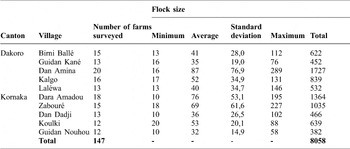
One hundred and forty seven farms were divided into four classes composed of 42, 47, 40 and 18 farms respectively (Table 1). The average age of all farmers was 44 years (the youngest was 25 and the oldest 95); their main occupations were farming and breeding, followed by trade (26 cases), handicraft (11) and education (7). Ruminants, predominantly goats (average of nine per household) were also kept on farm.
Farms surveyed and flock size.

Characterisation of Fp farming in Niger
flock characteristics
During the investigations, 8058 birds of different species were identified. Chickens were most predominant (78%) followed by guinea fowl (18%) (Figure 1). These proportions were different from those reported by Illa Kane (Reference ILLA KANE2005) of 65% and 30% chickens and guinea fowls respectively. This difference may be due to the timing of the surveys which took place just after the feast of TabaskiFootnote 2; where guinea fowls are commonly consumed.
Poultry main's species.

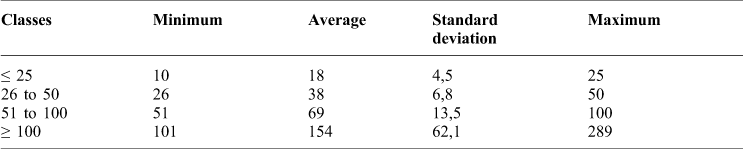
Each farm had an average of 53 birds (43 hens and 10 guinea fowls). There was an unequal distribution of flocks between classes (Table 2). The size of flocks obtained was higher than that reported by Prost (Reference PROST1987) in the same region. The presence of 58 farmers owning more than 50 poultry and therefore holding 69% of the total may explain this difference.
Average number of poultry (chicken and guinea fowl) observed by class.
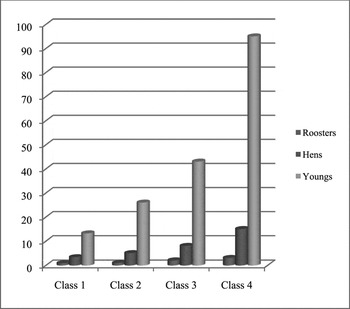
The ‘representative’ flock structure for chickens was one rooster, six hens and 35 young hens with 16 less than a month old (Figure 2).
Structure of chicken's flock.

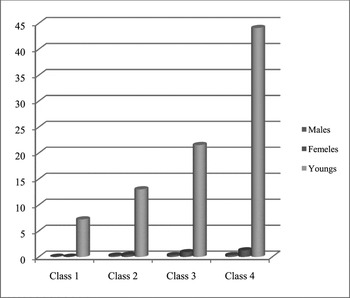
In the case of guinea fowl, the ‘representative’ flock structure was two young and 22 females (Figure 3). The average sex-ratio was 0.17 and 0.26 respectively in chickens and guinea fowl flocks.
Structure of guinea fowl's flock.

The predominance of young animals aged from 0 to less than 6 months (82% of the total) was observed in all classes of livestock. This differs from what was obtained in the region of Keita (Abdou, Reference ABDOU1992) and may be related to the timing of the surveys as they coincided with the crops, when laying and hatching were most optimal due to grain and insect availability. In terms of guinea fowl flocks, the absence of adults was due to sales made for the ‘Tabaski’ feast and in the rainy season to feed hired farm workers until the harvest. On the other hand, it could be explained by the production of Guinea fowl from eggs purchased and incubated by hens.
Poultry flocks were managed by men in 78% of farms, women in 17% of farms and children in 5% of farms. This is different compared to other countries (e.g. Cameroon, Morocco, Gambia and Senegal) where Fp farming is considered a woman's activity (Agbédé et al., Reference AGBÉDÉ, TEGUIA and MANJELI1995; Bonfoh et al., Reference BONFOH, ANKERS, PFISTER, PANGUI and TOGUEBAYE1997; Missohou et al., Reference MISSOHOU, DIEYE and TALAKI2001; Benabdeljelil et al., Reference BENABDELJELIL, ARFAOUI and KARARI2002). Guinea fowl belong to men in 99% of cases because their rearing has the potential to cause conflicts between farmers during the capture and/or collection of eggs in common nests.
Housing and equipment
In 117 farms, poultry had rudimentary shelters, based on stem grass (82%), which were renewed annually after the rainy season. These shelters are conically shaped with a diameter of 30 to 60 cm at the base and a height of 0.8 to 1.2 m. In 86% of farms, hens with chicks and/or young guinea fowls were the main beneficiaries of shelters at night. The other categories and species spent the night in trees, on rooftops and in other locations as reported by various authors (Prost, Reference PROST1987; Abdou, Reference ABDOU1992; Agbédé et al., Reference AGBÉDÉ, TEGUIA and MANJELI1995; Bonkoungou, Reference BONKOUNGOU2005; Sanfo et al., 2007). The availability of poultry shelters was negatively correlated with the number of poultry (r=0.20; P<0.05). Chick rearing houses were identified in 11 farms where they were used only during the rainy season for the protection of young guinea fowls. With a conical shape (1.2 m in diameter and 1.4 m high), they were made with millet stalks and could shelter two to three hens and their broods of young guinea fowls.
Drinkers made of clay, which kept water at lower temperatures during the hot season were recorded for 106 farms (73%). These drinkers had openings which were only accessible to poultry. Approximately 80% of the farmers had feeders made from recyclable materials (scrap canaries and calabash, old dishes). In the remaining farms (20%), feed (grains of millet) was poured on the floor, as reported in other countries by Agbédé et al. (Reference AGBÉDÉ, TEGUIA and MANJELI1995), McAinsh et al. (Reference MCAINSH, KUSINA, MADSEN and NYONI2004) and Sanfo et al. (2007).
Technical management
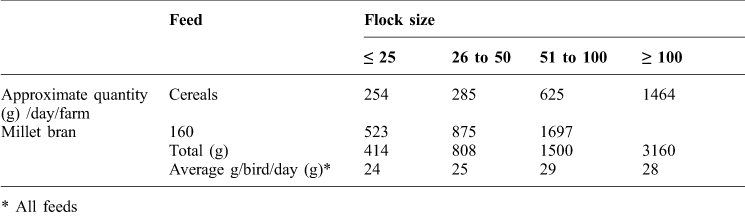
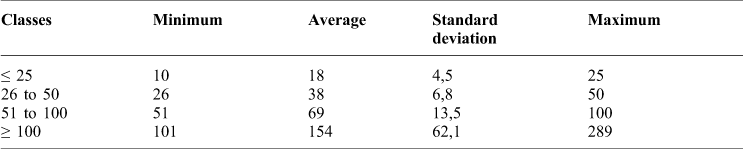
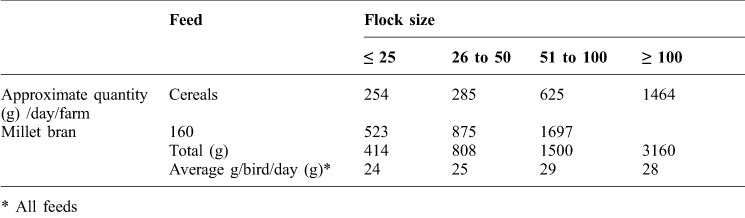
In 99% of the farms surveyed, poultry had supplementary feed composed of cereals and/or other by-products produced locally, which is in concordance with the results found by Prost (Reference PROST1987) in the same region. In two thirds of them, poultry received both grain and bran, two and three times a day in 61 and 64 farms respectively. The quantity distributed per chicken per day ranged from 24 g to 29 g according to classes (Table 3). The daily quantity received per chicken (24 g – 29 g) reported in this study was slightly higher than the 19.7 g reported by Sonaiya (Reference SONAIYA1995) for south-western Nigeria.
Daily chicken feed intake in different flock sizes.
* All feeds
For all farms, guinea fowls did not receive any additional food after they had left their parent hens to form their own flocks. They scavenged in fields around homes as described by Dahouda et al. (Reference DAHOUDA, TOLEBA, YOUSSAO, BANI KOGUI, YACOUBOU ABOUBAKARI and HORNICK2007) and returned to drink once or twice a day. In 78% and 76% of farms, chicks and young guinea fowls respectively received a starter feed composed of kitchen leftovers, millet bran and sesame seeds. Drinking water was sourced from wells and forages in 94% of the flocks surveyed. In the cold dry season, 30% of the farmers warmed the metal drinkers each morning before filling them.
Livestock performance
Age at sexual maturity was 24 and 25 weeks respectively for roosters and hens and 32 weeks for guinea fowl (Table 4). Farmers were unable to sex guinea fowl before sexual maturity, which is in concordance with the age reported by Boko (Reference BOKO2004), Dahouda et al. (Reference DAHOUDA, TOLEBA, YOUSSAO, BANI KOGUI, YACOUBOU ABOUBAKARI and HORNICK2007) and Sanfo et al. (2007).
Age at sexual maturity (weeks).

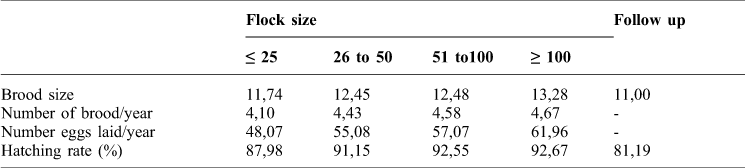
Hens lay all year around, while egg production remains seasonal for guinea fowl (May to September). The annual production of hens varied between 44 and 75 eggs with an average of 55 in 4.4 broods of 12 eggs each. These performances were consistent with estimates made by Prost (Reference PROST1987) and Abdou (Reference ABDOU1992). The variability could result from non-collection of eggs (development of brooding instinct) and the irregularity of adequate and balanced feed. The laying rate was also higher in large farms (r = 0.28; P < 0.05).
The annual production of guinea fowls was between 80 and 100 eggs per year with an average of 97, which was consistent with the results obtained in Burkina Faso by Bonkoungou (Reference BONKOUNGOU2005) and Sanfo et al. (2007). Accurate estimates of egg production can be difficult due to predation and theft and given that several females with different owners may share the same nest from which eggs are collected.
Chicken flocks: Laying rate and hatching performance.
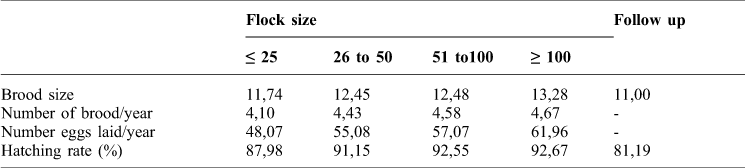
Guinea fowl: Laying and hatching performances.

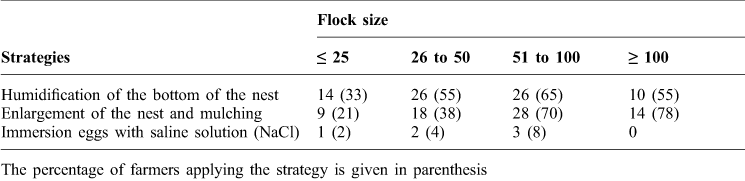
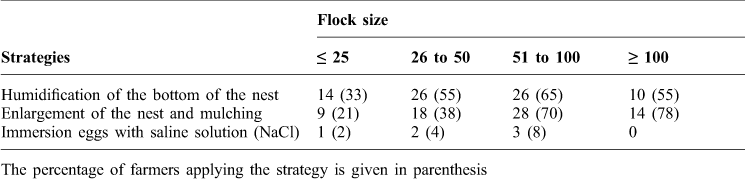
In 98% of farms, hens lay in various corners of houses (kitchen, garret) and in two thirds of cases, guinea fowl hens nested in fields. With the aim of creating an incubation atmosphere, nests were fitted out, moistened and demarcated with straw and rags by farmers. Candling and immersion in water were techniques practiced in 65 farms to identify ‘fertile’ eggs to incubate, especially if the origin was not known (in the case of purchased guinea fowl eggs). In six farms, guinea fowl eggs were dipped in a saline solution (Table 7) to select suitable eggs for incubation. Hatching rates varied from 81% to 93% for chickens and guinea fowls (Tables 5 and 6). There was a significant correlation between the flock size and the hatching rate (R = 0.18; P < 0.05). Hatching rates were in agreement with those reported by Sonaiya (Reference SONAIYA1995), Ekue et al. (Reference EKUE, PONÉ, MAFENI, NFI and NJOYA2002) and Msami (Reference MSAMI2002). Performances could be related to the timing of the survey, in which the highest hatching rates would be expected due to a favourable climate and feed conditions. They may also be explained by some of the famer's use of the strategies described by Idi (Reference IDI1996) for improving hatching rates and detecting ‘defective’ eggs. Additionally, the sodium chloride solution used to immerse eggs could act as a disinfectant and reduce embryonic mortality. Nest humidification increased relative humidity while borders demarcation and mulching favoured eggs reversal and reduced heat loss. However, contrary to what farmers thought, the immersion of eggs in lukewarm water informed rather on the age of eggs, without a direct link to their fertility.
Hens and/or ducks were used by 60% of farmers for the hatching of guinea fowl eggs as reported in Benin (Dahouda et al., Reference DAHOUDA, TOLEBA, YOUSSAO, BANI KOGUI, YACOUBOU ABOUBAKARI and HORNICK2007) and Burkina Faso (Bonkoungou, Reference BONKOUNGOU2005). The use of hens and ducks enhances hatching by inhibiting the brooding instinct and limiting the losses of young fowls as hens takes more care. Eggs were not consumed in 40% of farms, although there was no taboo. Priority for eggs was reserved for the renewal of flocks, as described by other authors (Abdou, Reference ABDOU1992; Mopaté et al., Reference MOPATÉ, HENDRIKX, IMADINE and IDRISSA1997; McAinsh et al., Reference MCAINSH, KUSINA, MADSEN and NYONI2004).
Strategies to improve hatching rates in chicken flocks.
The percentage of farmers applying the strategy is given in parenthesis
At hatching, chick weights ranged from 18 g to 29 g with an average of 23 g to 32 g from the 1st to the 5th day respectively. To improve the survival rate of chicks and young guinea fowls, farmers (83 who commented) isolated them with the hen for one week (61%) or two (28%). In 13 farms of classes three and four, young guinea fowls from three different hens can be left to be cared for by two of them. The third is then released to start a new laying cycle. Breeders’ choice was primarily based on conformation (47% of the cases), conformation and plumage (27%) and the number and size of eggs (22%).
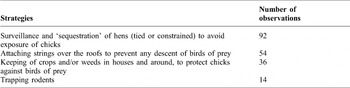
The average mortality rate recorded during the follow up was 33%. Rates were higher among farmers in classes 1 and 2 with respective average rates of 45% and 34%. Deaths were mainly attributed to disease (42%), predation (39%) and accidents (19%) and recorded among young aged from 0 to 4 months (97%). Different strategies have been adopted by farmers to combat predation, particularly during the rainy season (Table 8). The mortality rate reported was lower than those observed in other African countries by Buldgen et al. (Reference BULDGEN, DETIMMERMAN, SALL and COMPERE1992), Sonaiya (Reference SONAIYA1995), Kitalyi (Reference KITALYI1998) and Koko et al. (Reference KOKO, MAMINIAINA, RAVAOMANANA and RAKOTONINDRINA2002). This performance resulted from the registration period (three months) and would have been higher if the follow up had continued over six months or a year.
Strategies against predators.

Pathologies
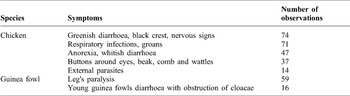
Disease was the main cause of mortality reported by all poultry farmers. Adult hens suffered from respiratory problems and diarrhoea, while fowls presented locomotion difficulties. Young guinea fowls and chicks suffered from diarrhoea and cold blows. According to 72% of farmers, Newcastle disease constitutes the first constraint hindering Fp development as observed by Abdou (Reference ABDOU1992) and Bonfoh et al. (Reference BONFOH, ANKERS, PFISTER, PANGUI and TOGUEBAYE1997). Without any clinical, post-mortem or laboratory's diagnosis, many symptoms were attributed to Newcastle disease except for external parasites and respiratory infections locally called ‘dan machako’ (Table 9).
Symptoms of dominant diseases as reported by farmers.

In the case of illness, 47.6% of farmers treated poultry. Among them, one quarter used veterinary products, one fifth used human medicinal products (Terramycine©, Paracetamol©) and one sixth used traditional products (pepper, roots and barks of plants such as Cucurbitaceous, Azadirachta indica etc). The use of traditional medicines was similar to that reported elsewhere by Agbédé et al. (Reference AGBÉDÉ, TEGUIA and MANJELI1995), Moreki et al. (Reference MOREKI, PETHERAM and TYLER1997) and Traoré and Sylla (Reference TRAORÉ and SYLLA1997). A lack of awareness by farmers and the cost and unavailability of veterinary products could be the reasons for this.
It was found that 74% of farmers vaccinated against Newcastle disease. This rate remained relatively high in the context of the Fp farming and would be related to the campaign of vaccination set up and funded by the project Proxel between October 2007 and April 2008. In 64% and 7% of the farms respectively, poultry were subjected to internal and external worming. A periodic pest treatment of shelters was applied by 126 farmers using hot wood ash and/or insecticide locally available as described by Prost (Reference PROST1987). The quarantining of newly acquired birds was limited to 15% of farms. Diseases (72%), lack of housing (13%), predation (8%) and inadequate feed (6%) were cited as major constraints hindering the development of poultry farming.
Uses of poultry products
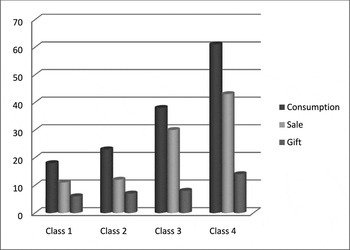
Poultry products are used primarily for nutritional, economic and social reasons. Consumption was the first use of products and accounted for 46%. It concerned mainly male adults and young with respective proportions of 42% and 40%. Although there is no taboo relating to this practise, egg consumption was reported in 60% of farms where it was mostly limited to the rainy season (fowl reproduction period). The incubation of chicken's eggs prevailed mainly for the renewal of the flock. This practice is consistent with situations described by Abdou (Reference ABDOU1992), Mopaté et al. (Reference MOPATÉ, HENDRIKX, IMADINE and IDRISSA1997) and McAinsh et al. (Reference MCAINSH, KUSINA, MADSEN and NYONI2004). Sales represented 43% of uses and were motivated by cash requirements (75%) or reduction of flock size (25%). In 25 households, it was reported that poultry were not subject to any sale.
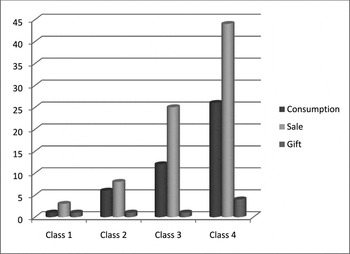
Donations accounted for 11% of uses. They were mainly observed at the beginning of the rainy season and during the month of ‘chaara Footnote 3’. Chickens are most concerned; the gift of fowl was limited to 11 farms. In case of guinea fowls, sales predominated over self-consumption in all farms. Figures 4 and 5 show the average number of chicken and guinea fowl self-consumed, sold or given annually.
Use of chickens.

Use of guinea fowl.

Purchases of poultry responded to the need of genetic improvement (38%) and flock renewal (37%). Collectors occupied 38% of the poultry marketing channel; 33% and 29% of birds were sold respectively on weekly rural markets and to other poultry farmers.
Conclusions
Fp farming in the area of Dakoro was characterised by the rearing of chickens predominantly, followed by guinea fowls. The herd structure was dominated by young (more than 80%) from 0 to less than 6 months of age. Almost all farmers (99%) provided (mainly chickens), food supplementation to their poultry, whereby chicks and young guinea fowls received starter feed in most of farms. Shelters were still rudimentary and were intended only for hens and their broods and recycled materials are used as feeders.
Sexual maturity was reached at 24 to 25 weeks respectively for the cock and hen and 32 weeks for the guinea fowl. Laying performances were on average 55 and 97 eggs per female per year respectively in chickens and guinea fowl and the mortality rate was 33%. Undiagnosed diseases, variously treated, were cited as major constraints to production. The consumption, sales and donations were the main destinations of poultry products.
To improve Fp productivity, several appropriate actions can be envisaged:
• Applying basic hygiene practices and preventions regarding housing, equipment and the introduction of new poultry (quarantine). Dead poultry and other leftovers must be destroyed. Products of dubious origin (‘market products’) should be avoided to struggle efficiently against main diseases.
• Offering drinking water ad libitum, especially in hot dry season. Heating drinking water in the cold dry season would reduce the cold shock and associated mortality, especially among young.
• Ensuring adequate housing to protect poultry against predators and weather changes. The use of locally available materials would permit wide distribution among poultry farmers. The existing henhouses could be arranged to facilitate cleaning and disinfection. Ventilation openings could reduce the moisture in the rainy season and thus limit the proliferation of pathogenic micro-organisms.
• Reducing flock sizes (sales and/or self consumption) to allow better management of feed resources available on farms and better health care.
• Taking care of broody hens and nests to increase hatching and chick survival rates.
• Organising farmers into groups (or co-operatives) would allow better implementation of practises and better marketing of produce. The presence in the region of farmers groups would be an asset. Such an organisation would facilitate management actions and awareness and could allow poultry farmers to receive support (training, financing) from projects and other development agencies.
Increasing awareness through applied extension programs should serve as a transmission medium of recommended practices. The presence of community radios in the region is an invaluable asset for wide distribution of information. Further survey or testing would be necessary to accurately further estimate poultry performances and feed resources available in the area. In addition, an economic study would estimate profit margins generated by Fp farming.
Acknowledgments
Authors express their sincere and heartfelt thanks to project Proxel through Stéphane Pil, Yacouba Ibrahim, Drs Faye D., Pissang T.D.C. and NGOs ‘Vétérinaires sans frontières – Belgium’ (VSF/B) and Karkara for their logistical and material support without which this study would have been impossible to conduct.