1. INTRODUCTION
Stimulated Raman scattering (SRS) is the process in which an incident light wave decays into a scattered light wave and an electron plasma wave. Similarly, stimulated Brillouin scattering (SBS) is the process in which an incident light wave decays into a scattered light wave and an ion acoustic wave. Both SRS and SBS instabilities do great harm to the laser driven inertial confinement fusion (ICF), because the scattered light waves take lots of energy away from the pump laser. Besides this, hot electrons generated by SRS preheat the fuel and affect the ICF drive efficiency. So it is a crucial problem to restrain these plasma instabilities, which prevent the realization of high efficient fusion (Kruer, Reference Kruer1998; Lindl, Reference Lindl1995; Powers et al., Reference Powers, Berger, Kauffman, MacGowan, Amendt, Back, Bernat, Dixit, Eimerl, Estabrook, Harte, Kalantar, Klem, Lasinski, Montgomery, Moody, Munro, Shepard, Suter, Turner, Williams, Fernandez, Hsing, Wilde and Failor1995; Sharma et al., Reference Sharma, Sharma, Rajput and Bhardwaj2009; Omatsu et al., Reference Omatsu, Kong, Park, Cha, Yoshida, Tsubakimoto, Fujita, Miyanaga, Nakatsuka, Wang, Lu, Zheng, Zhang, Kalal, Slezak, Ashihara, Yoshino, Hayashi, Tokizane, Okida, Miyamoto, Toyoda, Grabar, Kabir, Oishi, Suzuki, Kannari, Schaefer, Pandiri, Katsuragawa, Wang, Lu, Wang, Zheng, He, Lin, Hasi, Guo, Lu, Fu, Gong, Geng, Sharma, Sharma, Rajput, Bhardwaj, Zhu and Gao2012).
In SRS process, the scattering light can be both in the backward (SRBS) and forward (SRFS) direction. Although the rising threshold of SRFS is lower because of its little damping rate of Langmuir wave, in usual ignition regime where n e ≈ 0.1n c and T e < 5 keV, SRFS is limited to a low level by the Langmuir decay instability (LDI) (Langdon & Hinkel, Reference Langdon and Hinkel2002). The saturation threshold of SRFS by LDI is much lower than SRBS because of the larger Langmuir wave number and much higher Landau damping of the later. For these parameters, SRBS rises in the convective pattern, in which LDI commonly influence SRBS little. So, here we mainly discuss the backward SRS.
There have been many theoretical and numerical works on SRS and SBS in the past decades in which SRS and SBS are usually treated as an isolated process (Pesme et al., Reference Pesme, Laval and Pellat1973; Ramani & Max, Reference Ramani and Max1983; Mahmoud & Sharma, Reference Mahmoud and Sharma2001; Boyd & Sanderson, Reference Boyd and Sanderson2003; Hu & Hu, Reference Hu and Hu2003; Lindl et al., Reference Lindl, Amendt, Berger, Glendining, Glenzer, Hann, Kauffman, Landen and Suter2004; Strozzi et al., Reference Strozzi, Shoucri, Bers, Willians and Langdon2006; Shuller & Porzio, Reference Shuller and Porzio2010; Hao et al., Reference Hao, Liu, Zheng, Xiang, Feng, Hu and Li2012; Liu et al., Reference Liu, Hao, Xiang, Zhu, Zheng, Cao and He2012; Sharma et al., Reference Sharma, Bhardwaj and Sharma2012). However, under the real hohlraum condition, SRS and SBS generally coexist over large regions in the underdense plasma. Both of them need the pump laser energy to rise. So the competition between SRS and SBS happens under certain plasma parameters. Until now, the competitive phenomena have been observed in many experiments (Walsh et al., Reference Walsh, Villeneuve and Baldis1984; Villeneuve et al., Reference Villeneuve, Baldis and Bernard1987; Baldis et al., Reference Baldis, Young, Drake, Kruer, Estabrook, Williams and Johnston1989; Labaune et al., Reference Labaune, Baldis, Renard, Schifano and Michard1997; Froula et al., Reference Froula, Divol, London, Berger, Doppner, Meezan, Ralph, Ross, Suter and Glenzer2010). Obviously, the competition between SRS and SBS is very important for the ignition point design. On the one hand, the coupling evolutions of SRS and SBS are different from the isolated case. The saturations of the two instabilities are affected by each other. In order to estimate their coexistent reflectivity reasonably according to the experimental parameters, it is necessary to understand the competition regime deeply. On the other hand, when the SRS and SBS reflectivity are nearly equivalent, SBS is preferable to SRS because of the hot electrons. In this case, the competition regime is useful to weaken SRS by means of SBS under the suitable plasma parameters. Although the particle simulations and the Zakharov model have been applied to research the development of SRS in the presence of ion waves (Rose et al., Reference Rose, DuBois and Bezzerides1987; Rozmus et al., Reference Rozmus, Sharma, Samson and Tighe1987; Calder & Barnard, Reference Calder and Barnard1988; Estabrook et al., Reference Estabrook, Kruer and Haines1989). Theoretical studies of the competition between SRS and SBS for hohlraum plasma parameters of interest to ICF are still rare.
In this work, we theoretically study the competition between SRS and SBS based on a five-wave interaction (5WI) model with a finite plasma under the strong damping condition. For uniform plasma, we derive the stationary relations between SRS and SBS to estimate their reflectivity theoretically, which are universal to the problems of the coexistent two instabilities. A simple criterion to judge the dominant instability during the competitive process is given for the same noisy disturbance of SRS and SBS. The coexistent developments of SRS and SBS are simulated for the parameters of interest to ICF, and numerical results consist with our theoretical solutions, in which the competitive pattern is found to be sensitive to the electron density and temperature.Moreover, considering the nonuniform condition of the real hohlraum plasma, we deduce the inhomogeneous gain exponents of SRS and SBS with proper linear approximations. Influences of the nonuniform electron density, plasma temperature, and flow velocity to the competitive pattern are analyzed in detail. The inhomogeneity of electron density is found to be the most important factor to detune SRS, and SBS is influenced mainly by the flow velocity gradient. How the competitive pattern changes is determined by the gradients of the electron density and flow velocity. Relevant processes are also simulated for several educations, and our expectations are supported by the numerical results.
2. PHYSICAL MODEL
A 5WI model is introduced in this section, which is derived from the standard light wave propagation equation, Langmuir wave equation, and the ion acoustic wave equation (Forslund et al., Reference Forslund, Kindel and Lindman1975), under the temporal and spatial envelope approximation (Berger et al., Reference Berger, Still, Williams and Langdon1998). To discuss the competition between SRS and SBS, we mainly consider the three coupling light waves composed of the incident light wave  $A_0=a_0 \lpar z\comma \; t\rpar \exp [ \!-\! i{\rm \omega} _0 t+i\int_0^z \, k_0 \lpar z^{\prime}\rpar dz^{\prime}\rsqb /2+c.c.$, the SRS backscattering light wave
 $A_R=a_R \lpar z\comma \; t\rpar \exp [ \!\!-\! i{\rm \omega} _R t - i\int_z^L k_R \lpar z^{\prime}\rpar dz^{\prime}\rsqb /2+c.c.$, and the SBS backscattering light wave
 $A_B=a_B \lpar z\comma \; t\rpar \exp [ \!\!-\! i{\rm \omega} _B t - i\int_z^L \, k_B \lpar z^{\prime}\rpar dz^{\prime}\rsqb /2+c.c.$, where
 $a_{\rm \alpha} \lpar z\comma \; t\rpar $,
 ${\rm \omega} _{\rm \alpha} $,
 $k_{\rm \alpha} \lpar z\rpar $ (
 ${\rm \alpha}=0\comma \; R\comma \; B$) are relevant slowly varying complex amplitudes, frequencies, and local wavenumbers, which satisfy the linear dispersion relations
 ${\rm \omega} _{\rm \alpha} ^2={\rm \omega} _{\,pe}^2+k_{\rm \alpha} \lpar z\rpar ^2 c^2 $, respectively.
 ${\rm \omega} _{\,pe}=\lpar 4{\rm \pi} n_e \lpar z\rpar e^2 /m_e \rpar ^{1/2} $ is the electron plasma frequency, where n e (z) is the initial electron density of plasma, e is the fundamental charge, and m e is the electron mass. The rapidly-varying perturbation of the electron density δn e(z, t) is split into
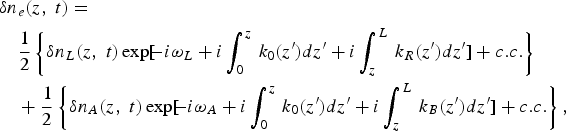 $$\eqalign{&{\rm \delta} n_e \lpar z\comma \; t\rpar =\cr&\quad {1 \over 2}\left\{{\rm \delta} n_L \lpar z\comma \; t\rpar \exp [ \!\!- i{\rm \omega} _L+i\int_0^z \, k_0 \lpar z^{\prime}\rpar dz^{\prime}+i\int_z^L \, k_R \lpar z^{\prime}\rpar dz^{\prime}\rsqb +c.c. \right\}\cr & \quad +{1 \over 2}\left\{{\rm \delta} n_A \lpar z\comma \; t\rpar \exp [ \!\!- i{\rm \omega} _A+i\int_0^z \, k_0 \lpar z^{\prime}\rpar dz^{\prime}+i\int_z^L \, k_B \lpar z^{\prime}\rpar dz^{\prime}\rsqb +c.c. \right\}\comma \; }$$
where δn L (z,t) and δn A (z,t) are the complex amplitudes of the Langmuir wave and the ion acoustic wave with the frequencies ωL = ω0 − ωR and ωA = ω0 − ωB responsible for SRS and SBS, respectively. Under the envelope approximation, coupling evolutions of SRS and SBS can be described by the 5WI model
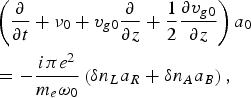 $$\eqalign{& \left({\partial \over \partial t}+{\rm \nu} _0+v_{g0} {\partial \over {\partial z}}+{1 \over 2}{\partial v_{g0} \over {\partial z}} \right)a_0 \cr & = - {i{\rm \pi} e^2 \over m_e {\rm \omega} _0 } \left({{\rm \delta} n_L a_R+{\rm \delta} n_A a_B } \right)\comma \; }$$
 $$\left({\partial \over {\partial t}}+{\rm \nu} _R - v_{gR} {\partial \over {\partial z}} - {1 \over 2}{\partial v_{gR} \over {\partial z}} \right)a_R=- {i{\rm \pi} e^2 \over {m_e {\rm \omega} _R }}{\rm \delta} n_L^ {\ast} a_0\comma \;$$
 $$\left({{\partial \over {\partial t}}+{\rm \nu} _B - v_{gB} {\partial \over {\partial z}} - {1 \over 2}{{\partial v_{gB} } \over {\partial z}}} \right)a_B=- {{i{\rm \pi} e^2 } \over {m_e {\rm \omega} _B }}{\rm \delta} n_A^ {\ast} a_0\comma \;$$
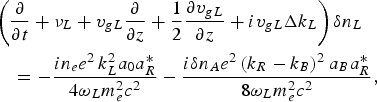 $$\eqalign{& \left({{\partial \over {\partial t}} +{\rm \nu} _L+v_{gL} {\partial \over {\partial z}}+{1 \over 2}{{\partial v_{gL} } \over {\partial z}} +iv_{gL} \Delta k_L } \right){\rm \delta} n_L \cr & \quad =- {in_e e^2\, k_L^2 a_0 a_R^ {\ast} \over 4{\rm \omega} _L m_e^2 c^2 } - {i{\rm \delta} n_A e^2 \left(k_R - k_B \right)^2 a_B a_R^ {\ast} \over 8{\rm \omega} _L m_e^2 c^2 }\comma \; }$$
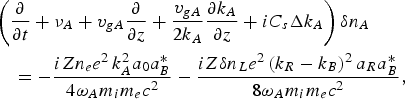 $$\eqalign{& \left({{\partial \over {\partial t}}+{\rm \nu} _A+v_{gA} {\partial \over {\partial z}}+{{v_{gA} } \over {2k_A }}{{\partial k_A } \over {\partial z}}+iC_s \Delta k_A } \right){\rm \delta} n_A \cr & \quad =- {iZn_e e^2\, k_A^2 a_0 a_B^ {\ast} \over 4{\rm \omega} _A m_i m_e c^2 } - {iZ{\rm \delta} n_L e^2 \left(k_R - k_B \right)^2 a_R a_B^ {\ast} \over 8{\rm \omega} _A m_i m_e c^2 }\comma \; }$$
where k L = k 0 + k R and k A = k 0 + k B are the wavenumbers of Langmuir wave and ion acoustic wave, respectively. Δk L is the wave number mismatch representing the detuning between three waves of SRS in consideration of the nonuniform plasma condition, which satisfy the local dispersion relation ωL2 = ωpe2 + 3(k L − Δk L)2T e/m e. Similarly, Δk A is the wave number mismatch of SBS satisfying ωA = (k A − Δk A)v (gA). The group velocities of the incident light wave,the Raman backscattering light wave, the Brillouin backscattering light wave, the Langmuir wave, and the ion acoustic wave are defined as v g0 = c 2k 0/ω0, v gR = c 2k R/ωR, v gB = c 2k B/ωB, v gL = 3T ek L/(m eωL) and v gA = C s − U z, respectively, while the relevant damping rates are sequentially denoted as ν0 = ωpe2νei/(2ω02), νR = ωpe2 νei/(2ωR2 ), νB = ωpe2 νei/(2ωB2), νL = ωpe2 νei/(2ωL2) + νpL, and νA = νie/2 + νaL. As usual,  $C_s=\sqrt {\lpar ZT_e+3T_i \rpar /m_i } $ is the adiabatic sound speed, U z is the flow velocity of plasma. The parameters T e, T i, m iZ, c, νei, νie and n c represent the electron temperature, the ion temperature, the ion mass, the charge state, the vacuum speed of light, the electron-ion collision frequency, the ion-electron collision frequency, and the critical density, respectively.
 ${\rm \nu} _p^L=\sqrt{{\rm \pi} /8}{\rm \omega} _L {\left({k_L {\rm \lambda} _D } \right)}^{ - 3} \exp \left[{ - {\left({\sqrt {2}\, k_L {\rm \lambda} _D } \right)}^{ - 2} - 3/2} \right]$ is the Landau damping rate of Langmuir wave, and
 ${\rm \nu} _a^L=\sqrt {{\rm \pi} /8} {\rm \omega} _A \big[\lpar Zm_e /m_i \rpar ^{1/2}+\lpar ZT_e / T_i \rpar ^{3/2} \exp \lpar \!\!- ZT_e / \lpar 2T_i \rpar - 3/2\rpar \big]$ is the Landau damping rate of ion acoustic wave.
3. HOMOGENEOUS PLASMA CONDITION
In homogeneous plasma, the mismatch of wave numbers is zero everywhere. The 5WI equations can be simplified as
 $$\left({{\partial \over {\partial t}}+{\rm \nu} _0+v_{g0} {\partial \over {\partial z}}} \right)c_0=- {{v_{g0} {\rm \gamma} _R } \over {\sqrt {v_{gL} v_{gR} } }}c_L c_R - {{v_{g0} {\rm \gamma} _B } \over {\sqrt {v_{gA} v_{gB} } }}c_A c_B\comma \;$$
 $$\left({{\partial \over {\partial t}}+{\rm \nu} _R - v_{gR} {\partial \over {\partial z}}} \right)c_R=\sqrt {{{v_{gR} } \over {v_{gL} }}} {\rm \gamma} _R c_L^ {\ast} c_0\comma \;$$
 $$\left({{\partial \over {\partial t}}+{\rm \nu} _B - v_{gB} {\partial \over {\partial z}}} \right)c_B=\sqrt {{{v_{gB} } \over {v_{gA} }}} {\rm \gamma} _B c_A^ {\ast} c_0\comma \;$$
 $$\left({{\partial \over {\partial t}}+{\rm \nu} _L+v_{gL} {\partial \over {\partial z}}} \right)c_L=\sqrt {{{v_{gL} } \over {v_{gR} }}} {\rm \gamma} _R c_0 c_R^ {\ast} \comma \;$$
 $$\left({{\partial \over {\partial t}}+{\rm \nu} _A+v_{gA} {\partial \over {\partial z}}} \right)c_A=\sqrt {{{v_{gA} } \over {v_{gB} }}} {\rm \gamma} _B c_0 c_B^ {\ast} \comma \;$$
where c 0 (z, t) = a 0 (z, t)/a 0 (0, 0),  $c_R \lpar z\comma \; t\rpar =\sqrt {k_R /k_0 } a_R \lpar z\comma \; t\rpar /a_0 \lpar 0\comma \; 0\rpar $,
 $c_B \lpar z\comma \;\; t\rpar =\sqrt {k_B /k_0 } a_B \lpar z\,\comma \; t\rpar /a_0 \lpar 0\comma \; 0\rpar $,
 $c_L \lpar z\comma \;\; t\rpar \;\;=\;\;i\sqrt {v_{gL} /k_0 {\rm \omega} _R } {\rm \pi} e^2 {\rm \delta} n_L \lpar z\comma \;\; t\rpar /\left({{\rm \gamma} _R m_e c} \right)$, and
 $c_A \lpar z\comma \;\; t\rpar\; =\;i\sqrt {v_{gA} /k_0 {\rm \omega} _B } {\rm \pi} e^2 {\rm \delta} n_A \lpar z\comma \;\;\, t\rpar / \left({{\rm \gamma} _B m_e c} \right)$ are the normalized complex amplitudes of the five waves,
 ${\rm \gamma} _R=\sqrt {{\rm \omega} _{\,pe}^2 /{\rm \omega} _R {\rm \omega} _L } k_L ea_0 \lpar 0\comma \;\; 0\rpar /\left({4m_e c} \right)$ and
 ${\rm \gamma} _B=\sqrt {Zm_e {\rm \omega} _{\,pe}^2 /{\rm \omega} _B {\rm \omega} _A m_i } k_A ea_0 \lpar 0\comma \; 0\rpar /\left({4m_e c} \right)$ are the maximum temporal growth rates of the Raman and Brillouin instabilities, respectively (Forslund et al., Reference Forslund, Kindel and Lindman1975). It is reasonable to neglect the second parts on the right hand side of Eqs. (5) and (6), which are tiny compared with the first parts. Considering the strong damping conditions
 ${\rm \nu} _L \sqrt {v_{gR} } /{\rm \gamma} _R \sqrt {v_{gL} } \gg 1$ and
 ${\rm \nu} _A \sqrt {v_{gB} } /{\rm \gamma} _B \sqrt {v_{gA} } \gg 1$ (Forslund et al., Reference Forslund, Kindel and Lindman1975), we get
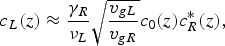 $$c_L \lpar z\rpar \approx {{{\rm \gamma} _R } \over {{\rm \nu} _L }}\sqrt {{{v_{gL} } \over {v_{gR} }}} c_0 \lpar z\rpar c_R^ {\ast} \lpar z\rpar \comma \;$$
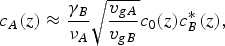 $$c_A \lpar z\rpar \approx {{{\rm \gamma} _B } \over {{\rm \nu} _A }}\sqrt {{{v_{gA} } \over {v_{gB} }}} c_0 \lpar z\rpar c_B^ {\ast} \lpar z\rpar \comma \;$$
from Eqs. (10) and (11). Commonly, ν0, νR, and νB are small. Substituting Eqs. (12) and (13) into Eqs. (7)–(9), we approximately obtain the stationary equations of the three light waves
 $${{\partial \mathop {\left\vert {c_0 \lpar z\rpar } \right\vert }\nolimits^2 } \over {\partial z}}=- {{2{\rm \gamma} _R^2 } \over {v_{gR} {\rm \nu} _L }}\mathop {\left\vert {c_0 \lpar z\rpar } \right\vert }\nolimits^2 \mathop {\left\vert {c_R \lpar z\rpar } \right\vert }\nolimits^2 - {{2{\rm \gamma} _B^2 } \over {v_{gB} {\rm \nu} _A }}\mathop {\left\vert {c_0 \lpar z\rpar } \right\vert }\nolimits^2 \left\vert {c_B \lpar z\rpar \vert ^2\comma \; } \right.$$
 $${{\partial \mathop {\left\vert {c_R \lpar z\rpar } \right\vert }\nolimits^2 } \over {\partial z}}=- {{2{\rm \gamma} _R^2 } \over {v_{gR} {\rm \nu} _L }}\mathop {\left\vert {c_R \lpar z\rpar } \right\vert }\nolimits^2 \mathop {\left\vert {c_0 \lpar z\rpar } \right\vert }\nolimits^2\comma\;$$
 $${{\partial \mathop {\left\vert {c_B \lpar z\rpar } \right\vert }\nolimits^2 } \over {\partial z}}=- {{2{\rm \gamma} _B^2 } \over {v_{g0} {\rm \nu} _A }}\mathop {\left\vert {c_B \lpar z\rpar } \right\vert }\nolimits^2 \mathop {\left\vert {c_0 \lpar z\rpar } \right\vert }\nolimits^2.$$
Supposing the laser plasma interaction length is L, solutions of Eqs. (14)–(16) can be written as
 $$\int_{\rm \varepsilon} ^{R_R } \, {{dz} \over {{\rm \varepsilon} ^{1 - {\textstyle{1 \over {\rm \beta} }}} z^{1+{\textstyle{1 \over {\rm \beta} }}}+z^2+\lpar 1 - R_R - {\rm \varepsilon} ^{1 - {\textstyle{1 \over {\rm \beta} }}} R_R^{{\textstyle{1 \over {\rm \beta} }}} \rpar z}}=G_R\comma \;$$
 $$\int_{\rm \varepsilon} ^{R_B } \, {{dz} \over {{\rm \varepsilon} ^{1 - {\rm \beta} } z^{1+{\rm \beta} }+z^2+\lpar 1 - R_B - {\rm \varepsilon} ^{1 - {\rm \beta} } R_B^{\rm \beta} \rpar z}}=G_B\comma \;$$
which are the stationary reflectivity relations between SRS and SBS in the regime of competition, where R R = |c R (0, t)|2 and R B = |c B (0, t)|2 are the backscattering reflectivity of SRS and SBS at the z = 0 boundary, respectivily. For simplicity, we take ɛ = |c R (L, t)|2 = |c B (L, t)|2, which denotes the noisy disturbance of the Raman and Brillouin backscattering light waves at the z = L boundary. The gain exponent of SRS is
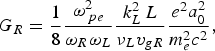 $$G_R={1 \over 8}{{{\rm \omega} _{\,pe}^2 } \over {{\rm \omega} _R {\rm \omega} _L }}{{k_L^2\, L} \over {{\rm \nu} _L v_{gR} }}{{e^2 a_0^2 } \over {m_e^2 c^2 }}\comma \;$$
and the gain exponent of SBS is
 $$G_B={1 \over 8}{{Zm_e } \over {m_i }}{{{\rm \omega} _{\,pe}^2 } \over {{\rm \omega} _B {\rm \omega} _A }}{{k_A^2\, L} \over {{\rm \nu} _A v_{gB} }}{{e^2 a_0^2 } \over {m_e^2 c^2 }}.$$
Parameter β in Eqs. (17) and (18) is the gain exponent ratio of SRS to SBS
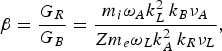 $${\rm \beta}={{G_R } \over {G_B }}={{m_i {\rm \omega} _A k_L^2\, k_B {\rm \nu} _A } \over {Zm_e {\rm \omega} _L k_A^2\, k_R {\rm \nu} _L }}\comma \;$$
which mainly depends on the parameters of plasma, and has nothing to do with the incident laser intensity I.
This competitive relations described by Eqs. (17) and (18) are universal to the problems of SRS and SBS coexistence in the uniform plasma, which can be reduced to the reflectivity relation of the isolated SRS or SBS process (Tang, Reference Tang1966)
 $$R\left({1 - R} \right)={\rm \varepsilon} \left\{{\exp\left[{G\left({1 - R} \right)} \right]- R} \right\}\comma \;$$
under the extreme condition β → ∞ or β = 0, respectively.
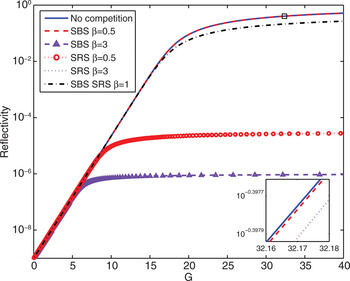
Figure 1 shows the reflectivity of SRS and SBS as a function of the gain exponent G for different values of β, where ɛ = 10−9. In order to facilitate comparison, we show the theoretical curve of Eq. (22) as a reference, which is the highest solid line in the figure. The dotdash line corresponding to β = 1 indicates that the reflected intensities of SRS and SBS are equal when G R = G B, but less than the isolated case obviously when the gain exponent large than 18. When β < 1, the reflectivity of SBS increases near the value of the isolated case, but the reflectivity of SRS is reduced several magnitudes, for example the curves of β = 0.5 shown as the dashed line for SBS and the dotted line with circles for SRS.This effect results from the competition between SRS and SBS for the incident laser energy. When G B > G R, SBS dominates the backscattering and consumes more energy than SRS, which contrarily restrain the rise of SRS. In contrast, SRS is the dominant instability when G R > G B, such as the β = 3 case shown as the dashed line with triangles for SBS and the dotted line for SRS.
(Color online) The reflectivity of SRS and SBS varies with G for different β.

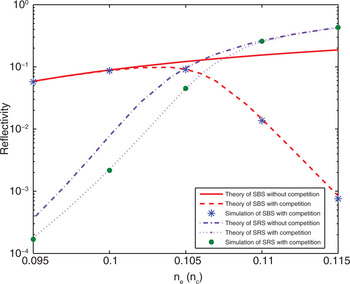
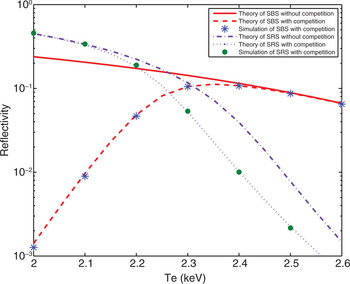
The competitive processes between SRS and SBS are simulated in a bounded homogeneous plasma under the strong damping conditions with a 5WI coupling code. Intensity of the incident laser is chosen to be I = 5 × 10¹⁵ W/cm2, with the vacuum wavelength λ0 = 0.351 µm. The simulated length is L = 600λc. Other simulation parameters are T i = 0.2T e, Z = 1, ɛ = 10−9, and m i = 1836m e. Figure 2 shows a strong dependency of the stationary SRS and SBS reflectivity on the electron density n e, with the electron temperature T e = 2.5 keV. Figure 3 shows the reflectivity of SRS and SBS in steady-state with the changes in the electron temperature T e, when the electron density n e remains 0.1n c. The simulation parameter regions of Figures 2 and 3 are chosen to keep  $5.16 \leq {\rm \nu} _L \sqrt {v_{gR} } /{\rm \gamma} _R \sqrt {v_{gL} } \leq 12.4$ and
 $8.59 \leq {\rm \nu} _A \sqrt {v_{gB} } /{\rm \gamma} _B \sqrt {v_{gA} } \leq 9.9$, so the strong damping conditions are satisfied. As references, the theoretical curves for the isolated SRS process and the isolated SBS process are shown as the dot-dash line and the solid line respectively both in Figures 2 and 3. The theoretical results of the competition between two instabilities calculated by Eqs. (17) and (18) are shown as the dotted line for SRS and the dashed line for SBS, respectively. The simulated results in the regime of competition are shown as the solid circles for SRS and the stars for SBS. Excitedly, the simulated results are almost consistent with the theoretical curves, which implies the availability of the relations given by Eqs. (17) and (18). Comparing the curves between the coexistence case and the isolated case, we find that the competitive pattern of SRS and SBS are sensitive to n e and T e. For high electron density and low electron temperature, SRS is the dominant instability, and the reflectivity of SBS is less than the isolated case several magnitudes. Contrarily, SBS dominates the backscattering in the low electron density and high electron temperature parameters region, in which SRS are suppressed.
(Color online) The reflectivity of SRS and SBS varies with n e.

(Color online) The reflectivity of SRS and SBS varies with T e.

4. INHOMOGENEOUS PLASMA CONDITION
Under inhomogeneous plasma condition, the mismatch of wave numbers must be considered, which usually restrains the development of the isolated instabilities (Rosenbluth, Reference Rosenbluth1972). In this section, we discuss the influence of nonuniform plasma condition to the competition between SRS and SBS. We mainly consider the linear inhomogeneity of the electron density, the flow velocity, the electron temperature, and the ion temperature. Assuming the spatial distribution of these physical quantities are n e (z) = n e0[1 + (z − z 0)/L n], U z (z) = C s (z − z 0)/L u, T e (z) = T e0 [1+(z − z 0)/L Te], and T i (z) = T i0 [1+(z − z 0 )/L Ti], where L n, L u, L Te, and L Ti are the gradient scale length of n e, U z, T e, and T i, respectively. z 0 is the resonant point at which the wave number mismatch Δk L = 0 for SRS and Δ k A = 0 for SBS.
To get the gain exponent G I of the isolated instability in the inhomogeneous plasma with the linear approximation, people commonly make (Liu et al., Reference Liu, Rosenbluth and White1974; Chapman et al., Reference Chapman, Huller, Masson-Laborde, Heron, Pesme and Rozmus2012).
 $$\Delta k\lpar z\rpar \approx {\rm \kappa} \lpar z - z_0 \rpar \comma \;$$
where the wave number mismatch gradient κ is defined as 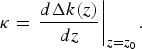 ${\rm \kappa}={\left. {{{{d\Delta k\lpar z\rpar } \over {dz}}}} \right\vert }_{z=z_0 }.$ Currently, we choose z 0 = L/2, then the inhomogeneous gain exponent of SBS
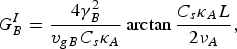 $$G_B^I={{4{\rm \gamma} _B^2 } \over {v_{gB} C_s {\rm \kappa} _A }}\arctan{{C_s {\rm \kappa} _A L} \over {2{\rm \nu} _A }}\comma \;$$
can be derived from Eqs. (4) and (6) as given by Maximov et al. (Reference Maximov, Oppitz, Rozmus and Tikhonchuk2000), where
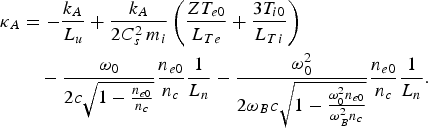 $$\eqalign{{\rm \kappa} _A & =- {k_A \over L_u }+{k_A \over 2C_s^2\, m_i}\left({ZT_{e0}\over L_{Te} }+{3T_{i0}\over L_{Ti} } \right)\cr & \quad -{{\rm \omega}_0\over{2c\sqrt{1 - {n_{e0} \over n_{c} }}}}{n_{e0}\over {n_c }}{1 \over {L_n }}-{{\rm \omega} _0^2 \over 2{\rm \omega} _B c \sqrt {1 - {{\rm \omega} _0^2 n_{e0} \over {\rm \omega} _B^2 n_c}}} {n_{e0}\over {n_c }}{1\over L_n}.}$$
For a given incident laser intensity, G B becomes smaller when κA increases. Peculiarly, for a strong inhomogeneity νA ≪ C sκAL, G BI tends to 2πγB2/v gBC sκA given by Rosenbluth (Reference Rosenbluth1972). According to the values of L u, L n, L Te, and L Ti in the ICF parameters region (Strozzi et al., Reference Strozzi, Williams, Hinkl, Froula, Londaon and Callahan2008), we find the first part on right hand side of Eq. (25) is larger than the latter four parts at least one magnitude. So the gradient of the flow velocity is the most important nonuniform factor suppressing the SBS instability.
Similarly, the inhomogeneous gain exponent of SRS is
 $$G_R^I={{4{\rm \gamma} _R^2 } \over {v_{gR} v_{gL} {\rm \kappa} _L }}\arctan{{v_{gL} {\rm \kappa} _L L} \over {2{\rm \nu} _L }}\comma \;$$
where
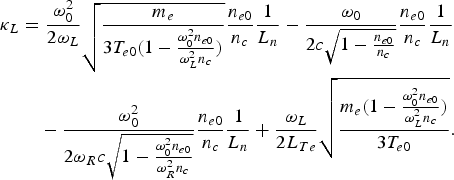 $$\eqalign{{\rm \kappa} _L & ={{{\rm \omega} _0^2 } \over {2{\rm \omega} _L }}\sqrt {{{m_e } \over {3T_{e0} \lpar 1 - {{{{\rm \omega} _0^2 n_{e0} } \over {{\rm \omega} _L^2 n_c }}}\rpar }}} {{n_{e0} } \over {n_c }}{1 \over {L_n }} - {{{\rm \omega} _0 } \over {2c\sqrt {1 - {{{n_{e0} } \over {n_c }}}} }}{{n_{e0} } \over {n_c }}{1 \over {L_n }}\cr & \quad - {{{\rm \omega} _0^2 } \over {2{\rm \omega} _R c\sqrt {1 - {{{{\rm \omega} _0^2 n_{e0} } \over {{\rm \omega} _R^2 n_c }}}} }}{{n_{e0} } \over {n_c }}{1 \over {L_n }}+{{{\rm \omega} _L } \over {2L_{Te} }}\sqrt {{{m_e \lpar 1 - {{{{\rm \omega} _0^2 n_{e0} } \over {{\rm \omega} _L^2 n_c }}}\rpar } \over {3T_{e0} }}}.}$$
The latter three parts on right hand side of Eq. (27) are smaller than the first part at least one magnitude, and the gradient of the electron density has the greatest impact on SRS.
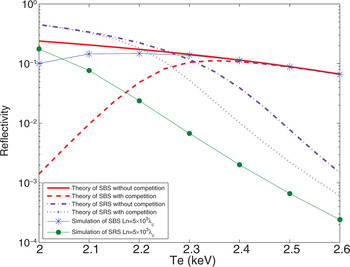
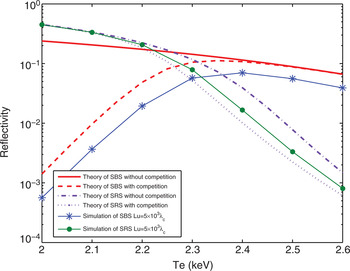
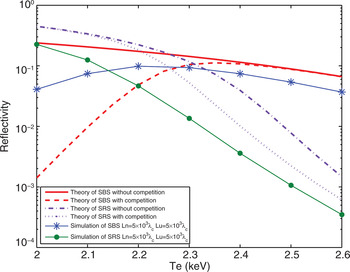
Appending the impact of the nonuniform plasma conditions, we have simulated the example described in Figure 3 again. Figure 4 shows the stationary reflectivity of SRS and SBS as a function of T e in the regime of competition influenced by the nonuniform electron density with L n = 5 × 10³λc. Figure 5 shows the R R and R B varying with T e in consideration of the flow velocity gradient, where L u = 5 × λc. Both the influences of L n and L u are simulated shown as Figure 6. In these three figures, the theoretical curves of SRS and SBS both in the isolated case and the competitive case under the uniform condition are shown the same as in Figure 3, which are used as the references for convenient comparison. Our simulation results are shown as the line with solid circles for SRS and the line with stars for SBS, respectively. In Figure 4, the reflectivity of SRS is obviously reduced because of the nonuniform electron density, which seemingly has little impact on SBS. But the reflectivity of SBS increases in the low temperature region caused by the competition regime. The competitive pattern is changed in 2.05 keV < T e< 2.26 keV region, where SRS is dominant in uniform plasma but SBS becomes dominant after the consideration of the electron density gradient. Figure 5 presents an opposite situation to Figure 4. The gradient of the flow velocity results in the decrease of SBS reflectivity during the whole simulation region. Even the nonuniform flow velocity has no direct effect on SRS, the reflectivity of SRS increases larger in competition and becomes the dominant instability in 2.26 keV< T e< 2.32 keV region. In Figure 6, we can see both the reflectivity of SRS and SBS are reduced in their dominating regions due to the inhomogeneity of n e and U z, respectively. How the competitive pattern changes is determined by the values of L n and L u.
(Color online) The reflectivity of SRS and SBS varies with T e in consideration of the nonuniform electron density.

(Color online) The reflectivity of SRS and SBS varies with T e in consideration of the nonuniform flow velocity.

(Color online) The reflectivity of SRS and SBS varies with T e in consideration of the nonuniform electron density and the gradient of flow velocity.

5. CONCLUSIONS
In conclusion, the competition between SRS and SBS are discussed based on a 5WI model. In uniform plasma, the equations of the stationary SRS and SBS reflectivity in the regime of competition are derived in theory. The coexistent developments of SRS and SBS are simulated with different parameters. It is found that the competitive pattern of SRS and SBS is sensitive to the electron density and temperature. The SBS instability dominates the backscattering and restrains the rise of SRS in the high temperature and low density parameters region. In addition, we analyze the influence of inhomogeneous plasma condition to the competition between SRS and SBS. The nonuniform electron density is found to be the most important factor resulting detuning between the interacted waves of SRS. And the gradient of flow velocity has the most impact on the SBS process. The competitive evolutions of SRS and SBS in nonuniform plasma have also been simulated for different situations. All of our numerical results consist with our theoretical results. Considering SBS is preferable to SRS for nearly equivalent reflectivity in ICF, high temperature and low density plasma condition should be chiefly considered during the ignition design. Based on our results, the high gradient of electron density is beneficial to the suppression of SRS, But the nonuniform flow velocity should be avoided properly.
ACKNOWLEDGMENT
This work was supported by the National High Technology Research and Development Program of China (863 Program) (Grant No. 2012AA01A303), the Sci. & Tech. Funds of CAEP (Grant No. 2010A0102004), and the National Natural Science Foundation of China (Grant Nos. 11147141, 11175029, 11075025, 10935003, 11201033).