Introduction
Poultry welfare has long been known to be influenced by housing system and management (Elson, Reference ELSON1988; Reference ELSON2010), but some aspects of it can be positive and others negative even within the same system. For example, as shown by Elson (Reference ELSON2008), extensive free-range pasture based systems allow poultry freedom to express a wider behavioural repertoire (positive) than intensive indoor ones but expose them to greater risks of predation, climatic extremes, endoparasitic infestation and infections carried by wild birds (negative). There are also major differences in welfare between systems; hens are most confined, but also safest, in cages and have greater freedom but are at more risk of problems causing higher morbidity and mortality on free-range (Elson and Croxall, Reference ELSON and Croxall2006).
A range of poultry housing systems for broilers was described by Elson (Reference ELSON1993) and for laying hens (Elson, Reference ELSON2004). Each of these systems was considered in relation to poultry behaviour, management and welfare by Appleby et al. (Reference APPLEBY, HUGHES and ELSON1992). An important point made by Elson (Reference ELSON2004) is that excellence in both system design and appropriate management are essential to achieve high standards of welfare and production.
Researchers have developed welfare indicators in order to study poultry welfare within and between the different systems available (broilers: Berg, Reference BERG2004 and Manning et al., Reference MANNING, CHADD and BAINES2007; turkeys: Martrenchar et al., Reference MARTRENCHAR, BOILLETOT, HUONNIC and POL2002; laying hens: Blokhuis et al., Reference BLOKHUIS, FIKS-VAN NIEKERK, BESSEI, ELSON, GUEMENE, KJAER, MARIA LEVRINO, NICOL, TAUSON, WEEKS and VAN DE WEERD2007 (LayWel project) and Nicol et al., Reference NICOL, CAPLEN, EDGAR and BROWNE2009b). Whilst several such indicators should be used when assessing poultry welfare in different systems, some have a major influence and are easier to measure than others especially in large scale applied studies carried out on commercial poultry farms. In this paper therefore, a few major welfare indicators that are routinely recorded on poultry farms and processing stations have been selected to assess poultry welfare within and across systems in widespread use. The main indicator used for broilers and turkeys is the prevalence and severity of contact dermatitis and, for laying hens, cumulative mortality as the flock ages.
Poultry meat production (broilers and turkeys)
Dawkins et al. (Reference DAWKINS, DONNELLY and JONES2004) demonstrated that chicken welfare is influenced more by housing conditions than by stocking density. An important component of most broiler and turkey housing is the littered floor since the birds are in constant contact with it. Studies on the subject of contact dermatitis in both species were initiated by Berg (Reference BERG1998) and more recently well referenced comprehensive study reports and reviews on it were provided by Mayne (Reference MAYNE2005), Shepherd and Fairchild (Reference SHEPHERD and FAIRCHILD2010) and Bassler et al. (Reference BASSLER, ARNOULD, BUTTERWORTH, COLIN, DE JONG, FERRANTE, FERRARI, HASLAM, WEMELSFELDER and BLOKHUIS2013). All confirm that poultry housed on littered floor systems are at risk of developing contact dermatitis, especially if the litter quality is poor i.e. wet and/or overloaded with faeces (Berg, Reference BERG2004). This condition may present as foot pad dermatitis (FPD), hock burn (HB) or breast burn; it is sometimes described as ammonia burn (Sanotra et al., Reference SANOTRA, LUND, ERSBOLL, PETERSEN and VESTERGAARD2001). It is seen most often in heavy broilers or turkeys and less so in laying hens, probably because most of the latter are lighter and more usually kept off litter in cages.
Platt et al. (Reference PLATT, BUDA and BUDRAS2001) observed that, in some such lesions, ulceration spreads into the dermis resulting in acute inflammation. The condition is probably painful, the degree of which will vary with lesion severity (Berg, Reference BERG1998; Schmidt and Luders, Reference SCHMIDT and LUDERS1976). Shepherd and Fairchild (Reference SHEPHERD and FAIRCHILD2010) confirmed this, noting reduced weight gain in broilers with such lesions due to pain-induced decreases in feed intake. Hocking and Wu (2013) observed behavioural evidence of pain in turkeys suffering from FPD. Contact dermatitis lesions are frequently in contact with surfaces that increase the problem and stimulate pain e.g. hard, capped litter.
Wet litter is an important cause of FPD. Indeed, Mayne et al. (Reference MAYNE, ELSE and HOCKING2007) demonstrated that high litter moisture alone is sufficient to cause FPD. This was tested by Van Harn et al. (Reference VAN HARN, GUNNICK and DE JONG2014) who systematically sprayed water over broiler litter. They concluded that increased litter moisture content not only caused severe FPD but, as reported by De Jong et al. (Reference DE JONG, VAN HARN, GUNNICK, HINDLE and LOURENS2012), reduced broiler performance and carcass yields and had a negative effect on other welfare aspects. This conclusion agrees with the earlier findings of Bray and Lynn (Reference BRAY and LYNN1986) and Lynn and Elson (Reference LYNN and ELSON1990), whereby the latter compared eight types of broiler drinkers and found that the design that caused the highest litter moisture had sticky capped litter and the highest incidence of HB whereas the design that had the lowest litter moisture had dry friable litter and the lowest HB incidence (Table 1). These were statistically significant differences. Wu and Hocking (Reference WU and HOCKING2011) reached the same conclusion with regard to turkeys i.e. that high litter moisture is the primary cause of FPD.
Study of eight broiler drinker types at ADAS Gleadthorpe UK.

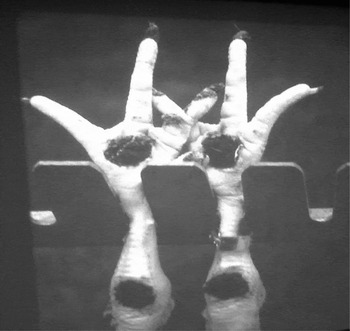
These studies indicate that FPD and HB have the same main aetiology due to wet litter. This is confirmed by the fact that FPD and HB lesions often occur in the same birds in the same conditions at about the same time (Figure 1), as found by Bray and Lynn (Reference BRAY and LYNN1986) and Kjaer et al. (Reference KJAER, SU, NIELSEN and SORENSEN2006).
Severe FPD and HB on both legs of the same bird.

Consumers are generally unaware of these serious welfare problems, because the legs and feet are removed at the hock from many broilers and turkeys during processing and the lesions are therefore not generally found on the finished product displayed in retail outlets. However, inspection of table poultry on processing lines reveals the prevalence and severity of the damage; it is an important welfare indicator and scoring systems have been devised to monitor this problem (Hocking et al., Reference HOCKING, MAYNE, ELSE, FRENCH and GATCLIFFE2008).
Broiler production has been managed almost entirely intensively within controlled environment housing for many years. Niche markets have been developed for slower growing, free range and organically grown chickens in the past two decades and production in such systems has subsequently increased. Some consumers are prepared to pay substantial premiums for these products, which are generally perceived to be produced in welfare friendly ways. However contact dermatitis has been found with much greater prevalence and severity in conventional and organic free-range chickens than in intensive ones.
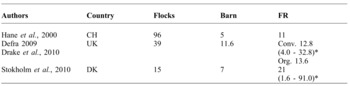
This was revealed in a large scale study by Pagazaurtundua and Warriss (Reference PAGAZAURTUNDUA and WARRISS2006) involving 3.93 million birds in 359 flocks on 91 farms. They found that the mean prevalence of FPD in standard intensive broiler systems was 14.8%. However, free range and organic flocks that had access to the outside showed significantly higher prevalence of FPD than those kept entirely indoors (confirmed by Sarica et al., Reference SARICA, YAMAK and BOZ2014). The prevalence of FPD was higher (32.8%) in free range birds and highest (98.1%) in organically reared ones; its severity was in the same order (Table 2).
Prevalence and severity of foot pad dermatitis (FPD) in intensive and extensive broiler flocks.

EU Council Directive 2007/43/EC (2007) attempted to address this issue by requiring that ‘all chickens shall have permanent access to litter which is dry and friable on the surface’ (Annex 1.3) and that ‘official veterinarians shall identify possible indications of poor welfare such as abnormal levels of contact dermatitis. These should be communicated to the owner and the competent authority who shall take appropriate actions’ (Annex 3.2-3). However this has not proved straightforward (Cassidy, Reference CASSIDY2013) and in any case the Directive does not apply to broilers kept under free-range systems (Art. 1.1. (d)). It should be noted that this was the first EU Council Directive to include animal welfare indicators.
Although the causal factors of FPD, including litter type and quality, drinker type, house temperature and humidity, feed composition, bird weight and stocking density, are reasonably well known, the reasons for its high prevalence and severity in extensive systems are not fully understood. Pagazaurtundua and Warriss (Reference PAGAZAURTUNDUA and WARRISS2006) suggested that the latter could be due to sharp objects outside the house cutting the bird's feet thus initiating the onset of lesions or that the birds are grown over a longer period allowing more time for lesions to develop. In addition, extensively reared chickens in small houses with large popholes often experience wet conditions outside and cold exposure inside, and bring moisture into the houses on their feet. This can result in wet litter which, as noted above, combined with the burning effect of ammonia from urea in the faeces in the litter is known to cause FPD and consequent poor welfare. Wet litter reduces overall welfare, technical performance, and carcass yield in broiler chickens (De Jong et al., Reference DE JONG, GUNNINK and VAN HARN2014).
Measures aimed at reducing litter-associated welfare problems should be developed and applied as soon as possible. Additional requirements going beyond those in the current Broiler Directive should be made. FPD scoring is also essential in extensive as well as intensive systems in order to address and attempt to solve the severe welfare problem of all forms of contact dermatitis (Haslam et al., Reference HASLAM, KNOWLES, BROWN, WILKINS, KESTIN, WARRISS and NICOL2007).
Egg production (laying hens)
Under this heading this review mainly considers liveability as a measure of bird welfare. Holt (Reference HOLT2011) stated that ‘Any discussion of welfare necessitates the inclusion of mortality data for that particular housing system. First, the liveability of a flock is a good indicator of the health and wellbeing of the birds and poor liveability suggests bird health problems. Second, because animals generally suffer during the time leading up to death, they are experiencing a poor quality of life and therefore poor welfare status during this period. Increased mortality stems from multiple causes such as disease, bird aggression, suffocation, and predators’.
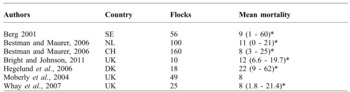
In view of this, published data on mean mortality during the laying year has been collected and is tabulated in Tables 3 to 5 below, although some figures are rounded and may require explanation. The original papers should therefore be examined for more detailed information and understanding. The categories of systems are those used in the LayWel report (Blokhuis et al., Reference BLOKHUIS, FIKS-VAN NIEKERK, BESSEI, ELSON, GUEMENE, KJAER, MARIA LEVRINO, NICOL, TAUSON, WEEKS and VAN DE WEERD2007) as detailed by Fiks-van Niekerk and Elson (Reference FIKS-VAN NIEKERK and ELSON2005).
Percentage mortality in studies across all systems for laying hens.

Percentage mortality in studies across barn and free range (FR) systems.

Percentage mortality in studies within free range systems.

CC = conventional cage,
FC = furnished cage, FR = free-range, Conv. = conventional FR and Org. = organic FR.
* indicates the range of mortalities reported.
The importance of mortality
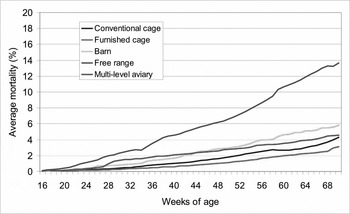
The data tabulated above do not tell the whole story, of course, but they do show that mortality, which is recorded on most poultry farms and is a valuable indicator of poor welfare, is considerably higher in non-cage systems especially free-range ones. That was shown clearly in the study reported by Elson and Croxall (Reference ELSON and Croxall2006), the results of which are summarised in the first row of Table 3 above. This study involved assessments on 39 well-managed flocks of beak trimmed laying hens of various brown feathered genotypes on farms in the UK, Germany and the Netherlands. These flocks were housed in conventional cages (CC), furnished cages (FC), single tier aviaries (barns), multi-tier aviaries and free range conditions (FR). As shown in Figure 2, the cumulative mean mortality during the laying year was highest in FR (14%) and lowest in FCs (3%). The breeders’ benchmark for most brown genotypes is between 4 and 5%.
Cumulative mortality in different housing systems (Elson and Croxall, Reference ELSON and Croxall2006).

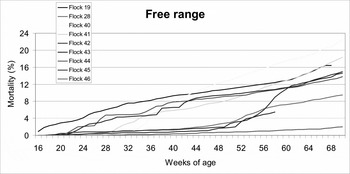
FCs were developed about 20 years ago (Appleby et al., Reference APPLEBY, WALKER, NICOL, LINDBERG, FREIRE, HUGHES and ELSON2002) and meet the requirements of EU Council Directive 1999/74/EC (1999). They are now widespread throughout Europe and their use is spreading to other continents. Experience with them has confirmed this low mortality, often below 3 %, generally combined with good feathering and excellent egg production (Elson and Tauson, Reference ELSON and TAUSON2012). However FR flocks have not fared so well. In the same study, the mean mortality in the nine FR flocks varied between 2% and 22% (Elson and Croxall, Reference ELSON and Croxall2006) (Figure 3).
Cumulative mortality in nine FR flocks in the UK (Elson and Croxall, Reference ELSON and Croxall2006).

Large scale FR studies in Denmark (Stokholm et al., Reference STOKHOLM, PERMIN, BISGAARD and CHRISTENSEN2010; Hegelund et al., Reference HEGELUND, SORENSEN and HERMANSEN2006), the Netherlands (Bestman and Maurer, Reference BESTMAN and MAURER2006), Sweden (Berg, Reference BERG2001) and the United Kingdom (Bright and Johnson, Reference BRIGHT and JOHNSON2011; Drake et al., Reference DRAKE, DONNELLY and DAWKINS2010; Whay et al., Reference WHAY, MAIN, GREEN, HEAVEN, MORGAN, PEARSON and WEBSTER2007) have revealed much higher mortality than in cage systems and identified large differences between FR flocks. Causes were attributed to several factors including predation, scares leading to smothering outside, endoparasitic infestation and infections spread by wild birds. Each of these is associated with the fact hens are free to go outside and mix with wild animals rather than being kept in safe controlled conditions.
Hegelund et al. (Reference HEGELUND, SORENSEN and HERMANSEN2006) found considerable differences between regularly recorded mortality and that discovered when the number of hens depopulated was subtracted from the number originally housed. The latter was higher; they called the difference ‘missing FR mortality’ and deduced that it could be accounted for by the fact that carcasses from predation and outside smothering seem to be removed by predators and scavengers without the awareness of stockpersons. True mortality should therefore be calculated by deduction of the depopulated numbers from those of the placed ones; this would give a better indication of bird wellbeing.
Cage versus range
Although outdoor access for hens is perceived by some to offer improved quality of life, these risks of high mortality indicate significant negative effects on hen welfare. The European Food Safety Authority (2005) scientific opinion noted various hazards and made several welfare recommendations. Recommendation 13 was: ‘Efforts should be made to minimise mortality and morbidity, including the use of benchmarking and other incentives, in order to reduce the risk of poor welfare. Only those systems, in which there is expected to be low mortality, should be used’. It is difficult to see how FR in its present form can consistently meet this recommendation (Elson, Reference ELSON2008).
Commenting on the results of another major UK study into laying hen welfare in four different housing systems reported by Sherwin et al. (Reference SHERWIN, RICHARDS and NICOL2010) (second row in Table 2), Nicol et al. (Reference NICOL, BROWN, HASLAM, HOTHERSALL, MELOTTI, RICHARDS and SHERWIN2009a) concluded ‘This study did not include a detailed analysis of all hen behaviours but, considering the indicators of physical wellbeing and stress response that were measured, the welfare of hens in the FC system appeared to be better than that of hens in the other systems’.
About 50% of UK laying hens are kept in FR systems and their eggs are sold at a considerable premium over those produced by hens in FCs. During 2013 there was much debate in the UK about the welfare of hens kept in these systems. Nicol (Reference NICOL2013) pointed out that three major potential welfare problems are more likely to occur in FR than in FCs, i.e. mortality, injurious pecking and bone fractures. Researchers at the University of Bristol combined measures of these three problems and summarised the situation for the average flock of FR hens. By the end of lay 10% of the flock will have died and, of the survivors, 42% will have both a bone fracture and a significant number of severe pecks; only 12% of the surviving hens will be unharmed. Having said that, as illustrated above, results from FR flocks vary greatly from one another, and some (probably a minority) have good feathering and liveability.
A possible way ahead
Verandas, called winter gardens in some European countries and porches in the USA, have been added to some intensive litter floored houses to increase the available scratching area and allow hens access to natural daylight and fresh air. However, eggs from such systems cannot currently be marketed as conventional, or organic, free range within the European Union.
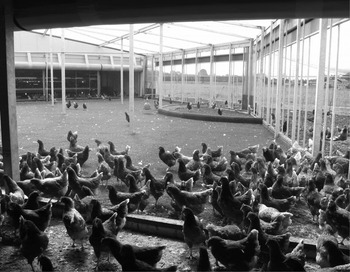
It is difficult to achieve good biosecurity and to protect welfare sufficiently when poultry are kept in extensive housing systems. A possible approach to making FR safe from predators, avoiding contact with wild birds and animals and reducing infection and infestation would be to introduce an indoor range area as well as a fully protected, limited outdoor area. This could be achieved using a housing system such as Rondeel™ (Figure 4), which incorporates a multi-level aviary and natural UV light (Van Niekerk and Reuvekamp, Reference VAN NIEKERK and REUVEKAMP2011). Such a system might be adapted to provide safe FR under a new definition (Elson, Reference ELSON2012). Its adoption, instead of outside FR as currently defined in EU Directive 1999/74/EC (1999), would leave only organic FR as a fully extensive land based system with the greatest risk of poor wellbeing.
View of RondeelTM showing bright airy indoor range, multi-tier aviary with curtains open at rear, dust bath at bottom and inside on right and wired in wooded fringe range outside on right (van Niekerk and Reuvekamp, Reference VAN NIEKERK and REUVEKAMP2011). Could this become the basis of ‘safe’ high welfare free-range?

Conclusions
Many broilers and turkeys can suffer from contact dermatitis for much of their short lives. Although the causal factors, of which wet litter is the major one, are well understood, the problem persists especially in extensively grown birds. Such broilers should be subject to FPD scoring as well as intensive ones and further measures should be taken to reduce this severe welfare problem in all meat birds.
For laying hens, liveability is generally best in flocks housed inside, especially in FCs. Allowing hens outside access increases their freedom and behavioural repertoire but is accompanied by greater risks to important aspects of their wellbeing. If FR systems are to continue in use they should be modified in order to provide full protection against detrimental external hazards. Safe enclosed systems, allowing increased indoor range activities and limited fully protected outdoor ones, should be researched and developed if possible.