INTRODUCTION
Over the last decades, nature conservation has been moving from a ‘fortress’ approach to one that builds on the rationale that people living in or adjacent to the natural areas to be protected have to benefit from their conservation to be supportive (Adams & Hulme Reference Adams, Hulme, Hulme and Murphree2001; Benjaminsen & Svarstad Reference Benjaminsen and Svarstad2010). This move towards the involvement of local communities in conservation has now influenced the design of numerous conservation projects and been crystallized in institutions from the local to the global level, including the Convention on Biological Diversity (Morgera & Tsioumani Reference Morgera and Tsioumani2010). A large literature comments on and evaluates such ‘community conservation’ (Hulme & Murphree Reference Hulme and Murphree2001) in general, and the success of benefit sharing schemes in particular. Some studies use modelling to predict conditions of success (Skonhoft Reference Skonhoft1998; Skonhoft & Solstad Reference Skonhoft and Solstad1998; Winkler Reference Winkler2011) or review the literature (Dickman et al. Reference Dickman, Macdonald and Macdonald2011; Nkhata et al. Reference Nkhata, Mosimane, Downsborough, Breen and Roux2012), while others use empirical data. Most empirical studies examine impacts of revenue sharing on attitudes, behaviour or ecological variables (Infield Reference Infield1988; Fiallo & Jacobson Reference Fiallo and Jacobson1995; Gillingham & Lee Reference Gillingham and Lee1999; Fisher et al. Reference Fisher, Maginnis, Jackson, Barrow and Jeanrenaud2005; Sekhar Reference Sekhar2003; Groom & Harris Reference Groom and Harris2008).
While a critical examination of the effectiveness of benefit sharing is undoubtedly essential, such studies can usually provide only limited insights into the actual processes of revenue generation and distribution and their governance, and thus contribute little to an improved understanding of the factors that cause success or failure of such schemes. We understand ‘governance’ here as the entire body of societal mechanisms that steer people's behaviour, including formal and informal institutions (namely rules; North Reference North1990). Only a handful of studies have so far explicitly addressed the governance of revenue sharing (for example Lewis & Alpert Reference Lewis and Alpert1997; Adams & Infield Reference Adams and Infield2003; Manyindo & Makumbi Reference Manyindo and Makumbi2005). Archabald and Naughton-Treves (Reference Archabald and Naughton-Treves2001) discussed broader political factors, such as changes in national policies, that influenced the success of a tourism revenue-sharing scheme in Uganda. Mabugu and Mugoya (Reference Mabugu and Mugoya2001) have explored a number of revenue sharing arrangements for Wildlife Management Areas in Tanzania. However, to our knowledge, no conceptual framework has yet been developed that organizes these insights or helps to systematically assess the governance factors that contribute to the success or failure of such approaches. By contrast, such frameworks do exist for comanagement arrangements, that is, a specific form of ‘community conservation’ that usually entails an element of revenue sharing.
Revenue sharing and comanagement
While sharing of benefits from conservation is certainly a key component of community conservation, such approaches usually address conservation action in a more comprehensive fashion, and include not only the distribution of the benefits derived from a resource, but also its management. We focus here on comanagement as a specific form of community conservation as it pays special attention to the interplay between communities, private (for example companies) and governmental actors (Carlsson & Berkes Reference Carlsson and Berkes2005), and is thus of particular relevance for the investigation of revenue-sharing arrangements. Comanagement can be defined as an approach ‘in which two or more social actors negotiate, define and guarantee amongst themselves a fair sharing of the management functions, entitlements and responsibilities for a given territory, area or set of natural resources’ (Borrini-Feyerabend et al. Reference Borrini-Feyerabend, Farvar, Nguinguiri and Ndangang2000, p. 1). The first applications of comanagement in Africa that involved revenue sharing from trophy hunting were implemented in the 1980s (Getz et al. Reference Getz, Fortmann, Cumming, du Toit, Hilty, Martin, Murphree, Owen-Smith, Starfield and Westphal1999; Frost & Bond Reference Frost and Bond2008). More recently, the need of comanagement to be adaptable to changing conditions and to explicitly incorporate learning has been emphasized (Folke et al. Reference Folke, Carpenter, Elmqvist, Gunderson, Holling and Walker2002).
Generally, sharing of benefits is seen as one of the central elements of comanagement (Borrini-Feyerabend et al. Reference Borrini-Feyerabend, Farvar, Nguinguiri and Ndangang2000; IUCN-WCPA [International Union for Conservation of Nature- World Commission on Protected Areas] 2008; Benjaminsen & Svarstad Reference Benjaminsen and Svarstad2010), and conversely, comanagement is classed by some as a specific type of revenue sharing (Nkhata et al. Reference Nkhata, Mosimane, Downsborough, Breen and Roux2012). It could also be argued that, as part of comanagement, the process of benefit sharing itself should be comanaged; that is, power and responsibilities in this process should be shared among actors. Indeed, as in our study, many cases exist where the management of the benefits resulting from the resource is collaborative, but not the management of the resource itself. We suggest that even where revenue sharing schemes do not entail comanagement of the natural resources in question, their governance can be meaningfully assessed against criteria of good practice in comanagement.
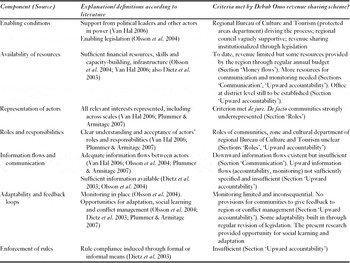
Several such evaluation frameworks exist (Dietz et al. Reference Dietz, Ostrom and Stern2003; Olsson et al. Reference Olsson, Folke and Hahn2004; Van Hal Reference Van Hal2006; Plummer & Armitage Reference Plummer and Armitage2007), and there are recurrent components within these frameworks (Table 1). While some authors discuss each component in detail (Olsson et al. Reference Olsson, Folke and Hahn2004; Van Hal Reference Van Hal2006), others (Plummer & Armitage Reference Plummer and Armitage2007) are more cursory in their descriptions. Key factors deemed as essential for functioning comanagement include well-developed communication mechanisms between the different actors, as well as provisions for monitoring, feedback and learning (Table 1). All authors concur that availability of resources is a key factor for successful comanagement, but while Olsson et al. (Reference Olsson, Folke and Hahn2004) emphasized the need for financial means, Dietz et al. (Reference Dietz, Ostrom and Stern2003) focused on technological and physical infrastructure, and Van Hal's (Reference Van Hal2006) framework encompassed all of these. All authors stressed the importance of adequate access to information. Scope for learning and adaptation was mentioned by most of the authors (Table 1), but only Olsson et al. (Reference Olsson, Folke and Hahn2004) specifically pointed to the need for monitoring of the resource, ideally carried out by the resource users themselves. Van Hal (Reference Van Hal2006) and Plummer and Armitage (Reference Plummer and Armitage2007) addressed the importance of adequate representation of all relevant actors and clarity in roles and responsibilities, although only Dietz et al. (Reference Dietz, Ostrom and Stern2003) mentioned the need for effective enforcement of rules.
Recurring key components of evaluation frameworks for (adaptive) comanagement, and degree to which evaluation criteria were met in the revenue-sharing scheme of Debub Omo.

Ostrom's (Reference Ostrom2000) design principles for sustainable self-organized resource regimes incorporate similar factors; however, these design principles focus on collective action by resource users as opposed to comanagement, which also involves governmental actors, and are thus less relevant to the present context.
Our study set out to examine the governance of revenue sharing in Southern Nations, Nationalities and Peoples Regional State (hereafter Southern Nations), one of the nine regions that together form the Federal Democratic Republic of Ethiopia. While federal legislation provides a broad framework for the sharing of revenues from wildlife-related tourism to local communities, revenues are usually held by regional governments and disbursed to communities only in an ad hoc and irregular fashion if at all, whereby regional actors maintain full decision-making power. Plans to devolve this power and to create transparent rules and regulations for revenue sharing exist in several regions; however, only the government of Southern Nations has so far developed and implemented such a scheme, and is thus the first in Ethiopia to trial such approaches. Well developed community-based approaches to the conservation of non-wildlife resources, such as forests and grasslands, also exist elsewhere in the country (for example Ashenafi & Leader-Williams Reference Ashenafi and Leader-Williams2005), usually institutionalized as community conservation areas or participatory forest management programmes. Due to wildlife mobility, wildlife management poses additional challenges, as population changes are difficult to monitor and causally explain. We focus here on governance of wildlife resources where there is a significant role of the (regional) government.
Regional legislation for revenue sharing from tourism, hunting and other wildlife uses was passed in 2007. So far, it has only been implemented in the area that because of its cultural and biological diversity currently attracts most visitors, namely Debub (i.e. south) Omo. While Debub Omo has a national park, two controlled hunting areas and two wildlife reserves, the main interest of foreign tourists is to experience its cultures, such as the Mursi and Hamar. Most tourist trips are organized by tour operators. Both cultural and nature-related tourism are regulated by the same regional government body albeit by two separate departments, and both sectors are included in the same legislation. However, to date, revenue sharing is implemented only for income derived from wildlife tourism and hunting.
Rather than assessing impacts of revenue sharing on wildlife or residents’ attitudes and behaviour, an approach that would be premature given the brief period in which the scheme has been active, we aim here to identify local conditions and regional institutions (such as legislation) that shape the success or failure of the revenue sharing scheme. In particular, we address the question how revenue sharing is governed both de jure and de facto, and identify the shortcomings of current legislation and implementation practice.
To do so, we investigate governance processes in a grounded fashion, structuring our analysis according to categories that emerge from the data. We then compare these categories to those included in frameworks for the evaluation of comanagement arrangements.
METHODS
Study area
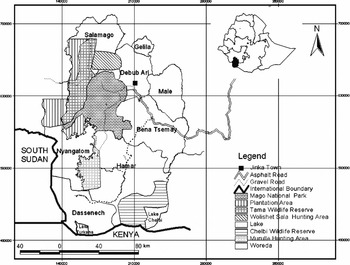
Debub Omo is one of the 14 zones that make up the Southern Nations in southern Ethiopia (Admasu et al. Reference Admasu, Abule and Tessema2010). The zone consists of six districts (woredas) which are divided into 70 communities (kebeles), and borders Kenya to the south and South Sudan to the west (Fig. 1). Debub Omo has an overall human population of c. 560 000 (CSA [Central Statistical Authority] 2007) in 14 different ethnic groups, with an average population density of 24 inhabitants per km2.
Map of Debub Omo zone, showing districts (woredas) and protected areas.

The area can largely be characterized as semi-arid to arid, ranging in altitude from 360 to 3300 m above sea level. In the lower eastern parts of the zone, where the protected areas contributing to the revenue-sharing scheme can be found, livelihoods are mainly agropastoral, with a strong cultural emphasis on the pastoral element; livestock husbandry, especially of cattle, is culturally extremely significant (Gebre Michael et al. Reference Gebre Michael, Hadgu and Ambaye2005).
The zone's protected areas, such as Mago National Park and Murulle Controlled Hunting Area, consist mainly of savannah habitats and are managed by the regional government's Bureau of Culture and Tourism. The protected areas are property of the state, not inhabited by humans, and, according to formal rules, consumptive land uses (such as grazing, hunting or crop cultivation) are not allowed except within controlled hunting areas, where hunting companies obtain the concession to conduct trophy hunting according to quotas set by the federal government. In practice, members of communities living close to protected areas use these for dry season grazing and hunting (Tadie & Fischer Reference Tadie and Fischer2013), which has led to conflicts between these local resource users, district governments, concessionaires and protected area staff.
The Debub Omo revenue-sharing scheme
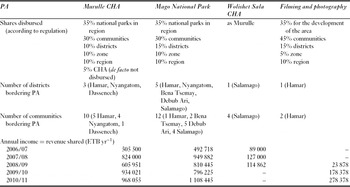
In 2002, the regional government decided to feed revenues from wildlife directly back into conservation and community development activities. In November 2007, these efforts led to the passing of new legislation that stipulates how income from protected areas (including hunting) and other tourist attractions is to be distributed to local communities and protected areas, with the explicit aim to incentivize improvements in wildlife conservation and the tourism sector. According to this regulation (and the accompanying directive), revenue from visitor fees, hunting and filming licences is to be disbursed to all stakeholders (Table 2).
Overview of revenue obtained and disbursed in Debub Omo since inception of the scheme. Allocation of shares depended on the type of PA (compare shares for controlled hunting areas and Mago National Park). Filming/photography took place in a variety of sites, in the present cases mainly outside the PAs. Actual sums disbursed to communities and districts depended on the number of communities and districts adjacent to the PA. CHA = controlled hunting area; PA = protected area. Wolishet Sala was closed as a CHA from 2009 onward. The value of the Ethiopian Birr (ETB) varied between € 1 = 11 ETB (2006) and € 1 = 23.7 ETB (2011) (see URL http://ec.europa.eu/budget/).

Income from three protected areas, plus filming fees, has contributed to the scheme since its inception (Table 2). While the use of one of the sites, Wolishet Sala Controlled Hunting Area, was temporarily discontinued in 2009 due to low wildlife abundance, the scheme was planned to be extended in the near future to include other conservation areas and also sites of cultural interest in Southern Nations that attract sufficient income, for example the Arba Minch crocodile ranch. Inclusion and exclusion of protected areas from the scheme depended on the income that they generated, as it was felt that transaction costs for areas with very few visitors were too high.
Districts adjacent to both the national park and the controlled hunting area received shares of revenues from both protected areas (Table 2). The actual sums disbursed to districts and communities depended on the number of communities bordering the protected area. The money disbursed was additional to the regular budget; protected areas received their annual budget as usual from the regional government, as the revenue retained would not have covered their overall budget needs. The exact sums to be distributed were announced by the regional government at the end of each year. Based on this information, all actors (in practice however only zone and districts) had to submit project proposals to apply for the release of the funds. Districts acted here as representatives of the communities and applied for projects on their behalf, while protected areas received their shares automatically.
Between 2007 and 2011, a total of 8.81 million Ethiopian Birr (c. € 400 000) were distributed by the scheme. While the current scope of the scheme is small, the approach is seen as a model by other regions in Ethiopia that are presently considering adopting similar procedures.
Data collection and analysis
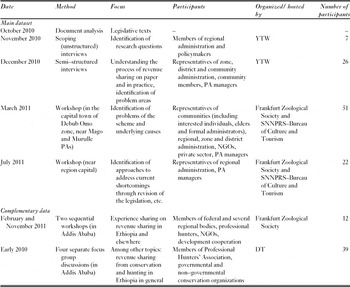
We collected qualitative data using several methods (Table 3). We aimed to examine processes rather than outcomes, and gain in-depth understanding of those issues that participants perceived as most relevant for the governance of the revenue sharing scheme. Most insights presented here are drawn from a set of semi-structured interviews and a two-day workshop specifically focused on the process of revenue sharing in Debub Omo, which involved not only staff from the different governmental bodies, but also community members such as elders.
Overview of methods and data sources. PA = protected area; SNNPRS = Southern Nations, Nationalities and Peoples’ Regional State; YTW = Yitbarek Tibebe Weldesemaet; DT = Degu Tadie.

Our selection of interview, workshop and focus group participants aimed to capture diversity (rather than consensus) of views and experiences. We thus contacted potential interviewees from an array of backgrounds as wide as possible, as long as these had (or were supposed to have had) some involvement in the revenue sharing scheme. For the scoping interviews (Table 3), we selected those members of the regional Bureau of Culture and Tourism who had been involved in the design of the legislation, and members of other regional bureaus, who had been part of the committee that passed the regulation.
Semi-structured interviews were then held with the head of the Bureau of Culture and Tourism at the zone level, those district officials administering the revenue scheme, the administrators of communities supposed to have received shares so far, one additional elder per community (usually suggested by the administrator), and protected area (PA) managers both from those PAs that financially contributed to the scheme and those that, so far, only received shares from revenues collected elsewhere. The first workshop consisted of representatives from the same offices as contacted in the interviews, as well as two to three members of each community supposed to have received shares (contacted through the district offices). The second workshop included PA managers and additional members of the regional Bureau of Culture and Tourism who were not involved in the previous interviews and the workshop, and was intended to develop concrete and specific approaches to address the shortcomings of the scheme identified in the previous workshop. Participants were selected by the regional bureau.
As well as providing the data for analysis, the research process served as a basis for the regional government's endeavour to revise and improve legislation and practice of revenue sharing. Other data, for example from workshops and group discussions at national level, complemented our information base.
Roles were distributed as follows: Yitbarek T.W. conducted all interviews, Yitbarek T.W., D. Tadie and A. Fischer ran the workshops, D. Tadie carried out the focus group discussions, G. Timer provided access to documents and background information, Yitbarek T.W. and D. Tadie recorded, transcribed and translated recorded information into english, and Yitbarek T.W. and A. Fischer carried out data analysis and write-up.
We employed a grounded and iterative-inductive approach to gather and analyse our data (O'Reilly Reference O'Reilly2005). We began with a broad research question, and allowed our study to develop its focus over time, rather than rigidly sticking to preconceived hypotheses. Preliminary analyses were conducted after each step of data collection. Throughout several rounds of iterative coding, we found that the issues brought up in interviews and workshops fell into four broad categories: (1) roles and responsibilities of the different actors are imbalanced and diverge in theory and practice, (2) information flows and communication are insufficient, (3) accountability is compromised, and (4) the disbursement of the funds does not foster conservation. Rather than constitute strictly defined, mutually exclusive categories, we used these four categories to organize the wealth of observations and views expressed in our interviews and workshops in a meaningful way. The thematic cluster ‘roles and responsibilities’ included references to the legislative endowment and actual empowerment of different actors to play an active part in the revenue sharing scheme. While observations categorized as ‘communication’ related mainly to communication from higher governmental levels to the lower levels and communities on the nature and conditions of the scheme, the category ‘accountability’ subsumed data on information flows from the lower levels, such as financial and technical reporting from communities, to districts and higher governmental levels. ‘Disbursement of revenue’ encompassed comments on the nature of money flows and their implications in the context of the scheme. Each of these categories was defined using the data, namely the observations and views expressed by our study participants (rather than theoretical considerations). In the last step of the analysis, we compared these factors to those identified in the literature on comanagement (Table 1) and related subjects.
RESULTS
Roles and responsibilities
The participants generally expressed appreciation for the scheme and its potential. They valued the opportunity to provide feedback through the interviews and workshops with a view to improving the scheme. Two main areas of concern emerged from the interviews and workshops in relation to the actors’ different roles and responsibilities in the revenue—sharing scheme: theory and practice diverged, and responsibilities and thus power were unequally distributed.
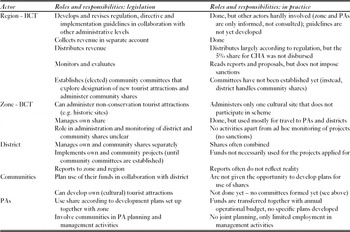
Discrepancies between roles and responsibilities de jure and de facto were seen by many participants as early problems of this scheme (Table 4). Issues such as community committees (as demanded by the directive) not having yet been established were often pointed out as areas for future improvement. Legislative texts provided ample scope for an extension of the scheme beyond regionally managed conservation areas to include cultural sites managed by the zone or communities, but despite the promising potential revenue from cultural tourism, hardly any such options had been used to date. Some aspects, such as the degree to which legislation and guidelines were to be developed in collaboration between regional and other actors, were left relatively vague in the legislative texts. This led to a wide array of interpretations, even among the staff of the regional Bureau of Culture and Tourism.
Roles and responsibilities within the revenue-sharing scheme, comparing legislation and practical implementation. PA = protected area, CHA = Controlled Hunting Area, BCT = Bureau of Culture and Tourism. Legislation includes Southern Nations, Nationalities and People's Regional State Payment Regulation for visiting tourist attractions No. 65/2000 (November 2007) and Tourist attraction sites revenue collection and sharing utilisation implementation directive (July 2008).

Interviews and workshops suggested that regional and district authorities were the most influential actors in the current implementation of the scheme (Table 5). As an active role and greater responsibilities in revenue sharing were generally associated with greater influence on how the money was used, a stronger role was seen to encompass greater power. While the legislative texts foresaw a strong role for communities to collaborate with the districts in the allocation of the funds, communities in practice had little or no say (Table 5). This was due to a number of factors. Communities had no institutional capability to administer their own budget; they were not formally registered as community-based organizations (CBOs), in Ethiopia a legal precondition to receive and handle funds. Obstacles to formal registration of CBOs included, for example, lack of knowledge and capacity in setting up and managing such an organization. This required the district offices to manage funds on the communities’ behalf, and effectively allowed districts to take charge of their communities’ shares, and to involve or exclude community actors as they saw fit. Committees of community representatives that could give communities a stronger voice (and as CBOs also administer their own funds) had not yet been established (Table 4), and districts were accountable to neither zone nor region, leaving them free rein over the identification of beneficiary communities and the disbursed revenue. In addition, the zone's role was not clearly defined, which resulted in it scarcely playing any active role in the scheme (Table 5).
Weight of the de facto role of actors in different components of the revenue-sharing scheme, as identified through semi-structured interviews and a workshop with participants from all levels. Qualitative information translated into approximate weights (from none to high) by the authors (Yitbarek T.W. and A. Fischer). PA = protected area.

Money flows: disbursement of the revenue
While the collection of the revenue went as planned through a separate account held by the region, two major points of critique with regard to revenue distribution were repeatedly raised in our conversations.
First, the overall amount of revenue available was considered as very limited. In most districts, communities would receive funds only on a rotational basis, as the amount disbursed per year would otherwise be too little to allow any meaningful use. Similarly, as the district's share was seen as too small, it was often combined with the communities’ share, and then either used in the district town (for example to build a small museum for tourists) or for small projects at the community level. However, to avoid entering any debate with communities about the appropriate use of the shares, three districts had, in some years, simply included the community share in their own administrative budget without consultation, and not funded any specific projects. By contrast, the example of Debub Ari district, which had used its shares to construct and furnish a school, was seen as positive. Much of the discussion at the workshops consequently revolved around options to increase the revenue from protected areas.
Second, interviewees and workshop participants, including both government staff and community members, were critical of the fact that neither disbursement nor use of the revenue was explicitly related to conservation activities. This critique had two sides. On the one hand, it was repeatedly emphasized in workshops and focus group discussions that recipients had to be able to associate the revenue clearly to its source (namely wildlife-related tourism) in order for it to have the intended incentivizing effects. Study participants saw the objectives of the scheme not only as helping to manage protected areas collaboratively (outbreak group at workshop in zonal capital) and reducing negative impacts of local communities on protected areas (district administrator), but also as communicating the value of wildlife more widely at a political level. However, for most communities, the reason for the scheme-funded activities of the district (such as the provision of a maize-grinding mill) was entirely unclear. Even protected area managers were unaware of the amount of revenue they received. Shares of the revenue were distributed both to those protected areas that contributed their income to the scheme (namely Mago) and those that did not (namely other regionally managed national parks in Southern Nations). As these funds were transferred together with their annual operational budget, their provenance remained obscure, and thus did not have any motivational effects on protected area managers.
On the other hand, not only the receipt of the funds, but also their use was required to be conservation-related. However, informants from the regional government indicated that project proposals from districts and zones were not reviewed with regard to their conservation relevance. Participants from zone and district levels consequently reported that funds were being used for generic administrative purposes (such as office equipment) or road construction.
Information flows: communication between actors
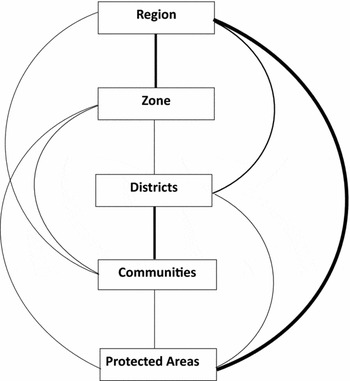
While interview and workshop participants largely concurred that the revenue-sharing scheme was, in principle, to be welcomed, most of the community representatives only became aware of the scheme as a result of the workshop and interviews. Information flows and communication between actors were thus identified as one of the main areas for future improvement. In particular, while communication between the regional Bureau of Culture and Tourism and protected area managers was seen as sufficiently frequent, the interviewees felt that the region had not provided enough information to the other actors (Fig. 2).
Communication links among actors concerning the revenue-sharing scheme. Thickness of lines reflects the perceived frequency of communication between actors. Based on data from semi-structured interviews (n = 26), complemented by further information gleaned from the first workshop (n = 51).

Perceptions about what was good communication diverged. Whilst the region had made efforts to reach the zone and all districts involved, community representatives felt either uninformed or confused, and the zone and district representatives’ understanding of the scheme appeared rather inconsistent. This may be for a number of reasons. First, the region had not invested enough time in training zone and district administrators in the implementation of the scheme. Consequently, zone and district representatives, being insufficiently informed themselves, had created misunderstandings at the community level. Second, while some communities had been informed of their role in the scheme by their district through general political community meetings, this information had seemingly often got lost among the many issues raised at such meetings. In some cases, districts also were seen to have used information about the scheme strategically, for example, as part of individual politicians’ election campaigns, to foster their own political interests. Third, because from the communities’ perspective no action had followed the information campaign, some communities had forgotten about the scheme in the meantime. Fourth, several interviewees from the communities observed that one-off communication was usually insufficient, as only information that emerged from long-term relationships was absorbed: ‘If there really is money for us, I think they should ask us what to do with it, and tell us that many times because we are pastoralists who tend to forget about such things‘ (community administrator near Murulle).
However, the biggest need for improvements in communication appeared to be between actors representing districts and communities. Despite their spatial proximity, information flows between the two actors did not seem to suffice; several community representatives had heard of the projects that were to be implemented from their share of the revenue, but had not been consulted (let alone involved in the development of proposals) or updated on their progress. Consequently, they felt their needs were misunderstood or misrepresented, and that the announced (but often not yet implemented) projects were not to their benefit. The following statement was a typical response to our question concerning whether a community knew what had been done with their share: ‘You better ask this question to those district tourism guys who told us: ‘We are about to buy you boats’ which we can't eat or drink; as if the river was our biggest problem’ (community administrator from Dassenech district).
Community members were largely disillusioned with the idea of revenue sharing: ‘We were kids when N. [the hunting concessionaire] came here. Our fathers gave it [the land] to him. Look, now I grew and got a child and she is now grown up but we didn't get a single thing in terms of development or money. Last time six people from Awassa [the regional capital] came here and the person from the hunting area was also here. They asked me what we wanted and we gave them our answers. We requested a water pump, health centre and a school. We told them and then they went but never came back’ (community member near Murulle).
Information flows: upward accountability
A further cluster of comments from our study participants referred to the upward accountability of actors in the scheme, here understood as the revenue recipients’ responsibilities in terms of reporting and answerability to higher administrative levels. Study participants particularly emphasized the role of reporting and monitoring of the way the revenue was used. While there was, in principle, a very clear hierarchical framework that included actors from local to the regional level (Fig. 2), the accountability of these actors was less well defined. Information on the scheme was supposed to flow from region via zone and districts to the communities, through awareness campaigns, workshops, meetings and official letters. As stipulated by the legislation, pathways for information flows in the reverse direction from the communities to governmental bodies consisted of the project applications and formal activity reports that districts and zones submitted to the region. However, as no clear provisions existed for direct monitoring and enforcement of project and other agreements, misreporting could often remain undetected or, even where identified, would not be followed up. Communities saw themselves as unable to communicate directly with the zone or region where they felt that the district had not used the funds appropriately. In a way, reporting and monitoring (that is, upward information flows on the spending of the revenue) were here portrayed as a necessary precondition for an enforcement of the appropriate implementation of the revenue-sharing scheme, but it was also observed that even where this information existed, legislation did not enable higher level bodies to take action, that is, effective enforcement was not possible.
This lack of capacity to enforce agreements under the revenue-sharing scheme was largely due to the position of the district office. As this office was not answerable to the Bureau of Culture and Tourism at the zone or regional level, but part of a completely separate (namely political) reporting line, regional actors were not in a position to hold the district office accountable. Consequently, one of the key suggestions voiced at our workshops was for the creation of a district office that would report directly to the Bureau of Culture and Tourism.
The reason why, to date, revenue from cultural tourism had not been included in the scheme was also related to accountability reasons. As the Bureau of Culture and Tourism had two departments, one chiefly responsible for protected areas and the other for cultural affairs, but legislative texts were ambiguous about the exact role of the department of cultural affairs, the scheme had simply not been implemented with regard to the (substantial) revenue from cultural tourism.
However, one aspect that was largely evaluated as positive was the inclusion of the fee structure in the regulation, detailing, for example, entrance fees and licences for photography. While this had the disadvantage that fees had to be passed by a regional parliamentary act and could thus not easily be adapted to reflect inflation or changing market conditions, it ensured transparency and helped to avoid corruption.
DISCUSSION
In Debub Omo, the main factors that seemed to hamper the success of the revenue-sharing scheme were connected to (1) the distribution of roles and responsibilities, (2) the practice of revenue disbursement and availability of resources, (3) communication and information, and (4) upward accountability. These factors strongly resonate with those recurrently proposed in the literature as key elements of successful comanagement arrangements, and most of our findings can be mapped against these criteria (Table 1). The idea of accountability seemed to be much more strongly and explicitly mentioned in our conversations than in frameworks for comanagement, where aspects of accountability are touched upon under various headings, but do not appear to be given major space. In the literature on related topics, such as decentralization and local governance, upward accountability (the aspect of accountability that was emphasized in our data) is understood as the ‘institutionalized practice of account giving’ by lower- to higher-level governmental bodies (World Bank 2009, p. 6) or as higher level counter power to lower level activities (Agrawal & Ribot Reference Agrawal and Ribot1999). However, the decentralization literature tends to focus on downward accountability to the constituency, as it is assumed that ‘decentralization typically implies some reduction in the accountability of sub-national governments to the central government’ (namely upward accountability; Smoke Reference Smoke2003, p. 11). As a counterweight, downward accountability thus has to be increased (Smoke Reference Smoke2003). By contrast, our participants seemed to argue that, in the context of revenue sharing, in spite of the concession of power and money to the district level, upward accountability should be strengthened rather than reduced. In their view, effective mechanisms for reporting and monitoring of revenue spending were an essential first step to achieve this accountability.
By comparison, the availability of funds to manage the scheme (Table 1) was not often mentioned in our conversations, but plays a relatively important role in comanagement frameworks. While participants were critical that not enough effort had been spent on communication between the regional bureau and other actors, financial and staff implications of a more thorough approach to communication were hardly addressed. The fact that limited resources were invested in awareness raising and empowerment of communities ultimately seemed to cause a fallback to a classical hierarchical approach to the management of the revenue from conservation, which kept the power in the hands of governmental actors.
In comparison to previous research on revenue sharing (Gibson & Marks Reference Gibson and Marks1995, Archabald & Naughton-Treves Reference Archabald and Naughton-Treves2001), our study participants also gave relatively little attention to distributional issues and the selection of target communities. This might have been due to the general frustration and lack of wider awareness among community members, and the fact that the scheme had only been introduced relatively recently. On the positive side, thus far the Debub Omo scheme did not have to struggle with the funding cuts and institutional volatility that Archabald and Naughton-Treves (Reference Archabald and Naughton-Treves2001) reported for several East African countries, where governmental agencies kept larger shares than initially agreed for themselves to plug their own income gaps. The approach chosen in Southern Nations allowed the scheme to retain its revenue over and above the bureau's regular annual budget, rather than replacing its budget by its revenue and thus making the scheme vulnerable to changes in tourist numbers and inflation. This advantage notwithstanding, a major shortcoming of the current scheme in Debub Omo lay in its limited income base.
Conversely, one criterion that is not mentioned in existing frameworks for comanagement (because in standard comanagement approaches, management of the natural resource and revenue sharing are usually inherently linked), but that our participants saw as crucial for meaningful revenue sharing from wildlife-related tourism, was the awareness of the connection between the revenue and its source, in order to incentivize behaviours that promoted wildlife and conservation. We conclude that institutional setups such as that in Debub Omo, which strictly separate wildlife management and distribution of the resulting benefits, require extra efforts to make the links between behaviours, resource and revenue explicit to all participants in the scheme.
However, the Debub Omo case also raises a question about the degree to which a scheme that concentrates only on the sharing of revenues, and excludes the comanagement of the natural resources, is likely to be successful at all. While neither the regulation nor the directive specified this explicitly, there was an implicit expectation that communities who received benefits from wildlife-related tourism would, at least in the longer run, not poach or use protected areas for livestock grazing. However, these activities are currently common practice in Debub Omo (Tadie and Fischer Reference Tadie and Fischer2013), illegal hunting being largely undertaken by members of local communities (Lowassa et al. Reference Lowassa, Tadie and Fischer2012) without connection to wider (urban) markets; the disbursement of revenue to particular communities, although in principle a promising tool, is completely decoupled from their behaviour and thus ineffective. Clearly communicated links between resource use and revenue obtained seem an essential precondition if the sharing of revenue is to act as an incentive.
In addition, annual revenue is not only dependent on the attractiveness of a site, but also on a multitude of other factors outwith the control of local residents (such as economic and political crises; Archabald & Naughton-Treves Reference Archabald and Naughton-Treves2001). Even if the source of the funds was more clearly communicated to the recipients and communities had more power over the use of their funds, the feedback between personal resource-use behaviour and the revenue obtained would thus be tenuous at best.
The focus on revenue (as opposed to joint wildlife management more generally) also gives rise to concerns, expressed by several of our focus group participants, about a potential crowding out of other non-monetary motivations for wildlife conservation, which could stem from the growing awareness that current resource-use practices lead to the depletion of wildlife and pasture, and hence to the disappearance of these vital resources (Tadie and Fischer Reference Tadie and Fischer2013). Direct incentives (such as payments) for pro-conservation behaviours have often proved ineffective once they are withdrawn (Hellin & Schrader Reference Hellin and Schrader2003), making conservation dependent on the continued provision of direct benefits, rather than building on more intrinsic behavioural change. We may thus speculate over the degree to which the Debub Omo scheme can be seen as a step towards ‘community conservation’, or if it can be better understood as an extension of the traditional idea of ‘fortress’ conservation which essentially attempts to retain power in the hands of the government (or conservation actors) by paying local residents so that they forsake their claims (Benjaminsen & Svarstad Reference Benjaminsen and Svarstad2010). At present, we note that protected areas in South Omo do not follow the fortress conservation approach, but are, based on implicit consent by the district government, used extensively by local residents for grazing at the end of the dry season, while in practice, illegal hunting in the protected areas cannot be prevented by government and park staff.
However, comanagement is a process rather than a state (Carlsson & Berkes Reference Carlsson and Berkes2005). Our research process contributed to the development of ideas for the upcoming revision of the legislation and implementation practice, and the adaptive capacity of the scheme (Folke et al. Reference Folke, Carpenter, Elmqvist, Gunderson, Holling and Walker2002) may enable the incorporation of currently neglected elements of comanagement fostering a joint approach to the management of wildlife and protected areas.
More importantly, similar schemes might be used to increase the weight of conservation interests in political decision-making. Currently, protected areas in Southern Nations and in Ethiopia more generally, as elsewhere across the globe, appear to be under high political pressure. Large-scale agriculture, often conducted by foreign investors, is given priority over nature conservation because of its seemingly high economic benefits. In some places, parts of previously protected areas are thus leased out for agricultural plantations. A revenue-sharing scheme like the one in Debub Omo can be (and has been) used to substantiate the argument that wildlife areas can also contribute to development objectives. However, as some of our focus group participants cautioned, monetary benefits from conservation are likely to always be small compared to the profit made by agricultural enterprises. A focus solely on revenue from hunting and other wildlife tourism might thus not stand up against other economic interests. However, taking into account not only monetary benefits, but also other ecosystem services provided by protected areas might tip the balance in favour of conservation.
CONCLUSIONS
With its focus on the governance of revenue sharing, this study addressed a gap in the literature and identified governance elements that need to be considered to make benefit-sharing work. Our analysis also provides a more nuanced picture of the relationships between comanagement and revenue sharing than that offered by Nkhata et al. (Reference Nkhata, Mosimane, Downsborough, Breen and Roux2012).
In the Introduction, we argued that benefit sharing could be considered both as an important part of comanagement and subject to the principles of comanagement, even where only the revenue but not the natural resource itself is being comanaged. Indeed, our analysis suggests that the governance of revenue sharing can be meaningfully evaluated against frameworks proposed for the assessment of comanagement arrangements more generally. Such frameworks could (and possibly should) thus be used more regularly as an instrument to diagnose needs for improvement in the governance of revenue sharing. It also implies that the shortcomings identified in the current version of the Debub Omo scheme are by no means unique, rather they reflect common challenges wherever resources are to be managed in a collaborative way (Prager et al. Reference Prager, Reed and Scott2012). By analysing the Debub Omo scheme against this backdrop, we raise the question whether revenue sharing can ever be an effective instrument for sustainable conservation if power over the management of the natural resource is not shared. However, the real political relevance of the Debub Omo scheme may lie in its potential to make the economic benefits of wildlife visible and tangible.
ACKNOWLEDGEMENTS
We thank Meseret Ademasu of the Southern Nations’ Bureau of Culture and Tourism for his collaboration and support. We are grateful for all participants’ contributions to the interviews and workshops, and for Fetene Hailu's contributions to this study. Katrin Prager, Bill Slee, Camilla Sandström and three anonymous reviewers provided comments on earlier versions of this manuscript. This work was carried out as part of the project ‘HUNT-Hunting for Sustainability’ (http://fp7hunt.net/) and funded by the European Union's Framework Programme 7 and the Frankfurt Zoological Society.