I
The adoption in Latin America of the technological innovations that transformed agriculture in Western Europe and the US in the late nineteenth century remains an under-studied topic. This is the case due to insufficient research on agricultural history in Latin American historiography, and the reiteration in general economic histories of decades-old interpretations emphasising the backwardness of both the agricultural sector and the large estate.Footnote 1 In addition, by and large the specialised literature focuses on the supply side, that is, the growing influx of primarily British and then American machines and implements, paying much less attention to the demand side. However, an examination of the diffusion of modern farming implements, considering both ‘global supply’ and ‘local demand’ as mutually influencing dimensions of that process, would shed new light on the international history of technological innovation in agriculture. Adopting that approach, this article analyses the introduction of farming machinery and the ensuing ‘first wave’ of mechanisation, which developed in the period of export-led growth in Chilean agriculture (c. 1850–90), focusing on the interaction between global suppliers and local consumers of technological innovation. From this perspective, the development of the market for agricultural equipment can be better understood as a rather complex process of technical and cultural exchange. Indeed, that process involved a rich interaction between ‘global merchants’ and diverse local actors. In fact, on the local demand side there were not only a sector of market-responsive or ‘progressive’ landowners, but also institutional and cultural agents, such as agricultural societies, state institutions, specialised magazines, agronomy scientists, and a community of learned agrarian experts and ideologues.
Yet, according to conventional wisdom, Chilean rural society was a paradigmatic case of agricultural backwardness in nineteenth-century Latin America, mainly because large landowners were not interested in modernising their large rural estates (haciendas). The persistence of technological primitivism resulted in the inefficiency of the agricultural sector, and prevented it from supplying food in keeping with the demand from Chile's growing and urbanising population. Furthermore, landowners’ alleged lack of interest in introducing technological innovations was also instrumental in the failure of the ‘early industrialisation’ process, as the supposedly limited demand for agricultural machinery and implements prevented the growth of a capital-goods sector, which, for most scholars of Chile's economic history, could have otherwise provided the basis for ‘self-sustained development’. Thus, in addition to minimising the impact that the expansion of Chile's nitrate-based export economy (c. 1870–1930) had on inducing the modernisation of the agricultural sector, an important implication of the conventional interpretation is the underlying idea that a single economic sector, agriculture, accounts to a great measure for the failure of Chile to achieve higher economic growth.
The introduction of technological innovations in agriculture in the period of export-oriented growth has not, however, been the subject of thorough research in the economic and agrarian history of Chile. Only a few studies have dealt with mechanisation, and the available knowledge rests almost exclusively on anecdotal information. Silvia Hernández's groundbreaking article briefly discussed a number of ‘technological transformations’ in the second half of the nineteenth century, and contended that the introduction of agricultural machines was restricted to a few ‘model estates’. Yet, assuming that official statistical sources were not suitable to estimate machinery imports or stocks, Hernández actually did not establish the trends and pattern of mechanisation.Footnote 2 In his influential study, US historian Arnold J. Bauer agreed on the unsuitability of the statistical sources, and, arguing that labour was abundant and cheap, maintained that, ultimately, landowners did not have incentives, let alone a pressing need, for investing in agricultural machinery. Agricultural mechanisation was late and limited, he added, not only because machinery was expensive, but also because of technical obstacles. Chile did not have draught horses appropriate for pulling machines, which, for instance, inhibited the adoption of reapers. Moreover, having being designed for levelled and clean fields in Western European agriculture, imported machinery was subject to frequent breakdowns on the typically rough Chilean crop fields. Such technical problems were difficult to solve given the lack of a culture of mechanical knowledge in the Chilean countryside.Footnote 3
The traditional view on agricultural mechanisation in Chile is also flawed by its narrow approach. It overlooks the fact that the introduction of machinery was a development of the latter part of the nineteenth century, even in the most technologically advanced rural economies. In England, the much-debated ‘agricultural revolution’ that continued in the nineteenth century rested primarily on organic sources of energy and a limited use of mechanical means of production; the use of seeders became common in the 1850s, and even earlier in the case of threshers, but reapers spread only at the end the nineteenth century.Footnote 4 Further, as historian Ramón Garrabou points out in his pioneering study of mechanisation in nineteenth-century Spain, although the innovations associated with the English ‘Agricultural Revolution’ became a paradigm for those interested in fostering agricultural modernisation, their diffusion in other countries was late and slow.Footnote 5 In addition, although in the US and England tractors began to spread before the First World War, draught animals still provided half of the horsepower in the 1930s.Footnote 6
This article presents an alternative interpretation of mechanisation in Chile during the period of export-led expansion in the agricultural sector. First, it shows that the introduction of agricultural machinery was promoted, and carried out, by a sector of knowledgeable, ‘progressive landowners’, which established a close exchange of ‘practical knowledge’ with the foreign firms that monopolised the importation of farming equipment. That interaction also involved active participation from agrarian experts and institutions, which decisively contributed to the development of a mechanical culture in the countryside, thus facilitating the adoption of the new technology. Secondly, the article also demonstrates that the diffusion of modern agricultural equipment proceeded in a similar manner as in ‘old’ cereal-producing agricultures; therefore, in the late 1870s, the scale and pattern of mechanisation were in line with the international supply of available technological innovation. The experimental importation of agricultural machinery in the 1840s built up into a first wave of mechanisation during the ‘export booms’ of the 1850–90 period, when Chile exported wheat first to California, then to Australia and, finally and more substantially, to England. As landowners needed to solve recurring labour shortages during the harvest seasons, the use of machines increased on properties in which the area under cultivation was considerable, and in the most labour-demanding operations, above all, the harvest of wheat. In the third place, the article also establishes that mechanisation was consequential, for the area mechanically harvested was much larger than previous estimations. In 1874, at least 25 per cent of the wheat was reaped by machine, and 30 per cent mechanically threshed. Agricultural mechanisation was, then, a crucial element of the first phase of the capitalist transition of the Chilean large estate.Footnote 7 That was certainly a long-term process, which, it must be noted, was completed in the late twentieth century by the state through a conflict-ridden agrarian reform (1964–75).Footnote 8
II
The beginnings of agricultural mechanisation in Chile go back as early as the 1840s. The French naturalist Claude Gay's Agricultura Chilena, a valuable introduction to the rural history of modern Chile and published in Paris from 1862 to 1865, provided the first systematic discussion of farming implements.Footnote 9 Gay conducted field research in the 1830s and 1840s, combining meticulous descriptions of the Chilean countryside with comparative considerations informed by his knowledge of rural France and, more generally, of European estate agriculture. Against that background, he pointed out the primitive character of the agricultural implements and the delay in the introduction of modern equipment. Yet, unlike latter-day commentators, Gay attributed technological backwardness not to landowners’ lack of interest, since some had in fact purchased imported machines, but mainly to the lack of incentives for modernisation, as agriculture lacked markets. Additionally, Gay pointed to the lack of skilled workers and the irregularity of the fields in the Chilean countryside as important obstacles to mechanisation.Footnote 10
Significantly, however, Claude Gay also commented on the earliest development of agricultural mechanisation, noting the interaction between some landowners pioneering the introduction of machinery and the importers. In the first place, ‘wealthy landowners’ began introducing iron ploughs and machines ‘in spite of the high prices of the initial purchase’. The hacendado José Vargas, for instance, travelled to the United States ‘with the sole purpose of ordering modern ploughs, and brought into Chile four horse-driven threshing machines’; landowners Larraín y Gandarillas carried out ‘the latest harvest with reaping machines’, and Manuel Beaucheff ‘introduced a costly steam-powered thresher’.Footnote 11 Although exceptional in the context of Chile's rural society, those initiatives were important precisely because of their pioneering character. Second, as more landowners became interested in modern agricultural equipment, the adoption of machinery extended beyond the rural districts close to Santiago and reached other areas of the country. Thus, while ‘the system of reaping by machine ha[d] reached the plains of the Maule River’, the province of Concepción distinguished itself ‘by the hundreds of foreign ploughs’ and ‘even the most complex instruments, such as threshing machines, winnowers and cleaners’.Footnote 12 Furthermore, individual efforts at introducing modern machinery were followed by those of both public institutions and businesses. The government commissioned the directors of Santiago's School of Crafts and Arts (Escuela de Artes y Oficios) to establish machine shops in Concepción, and ‘important foreign manufacturers such as Clayton & Shuttleworth of England and Pitts from the United States opened warehouses in the largest cities of the Republic’. As another expression of the growing interest in machinery, in April 1857 over one hundred landowners gathered at Santiago's agricultural experiment station (Quinta Normal de Agricultura), to attend a test of a Pitts thresher powered by four teams of oxen, after which the eleven machines brought by the American manufacturer's son were sold.Footnote 13 In light of these cases, Claude Gay enthusiastically concluded, ‘in Chile, like in more civilized countries, machines begin to transform the agricultural conditions of every province and to substitute manpower with mechanical devices.’Footnote 14 In fact, as the steam engine rapidly displaced animal sources of power, the introduction of modern agricultural equipment increased after the 1850s, along with the economic expansion and modernisation that Chile experienced with its integration into the world market as a primary exporter.
III
The importation and diffusion of modern agricultural equipment was to a large extent related to the expansion of foreign commercial firms in the Chilean economy. As in other countries in nineteenth-century Latin America, in Chile the ‘commission houses’ dominated the supply of modern capital goods and, therefore, the introduction of agricultural machinery. The most important companies were owned by members of the powerful British community in Valparaíso, Chile's main port and a leading commercial centre on the West Coast of South America. From that privileged entrepôt, influential companies such as Clark & Co., Duncan, Fox & Co., Williamson, Balfour & Co., F. Huth, Grüning & Co., William Gibbs & Co., Rose Innes & Co., dominated the import-export commerce between Chile and a number of nations among which Britain was by far the leading trading partner. Imports consisted of a large variety of manufactured goods, from railway equipment and hardware to luxury items. In return, and usually on a consignment basis, these companies handled the shipping, insurance, and selling of such export goods as metals, namely silver and copper, and agricultural products.Footnote 15
Although the commission houses concentrated on investing in the mining industry, they also played an active role in the creation of a market for machines, instruments, and tools in the agricultural sector. In doing so, they established a close relationship with the landowning elite, and thus created a social and cultural context conducive to the marketing of agricultural equipment, and attained a great deal of influence in economic policymaking. The importers’ most effective instruments to develop an agricultural capital goods market were agricultural exhibitions and advertising. In a time when the advantages of modern agricultural technology were not self-evident, displays, tests, and publicity played the important role of informing landowners of the latest innovations available.
Furthermore, the commission houses developed a market for agricultural equipment by directly participating in the activities carried on by the National Agricultural Society (SNA). Founded in 1869 by a sector of self-called ‘progressive agriculturalists’, from the beginning the SNA cultivated a close relationship with the foreign commercial firms. The case of Rose Innes & Co., one the largest companies doing business in Chile, is illustrative of this involvement. In 1869 Rose Innes & Co. was listed among the initial membership of the SNA, and had collaborated with that organisation in a number of initiatives aimed at promoting the use of agricultural machinery.Footnote 16 One such occasion was the organisation of the International Exhibition, held in Santiago in 1875. According to the SNA's bulletin, among the importing houses contacted by the SNA, Rose Innes & Co. demonstrated a special interest in ‘promoting our great exhibition beyond what might be expected’. One of the firm's agents, Ramón Cruz Montt, himself a prominent landowner, interviewed with SNA's board of directors, stated that the company ‘would not hesitate to invest large sums nor save any effort to start an active campaign to promote the Exhibition’. Thus, Mr Cruz noted that the firm had decided to distribute ‘not hundreds but thousands of copies of the exhibition program by all the house's agents in both the Old and New World’. Cruz stressed that, to further publicise the exhibition, George Rose Innes, the company's proprietor, wrote in London a pamphlet that was ‘laudatory to his adoptive fatherland’, and ‘widely circulated in the main financial and commercial centers to make known our past, present and future’.Footnote 17
At the exhibition itself, Rose Innes & Co. certainly demonstrated a ‘special interest’ in stimulating the demand for agricultural machinery. This firm built an impressive eight thousand-square feet pavilion, which ‘not only displayed the best of its vast warehouses of Valparaíso’, but also ‘the new equipment it has ordered especially from England’. The display, which was detailed in a 375-page catalogue, included ‘threshers by such manufactures as Clayton, York, and Pitt; reapers by Wood, Buckeye, and Governor’; several kinds of ploughs, harrows, winnowers, balers, mills, carts, as well as numerous instruments and tools. Impressed by the collection, a columnist of El Correo de la Exposición attributed to the work of Rose Innes & Co. ‘the steady introduction of agricultural machinery that in the course of a few years has changed the aspect and production of our countryside’.Footnote 18 Although exaggerated, this description regarding the spread of new agricultural technology indicates the role of the commission houses.
The foreign merchants of the commission houses integrated prominent landowners into their businesses and, in doing so, created yet another kind of relationship with the Chilean landed oligarchy. This further helped them conduct business in a social milieu where landownership had been more closely associated with social prestige and pseudo-aristocratic values than with entrepreneurial skills. An example of these connections is provided by later developments in the relationship between Ramón Cruz Montt and Rose Innes & Co. In 1881, in what seems a culmination of his career at that firm, Cruz became a member of the board of directors and, shortly after, purchased 140 shares of the Banco Nacional de Chile, by then the largest in the country, of which Rose Innes & Co. owned another 153 shares.Footnote 19 The Banco Nacional de Chile was founded in Valparaíso in 1865 by issuing 2,240 shares, and George Rose Innes was his first president. John Mayo notes that by raising loans in England for the Chilean government and making them domestic loans, it became in practice the government's bank.Footnote 20
Another important aspect of the expansion of the commission houses that facilitated the import of agricultural equipment was their direct interaction with Chilean landowners. These contacts took place at the branch offices that the importers established in the most important provincial cities. These were often not mere warehouses but well-equipped shops that provided technical assistance, repaired broken equipment, and supplied spare parts. According to Claude Gay, in the late 1850s manufacturers such as Clayton, Shuttleworth, and Pitts opened some shops, while another company, ‘the house of André Brown’, even brought in to Santiago ‘competent workers to set up the machinery, repair, and teach how to use it’.Footnote 21 Communication between importers of machinery and landowners interested in trying the new equipment allowed for an exchange of information and expertise on the use of mechanical technology that proved decisive to the progress of agricultural mechanisation. One the one hand, competition among the commission houses made available a variety of makes and models manufactured in several countries, United States, Britain, France and, later in the nineteenth century, Germany and Belgium, where different farming practices and histories had called for specially designed agricultural instruments. Also, some landowners proved to be useful in the spread of machinery because of their technical and practical knowledge. In an illustrative example of the kind of exchange between machinery dealers and their customers, Samuel Izquierdo, a hacendado in Rancagua, wrote to Clark & Co., which distributed The Champion, a reaper manufactured by Whiteley, Fassler & Kelly, that:
The machine reaps with the same perfection both on thick and thin stands of wheat, even on the slopes . . . it has a useful mechanism that allows it to cut bent wheat in a perfect manner. It is sturdy and light [and] at the oxen's pace it reaps admirably well [because] it is mounted on two wheels that make it suitable to reap hills, and a wheel which supports the platform and speeds up its operation. It is my opinion that, out of the several models I have seen at work so far, this is the most convenient reaper for our fields, and I will be pleased to recommend it.Footnote 22
Mechanisation was Chilean landowners’ response to labour-supply issues. The agricultural sector experienced a sequence of wheat export booms to California, Australia, and England, roughly between 1850 and 1890.Footnote 23 However, landowners expanded wheat production while facing a growing emigration of rural labourers. Most of them were landless peons, with no family ties that would prevent them from wandering around for the allure of better wages. Reaching massive proportions from the late 1860s, the ‘rural exodus’, as some called it, was also related to the expansion of railroads and public works, which provided alternative sources of employment, especially in the summer, when the harvests were carried out. As a result, the workers who remained in the countryside had more bargaining power to push for higher wages, at least during the harvests. Julio Menadier, the knowledgeable editor of the SNA's bulletin, discussed this situation regarding the province of Ñuble, where the construction of a railroad from Chillán to the port of Talcahuano had become an important employment alternative to hacienda agriculture. Using data from a report by the Ministry of Interior, he observed that the number of workers employed in the construction of the railroad increased from 3,600 in March to 8,379 in November, but then it declined rapidly, when the demand for labour began to increase in the agricultural sector. Menadier also noted that landowners paid higher wages to recruit workers. As Menadier commented, ‘be it that they did not want to take away more hands from the pressing works of the harvest or that it was not convenient for the railroad contractor to pay the increased wages offered by landowners’, the case was that the latter ‘have not hesitated to pay highly increased wages (‘salarios muy subidos’) hoping to compensate for the higher cost of production with reduced trasportation costs’ once the railroad became operative. Menadier did not include any data on peon wages, but suggested that they could reach 40 and even 50 cents, which, he added, hacendados could afford because of the still ‘highly remunerative’ wheat prices at the European markets. Writing in late February 1872, Menadier estimated that wheat exports from the Ñuble would reach at least 600,000 fanegas (429,000 metric quintals). He complained that the harvest was so delayed because of the shortage of hands that, he suggested, landowners ought to rent steamers instead of vessels, and ship their wheat to Rotterdam and Antwerp, ‘where the price of a fanega is usually 8 to 25 cents higher than in Liverpool’. Footnote 24 In short, by taking advantage of the seasonal character of the demand for labour, rural workers managed to get higher wages.
A number of contemporary Chilean analysts of rural society commented on, and some were alarmed by, the rise of rural peon wages. The matter prompted an unprecedented debate about the causes of the rural migration, and some social critics even denounced the oppressive nature of the large estate. It was also discussed profusely in the main newspapers. El Independiente, for instance, commented in April 1872 that ‘Everybody is uneasy about the shortage of hands in our countryside. Agriculturists, newspapers, and authorities unanimously voice a chorus of grievances.’ Yet, the newspaper also noted that labour issues had prompted the diffusion of agricultural machinery. Thus, ‘At the present moment’, it remarked, ‘there is only one thing certain: the problems of this year's harvest have been greater than in the previous years, and if it were not for the use of machines it would have not been possible to escape a crisis that seemed inevitable.’Footnote 25 In fact, as the British representative in Santiago observed in 1875, the main reason for the increase in the use of agricultural machines was the seasonal increase of peons’ wages. Although he pointed out that the daily wages of the ‘agricultural labourers’ varied ‘between 25 cents and 40 cents, sometimes rising as high as 50 or falling as low as 10 cents’, the British diplomat categorically remarked that ‘the average of wages has increased considerably of recent years’.Footnote 26 Thus, large landowners’ response to the emerging labour supply issues was agricultural mechanisation.
The rise in wages for harvest tasks made more evident the benefits of mechanisation. Chilean hacendados not only realised that agricultural machinery helped solve labour bottlenecks and reduced the length of the harvest, which they could now carry out before the autumn rains, but also that machines saved them money. In 1873, for instance, SNA president Domingo Bezanilla reported on the results of the test of a Hornsby reaper. The machine could do ‘at least’ 20 tareas in an 11-hour work day, needing only two peons instead of the twenty who were normally required if wheat was cut by hand with the sickle. Considering 50 cents per day for each peon, 50 cents for renting the teams of oxen (three teams were needed for one work day), 1 peso for the machine's depreciation, and 7.21 pesos for loss of grain, the total cost of reaping 40 tareas by machine came to $10.71. By hand, if each peon was paid 55 cents, the cost of reaping was $22, assuming that each man could do only one tarea per day. In light of this, Bezanilla concluded that ‘no other machines are as economical as reapers’. According to his estimates, ‘even considering in the production costs the greater loss that sometimes occurs when using machines, they save 50 per cent in reaping, and 95 per cent of time’.Footnote 27 According to another analyst, over an eighty-day harvest of 430 cuadras, reaping by machine saved $3 per cuadra or $8 per working day.Footnote 28 As these examples suggest, for large hacendados mechanisation had become an economical option, which explains why in the late 1860s Chilean landowners gradually increased the number of agricultural machines, and mechanised primarily the reaping and threshing of cereals.
IV
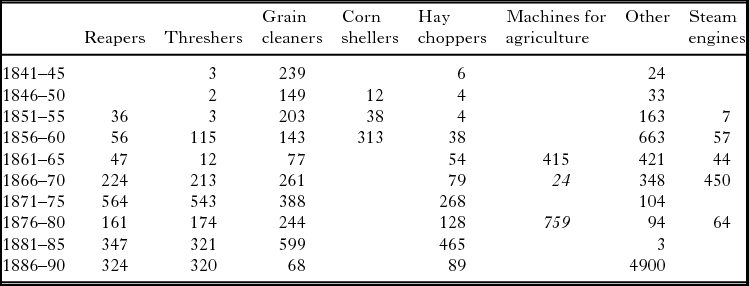
The spread of machines was not only enthusiastically recorded in the pages of the SNA's bulletin, but also acknowledged in a number of sources, from newspapers to agricultural yearbooks. Since the vast majority of the agricultural equipment used in Chile was imported, official commercial statistics are an important source of information about the development of mechanisation. Table 1 shows agricultural machinery imports, which were recorded since 1841 in the Estadística Comercial de la República de Chile.Footnote 29
Agricultural machinery imports in Chile (1841–89).

Note: Italics indicate data for one year only.
Source: Estadística Comercial de la República de Chile.
The demand for wheat in the ‘markets of the Pacific’ set in motion mechanisation, which further developed with the integration of Chilean agriculture into the Atlantic market. Thus, imports grew during the 1850s when Chile simultaneously exported to Peru, California, and Australia, and wheat exports increased from 1,290 metric tons in 1850 to 4,000 metric tons in 1867. The number of reapers and threshers increased in the late 1850s, but before 1868 imports consisted mostly of grain-cleaning and hay-making equipment, that is, mowers, choppers, and hay balers. As wheat exports to England grew, importation of agricultural equipment expanded and diversified. This was especially true after 1869, due to the influence of the National Agricultural Exhibition held in Santiago that year. As the considerable increase in the number of reapers, threshers, and steam engines shows, mechanisation developed more in wheat harvest operations than in any other stage of the production cycle, which indicates that there was a real need for solving labour supply problems. However, the diffusion of modern implements also extended to ploughing and tilling, as indicated by the increase of imports of iron ploughs, cultivators, and seeders. According to Estadística Comercial, 8,829 metal ploughs were imported between 1844 and 1868; after the 1869 Agricultural Exhibition, their number multiplied, as 23,013 were imported between 1869 and 1878.Footnote 30
Imports of agricultural equipment drastically fell in 1876–80, a period when Chilean wheat exports declined sharply, which aggravated the economic crisis of 1874–8, during which the entire export sector collapsed.Footnote 31 While the entrance of new regions drastically increased the world supply and international cereal prices fell, Chilean exports, which had increased from 629,087 metric quintals in 1869 to 1,592,589 metric quintals in 1874, plummeted to only 375,638 qqm. in 1878.Footnote 32 As a result, a significant reduction took place in the importation of wheat harvesting equipment, that is, reapers and threshers. As figures for reapers and threshers indicate, there was a recovery in the first half of the 1880s, which is also observable in imports of grain cleaners and mowers, choppers, and hay balers. According to figures for individual types of machines, imports did not reach the pre-crisis levels; this seems to be rather an indication of the poorer quality of the source than a general decrease in the importation, for in the second half of the 1880s Estadística Comercial recorded much larger numbers of unspecified ‘agricultural machinery in crates’.
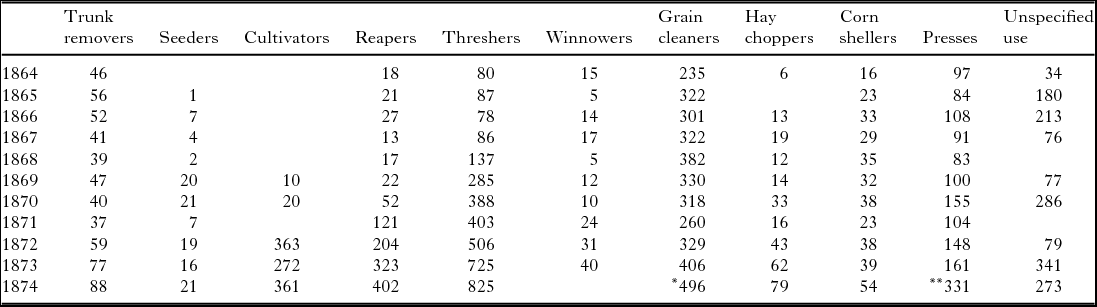
The inclusion in Chile's main statistical yearbook of a section exclusively destined to record agricultural machines is in itself another indication of the development of the process of mechanisation. Machinery stocks were recorded for the first time in 1864, and included in issues of the Anuario Estadístico de la República de Chile until 1874 (Table 2). Unlike importation records in the Estadística Comercial, this stock series is the earliest set of statistical data about machines that, arguably, agriculturists reported as being in use, and provides unique nationwide information. More importantly, the series corresponds with the period of greatest wheat exports, giving us a measure of the impact of the export cycle as a stimulus for agricultural modernisation. There are, however, several inconsistencies between this stock series and that of imports shown in Table 1. The stock series did not include machines that broke and, obviously, those thtat were deliberately not reported by their owners, a well-known problem at the time. As the director of the Statistical Office explains, surveys were conducted by the personnel of municipalities, whose efforts were often met by the agriculturists’ reluctance to provide adequate information because of ‘the unfounded fear of new taxes that is so generally spread among our agricultural classes’.Footnote 33
Stocks of agricultural machinery and implements in Chile, 1864–1874

Notes: * Includes winnowers; ** Includes grape presses.
Source: Anuario Estadístico de la República de Chile, ‘Máquinas al servicio de la agricultura’ (1865–1875).
Agricultural machinery stocks show that the number of most types of machinery increased, especially after the 1869 Agricultural Exposition, and confirm that mechanisation was extending to operations other than harvesting. The number of mechanical implements for tilling increased, further contributing to the introduction of cultivators and seeders. The growing use of tilling implements was related to other developments, namely, the introduction of ‘trunk removers’ (‘destroncadoras’), a rather simple implement that facilitated the functioning of machines that were designed to work on cleared fields, not the rough terrains of nineteenth-century Chile's countryside. Furthermore, some agriculturists even attempted to use steam traction engines for ploughing. In 1869, Nicolás Schuth, a foreigner known for introducing a number of the ‘most perfect’ machines and instruments to his ‘precious property’ in the district of Parral, province of Chillán, tried to introduce the English cable system of ploughing. The system was a John Fowler model with two 10-hp stationary steam engines located 400 yards from each other at opposite sides of the field to be ploughed that alternatively pulled the plough with a steel cable. Breaking ground ‘at a depth of 9 inches and made a one-meter wide furrow’, this plough ‘takes four minutes to complete 400 yards, and, when the cultivator is used, it stirs the soil at a breadth of two yards’. In addition, it was estimated that if the plough ‘worked without interruptions, it would plough one cuadra in three hours and half, or half that time if the cultivator were used’. The plough did not work continuously due to ‘natural obstacles, workers’ lack of experience, and the repairs that any new machine requires’.Footnote 34 Interestingly, this system was tried at the same date in California, but with so little success that The California Farmer wrote that farmers thought they needed ‘an implement that will march over our soil “like a thing of life” and stationary engines will never do it’.Footnote 35 In all, the introduction of tilling implements such as harrows and rakes suggests that at least some landowners did not lack interest in improving the fields. In 1871, Félix Echeverría, a knowledgeable SNA member and prominent landowner in the province of Quillota, in Valparaíso's rich agricultural hinterland, asserted that the seeder was ‘virtually unknown to Chilean agriculturists’, and that ‘disappointing results’ had been obtained with the few machines so far tested. He added that although the cultivator ‘was especially effective as a labour-saving implement’, it could be economically used ‘only on farms where the scale of cultivation was large enough to require that cultural operations were quickly done’. Yet, despite Echeverría's opinion, cultivators considerably multiplied in the following years (see Table 2).
Harvesting implements became more widely used in Chile during the period of export-led agrarian expansion (c. 1850–90). Echeverría estimated that some two hundred reapers had been introduced ‘in the past few years only’, but thought that these were not as many as might be expected. He attributed the delay in the diffusion of reaping machinery to the fact that the rough fields in the Chilean countryside were not appropriate for the proper functioning of those machines; most models, he thought, would need a number of modifications before they could be used more widely. Even so, he observed that ‘no other machine will have a more profound impact than the reaper’, considering that, on average, each machine saved the work of eleven men per cuadra. Thus, Echeverría noted,
The worker will see himself for ever displaced from what is his most beloved activity, for reaping has always been his most remunerative and comfortable job, considering that he works from sunrise to sunset in complete freedom, not having a watching eye spying over him. I confess, with sorrow, that I have heard many of these disgraced men complaining about the jobs that machines take away from them.Footnote 36
Félix Echeverría's expectations were met in the following years. According to data in the Anuario Estadístico, stocks of reapers increased from 121 units in 1871 to 402 in 1874. Since reaping was the most labour-demanding operation, the larger numbers of reapers suggest that an increasing substitution of machines for labourers took place in this short period of time when wheat exports more than doubled. Echeverría estimated that the two hundred reapers he believed were in use in 1871 saved the work of 4,400 men in a two-month harvest season.Footnote 37
Threshing machines also spread through the Chilean countryside in the late 1860s and early 1870s. While the stocks recorded by the Agricultural Statistical Office steadily increased from 137 in 1866 to 825 in 1874, contemporary observers repeatedly pointed out the increase in the number of threshers. Santiago Lindsay, director of the Statistical Office, attributed it to ‘the general conviction that what is most appropriate is to save hands so as to use them in other activities where they are irreplaceable’.Footnote 38 Félix Echeverría explained that ‘despite their high prices’ threshers ‘did a great service to agriculture, by reducing the demand for labourers and the harvest period by more than half of what was needed when threshing with mares’. Thus, he went on to state that ‘the three hundred or so machines that are in use have produced a harvest that would not fall short of one million and a half fanegas, which roughly represents one quarter of the total harvest’.Footnote 39 In 1876, another authoritative observer, José W. Sánchez, a machinist who had graduated from the School of Crafts and Arts, commented that, although threshers of many makes and models existed in the country, the Pitts were the most widely used because of the ‘simplicity and the easiness [with which one can] get and replace any broken part’. That was not the case with the British machines, which yielded very clean grain but had ‘a larger mechanism than the American ones’, and were therefore not affordable by everybody; further, there was ‘little chance to get spare parts’.Footnote 40 In 1875, Lauro Barros, a prominent, knowledgeable landowner and deputy for the rich agricultural department of Melipilla, also enthusiastically evaluated the spread of the threshers. Thus, commenting on the ‘rapid passage’ from the old method of threshing with mares to the mechanical system, he thought that the threshers employed in the harvest of the non-irrigated wheat fields of Melipilla worked ‘as efficiently as those in the United States and England’.Footnote 41 A few years later, in 1878, Barros also noted that ‘in just the 40 years that have passed from the test of the first thresher, agricultural machinery has become so well established that even the rural workers turn their backs on those places where it was not used’. Significantly, another indication of the spread of threshers was the resistance of the workers. As Barros explains,
One the main difficulties that agricultural innovations have faced everywhere has also taken place in Chile, that is, the resistance of rural workers to the introduction of threshing machines. Precisely, because hacendados were beginning to adopt a favorable opinion of threshers, the workers declared the crudest war on these machines, fearing that they would reduce need of labourers and cause a decrease in wages.Footnote 42
Stocks of other types of agricultural machines also increased. Grain-cleaning equipment was commonly used in the early 1860s and until 1870 existed in larger numbers than reapers and threshers. Grain cleaners included relatively simple implements such as winnowers, sheaf separators, and sorters. These spread rapidly because they were much less expensive than reapers and threshers and, of course, did not require draught animals or steam engines. Hay-making equipment, including mowers, choppers, and balers, was much less common than other types of machinery. However, their number began to increase in the early 1870s, as alfalfa and clover became important items for large haciendas.Footnote 43 The ‘baled hay industry’ became an important activity as the demand for fodder and draught animals increased with the extension of urban transportation and the expansion of the nitrate industry. In 1874 exports of baled hay reached 92,638 metric quintals, and were worth $147,503.Footnote 44 In 1875, commenting on the growing commercialisation of produce from Ocoa, a rich hacienda in the Quillota valley, Félix Echeverría estimated that by selling each Spanish quintal of baled dried hay at $1, a cuadra could produce a profit of $200. In a 1876 article, the SNA bulletin pointed out the direct relationship between the commercialisation of bales and the introduction of machinery. It observed that ‘it is surprising that such useful machines’ were not yet generally adopted except by the ‘most progressive hacendados’, while ‘the majority of the agriculturists’ resisted purchasing them ‘unless their harvests were to supply the industrial establishments and commercial houses in Valparaíso and Santiago’.Footnote 45
Other sources also commented on the increasing introduction of agricultural equipment in Chile before the War of the Pacific (1878–83). In 1878, SNA's members Martin Drouilly and Pedro Lucio Cuadra, authors of an official report on the state of Chilean agriculture prepared for the Paris International Exhibition, estimated the nation's agricultural capital and, using data from the customs house, the stocks of machinery. While in 1874 stocks included only 424 reapers and 825 threshers, Drouilly and Cuadra calculated that there were 1,076 reapers and 973 threshers, 424 steam engines, and 1,391 machines of other types.Footnote 46 Drouilly and Cuadra's estimates were based on customs information, and are the only quantitative data for the late nineteenth century.Footnote 47 These estimates show that mechanisation continued in spite of the drastic fall of wheat exports, and the economic and financial crisis of 1874–8. In 1874, there were 666 properties considered ‘large’ (with an assessed value of $4,000 or more) and 1,513 ‘medium’ ($1,000–$3,000.)Footnote 48 If each property had only one reaper, Drouilly and Cuadra's figures imply that half of the large and medium estates had reapers. Thus, agricultural machinery was becoming a more important part of the fixed capital of most economically dynamic haciendas and lesser properties or fundos. In short, despite their limitations, importation and machinery stock records, as well as a variety of qualitative sources, indicate that between 1850 and 1890 a first wave of mechanisation developed along with the export-led expansion of Chilean agriculture.
V
An important limitation in the conventional view about the supposed absence of modernisation in Chilean agriculture in the nineteenth century was, with the exception of Bauer's outstanding work, the lack of a comparative approach to evaluate the scale of agricultural mechanisation. By the middle of the 1870s, that is, at the apex of the export-led agrarian expansion, the scale and pattern of agricultural mechanisation in Chile were consistent with the supply of available technological innovations, and had proceeded at a rate similar to that of other cereal-producing agricultures.Footnote 49 In the first place, the area harvested by machine was much larger than what has been estimated. Based on Drouilly and Cuadra's figures, Bauer estimated that in 1878 only 5 per cent of the area sown to cereals was harvested using machinery.Footnote 50 This estimate can be revised using case material. In 1871, an article in the SNA's bulletin reported that a governor reaper cut thirty tareas, that is, five hectares planted in wheat, ‘working 10 hours a day’ and drawn by oxen (three teams were rotated in a work day). The article's author added that the thirty-tarea capacity could be lowered to only twenty-five because of the problems that normally occurred in reaping; in addition, he considered that, although the machine ‘works during 80 days’, it could be used up to for 100 days in a harvest season, thus implying that the reaper was worked on more than one property.Footnote 51 According to these data, but considering a lower-bound four-hectare capacity per machine and only a seventy-day harvest, if used to maximum, a mechanical reaper would cut 280 hectares in a season.Footnote 52 In 1874, the agricultural yearbook (Anuario Estadístico) recorded 424 reapers. Therefore, the area mechanically reaped would be 118,720 hectares or 25 per cent of the area dedicated to wheat. In 1878, the area reaped by machines would have been much larger, around 301,280 hectares, if we consider Drouilly and Cuadra's higher-bound estimate of 1,076 reapers.Footnote 53
Furthermore, since by the early 1870s the use of threshers was rapidly spreading, the area that could have been mechanically threshed was significant. We may estimate it using data from 1872, provided by an article in the SNA bulletin, which detailed the threshing of wheat on two haciendas near Santiago. In this case, although the harvest season lasted eighty-six days, from 3 January to 29 March, the number of days actually used to thresh was only seventy, due to various holidays and because several days were spent on other tasks, mainly bundling. Interestingly, other six days were dedicated to threshing the labour tenants’ own wheat, which is another indication of the extensive use of machines. The thresher was a Ransomes, Sims & Head, with a 54-inch cylinder and the power source was a 10-hp steam engine. In all, the machine did a very good job separating the grain from the straw ‘without much loss’, but the threshing was not carried out with regularity because, as usual in the summer, ‘it was not always possible to have all the necessary workers’; even so, it threshed a total area of 162 hectares (equivalent to 400 acres).Footnote 54 Since there were 825 threshers recorded in the Anuario Estadístico in 1874, assuming that the maximum capacity of each machine was 160 hectares, the area that could have been mechanically threshed was 132,000 hectares, or 30 per cent of the area sown in wheat. In 1878, using Drouilly and Cuadra's estimate of 976 theshers, the area mechanically threshed would increase to 156,160 or nearly 40 per cent.
The estimates of the cereal area that could have been mechanically harvested in the 1870s may now be used to place the experience of a peripheral country like Chile in the context of late nineteenth-century agrarian development. Chile was far behind the new, labour-scarce countries that in the 1870s emerged as leading competitors in the international wheat market. That was certainly the case of Australia and the United States, where industrial development and competition among manufacturers dramatically improved the supply of agricultural equipment in the second half of the nineteenth century. Furthermore, the scale of mechanisation in Chile was also modest compared to that of Argentina, another importer of machinery, where mechanisation of cereal production rapidly progressed in the 1880s. The number of machines was not much higher than in Chile, since in 1881 there were 1,698 reapers and only 185 steam-powered threshers in the provinces of Buenos Aires and Santa Fe. Yet, as the area cultivated in wheat was only 219,000 hectares, half of Chile's, the area mechanically harvested was proportionally much higher.Footnote 55 However, even considering Bauer's estimate of the area mechanically reaped, Chile compared relatively well with European wheat-producing countries where, as Collins observed, machinery was introduced in the latter part of the nineteenth century and ‘mechanization played but a very small part’ in the expansion of agricultural production.Footnote 56 In Germany, a country where the social and economic organisation of estate agriculture was not radically different from that of Chile, approximately 600,000 hectares would have been mechanically harvested in 1882, which represented only 3.6 per cent of the total cultivated area. In France, meanwhile, the proportion was 7 per cent, while in Belgium only 4 per cent of grain was cut by machine in 1880.Footnote 57
As was the case in other grain-producing countries until late in the nineteenth century, in Chile mechanisation developed unevenly not only in the different tasks of agricultural production, but also among regions and types of agricultural enterprises. By 1880, in addition to ploughing, agricultural machinery was most widely used in harvesting, where reapers and threshers played an important role in the expansion of extensive cereal cultivation. In fact, stimulated by the prospect of obtaining huge profits by exporting increasing quantities of wheat, Chilean large landowners integrated those machines into a production system based on a direct relationship between land and output. As landowner and knowledgeable agrarian analyst Lauro Barros put it, ‘with the introduction of such powerful means of production, hacendados realized that the most pressing agricultural task, the harvest, disappeared as if by magic’.Footnote 58
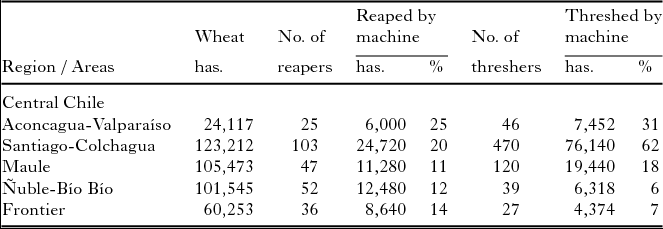
Mechanisation was also geographically unbalanced. Machinery was most widely used in Central Chile, the agricultural core since colonial times and the most important wheat-producing area up until the crisis of the export sector (1874–8.) Moreover, the area comprising the provinces from Santiago to Colchagua, traditionally thought as dominated by inefficient latifundia, had actually a significant degree of mechanisation, which reached over 60 per cent of the wheat harvest. In addition, already in the early 1870s, agricultural machines were introduced in growing numbers into the Frontier region, which would soon become Chile's breadbasket.Footnote 59 Mechanisation also considerably varied within any given region. Some districts were especially noted as areas where agriculture had made ‘enormous progress’, the use of ‘European ploughs’ was widespread and the ‘beneficial introduction of machines’ evident. In 1874, for example, 197 of the 825 threshers used in Chile were in the department of Rancagua alone, where nearly 40,000 hectares of wheat were cultivated (10 per cent of the total wheat area in Chile.)Footnote 60 An authoritative observer, Santiago Lindsay, the head of the Statistical Office, attributed the higher number of machines in some areas to their closeness to towns and cities, where alternative sources of employment drew large numbers of rural workers.Footnote 61 In 1868 Lindsay observed a ‘considerable difference’ in the number of workers employed per unit of land from one province to another, which, he believed, was undoubtedly a consequence of ‘the development that cultivation methods have reached in the central provinces, and the introduction of machines that save hands’.Footnote 62 Table 3 presents a detailed picture of the use of reapers both in Central Chile and the Frontier regions, and in the former's main agricultural areas, in the agricultural year of 1872–3, and thus further illustrates the disparity of mechanisation.Footnote 63 It must be noted, however, that in the early 1870s agriculture was still incipient in the Frontier region; its expansion came in the 1890s, after the Chilean state carried out a military invasion of the Mapuche indigenous communities’ territory in the late 1880s.
Maximum potential use of reapers and threshers in Chile (1872–3).

Note: These estimates consider that a reaper's maximum capacity was 240 hectares, and that of a thesher was 162 hectares in a seventy-day harvest season.
Source: Calculated with data from Anuario Estadístico, 1872 and 1873.
The geographically uneven diffusion of mechanisation was compounded by a disparate use of modern agricultural equipment among the different types of agricultural enterprises. Machinery normally concentrated on haciendas, the largest estates, and was used to a lesser degree on hijuelas and fundos, properties of a smaller size that exploited a more reduced area. Thus, for instance, in the department of Curicó, in the province of the same name, twenty-one of the thirty-nine haciendas and one third of the hijuelas surveyed in 1873 reported some type of machinery, and roughly the same percentage of reapers and threshers. In contrast, just eleven out of 182 fundos reported machinery, which included only six threshers and no reapers. The neighbouring department of Lontué showed a similar pattern in 1875, since sixteen haciendas reported thirty-five machines, seven fundos only five machines, and eleven hijuelas just two machines.Footnote 64
As another expression of this trend of unequal agricultural modernisation, as early as the 1870s, the use of machines and implements extended on some haciendas virtually to the entire production process. A case in point was Viluco, a rich hacienda located just to the south of Santiago, in the fertile lands of the Maipo valley. Julio Menadier, the editor-in-chief of the SNA bulletin visited it in February 1872, when the harvest of cereals was in full progress, and listed the equipment in detail. It included ‘180 Howard & Grignon American ploughs, two steam engines and two hydraulic engines, one Ransomes and three Pitts threshers, two winnowers, ten grain cleaners, a steam-powered mill, a tobacco chopper, a corn sheller, a Buckley steam-powered saw mill, five Governor & Buckley reapers’, plus a number of tilling implements, such as trunk removers, rakes, rollers, etc. Menadier also noted that ‘the large machinery shops drew attention not only because of their order, symmetry, and good organization’, but also for the ‘smart arrangement of the steam engines, which can power all the machinery [used] in the agricultural industries’. Viluco was certainly exceptional, as it ranked fourth among the twenty ‘largest estates’ (fundos grandes) whose assessed value was above $20,000; in 1874, it was valued in $34,200, and paid an income tax of $3,078.Footnote 65 It was in Viluco, precisely, where Menadier also witnessed the process of demesne expansion at its peak, for on this rich large estate the area cultivated with wheat more than doubled in just ten years, rising from 706 hectares in 1861 to 1,621 hectares in 1871. Menadier was also able to assess the impact of the cereal export boom thanks to another expression of the expansion of hacienda system: a ‘general accounting system’ recently adopted in Viluco, according to which yields from each field were separately recorded in order to maximise land use by leaving out fields of lesser productivity. Next to the city of San Felipe, in the Aconcagua valley, another case of a mechanised large estate was hacienda Quilpué, a rich property consisting of 3,920 hectares, only 1,068 of which were irrigated. Agricultural machinery seems to have been introduced in the course of the 1880s, for in 1892 its 125 hectares planted in wheat were harvested using two reapers, two balers, and at least one steam engine, which burnt coal brought from the mines in Lota.Footnote 66 Interestingly, some of these fairly mechanised properties were located not only in the core agricultural areas of Central Chile, but also in relatively peripheral provinces. One such mechanised estate in an area some 400 kilometers distant to Santiago was hacienda San Nicolás in Parral, which in 1872 had 1,600 hectares of irrigated, level land. The agricultural equipment included ‘two steam engines Ransomes & Sims with which it is possible to plow six cuadras [nine hectares] per day even when the ground is dry’; in addition, there were ‘two threshers of the same brand, seven reapers, four mowers, four Danish seeders and other six of English manufacture, two Ransomes rakes and other twelve of iron, two grain cleaners, a steam mower for alfalfa’, and a number of implements and vehicles.Footnote 67 Undoubtedly, there were more highly mechanised properties. Yet, in sharp contrast to the Mexican case, one of the most important limitations in examining the modernisation of the Chilean hacienda is the lack of primary sources directly produced by the functioning of the large estate.Footnote 68
The development of modern haciendas in Chile in the latter part of the nineteenth century has been attributed to the influx of foreigners’ capital into agriculture.Footnote 69 Indeed, such was the case of wealthy miners and merchants, seeking to obtain a place among the pseudo-aristocratic Chilean elite by means of a landed estate, still then a most significant basis of social prestige. Yet, the capitalist modernisation of the Chilean large estate was a much more complex process, in which ‘traditional’ landowners played a relevant part. The owner of Viluco, Rafael Larraín Moxó, was a notable example of a sector of landowners of ‘colonial’ origins, who in the nineteenth century fostered the modernisation of Chilean agriculture, and carried it out on their own estates. Belonging to the powerful Larraín clan, and the eldest son to José Toribio Larraín y Guzmán, Marquis of Larraín since 1787, Rafael Larraín Moxó was an enterprising landowner, whose agricultural income alone quadrupled from 1834 to 1852. Yet, like many other large hacendados Larraín Moxó was actually an active businessman whose investments extended to other economic activities. Starting in the early 1850s Larraín's portfolio included shares in the Ferrocarril del Sur, Chile's main railways company, and in other sixteen joint-stock companies, in some of which he was the board's president. In the banking sector, Larraín was a shareholder in the Banco Sudamericano and the Banco de Chile, over which he also presided; while in the coal-mining sector his investments focused on the Compañía Explotadora de Lota y Coronel. In 1855 he had a substantial participation in the insurance company El Porvenir de las Familias, along with the mining tycoon José Tomás Urmeneta. In 1869 Larraín was the president of the Compañía Chilena de Depósitos y Consignaciones, a large commercial firm in partnership with such prominent foreign businessmen as George Delano and David Allison, and with offices in Santiago and Valparaíso.Footnote 70 In 1872, when his Viluco hacienda was one the richest estates in the country, Larraín Moxó had shares in the Compañía Agrícola, the first sociedad anónima in the agricultural sector, along with José Manuel Balmaceda, a wealthy landowner and future President of Chile (1886–91). Likewise, between 1850 and 1880 Larraín had a long political career, as deputy, senator, and president of the Senate.Footnote 71
The Chilean large estate, in sum, did experience a process of mechanisation during the period of growth of wheat exports. As was the case in other Latin American nations, large foreign importing companies dominated the capital goods market, and controlled the supply of agricultural equipment. The development of the market for modern agricultural equipment was, therefore, the result of their expansion in Chile. Indeed, by opening branch offices throughout the country, as well as through exhibitions and publicity, these firms were very active in increasing and diversifying the supply of agricultural machinery. At the same time, however, in the rural society of a peripheral nation like Chile, from the demand side, diverse local actors also shaped agricultural mechanisation. Agrarian analysts and experts promoted the adoption of machinery, not only publicising it in agricultural magazines, but also testing different makes and models to evaluate both their performance and suitability to the Chilean countryside. Chilean large landowners, for their part, were not a homogeneous upper class of ignorant agriculturalists. Some already had, and an increasing number acquired through experience, a ‘mechanical culture’ of their own. The very fact that the vast majority of the new equipment was imported made it necessary for them to learn about the practicalities of machines and implements that, in addition to being expensive, had no precedent in such a barely industrialised economy. Thus, as shown in this article, some large landowners were actually quite knowledgeable agriculturalists who did find their way to using the mechanical innovations, and took part in an exchange of technical expertise with the importing firms.
Agricultural mechanisation in Chile was certainly limited, but by no means inconsequential. Despite the difficulties posed by the statistical sources, it is possible to assert that it began slowly in the 1850s, as a few ‘progressive agriculturalists’ who belonged to the core of Chile's landowning oligarchy imported agricultural machinery in an experimental way. Then, in the 1860s, and particularly in the 1870s, in response to bottlenecks in labour supply, more large landowners introduced modern agricultural machines and implements in the cultivation of estate agriculture's most important crops, above all wheat, but also alfalfa and clover. By then, the scale and pattern of mechanisation had followed a pace not dissimilar to that of advanced agricultures where cereals were the main crops; the notion that the introduction of machinery was significantly late in Chile needs to be modified. More importantly, the mechanisation of the large estate implied that the area mechanically harvested was much larger than what has been estimated in previous works. The development of mechanisation, therefore, was a significant transformation in the agricultural sector in late nineteenth-century Chile.
Acknowledgements
In loving memory of Professor Arnold J. Bauer (1931–2015). The author wishes to thank A. L. Olmstead and M. Llorca-Jaña for their advice and support.