Whether the citizen lives or dies is not a concern of the state. What matters to the state and its records is whether the citizen is alive or dead.
6.1 Introduction
More than 15 years after the Zapatista rebellion, infant mortality rates among indigenous people in Chiapas today are unacceptably high. According to the Health Ministry, in 2007 there was less than one doctor per 1,000 inhabitants in Chiapas, the lowest rate in the country, and nearly 25 percent of the population, mostly indigenous, had no access to any health service. Most of the indigenous population in that state live in a mountainous region, with only one hospital that serves more than 300,000 people spread across 17 municipalities. In the same zone there are only 6 community clinics offering basic services, and around 166 health units – primitive health centers with no doctors, medicines, or, often, even nurses. The infant mortality in the area is more than 40 per 1,000 live births, almost triple the national average of 16.7 for 2005.
Even when the rural poor can get to a clinic, doctors and nurses are often absent and basic medication is unavailable. Located within Guerrero’s municipality of Metlatónoc, Mini Numa is the first community ever to sue the authorities in federal court for denying it basic health services and to win an amparo injunction to force the government to redress the situation. The court’s ruling was unprecedented in Mexico as it affirmed that basic health is a fundamental right and that the state has an obligation to deliver it. The heroic judicial battle of the Nahua community in Mini Numa began after six preventable deaths occurred in 2007, which resulted from clinics being either too far away or nonoperational. People living in the small village had to walk two hours to get services; and upon arrival, they often found the clinic closed. The community asked the governor of Guerrero to build a health clinic, but the request was denied. The inhabitants of Mini Numa then built a health clinic themselves, only to have the authorities refuse to staff it. In 2008 the judge of one of the region’s district courts ruled in favor of the community and, three months later, a doctor was finally sent to the community to begin providing basic health services. The judge’s ruling, however, has met with only partial compliance and the state government has yet to build a new, court-prescribed hospital in Metlatónoc.
Mini Numa’s battle is an illustration of the tragic consequences of extreme poverty. Poverty is a multifaceted condition going beyond low-income levels. It can encompass precarious living standards, deficient health, malnutrition, and lack of access to public services. The children of the extreme poor often die of curable diseases, such as diarrhea, respiratory infections, and other contagious diseases that barely affect the children of the nonpoor. In this chapter we discuss the impact of Mexico’s antipoverty programs, centering on how they affect the life and death chances of the most vulnerable population, namely infants. As in the previous chapter, our goal is to compare two counterposed types of antipoverty policy – the clientelistic Pronasol and the entitlement-based Progresa/Oportunidades – with respect to their efficacy in preventing infant deaths in Mexico’s poor communities. We also seek to assess whether democracy and electoral accountability play a role in reducing infant mortality.
Despite the dismal statistics still present among indigenous people in Mexico, infant mortality rates have been declining for the past three decades after the country embraced UNICEF’s GOBI initiative (Growth monitoring, Oral rehydration, Breastfeeding and Immunization), and the child survival revolution. Although mortality remains unacceptably high, there has been substantial improvement between 1990 and 2000, particularly in the poorest states. Our goal in this chapter is to assess the extent to which the various antipoverty programs contributed to this decline.
Our work contributes to a vibrant debate within the political science literature on the effects of political regimes on infant mortality rates (IMR). Existing comparative literature has focused on how democracy reduces mortality (Przeworski et al., Reference Przeworski, Alvarez, Cheibub and Limongi2000; Navia and Zweifel, Reference Navia and Zweifel2003; Zweifel and Navia, Reference Zweifel and Navia2000; Ross, Reference Ross2006; Gerring et al., Reference Gerring, Thacker and Moreno2005; Lake and Baum, Reference Lake and Baum2001; Baum and Lake, Reference Baum and Lake2003). We depart from this literature in that we study the effects of the design of public policies in the reduction of IMR. Our work shows how improved provision of public goods, such as drinking water, sewerage, and electricity impact IMR; we also look at the impacts of conditional cash transfers (CCTs) versus discretionary transfers to individuals based on patron-client networks.
Social infrastructure programs such as FISM or Pronasol‘s public goods programs might have an indirect effect on infant mortality through their impact on sanitation and the construction of health clinics and roads. Clientelistic programs such as Pronasol’s crédito a la palabra (a subsidized credit program) might have an indirect effect on infant mortality by increasing household’s income. CCTs, for their part, might have both direct and indirect effects on infant health. Household’s increase in cash availability facilitates access to health services. But CCTs also might have a direct effect related to how the program conditions the cash transfer on regular health visits and women health education programs.
The chapter proceeds as follows. The next section briefly discusses the existing comparative literature on infant mortality and how we depart from the conventional approach by assessing policy interventions rather than focusing exclusively on regime type. The third section reviews the national trends for IMR, discussing data quality issues that emerge from shifting from national to local measurements of infant mortality. The section calls for a better understanding of the processes of data collection and reporting in the use of off-the-shelf datasets, which anchor most cross-national research strategies. In particular, the section discusses problems of underreporting and excessive reliance on forecasting models in available IMR datasets in Mexico. The fourth and fifth sections estimate statistical models of changes in municipal IMRs and explore the distributive effects of various poverty-relief interventions and local democratization.
6.2 Comparative Studies of Infant Mortality
There is an important debate within political science regarding the effect of political regimes on infant mortality. In their path-breaking study of democracy and development, Przeworski et al. (Reference Przeworski, Alvarez, Cheibub and Limongi2000) found that democratic regimes generate a host of impacts on demographic behavior, fertility rates, the spacing of children, and their chances of survival. Controlling for regime-selection effects, democracies lead to lower population growth, higher life expectancies, fewer child deaths, and thus enhanced well-being. A crucial element in these findings is that the mechanism for improvement in human development is not simply a higher level of health spending by democracies. What democracies seem to do better than autocracies is to empower women to make free choices about their own fertility and to enjoy higher relative wages.
Lake and Baum (Reference Lake and Baum2001) explore the effect of regime type on public health outcomes and public goods provision, finding that democracies are more likely to reduce IMR. Navia and Zweifel (Reference Navia and Zweifel2003) find similar effects, controlling for regime-selection bias. In their most recent work, they show that, beyond a direct positive effect of democracy in reducing IMR by around 5 percent, policy interventions purportedly aimed at reducing IMR, such as immunization campaigns, generate positive effects only in democracies. They posit that these findings are consistent with the likelihood that democracy provides the public services that citizens actually want.Footnote 1 All of these studies are based on cross-national comparisons using readily available official statistics.
Kudamatsu (Reference Kudamatsu2012) shows that democracy in Africa decreased IMR by an astonishing 18 deaths per 1,000. His analysis differs from previous work in that he uses individual-level data from the Demographic and Health Surveys (DHS), which permit an identification of the effect of democracy by comparing children born to the same mother under different political environments. The mechanisms underlying the findings are related to the improvement of health interventions leading to more medical attention at birth, breastfeeding, and, in general, better health services.
Using historical data from the United States, Miller (Reference Miller2008) found an effect of female enfranchisement upon the survival of children (an improvement ranging between 8 and 15 percent). This analysis is based on a careful reconstruction of IMR across the United States, taking advantage of the differential timing of enfranchisement. In this account, the mechanism that explains the outcome is a shift in legislative behavior once women were given the right to vote, which is followed by rapid increases in local public health spending. This is one of the few studies providing an explicit link between IMR and political arrangements mediated by budgetary priorities and legislative behavior.
Ross (Reference Ross2006) has cast doubt on cross-national analyses of IMR, calling for a greater awareness of the problems of validity in available datasets. In particular, he shows that if missing data in autocracies with relatively good development performance are taken into account, the main findings in the literature tend to disappear. The econometric estimations he proposes include country fixed effects, to control for likely omitted variable biases incurred in the prevailing work. Democracy seems to have no effect in reducing infant deaths.Footnote 2
The only analysis exploring these issues in Mexico is the work by Tania Barham (Reference Barham2011) evaluating the impact of Progresa on IMR. In her carefully designed study, she calculates that Progresa diminished infant deaths in rural areas, as reported in vital registration statistics, by around 11 percent (i.e., too fewer deaths per 1,000 live births). This effect is found in municipalities where the program was implemented by random assignment at an early date, as compared to a control group of municipalities chosen for inclusion, but left untreated. The statistical approach she uses takes advantage of the experimental setting of these temporal waves in the introduction of Progresa, in order to isolate the effect of treatment on otherwise nearly identical rural communities. Hence Barham (Reference Barham2011) finds a clear link between one poverty-relief program and the decline of child mortality. But what about the earlier programs administered under the umbrella of Pronasol from 1989 to 1994? Or the far-reaching decentralized strategy for municipal provision of basic public services since 1996? How have these strategies contributed to the reduction in IMR, compared to Progresa/Oportunidades?
There is general agreement among the public health community that public policy interventions have contributed to the reduction of IMR. IMR trends in Mexico are historically preceded by important policy initiatives, including the widespread distribution of oral rehydration salts since 1984, efforts to extend universal vaccinations since the 1990s and the improvement of water quality with the chlorination program in 1992 (Sepúlveda et al., Reference Sepúlveda, Bustreo, Tapia, Rivera, Lozano, Oláiz, Partida, García-García and Valdespino2006). But studies have failed to specify the channels and mechanisms through which policies affect outcomes. The link is plausibly posited but untested. Statistical analyses of the determinants of IMR based on health surveys, to which the public health community has been very attentive, have failed to determine how important the influence of specific policy interventions are vis-à-vis socioeconomic and physiological factors, because individual-level databases rarely include many policy related and social variables – let alone political ones.
Our working hypothesis is that the antipoverty programs we have analyzed, all of them, should have indirect and/or direct effects on infant mortality. First, social infrastructure projects from Pronasol and FISM affect IMR indirectly by improving access to drinking water, sanitation, electricity, roads, and health clinics. The previous chapter modeled how these programs shaped improvements in public goods provision and showed that formula-based public goods transfers within FISM were more effective at targeting the poor than the discretionary pork-barreling projects within Pronasol. Here we focus on understanding how improvements in public goods provision during the 1990s shaped reductions in IMRs at the municipal level. Second, we model the direct and indirect effects of Progresa transfers and Pronasol’s clientelistic allocations on IMR. Our expectation is that private good transfers within each of these programs shape IMR by increasing a family’s disposable income. After some time, the CCT program’s more direct impact on targeted health monitoring should translate into a much larger effect in infant death.
6.3 Issues in Measuring IMR
Infant deaths provide an undeniable indicator of well-being linked to development policy. Notwithstanding the deprivation of poor regions like Oaxaca, Guerrero, Hidalgo, and Chiapas, overall IMRs in Mexico have declined substantially in the past twenty-five years. These reductions coincided with important innovations in public health and the implementation of different poverty-relief strategies. Although statistical sources vary in their estimates, it is fair to say that IMR in Mexico fell from around 50 deaths per 1,000 in 1980, to levels slightly above those found in developed countries (19 per 1,000 in 2005). The same trend is observed in the children under five years of age (Sepúlveda et al., Reference Sepúlveda, Bustreo, Tapia, Rivera, Lozano, Oláiz, Partida, García-García and Valdespino2006).
Still, failures in government policy and the overall social environment in which poor children live are key determinants of mortality. An early study on poverty in Mexico concluded that 43 percent of deaths in 1974 were preventable (Coplamar, Reference Coplamar1982), in the sense that timely health interventions could have saved their lives. Despite great strides in public health in the intervening years, the percentage of preventable deaths has barely changed. Twenty years after the landmark Coplamar study, the Health Ministry estimated preventable deaths still at around 38 percent during 2000–2004 (Secretaría de Salud, Reference Secretaría de2006). For the specific case of infants, the Health Ministry calculates the percentage of preventable deaths in recent years at around 80 percent. Most infant mortality is related to common infectious diseases, which are preventable with simple medical interventions if appropriate and opportune care is available.
The reduction in infant mortality in Mexico is part of a worldwide phenomenon, and a clear continuation of downward trends observed throughout the century (Roberts, Reference Roberts1973; Bobadilla and Langer, Reference Bobadilla and Langer1990). Mexico is usually considered a success story because it is one of only seven developing countries on track to meeting Millennium Development Goal Number 4: to reduce the underfive mortality rate by two-thirds by 2015 (Bryce et al., Reference Bryce, Terreri, Victoria, Mason, Daelmans, Bhutta, Bustreo, Songane, Salama and Wardlaw2006).Footnote 3 Notwithstanding the national trend of declining mortality during the past decades, there is significant regional variation within Mexico, with some regions experiencing sharper reductions in IMR than others.
To study the regional variation of IMR in Mexico, we first need to tackle an important problem related to the availability of data at the municipal level, which is our unit of analysis. The tragedy of child deaths often goes unnoticed – and therefore uncounted – by both government officials and the public at large. The main thrust of the Ross (Reference Ross2006) critique is that many countries without democracy have better outcomes in IMR, but are frequently not included in international health data due to inadequate reporting. Statistical analysis based on publicly available datasets often entail case-wise deletion of missing values, which can lead to dubious conclusions. Moreover, with the exception of Kudamatsu’s (Reference Kudamatsu2012) use of individual-level survey data, the cross-sectional literature has often not been very conscious of the measurement issues that plague demographic studies of infant mortality. Specifically, the most widely used IMR datasets from the World Health Organization (WHO), the United Nations Children’s Fund (UNICEF), and the World Bank involve a mix of official country data based on vital registration statistics, census information, and survey data.
The problem with using IMR data without understanding their provenance is that estimates can differ according to the methods used to generate them. In particular, IMR statistics are plagued with two problems that determine their quality, namely, the way in which they deal with underreporting and the technical choices made in forecasting models. Researchers need to be mindful of the advantages and disadvantages of the different methods employed to measure IMR and to be explicit about their reasons for choosing one data source over another.
Arguably the most comprehensive effort to deal with the issues of data quality and comparability in IMR across countries has been done by UNICEF.Footnote 4 Infant Mortality Rates are calculated by UNICEF as the best fit model combining direct survey responses, indirect census estimations and official vital registration statistics. Direct estimations of IMR in Mexico are made using the reconstruction of birth cohorts reported in health surveys, such as the internationally sponsored Demographic and Health Survey (DHS) from 1987 and the Encuesta Nacional de Dinámica Demográfica (ENADID) from 1997. An alternative source of IMR data for Mexico comes from official vital statistics collected by the civil registry, as reported by the national statistical office (INEGI).
Both UNICEF and direct estimations from surveys show much higher IMRs than vital registration data. The gap between sources is in the range of around 20 deaths per 1,000. This means that, given the general decline of IMR over the years in Mexico, underreported deaths in vital statistics are an increasingly relevant problem in counting actual infant deaths, defying the downward secular trend. Increases in infant mortality calculated through vital statistics might represent efforts by public officials to improve the registration of children. But they might also signal periods in which the reduction of infant deaths in fact stagnated (say in the early 1970s and late 1980s).
There is hence an obvious challenge in using vital statistics data as an indicator of IMR, particularly since the poorest localities are the least likely to register births and deaths. In addition, according to INEGI, around 40 percent of births in Mexico are registered after a child is more than one year old. In short, calculating infant deaths from vital registries is not very reliable. One of the limitations of the Barham (Reference Barham2011) study on the effects of Progresa on IMR is precisely that it employs vital statistics.Footnote 5
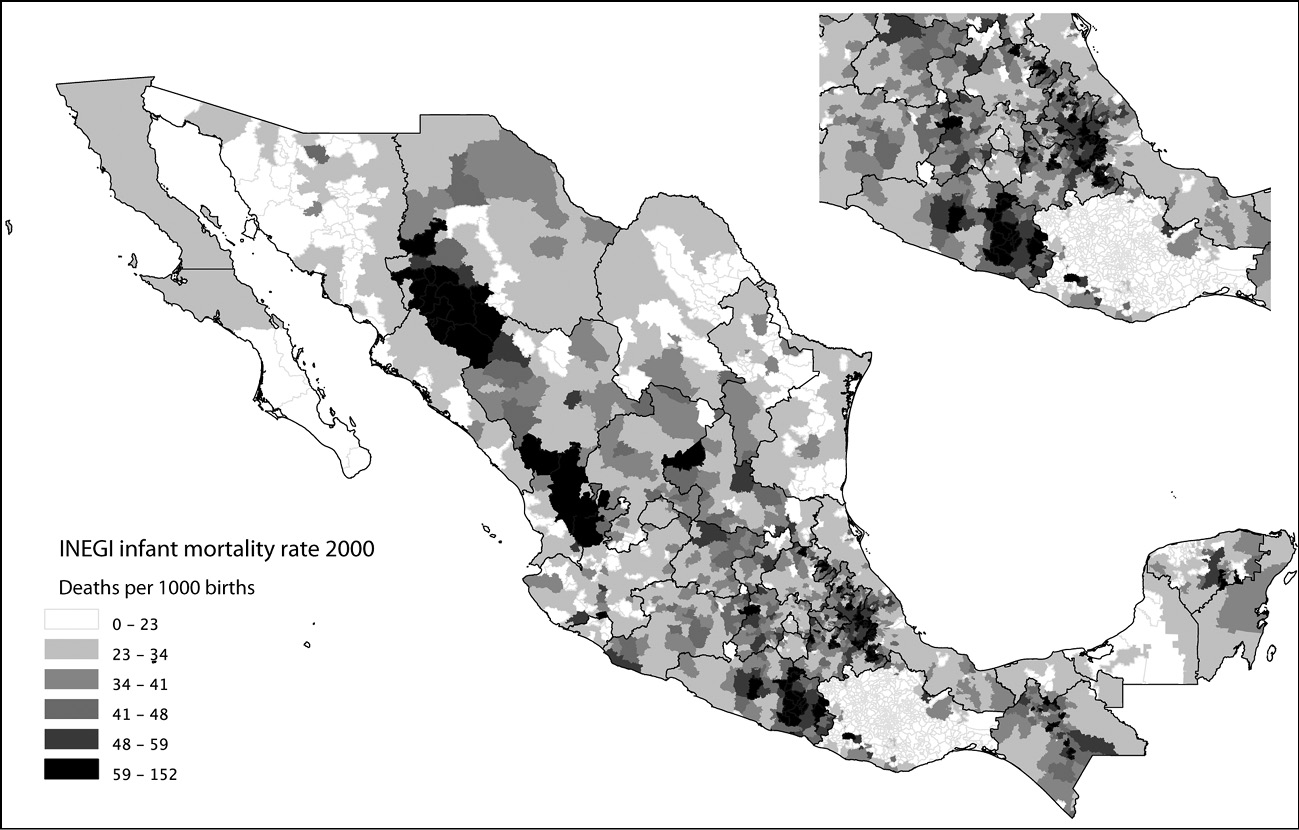
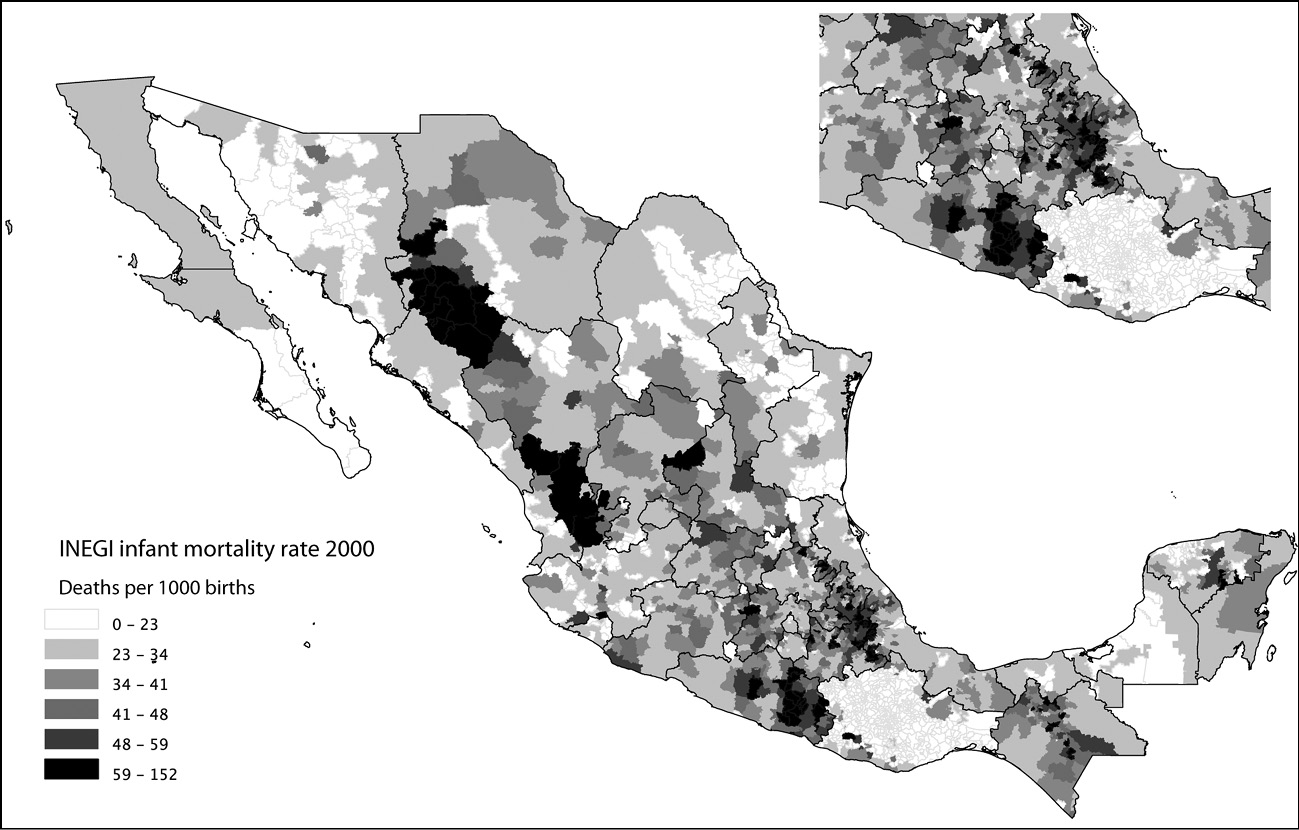
INEGI calculates an alternative disaggregated IMR through demographic models from the relatively reliable census data, estimating deaths and births by mother cohort. Their method does not interpolate or extrapolate and calibrates yearly estimates through independent models of fertility patterns.Footnote 6 As shown in Figure 6.1, municipal IMRs calculated by INEGI have an average value of 47.5 per 1,000 in 1990 and 34.6 in 2000.Footnote 7 The level of those indicators and the decline over the decade are consistent with the calculations of IMR obtained from health surveys, such as ENADID. If we accept the INEGI estimations, municipal vital registration data suffer from underreporting. In the average municipality only 40 percent of the infant death ratios are registered; and in the bottom quartile of the municipalities only one quarter of the ratios between deaths and births are ever registered.Footnote 8
Geography of infant mortality rate in 2000.
6.4 The Determinants of IMR Decline
In order to explore the determinants of the performance of municipalities in children’s health, and in particular, the role of antipoverty policies in the reduction of infant mortality, we estimate a statistical model in first differences. The dependent variable is the change in every municipality’s IMR between 1990 and 2000. The differentials use indirect estimations based on the reconstruction of births and deaths according to census data, as calculated by INEGI. The model includes improvements in basic public goods, variables measuring antipoverty policies, and municipal changes in political regime. Controls for demographic and health interventions include changes in the level of female illiteracy (as a proxy for maternal capabilities), changes in the rate of infant delivery under doctor supervision, shifts in the quality of birth registrations, population growth and changes in the poverty headcount.
| Δ IMR1990–2000 = | α1 Pronasol Spending 1989–1994 + |
| α2 Progresa Coverage 1997–2000 +β1 Democracy (Instrumented) 1990–2000 + | |
| γ1 Δ Public Goods1990–2000 +γ2 Δ Doctor Deliveries 19990–2000 + | |
| γ3 Δ Delay in Registration 1990–2000 +γ4 Δ Population1990–2000 + | |
| γ5 Δ Poverty1990–2000 + ε |
It should be noted that municipalities with strong declines in mortality are found throughout the country. Places with most improved infant well-being cluster near the Huasteca region, the mountainous zone of Puebla and the state of Chiapas. Coastal municipalities and most northern ones have witnessed much smaller improvements over the decade. A Moran test for spatial autocorrelation, however, found no systematic spatial patterns in the declines of IMR across neighboring municipalities, so no spatial correction is made in the estimations.
The independent variables of interest are three antipoverty policies. The first is the household coverage of Progresa by the end of 2000. Since Progresa transferred cash and nutritional supplements while requiring medical checkups for children, IMR should decline as a consequence of greater coverage, which would be indicated by a negative sign. Mothers benefiting from Progresa take their children in for regular physical exams and vaccinations, and also receive information on breastfeeding, oral rehydration therapy, and basic hygiene. Given that Progresa was allocated according to a system of targeting at locality and household levels, it is important to control for the poverty profile of municipalities so that the substantive indicator reflects the effect of the intensity of Progresa participation, given a certain poverty level.
We also include the prevalence of clientelism in each municipality, as measured by the per capita private goods provision targeted to individuals and groups through Pronasol. This variable might affect IMRs thorough an income effect among benefited households. Given that these transfers were not conditional on health interventions, but rather on political behavior, the relative effect should be much smaller than the one observed for conditional cash transfers.
The third policy variable is the change in the index of public goods provision of water, sewerage, and electricity used in Chapter 5, as an indicator of the improvements in local public goods. This variable reflects infrastructural investments under Pronasol and the decentralized funds of FISM after 1996. As demonstrated in the previous chapter, local public goods provision improved only slightly through Pronasol expenditure, whereas decentralized funds in FISM were much more effective in expanding public service delivery. We expect this variable to show a negative sign, since greater coverage of public goods should be associated with lower IMR.Footnote 9
To measure democratic practices at the municipal level, we follow an approach similar to the previous chapter, where we used alternative specifications for electoral democracy. The analysis poses a problem of econometric identification, which we address following the approach used in Chapter 5.
We include two indicators of state capacity from vital statistics. The first is the change in the share of babies delivered by doctors in each municipality.Footnote 10 The second is the change in the average delay of registering children after they are born. The lower the state capacity, the more we expect families to delay registering their children. These state capacity indicators should show a positive sign.
As a measure of poverty, we include changes in the percentage of the population living below two minimum wages (using one minimum wages makes no difference in the results). Widespread poverty limits the choices and capabilities of mothers and families, so we expect a positive sign in this level variable, indicating a greater difficulty in reducing IMR where poverty is more prevalent.
Table 6.1 shows the results of our IV-regressions. The first column reports the results of a simple regression that does not instrument for clientelism and electoral democracy. Model 2 instruments for clientelism, model 3 for electoral democracy, and model 4 for both variables simultaneously.
| 1 Change in IMR (1990–2000) |
2 Change in IMR (1990–2000) |
3 Change in IMR (1990–2000) |
4 Change in IMR (1990–2000) | |
|---|---|---|---|---|
| Change public | –2.521 | –2.49 | –2.531 | –2.559 |
| Goods index | (2.64)*** | (2.57)** | (2.42)** | (2.72)*** |
| Alternation | –0.317 | –0.062 | –19.301 | –6.362 |
| (0.56) | (0.09) | (1.92)* | (1.82)* | |
| Clientelism | 0.494 | 1.359 | –0.585 | –1.125 |
| (2.20)* | (1.03) | (0.94) | (0.81) | |
| CCT | –58.779 | –64.782 | –101.024 | –62.378 |
| (6.55)*** | (4.82)*** | (4.15)*** | (4.47)*** | |
| Observations | 1817 | 1817 | 1814 | 1814 |
| R-squared | 0.18 | 0.17 | 0.16 | 0.12 |
| Endogenous | None | Clientelism | Alternation | Clientelism |
| Variable | Alternation | |||
| Instruments | None | Alpha | Railroads | Railroads |
| Erosion | Longitude | Longitude | ||
| Alpha | ||||
| Erosion |
Note: All models include a constant term and control variables in first differences: population growth, illiteracy, poverty, and doctor delivery and delay in registration changes. All models use robust standard errors. Instruments pass the Sargan and Basmann tests of overidentification.
* Significant at 10%; ** significant at 5%; *** significant at 1%.
t statistics in parentheses.
The main findings can be summarized as follows: the conditional cash transfer program of Progresa always exhibits a strong and statistically significant effect. Clientelism increases IMR in the first model; but once instrumented it fails to have discernible effects on changes in infant mortality. Improvements in local public goods (water, sanitation, and electricity) have consistent negative effects, indicating that their expansion in the 1990s helped to reduce IMRs. Democracy, as reflected in municipal alternation, shows a similar effect to that found in the previous chapter. There seems to be some effect of greater accountability in health outcomes brought about by electoral contestation.Footnote 11
Table 6.2 estimates similar models using various specifications for electoral democracy. As in the last column of Table 6.1, the models in Table 6.2 instruments for clientelism and electoral democracy simultaneously. A clear pattern emerges from the data suggesting that only alternation of political power at the municipal level makes a difference in health outcomes for the poor, rather than overall levels of electoral competitiveness. The cumulative years since a municipality first experienced political alternation in power and the alternation dummy variable in the 1990s (reported in Table 6.1) have negative and statistically significant effects on IMR. Yet, the index of democracy and close margins of victory do not seem to impact health. In any event both expansion in public goods coverage and the spread of Progresa always reduce infant mortality rates.
| 1 | 2 | 3 | |
|---|---|---|---|
| Dem. Index | –0.673 | ||
| (0.97) | |||
| Margin | 0.537 | ||
| (0.16) | |||
| Years Alternation | –0.598 | ||
| (1.77)* | |||
| Pronasol private | –0.451 | 0.567 | –0.833 |
| (0.32) | (0.42) | (0.65) | |
| Change in public goods index | –2.503 | –2.496 | –2.552 |
| (2.62)*** | (2.56)*** | (2.76)*** | |
| CCT | –63.086 | –55.831 | –57.908 |
| (4.21)*** | (3.60)*** | (4.35)*** | |
| Observations | 1786 | 1786 | 1814 |
| R-squared | 0.17 | 0.18 | 0.14 |
| Endogenous | Dem. Index | Margin | Years Alternation |
| Variable | Clientelism | Clientelism | Clientelism |
| Instruments | Railroads | Railroads | Railroads |
| Longitude | Longitude | Longitude | |
| Alpha | Alpha | Alpha | |
| Erosion | Erosion | Erosion |
Note: All models include a constant term and control variables in first differences: population growth, illiteracy, poverty, and doctor delivery and delay in registration changes. All models use robust standard errors. Instruments pass the Sargan and Basmann tests of overidentification.
* Significant at 10%; ** significant at 5%; *** significant at 1%.
t statistics in parentheses.
6.5 Quantile Regressions
The challenge of improving infant health in highly marginalized zones is likely to be different from reducing deaths in wealthier places. Because of convergence, highly marginalized municipalities tend to exhibit faster improvements in health than rich ones. To explore this heterogeneity in our data, we perform quantile regressions to estimate differential effects for our covariates in municipalities that exhibit large improvements (normally the poorest) and in municipalities that exhibit smaller changes. Because of the way the data is coded, municipalities that exhibit the largest reductions in IMR are in the lowest quantiles.
Table 6.3 dissects the differential effects of our main variables of interest on infant mortality. Our two endogenous variables are instrumented in the same manner as before. The results of the quantile regressions are striking. Progresa shows a consistently strong negative effect on IMR for all quantiles. Similarly, expansion in public goods coverage reduces IMR across the board. Clientelism lowers IMR only in the bottom quantile (q.2), suggesting that under some conditions destitute poor benefited from this form of political linkage. It should be emphasized that any effect of clientelism pales in comparison to Progresa and to actual improvements in public goods.
| q.2 Change in IMR (1990–2000) |
q.4 Change in IMR (1990–2000) |
q.6 Change in IMR (1990–2000) |
q.8 Change in IMR (1990–2000) | |
|---|---|---|---|---|
| chpubgoods | –1.632 | –2.627 | –2.572 | –1.934 |
| (2.96)*** | (2.68)*** | (2.10)** | –1.45 | |
| ^Alternation | –0.219 | –5.038 | –6.103 | –6.967 |
| (0.08) | (2.62)*** | (2.03)** | (2.73)*** | |
| ^ clientelism | –4.297 | –1.978 | 0.481 | 1.411 |
| (2.17)** | (0.9) | (0.19) | (0.68) | |
| oport00 | –50.147 | –63.604 | –61.956 | –66.076 |
| (3.58)*** | (3.88)*** | (3.58)*** | (3.25)*** | |
| Observations | 1814 | 1814 | 1814 | 1814 |
Note: Alternation and clientelism are instrumented with alpha, erosion, distance to railroads, and longitude. All models include a constant term and control variables in first differences: Pronasol hospitals and clinics, population growth, illiteracy, indigenous, poverty, doctor delivery, and delay in registration changes. All models use robust standard errors. Instruments pass the Sargan and Basmann tests of overidentification.
* Significant at 10%; ** significant at 5%; *** significant at 1%.
t statistics in parentheses.
6.6 Final Remarks
When transferring funds to individuals based on their political loyalty becomes the overriding consideration in the design of social policies, the developmental goal of using social programs to help the poor is distorted. That does not necessarily mean that social policies are irrational or always wasteful. Public administrators tend to think that better management of personnel, better planning and oversight, and improved mechanisms for controlling corruption are the best way to make sure that public policies can help the poor. Our analysis suggests, instead, that democracy and the empowerment of women are more promising solutions than seeking to reform governance by administrative design.
Results in this chapter demonstrate that the creation of better-designed social policies targeted to poor women has had a decisive impact on development by saving the lives of children. New social programs such as FISM and Progresa that came as a result of stronger checks and balances increased electoral competition, and decentralization improved the provision of municipal public goods and allowed poor families greater access to health services.
Our results also demonstrate that there were some clear effects of local democracy on the reduction of IMR. Municipalities that experienced an alternation of power between political parties are better at preserving infants’ lives than municipalities that remained under the exclusive hegemonic control of the PRI.
Democracy does not necessarily lead to increases in funding for social programs or a greater budgetary priority for social expenditures, nor does it induce a normative consensus in society to address the plight of the poor. But the introduction of checks and balances brought about by democracy generated the possibility for a compromise among politicians, which led to a better architecture of social policies. The social policies chosen in Mexico combined elements of decentralized decision making for the municipalities, with centralized control by the federal government over the conditional cash transfer program. As the federal government allocated fewer funds to the goal of fighting poverty, compared to the largesse witnessed under Pronasol, it also shifted away from the expensive clientelistic strategies of vote buying in favor of a greater orientation toward public goods provision and the empowerment of the most vulnerable citizens through Progresa.
There are some painful lessons for Mexico and its clientelistic past: thousands of children likely would have remained alive had the transformation of programs occurred a few years earlier. As mentioned in the introduction, Subcomandante Marcos was right in pointing out that children died from curable diseases and no one took notice. Pronasol‘s claims about “putting an end to poverty”are assessed against a clearly defined metric: Was the program able to save the lives of the most vulnerable? Our results suggest that its effects were at best marginal; some poverty alleviation took place, but it was marginal compared to what better-designed poverty-relief policies achieved.