1. Introduction
Over the last decades we have witnessed a significant change in how the advanced democracies of Europe, North America and Australasia treat their unemployed. Starting in the late 1970s and early 1980s, countries have reformed their labour market and social policies with the aim of reducing dependency on benefits, raising levels of employment, and increasing the cost-effectiveness of social protection systems. This has, in part, involved greater efforts to support and help the unemployed by expanding labour market training schemes or providing job-search assistance. In many important respects, however, recent social and labour market policy-making has had a decidedly demanding and coercive character as governments have tightened eligibility conditions for unemployment benefits and introduced tougher sanctions for claimants who fail to comply with these conditions (e.g. Rueda, Reference Rueda2015).
This turn toward ‘demanding activation’ has been the subject of a large and growing body of research in comparative social policy and other fields (for recent and comprehensive reviews see Raffass, Reference Raffass2017 or Watts and Fitzpatrick, Reference Watts and Fitzpatrick2018). Next to studies concerned with the general trend toward activation in both its enabling and demanding forms (e.g. Bonoli, Reference Bonoli2013; Eichhorst et al., Reference Eichhorst, Kaufmann and Konle-Seidl2008a), related research on unemployment benefit reform generally (Clasen and Clegg, Reference Clasen and Clegg2011), and several studies on the implementation of activation policies, (van Berkel, Reference van Berkel2010; Jordan, Reference Jordan2018; Dunn, Reference Dunn2013; Ludwig-Mayerhofer et al., Reference Ludwig-Mayerhofer, Behrend and Sondermann2014), there is also a considerable amount of scholarship focusing specifically on demanding policies. Here, many studies have been concerned with the (often harsh and adverse) effects of these policies (e.g. Loopstra et al., Reference Loopstra, Fledderjohann, Reeves and Stuckler2018; van Oorschot, Reference van Oorschot2002), with how citizens think about them (Fossati, Reference Fossati2018; Kootstra and Roosma, Reference Kootstra and Roosma2018) and, of course, with the variation in these policies across countries and their political determinants (Atkinson, Reference Atkinson1990; Clasen, Reference Clasen2000; Jessop, Reference Jessop1999; Oschmiansky et al., Reference Oschmiansky, Schmid and Kull2003).
This existing research on the politics of demanding activation policies has so far relied only on qualitative evidence, probably due to the absence of systematic large-N comparative data on demanding activation policies. Unlike in the closely related field of research on active labour market programmes (ALMP), where the availability of quantitative data has enabled an agenda of systematic large-N research (e.g. Vlandas, Reference Vlandas2013; Cronert, forthcoming.; but see also Clasen et al., Reference Clasen, Clegg and Goerne2016 on the limits of these data), no comparable data sources are available for demanding activation policies. As a result, there is a wealth of in-depth evidence on the variation in demanding policies and the specific drivers and contexts that produce them from single- or small-N country studies, yet no evidence concerning the broad and systematic patterns across the OECD-world. Both types of evidence are necessary, however, to obtain a complete and comprehensive picture (cf. Scruggs, Reference Scruggs, Clasen and Siegel2007).
The paper addresses this gap by examining reforms that have tightened sanction rules for unemployment benefit claimants in 20 advanced democracies since 1980 using an original comparative dataset. Sanction rule reforms increase the duration for which unemployment benefit claimants can lose their benefits or increase the amount of benefits that can be withheld when a sanction is imposed (or both). These reforms have been identified as a key type of demanding or coercive social policy reform (Eichhorst et al., Reference Eichhorst, Kaufmann, Konle-Seidl, Reinhard, Eichhorst, Kaufmann and Konle-Seidl2008b: 6). Hence, accounting for the variation in sanction rules moves us a significant step closer to understanding coercive and demanding reforms more generally.
My account of the political logic of sanction rule reforms highlights the role of adverse economic conditions as one important determinant. In a nutshell, economic downturns create a dilemma for governments wherein they are faced with increased demands for social protection, in particular when unemployment increases, while their fiscal revenues decline at the same time (for related arguments see Atkinson, Reference Atkinson1990; Oschmiansky et al., Reference Oschmiansky, Schmid and Kull2003; Huber and Stephens, Reference Huber and Stephens2001). Since sanctions should – in theory – only be imposed on the ‘undeserving’ unemployed while all others remain unaffected, introducing tougher sanction rules allows governments to signal to voters that the costs of social protection are at least contained, but without harming the ‘truly deserving’ (the reality often differs, of course).
The remainder of this paper is structured as follows: the next section develops the theoretical argument about the purpose and political logic of tougher sanction rules. The third section presents the dataset on sanction rule reforms and shows, by way of a dynamic time-series cross-section regression analysis, that tighter sanctioning rules are indeed introduced in the context of economic downturns, in particular in response to rising unemployment and budget deficits. The fourth section provides a discussion of the findings, focusing in particular on whether it is possible to generalise the insights gained here to earlier historical periods as well as to other policy fields. The final section concludes and discusses the more general implications of my findings for comparative welfare state research and other fields.
2. The political logic of sanction reforms
Economically difficult times with high and rising unemployment create dual pressures on governments. On the one hand, they are under greater functional as well as political pressure to expand social protection policies. Functional pressure results from the fact that a greater part of the population will experience economic hardship including unemployment and income losses, which will in turn translate into an increased level of need for social protection (Margalit, Reference Margalit2013; Blekesaune, Reference Blekesaune2007). Political pressure for social policy expansions results from more people feeling at risk of experiencing hardship in the near future and hence demanding greater government efforts to provide protection against these risks (Iversen and Soskice, Reference Iversen and Soskice2001; Hacker et al., Reference Hacker, Rehm and Schlesinger2013). In addition, research on deservingness perceptions suggests that the public also tends to see vulnerable groups like the unemployed as more deserving of support when their being in need is more clearly attributable to external conditions rather than self-induced: for instance, due to unwillingness to work or ‘choosiness’ (Jeene et al., Reference Jeene, van Oorschot and Uunk2014). All these factors provide incentives for governments to expand or at least not retrench social protection systems.
On the other side, however, governments will also be under pressure to reduce or at least contain spending in order to cope with reduced revenues. Rising unemployment, in particular, generates a double cost (Huber and Stephens, Reference Huber and Stephens2001) since there will be not only increased outlays due to additional benefit claims but also reduced revenues since unemployed workers pay no taxes and contributions, thus putting government budgets under strain and creating a functional pressure to reduce spending.
Next to this functional pressure, there will also be political pressure to stabilise budgets. The fact that, as just described, there are increased demands for social protection policies in economic downturns should not lead us to forget that voters have other concerns as well (Giger and Nelson, Reference Giger and Nelson2013). The budget balance, in particular, is an issue voters care about, as evidenced by the fact that voters tend to penalise governments for budget deficits (Brender and Drazen, Reference Brender and Drazen2008). There is, furthermore, evidence that it is precisely in downturns when those voters who are not immediately affected by unemployment or income losses (and who usually are the majority) actually prioritise sound public finances over generous social protection systems. Some of this evidence comes from recent research on the effect of the Great Recession on welfare state attitudes. Margalit (Reference Margalit2013), for instance, finds that following the financial crisis of 2008, support for social spending in the US increased only among those who actually experienced unemployment or a reduction in income, while the overall electorate grew less supportive of increased spending. Margalit (Reference Margalit2013: 88) suggests that this was because ‘voters became increasingly concerned about the spectre of growing budget deficits and the consequent possibility of future tax hikes’. Barnes and Hicks (Reference Barnes and Hicks2015), who use British panel data, find the same pattern and also confirm that concerns about budget imbalances grow in economic downturns (see also Rehm, Reference Rehm2016). Related findings come from the literature on the determinants of the public mood (Durr, Reference Durr1993; Stevenson, Reference Stevenson2001), which has found that electorates become more critical toward government spending on progressive policies in economic downturns, whereas a conservative political agenda of less spending and smaller government finds more public support. A recent study on the electoral consequences of economic crises by Lindvall (Reference Lindvall2014) found, indeed, that conservative parties enjoy more electoral support in the aftermath of economic downturns. In sum, it is not only an objective need to avoid deficits but also voter demands that create pressures for governments to engage in budget consolidation, which directly competes with the above-mentioned pressure to provide additional support to vulnerable groups.
Faced with these competing pressures, I argue, governments have strong incentives to cut spending but to do so in a way that, at least ostensibly, does not affect vulnerable parts of the population. Tougher sanction rules for the unemployed allow them to satisfy both objectives. Firstly, tougher sanction rules reduce public spending, both directly and indirectly. The indirect effect can materialise when tougher sanctions increase the pressure on unemployment benefit claimants to seek and accept employment, as is suggested in research on current labour market reforms (Eichhorst et al., Reference Eichhorst, Kaufmann and Konle-Seidl2008a; but see also van den Berg and Vikström, Reference van den Berg and Vikström2014). An important caveat here is, however, that whether or not this effect materialises will arguably be contingent on enforcement practises (Grubb, Reference Grubb2000).
The direct cost-saving effect of tougher sanctioning rules, which is independent of enforcement practices, arises simply when those claimants who do end up being sanctioned lose more of their benefit payments for longer periods of time. As available data on the imposition of sanctions show (Grubb, Reference Grubb2000) – although countries differ with respect to how frequently sanctions are imposed – there are always some claimants that do receive a sanction, even if this group is small. And as long as there is some group that is found to be in breach of their obligations, excluding them for longer periods will directly reduce spending (although often at significant social costs; see e.g. Watts et al., Reference Watts, Fitzpatrick, Bramley and Watkins2014). How substantial these savings are is of course debatable, given that sanctions affect only a sub-group of claimants of an already comparatively small type of social security programme. Yet, at the least, tougher sanctioning rules serve as a political signal that spending is being reduced.
Another important signal sent by tougher sanctioning rules is that these will (at least in theory) only affect claimants who are not truly available for employment, have induced their unemployment voluntarily, or have otherwise breached their obligations – in other words, the ‘undeserving’. This means governments can promote tougher sanctioning rules as measures that generate at least some savings but do not harm vulnerable groups.Footnote 1 Hence, compared to alternative courses of action to generate savings like increased monitoring or reduced entitlements, which would affect all unemployed by default, tougher sanctioning rules can at least be presented as measures that target only a very specific group. Introducing tougher sanctioning rules, in other words, allows governments to signal that no resources are being spent on those that have been identified as ‘lazy’ or ‘choosy’, whereas the ‘deserving’ claimants remain unaffected. This is not, of course, to say that increased monitoring or other cutbacks are never introduced – they have been, as is well documented in research; see e.g. Vis, Reference Vis2009. Yet, as is also shown by Vis (Reference Vis2009), these alternative measures are potentially unpopular and therefore carry an electoral risk. This risk should be lower in the case of more targeted sanction rule reforms.
There are hence good reasons to believe that sanctions will be tightened in times of austerity. It is not clear, however, that times of affluence will also lead to relaxations. It may of course be the case that, as economic concerns become less pressing, the public becomes less willing to tolerate the often harsh effects of punitive sanctioning practices (Durr, Reference Durr1993), which would give political actors an incentive to relax sanctions. But it may also be the case that, even when conditions improve, the concerns of many other vulnerable groups will be prioritised over those of the unemployed, and in particular over those of the undeserving unemployed (cf. van Oorschot, Reference van Oorschot2006). Sanction restrictions in times of austerity may therefore not be automatically reversed in times of affluence, giving rise to an upward ‘ratchet effect’.
3. Analysis
My argument predicts that sanction reforms should be introduced during economically difficult times since it is then when the dual pressure to provide social protection while also being fiscally prudent is particularly strong. I provide a test of this implication by way of a time-series cross-sectional analysis of sanction rule reforms in 20 advanced democracies since the 1980s.
3.1 Measuring sanction reforms across space and time
To measure sanction reforms across countries and over time, I draw on a novel comparative dataset on the conditionality of unemployment benefits (Knotz and Nelson, Reference Knotz and Nelson2015; see also Knotz, Reference Knotz2018). The dataset covers 21 advanced democracies (Australia, Austria, Belgium, Canada, Denmark, Finland, France, Germany, Greece, Ireland, Italy, Japan, the Netherlands, New Zealand, Norway, Portugal, Spain, South Korea, Sweden, Switzerland, and the United Kingdom) over the period between 1980 and 2012.Footnote 2 It provides information on the statutory strictness of sanctions for unemployment benefit claimants who a) become voluntarily unemployed, b) refuse an offer of suitable employment once, twice, three times, and ‘repeatedly’, c) fail to attend appointments with employment service providers or the benefit administration, and d) fail to report sufficient evidence of job-search activities.Footnote 3
The data are based primarily on original historical documents, in particular historical legislation, regulations, guidelines, and policy manuals, which were retrieved from legislative databases, national archives, and libraries. This very labour- and time-intensive strategy was chosen since secondary sources like previous studies or social policy compendia and databases by international organisations and think tanks do either not provide sufficiently precise information on aspects like sanction rules or provide this information only for certain countries or years. The data collection proceeded as follows: as a first step, each country's last fundamental revision of its main unemployment benefit statute (e.g. the United Kingdom's Social Security Act) prior to 1980 was identified.Footnote 4 The next step was to locate the relevant paragraphs or sections in these statutes. Subsequently, all changes that were made to these provisions were traced by inspecting all relevant amendments and revisions up until 2012. In some cases, certain rules and requirements were either not specified in primary legislation or were only very generally worded (Grubb, Reference Grubb2000). In these cases, it was necessary to retrieve and inspect regulations, guidelines and manuals, which contain more specific and detailed information, to reconstruct the development of these provisions over time.
Since interpreting statutes is of course generally not a straightforward task, great care was taken to avoid misinterpretations or overlooking reforms. First, where possible, existing cross-sectional data or country-specific studies (Ministry of Finance Denmark, 1998; Hasselpflug, Reference Hasselpflug2005; Clasen and Clegg, Reference Clasen, Clegg, Clasen and Siegel2007, Reference Clasen and Clegg2011; Venn, Reference Venn2012) were used to guide the data collection and to cross-check the findings. Second, at least one expert reviewer per country was asked to inspect the collected data and to check them for accuracy and completeness.Footnote 5
To make the qualitative information analysable, a quantitative measure of the strictness of sanctions was constructed. The procedure chosen here generally follows the example of a similar indicator produced by the OECD (Venn, Reference Venn2012), some modifications notwithstanding. The indicator was constructed by first scoring the strictness of four types of sanctions (sanctions for voluntary unemployment, for the first refusal of an offer of suitable employment, for repeated refusals of offers of suitable employment, and failures to report sufficient evidence of job-search activities). Modifications, which concern the number of steps on the scales used to rate the strictness of these provisions as well as the location of cut-off points, were applied. This was done in order to take into account the greater variation in my data, which have a temporal dimension as opposed to the purely cross-sectional data generated by earlier studies. Despite these modifications, my data are still strongly correlated with the data generated by Venn, as is shown in the Supplementary Materials. This indicates that the design of the coding scheme does not affect the shape of the data in a very substantial way.
The numerical scores were then summed up and finally divided by the theoretical maximum to obtain an indicator of the overall strictness of sanction rules that ranges between 0 (no sanctions) to 1 (very harsh sanctions). More detailed information on the aggregation procedure is also provided in the Supplementary Materials.
While the indicator on sanction rules is used as the dependent variable in the large-N analysis, the main predictors used in the analysis are a) the unemployment rate and b) the government's budget balance, both being key measures of pressure experienced by countries due to socio-economic problems.Footnote 6 A positive effect of unemployment on the strictness of sanctions would indicate that sanction rules are tightened in times of high unemployment and would hence provide support for my argument that sanction reforms are linked to economically difficult times. Arguably, even more important is the effect of the budget balance because a significant effect of budget deficits on the strictness of sanctions, especially with unemployment controlled for, would suggest that it is really concerns about deficits that are a key driver of these reforms.
3.2 Sanction rule reforms in the advanced democracies since 1980
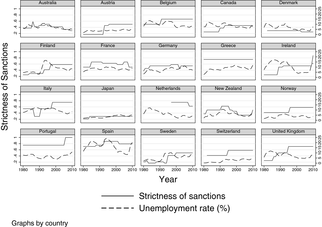
I start the analysis by providing descriptive evidence for the relationship between sanction reforms and unemployment and budget deficits. Figure 1 depicts the varying strictness of sanctions (solid line) as well as the unemployment rate (dashed line) in each country in the dataset. The first thing to note is that countries clearly differ with regard to how often and how significantly they reform their sanctioning rules. The United Kingdom, Ireland, Finland, Sweden, Austria and Italy introduced significant reforms in the period between 1980 and 2012, as indicated by strong increases in the sanctions indicator. Japan, Belgium and Denmark, on the other hand, introduced only a few reforms, and Greece has introduced no significant reforms since 1980. It is also interesting to see that sanctions are occasionally relaxed. Germany in the early 2000s is one example, as are New Zealand and Australia. Relaxations are, however, overall not as common as restrictions, even in economically better conditions, which corresponds to the prevailing finding in the literature that coercive instruments were generally strengthened rather than relaxed in recent decades. This pattern also confirms the presence of the above-mentioned ratchet effect. It hence seems as if policymakers do indeed have other priorities in times of affluence than to reverse harsh measures introduced under economically adverse conditions.
Sanctions and unemployment since 1980

Figure 1 also shows that there is covariation between sanction reforms and the unemployment rate. This is particularly clear in the case of New Zealand, where the strictness of sanctions follows the unemployment rate surprisingly closely but there are also a number of cases where increases in the unemployment rate led to restrictive sanction reforms as indicated by increased strictness scores (for instance, in Sweden and Finland in the early 1990s, in the United Kingdom in the late 1980s and mid-1990s, and in Ireland in the 1980s and in 2009). Similar, albeit less pronounced, developments are visible in Canada and Switzerland in the early 1990s, in Portugal in the mid-2000s, Spain in the early 1990s, and France both in the early 1980s and the mid-2000s. This being said, there are, as always, also some cases that do not fit the predicted pattern. In a few cases, countries restricted sanctions after sustained decreases in unemployment. These include Belgium and Norway in the early 1990s, and Sweden and Finland in the late 1990s.Footnote 7
The fact that sanctions tend to be tightened in times of high unemployment is in line with my argument. In most cases, however, it took at least some years of increased or increasing unemployment before sanctions were eventually tightened. Finland, for instance, experienced several years of rising unemployment in the early 1990s before reforms were eventually introduced. This pattern is certainly not implausible since smaller fluctuations in the unemployment rate will arguably not provide a strong enough impulse to trigger a political reform process. For reforms to happen, a more significant and enduring increase in unemployment is needed.
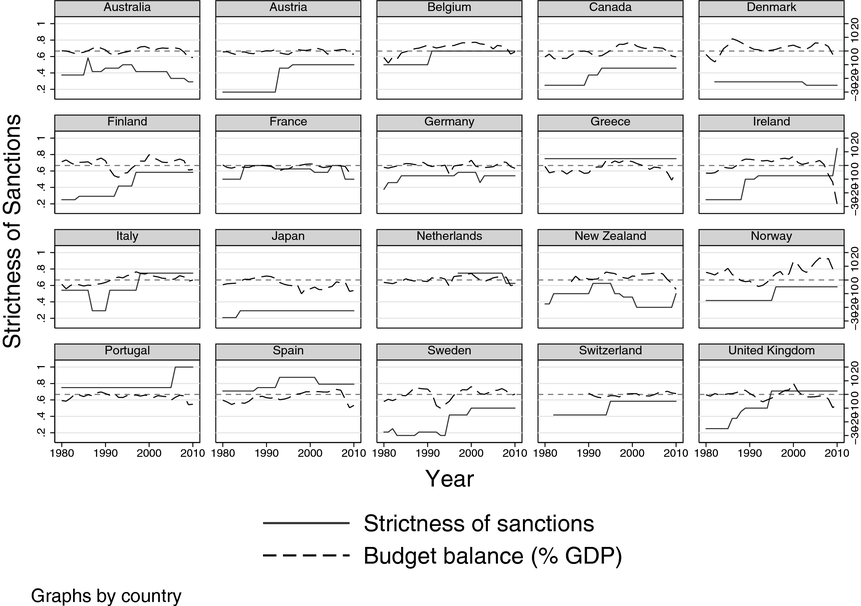
Figure 2 depicts the relationship between sanction reforms and the budget balance. Although not as clearly visible at first sight, the two variables co-vary as well. The significant budget deficits experienced by Sweden and Finland in the 1990s, for instance, were followed by the introduction of tougher sanctions. Particularly illustrative are also the recent reforms in New Zealand and Ireland in 2009. Both countries’ budget balances deteriorated significantly after the onset of the 2008 financial crisis, which in both cases coincided with reforms that tightened sanctions. Austria's budget balance also turned slightly negative in the early 1990s, which was then followed by one significant and one smaller sanction restriction. The case of Spain in the early 1990s is a final fitting case.
Sanctions and budgetary crises since 1980

While these descriptive analyses indicate that sanctioning rules are tightened in response to adverse economic conditions, a multivariate regression analysis is necessary to provide a more thorough test of whether there really are effects of rising unemployment and budget deficits on sanction reforms and also how large these effects are. To provide such a test, I estimate several error-correction models (ECM). ECMs are a type of dynamic regression model that is ideally suited to my analysis because they allow me to estimate not only the instantaneous but also the long-term effects of changes in the predictors (De Boef and Keele, Reference De Boef and Keele2008). This is crucial because the descriptive analysis above indicated that, in particular, the effect of unemployment may only materialise in the long term. For related reasons, Podestà (Reference Podestà2006) also suggested that the ECM should be the preferred model specification for regression models of welfare state reforms. A generic ECM specification looks as follows: the current change in the dependent variable is regressed on both the current changes and the lagged levels of the predictors, as well as on the lagged level of the dependent variable:
 $$\begin{equation*}
\Delta {Y_t} = {\alpha _0} + {\alpha _1}{Y_{t - 1}} + {\beta _0}\Delta {X_t} + {\beta _1}{X_{t - 1}} + {\varepsilon _t}
\end{equation*}$$
The coefficient of the current change of a predictor (β0) captures this predictor's instantaneous or short-term effect, while the coefficient of the lagged level (β1) can be used to compute the overall long-term effect of a change in X. The coefficient of the lagged dependent variable (α1) indicates how quickly this latter effect dissipates over subsequent time periods. The total long-term effect of a predictor, finally, can be calculated as the ratio of the coefficients of its lagged level (β1) and the lagged level of the dependent variable (α1; see also below).
In addition to including the unemployment rate and the budget balance as the two main predictors, I also control for a number of potentially relevant variables: government partisanship (the share of left parties in government), the strictness of dismissal rules for permanent contracts, and the presence of veto points in the political system (the effective number of parliamentary parties, and dummy variables for bicameralism and federalism).Footnote 8 All controls are introduced as both current changes and lagged levels except for the controls for bicameralism and federalism, for which only lagged levels are included. Since these institutional variables are very stable over time, their changes and levels are necessarily very highly correlated. Introducing both into the model thus creates problems of multicollinearity.
The controls for the features of the political system account for the potential distorting influence of institutional and partisan veto players, which may affect how strongly governments respond to economic downturns (Wlezien and Soroka, Reference Wlezien and Soroka2012). Government partisanship is included since there are good reasons to assume that the partisan composition of governments is simultaneously linked to economic downturns and sanction reforms, making it a potential confounder. That partisanship is linked to social policy reforms is, of course, one of the central hypotheses of power resources theory (Korpi and Palme, Reference Korpi and Palme2003).Footnote 9 Partisanship is also linked, however, to downturns since recent research has found that the electoral prospects of left parties are hurt by economic downturns (Lindvall, Reference Lindvall2014). It is therefore possible that any effects of economic downturns on sanction reforms may simply result from the fact that economic downturns favour right parties, who in turn are more likely to introduce tougher sanctions. The strictness of dismissal rules is controlled for to account for the fact that dismissal rules affect the distribution of economic vulnerability in the population, which may in turn affect how countries respond to increasing unemployment (Saint-Paul, Reference Saint-Paul1998; Rueda, Reference Rueda2014).
Finally, I also control for period-specific common shocks by introducing a set of year-dummies and use panel-corrected standard-errors to account for panel-heteroscedasticity (Beck and Katz, Reference Beck and Katz1995). Note that the findings are robust to various different specifications of the statistical model, including using a simple linear time trend instead of period dummies or not controlling for time at all.Footnote 10
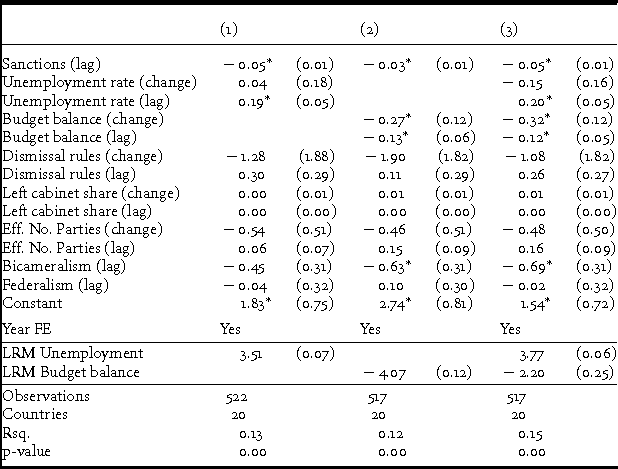
The main results are presented in Table 1. Starting with the first model, which focuses on the effect of unemployment, the short-term effect of unemployment is not statistically significant and changes its sign across model specifications. Short-term fluctuations in the unemployment rate have, in other words, no significant effect on sanction reforms. This corresponds to the patterns shown in Figure 1 above. The lagged level of the unemployment rate, however, has a strong, significant and robust effect, which indicates that there may indeed be a significant long-term effect of increases in unemployment on sanction rules. This effect is, as expected, positive, which also confirms the finding from the descriptive analysis that sanction restrictions follow enduring increases in the unemployment rate.
The effects of unemployment and budget deficits on the strictness of sanctions

Panel-corrected standard errors in parentheses; * p < 0.05
The effect of the budget balance is estimated in the second model. In contrast to unemployment, budget deficits have a significant and negative short-term effect. This indicates that sanction reforms tend to be introduced rather swiftly when countries struggle with budget deficits. The fact that the lagged level is also significant and goes in the same direction suggests that there is an additional long-term effect of enduring budgetary problems, albeit a weaker one.
The third model includes both the unemployment rate and the budget balance as predictors. Although multicollinearity could of course be a problem here, it turns out that the budget balance and the unemployment rate are not overly strongly correlated (ρ = −0.27; p < 0.000), which suggests that there is not much risk in including both predictors in the same model. Doing so does change the results slightly: the coefficient for the lagged level of the budget balance becomes smaller and is estimated less precisely, and the coefficient for the current change in the unemployment rate becomes negative. The overall conclusion remains the same, however.
While the main predictors have rather clear effects, the effects of the controls are very weak. In fact, most have no significant effects at all. Particularly striking is the (not only statistically, but also substantively) insignificant effect of partisanship. This, however, resonates with recent criticisms of the partisanship-argument (Häusermann et al., Reference Häusermann, Picot and Geering2013) and, more generally, the recurrent finding that left governments have on many occasions tightened the access to unemployment benefits in recent decades (e.g. Arndt, Reference Arndt2013). Only bicameralism has a statistically significant effect but this effect turns out to be not robust across model specifications.Footnote 11 The reason why these usually strong political predictors perform so weakly may be that, across all the advanced democracies, there is very little societal support for unemployment benefit claimants who breach benefit conditions.Footnote 12 Hence, left parties and other potential advocates have few political incentives to defend this group and, in the absence of actors with an incentive to oppose sanction rule reforms, the presence of the means to effective opposition (political veto points) makes little difference.
The fact that only the lagged unemployment rate but not its contemporary change has a significant effect indicates that the effect of unemployment works only in the longer run. How strong exactly this long-term effect is can be calculated via the long-run multiplier (LRM)
 $$\begin{equation*}
k = \frac{{{\beta _1}}}{{\left| {{\alpha _1}} \right|}}
\end{equation*}$$
where, as above, β1 is the lagged level of the predictor and α1 is the lagged level of the dependent variable (De Boef and Keele, Reference De Boef and Keele2008: 191-192). The long-run multiplier is the total effect that a change in a given predictor has over all subsequent time periods, starting at t+1.
The long-run multipliers for the unemployment rate and the budget balance, as well as their standard errors, are presented at the bottom of Table 1. All long-run multipliers are statistically significant (all are greater than 1.96 times their standard errors).Footnote 13 An increase in the unemployment rate has a robust and strong long-term effect on the strictness of sanctions. Depending on the model, an increase in the unemployment rate will result in an around three- to four-fold increase in the sanctions-indicator. This corresponds to the patterns shown in the descriptive analysis: Sweden, for instance, experienced an increase in the unemployment rate of around eight per cent between 1990 and 1994, which resulted in a reform that increased Sweden's score on the sanctions-indicator by a bit more than 20 points (see Figure 1).
The long-run multiplier of the budget balance is less stable across specifications and also not as precisely estimated. Controlling for unemployment in model 3 reduces the magnitude of the long-run multiplier of the budget balance considerably. In this specification, the long-term effect of the budget balance is only a bit more than half the size of the long-term effect of unemployment. This suggests, again, that the effect of unemployment unfolds over the longer run, whereas budget deficits have a more immediate impact.
4. Discussion – how well do the findings travel?
The focus so far was specifically on unemployment benefit sanction reforms and the empirical results were based on data from an important yet nonetheless specific historical period. The question remains, of course, whether similar dynamics are also observable in other policy areas and other historical periods.
First, does the argument travel to other historical periods? Data availability is an issue here, of course, but the data we do have suggest that the answer is yes. Alber (Reference Alber, Flora and Heidenheimer1981: 167), who studied the development of unemployment benefit systems in Western Europe up to 1975, reported that the typical length of disqualification periods (as a measure of the strictness of sanction rules) across thirteen European countries decreased from around six and a half weeks in the early twentieth century to around three and a half weeks in 1975. This coincided precisely with the period of buoyant economic growth and full (male) employment during the first three decades following the Second World War. Following this was the return of mass unemployment after the oil price crises and the ‘ratcheting-up’ of unemployment benefit sanction strictness documented above. This indicates that systematic covariation between sanction rules and unemployment is present not only within the decades observed in the empirical analysis but also when viewed over the course of an entire century. This, in turn, suggests that the patterns uncovered here really do represent a very fundamental dynamic of welfare state politics.
Second, could the theoretical mechanism behind sanction reforms I have proposed here also be at work in other policy areas? In general terms, my argument is that the political response to rising problem pressure often consists of tighter targeting of benefits and services at those most in need while greater efforts are made to exclude those seen as ‘undeserving’. When looking at the experiences of three European countries, Austria, Germany and Sweden, since 2015, it seems that the currently highly salient case of asylum policy works according to a very similar logic. Austria, Germany and Sweden all experienced an exceptionally large inflow of asylum seekers in the second half of 2015. The response to this was, in part, increased spending on housing, education, health care, labour market policies, and social benefits. The other part of the response, however, comprised tighter family reunification rules and increased efforts to swiftly deport those whose applications were rejected. The governments of these countries were also eager to emphasise that deportation numbers will, in fact, increase and that support and that protection will only be granted to those who really require it.Footnote 14 All this happened in the context of declining popular support for the respective governments and increasing support for populist right-wing parties.Footnote 15 In this case, as in the case of unemployment benefit sanctions, governments imposed coercive measures on politically and economically weak groups to assure the general public that tax revenues are not spent on the ‘undeserving’. It seems thus that the turn toward tougher sanction rules in response to unemployment observed here is indeed also indicative of a more fundamental political dynamic of ramping up punitive instruments and thereby excluding claimants deemed ‘undeserving’ in response to rising problem pressure.
5. Conclusion
This paper was concerned with the political determinants behind the trend toward tighter unemployment benefit sanctioning rules in the advanced democracies of Europe, North America and Australasia over the last three decades. It has showed that sanctions are often tightened following long-term increases in unemployment and short-term increases in the budget deficit, as well as to reduce spending or to compensate for expansionary measures.
These findings have further implications for research on the politics of welfare state and labour market reform. One implication concerns research on the ‘activation turn’ in labour market and social policy-making (Eichhorst et al., Reference Eichhorst, Kaufmann and Konle-Seidl2008a; Bonoli, Reference Bonoli2013), where sanction reforms are typically thought of as activation policies. This paper provides a different way to think about sanction rule reforms, namely not as labour market activation measures as such but rather as measures to reduce costs and to compensate for other spending. A second implication concerns the literature on the politics of welfare state retrenchment, and, in particular, research on the question of how governments respond to economic downturns. The welfare state literature often either implicitly or explicitly assumes that governments respond to crises and the increased economic vulnerability of voters by expanding (or at least not retrenching) social protection programmes, at least in the case of those programmes that provide coverage against risks that vary with the state of the macro-economy (Jensen, Reference Jensen2007; Rueda, Reference Rueda2006; Clasen, Reference Clasen2000; Blekesaune and Quadagno, Reference Blekesaune and Quadagno2003).Footnote 16 This view has received some criticism recently as studies have shown that electorates as a whole may actually become more favourable toward retrenchment, leading governments to respond accordingly (Davidsson and Marx, Reference Davidsson and Marx2013; Barnes and Hicks, Reference Barnes and Hicks2015). My argument takes a middle way: while governments do respond to crises by expanding programmes for vulnerable groups, they also take care to ensure that not more is spent than necessary by disqualifying ‘lazy’, ‘choosy’ or otherwise ‘undeserving’ claimants more consequently via tighter sanction rules. Whether this always affects only the truly ‘undeserving’ is, of course, a different question.
As a final step, I want to discuss the limitations of my study. First, adverse economic conditions, which have been in focus here, are probably not the only drivers of sanction reforms, as other research suggests. Clasen (Reference Clasen2000), for instance, argues that both institutional variables as well as policy-diffusion processes may also have significant effects on the shape and likelihood of reforms. While my analysis found no effects of institutional variables, policy diffusion processes cannot be ruled out yet since they have not been assessed here. A test for their effects would require an entirely different empirical analysis (see e.g. Jahn, Reference Jahn2006), however. Conducting such an analysis would seem like an interesting endeavour for future research.
Second, it is important to point out that the focus here has been on the general patterns of variation in sanction rules, while any period- or country-specific contextual factors and nuances have, as is typical in large-N research, been de-emphasised. Still, the descriptive analysis has shown that there are at least a few exceptions defying the general pattern. It seems hence that the introduction of tougher sanction rules in response to economic troubles is not automatic and that there may be factors that can bring about deviations from this general pattern. One potential factor could be, as very recently shown by Kootstra and Roosma (Reference Kootstra and Roosma2018), opinion framing through political discourse. Kootstra and Roosma show that exposing proponents of sanction policies to counterarguments can make them more critical of these policies, with moral counterarguments being more effective than economic ones. Relatedly, Fossati (Reference Fossati2018) has shown that voters’ attitudes toward demanding activation policies are shaped by the prevailing public discourse around unemployment and activation, with voters in traditionally more ‘enabling’ countries such as Denmark being less supportive of harsh demanding policies than voters elsewhere. Hence, opponents of harsh sanctioning reforms may be able to counteract tougher sanction rules if they manage to frame the public perception of unemployment and the unemployed and thereby reduce public support for such reforms.
At the same time, however, one needs to be realistic about the possibilities that public opinion as a whole can really be shifted by persuasion and framing. As research on framing effects in competitive environments (Druckman, Reference Druckman2004) has shown, the simultaneous exposure to directly competing frames and arguments – as is usually the case in liberal democracies – significantly reduces, and may even completely eliminate, any framing or persuasion effects. Nevertheless, investigating whether there is still potential to change public support for harsh sanction rules and other demanding policies even in competitive political environments could be another interesting avenue for future research.
Acknowledgements
Previous versions of this paper were presented at the 2016 Conference of Europeanists in Philadelphia, PA, at the 2016 ECPR Joint Sessions of Workshops in Pisa, at the IDHEAP Labour Market Colloquium at the University of Lausanne, and at the Centre for Welfare State Research at the University of Southern Denmark in Odense.
Supplementary material
To view supplementary material for this article, please visit https://doi.org/10.1017/S0047279418000740