Introduction
In developing countries marital status has been mainly studied because of its impact on fertility given that most births take place within marriage (Newell, Reference Newell1988). Much of the information derived from World Fertility Surveys (WFS) or Demographic and Health Surveys (DHS) has concentrated on the married population at risk of conception (Van de Walle & Foster, Reference van de Walle and Foster1990). This is because the level of fertility is the primary determinant of population growth in most developing countries, and because fertility is correlated to the length of exposure in marital unions. The combined effects of social and cultural identities with modern economic constraints as related to marital union formation, have not been fully understood in Africa, partly due to the paucity of demographic data with detailed information on union formation. The common perception is that cultural values and identities, as measured by proxies such as ethnicity, religion or place of origin, govern union formation in Africa, and that couples do not so much consider the economic viability of their household before engaging into a union. But is human capital, as measured by education and economic status, so inconsequential in the decision to marry in Africa? This paper is an attempt to identify a range of factors influencing union formation in a changing social and economic context with data from Nairobi, Kenya.
Nairobi, with over 2.1 million inhabitants in 1999, is one of the major cities in Eastern Africa, comparable in population size to Addis Ababa (Ethiopia) and Dar es Salaam (Tanzania). However, it has been the subject of few comprehensive studies. Apart from monographs on informal enterprises and settlements and DHS surveys that are addressing mainly fertility and mortality issues, no survey has been able to offer a representative sample of the city. It has therefore been almost impossible to capture the diverse social components of the citizens of Nairobi through a common analytical tool. This was the aim of the Nairobi Urban Integration Project (NUrIP), which provides most of the data for the present paper. The project's main purpose was to measure the medium- and long-term effects of macro-economic changes on the job market, access to housing and on demographic events such as entry into marital union and parenthood. A representative sample of three cohorts of 901 women and 684 men aged 25–54 in 2001 were interviewed within Nairobi, representing a population of about 2.3 million inhabitants. The main tool for collecting data was the biographical questionnaire (available on request), which collects the aspects of individual lives that change over time and that can be well remembered and dated. The design of the questionnaire allows for the recording of important residential, professional and family changes at each point in time since birth, by the use of an ‘Age and Event recording form’ to help the interviewer and the respondent to better locate in time the occurrence of events experienced by the respondent, in relation to a historical calendar. In this paper, all but a few variables used in the regression analyses are time-varying, thus making causal analysis free of the temporal order issue common in cross-sectional data analysis.
From the biographies collected, the timing of union formation of 496 men and 459 women who at some point in their lifetime were found single in Nairobi was analysed. The retrospective nature of the data and the control for the place of residence since birth allowed for the study of the determinants of union formation from the 1960s to the 1990s, for both men and women residing in Nairobi. This article gives new insights into the relative importance of education and occupation over social and cultural origins in explaining first-union formation, and its informality and delay, in an urban African setting. It also explains the influence of fertility on union formation.
Background
Africa has long been a region of very early and universal marriage, and large age difference between the spouses (United Nations, 1990). This generalization may no longer hold as social and economic changes alter the social meaning of marriage and marriage patterns in Africa (Meekers, Reference Meekers1992; Gage, Reference Gage1998). The old norm of female universal marriage may no longer be valid on the continent (Van de Walle, Reference van de Walle, Foote, Hill and Martin1993). Antoine (Reference Antoine2000), using various measures of marriage prevalence from the Demographic and Health Surveys, showed an increase in age at first marriage of women in most urban areas of Africa.
Education and industrialization were expected to give way to the Western type of families and delay female age at marriage (Macfarlane, Reference Macfarlane1981), gradually abolishing polygynous unions and leading to a decrease in arranged marriages, in favour of courtship and partner choice. Yet, Meekers (Reference Meekers1992) observed that this expectation has not been fully realized, and in fact there has been an integration of traditional with Western family models. Antoine (Reference Antoine2000), by comparing various data sets over the second half of the twentieth century, showed that polygyny remained important, in West Africa in particular, and that it did not disappear in urban areas. It is in the English-speaking countries of Africa that polygyny decreased most, particularly in Kenya. Ezeh (Reference Ezeh1997) showed that polygyny levels in the country declined by 33% between the 1977/78 Kenya Fertility Survey (KFS) and the 1993 Kenya Demographic and Health Survey (KDHS). Official polygyny has often been replaced by official monogamy, sometimes accompanied by informal unions with extra-marital partners.
Marriage is in Africa, perhaps more than in any other continent, a process rather than an event. Entry into union may take place over an extended period of time and the date at which formal marriage occurs may be subject to several interpretations (Van de Walle, Reference van de Walle, Foote, Hill and Martin1993). The payment of bride wealth, the ceremonies, the cohabitation of spouses and the eventual consummation of marriage can take several months, but not necessarily in that order (Meekers, Reference Meekers1992). Traditional marriages may not be legalized immediately under the modernization process, but could take several years of living together under customary law, before couples formalize their union through civil or religious ceremonies. In addition, there has been an increased incidence of couples beginning their marital life without any formal ceremony. Conversely, a sizeable proportion of formal marriages are contracted without co-residence of spouses. Thus, the coexistence of various forms of union complicates measurements of trends in union.
The economic model of marriage hypothesizes that couples and families weigh carefully economic considerations against normative costs derived from social pressure and traditional moral codes before entering into first marital union at a particular time or delaying the process. Becker (Reference Becker1974) predicts that marriage occurs when the benefits of marriage exceed the costs. The economic gains that accrue to marriage derive from the production of household commodities such as food, companionship and children. Thus, under the assumption of rationality, if an individual's share in the optimal output of these commodities in a married household exceeds that in a single household then the individual will marry. The timing of first marriage also depends on the lifetime costs and benefits. The age at first marriage can be treated as an optimal time of transition from single to married. Lam (Reference Lam1988) extended Becker's hypothesis that the existence of household collective goods such as housing or children often leads to positive assortative mating (i.e. highest income man to highest income woman who bear children and share the respective costs of rearing them). If the joint income of a couple is below a threshold required for them to desire to bear children then there will be no incentive to marry. Economic cycles may exert pressures on marriages and births and these operate through time trajectories involving lags and echoes. In pre-industrial Western Europe, high grain prices were almost inevitably followed by a sharp fall in the number of marriages (Palloni et al., Reference Palloni, Hill and Aguirre1996). This indicates a behavioural effect involving economic considerations regarding the prospects of establishing a self-sufficient household. A long-lasting economic effect can result in a permanent disequilibrium in the marriage market, with large proportions of members of a cohort never marrying or remarrying (National Research Council, 1993; Palloni et al., Reference Palloni, Hill and Aguirre1996). It is evident that postponement of marriages, especially the first, is a very common response to economic crises and recessions, and is said to be the only Malthusian mechanism with some relevance to population change (Gaisie, Reference Gaisie1996).
These explanations, mainly derived from observations on marriage timing under rapidly changing socioeconomic conditions in developed countries, led to the ‘independence model’, also called the ‘trading and specialization model’, largely formulated within the new home economics theories (Becker, Reference Becker1974, Reference Becker1981). It states that a major benefit of marriage is the mutual dependency that arises from the gendered division of labour between spouses. Men tend to specialize in market work and women on household activities. This tendency makes marriage desirable because of the trading of different skills, which is beneficial to both partners. During the process of development, rising female education and labour force participation reduce gender specialization and makes women less dependent on men. As a consequence, economic gains because of marriage tend to decrease for women, rendering marriage less desirable. It therefore predicts that women's independence increases when they improve their education and occupational and economic profiles. Marriage will be delayed and the proportion never marrying will increase among women. On the other hand, for men, the attainment of high human capital generally improves their position in the marriage market by increasing their attractiveness to potential wives. Men with high human capital will therefore be more likely to marry than those with less.
Yet, the independence model has been considered to be weak in prediction, especially in studies at the micro level on transitions to first marriage (McLaughlin & Litcher, Reference McLaughlin and Lichter1997). It only tends to explain female rather than male entries into marriage and does not account for premarital relations such as cohabitation. In contrast to the independence model, Oppenheimer (Reference Oppenheimer1994) has shown that women with higher education are more likely to marry than those with less education and lower earnings. Employment may increase women's access to economically more attractive men in the workplace and may enhance their attractiveness as potential partners (Oppenheimer, Reference Oppenheimer1988). Such observations have generated the ‘marriage search model’, in which the timing of marriage is dependent upon the interactions of human capital acquisition by both men and women, the timing of transition from schooling to work careers and duration of transitions out of schooling (Parrado & Zentuno, Reference Parrado and Zenteno2002). Successful marriage matches are affected by the uncertainties surrounding the current and future attributes of potential partners (England & Farkas, Reference England and Farkas1986). One such player is the structure of the labour market and the desire to establish one's own household (Lindberg et al., Reference Lindberg, Nathanson, Pleck and Wolpin1997).
For men and women, the period of human capital investment (notably the schooling period) conflicts with family responsibilities and discourages union formation. After school, educational attainment, and other factors (assets, independent housing, etc.) that indicate potential success in the labour market, facilitate marriage and raise the issue of gender differences in economic activities and its impact on marriage timing (Parrado & Zentuno, Reference Parrado and Zenteno2002). Berstrom & Bagnoli (Reference Berstrom and Bagnoli1993) suggest that in traditional societies, women are valued as marriage partners for their ability to bear children and manage the household, while men are valued for their ability to make money. Information about how well a man will perform economically in the future only becomes available at a later age than the relevant information about how well a woman will perform her household roles. This leads to the prediction that men who expect to do poorly in later life will marry at a relatively young age, and men who expect to prosper will postpone marriage until their success becomes evident to potential partners. Wilson (Reference Wilson1987) argued that women's search for partners is confined to a pool of marriageable men, i.e. men who bring resources to the household. For men, indicators of successful career development such as education, or stable employment, facilitate marriage. For women, it is rather the interactions between education and labour market opportunities. Parrado & Zentuno (Reference Parrado and Zenteno2002) argue that where the labour market is segmented, with very few skilled jobs for women, then the educated elite will take up such positions. Women with less education, like their male counterparts, face poor employment prospects and are found primarily in the domestic or informal economy. The least educated, since they are not expected to supplement the household economy, may work or not work outside the home. Therefore, women with intermediate levels of education face substantial uncertainty because they are not qualified enough for the skilled professional jobs but are overqualified for domestic work. They face the greatest difficulties in translating their skills into commensurate employment status.
When poverty and unemployment are rampant, as it is in most developing countries, families develop survival strategies to ensure a better standard of living and therefore women's contribution to the household economy may become important (Oppenheimer, Reference Oppenheimer1994, Reference Oppenheimer1997; Parrado & Zentuno, Reference Parrado and Zenteno2002). According to the marriage search model, women with higher human capital potential are more likely to enter into marriage than those with weak potential. Oppenheimer (Reference Oppenheimer1994) hypothesizes that an adaptive strategy for both husbands and wives is to work in the labour market. This increases incidence of cohabitation since couples utilize such options to explore prospects for living with a partner in order to gather more information about the long-term potential of the partner while still enjoying the short-term benefits of living together.
Data and Methods
Hypothesis
The slow but continuous decline of the GDP per capita growth that Kenya experienced in the 40 years since independence has been paralleled with a dramatic expansion of schooling that may have affected men and women in various ways. The economic situation was such that the GDP per capita growth started to decrease in constant terms from the 1990s and became negative in absolute terms in 2000 (Kenya Economic Survey, 1970–2001; Bocquier, Reference Bocquier2005). As a consequence, entry of the youth into the labour market was delayed, creating unemployment and expansion of the informal sector. Since the Kenyan economy has deteriorated from a rather booming situation (when the coffee market was at its peak in 1978) to depression over the past 40 years it would be expected that differences in union formation would appear not only over the generations but also across the social spectrum, as measured by differences in education and economic status. The hypothesis of this paper is that in Nairobi human capital factors supersede social and peer pressures deriving from cultural and social contexts in explaining marital union and the timing of this union. Event history data analysis will test variables measuring religious affiliation, cultural origins (father's ethnicity) and place of residence at age 15, against those measuring the level of education, the household status (position in the household) and the economic status (tenancy status, economic occupation). Analysis is done for both women and men to check if factors influencing entry into first marital union differ by gender, and in which direction. This will help to confront the data with the three main theories identified in the literature review, i.e. the integration model of Meekers putting emphasis on the social and cultural community context and pressure, the independence model of Becker highlighting the economic rationale underlying the marriage market, and the search model of Oppenheimer considering marriage as a matching process between individuals with varying human capital. These three theories attempt to explain the decline in the centrality of marriage in terms of the benefits accruing and the timing of these events as a result of changing social and economic contexts. These models, at the time they were conceptualized, referred mainly to formal marriage, although the latter also integrated more recent types of marriages in the form of cohabitation. The main objective of the paper is not so much to come up with a comprehensive marriage model for Nairobi (for that, we would need more complex and extensive data), as to measure the relative weights of the three types of determinants of union formation identified by these theories.
Choice of the dependent variable
Before going into the methodological details, this section justifies the dependent variable that is used throughout this article. Subsequent analyses make no difference between first unions, whether informal (i.e. simple cohabitation) or formal, by way of religious marriage (Christian or Muslim), customary law marriage or civil marriage. In the sample, none of the formal marriages occurred without cohabitation. The assumption is that the difference between marriage and cohabitation is often tenuous in Kenya, hence the use in this study of the proxy term ‘in union’ to depict married as well as cohabiting couples, following the terminology used by Hattori & Nii-Amoo Dodoo (Reference Hattori and F. Dodoo2007). This unusual choice is based on the observation that couples in Nairobi not only stay a long time in informal union – familiarly referred to as ‘come we stay’ – but that cohabitation is not necessarily a transient state toward formal marriage. Exploratory data analysis can easily show this phenomenon.
The descriptive analysis in the next section shows the high and increasing proportion of informal unions in Nairobi. Between two-thirds and three-quarters of all unions are informal (simple cohabitation), depending on the mode of computation, and transitions from informal to formal unions are rare. This implies that if only formal unions were to be taken into consideration, the sample would be too small and the transitions too late for meaningful analyses and interpretation. For the purpose of this paper, the dependent variable in all subsequent analyses of the timing of first union will combine the majority of informal unions (‘come we stay’) and the minority of formal unions.
Sampling issues, bias correction and data quality
The sampling objective was to get a representative sample of three generations aged 25–34, 35–44 and 45–54 at the time of data collection (mid-January to mid-May 2001) in Nairobi Province. The experience of entering adulthood for these three generations (referred to as the ‘older’, ‘intermediate’ and ‘younger’ cohorts, respectively) was the focus of the research.
The household sampling procedure was a stratified two-stage sampling. Nairobi was stratified into eight main administrative areas. Because of the difficulty in accessing certain areas, the population of the agglomeration outside the administrative boundaries was not sampled, although it was estimated that Greater Nairobi consisted of an additional 15% of the population of the province. To avoid a clustering effect, a large number (130) of Enumeration Areas (EAs) scattered among the eight administrative areas were sampled. The number of selected EAs from each stratum h was proportionate to the number of households in each administrative area, i.e. the number of selected EAs per division (mh) was expected to be roughly equal to: 130 * Total No. households in area/Total No. households in Nairobi.
Because EA size was not available from the 1999 Census, EAs were simply randomly sampled. The probability of an EA being selected is mh/Mh, where Mh is the number of EAs in an administrative area h. The households of each selected EA were listed with the help of Central Bureau of Statistics maps. Then this enumeration list was used randomly to select a sample of 35% of households in each selected EA. The probability of a household in an administrative area h being selected is 0.35×mh/Mh. All households from the same administrative area have the same weight, but there are more households from large EAs in the sample.
To obtain a comparable number of biographies of women and men for the three cohorts aged 25–34, 35–44 and 45–54 (forming six strata), individuals from the selected households were randomly drawn with different sampling rate in each stratum: 1 out of 2 men aged 45–54, 1 out of 1 women aged 45–54, 1 out of 4 men aged 35–44, 1 out of 2 women aged 35–44, 1 out of 8 men aged 25–34 and 1 out of 6 women aged 25–34. Out of the 3787 households surveyed, representing 14,343 individuals of all ages, 1585 biographies were collected.
The targeted sample of individuals suffered a 15.4% loss due to absence or refusal to respond from either the entire household, or from particular household members. A comparison with the 1999 Kenya Population Census shows that this sample had fewer small households (more difficult to visit) than bigger households: households with one or two members account for 30.4% of the sample against 41.1% in the 1999 Census. As a consequence the household survey shows an average of 3.79 persons per household as against an average of 3.23 persons according to the 1999 Census. The analysis of biographies would be biased if the losses both at the household level and at the individual level were not random.
To test for potential biases, the probability of being interviewed was computed using a probit regression analysis. To perform the bias analysis after data cleaning, the 2001 sample of biographies was merged with the 5% sample from the 1999 Census data. The biographies were weighted according to the above-mentioned unequal sampling weights to account for the unbalanced age structure of the population. In other words, the weighting was done as though the biographies were directly drawn from the Census, making the hypothesis that the two-year lag between the two data set would not distort the analysis. Since the samples are drawn from two different universes, the bootstrap method had to be used to compute confidence intervals. From this analysis (results not shown here) sampling-bias corrected weights were computed and used in all subsequent analysis of union formation.
The cluster effect, resulting from the possibility that some respondents were interviewed in the same household, is negligible. First, analyses are conducted separately for men and women, thus reducing the clustering effect to same-gender clusters. Second, only 2.6% of male respondents and 6.4% of female respondents were interviewed in the same household as another respondent of the same gender. Lastly, in this retrospective data set the fact that some individuals lived in the same household at the time of the survey did not imply that they did at all time during exposure. The same holds for clustering effect due to the interview of respondents in the same enumeration area. Nevertheless, in order to prevent sampling bias from affecting all subsequent regression analyses, the more conservative bootstrap method (1000 replications) was used to compute confidence intervals instead of the standard Breslow or Efron methods offered by Stata, the software used for the computations.
In summary, after controlling for biases, the analytic sample is representative of the 25–54 age group living in Nairobi in 2001. For the analysis of union formation, 955 respondents (496 men and 459 women) who at some point in their lifetime were found single in Nairobi were selected out of 1434 respondents age 25–54 in 2001.
Analytic tools and approach
The originality of the biographical questionnaire does not hinge on the complexity of the questions asked of the respondents, but rather on its capacity to reconstruct the chronology of life events. Before filling in the biographical questionnaire, an ‘Age and Event recording form’ was used to help the interviewer to sketch the biography, i.e. to better locate the time of occurrence of events experienced by the respondent. Family events such as births, marriages and deaths were first recorded on this form as they are usually the best remembered, and also because they are usually officially recorded in the vital registration system and certificates often shown spontaneously to the interviewer. Then residential and professional events were placed along a timescale where main historical national events were also mentioned. In this way event ordering was easily achieved and confirmed, which is important to get consistent time-varying covariates for subsequent analysis. Only changes separated by more than 6 months were recorded. Hence, with the biographical questionnaire, it was possible to identify the residential, professional and fertility status at each point in time from age 15 years to the time of interview with a 6-month precision.
This data collection procedure cannot avoid all recall biases but is meant to reduce them to a minimum. In particular, it is possible that informal unions among the older generation that took place a couple of decades before the survey (e.g. when they were as young as 15 years) will go unreported. In that case, the rise of informal unions would be spurious. However, comparison with Census data shows consistency with the trends depicted by the retrospective data.
All analyses were conducted separately for men and women. The generation group was used as a stratification variable in all analyses to reflect the sampling design. The ordinary covariates are place of residence at age 15 (Nairobi, other urban area, and rural area) and father's ethnicity in four homogeneous groups from the point of view of language and customs plus a heterogeneous group of ethnic minorities. In Kenya, most people refer to their father's ethnic group when asked their ethnicity. Only 4.3% of the sample was born from a mother of a different ethnic group than their father's.
The remaining are all time-varying covariates identifying the status of the respondents before the event took place, at the time when they were at risk of experiencing co-residence. In this way issues of temporal order that most non-longitudinal studies face using cross-sectional data were avoided. Religious affiliation, which is supposed to set the matrimonial rules, was recorded in the field into ten categories. Grouping them in large homogeneous groups would be hard to justify because of the diverse religious affiliations in Kenya. The main religious groups represent between 3% and 28% at the time of survey, while minorities are grouped either within ‘other Christian’ (21%) or ‘other religion’ (3%). In this study, ethnic group and religious affiliation, both governing the rules and norms of marriage in Kenya, are considered to be good quantitative proxies for the many social and cultural factors that can influence entry into union. Household status originally had six categories: household head (HH), son/daughter of HH, sibling of HH, other relative of HH, non-relative of HH, and employee of the household. When they are not HH, respondents are generally housed by the HH. Therefore, the tenancy status (housed, tenant, or owner) is only relevant for the HH. To avoid collinearity between household status and tenancy status the two variables were combined into one by splitting the HH category in three according to the tenancy status. The new variable now has eight categories. Occupation was coded into ten categories. Apart from the periods of study, inactivity, unemployment, and apprenticeship, the periods of employment were categorized into self-employment and wage employment. Self-employment was further divided into three categories, namely family business, own informal business and own formal business. Wage employment was coded into three categories from the most informal to the most formal job: no fixed salary, fixed salary but with some kind of record, and fixed salary with payslip. In this way, the effect on the timing of union formation of the quality of job, measured by the degree of formality in self-employment and wage-employment, could be captured. Education was coded in four categories from no formal education to primary, secondary and tertiary education. Fertility prior to union formation was categorized as confirmed pregnancy (i.e. at least three months) status ranked 1 and 2 or more, and through the number of living children (either 1 child or 2 children or more). Pregnancies that led to miscarriage or abortion were not taken into account. The pregnancy periods before union were derived from information collected on live births only. Since information on short pregnancies and still-births was not collected, the estimates are probably biased downward. Lastly, all models control, through an age-period variable crossing age group and historical period (by step of five years), the possible effects of unobserved economic and social macro changes.
Given that the categories for each covariate are relatively straightforward, and because of the face-to-face nature of the interviews, very few missing values were observed. After interviews, most missing information was corrected through careful examination of open-ended questions, interviewers' notes and successive events of each respondent. At the analysis stage, among the relevant covariates, only household status was left with missing values. These missing cases were grouped with the ‘non-relative’ category, making the hypothesis that if the respondent knew he/she was related to the household head, he/she would have at least responded ‘other relative’. Given the very low proportion of missing values for this covariate (2% of all cases), the consequence for the results is expected to be negligible.
Some covariates, like religious affiliation, household status, occupation and fertility status, have many categories, resulting in potential loss of statistical power. Models presented in the next section were tested with and without grouping of related categories, but the results showed no difference in the direction or significance of the effect for other categories or covariates. The bootstrap standard errors used in the semi-parametric proportional hazard models framework explain the robustness of the results.
The first descriptive step in event history analysis (EHA) is to compute the median time of occurrence of each type of event and to compare those medians over generation and gender. This is done through the computation of the survival or Kaplan-Meier tables (Kalbfleisch & Prentice, Reference Kalbfleisch and Prentice1980). The principle is to take into consideration the time from a starting point (chosen to be the same for all individuals who can possibly experience the event) until the occurrence of the event or until the end of observation. The second and more technical step in EHA is to use the Cox model, also known as the semi-parametric proportional hazards model. The dependent variable is called the event and the objective of the model is to measure the effect of other variables on the occurrence of this event. The model is specified as follows:

where h 0(t) is the baseline hazard and β is a vector of parameters to be estimated and X is a vector of covariates or independent variables. The latter can be either fixed in time (such as gender, generation or ethnicity) or time-dependent in order to capture the interaction between events that are of particular interest in analysing biographical data (Kalbfleisch & Prentice, Reference Kalbfleisch and Prentice1980; Andersen et al., Reference Andersen, Borgan, Gill and Keiding1993).
The possible effects of sample design by generation and gender were controlled by stratifying the regression equations by generation and doing analysis separately for each gender. In particular, estimates were computed using the stratified Cox model:

g=1,2,… k.
The subscript g represents the g th stratum corresponding to the k different categories of the stratification variable. The stratified model allows for different baseline hazard functions h 0g(t) for each of the different strata but the coefficients βi are the same across strata. In other words, the timing of event may be different for each stratum but the effect of the covariates is assumed to be constant at each point in time. This proportionality assumption is relaxed by the use of time-varying covariates.
The unit of analysis is the person-year, hence the standard errors are adjusted for clustering on the individual along exposure. The household clustering effect is believed to be negligible but standard errors are computed using the conservative bootstrap method for safety, as explained in the previous section.
These different techniques are believed to allow the optimal use of the data taking into consideration all the time at risk and controlling the factors that can bias the analysis. By excluding time when the respondents were not yet in Nairobi or temporarily out of Nairobi, only the conditions prevailing during time of exposure in Nairobi are measured. In each table of regression analysis results, only the significant covariates are indicated and the list of other non-significant covariates appears in a note below the table.
The next section analyses the trends in union formation in Kenya on the basis of evidence from various censuses that have been undertaken in the country. The second section examines the evolution of entry into first marital union by gender and generations in Nairobi, using the survey data. With the same data, the last section before the conclusion examines the underlying factors influencing entry into first marital union by gender and generation.
Results
Cross-sectional analysis
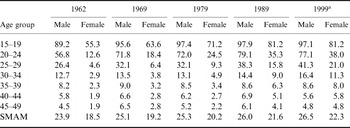
Both the expansion of secondary schooling (gross secondary education enrolment increased from 28% in 1991 to 39% in 2000, according to the UNESCO Institute for Statistics database) and the shrinking formal labour market (decreasing from 75% to 56% between 1980 and 1999 in urban areas; Bocquier, Reference Bocquier2005) may have influenced entry into marital union across the generations. Table 1 presents trends in union formation in Kenya for various censuses that have been undertaken in the country over the years. Indeed, the proportion that remained single has declined progressively by age and from one census to the next. After age 40, the proportion that never married remained very low. This confirms that union formation in Kenya, as in most developing countries, has been near universal, the percentage single reaching 5% or less at age 50. Yet, the results show that the proportion of single women has been rising at all ages, but particularly before 35. This has in turn resulted in a steady rise in singulate mean age at marriage (SMAM) from 23.9 to 26.5 for men and from 18.5 to 22.3 for women. The male–female gap in SMAM was about 5 to 6 years between 1962 and 1979, but this declined slowly to 4.4 years in 1989 and 4.2 years in 1999. Men experienced a less dramatic change than women in the proportion single from 1962 to 1999. The proportion never married at age 45–49 varied only slightly from 4.5% to 6.5% for men but increased more steadily for women (from 1.9% to 4.8%) between 1962 and 1999.
Proportion single by age and gender (Kenya Censuses, 1962–99)

a 5% sample.
SMAM: singulate mean age at marriage.
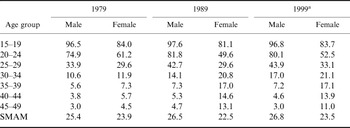
The results in Table 2 indicate more dramatic changes for women in Nairobi than for the country as a whole. The proportion of women remaining single has been increasing over the years and by age group. At age 30–34 the proportion never marrying increased from 12% to 21% between 1979 and 1989, and over age 35 the proportion increased two and a half times between the same dates. The proportion stabilized between 1989 and 1999. One unique feature is the cross-over of the trend for women and men. Beyond age 30, more women remained single than men. At age 40–49, about 1 out of 8 women were still single while the proportion was four times less for men.
Proportion single by age and gender (Nairobi Censuses, 1979–99)

a 5% sample.
SMAM: singulate mean age at marriage.
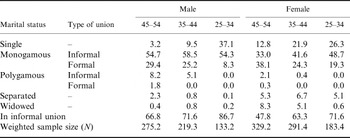
The census data do not offer details on the type of unions contracted. Do couples engage mostly in formal marriage? Is cohabiting commonplace? It is not clear what respondents will understand by ‘marriage’, and the authors' contention is that the published census figures suffer from a conformity bias, as most cohabiting couples may respond in affirmative to the question on marital status to avoid giving cumbersome explanations to the interviewer. The NUrIP data confirm that the term ‘married’ as used in the Census could lead to misinterpretation and actually depict all sorts of union. Table 3 shows the proportion of respondents by marital status at the time of the survey, in 2001. Comparison of the three generations is not so straightforward because the exposure periods are not the same for all generations. Nonetheless, the table is presented here for two reasons: first to show that the percentage single in the survey is consistent with census figures for 1999 (Table 2) and second to show the importance of informal unions, i.e. cohabitation. Therefore, it appears that the census is capturing all types of unions, from simple cohabitations to formalized marriages.
Percentage distribution of respondents by marital status and generation in Nairobi at the time of survey (2001)

Note: Weights are sampling biases corrected weights. Figures may not add to 100 because of rounding. Informal here means cohabitation, as opposed to formal marriage by way of a civil, religious or traditional ceremony. A polygamous man is said to be engaged in informal unions when all unions are informal.
From Table 3 it appears that informal union actually formed the majority of all unions in Nairobi in 2001. Informal unions represented from the oldest to the youngest generations 67% to 87% of all men in union, and 48% to 72% of all women in union.
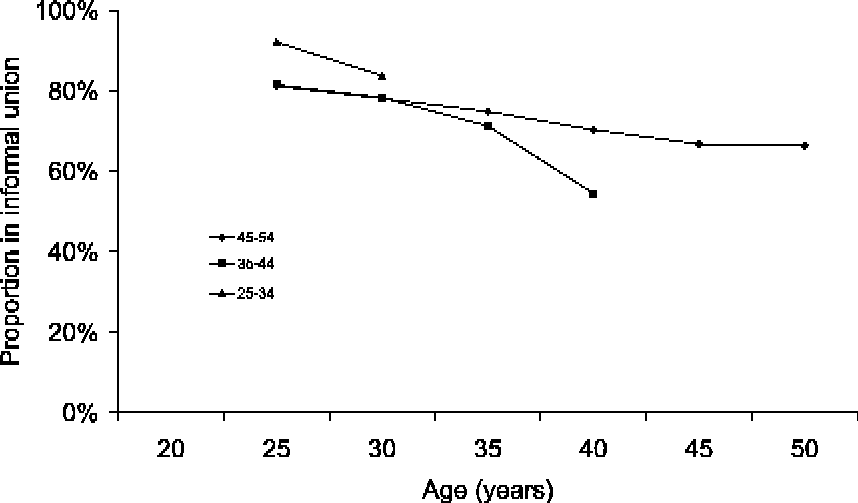
A good exploratory tool to test the importance of informal unions using retrospective data is to compute from the biographies collected the percentage in informal union in each generation at age 20, 25, 30, etc., for periods of stay in Nairobi. The retrospective nature of the data is subjected to migration and mortality biases, but this cross-sectional way of analysing retrospective data gives a fairly good idea of the trends regarding informal unions over the life cycle under the conditions prevailing in Nairobi.
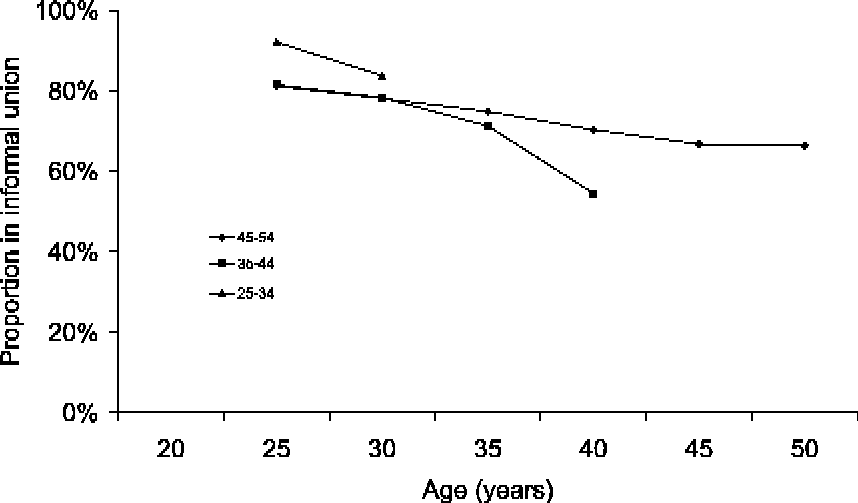
Figure 1 presents the proportion of men in informal unions by age and generation among all men in union. For the older generation, the proportion in informal unions decreased slightly with age, from above 80% at 25 years old (the earliest age at which there were enough men in union) to more than 65% at 50 years old. In the middle generation, the proportion declined from 80% at 25 years old to 55% at 40 years old, a level below that of the older generation (70%). In the youngest generation, the proportion in informal union is higher (92% at 25 years old): this may show a delay in formalizing the union, adding to the delay in union formation.
Proportion in informal union among men in union by age and generation.
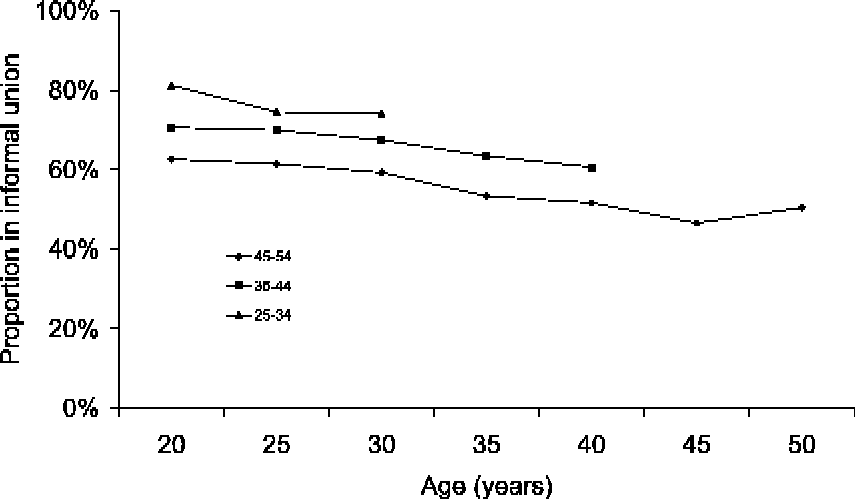
Proportion in informal union among women in union by age and generation.
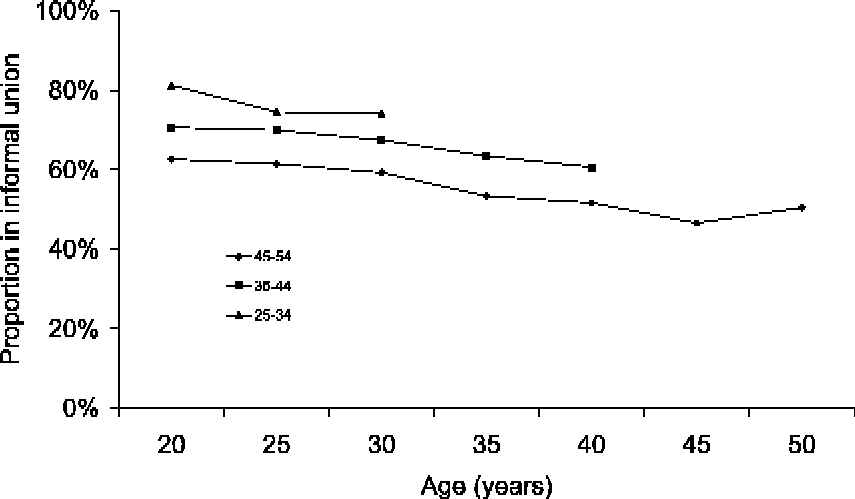
The proportion of women reported being in informal unions increases from one generation to the other (Fig. 2) more distinctly than for men. For the older generation, this proportion decreases from over 60% before age 25 to around 50% at age 50. The proportion is about 10 percentage points higher in the middle generation and almost 20 percentage points higher in the youngest generation. As already noted for the men, the increasing proportion in informal union illustrates a delay in formalizing the unions. Both Figs 1 and 2 confirm the high and increasing proportion of informal unions.
Informal unions form 74.5% of all first unions recorded in the sample and 64.9% of the unions at the time of the survey. Once in informal union, the transition to formal union is only 1.4% a year (95% CI: 1.1–1.8%), with non-significant variations across cohort and age group (computation not shown). For the purpose of this paper, the dependent variable in all subsequent analyses of the timing of first union will combine the majority of informal unions (‘come we stay’) and the minority of formal unions.
Analysis of the time before first union
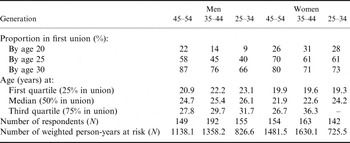
Table 4 shows the timing of first union (formal or informal) by generation and gender computed using the standard EHA tools explained above to evaluate the economic and social conditions for union prevailing in Nairobi only.
Descriptive statistics of percentage of first union at specific ages and age at specific percentage in first union by gender and generation

Note: Weights are sampling biases corrected weights.
Among men, the delay in union formation is clearly visible from the older to the middle generation. Whereas 22% did not enter a union by age 20 in the older generation, there were only 14% in the intermediate and 9% in the youngest generations. By age 25, they were 58% in the older generation compared with 45% in the intermediate and 40% in the youngest generations. By age 30 the figures are respectively 87%, 76% and 66%. The median age at first union increased from 24.7 years old to 25.4 and 26.1 years old. Among men the older generation is not significantly different (Cox regression test below age 45) from the middle generation but is at the 1% level from the younger generation (below age 35). The younger and the middle generations are statistically different at the 10% level (below age 35).
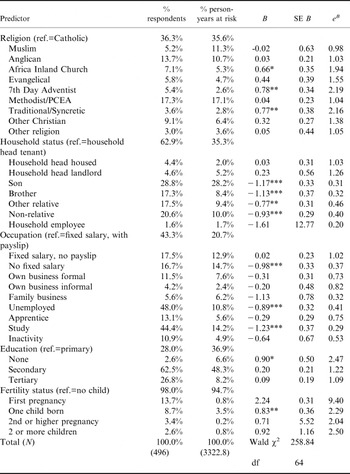
Summary of Cox proportional hazard regression for variables predicting first union for men in Nairobi

Note: Data are weighted using sampling biases corrected weights. Standard deviations are computed using the bootstrap resampling method (1000 replications). The table reads, for example, 48% of the respondents who went through a period of unemployment, representing 10.8% of all person-years at risk, had their chances of forming a union multiplied by 0.41 or, in others words, their chances reduced by 59%, at the 1% significance level. Only predicting variables showing categories with significant coefficients are mentioned here. Note that all of them are time-varying variables, even religion, since the survey was able to trace changes in religion. Respondent percentages do not add up to 100% for each variable because respondents can move from one category to the next and can therefore be represented in several categories. Person-year percentages add up to 100% because they refer to the time of exposure. The controlling but non-significant variables are: age-period effect, place of residence at age 15, and father's ethnicity. The model is also stratified by generation, the sample stratification variable.
e B=exponentiated B, often called Hazard Ratio.
All variables coded as 1 for yes and 0 for no.
* p<0.10;
** p<0.05;
*** p<0.01.
Among women the differences were not significant between generations despite a steady increase in median age at first union from 21.9 to 24.2 years old. Women entered a first union earlier than men (a good quarter of them did so before age 20), and the median age at first union is 2 to 3 years less than for men. One noteable fact is that at age 30 the proportion of women not yet in any form of union is comparable or higher to that of men. In the youngest generation of women, the third quartile is not even attained. The timing of first union became much less homogenous for women: while 28% of them entered first union before 20 in the youngest generation as in the older generation, 27% are still single at age 30 against 20% in the older generation, though the difference is not significant. For men as for women, the longitudinal descriptive indicators of union formation confirm the delay in union formation observed in the cross-sectional analysis of the censuses and of the NUrIP survey data.
Factors influencing entry into first union for men
The results of the event history regression analysis are presented in Table 5. Because the model is stratified by generation, the age-period effect is net of generation effect, which is captured by the non-parametric component of the model (the stratified baseline hazard rates). The results show no evidence of historical changes by age group.
Social and cultural factors hardly influence entry into union. Men belonging to some religious groups, however, were about two times more likely to enter into first union as compared with Catholics (the reference category) and other religious groups not significantly different from Catholics. The religious groups showing a significant difference were the Seventh Day Adventists (p<0.05), the traditional or syncretic religions (p<0.05) and the Africa Inland Church (p<0.10). Yet, the proportions for these three categories are small (less than 11% of person-years at risk, and 16% of the respondents who at some point in time belonged to these religious minorities). This religious effect may therefore have little influence in counteracting the overall decline of entry into union.
For household heads, there was no statistically significant effect of the tenancy status (landowner versus housed or tenant). The dependency in the household appears to be negatively and very significantly correlated with union formation, reducing the chances by almost 70% for sons and brothers of the head of the household (p<0.01) to 54% for other relatives (p<0.05) and 60% for non-relatives (p<0.01). In Nairobi, being the household head is for a man an incentive to union, if not a prerequisite.
Among wage employees, informality is strongly and negatively correlated with union formation. Men with no fixed salary have their chance of entering first union reduced by 63% (p<0.01). Informality makes no significant difference for the self-employed. Male students or the unemployed have their chance reduced respectively by 71% (p<0.01) and 59% (p<0.01) of entering first union compared with wage employees. These results imply that men postpone first union until they gain some form of economic independence and security. This result, together with the higher chance associated with being a household head, supports the Berstrom & Bagnoli (Reference Berstrom and Bagnoli1993) hypothesis that the timing of men's first unions varies with their ability to become independent both in economic and residential terms.
Level of education is hardly correlated with union formation. Men with no education appear to have a two and a half times greater chance of entering first union than those with primary education, but not very significantly (p<0.10). This result mildly conforms to the Berstrom & Bagnoli (Reference Berstrom and Bagnoli1993) hypothesis that men who expect to do poorly in later life will marry at a relatively young age. Nevertheless, the proportion of men with no education is small (less than 7% of person-years at risk, and 3% of the respondents) and may therefore have little influence on entry into union in Nairobi as a whole.
For a man, having children before any union formation appears to multiply by more than two (p<0.05) the chance of forming a first union. When the pregnancy of the partner of these men is confirmed and this is the first pregnancy, then the man is 9.4 times more likely to enter into first union (p<0.01, but with only 0.8% of person-years at risk, though this concerns 13.7% of the male respondents). A strong bias may affect this result because men probably tend to acknowledge children they have as a result of a union. They may either be unaware of other children or unwilling to declare them if they did not enter or did not wish to enter into a union with the mother. The fact that fewer men declared having children before a union (11%) compared with women (38%) in the sample confirms the men's declaration bias. As is often the case in surveys, measuring the effects of fertility from women's declaration is certainly more reliable.
Factors influencing entry into first union for women
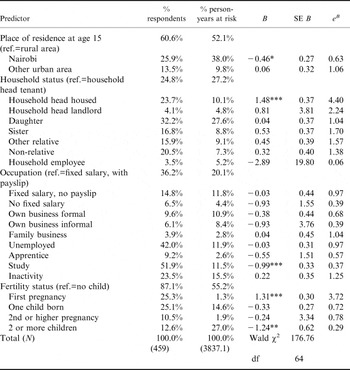
Table 6 presents the factors that influence entry into first union for women in Nairobi. As for men, the age-period effect shows no significant effect and not even one category of the ethnicity and religion variables has a significant bearing on entry into first union for women. Only women who lived in Nairobi at age 15 are less likely (reduction by 37%, p<0.10) to enter into a union. Though the evidence is weak, it could indicate that having been raised in Nairobi and exposed to the city way of life earlier than other women could delay union formation more than belonging to one ethnic or religious group or another.
Summary of Cox proportional hazard regression for variables predicting first union for women in Nairobi

Note: Data are weighted using sampling biases corrected weights. Standard deviations are computed using the bootstrap resampling method (1000 replications). The table reads, for example, 25.3% of the respondents who went through a period of pregnancy, representing 1.3% of all person-years at risk, had their chances of forming a union multiplied by 3.72, at the 1% significance level. Only significant predicting variables are mentioned. Note that all of them are time-varying variables apart from the place of residence at age 15. Except for the latter, respondent percentages do not add up to 100% for each variable because respondents can move from one category to the next and can therefore be represented in several categories. Person-year percentages add up to 100% because they refer to the time of exposure. The controlling but non-significant variables are: age-period effect, religion, father's ethnicity, and education. The model is also stratified by generation, the sample stratification variable.
e B=exponentiated B, often called Hazard Ratio.
All variables coded as 1 for yes and 0 for no.
* p<0.10;
** p<0.05;
*** p<0.01.
Women who were head of their household were 4.4 times more likely (p<0.01) to enter into first union when they were housed by another person than those who were tenants or landlords. This is probably because many of these women were actually housed by their future partner, making the household status partly endogenous to union formation.
With regard to occupation, only women who were studying were less likely (reduction by 63%, p<0.01) to enter into first union when compared with other occupational categories. This result, which was also observed for men, implies that most students postpone their first union until they have finished their study. Inactive and unemployed women have the same chance of entering a union as women involved in economic activities. Contrary to men, access to economic independence does not make a difference for entry into union. It is also noticeable that there is no difference between formal and informal sectors for wage employees or for the self-employed, further demonstrating the small importance of women's economic status as regard to union formation. Level of education attained has no effect either. In short, and in contrast to the men's case, the potential of a woman as a partner has little to do with her human capital potential or realization, as measured by education or economic independence.
Because women are less subjected to under-reporting children born out of union, the effect of pregnancy status or of having a child is more reliable for women than for men. Only the first pregnancy seems to encourage union formation, increasing the chance 4.8 times (p<0.01). Failing this narrow window of opportunity, the chances diminish by 28%, though not significantly, when the first child is born, and by 71% (p<0.05) after the second child is born. Pregnancy of rank 2 or more is not different from having no child. Pregnancy of rank 2 or more might offer a window of opportunity for union formation before the child of rank 2 or more is born, but the test (comparing the coefficient for pregnancy of rank 2 or more with the coefficient for child 2 or more) is not significant. The pregnancy, especially if it is the first, appears to accelerate marital union with the father but, failing that, childbearing outside union appears to install durably the women out of union, especially when she already cares for two children.
Conclusion
This article has attempted to review patterns of entry into first union and the factors that have influenced the observed patterns over generations in Nairobi using retrospective data. The delay in entry into first union is more pronounced in Nairobi than for Kenya as a whole. From the 1980s, more women remained single than men beyond age 30 in Nairobi. The survey data also show a sustained and even increasing proportion of Nairobi inhabitants in informal unions, making formal union the exception rather than the norm.
For the purpose of this study, informal and formal unions were combined to analyse the occurrence of the first union. In terms of the factors that have influenced its timing, these differ importantly by gender. For men and even more so for women ethnic, religious and migration factors explain very little of the timing of union formation. This shows weak differential pressure from peers and the community. Men with poorer economic prospects may probably be deterred from entering their first union. This is confirmed by the postponement of union formation by those who are still studying, are unemployed or occupied in very informal jobs: this suggests that job security is a crucial factor explaining entry into first union for men. Residential independence, another factor favouring union formation, is telling about the necessity for men to consolidate their human capital investments before engaging themselves in a union.
By contrast, very few available factors stand out to explain women's union formation. Certainly female students tend to postpone entry into union, while women who wish to get independent housing tend to accelerate this entry. But the main factors that stand out are related to fertility prior to union. A pregnancy is a strong incentive to union formation, but once the child is born, the opposite holds. Caring for children born out of union is borne mainly by single mothers, who may stay out of union. In short, a woman will tend to form a union with a man if she has no child or if she is pregnant.
Evidence gathered in Nairobi does not support the integration model since social and cultural factors show weak or no association with entry into first union. The search model, which asserts that the timing of union is dependent upon the interactions of human capital acquisition by both men and women, is only partially confirmed since human capital factors affect the timing of men's but not women's union formation. But the independence model does not explain women's behaviour any better: delay in union and increasing proportion never marrying occurred, but this cannot be attributed to improvement in women's education and economic conditions. For women, the only variables positively correlated with union formation are those that are more or less endogenous to the process of union formation: being a household head but housed (the benefactor probably being the future partner) or being pregnant (again, the father probably being the future partner). No exogenous variables were found to explain women's union formation. Men's independence achievement, in both residential and economic terms, makes them potential partners for their female counterparts, but what does make women potential partners to men? Men tend to be valued on the matrimonial market when they are also valued on the job market, but what is the measure of women's value on the matrimonial market? The importance of endogenous variables in women's union formation is probably an indicator that despite progresses in female education and economic achievement, women are still better valued for their ability to bear children and manage a household than for their economic contribution. This would certainly need further investigation into the more complex, notably qualitative determinants unobserved in the survey.
By comparing the union formation processes that men and women go through, a rare case in African family studies, this study highlights the huge gender differences in Nairobi. It shows that the marriage search model, which stresses the importance of human capital over social and cultural origins in explaining union formation in Western countries, can also hold in cities of the developing world. Nonetheless, as other models, the marriage search model is weak in explaining women's union formation in Nairobi. It is possible that urban values and norms, not captured by social and cultural origins, explain women's union formation better than their human capital.
Acknowledgments
The authors would like to thank anonymous reviewers of earlier versions of this paper. They wish to acknowledge the CODESRIA, Rockefeller Foundation, IFRA and IRD for providing financial support, and the University of Nairobi for providing the research team with an enabling environment to complete the analysis. They also acknowledge IPUMS (Minnesota University) for use of the 5 percent census data for Kenya for comparative analysis. Finally, they extend special thanks to Dr Alfred O. Agwanda and Dr Samuel Owuor for their friendly support and encouragement.