Interviewing is the foundation of oral history.Footnote 1 The value of interviews is informed by the interviewer’s skills and preparation, and the quality of information or analysis that interviewees can bring to the research question or area of study.Footnote 2 The latter is determined by the personal attributes and experiences of interviewees, but is also dependent on the selected sample. The process of interviewee recruitment is thus an important area of concern for scholars engaged with oral evidence.Footnote 3 With this in mind, this article examines a snowball recruiting strategy used to gather oral histories for a project on the Australian retail property industry. In doing so, it contributes to a relatively small scholarship focused on methodology in business history.Footnote 4
Interview recruitment processes vary across disciplines and are determined by a project’s particular goals.Footnote 5 This article reports on a relatively small-scale oral history project, drawing on interviews with business elites who were approached as “information-rich key informants.”Footnote 6 It contributes to a range of historiography that has drawn on elite interviews and discusses the processes through which such interviews take place.Footnote 7 For business historians, such informants might generally include people who have played an innovative role in the field being researched, who have insights into causal processes within firms or industries, who can provide eyewitness accounts of events or practices, or who have directly interacted with firms or observed the influence of their business activities.Footnote 8 While there are valid arguments for interviewing subjects across the full breadth of organizations, as Robert Crawford and Janis Thiessen each note in this special collection, in this project interviews were with senior executives who had spent much of their careers in the industry or in associated retail firms.Footnote 9 The resulting data set allowed investigation into the complexities of business practices and historical changes, in-depth explorations of specific issues, and insights into the social networks that link executives across firms within the Australian retail property sector.Footnote 10
Accessing such interviewees can be difficult.Footnote 11 William Harvey, for example, argues that “the success of gaining access to elite subjects depends a great deal on serendipity, social networks as well as particular circumstances.”Footnote 12 In this context, snowball sampling offered a means of generating an interview pool. The process began with interviews with accessible informants, and used referrals from them to expand the sample.Footnote 13
When snowball sampling was first employed in the 1940s and 1950s by Merton and Coleman, systematic processes were employed to produce replicable referral patterns from easy-to-find respondents.Footnote 14 Referrals were generated by sociometric questions, which allowed for the exploration of potential interviewees’ social networks. Later studies began using referrals to access hard-to-reach populations, where social networks were less the object of research than a means to an end. Networks offered researchers pathways to respondents they would not have otherwise known about or been able to access.Footnote 15
The distinction between easy-to-find and hard-to-reach subjects refers to relative ease of identification and access. While discussions about sampling hard-to-reach populations has tended to focus on marginalized groups,Footnote 16 privileged populations—including those of interest to business historians—can also be difficult to access.Footnote 17 Recruiting a sample population from retired professionals, for example, can be problematic, especially if they are no longer in contact with their former firms or business groups. Executives with important roles who have not reached the pinnacle of their organizations may also have little public visibility, requiring identification by industry insiders.
Referrals can help overcome obstacles to reaching elites still working in their fields. Currently employed executives may lack the time for interviews, be difficult to contact directly, or be shielded from scrutiny by business organizations with little interest in publicizing how they operate.Footnote 18 Referrals can bridge such obstacles because they convey trust, particularly when coming from senior industry figures. While trust is an essential ingredient of any successful oral history interview, in snowball sampling it also acts as an aid to recruitment.Footnote 19 How trust is developed is dependent on the judgment and sensibilities of the interviewer, and will vary from situation to situation, but will likely include efforts to convey an understanding of the interviewee’s point of view, a shared use of language, and, perhaps most critically, a demonstrated (if possibly general) understanding of that person’s field of expertise.Footnote 20 Referrals arising from interviews in which such groundwork has been laid serve as a positive recommendation about the capacity of the interviewer and the project’s worth.
The referral process can take different forms, but is analogous to a journalist following leads.Footnote 21 In the case of a business research project, it may involve asking interviewees if they know of people with particular experiences or certain expertise of which knowledge is required; for example, a leasing expert who was involved in a business lobby group’s response to a retail tenancy act,Footnote 22 or an executive who held a marketing position when new research methods were being introduced into an industry.Footnote 23 Guided referrals like these allow the researcher to shape the sources of data to suit the project’s needs, which will change as interviews and other evidence are gathered. In other instances, the interviewee may offer suggestions about what should be explored or who should be interviewed for insights into particular areas.Footnote 24 This is more likely to occur when the researcher is interviewing elites with a long history in a firm or industry and/or deep knowledge of it.
Oral History Interviews in the Australian Retail Property Sector
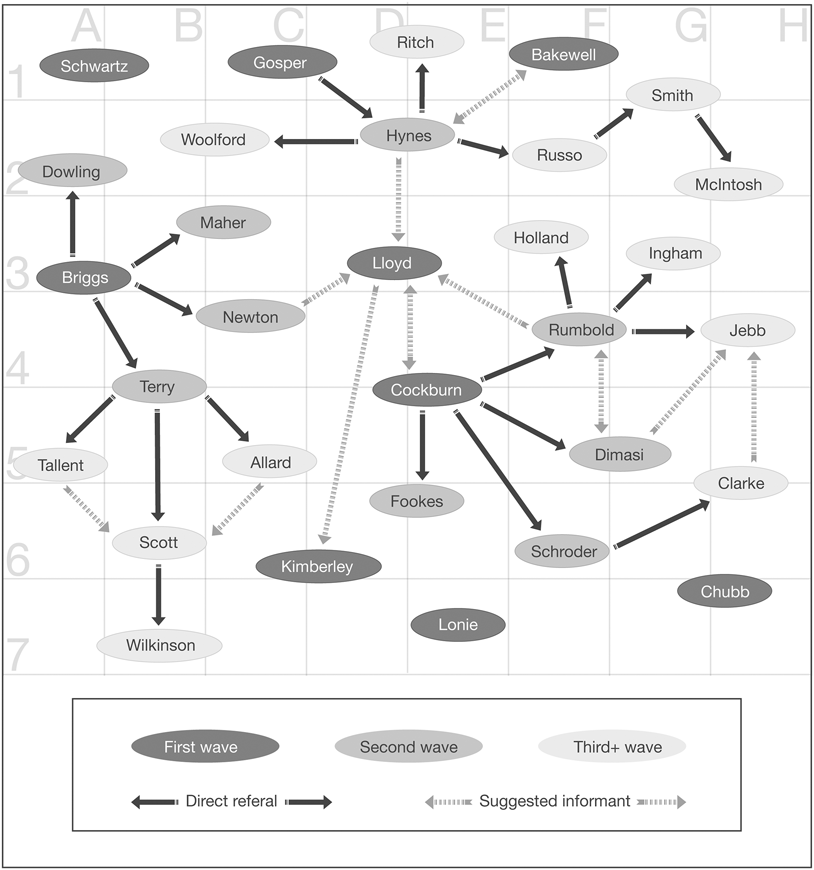
I interviewed former and current executives in the Australian retail property industry between 2013 and 2015. Figure 1 provides a graphical representation of the referral chains connecting interviewees. The dark gray ovals indicate initial contacts, or the first level of interviewees. Second-level interviewees, generated by referrals from the first level, are medium gray, with third and subsequent levels in light gray. The solid lines indicate referrals. The dashed lines indicate informants that interviewees suggested should be interviewed but to whom they were not directly connected, did not have contact information, or who were already included in the sample via another referee or through a direct approach by the author. The grid provides a reference with columns (A– H) and rows (1–7) to help locate names mentioned in the text.
Interviewees from the Making Modern Retail Landscapes oral history project.

A variety of approaches were taken to recruit first-level informants. While direct communication with major firms yielded some interviewees,Footnote 25 access in other cases was gained through personal connections and referrals, not least because many ideal informants were retired. Some chains began serendipitously, confirming Biernacki and Waldorf’s view that referral chains can be initiated fortuitously.Footnote 26 For example, an academic colleague facilitated an interview with Steve Gosper (C1), a nonexecutive director of Australian Mutual Provident (AMP) Capital Shopping Centres. The AMP Society, which drew substantial revenue from its insurance schemes, was an important player in the history of shopping center development in Australia. In the early postwar years, it invested almost exclusively in government bonds and mortgages, but as its pool of investment funds grew, it began “looking for big, secure, rewarding investment outlets,” including direct property.Footnote 27 By the 1970s, this encompassed ownership stakes and development activity in shopping centers, including joint projects with specialist development firms such as Westfield Holdings Ltd.Footnote 28
Gosper had been employed by AMP for thirty years, beginning his career as an engineer, before moving into leasing, shopping center management, and, later, board positions.Footnote 29 An informative subject himself, he also held a professional relationship and personal friendship with Managing Director Bryan Hynes (D2), who, on Gosper’s recommendation, consented to an interview. Like many others interviewed for the project, Hynes expressed considerable pride in the sophistication of the Australian industry, noting the success of Australian firms that had internationalized.Footnote 30 This trope of an overachieving industry from a small market is informative of the ways that elites deploy narratives to derive meaning from their professional endeavors. In numerous interviews, personal careers were contextualized by the significance of the Australian retail property industry, which remained a constant surrounding individuals’ interfirm mobility.Footnote 31 Hynes also provided archival sources from his personal collection, a not uncommon experience in oral history interviews, as well as referrals to a third level of informants.Footnote 32
A brief outline of this third level is instructive of both the generative power of the snowball method and the interlocking interests that characterize professional networks in the retail property sector in Australia. The referrals from Hynes included former colleagues, important retail clients, industry commentators, and service providers. Jack Ritch (D1) was a predecessor of Hynes and the former property director of AMP. He held vast experience and was the first chairman of the Shopping Centre Council of Australia.Footnote 33 Guy Russo (F2) was, at the time of interview, managing director of the Australian Kmart operation, one of AMPs most important tenants and a key anchor in many of their centers. Craig Woolford (C2) is an investment analyst with financial services firm Citibank. He maintains frequent contact with numerous retail property figures who operate as both sources of information and objects of study.Footnote 34 Prior to becoming AMP’s strategic research manager, Helen Bakewell (F1) had provided consumer research services to the firm through her own consultancy business.Footnote 35 A referral chain anchored to a serendipitous recruitment (Gosper) thus served to create an oral history archive that comprised informants from one of Australia’s most significant retail property developers and managers, the country’s largest and most successful discount department store (DDS) operation, an investment institution with a deep interest in retail development, and a boutique consumer research firm.
Russo subsequently suggested contacts in his organization who would have provided additional information into the retail property sector. While the extent to which these links were pursued was limited by the funding allocated to this project, his offer provided an indication of the potential length of chains and the importance of personal referrals in extending them through professional networks: “One other help for you is that the guy that heads up my real estate, Ben Smith … [has] been doing deals for Kmart/Coles nearly all his life. He knows Bryan [Hynes] and every one of these guys firsthand. He meets with them regularly. … I’ll introduce you to Ben. … He knows all the other players, too.”Footnote 36
Alan Briggs (A3), a former manager of Operations for Westfield, was another serendipitous first-wave interviewee who provided deep access into the industry. Briggs came to my attention through his enrollment in a history degree program at my university. He offered referrals to a number of former Westfield employees, as well as to Mort Dowling (A2), a former marketing manager for Woolworths, one of Australia’s largest retailers and a dominant supermarket chain. Briggs had worked with Dowling at Woolworths before moving to Westfield in a career trajectory that reflects, as with the link between Bryan Hynes and Guy Russo above, the entwined professional networks connecting large retail and shopping center firms.Footnote 37
Such relationships are particularly tight in Australia because planning legislation has historically limited laissez-faire stand-alone store development, creating an environment in which shopping center construction or redevelopment has become the dominant means of chain, supermarket, and DDS expansion.Footnote 38 For developers, large anchor stores generate customer traffic that can be monetized through specialty retail rents, while their long lease terms provide a stable platform and a guarantee of future income when obtaining finance.Footnote 39 The advantages of retail agglomeration and the ability to subsidize costs through specialty shop rents has also encouraged Australia’s biggest retailers to construct their own shopping centers.Footnote 40 This has generated expertise of value to the retail property sector.Footnote 41 Shared interests and development know-how have thus resulted in career mobility between the retail and retail property sectors, as well as ongoing professional ties built through constant negotiation and dialogue concerning development, leasing, and market research.Footnote 42
Briggs’s referral to Dowling proved highly valuable. The latter was an upper-level executive with a low profile.Footnote 43 They had maintained a friendship since their days at Woolworths, where Dowling worked as a marketing executive in the firm’s BigW DDS chain.Footnote 44 BigW was established in 1976 but did not turn a profit for fifteen years, having ceded first-mover advantage to Australia’s Kmart and Target chains (run, respectively, by the Coles supermarket group and the Myer department store chain).Footnote 45 BigW revived its fortunes by acquiring, for virtually no transactional cost, operating expertise from Walmart.Footnote 46 It was Dowling who established the groundwork and initial contact with Walmart through personal correspondence with Jack Shewmaker, a senior executive, and founder Sam Walton.Footnote 47 Oral history is a particularly useful source for exploring this counterintuitive dynamic in which Walmart received little recompense for its shared expertise.Footnote 48 In his interview, Dowling described the manner of his approach to the notoriously secretive firm, the relational dynamic between himself and Shewmaker, and the mutual retailing philosophies that laid the foundations for the transaction.Footnote 49 At the time, BigW was losing tens of millions of dollars a year, threatening to derail its parent company, Woolworths.Footnote 50 Without the chain referral system adopted for this project, Dowling’s testimony about these events would likely never have been recorded.
While the personal friendship of Briggs and Dowling resulted in a direct referral to the latter, it took a number of referrals, and thus longer chains, to locate other retired professionals who had working experience in the DDS sector. Accessing such informants was important, owing to the pivotal role DDSs played in the development of shopping centers in Australia (both Kmart and Target had developed community shopping centers across the country from the early 1970s and onward).Footnote 51 Bruce McIntosh (H2), a former Kmart property manager, and Peter Wilkinson (B7), who had been managing director of Target before taking other senior roles in its Coles/Myer parent company, were the fifth links in chains that began fortuitously with Gosper (C1) and Briggs (A3). The interview with Wilkinson was secured by the referral from Andrew Scott (B6), his former colleague, whom Wilkinson held in high regard as a result of his work as director of Strategy and Property at Coles/Myer in the 1990s.Footnote 52 McIntosh was long retired, and could only be contacted by phone and postal mail, which were provided at the behest of Russo at Kmart. Both Wilkinson and McIntosh had long careers in their respective firms. They were able to convey deep operational knowledge, fill gaps missing from archival records, explain strategic decisions, discuss business responses to legislative and planning regimes, reveal patterns of knowledge transfer from other markets, and provide analysis of the fluctuating fortunes of their firms.Footnote 53
Chains consisting of a number of referral links were required to access this information because, despite the close connections and career mobility between the retail and retail property industries in Australia, many executives also lived out their careers in one sector or the other, and sometimes within a single firm. Dowling, McIntosh, and Wilkinson had all remained in retail but were several steps removed from the starting points of chains emerging from the retail property sector. Just as referrals, or links in chains, can be revealing of proximity—for example between current or former employees of the same firm or a personal friendship—the length of chains can also indicate various types of distance.
Intergenerational links offer another example of this distance-traversing affect, whereby chains reach not only across firms or sectors but also extend into the past. When interviewed, Milton Cockburn (E4), the executive director of industry lobby group the Shopping Centre Council of Australia (SCCA), provided information about the industry’s position on a range of legislative and planning matters. In a reflection of his role as a public relations professional, the referrals he provided were all to executives currently working in the industry. The more experienced of these referrals were highly valuable, such as John Schroder, (F6) who had come through both Lend Lease and Westfield and was the latter’s joint chief operating officer for its American operations in the early 2000s. In other instances, though, it was subsequent referrals to a third level of interviewees who had worked in the industry since the 1960s and 1970s that generated the most useful interviews.Footnote 54
Nonchain Suggested Contacts
Suggested contacts (the dashed lines in Figure 1) include a variety of relationships and connections: markers of status within the industry, previous professional relationships, or a suggested contact who has valuable information and perhaps further connections into the industry. Reg Jebb (H4) offers a revealing example. In his interview, Richard Clarke (H5) identified Jebb as an authority on economic market research and one of the pioneering Australian figures in the field who had provided services to Lend Lease when Clarke held executive roles there in the 1970s and 1980s.Footnote 55 Jebb had been providing property research to firms since the early 1960s, beginning his tutelage under George Connor, who had set up what was probably the first economic consultancy for property development in Australia.Footnote 56
After his retirement, though, Clarke had no contact with Jebb, who was instead accessed through a chain that began with Cockburn. The second-level link from Cockburn was Simon Rumbold (F4), a director of Urbis, one of Australia’s largest full-service market research firms, which works closely with the SCCA and major developers.Footnote 57 The referral from Rumbold to Jebb, as well as his suggestion to speak to Tony Dimasi (G5), resulted from previous professional relationships: all had worked together and at one time were partners in the same firm. Dimasi is currently managing director of retail at MacroPlan Dimasi, another of the key research service providers for the Australian retail property industry. These close connections between market researchers, the SCCA, and large developers reflect the relatively small community at the top of the retail property hierarchy in Australia into which snowball referrals offered access.
The frequent naming of an individual in snowball research suggests importance in a social network. A useful example from this project is provided by Michael Lloyd (D3), who a number of interviewees suggested contacting. In the 1980s, Lloyd virtually ran the shopping center arm of Lend Lease, a multidivisional firm, and at the time one of the “big 3” Australian retail developers, along with Westfield and AMP.Footnote 58 Lend Lease holds a revered position in the industry as a “university” for executive talent. This is in part due to its relative early engagement with graduate students as it sought to develop more sophisticated marketing programs in the 1980s. As one of those responsible for instituting this recruitment strategy, Lloyd mentored a number of graduates, some of whom now hold senior executive or CEO positions, such as John Schroder.Footnote 59
Lloyd maintains deep connections in the industry through his role as a consultant and as publisher of the journal Shopping Centre News. As an experienced professional operating in a media capacity that serves the broad interests of the industry, Lloyd holds an important strategic position in its social network.Footnote 60 His public profile made him easy to locate, and he proved to be amenable to an interview at the first sample level. Just as chance can spark the generation of referral chains, however, it can also curtail them. At the end of his interview, Lloyd revealed a recent tragic personal loss, which, for obvious reasons, curtailed further discussion at a time when referrals would normally have been sought. Thus, while he remains a central intellectual figure in the industry, and maintains a professional network in the course of his work, he did not provide referrals to second-level participants for this study. Situations like this, of course, can be rectified with follow-up requests for referrals later on. There were other instances, though, in which first-level interviewees were simply not viable starting points for high-value chains. Some did not have contacts with a deep historical understanding of the industry.Footnote 61 Others were not forward in providing access to contacts, or offered contacts that were of insufficient value for the project.Footnote 62 These latter issues demonstrate the filtering involved in the snowball referral process.
Interventions to correct bias are also required. The most obvious of these in the current sample is gender. Only two women have thus far been interviewed in the project. This will be balanced with future interviews, but the chain referral method has been conspicuously poor in generating them. Carol Schwartz (A1) and Helen Bakewell (F1) were both located and contacted directly as first-level interviewees. Contacts and referrals were provided for one other female executive, but she was unavailable for interview. The poor representation of women in the sample is a direct result of corporate culture in Australia, particularly when many of the interviewees were making their way in the industry. As Schwartz noted in her interview: “It is ridiculous to talk about the late ’90s as being an era where no women existed in senior roles, but it is actually true.”Footnote 63 Schwartz had a successful retail property career, was the first female national president of the Property Council of Australia, and played an instrumental role in engaging the council in urban revitalization. The absence of mentions or referrals to Schwartz, and the small number of women to which referrals were suggested or made, raises questions about bias in the referral method. Without remediation, such sampling risks further perpetuating the invisibility of women in corporate life.Footnote 64 Additional interviews are currently being sought with women who have made substantial contributions at executive and board levels. Such active recruitment is an essential corrective to snowball sampling’s homogenizing tendencies. It should also be noted, however, that the social networks that are mapped through snowball sampling are revealing in and of themselves; in this instance, of the patriarchal power structure of corporate Australia in near recent times.Footnote 65
Conclusion
For this project, in which oral histories were sought with members of an elite and relatively small community, snowball sampling produced a data set that added value to extant archival and media sources. Access was gained into these networks by building trust in interviews, which generated personal recommendations in the form of referrals. The snowball sampling method, though, is selective and contingent on the social network of the interviewee, which can create distortions and bias. For this reason, an ongoing process of selection and screening to filter potential informants arising from referrals, as well as active recruitment of new first-level informants is required.Footnote 66 Additional interviews are being planned to fill in missing gaps, address bias, and extend the scope of the data set as the research progresses.
The snowball method to date, however, has generated a broad interview pool, which rendered detailed information about firm operations, strategies, and innovations. It also remains a valuable resource for follow-up inquiries.Footnote 67 The construction of the sample has also been revealing of the industry itself. The chains traced in Figure 1 connect individuals across firms, industry sectors, and generations. These links mark not only social connections but also paths through which knowledge was transferred via mentoring or shared experience, personal friendships that developed in workplaces, and professional contacts that demonstrate the various interacting components of a complex and constantly changing industry.