Introduction
Biological control has become an important pest management strategy to reduce the use of insecticides (van Lenteren et al., Reference van Lenteren, Bolckmans, Köhl, Ravensberg and Urbaneja2018), and the performance of biological control agents (BCAs) released in augmentative pest control programs is of major importance for the success of integrated pest management (Beukeboom, Reference Beukeboom2017). However, BCAs may be raised under suboptimal laboratory conditions and therefore will be in poor body condition (Jakob et al., Reference Jakob, Marshall and Uetz1996). Commercially produced BCAs may thus be more or less physiologically fit compared to their wild conspecifics due to effects of their rearing environment, including both physical and biological factors (Sørensen et al., Reference Sørensen, Addison and Terblanche2012; De Clercq et al., Reference De Clercq, Coudron, Riddick, Morales-Ramos, Rojas and Shapiro-Ilan2014; Terblanche, Reference Terblanche2014; Jensen et al., Reference Jensen, Kristensen, Heckmann, Sørensen, van Huis and Tomberlin2017). Moreover, BCAs can be genetically maladapted to their natural environment after generations of laboratory maintenance (Mackauer, Reference Mackauer1976). This can occur as BCAs adapt to laboratory conditions, or they may become inbred and genetically depauperate compared to their wild, widely outbred conspecifics (Hoffmann and Ross, Reference Hoffmann and Ross2018). Quality assurance of mass-reared insect cultures is therefore of key importance (Boller and Chambers, Reference Boller, Chambers, Ridgway and Vinson1977; Bigler, Reference Bigler1989; van Lenteren, Reference van Lenteren2003).
Studies comparing wild and laboratory-reared predacious BCAs are scarce in the literature (Sørensen et al., Reference Sørensen, Addison and Terblanche2012; Terblanche, Reference Terblanche2014), but it has been hypothesized that laboratory rearing produces individuals with lower predatory performance and therefore lower impact on pest prey populations. This can be caused by low body condition of produced BCAs due to poor quality and variation of the food offered, by suboptimal temperature and humidity, by high density involving raised immune responses, and by a lack of micro-environments that facilitate self-regulation (Jensen et al., Reference Jensen, Kristensen, Heckmann, Sørensen, van Huis and Tomberlin2017). Laboratory environments moreover typically lack the overall variation and complexity of natural environments, and therefore selective pressures associated with variable conditions are relaxed. In the vinegar fly, Drosophila melanogaster (Meigen), mass rearing and associated loss of genetic diversity have led to lower resistance against various environmental stressors (Hoffmann et al., Reference Hoffmann, Hallas, Sinclair and Partridge2001), as well as lower reproductive fitness (Woodworth et al., Reference Woodworth, Montgomery, Briscoe and Frankham2002). In Queensland fruit flies, Bactrocera tryoni (Froggatt), stress tolerance was reduced in mass-reared compared to wild-caught individuals (Weldon et al., Reference Weldon, Yap and Taylor2013), and laboratory maintenance led to inbreeding and reduced performance in the mosquito Aedes aegypti (L.) (Ross et al., Reference Ross, Endersby-Harshman and Hoffmann2019).
Heteropterans of the genus Orius (Hemiptera: Anthocoridae) are valued BCAs that are produced commercially but also occur naturally in a range of crops (Bosco et al., Reference Bosco, Giacometto and Tavella2008; Bosco and Tavella, Reference Bosco and Tavella2013). Orius majusculus (Reuter) is widespread in Europe and commercially produced to control various pest insects, in particular thrips (Blaeser et al., Reference Blaeser, Sengonca and Zegula2004; Tommasini et al., Reference Tommasini, van Lenteren and Burgio2004) and aphids (Messelink et al., Reference Messelink, Bloemhard, Sabelis and Janssen2013; Helgadóttir et al., Reference Helgadóttir, Toft and Sigsgaard2017). Variation in a number of traits of O. majusculus from different commercial stocks has been reported including body size, resistance to stressors, and predation rate (Rasmussen et al., Reference Rasmussen, Jensen, Sørensen, Sverrisdóttir, Nielsen, Overgaard, Holmstrup and Kristensen2018). This study furthermore found higher genetic diversity in a wild population compared to the commercial stock populations (Rasmussen et al., Reference Rasmussen, Jensen, Sørensen, Sverrisdóttir, Nielsen, Overgaard, Holmstrup and Kristensen2018). Using O. majusculus, we investigate whether individuals from a wild, naturally occurring population of BCAs are in better body condition and hardier than commercially produced conspecifics and whether they, therefore, have a higher capacity to reduce the abundance of different species of pest prey.
We test the overall hypothesis that wild-caught O. majusculus are hardier and more efficient BCAs than mass-reared, commercially produced individuals. To test this hypothesis, we compared their survival and predation of different prey species under controlled conditions. We also compared body condition (initial mass) before testing upon arrival to the laboratory. Experiments were performed both in Petri dishes and in outdoor mesocosms containing live wheat seedling grass. Our study provides information on differences in performance between wild and commercially produced O. majusculus over the late summer season.
Materials and methods
Animals
For tests with thrips, Frankliniella tenuicornis (Uzel) (Thysanoptera: Thripidae) and eggs of the flour moth Ephestia kuehniella (Zeller) (Lepidoptera: Pyralidae) we collected wild O. majusculus in a maize, Zea mays (L.) (Poales: Poaceae), field near Aarhus, Denmark (56,15 N, 10,03 E) on 23 and 24 July 2018. Thrips were collected in the same field on the same dates. June and especially July 2018 were exceptionally dry in the Danish summer with an average July temperature of 19.2°C and precipitation of 17 mm (Cappelen, Reference Cappelen2018), under which conditions F. tenuicornis can be extremely abundant in maize (Bereś et al., Reference Bereś, Kucharczyk and Kucharczyk2013). For tests with aphids, Rhopalosiphum padi (L.) (Hemiptera: Aphididae), we collected wild O. majusculus in the same maize field on 16 August 2018. Commercially produced O. majusculus and flour moth eggs were purchased from EWH BioProduction, Tappernøje, Denmark, using a second consignment for tests on aphids in August. The commercially produced O. majusculus were reared at 23°C on E. kuehniella eggs, which are a monotypic but high-quality prey (Toft et al., Reference Toft, Jensen, Sørensen, Sigsgaard and Holmstrup2020), at high density compared to densities in nature. Aphids were collected from our laboratory culture and maintained on seedling wheat, Triticum aestivum (L.) (Poales: Poaceae). Commercially produced animals arrived at the laboratory within 1 day of wild collection in both July and August. Wild-caught and commercially produced O. majusculus were kept separately in containers (34 cm length × 25 cm width × 12 cm height) of up to 200 animals per container and provisioned with E. kuehniella eggs ad libitum for 1–3 days before tests. Individuals from the wild and commercially produced populations were tested simultaneously within prey and test environments. This ensured a similar age of commercially produced O. majusculus, whereas the age of wild-caught individuals was unknown but likely more variable. Each O. majusculus was weighed to the nearest 1 μg prior to setup of the experiments.
Tests in Petri dishes
Experiments in Petri dishes involved a monotypic diet of thrips, moth eggs, or aphids as prey. Individual O. majusculus were allocated to Petri dishes (8.5 cm diameter, 1.4 cm height) containing 2 mL droplets of a 2% agar solution in water to maintain moisture. The three treatments differed only in prey species and numbers of prey provisioned, and as noted above, the time of year when different prey was available. For tests performed in July, Petri dishes contained either >50 uv-killed moth eggs or 20 live adult thrips, whereas Petri dishes for tests performed in August contained 10 live adult aphids. All test conditions ensured ad libitum feeding opportunities. From each of the two O. majusculus populations (wild or commercially produced), 20 females and 20 males were tested on each prey species. In addition, 20 Petri dishes with each prey species but without a predator were used as controls. For all tests, Petri dishes were placed for 24 h in a room at 21–23°C with natural light conditions avoiding direct sunlight (L:D = 16:8 in July and 15:9 in August). After 24 hours, we noted survival of each O. majusculus individual, and empty moth egg shells from eggs destroyed by predation were counted or the number of killed thrips or aphids were estimated. Reduction in thrips or aphids was estimated as the difference in the number of live prey individuals provisioned at the start and the number remaining after the test, subtracting the mean of missing prey in the controls within prey species. Aphid offspring were counted within each Petri dish. Aphid offspring reduction in each Petri dish was estimated as the difference from the mean number of offspring produced in the controls.
Tests in mesocosms
Experiments in mesocosms involved a monotypic diet of either thrips or aphids as prey and differed only in prey species and numbers of prey provisioned, and the time of year when they were performed. Tests with thrips as prey were performed in July, and tests with aphids as prey were performed in August. Mesocosms comprised transparent plastic boxes (17 cm length × 17 cm width × 11 cm height). Four grams of wheat seeds were spread evenly over the bottom on wet tissue paper, which yielded approximately 100 seedlings that were allowed to grow to the height of the container. The day before adding the prey, the bottom including seeds and roots was covered with 2 cm of a 2% agar solution in water to maintain moisture and minimize hiding opportunities, thereby enhancing rediscovery at final counting. Mesocosm tops were covered with a paper towel to allow evaporation and aeration but prevent escape. The paper towels were sealed thoroughly by closing the box using lids with the centre cut out. Mesocosms contained 100 live adult thrips (July) or 30 live late-instar aphids (August). Late-instar aphids were used to limit offspring production and thus prey supplementation. For each prey species, pairs of one female and one male (N = 17 for thrips and 22 for aphids) were set up for each of the two O. majusculus populations (wild or commercially produced), as well as the same number of controls without predators. Mesocosms were placed outdoors protected from rain, wind, and direct sunlight over 5 days (25–30 July 2018) with thrips as prey (Thermal mean: 22.7°C, range: 13.4–29.0°C), and over 3 days (17–20 August 2018) with aphids as prey (Thermal mean: 17.0°C, range: 12.1–20.9°C). Survival was recorded for each O. majusculus, and prey reduction was estimated as the difference in the number of live prey individuals provisioned at the start and remaining after the test, subtracting the mean of missing prey in the controls within prey species. Few aphid offspring were observed in the mesocosms and were not included in counts and calculations, but may have been available and preyed upon to a small extent.
Statistical analysis
Effects of O. majusculus population (wild or commercially produced), sex, and their interaction on initial body mass and prey reduction when feeding on thrips, moth eggs, aphids, or aphid offspring in Petri dishes, or on thrips or aphids in mesocosms, were analysed using two-way analysis of variance (ANOVA) followed by a Student's t-test at α = 0.05. The same predictor variables were included in two-way nominal logistic regression followed by a likelihood ratio comparison of each pair at α = 0.05 for O. majusculus survival during experiments. In mesocosms, only the effect of the population was included in the test on prey reduction as the sexes foraged together in pairs. Statistical analyses were performed in JMP 13.0.0 (SAS Institute Inc., Cary, NC, USA).
Results
Tests in Petri dishes
Initial mass
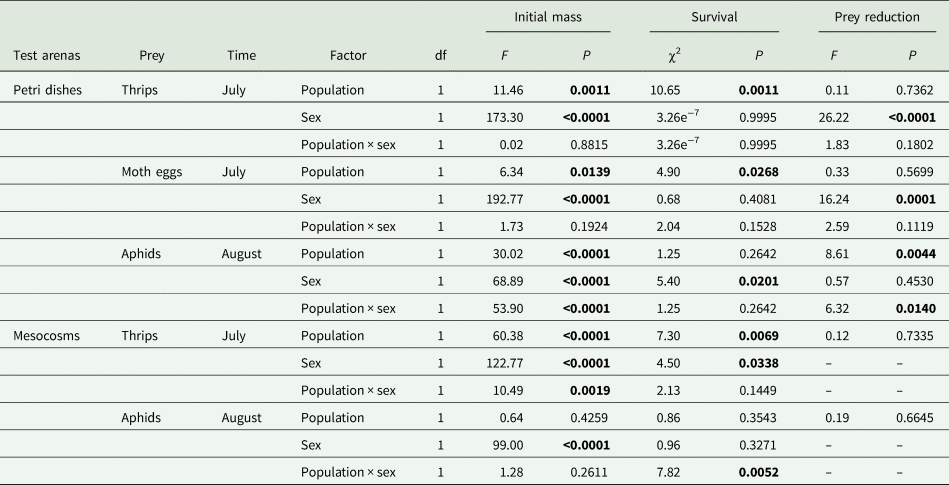
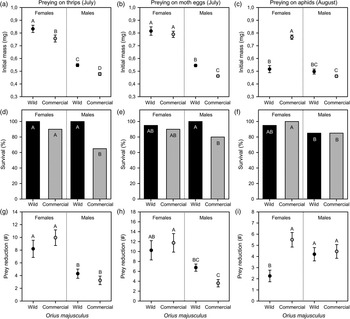
The initial mass of experimental O. majusculus differed depending on both population and sex within all three prey treatments (table 1), with a significant interaction in August when feeding on aphids but not in July when feeding on thrips or moth eggs (table 1). In July, the initial body mass was significantly larger in wild than in commercially produced individuals both within females and males when feeding on thrips (fig. 1a), but only within males when feeding on moth eggs (fig. 1b). In contrast, wild-caught females were much lighter than commercially produced females in August when feeding on aphids (fig. 1c), while wild-caught and commercially produced males had similar weight at this time (fig. 1c). Initial body mass was much larger in females than in males in July when feeding on thrips (fig. 1a) or moth eggs (fig. 1b), but was not larger in wild-caught females than in wild-caught males in August when feeding on aphids (fig. 1c).
Effects of population (wild-caught or commercially produced), sex (female or male), and their interaction on initial body mass, survival during tests, and prey reduction by adult Orius majusculus in Petri dishes or mesocosms with adult thrips (Frankliniella tenuicornis), moth (Ephestia kuehniella) eggs, or aphids (Rhopalosiphum padi) as prey. Only the effect of the population is included in the analysis of prey reduction in mesocosms because the sexes foraged together in pairs. Significant P-values (P < 0.05) are given in bold

Performance measures of wild-caught and commercially produced Orius majuscucus in Petri dish tests. (a–c) Initial mass of individuals provisioned with (a) adult thrips (Frankliniella tenuicornis), (b) moth (Ephestia kuehniella) eggs, or (c) aphids (Rhopalosiphum padi). (d–f) Survival during tests of individuals provisioned with (d) thrips, (e) moth eggs, or (f) aphids. (g–i) Prey reduction relative to the control of individuals provisioned with (g) thrips, (h) moth eggs, or (i) aphids.

Survival
Survival during the experiment was overall significantly higher in wild-caught than in commercially produced individuals in July (table 1), both when feeding on thrips (fig. 1d) and moth eggs (fig. 1e), but overall did not differ significantly between the sexes (table 1). When feeding on aphids in August, survival was significantly higher in females than in males (table 1, fig. 1f), but did not differ significantly between the populations (table 1). Likelihood ratio comparisons further indicated a lower survival in commercially produced males than in commercially produced females when provisioned with both thrips (fig. 1d) and aphids (fig. 1f).
Prey reduction
Prey reduction in July was significantly higher in females than in males but did not differ significantly between the populations, both when feeding on thrips (table 1, fig. 1g) and moth eggs (table 1, fig. 1h). When feeding on aphids in August, prey reduction by wild-caught females was significantly lower than by commercially produced females and males from both populations (fig. 1i), which caused significant overall effects of population and of the interaction between population and sex (table 1). The aphids in the controls on average produced 4.25 ± 0.81 (SE) offspring within each Petri dish. Aphid offspring reduction by O. majusculus was higher in females (mean ± SE = 3.50 ± 0.16 offspring) than males (2.83 ± 0.25 offspring) (Two-way ANOVA: F 1,80 = 5.20, P = 0.025), but with no significant effect of population (F 1,80 = 0.064, P = 0.80) or of the interaction between population and sex (F 1,80 = 0.0071, P = 0.93).
Tests in mesocosms
Initial mass
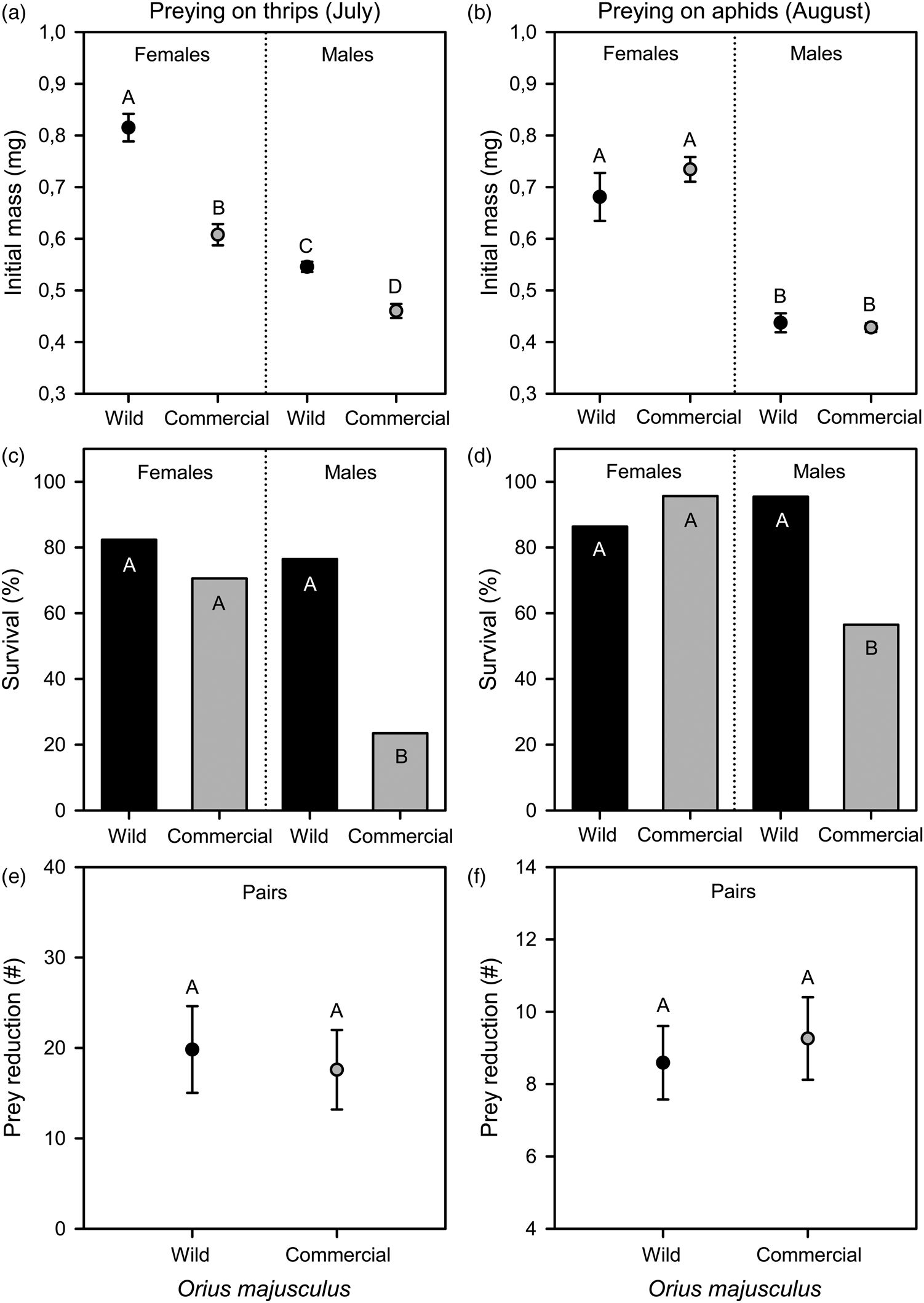
Initial mass of experimental O. majusculus in mesocosms differed depending on population, sex, and their interaction when feeding on thrips in July (table 1). Wild-caught individuals were significantly heavier than commercially produced individuals within both sexes, but the difference was larger in females than in males (fig. 2a). In August when feeding on aphids, females were significantly heavier than males within both populations, but with no significant differences between the populations (table 1, fig. 2b).
Performance measures of wild-caught and commercially produced Orius majuscucus in mesocosm tests. (a and b) Initial mass of individuals provisioned with (a) adult thrips (Frankliniella tenuicornis) or (b) aphids (Rhopalosiphum padi). (c and d) Survival during tests of individuals provisioned with (c) thrips or (d) aphids. (e and f) Prey reduction relative to the control of pairs provisioned with (e) thrips or (f) aphids.

Survival
When feeding on thrips in July, wild-caught individuals had higher overall survival during the experiment than commercially produced individuals (table 1, fig. 2c), with higher overall survival of females than males especially within the commercially produced population (table 1, fig. 2c). When feeding on aphids in August, survival did not differ overall between populations nor sexes but was significantly affected by their interaction (table 1). This was caused by a slightly lower survival of wild-caught than commercially produced females, while survival was significantly lower in commercially produced males than in wild-caught males (fig. 2d).
Discussion
Laboratory rearing of BCAs may have negative effects on the genetic composition and physiological performance of the population, and thus on the control potential of individuals when used in integrated pest management (Mackauer, Reference Mackauer1976; Chambers, Reference Chambers1977; van Lenteren, Reference van Lenteren2003). It can therefore be hypothesized that individuals from wild populations are in better body condition and more voracious predators than individuals from commercially produced populations and induce more effective biological control (Sørensen et al., Reference Sørensen, Addison and Terblanche2012). A previous study showed higher genetic diversity in a wild population of O. majusculus than in commercially purchased populations (Rasmussen et al., Reference Rasmussen, Jensen, Sørensen, Sverrisdóttir, Nielsen, Overgaard, Holmstrup and Kristensen2018), which suggests that the latter might be inbred or laboratory-adapted (Hoffmann and Ross, Reference Hoffmann and Ross2018; Ross et al., Reference Ross, Endersby-Harshman and Hoffmann2019). We found that wild-caught O. majusculus were generally heavier than commercially produced individuals and that they had higher survival under experiments. However, wild-caught individuals did not have a higher impact on pest prey numbers neither when tested in Petri dishes nor in mesocosms.
Differences between wild-caught and commercially produced O. majusculus in the present study can be caused by genetic differences between the populations, by different environmental conditions during development and maturation, and by age differences. As wild-caught O. majusculus had developed in the field while commercially produced individuals had developed under laboratory conditions, we cannot separate the effects of developmental environments from genetic effects or from a possibly higher average age of wild-caught individuals, as commercially produced individuals are received within 4 days of reaching adulthood. Heavier body mass of wild-caught individuals was also observed in a similar study comparing wild-caught and laboratory-reared Geocoris punctipes (Fallén) (Hemiptera: Geocoridae) (Cohen, Reference Cohen2000). This indicates that wild individuals were in better body condition than commercially produced individuals, which is supported by their higher survival during tests. The larger body size may be caused by lower density in the field than during laboratory rearing and possibly by access to a more diverse diet. It can also be caused by lower overall developmental temperature in the field (Kingsolver and Huey, Reference Kingsolver and Huey2008), as commercially produced individuals are reared at a constant temperature of 23°C. However, this did not cascade to a higher total prey reduction under the experimental conditions, although comparing the patterns of initial body mass with those of prey reduction do indicate some correlation between body mass and prey reduction (fig. 1). We can therefore conclude that the wild-caught individuals were heavier and had higher survival than the commercially produced individuals, but they were not more efficient biocontrol predators.
Females survived better and killed more aphid offspring and about twice as much prey as males when feeding on thrips or moth eggs (fig. 1a, b). Body mass and survival in wild females were affected by season resulting in lighter females in August, although wild-caught females were generally larger than commercially produced females in June. This most likely reflects the transition from being reproductively active to halting egg production and preparing for diapause, which corresponds with the late season and low prey availability in the maize at this time. Female Orius are typically larger and heavier than males (Bonte et al., Reference Bonte, De Hauwere, Conlong and De Clercq2015; Helgadóttir et al., Reference Helgadóttir, Toft and Sigsgaard2017; Rasmussen et al., Reference Rasmussen, Jensen, Sørensen, Sverrisdóttir, Nielsen, Overgaard, Holmstrup and Kristensen2018), and it is also typically found that female Orius kill more prey than males (Sobhy et al., Reference Sobhy, Sarhan, Shoukry, El-Kady, Mandour and Reitz2010; Aragón-Sánchez et al., Reference Aragón-Sánchez, Román-Fernández, Martínez-García, Aragón-García, Pérez-Moreno and Marco-Mancebón2018; Rasmussen et al., Reference Rasmussen, Jensen, Sørensen, Sverrisdóttir, Nielsen, Overgaard, Holmstrup and Kristensen2018). Females therefore clearly have a higher value as BCAs than males, both by being more robust and having a higher impact on prey populations.
Similar to a study on G. punctipes (Cohen, Reference Cohen2000), as well as a recent study on the predatory mite Cydnoseius negevi (Swirski & Amitai) (Acari: Phytoseiidae) (Alatawi et al., Reference Alatawi, Mushtaq, Mirza and Kamran2019), we did not find that commercially produced O. majusculus had a lower predation rate when compared to wild-caught individuals. Moreover, in a study on Orius laevigatus (Fieber) that were given different diets through their development to the fifth instar or to adults, body mass was significantly affected by rearing diet but subsequent predation rate on Frankliniella occidentalis (Pergande) thrips did not differ between individuals that had developed on either diet (Bonte and De Clercq, Reference Bonte and De Clercq2010), and the pattern is representative for a number of heteropteran predators used in biological control (De Clercq and Degheele, Reference De Clercq and Degheele1993; Castañé et al., Reference Castañé, Iriarte and Lucas2002; Vandekerkhove et al., Reference Vandekerkhove, De Puysseleyr, Bonte and De Clercq2011). Thus, studies on the predation rate of BCAs do not show any apparent differences in predation capacity depending on developmental environment or diet.
We conclude that, although wild-caught O. majusculus are often in better body condition and have higher survival, they do not exhibit a better capacity to reduce the abundance of prey in the short term than a commercially produced population. For use in situations where the predator does not need to establish and reproduce in order to be present over a longer term (e.g., because the pest population quickly diminishes or because a new sending of BCAs will be released), commercially produced O. majusculus are equally efficient for pest management as individuals from the wild. Many integrated pest management programs use repeated augmentation of BCAs over the season (Crowder, Reference Crowder2007), and under this circumstance commercially produced O. majusculus function as effective control agents. Although the kill rate of pest prey is a major success criterion for quality assessment of BCAs (van Lenteren et al., Reference van Lenteren, Bueno, Burgio, Lanzoni, Montes, Silva, de Jong and Hemerik2019), body condition and survival are important parameters influencing fitness and thus long-term control potential. If our experiments had been extended over a longer duration, we might have found higher prey reduction by wild-caught O. majusculus due to their higher survival, and to higher fecundity associated with their higher body mass (Honěk, Reference Honěk1993; Mendoza et al., Reference Mendoza, Balanza, Cifuentes and Bielza2020). We thus suggest measuring additional performance traits to prey reduction when assessing the quality of BCAs over a short time scale.
Acknowledgements
This study was funded by the Danish Council for Independent Research – Technology and Production Sciences (DFF-4184-00248). The authors thank Torsten N. Kristensen and Johannes Overgaard for discussion on the project. They also thank H. Sørine Gerlich for technical assistance in the field and laboratory, and Lara Bosco and Luciana Tavella for assistance in attaining field experience with O. majusculus. The authors have no conflict of interest to declare.