Introduction
The National Registry of Emergency Medical Technicians (NREMT, www.nremt.org) maintains the most comprehensive national database of its type in the United States, with information on more than 280,000 registered emergency medical service (EMS) professionals. The NREMT is a non-profit certification entity providing the nation with testing that certifies the following levels of EMS professionals: First Responder, EMT-Basic, EMT-Intermediate, and Paramedic. Peoples’ lives can depend on the competent and quick reaction of out-of-hospital-care EMS providers. These EMS professionals deal with a broad array of emergency situations, often via “9-1-1” notification, including heart attacks, falls, driving accidents, and firearm wounds. 1 Beyond critical delivery skill certification, recent empirical research has focused on other issues facing such EMS professionals, including: higher self-risk behaviors, i.e., not wearing seatbelts, driving too fast, and not exercising enough;Reference Pirrallo, Levine and Dickison 2 sleep problems increasing ambulance crash probabilities;Reference Studnek and Fernandez 3 dealing with workplace violence from patients, i.e., verbal abuse, theft, intimidation, physical abuse, sexual harassment, and sexual assault;Reference Koritsas, Boyle and Cole 4 and perceived inadequacy of training to give death notification to bereaved family members.Reference Smith-Cumberland and Feldman 5 Empirical research has also highlighted EMS professionals feeling adequately prepared to respond to man-made and natural disasters, and that such a preparedness perception is positively related to hours of training.Reference Fernandez, Studnek, Margolis, Crawford, Bentley and Marcozzi 6
Patient safety is an acknowledged critical component for measuring quality of emergency medical services.Reference Graff, Stevens, Spaite and Foody 7 A qualitative study of adverse events and near misses reported by out-of-hospital care EMS providers found 61 total events broken down as 27 near misses (i.e., incidents that did not result in harm to the patient but had the potential to do so) and 34 adverse events (i.e., mistakes caused by medical management, not the underlying condition of the patient).Reference Fairbanks, Crittenden and O'Gara 8 Types of errors included 33 clinical judgment (54%), 13 skill performance (2%), 9 medication event (15%), 3 destination choice (5%), and 3 others (5%). Seventy percent of the focus group participants and 73% of the interview participants were advance life support providers. Themes from the data included focusing on the error of others and a “blame and shame” perspective.Reference Fairbanks, Crittenden and O'Gara 8 More recent recommendations for quality improvement and patient safety in emergency medicine have advocated creating a culture where mistakes need to be admitted, but accountability for human error, at-risk behavior, and reckless behavior is critical.Reference Kelly, Thallner and Broida 9
Professional behavior is another key component of effective out-of-hospital-care EMS provider practice.Reference Brown, Margolis and Levine 10 In a survey of 11 professional behaviors, EMS professionals were asked to rate the behaviors of the partner with whom they worked most closely in the past year, using the following 4-point scale: 0 = poor, .33 = fair, .66 = good and 1.0 = excellent.Reference Brown, Margolis and Levine 10 The averaged peer rating of each professional behavior was: integrity, .77; appearance/personal hygiene, .74; patient advocacy, .73; empathy, .72; self-confidence, .70; careful delivery of service, .70; respect, .65; communication skills, .64; time management skills, .63; teamwork/diplomacy skills, .62; and self-motivation, .61. The combined behaviors’ average rating was .68. Examples of integrity, the highest peer-rated behavior, include consistent honesty with patients, being trusted with the property of others, being trusted with confidential information, and accurate documentation of patient care. Examples of patient advocacy include placing patient needs above self-interest, and protecting and respecting patient confidentiality and dignity.Reference Brown, Margolis and Levine 10 Overall, these study results suggested that EMS professionals exhibit “good” peer-rated professional behaviors.Reference Brown, Margolis and Levine 10 In a real emergency, e.g., a heart attack or serious driving accident, it is unlikely that an EMS-caller would question the qualifications of EMS professionals arriving to help. The EMS professionals are assumed to be properly trained, trustworthy, absent a criminal record, screened, and properly licensed or certified.
The literature contains general articles on health care professionals’ crimes, including murder of patients,Reference Yorker, Kizer, Lampe, Forrest, Lannan and Russell 11 fraud, 12 and theft and violence.Reference Payne and Cikovic 13 Hospitals and nursing homes are the most common sites of these crimes.Reference Payne and Cikovic 13 , Reference Bradley and Moore 14 General health care research has stressed the importance of adhering to careful hiring practices.Reference Martanegara and Kleiner 15 However, no study investigating public (potential EMS caller) perceptions of out-of-hospital-care EMS professionals was found. The purpose of this study was to investigate (1) how comfortable an EMS-caller would be receiving care from an EMS professional who might have a legal conviction, and (2) whether there are factors or correlates that might help to explain perceived care comfort with an EMS professional who may have a legal conviction.
Methods
Sample and Procedure
A phone survey instrument was developed with input from state EMS officials, fire captains and lieutenants, a public NREMT Board Member, and research personnel at the NREMT and Kent State University. Prior to data collection, Institutional Review Board (IRB) approval was obtained from the American Institute of Research. The instrument was first pilot-tested by the Social Research Laboratory (SRL) at Kent State, which maintains an 18-station computer assisted telephone interviewing laboratory. Research is generally inconclusive on how the number of questions affects response rate;Reference Dillman, Sinclair and Clark 16 , Reference Dillman 17 pilot testing indicated the telephone survey was “respondent friendly.” The SRL initiated data collection in the fall of 2010. To maximize geographical representation across the contiguous United States, a clustered stratified sampling strategy was used based upon US Postal Service zip codes. A geographical representation of survey respondents by zip code is shown in online supplemental Figure 1. All probabilistic surveys are subject to sampling error. For the present study, a 95% degree of confidence would produce a statistical precision of plus/minus 3.1%.Reference Kazner, Baren and Le Rous 18
Using a protocol, interviewers identified themselves as calling from Kent State and as conducting a phone survey to ask about public opinions and perceptions concerning EMS on behalf of the NREMT. If a respondent asked about the NREMT, telephone interviewers were instructed to say “the National Registry is a non-profit, non-government certification agency that tests and establishes competency standards for EMTs and Paramedics.” Interviewers indicated that all individual responses were confidential and participation was voluntary, with the full survey taking approximately 20 minutes. Interviewers also told respondents that: they could stop the interview at any time, and that there was no compensation for participation. To help survey respondents answer more realistically and reduce impression management effects, respondents were asked to place themselves in an actual emergency situation (simulation) by the interviewer via prompts, for example “Imagine you've called 9-1-1 and…” or “Now let's imagine that the ambulance has arrived, the following questions are about the EMS professionals who have arrived….” Such prompts have been shown to improve the realism of questions while reducing impression management effects.Reference Alexander and Becker 19
Measures
Employment Status—Interviewees were asked to indicate their current employment status as employed (full- or part-time); retired; self-employed; unemployed; homemaker; disabled/unable to work; or student.
Care Comfort If EMS Legal Conviction—Interviewers used the lead in phrase: “On a scale of 1 to 10 with 1 being very uncomfortable and 10 being very comfortable, what is your level of comfort in receiving care from an EMS professional that may have one of these legal convictions.” Nine items were asked about, and responses aggregated: “elderly abuse;” “sexual misconduct with an adult (over age 18) such as rape;” “sexual misconduct with a child (under age 18);” “violent crimes;” “theft;” “illegal drug possession;” “cashing a bad check;” “behind on their income taxes;” and “driving under the influence or driving while intoxicated.”
Control Variables—Seven variables were used for data analysis: race, marital status, income level in 2009, times used EMS in last 5 years, current political perspective, highest education level, and age. Race was recoded into two categories: 1 = Caucasian or white American and 2 = non-white. Marital status was recoded into two categories: 1 = married and 2 = not married.
Income level in 2009 was measured by asking a respondent to stop the interviewer when the category best describing his total 2009 income before taxes was reached, where: 1 = less than US $15,000; 2 = $15,000 to under $25,000; 3 = $25,000 to under $35,000; 4 = $35,000 to under $50,000; 5 = $50,000 to under $75,000; 6 = $75,000 to under $100,000; and 7 = over $100,000. Times used EMS in last 5 years was measured by asking how many times the respondent had used emergency medical services in the past five years; responses were recoded into categories where 1 = never, 2 = once, 3 = twice, and 4 = three or more times. Current political perspective was assessed by asking how respondents would describe their political perspectives using response categories from 1 = very conservative to 7 = very liberal. Respondents were asked to indicate highest education level completed, where 1 = less than 12 years; 2 = high school diploma or General Equivalency Degree; 3 = high school plus vocational/technical training; 4 = high school plus some college; 5 = four year college graduate; and 6 = post-graduate degree (respondents were further probed to indicate, e.g., Masters, MBA, PhD, MD, JD). Finally, for age, respondents were asked how old they were in years.
Scaled Variables—Five multi-item scales were asked (number of items aggregated): admire EMS professionals (2 items), EMS wrongdoing license revoke (5 items), EMS pre-hire screening (4 items), EMS credentials importance (4 items), and EMS improper care lawsuit (4 items). The first three measures used a response scale of 1 = strongly disagree to 10 = strongly agree. For admire EMS professionals, the items were: “I admire people who work in EMS” and “people in EMS are heroic.” For EMS wrongdoing license revocation, items asked about an EMS professional's license being taken away for “illegal use of narcotic drugs or other drugs meant to treat a patient;” “violation of a patient's confidentiality;” “stealing property from a patient;” “deliberate withholding of or negligent care;” and “improper care that did not harm you.” For EMS pre-hire screening, items asked about the need for screening EMS professionals before they are hired for “mental health;” “illegal drug use;” “physical fitness;” and “criminal background.” For EMS credentials importance, respondents were asked to indicate how important (from 1 = very unimportant to 10 = very important) it was that EMS professionals “have a state license;” “have national certification;” “renewed their certifications by meeting valid education requirements;” and “graduated from a nationally accredited education program.” For EMS improper care lawsuit, respondents were asked (using a 3-point scale where 1 = no, 2 = don't know and 3 = yes) about a lawsuit for improper care against “EMS professional;” “owner of the ambulance service;” “city offering the ambulance service;” and “physician providing EMS oversight.”
Data Analyses and Sample Size Reduction
SPSS-PC version 17 (IBM, Armonk, New York USA) was used to analyze the data. 20 A listwise deletion of data across all study variables was done to ensure there was complete data for those respondents retained. Stepwise regression analyses were used to investigate the impact of control and scaled variable correlates for explaining perceived care comfort with an EMS professional having a legal conviction. The final regression model was checked for outliers, as well as the assumptions of no multicollinearity, linearity and homoscedasticity being met.Reference Stevens 21
Results
Sample Demographics
Of the 2,443 phone calls made, 1,051 (43%) full survey data responses were obtained. These participants stayed on the telephone with the interviewer all the way through to the end of the survey (although there could still be individual item answers missing). There were 297 (12%) respondents who formally dropped out of the survey at some point, and the remainder refused to participate. Of the 1,051 full survey respondents, 386 (37%) indicated that they were currently employed (includes full/part time), 365 (35%) were retired; 68 respondents (6%) were self-employed; 53 (5%) were unemployed; 95 (9%) were homemakers; 62 (6%) were disabled/unable to work; 19 (2%) were students; and 3 (.3%) refused to answer the employment status item.
Race of the 1,051 full-survey data respondents was 83% Caucasian or white American and 17% non-white (including African/Black American (7%); Asian American/Pacific Islander (2%); Hispanic (3%); Native American (1%); Bi-racial/multi-racial (1%); and other (3% - not specified). Sixty-three percent listed marital status as married, while 37% reported they were not married. The not married category included divorced (9%); widowed (12%); single/never married (10%); and living with partner (6%).
For income level in 2009, responses were: 1 = less than $15,000 (12%); 2 = $15,000 to under $25,000 (11%); 3 = $25,000 to under $35,000 (9%); 4 = $35,000 to under $50,000 (18%); 5 = $50,000 to under $75,000 (19%); 6 = $75,000 to under $100,000 (13%); and 7 = over $100,000 (18%). For times used EMS in last 5 years, responses were: 1 = never (62%), 2 = once (19%), 3 = twice (8%), 4 = three or more times (11%). For highest education level completed, responses were: 1 = less than 12 years (5%); 2 = high school diploma or General Equivalency Degree (19%); 3 = high school plus vocational/technical training (7%); 4 = high school plus some college (29%); 5 = four year college graduate (23%); and 6 = post-graduate degree, (17%).
Study Variable Descriptive Statistics and Correlations
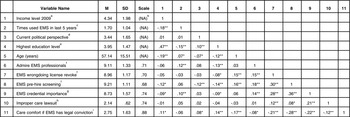
A listwise deletion of data across all study variables resulted in dropping 97 respondents (from N = 1,051 to 954). There were no significant demographic differences between the incomplete versus complete data respondents. Study variable means, standard deviations, reliabilities (for multi-item scales), and correlations are shown in Table 1. Scale means indicated that overall, respondents have a high level of admiration for EMS professionals, strongly agree with revoking an EMS professional's license for wrongdoing, strongly agree with pre-hire EMS screening, perceive EMS credentials as very important, and are not sure that there should be a lawsuit for improper care. Respondents were uncomfortable with being cared for by an EMS professional who may have a legal conviction (Mean = 2.75 out of 10). This scale had very good internal consistency reliability (.88).Reference DeVellis 22 Other scale reliabilities were adequate, except for EMS pre-hire screening, which was minimally acceptable (.68).Reference DeVellis 22 Given the large sample size, very small correlations are statistically significant. The strongest correlation among correlates was between income level and education level (r = .47). Stepwise regression was used to test the second research question regarding which correlates can help to explain perceived care comfort with an EMS professional who may have a legal conviction (shortened to “care comfort if EMS legal conviction”).
Study Variable Means, Standard Deviations, Scale Reliabilities, and Correlations

N = 954.
* P < .05
** P < .01 (two-tailed)
a Income level, 1 = less than $15,000, 2 = $15,001 - $25,000, 3 = $25,001 - $35,000, 4 = $35,001 - $50,000, 5 = $50,000 - $75,000, 6 = $75,001 - $100,000, 7 = $100,000 or more.
b Reliability calculated if multi-item scale using (coefficient alpha), otherwise (NA) = not applicable.
c Times Used EMS in Last 5 Years, 1 = never, 2 = once, 3 = twice, 4 = three or more times.
d Current Political Perspective, 1 = very conservative to 7 = very liberal.
e Highest Education Level, 1 = less than 12 years, 2 = high school diploma or General Equivalency Degree, 3 = high school plus vocational/technical training,
4 = high school plus some college, 5 = four year college graduate, and 6 = post-graduate degree.
fAdmire EMS Professionals, EMS Wrongdoing License Revoke and EMS Pre-hire Screening, 1 = strongly disagree to 10 = strongly agree.
g EMS Credentials Importance, 1 = very unimportant to 10 = very important.
h EMS Improper Care Lawsuit, 1 = no, 2 = don't know, 3 = yes.
iCare Comfort If EMS Legal Conviction, 1 = very uncomfortable to 10 = very comfortable.
Regression Analysis
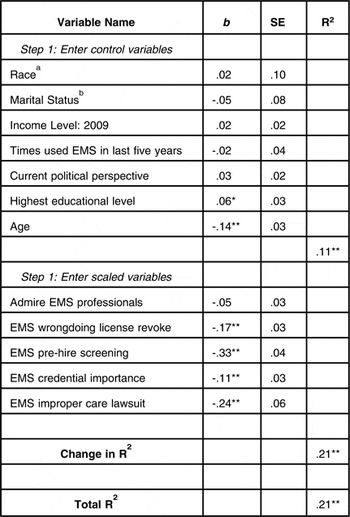
Twenty-five outliers (at least three standard deviations from the predicted value) were deleted from the analyses, which reduced the sample size from 954 to 929. Table 2 shows the final stepwise regression model. The control variables set was entered first, and it collectively accounted for 11% of the variance in care comfort if EMS legal conviction. Two correlates were significant, highest education level (b = .06) and age (b = -.14).
Summary of Final Model Stepwise Regression Analyses for Contribution of Control and Scale Variables for Explaining Care Comfort if EMS Professional Has Legal Conviction

Notes: N = 929. Regression coefficients, b, are unstandardized regression weights.
Abbreviation: SE, standard error.
aRace: 1 = white, 2 = non-white.
bMarital Status: 1 = married, 2 = not married.
*p < .05.
**p < .01 (two-tailed).
The scaled variables set, entered second, accounted for an additional 21% of the variance in care comfort if EMS legal conviction. Four correlates were significant, EMS wrongdoing license revoke (b = -.17), EMS pre-hire screening (b = -.33), EMS credentials importance (b = -.11) and EMS improper care lawsuit (b = -.24). The overall amount of variance explained (total R2) was 32% (adjusted R2 = 31%).
Discussion
There is public discomfort in receiving care from EMS professionals who may have been convicted of a crime. It is important for research to empirically demonstrate what one might only assume. What would be the interpretation had the results not shown this level of discomfort? This study aggregated different types of legal conviction items into a scale which exhibited good reliability, and can be used for future research. As noted in the Introduction, patient safety is an acknowledged critical component for measuring quality of emergency medical services.Reference Graff, Stevens, Spaite and Foody 7 , Reference Fairbanks, Crittenden and O'Gara 8 To shift from a “blame and shame” perspective for adverse events to creating a culture where mistakes need to be admitted but there is also accountability for human error, at-risk behavior and reckless behavior, is recommended.Reference Kelly, Thallner and Broida 9 To account for such discomfort, the results of this study show that respondents who are less educated and older more strongly (1) agree that EMS professionals should have their licenses revoked for wrongdoing; (2) agree EMS professionals should be screened before being hired; (3) perceive EMS credentials to be important; (4) support a lawsuit for improper care; and (5) are collectively less comfortable with being cared for by an EMS professional who may have a legal conviction. The scaled variables set explained most of the variance, and individual scales were found to be reliable. Such scales can be used in future research.
Limitations
A number of study limitations need to be noted. First, the sample overrepresented whites and underrepresented African Americans and Hispanics compared to 2010 census data. 23 The sample was confined to households with only landline telephones, and excluded cell phone users and cell phone-only households. Recent research indicates that cell phone users and cell phone-only households have become a distinct group, and that one in five households only has a cell phone.Reference Ansolabehere and Schaffner 24 Another important limitation is that this was a simulated situationReference Stone 25 in which respondents were surveyed by telephone about their comfort level for receiving care from an EMS professional who may have a legal conviction. Although the phone interviewers attempted to make this simulation as “real” as possible with prompts, it was not an actual emergency. It would be very difficult to ask an EMS-caller such questions in a real emergency situation. No differentiation was made among types of EMS professional (e.g., EMT Basic, Paramedic). The cross-sectional research design used did not allow for inferring causality, and no gender data was collected. However, prior research has shown that women tend to be those at home most available to answer a telephone survey during the weekday daylight hours. 26
The results of this study reinforce how important it is to carefully screen EMS professionals before they are hired or allowed to be volunteers. There is a current shortage of emergency medicine personnel in the United States, including physicians and nurses, as well as concern about patient issues such as patient transfer capabilities.Reference Ginde, Rao and Simon 27 The Bureau of Labor Statistics (BLS) projects a need for an additional 62,000 EMTs and Paramedics in the next decade to fill new jobs and replace workers who leave the EMS profession. 28
With such a projected EMS shortage, careful and deliberate due diligence in hiring EMS professionals is critical. As with other health care professionals, such due diligence includes verifying state licenses and certifications, performing criminal background checks, verifying prior employment, following up on references, drug testing, physical examinations, and careful interviewing.Reference Bradley and Moore 14 , Reference Martanegara and Kleiner 15 Beyond this due diligence, these study results can collectively serve as a reminder for increased EMS provider awareness of the importance of exhibiting professionalism when dealing with the public.Reference Brown, Margolis and Levine 10 , Reference Mowafi, Nowak and Hein 29
Conclusion
There is significant public discomfort in receiving care from EMS professionals who may have a legal conviction. The results of this study provide increased impetus for the careful screening of EMS professionals before they are hired or allowed to be volunteers. Beyond this due diligence, the results serve as a reminder for increased EMS provider awareness of the importance of exhibiting professionalism when dealing with the public.
Abbreviations
- EMS:
-
emergency medical services
- NREMT:
-
National Registry of Emergency Medical Technicians
- SRL:
-
Social Research Laboratory
Supplementary Material
To view supplementary material for this article, please visit http://dx.doi.org/10.1017/S1049023X12000969.