Introduction
Under the ornate arches of the Bab El Makina on a balmy June night in Fes, Youssou N'Dour, dressed in a pristine white damask boubou, bows in appreciation of the standing ovation and thunderous applause he has just received from an audience of some 5,000 people at the World Sacred Music Festival. ‘Aujourd'hui je suis libéré’ (‘Today I am liberated’), he tells a Moroccan journalist just a few minutes after the concert is over, explaining that his live performance had been something of a test for his experimental musical endeavour (Ezzakhrajy Reference Ezzakhrajy2004). In November of 2003 during the holy month of Ramadan the Senegalese superstar released a new album under his Xippi label in Dakar entitled Sant Yàlla meaning ‘praise God’ in Wolof, Senegal's lingua franca and N'Dour's native tongue. The accompanying musical videos were shown for a brief period on Senegalese television but were abruptly pulled after a religious leader, in a bid for authority, protested their airing and threatened the singer with sanctions.Footnote 2 Several months later, even pirated copies of those videos could not be found anywhere in Dakar's markets, a testament to the political power of Senegal's religious elite. The album was subsequently released on the international market under the name Egypt by Nonesuch Records in June 2004, a little more than a week after the singer had performed the ensemble of pieces on the album at the festival in Morocco, and it went on to win the 2005 Grammy Award for best contemporary world music album. On the front of the album cover the name Egypt, in small red letters, is dwarfed by a much larger gold ‘Allah’ in Arabic script on a white background, while on the back, a damask and embroidery clad N'Dour, eyes reverently closed and arms outstretched, strikes a Sufi pose evoking a whirling dervish from Konya, the spiritual centre of Turkish Sufism.
Sant Yàlla/Egypt is, in musical terms, strikingly different from N'Dour's other albums, most of which feature the distinctive mbàllax dance rhythm that has become synonymous with his unique style since the early 1980s. In this album, however, N'Dour and his entourage of Senegalese musicians, including kora player Babou Laye and several percussionists (Mbaye Dièye Faye and the Beugue Fallou Ensemble), are accompanied by an Egyptian orchestra led by Cairene musician, composer and producer, Fathy Salama, who arranged and conducted the contemporary pieces on Sant Yàlla/Egypt. The songs on the album form a suite of interrelated works, all of which are religious in nature, praising God and the various, mostly local, Sufi saints and marabouts or holy men who are venerated in Senegal. As exemplars, their lives legitimate Islam as a religion of tolerance and peace for N'Dour, and he takes pride in presenting them to the rest of the world through his music.
N'Dour's album is a grand undertaking, not only in terms of the experimental and collaborative nature of the music, but also in the historic moment when Senegalese intellectuals and artists, like their counterparts throughout the Muslim world, are finding new ways to articulate a specifically Sufi modernity in response to post-9/11 Western critiques of Islam as well as reformist movements from within their own society. It is also a moment at which events of global significance, from the Iranian revolution of 1979 to the escalation of political violence in Iraq following the US invasion and occupation of that country, have raised important questions about what it means to be a Muslim. Youssou N'Dour, who cancelled a scheduled tour to the United States in protest at former American president George W. Bush's decision to invade Iraq, has made it abundantly clear in the many interviews he has participated in with regard to Sant Yàlla/Egypt, that the album is meant to contribute to the promotion of tolerance and a better understanding of the peaceful nature of Islam, and to the ways in which it is practised beyond the Arab world in places like Senegal. Dismissing the equation of Islam with the Arab world – ‘Il n'y a rien de plus faux … les champs de l'islam sont beaucoup plus vastes’ (‘Nothing could be further from the truth … the domain of Islam is much more vast’) (Mortaigne Reference Mortaigne2004, p. 2) – N'Dour points to places like Iran, Indonesia, Mali, Pakistan, Azerbaijan, Senegal and Turkey to show that the religion has universal appeal. To promote his views on Islam as a religion of peace, N'Dour looks towards home, to the Senegalese model of Islam, centred on the Sufi orders to which most Muslims in a country that is approximately ninety-five per cent Muslim claim allegiance. The peaceful and conciliatory nature of Senegalese Islam in particular is what Youssou N'Dour sings about in Sant Yàlla/Egypt, and what he offers for the rest of the world to consider in their evaluation of the religion.
In this essay I argue that in bringing Senegalese Islam to the international arena, N'Dour uses his stature as a world-class musician to both articulate and participate in the creation of a Sufi modernity, namely a way of being a Sufi Muslim in a globalised world. In addition to being a personal journey for Youssou N'Dour, both musically in its orientation towards the East rather than the West, and in his own religious faith, Sant Yàlla/Egypt also echoes many of the current preoccupations of Muslim intellectuals and artists as they seek to renew and reinterpret their own local religious traditions. N'Dour's musical experiment can be viewed both as a response to anti-Islamic discourses originating in the West, and as an attempt to situate a vernacular Senegalese Sufism, represented by the praise songs to local religious figures, within a larger context of global Islam, represented by the musical accompaniment of Fathy Salama's Egyptian orchestra. Just as importantly, it legitimates the larger context of global Islam through the vernacular, that is, by exemplary local practice, namely the lives and deeds of the Sufi saints recounted in the songs. Soares (Reference Soares2000, p. 277) argues for an approach to the study of Muslim societies in Africa that views their practices as constituting ‘a discursive tradition at the intersection of the local and the supralocal’. This dialogue between the two, which N'Dour has taken up in his musical experiment, constitutes one of the primary means of articulating a Sufi modernity. Thus, rather than simply melding two musical traditions, Sant Yàlla/Egypt addresses in a new and direct way one of the central concerns of contemporary Muslim societies, namely the articulation of a local Muslim identity within the larger global or supralocal Muslim world.
Sufi praise songs and the maraboutic tradition
While the musical arrangement of Sant Yàlla/Egypt differs from N'Dour's previous compositions, the subject matter and the lyrics of the individual pieces have precursors in N'Dour's oeuvre as well as in that of other Senegalese musicians. The relatively new genre of popular song devoted to the praise of marabouts or Sufi religious leaders has become part of the current repertoire of the majority of Senegalese popular singers, including rappers and hip-hop groups like Daddy Bibson, Daara J and Bamba J Fall, and has contributed a number of very successful hits on the international as well as local music scenes. Some musicians, like Fatou Guewel, Cheikh Lô and Bamba J Fall, have even built their repertoires around a set of such songs so that their concerts or videos at times seem to blur the distinction between religious ceremony and popular entertainment, just as N'Dour does in Sant Yàlla/Egypt.
The popular Sufi song has its origins in two important sources, namely the praise-singing tradition of the Sahelian griots and the numerous Sufi ceremonies held throughout the Muslim year (McLaughlin Reference McLaughlin1997, Reference McLaughlin2000). Senegalese Sufism is organised around the veneration of marabouts, a practice that has at times attracted criticism from Islamic reformists, but which up to now has contributed to the unique and peaceful character of Senegalese Islam, and one that Youssou N'Dour defends as an exemplary practice in his album. A brief historical background on both Senegalese Sufism and the praise-singing tradition of the griot will allow for a more complete discussion of the popular Sufi song and a richer contextualisation of Sant Yàlla/Egypt within the local tradition of Senegalese Islam.
Although Islam was present in the Muslim state of Tekrur in northern Senegal as early as the 11th century, mass conversions to the Islamic faith by the general population did not occur until the 19th and especially the early 20th centuries, at the height of colonial expansion in Africa. Historians have shown that the two events, colonial expansion and mass conversion to Islam, are closely related, and that the dissolution of Senegambian kingdoms under pressure from French and British colonial rule created a climate of social instability favourable to the expansion of a religion that offered not only a theology, but also a legal system, a code of personal conduct and a vision of social order that could replace the one that had been lost. Most practitioners of Islam in Senegal follow the Sufi tradition, a mystical tradition within Islam, and adhere to a particular Sufi order or tariqa (‘path’). Three Sufi orders are the subject of Youssou N'Dour's praise songs in Sant Yàlla/Egypt, namely the Tijaniyya whose historical origins are in North Africa and which counts the largest number of followers in Senegal, and two indigenous orders, the Mouride order of which Youssou N'Dour is himself a member, and the Layene, a smaller order whose disciples are drawn mainly from the coastal Lebou ethnic group. While they have much in common, the orders are distinguished by differences in prayer sequences used in devotional and initiation practices, and by the nature of the relationship between taalibe (‘disciple’) and marabout. In Sufi thought, the quest for spiritual enlightenment is likened to a path or way through life that cannot be undertaken alone but must be embarked upon with the help of a spiritual guide, or marabout in the Senegalese context. This emphasis on a spiritual guide is reflected in a variety of popular beliefs including a Wolof proverb that states ‘Nit ku baax, ku amul kilifa, dotul nekk nit ku baax’ (‘a good person who does not have a leader will no longer remain a good person’). Similarly, certain types of mental illness are popularly attributed to the afflicted's attempts to study the secrets of Sufism on their own without the benefit of a guide. The taalibe–marabout relationship is thus central to the lives of the majority of Senegalese Muslims, and finds its expression in myriad genres of popular culture, including dress, painting and sports events, as well as popular music.Footnote 3
Marabouts, and especially the caliphs of the various Sufi orders, have long been involved in political issues, both during the colonial and post-colonial periods, and wield considerable power in this arena. Although negotiation between politicians and marabouts involves a delicate and constantly negotiated balance of power, Senegal has had a long history of relative political and social stability, at least some (and possibly much) of which can be attributed to the institutionalisation of religious organisation (Cruise O'Brien Reference Cruise O'Brien1971; Villalón Reference Villalón1995; Robinson Reference Robinson2000; Babou Reference Babou2007).
The social and political conditions of the colonial period served as the historical backdrop against which the great leaders of Senegalese Islam emerged. Two marabouts in particular, El Hajj Malick Sy (c. 1855–1922) and Cheikh Amadou Bamba Mbacké (1850–1927), attracted large numbers of followers to their religion and their respective legacies have shaped Senegalese Sufism to the present day. El Hajj Malick Sy was a member of the Tijaniyya Sufi order, an order founded by a North African cleric from what is now southern Algeria, Ahmed at-Tijani, who preached and taught in Fes. His tomb, in the city that now hosts the World Sacred Music Festival, has remained an important pilgrimage site for Sufi Muslims from West Africa and beyond since his death in 1815. El Hajj Malick Sy founded a Tijani zawiya or centre of religious learning in Tivaouane, a town in Senegal's interior to the northeast of Dakar, regarded today as one of the holy cities of Senegal. A yearly festival known as the gàmmu, celebrating the Prophet's birthday and honouring the Tijani marabouts, is held in Tivaouane and attracts followers from all over the country and abroad. A second Tijani zawiya was established by the marabout Abdoulaye Niasse (c. 1844–1922) in Medina Baye in Kaolack, an inland railroad city to the southeast of Dakar. The zawiya became more prominent under the leadership of his son, the influential marabout El Hajj Ibrahima ‘Baye’ Niasse (1900–1975), who had large followings both within Senegal and abroad, and particularly in northern Nigeria. The zawiya currently attracts Qur'anic students from Senegal, Mauritania, northern Nigeria and as far afield as the United States.
The Qadiriyya order, founded in 12th century Baghdad by Abd al-Qadir al-Jilani, spread from Mauritania into Senegal, and the ties between the two communities are still strong. Mauritanian shaykhs come to Senegal as religious emissaries, and Qadiriyya religious ceremonies often involve chanting to the accompaniment of the deep resonant Moorish tabala drum. Cheikh Amadou Bamba Mbacké (c. 1850–1927) was originally a member of the Qadiriyya order, but through his teachings he established a new tariqa, the Mouride Sufi order, which grew rapidly among the displaced peasantry and warrior and artisan classes of Wolof society after his death. Work is a touchstone of the Mouride ethos and is derived from the teachings of Cheikh Amadou Bamba who recognised that an ideal life of religious contemplation was an impossible goal for a population drawn largely from the peasant classes and casted groups of Wolof society. He preached that while those scholars who knew how to read Arabic could devote themselves to a life of contemplation, those who could not should devote themselves to their work. ‘Demleen liggéey’ (‘go and work’) is an oft-cited message that Bamba left with his followers, and it has translated into a successful economic formula. Historically, Mouride disciples were based in the rural areas of Senegal's peanut-producing heartland and were involved in the cultivation of the crop that fuelled Senegal's colonial economy. Trading networks were subsequently organised among disciples, and some of them eventually moved to Dakar's urban markets after World War II. Since then, they have expanded their closely knit social and economic networks to other African capitals, then to Europe in the 1970s, and more recently to the United States as well as Asia and the Middle East. The disciples who make up the fabric of these large international trading networks carry their religious practices, organisations and beliefs with them into the global economy in what Diouf (Reference Diouf2000) aptly calls a ‘vernacular cosmopolitanism’, all the while maintaining close ties to the geographic centre of Mouridism, the city of Touba in the Senegalese interior. Emigrants build houses in Touba, return there every year or two insofar as they are able for religious ceremonies, and have contributed generously to the expansion of the mosque of Touba, currently purported to be the largest in sub-Saharan Africa.Footnote 4 Mouridism has proved to be a flexible model in the practice of Sufi modernity at various stages in its history, the colonial, the post-colonial, and now the global.
Cheikh Ahmadou Bamba's charisma as a religious leader was enhanced by the colonial regime's suspicion of his activities. The French saw in this ascetic Sufi a potential challenge to colonial authority and exiled him first to Gabon and afterwards to Mauritania. There are many legends and miracles associated with Bamba's exile which have captured the popular imagination and enhanced his stature, and the màggal, an annual pilgrimage to Touba, commemorates the marabout's return from exile in Gabon. One of the most oft-recounted miracles takes place on the French ship that carried Bamba to exile: when prayer time came, the French captain refused to allow Bamba to pray in the ship so the marabout climbed overboard with his prayer skin, threw it on top of the water and prayed on it. When he arose after praying to get back on the ship there was a patch of sand stuck to his forehead as if he had prayed on land. This miracle is recounted in Youssou N'Dour's 1994 hit, ‘Mame Bamba’, which appeared on the album Wommat (‘The Guide’). In a showdown between temporal and spiritual authority, the French captain speaks to Bamba, telling him that even though God wants him to pray, he cannot pray on the ship:
An ascetic, mendicant offshoot of the Mouride order was founded by Cheikh Ibra Fall, Amadou Bamba's most ardent follower, whose disciples, the Baye Fall, have named themselves after him, in his honour. According to legend, upon recognising Cheikh Amadou Bamba as a true guide, Cheikh Ibra Fall prostrated himself in front of the marabout and pledged his allegiance to him. He renounced his worldly goods and vowed to lead the peripatetic life of a mendicant, begging for food from strangers. He fabricated a patchwork garment out of pieces of cloth that were given to him, and his followers today wear similar garments made out of cloth known as njaxas (‘patchwork’) sewn from small leftover pieces. They also sport dishevelled hair or dreadlocks as a sign of their lack of attachment to the physical world. The Baye Fall are exceptional within the Muslim world in their interpretation of their religious duties. Eschewing two of the five pillars of Islam, they do not pray and they do not fast during the month of Ramadan, substituting, instead, hard physical work (such as agricultural labour or serving as bodyguards) for their marabouts. The subservient relationship of the disciple to the marabout among Mourides in general and Baye Fall in particular is more pronounced than in the other Sufi orders and, along with the somewhat unorthodox practices of the Baye Fall, has periodically attracted negative attention from reformist groups. Nevertheless, the Baye Fall ethos has had a great impact on popular culture, inspiring all types of patchwork fashion (McLaughlin Reference McLaughlin1997; Roberts and Nooter Roberts Reference Roberts and Nooter Roberts2003; Rovine Reference Rovine, Palmer and Clark2004), hairstyles (Biaya Reference Biaya1998) and ways of speaking (Ngom Reference Ngom2002), especially among youth who are attracted both by the holy man's message and the visual parallels between the Baye Fall and Rastafarians who are associated with ever popular Jamaican reggae musicians. Two contemporary popular singers who identify themselves as Baye Fall and sing praise songs devoted to Cheikh Ibra Fall are Cheikh Lô and Maam Goor, while the hip-hop group, Bamba J Fall, re-enact scenes from Cheikh Ibra Fall's life in their video clips (Ware Reference Ware2004).
Another Sufi order with indigenous origins in Senegal is the Layene. This order is comprised almost exclusively of members of the Lebou ethnic group and centred on the fishing village of Yoff, just north of Dakar. The founder of the Layene order was Seydina Limamou Laye (1843–1909) who was proclaimed the mahdi or renewer of Islam by his followers, and one of the songs on Sant Yàlla/Egypt, namely Mahdiyu Laye, is devoted to him.
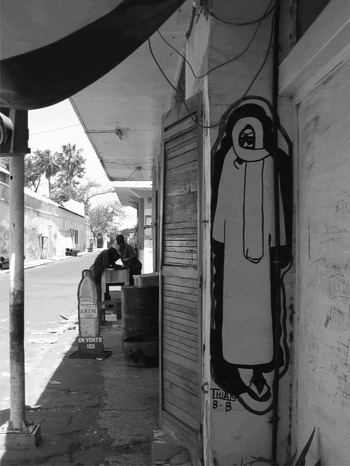
Marabouts and their descendants are revered and venerated in Senegal and are central figures in the social, political, economic and cultural arenas. They are also the subject of much popular artistic expression, and iconic portraits of them are to be found on walls throughout the country: Cheikh Amadou Bamba is always depicted in a long white robe and scarf that covers his head (see Figure 1), modelled after the only extant photographic portrait of him (Roberts and Nooter Roberts 2000); Cheikh Ibra Fall is depicted wearing a dark cape; El Hajj Malik's attribute is an opened umbrella, protecting him from the sun; and Limamou Laye is accompanied by a dove.
Wall portrait of Cheikh Amadou Bamba in the place where he is believed to have prayed the prayer sequence of the two rakas in Saint-Louis, Senegal, by B.B. Thiam, 2004. (Photograph by Fiona McLaughlin).

The practice of maraboutic hagiography likewise extends to the domain of the Sufi popular song, currently so prevalent in the repertoires of Senegalese popular musicians. This phenomenon is a fairly recent adaptation of the praise-singing tradition of the griot to Sufi Islam. The class of griots (géwél in Wolof) are part of the hierarchical social structure of Western Sahelian societies, and together with other artisan groups like leatherworkers, weavers and smiths comprise an endogamous group known as ñeeño in Wolof, a term that is often translated as casted, in opposition to géer or nobles.Footnote 5 A symbiotic relationship exists between these groups. Griots have traditionally sung the praises and genealogy of géer families at major life events such as naming ceremonies, marriages and the like, and also serve as intermediaries of various sorts. In return for making people's names, griots are rewarded with monetary presents, in acceptance of which (if the sum is sufficient) they praise the generosity of their patrons. Generosity is seen as one of the most important and desirable qualities of a géer, and the griot in a sense compels the géer to demonstrate this quality to his or her own advantage. Many géer criticise these practices as a type of extortion and try to avoid their griots, but many also enjoy the praise and sense of aggrandisement that comes from it. Griots, like other similar groups in Senegal and neighbouring countries, are associated with occult powers and work with dangerous substances such as fire and blood, and – in this case – words. Géer whose praises are being sung often report that the words and music have an inexplicable effect on them, causing them to lose control so that they cannot help but offer the griot money and other gifts, and some have even pleaded with their griots to stop before they are overcome by the power of the words.Footnote 6 Youssou N'Dour's mother, Ndèye Sokhna Mboup, comes from a family of griots and is thus privy to this tradition.
A second tradition of praise poetry is to be found in the writings of Sufi savants like El Hajj Malik Sy and Cheikh Amadou Bamba who wrote important bodies of mystical poetry in Arabic praising God and the Prophet Mohammed. These poems are set to music and chanted at religious ceremonies, and many of the faithful believe them to have mystical powers. For example, the recitation of Cheikh Amadou Bamba's khassayids can cause the chanter to enter into a spiritual trance, daanu leer in Wolof. Witness Youssou N'Dour's commentary on the transformative power of the khassayids in his 1994 hit, ‘Mame Bamba’ from the Wommat album, sung partly in English:
The occult properties associated with the release of power in the griot's speech thus have a religious equivalent in the mystical Sufi poetry of the same geographical area, which can provoke phenomena like daanu leer. Sung at religious ceremonies, these praise poems came to be imitated in order to sing the praises of marabouts and then to promote them in rivalries among their followers. These latter were sung in vernacular languages, especially Wolof and Pulaar, and gradually moved into contexts outside of religious ceremonies (McLaughlin Reference McLaughlin2000). Rather than using figures of speech and conceits from classical Arabic poetry, these praise songs came to resemble the typical griot's praise song in terms of the poetic language that was used, incorporating genealogy and formulaic praises. Finally, such songs have made their way into the popular domain and figure among the best known hits of many singers, such as Fatou Guewel, Pape Diouf, Baaba Maal, Cheikh Lô, Ismael Lô and Youssou N'Dour.
Since the extension of the Sufi praise song into the domain of popular music, many Senegalese singers have sung their allegiance to their own particular marabout while extolling the virtues of marabouts in general. The figure of Cheikh Amadou Bamba, founder of the Mouride order, is in particular a favourite topic for such songs. Some singers, such as women singers Kine Lam and Fatou Guewel, have devoted most of their careers to singing Amadou Bamba's praises, so much so that a tongue-in-cheek headline in a Dakar newspaper asked ‘If Touba [the holy city of the Mourides] didn't exist, what would Kine Lam sing?’ Fatou Guewel, a wildly popular singer whose last name is the word for griot in Wolof, also makes Mouridism the centrepiece of her repertoire. In her 1999 birthday concert, described in McLaughlin (Reference McLaughlin2000), the two traditions of griotic and Sufi praise-singing were abundantly on view. She sang the praises of Cheikh Amadou Bamba after which Youssou N'Dour came on stage to sing her praises, praising her for having sung the marabout's praises, after which another griot came on stage to sing N'Dour's praises for having sung Fatou Guewel's praises for having praised Cheikh Amadou Bamba. The chain of praise ended with the marabout and his barka (blessings) extended to all the singers and those who rewarded the singers monetarily.
Senegalese Sufi popular songs are by no means uniform in their style and content. While some singers, especially women, focus on genealogy and formulaic praise-singing in the griotic tradition, other singers use such songs to call people to convert or to make a pilgrimage to a holy site, or even to criticise unseemly behaviour – such as quarrelling over succession to the various caliphates – on the part of religious leaders. Ndèye Mbaye, for example, sings within the griotic tradition of genealogy and praise singing. Her songs devoted to Mouride marabout Sëriñ Moustapha Mbacké and Tijani marabout Ibrahima Niasse on the album Incha Allah, incorporate the repetition of formulaic phrases such as amul moroom (‘he has no peer’) interspersed with genealogies, both biological and spiritual. Orchestre Baobab's ‘Bamba’, a powerful ode to Cheikh Amadou Bamba, which playfully evokes Ritchie Valens' 1958 hit, ‘La Bamba’, calls for conversion to Mouridism: Tuubileen, tuubinaa, mbir maanga Tuubaa (‘go and convert, I have converted, the reason is in Touba’), while Seydina Insa Wade whose music is strongly oriented towards the Layene order urges listeners on his 1995 album Libaas to convert to that order: Tuubileen, tuubileen ci Yoff (‘go and convert, convert in Yoff’). The work of Baaba Maal includes similar types of praise songs such as ‘Sy Saawaande’ on his Lam Toro album, but his 1994 song, ‘Mbaye’, which appeared on the album Firin' in Fouta is also a subtle call for harmony among members of the maraboutic Sy family after their public demonstrations of discord over rights of succession to the Tijani caliphate (McLaughlin Reference McLaughlin2000). More recently, with the proliferation of rap and hip-hop groups in Senegal, the Sufi popular song has undergone another transformation since the praise of marabouts is also a common theme in these types of music.
Sant Yàlla/Egypt: A musical experiment in Sufi modernity
This is ‘not what we expect from your music’ writes a Dakar high school student in an affectionate ‘open letter’ to Youssou N'Dour, published in WalFadjri, an independent Senegalese daily newspaper shortly after the Senegalese release of Sant Yàlla, ‘so come back to your everyday mbàllax to make us happy again and again’. Sant Yàlla did not become a great hit in Senegal when it was released, partly because, as the high school student writes, mbàllax is what is expected of the musician.Footnote 7 Youssou N'Dour's popularity among Senegalese youth cannot be overestimated. He is the most charismatic of Senegalese popular singers with a fabulous stage presence and has always spoken to Senegal's urban youth culture. His music has been political and socially conscious, ranging in topic from birth control to democracy to clandestine migration, and his mbàllax style, based on a specific drum rhythm, has been wildly popular and has become synonymous with Senegalese dance music.Footnote 8 It is not surprising, given what N'Dour has come to represent to Senegalese youth, that the high school student cited above is somewhat disappointed by Sant Yàlla. The last 15 years or so have witnessed some memorable hits like ‘Birima’ on the 1997 Lii! album, and ‘Diambar’ on the Saint-Louis album that showcase both N'Dour's mellifluous voice and Jimi Mbaye's superlative guitar playing. These are some of N'Dour's strongest compositions and they show off aspects of the richness of his voice in ways that, given their different style and type of melody, the compositions on Sant Yàlla/Egypt do not. Egyptian instruments like the reed flute and the oud demand a lighter voice, and N'Dour weaves his songs in a somewhat staccato way among the Arab rhythms and melodies, making for a much more ephemeral sound than he is normally associated with.
However, Senegalese reactions to Sant Yàlla go beyond a simple preference for mbàllax dance music. N'Dour has taken two familiar genres, the popular Sufi praise poem and the Arabic song and combined them in a way that is unfamiliar to the Senegalese audience. ‘He should have sung the songs in Arabic’ was a frequent reaction to the album after it was released, as was ‘Why is he singing Wolof songs about Senegalese marabouts to Arabic music?’ The nature of Fathy Salama's arrangements which, although they incorporate elements from many Arab musical traditions, are essentially contemporary arrangements, led some Senegalese listeners to fault N'Dour for not using ‘real Arabic music’ in the album. The experimental nature of N'Dour's endeavour, however, lies in the fact that he breaks the continuity between Arabic language and Arabic music by introducing Wolof into the cultural space bounded by Arabic and creating a heteroglossic dialogue between local and global Islam in Sant Yàlla/Egypt.
N'Dour, for whom the Egyptian orchestra recreates musical memories of Ramadan in Dakar, listening to the grande dame of Egyptian music, Oum Kalthoum, on the radio as a child during the month of fasting, began his ambitious project in 1999 when he met Fathy Salama in Paris. He and Kabou Guèye wrote the lyrics and the initial melodies, which they then worked on with Fathy Salama. As Salama recounts, there were adjustments to be made on both rhythmic and melodic levels, but the final compositions reflect aspects of both West African and Arabic musical traditions, and unexpected points of commonality were found throughout. For example, in speaking about the melody of ‘Shukran Bamba’, Salama says:
(I)t starts with the scale itself, a scale called bayeti … which has microtonal intervals. For me it was a surprise, because right away when I listened to this tune in Dakar for the very first time I said ‘Does he [Youssou] really mean it?’ I asked Youssou and he said he didn't know what this scale was called but he could sing it perfectly, and Kabou [Guèye] too. … A funny thing about [the Egyptians] who recorded this song. They asked ‘Did you teach [Youssou] the scale or is this your melody?’ I said ‘No, this is not my melody; this is coming from the Senegalese side.’ I didn't teach him anything, he just sang it perfectly. They were amazed because [bayeti] is a very old oriental scale, and especially the open part in the middle of the song called mahwe'el is typical Arabic tradition. (Eyre and Barlow Reference Eyre and Barlow2004, p. 3)
The final outcome is a sophisticated, multifaceted and, above all, new sound that goes far beyond the fusing of Senegalese and Egyptian traditions to create a musical correlate, as it were, of a modern Sufi identity, linked to local traditions but distinct from them – in a word, experimental.
Sant Yàlla/Egypt consists of eight interrelated compositions. The first piece, ‘Allah’, sings of the omnipotence and oneness of God, intercalating the Arabic phrase Yaa waahidun (‘Oh, One’) with the Wolof Kenn la (‘He is One’). After invoking the Prophet Mohammed, N'Dour invokes two Mauritanian Arab shaykhs, Cheikhouna Sanusi and Cheikh Saad Bu and recites part of their genealogy. Through this introductory piece the entirety of the Islamic world and the oneness of Islam are evoked, as are the Mauritanian origins of Senegalese Islam; thus ‘Allah’ constitutes an appropriate prelude to the local focus of the remainder of the pieces. Of the remaining seven pieces, six are praise songs to Senegalese marabouts: ‘Shukran Bamba’ and ‘Bamba the Poet’ are devoted to the founder of the Mouride order, Cheikh Amadou Bamba; ‘Mahdiyu Laye’ is devoted to Seydina Limamu Laye, founder of the Layene brotherhood; ‘Tijaniyya’ and ‘Baay Niasse’ sing the praises of the Tijani marabouts, El Hajj Malick Sy and Ibrahima ‘Baay’ Niasse respectively; and ‘Cheikh Ibra Fall’ is a praise song to the most ardent disciple of Cheikh Amadou Bamba and founder of the Baye Fall movement. The remaining and final song, ‘Touba – Daru Salaam’, sings of the holy city of the Mourides, the geographic centre of the religious community to which pilgrims come every year from Senegal and abroad, where Mourides aspire to build houses for their families and to be buried when they die.
The Sufi saints whose praises are sung on this album are held up by N'Dour as exemplary figures, to be imitated in their practice of Islam. In ‘Shukran Bamba’, a piece dedicated to thanking and praising the founder of the Mouride order for what he has done for Islam, N'Dour portrays the marabout as a defender of Islam in the wake of colonial attacks against the faithful:
Youssou N'Dour uses Wolof proverbs very effectively in his lyrics, and in ‘Shukran Bamba’ the importance of the marabout's message and what it means to his followers, including the singer himself, is portrayed through such a proverb, followed by an interpretation:
N'Dour expresses his heartfelt appreciation for what the marabout has taught him by example, and in a very poetic and touching phrase, repeated in the chorus, he sings, ‘Mënuma la fey, xanaa ma woy la’ (‘I cannot repay you; let me sing your praises’).
The theme of the exemplary life is extended, in the piece entitled ‘Baay Niasse’, beyond the horizon of Senegalese Islam: Baye Niasse is portrayed by N'Dour as having most perfectly imitated the life of the Prophet Mohammed:
The spiritual chain of religious practice thus extends from Islam's beginnings, in the person of the Prophet Mohammed, to one of the great leaders of Senegalese Islam, Baye Niasse, to the current day taalibe, looking for models of exemplary religious practice.
Cheikh Ibra Fall, ardent follower of Cheikh Amadou Bamba and founder of the Baye Fall, is likewise praised as an exemplar of the Mouride way, in the piece bearing his name. Episodes from the story of his conversion depict a man covered in amulets that evoke pre-Islamic beliefs who is overwhelmed on meeting Amadou Bamba and subsequently devotes his life to him. His ascetic devotion enables him to enter trances and perform miracles, now a marabout in his own right.
In addition to exemplars of religious practice, the marabouts whose praises N'Dour sings are also portrayed as erudite scholars and writers. N'Dour dedicates an entire song, ‘Bamba, the Poet’, to the praise of the marabout's writings, including the khassayids which, as mentioned earlier, often inspire ecstatic trances. Bamba's writings, the products of a mere mortal, are transformed into the writings of a saint by the astounding quality and sheer quantity of what was produced, including lost texts, and N'Dour speculates as to whether the marabout ever slept.
This praise poem portrays Bamba as a savant, but not an ordinary one. N'Dour goes back and forth, trying to find a plausible explanation for how the marabout could have written so much (by forgoing sleep?), but also suggesting that his prolific production is in itself a miracle, since no mere human being could have done it.
The scholarly tradition is outlined in more concrete terms in the piece entitled ‘Tijaniyya’, one of the musically most successful pieces on the album, where N'Dour praises the work of El Hadj Malik Sy, who institutionalised a zawiya or centre of religious learning in the city of Tivaouane.
Similarly, another Tijani marabout, Baye Niasse, is praised for his erudition and emphasis on education:
The qualities N'Dour has chosen to emphasise in singing the praises of these leaders of Senegalese Islam are both spiritual, in terms of their exemplary asceticism and contemplation of God, but also of this world, insofar as they are portrayed variously as defenders of Islam in the face of colonialism, innovative educators and preachers of tolerance. They are, thus, a model for the contemporary Muslim world, a model that N'Dour intends to introduce to the rest of the world through his music.
While Sant Yàlla/Egypt begins by invoking Allah and the unity of Muslims throughout the world, it comes to its conclusion locally, in a precise place in the Senegalese heartland, Touba, the holy city of the Mourides. Perhaps the most interesting piece on the album, ‘Touba – Daru Salaam’ (‘Touba – Land of Peace’), sung to an Arabic melody in a scale known as rast (Eyre and Barlow Reference Eyre and Barlow2004, p. 4), sings the praises not directly of a marabout but of a locality that is strongly associated with Cheikh Amadou Bamba and Cheikh Ibra Fall. Replete with vernacular references – including, for example, references to the Touba market, Marse Okaas, and to the patchwork cloth or njaxas typical of Baye Fall garments, as well as taking into account the reality of everyday life in Senegal by telling people to ‘go and ask for their fare’ (ñaani paas) to get to Touba – ‘Touba – Daru Salaam’ casts the city as the ideal place to embark on the Sufi way because of the guidance one can receive there. N'Dour emphasises Touba as the geographic centre of Mouridism when he sings of disciples dispersed in places like France, Casamance (a region of southern Senegal that has periodically been the seat of violent separatist uprisings – and a felicitous rhyme with France), and throughout the world, who return for the yearly pilgrimage of the màggal. In addition, N'Dour uses something approaching his native Dakar Wolof – an urban Wolof that has incorporated many French loanwords into it – in this piece, while he maintains a so-called ‘pure Wolof’ (olof piir) for the other pieces. In this final song N'Dour has worked his way back to the local, leaving those listeners who understand the lyrics to contemplate their religion in the streets and mosques of the holy city of Touba.
Egypt and beyond
In ‘Touba – Daru Salaam’, as in the other pieces that comprise the ensemble of Sant Yàlla/Egypt, N'Dour reopens the dialogue between local and global Islam in a new way. Making use of the two available channels, lyrics and music, he chooses to have the lyrics carry the local – praise songs coming out of a long-standing West African tradition sung to local saints in Wolof, a local language – while the music evokes, to a certain extent, the larger Arab – and by extension Muslim – world. While Egypt is home to the Al-Azhar University, an important site of legitimacy in Islamic legal matters whose authority is widely recognised in Senegal, religious connections between Senegal and Morocco, for example, are much closer than those between Senegal and Egypt. There are, however, many other factors that make Egypt particularly appropriate to N'Dour's project. A direct relationship between the peoples of Senegal and those of ancient Egypt has long been a popular and academic theme among the Senegalese. Within the academic domain, Cheikh Anta Diop, an archaeologist after whom the University of Dakar is named, espoused the controversial and highly political view that the languages of Senegal, and especially Wolof, are related to ancient Egyptian (Diop Reference Diop1977), a notion that has gained much currency in the popular imagination for its obvious stakes in a claim to Egyptian civilisation. The Islamic legitimacy afforded to the local tradition by association with Egypt is, arguably, the lesser part of N'Dour's equation, since the semiotics of Egypt as a place and a cultural construct go well beyond the realm of Islam. Many of the same elements evoked by reference to Egypt are also present in the Western popular imagination, a factor that no doubt influenced Nonesuch Records to rename the album Egypt for the international market.
In addition to the overwhelmingly religious nature of Sant Yàlla/Egypt, there is also an undercurrent of sheer musical experimentation on N'Dour's part. Senegalese musicians have long been influenced by both Western and Eastern music, particularly Cuban, American and Arabic melodies and rhythms, and while many popular musicians have at times adapted elements of Western music into their repertoires – N'Dour himself has collaborated with many Western musicians—not as many have experimented with elements of Eastern music. Sant Yàlla/Egypt is a bold move in this direction, but it does not stand alone. Another very popular Senegalese musician, Thione Seck, released an album entitled Orientissimo, at around the same time that Sant Yàlla was released in Senegal. Orientissimo is a remarkable album because while it incorporates elements of Arabic music into some of the melodies, it is overwhelmingly Indian in its orientation. Seck, who on the album cover is seated on a chair in front of a many-armed Hindu goddess, sings with Indian vocalist, Bombay Jayashri, accompanied by a group of Senegalese and Indian musicians. Seck's oeuvre and singing style have been influenced in the past by Indian music, a beloved feature of popular Bollywood films frequently shown in Senegalese cinemas and television. So suggestive and popular are these ‘Hindu films’, as they are called locally, that Senegalese women have dressed in saris and donned nose rings and bindis, the red cosmetic markings on the forehead, to have their pictures taken in photographic studios, and some even claim to speak Hindi from watching so many Indian films. While the rap groups that are so popular in Senegal – numbering in the thousands, according to Benga (Reference Benga, Palmberg and Kirkegaard2002) – take an African-American musical genre and make it Senegalese, both Thione Seck and Youssou N'Dour, in these albums, bear witness to the fact that Senegalese music can also be enriched by Eastern music, illustrating that globalisation does not necessarily entail Westernisation.
Youssou N'Dour's multiple audiences
Returning now to the unenthusiastic reception that Sant Yàlla received in Senegal, articulated in the words of the high school student cited above, it is almost certain that Senegal was never intended as N'Dour's primary audience for the album. To go beyond the acceptable Senegalese, or at least the perceived ‘N'Douran’ soundscape, as he did in Sant Yàlla, was to take a risk with the local audience, but given his unparalleled popularity at home, it was a risk he could afford to take, especially for a greater gain, namely taking his place on the world stage as a spokesman for Islam. If what he intended in Sant Yàlla/Egypt was to introduce Senegalese Sufism to the world in musical form for all to appreciate, then he has succeeded. In contrast to the lacklustre reception the album received at home in Senegal, it has been very successful as an international release. Georges Collinet's American radio program and website, Afropop Worldwide, voted it one of the top ten albums of 2004. It won the 2005 Grammy Award for best contemporary world music album, and it has become the subject of a recent documentary film, I Bring What I Love (Chai Vasarhelyi Reference Chai Vasarhelyi2008), ushering N'Dour back into the international limelight five years after the appearance of the album on the international market.Footnote 9 While N'Dour's more recent releases such as ‘Borom Gaal’ on his 2007 album, Alsaama Day, which speaks to the crisis of the clandestine emigration of Senegalese youth who risk their lives at sea to get to Europe, and his most recent album and tribute to Bob Marley, Dakar-Kingston (2010), have been enormously popular in Senegal, Egypt remains his most important contribution to date to the world music arena, and promises to remain so for a long time, given the appreciation for cultural icons such as N'Dour who embrace the role of spokesperson for Islam. Like all musicians who emerge from a strong local tradition and are propelled onto the world music scene, N'Dour must grapple with the demands of his multiple audiences while retaining his integrity as a superlative musician. Now in his early 50s, Youssou N'Dour has reached a musical maturity that goes beyond the voice of youthful protest in Senegalese music. His songs, like those of the new generation of young Senegalese rappers, are still as socially relevant as they always have been, but his engagement with a larger, more global audience as a Sufi Muslim has led to important collaborations and new styles of music reflected in Sant Yàlla/Egypt. By engaging with the complexities and challenges of forging a viable Sufi modernity, N'Dour has joined other Senegalese artists and intellectuals in seeking to have a voice in contemporary discourses about Islam.