Implications
The traditional Mediterranean beef is based on a discontinuous growth (DG) production system. This requires both lower external input and provides an enhanced financial return to cattle producers than continuous systems, and contributes to environmental sustainability. This study shows that DG production could be a valuable strategy for the improvement of the palatability of Portuguese beef. The increased growth rates that are obtained before slaughter in DG animals could overcome the negative effects of age on tenderness and other markers of consumer acceptability.
Introduction
Traditionally, beef production in the South of Portugal is based on a DG production system, whereby the calves that are born in the summer are weaned at the beginning of, and then spend all of, spring grazing on pasture. Afterwards, the cattle are maintained on low-quality pasture, supplemented with hay in order to ensure at least the weight maintenance until the following spring. The farmers thus take advantage of the bull’s compensatory growth phase during its second spring when pasture is abundant. Finally, the cattle are fed on concentrate for 2 to 3 months before slaughter at 24 months of age. This system requires lower external input and could enhance both meat quality and thus cattle producers’ financial return. However, some beef producers are reluctant to use this system because, in order to obtain commercially acceptable carcasses, animals have to be slaughtered 6 months later than those produced via more intensive systems.
It is widely accepted that meat quality varies with fibre type profile (Lefaucheur, Reference Lefaucheur2010). This is mainly due to indirect effects of muscle fibre type on muscle components such as sarcoplasmic proteins, muscle enzymes, intramuscular fat (IMF) levels and connective tissues (Lefaucheur, Reference Lefaucheur2010). Beef palatability is determined by tenderness, juiciness and flavour (Calkins and Hodgen, Reference Calkins and Hodgen2007; Hocquette et al., Reference Hocquette, Van Wezemael, Chriki, Legrand, Verbeke, Farmer, Scollan, Polkinghorne, Rødbotten, Allen and Pethick2014). Meat final tenderness depends mainly on the postmortem changes affecting the muscle contractile system. The increase in meat tenderness that results from ageing is a consequence of proteolytic degradation of structural (cytoskeletal) components of muscle by endogenous proteases which depend on fibre profile. The ageing rate of glycolytic fibres is generally faster than that of oxidative fibres (Ouali and Talmant, Reference Ouali and Talmant1990; Whipple and Koohmaraie, Reference Whipple and Koohmaraie1992; Lefaucheur, Reference Lefaucheur2010).
As the proteolytic enzymes in the living muscles have a decisive role in postmortem protein degradation and meat tenderness (Fishell et al., Reference Fishell, Aberle, Judge and Perry1985), it is expected that a restrictive/re-feeding strategy before slaughter would lead to greater postmortem proteolysis and improved ultimate tenderness (Therkildsen, Reference Therkildsen2005). The ensuing high energy intake during re-feeding leads to an increase in protein turnover, with the increase in protein synthesis larger than protein degradation leading to improved meat tenderness. In a previous study from our research team, it was found that Alentejana bulls produced on DG had consistently low Warner-Bratzler shear force (WBSF) values than their counterparts produced on continuous growth (CG). Therefore, the practice of employing fast gain rates before slaughter, as in a DG production system, could be a valuable strategy to improve tenderness and to reduce its inconsistency in beef meat production. Thus, the effect of growth path on muscle fibre composition and protein degradation and how these effects relate to beef palatability in longissimus thoracis (Lt) of Alentejana bulls will be evaluated in the present study.
Material and methods
Animals and meat samples
This experiment is fully described in Costa et al. (Reference Costa, Simões, Costa, Lemos, Navas, Hocquette, Calkins and Bessa2015). In brief, 40 purebred Alentejana male calves (9.0±0.46 (mean±SD) months of age, 239±45 kg live weight) were randomly allocated to each of the two distinct feeding regimes. In the CG production system, the animals were fed ad libitum on concentrates plus hay throughout the trial and slaughtered at 18 months of age. In the DG production system, animals were fed ad libitum on hay only from 9 to 15 months of age. They were then fed the same diet provided to the CG group (concentrates plus hay) until 24 months of age. After being stunned with a captive bolt, the cattle were dressed with carcasses suspended by the Achilles tendon. The carcasses were split along the spine and the kidney knob and channel fat from both sides were removed. During the first hour postmortem, biopsies of about 1 cm3, for the purpose of histological analysis, were obtained from the superficial/middle layer of the Lt muscle at the level of the 9th vertebrae and on the right side of the carcass. The samples were immediately frozen by immersion in isopentane cooled by liquid nitrogen, and were kept at −80°C until analysis.
After 24 h chilling at 6°C, muscle pH was assessed using a Hanna Instruments Hi 9023 device (Póvoa do Varzim, Portugal). The carcasses were then stored at 4°C until 7 days postmortem (cold carcass). They were then jointed and two steaks of 2.5 cm thickness were taken from the space between the 8th and 12th vertebrae of the Lt muscle. The steaks were vacuum packed and frozen at −30°C until subsequent analysis.
Muscle histology
Serial transverse muscle sections (10 µm thick) were cut in a cryostat at −24°C and stained for myosin adenosine triphosphatase (ATPase) at pH 4.45 (Brooke and Kaiser, Reference Brooke and Kaiser1970). Fibres were classified as type I, type IIA and type IIX. It has been reported that myosin heavy chain-IIb (MHC-IIb) is not expressed in cattle limb and trunk muscles (Maccatrozzo et al., Reference Maccatrozzo, Patruno, Toniolo, Reggiani and Mascarello2004; Toniolo et al., Reference Toniolo, Maccatrozzo, Patruno, Caliaro, Mascarello and Reggiani2005). However, Picard and Cassar-Malek (Reference Picard and Cassar-Malek2009) found the MHC-IIb isoform in semitendinosus and Lt muscles of the Blonde d’Aquitaine breed. It is possible that some of the muscle fibres classified here as type IIX are in fact IIb.
The succinate dehydrogenase (SDH) protocol of Sheehan and Hrapchak (Reference Sheehan and Hrapchak1987) was used to classify fibres as oxidative or glycolytic. The combination of ATPase and SDH classifications in serial cuts has previously been used to distinguish between slow oxidative, fast oxidative-glycolytic and fast glycolytic types (Picard et al., Reference Picard, Duris and Jurie1998; Oury et al., Reference Oury, Dumont, Jurie, Hocquette and Picard2010). Here, the ATPase and SDH classifications were performed separately. The percentage of each fibre and the mean surface area for 200 fibres were obtained from two randomly selected areas of the serial sections using an image analysis software program (version 10.5.0, VectorWorks, Nemetschek, 2003). Type IIC fibres were also identified by staining at pH 4.2 (Picard et al., Reference Picard, Duris and Jurie1998) but are not included in the ‘Results’ section of this paper because they accounted for <5% of the total fibre population of each section.
Muscle protein fragments
Myofibrils from Lt muscle at 7 days postmortem were obtained according to the method of Parrish et al. (Reference Parrish, Young, Miner and Andersen1973), using 50 mM Tris, 5 mM ethylenediaminetetraacetic acid (EDTA) and 100 mM KCl, pH 7.6 buffer as the isolation medium. The final residue was suspended in 100 mM KCl, 1 mM NaN3. The sample suspension was then adjusted to 2 mg protein/ml with the same KCl–NaN3 solution and stored at −20°C until analysis. Myofibrillar proteins from the suspensions were precipitated with acetone and evaporated to dryness (Savant™ SC210 P1 SpeedVac-Thermo Fisher Scientific, Waltham, MA, USA). Dried samples were dissolved in the following buffers: 5 mM Tris, 0.5 mM EDTA, 1.25% SDS, 1% of 2-mercaptoethanol, 0.1% urea, pH 8.0 and 8 M urea, 2 M thiourea, 3% SDS, 75 mM dithiothreitol (DTT) and 25 mM Tris, pH 6.8 (Fritz and Greaser, Reference Fritz and Greaser1991) in a 1 : 1 proportion. The samples were heated at 50°C for 20 min before electrophoresis. Horizontal electrophoresis was performed using PhastSystem equipment (Amersham Biosciences; Buckinghamshire, UK) using a PhastGel Homogeneous 12.5% and a PhastGel Gradient 4% to 15%. The samples (5 µg) were run in the stacking gel at 1.0 mA for 1 V h and in the separation gel at 3.0 mA, 80 V h at 15°C. Gels were stained with Coomassie Blue R-350 and molecular weights of the proteins were estimated by running standard proteins of known weight in each gel. The quantification of major proteins and the identification of their respective bands separated in each gel were performed using a Biotec-Fischer HI-CAM densitometer (Reiskirchen, Germany).
Trained sensory panel analysis
The meat trained panel that was used for this study had a minimum of 3 years experience in performing sensory evaluation of meat. The panellists were recruited from 80 FMV/CIISA employees and graduate students who had previously been selected and trained according to Cross et al. (Reference Cross, Moen and Stanfield1978), Meilgaard et al. (Reference Meilgaard, Civille and Carr2006) and American Meat Science Association (Reference Allingham, Harperand and Hunter2015). In brief, the candidates were first pre-screened to determine their level of interest, availability, dependability, health (including dentures, allergies, use of medication), work experience, gender, age, smoking and food preferences. Those who passed the pre-screening stage were then invited to participate in several screening exercises with the objective of selection of those having interest and motivation in sensory evaluation, normal sensory acuity and ability to discriminate and reproduce results. In all, 26 candidates were selected for training to improve their ability to categorise and recall sensory information accruing from meat tasting sessions.
For the present study, five males and seven female panellists (average±SD age 38.9±7.76 years) were recruited. For each session of sensory analysis, 10 frozen steaks were thawed at 4°C for 24 h and cooked in a plate grill (65/70 FTES Electric Griddle; Modular Catering Equipment, Treviso, Italy) at 250°C, until they reached an internal temperature of 70°C, which was monitored by an internal thermocouple (Lufft C120; München, Germany). Cooking losses (CL) were determined by calculating the difference in weight before and after thermal processing. The steaks were trimmed of any external connective tissue, cut into ~2×2×2 cm3 samples and maintained at 60°C until tasting. The tasting involved two cores of each sample being tasted, as soon as possible, by each panellist. The sensory analysis was performed in four sessions (eight to nine samples per session).
The beef attributes evaluated were as follows: tenderness (defined as the opposite of the force required to bite through the sample with the molars), juiciness (the amount of liquid drained from the sample during the two initial chews), off-flavour (the intensity with which an undesirable flavour, not associated with beef, is recognised), flavour (the intensity with which the beef sample is recognised as distinctly bovine rather than deriving from any other species) and global acceptability (the perception of palatability, taking into account the aforementioned attributes). The scale applied in the sensory analysis was structured into 8 points, with 1 being extremely tough, dry, weak and less desirable and 8 being extremely tender, juicy, strong and more desirable for tenderness, juiciness, flavor and overall acceptability, respectively. The off-flavour was structured into nine points, representing 0 (absence) and 8 (extremely intense).
Shear force measurements
After thawing for 24 h at 4°C, the steaks were grilled to an internal temperature of 70°C (model HD8704; Delta OHM, Caselle di Selvazzano, Italy). Then, after cooling for 1 h, the steaks were cut, in the direction of the fibres, into eight to 10 cores each with cross-sectional area (CSA) of about 1 cm2 and a length of 2 cm. Shear force expressed in kg was measured in a texturometer (TA-tx2i Texture Analyser; Stable Micro Systems, Surrey, UK) equipped with a Warner-Bratzler shear device, using specific software (Texture Expert Exceed; Stable Micro Systems).
Intramuscular fat content and myofibril fragmentation index
The IMF content of fresh Lt muscle samples was determined by hydrolysis with 4 M HCl followed by Soxhlet extraction with petroleum ether for 6 h (Association of Official Analytical Chemists, 2000). The myofibril fragmentation index (MFI) was determined for frozen Lt muscle samples 7 days postmortem, according to Culler et al. (Reference Culler, Smith and Cross1978).
Statistical analysis
Sensory scores, meat traits, muscle protein fragments and muscle fibre profile were analysed using the Proc Mixed procedure of SAS software, version 9.2 (SAS Institute, Cary, NC, USA), considering the animal as the experimental unit. The model included the fixed effect of production system (CG v. DG). All data were reported as mean±standard error. Differences between groups were examined for statistical significance at the 95% confidence level using the PDIFF option. Pearson’s correlation coefficients between sensory panel scores, fibre profile and meat quality traits were calculated using STATISTICA (StatSoft Inc., OK, USA, 2004) software. In order to explore the relationship between meat traits, a principal component analysis (PCA) was carried out using STATISTICA software, with the variables for PCA being standardised to a mean of 0 and variance of 1. The use of multivariate statistical methods, such as PCA for complex samples as meat, makes it possible to identify the most important directions of variability in a multivariate data matrix and to present the results in a graphical plot. The PCA transforms the original variables into new axes, or principal components (PCs) that are orthogonal, so that the data presented in those axes are uncorrelated with each other. PCA therefore expresses as much as possible of the total variation in the data in only a few PCs and each successively derived PC expresses decreasing amounts of the variation (Destefanis et al., Reference Destefanis, Barge, Brugiapaglia and Tassone2000).
Results
Muscle fibre characteristics
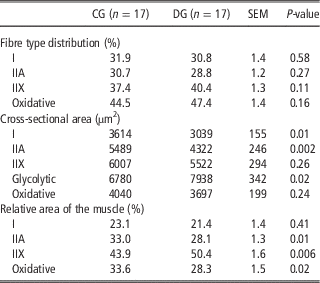
The production system was not a source of variation in muscle fibre type distribution (Table 1). In contrast, the fibre CSA was 575 µm2 and around 1100 µm2 greater in CG for type I (P=0.01) and type IIA (P<0.01), respectively, than in DG bulls. Glycolytic fibre CSA was about 1100 µm2 greater (P=0.02) in DG than in CG bulls. The CG bulls also had a greater proportion of type IIA (P=0.01) and oxidative fibres (P=0.02) than DG. The relative muscle area (RA) occupied by IIX fibres was greater (P<0.01) in DG than in CG.
Muscle fibre profile of longissimus thoracis from Alentejana bulls produced from to continuous (CG) and discontinuous growth (DG) production systems

Muscle protein fragments
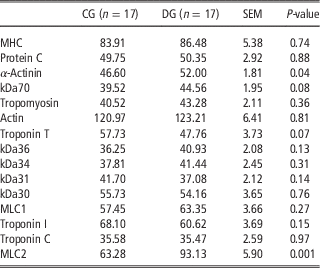
Details of the Lt muscle protein fragments at 7 days postmortem are presented in Table 2. DG bull meat had greater levels of α-actinin (P=0.04) and myosin light chain 2 (MLC2) (P=0.001) than bulls on the CG system. The production system was not a significant source of variation for the remaining protein fragments (P>0.05). However, CG bulls had a tendency to present greater kDa70 (P<0.08) and less troponin T (P<0.07) levels than DG bulls.
Protein fragments of longissimus thoracis muscle from Alentejana bulls produced according to continuous (CG) and discontinuous growth (DG) production systems

MLC, myosin light chain; MHC, myosin heavy chain.
Sensory panel scores and meat quality traits
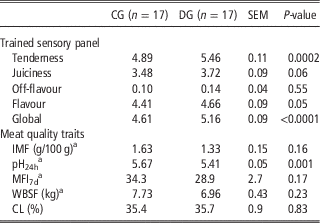
Sensory panel scores for, and meat quality characteristics of, the Lt muscle are presented in Table 3. Tenderness (P<0.001) and global acceptance ratings (P<0.001) were 0.5 points greater in meat from DG than CG bulls. As compared with CG, a tendency (P<0.06) to greater juiciness and flavour was observed in DG cattle. With respect to meat quality traits, except for pH24h (P<0.01), the production system had no significant influence on the IMF content, MFI after 7 days of ageing (MFI7d), WBSF and CL of Lt muscle.
Sensory panel scores and meat quality traits of longissimus thoracis muscle from Alentejana bulls produced according to continuous growth (CG) and discontinuous growth (DG) production systems

IMF=intramuscular fat; MFI7d=myofibril fragmentation index after 7 days of ageing; WBSF=Warner-Bratzler shear force; CL=cooking loss.
a Published in Costa et al. (Reference Costa, Simões, Costa, Lemos, Navas, Hocquette, Calkins and Bessa2015).
Correlations between fibre type profile, meat quality and sensory panel scores
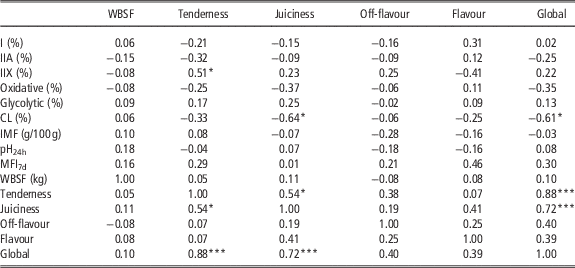
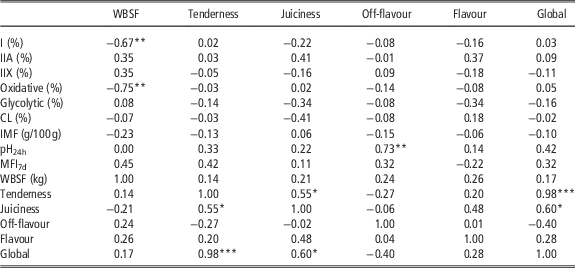
Pearson’s correlation coefficients for the relationship between muscle histological traits, meat quality and sensory scores are presented in Tables 4 and 5. As regards the CG samples, tenderness was positively correlated with IIX fibre type frequency (r=0.51, P=0.04), juiciness (r=0.54, P=0.04) and global acceptability (r=0.88, P<0.001). Furthermore, global acceptability was positively correlated with juiciness (r=0.72, P=0.002). Negative correlations were recorded between CL and juiciness (r=−0.64, P=0.01) and global acceptability (r=−0.61, P=0.02).
Pearson’s correlation coefficients between fibre profile, meat quality and sensory panel scores of longissimus thoracis muscle from Alentejana bulls produced according to a continuous growth production system

WBSF=Warner-Bratzler shear force; CL=cooking loss; IMF=intramuscular fat content; MFI7d=myofibril fragmentation index after 7 days of ageing.
*P<0.05, ***P<0.001.
Pearson’s correlation coefficients between fibre profile, meat quality traits and sensory panel scores of longissimus thoracis muscle from Alentejana bulls produced according to a discontinuous growth production system

WBSF=Warner-Bratzler shear force; CL=cooking loss; IMF=intramuscular fat content; MFI7d=myofibril fragmentation index after 7 days of ageing.
*P<0.05, **P<0.01, ***P<0.001.
As for the DG production system samples, noticeable negative correlations were observed between WBSF and type I (r=−0.67, P=0.006) and oxidative (r=−0.75, P=0.001) fibres. Moreover, a positive correlation was observed between pH24h and off-flavour (r=0.73, P=0.001). The increase of tenderness was associated with greater juiciness (r=0.55, P=0.03). In addition, the global acceptability was positively correlated with tenderness (r=0.98, P<0.001) and juiciness (r=0.60, P=0.02).
Principal component analysis
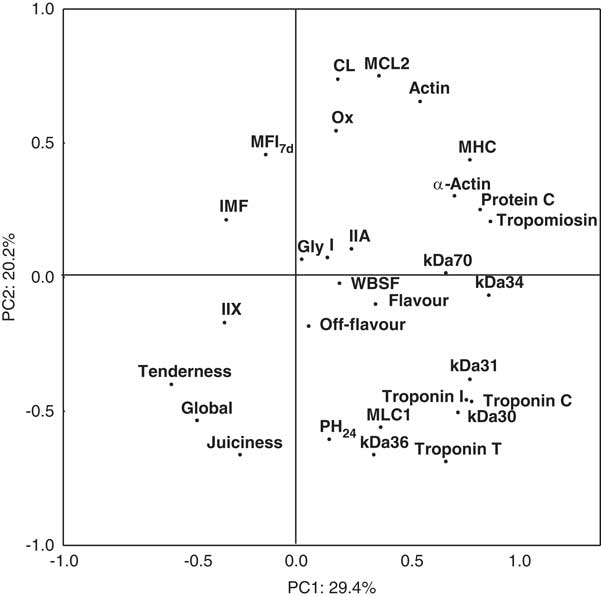
The PCA for the CG and DG production systems are presented in Figures 1 and 2, respectively. The PC1 in CG bulls explained 29.4% of the total variation. Two groups of variables lying on the PC1 were distinguished. The first group included several muscle protein fragments in the right side of the plot. In opposite direction, tenderness, global acceptability, juiciness, IIX fibres and IMF formed a distinguished group lying in the left hand side of the plot. The PC2 explained 20.2% of the variance and it was influenced by MLC2, CL and actin and by troponin T, juiciness and kDa36 in the opposite extreme of the plot.
Projection of the variables in the plane defined by the first two principal components (PC) for longissimus thoracis muscle of Alentejana bulls produced according to continuous growth production system. Ox=oxidative; Gly=glycolytic; CL=cooking loss; IMF=intramuscular fat content; MFI7d=myofibril fragmentation index after 7 days of ageing; WBSF=Warner-Bratzler shear force; MLC=myosin light chain.

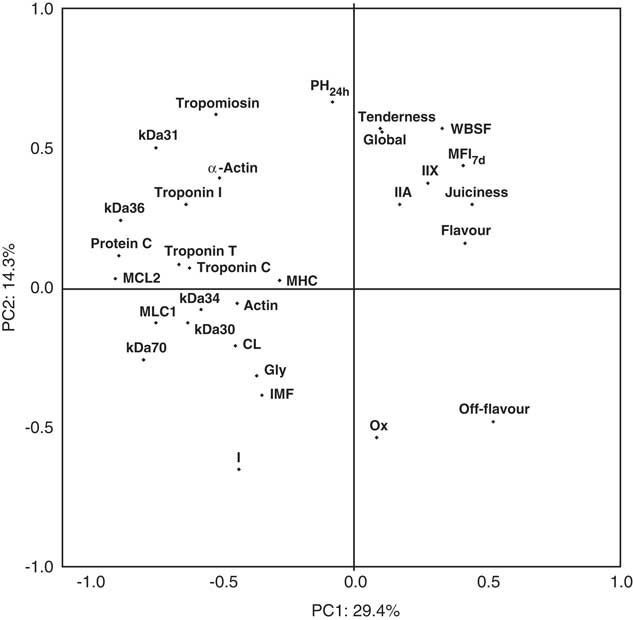
Projection of the variables in the plane defined by the first two principal components (PC) for longissimus thoracis muscle of Alentejana bulls produced according to discontinuous growth production system. Ox=oxidative; Gly=glycolytic; CL=cooking loss; IMF=intramuscular fat content; MFI7d=myofibril fragmentation index after 7 days of ageing; WBSF=Warner-Bratzler shear force; MLC=myosin light chain.

In DG bulls, PC1 and PC2 explained 29.4% and 14.3% of the variance, respectively. The PC1 was mainly characterised by a group of variables that include muscle protein fragments in the left side and flavour, juiciness, off-flavour and MFI7d in the right side of the plot. The PC2 was mainly affected by fibre type I and oxidative, and off-flavour in one direction, whereas in the opposite direction it was mainly characterised by pH24h, tropomyosin, WBSF, global acceptability and tenderness.
Discussion
Muscle fibre characteristics
Restricted feeding has been reported to increase the proportion of red fibres in longissimus dorsi muscle (Seideman and Crouse, Reference Seideman and Crouse1986; Nicastro and Maiorano, Reference Nicastro and Maiorano1994) and to reduce fibre hypertrophy in skeletal muscle of bovines (Yambayamba and Price, Reference Yambayamba and Price1991). However, when the effect of feed restriction was studied at similar BW and after 3 to 4 months of ad libitum fed, no differences in fibre size and proportions were found between older restricted bovines and their younger and unrestricted counterparts (Yambayamba and Price, Reference Yambayamba and Price1991). Cassar-Malek et al. (Reference Cassar-Malek, Hocquette, Jurie, Listrat, Jailler, Bauchart, Briand and Picard2004) reported that a DG path affected muscle metabolism but not histological profile. The authors hypothesised that feed restriction (from 9 to 12 months of age) was not severe enough to induce fibre type transitions. In this study, the average daily gain (ADG) from 9 to 15 months of age was around 1.5 kg/day greater (P<0.0001) in CG than in DG Alentejana bulls. In contrast, in the period from 15 to 18 months of age, the ADG was almost 0.5 kg greater (P=0.0004) in DG than in CG bovines. ADG for DG bulls were around 1.3 and 1.1 kg/day from 18 to 21 months of age and from 21 to 24 months of age, respectively (Costa et al., Reference Costa, Simões, Costa, Lemos, Navas, Hocquette, Calkins and Bessa2015). The fibre type frequency was not affected by growth path (Table 1). However, the fibre CSA of types I and IIA in DG bulls were significantly lower than in the CG bulls while the CSA of glycolytic fibres was greater in DG bulls. Consequently, the RA occupied by type IIX fibres was greater, while the IIA fibre RA was lower in DG in relation to CG. The RA of oxidative fibres was significantly higher in CG than in DG. It appears that the long re-feeding period (9 months) did not compensate the effects of the restrictive period (6 months) on muscle fibre profile of Alentejana bulls.
Meat quality traits
Beef tenderness, juiciness and flavour are among the most important eating quality attributes for consumers (Calkins and Hodgen, Reference Calkins and Hodgen2007; Hocquette et al., Reference Hocquette, Van Wezemael, Chriki, Legrand, Verbeke, Farmer, Scollan, Polkinghorne, Rødbotten, Allen and Pethick2014). Tenderness is considered to be a major influence on the consumers’ acceptance, and repetitive purchase, of a particular type of beef (Calkins and Hodgen, Reference Calkins and Hodgen2007). It depends on the architecture and integrity of the skeletal muscle cells and on events that modify those cells (Huff Lonergan et al., Reference Huff Lonergan, Zhang and Lonergan2010). The impact of growth rate on tenderness could be related to its effect on the structure and crosslinking of the collagen matrix (Allingham et al., 1998), as well as on the proteolytic activity and glycolysis rate of the muscle myofibrils (Oddy et al., Reference Oddy, Harper, Greenwood and McDonagh2001).
After 7 days of ageing, α-actinin and MLC2 were the only protein fragments that were significantly influenced by growth path (i.e. greater in DG bulls) (Table 2). MLC2 has a regulatory role in muscle contraction (Kamm and Stull, Reference Kamm and Stull2011), whereas α-actinin anchors myofibrillar actin filaments in the Z-disc. These differences in muscle protein degradation fragments between DG and CG bulls result from different disruption of muscle cell integrity. This disruption is influenced by compensatory growth (Therkildsen, Reference Therkildsen2005) and could help to explain the differences found on meat sensory tenderness between the two groups (Table 3). Meat tenderness is influenced by postmortem activity of muscle proteolytic enzymes. As these enzymes are also involved in protein turnover in the living muscles, it could be expected that feed restriction, followed by re-alimentation, could have the potential to improve tenderness (Therkildsen, Reference Therkildsen2005). A fast growth, as observed during compensatory phase, increases protein turnover and the ratio between protein synthesis and degradation in connective tissue and myofibrils, making these younger and more liable to breakdown during conditioning and cooking. After the feed restriction period (from 9 to 15 months of age) during which the ADG was around 100 g/day, the DG bulls had a compensatory growth phase in which the ADG was of almost 1700 g/day (Costa et al., Reference Costa, Simões, Costa, Lemos, Navas, Hocquette, Calkins and Bessa2015). However, the production system had no significant impact on WBSF, contrary to the results of previous studies that used longissimus muscle (Muir et al., Reference Muir, Smith, Dobbie, Smith and Bown2001; Therkildsen, Reference Therkildsen2005; Hansen et al., Reference Hansen, Therkildsen and Byrne2006) but used a compensatory period of <5 months. Despite not observed for Lt muscle, supraspinatus, triceps brachii, semitendinosus and biceps femoris muscles from DG bulls exhibited lower WBSF values than CG bulls (Costa et al., Reference Costa, Simões, Costa, Lemos, Navas, Hocquette, Calkins and Bessa2015).
The longer (9 months) re-feeding period that was implemented here may have partially diluted the effects of compensatory growth, particularly on Lt muscle. The long re-feeding period is necessary to produce commercially acceptable carcasses but could be responsible for a decrease on meat tenderness perceived by the consumer. Studies regarding the best feed manage to finish Alentejana bulls, produced according to DG, are warranted in order to obtain homogeneous high meat quality.
The fibre proportions influences muscle postmortem conversion into meat, and may therefore affect meat quality (Ozawa et al., Reference Ozawa, Mitsuhashi, Mitsumoto, Matsumoto, Itoh, Itagaki, Kohno and Dohgo2000). As regards the association between muscle fibre profile and meat sensory panel scores, Maltin et al. (Reference Maltin, Sinclair, Warriss, Grant, Porter, Delday and Warkup1998) reported a positive correlation between tenderness and proportion of slow-twitch oxidative fibres. They noted a negative correlation between tenderness and frequency of fast-twitch glycolytic fibres. Using a different fibre classification system, Calkins et al. (Reference Calkins, Dutson, Smith, Carpenterand and Davis1981) reported that αW muscle fibre content was negatively correlated with marbling and tenderness while at the same time the αR content was positively correlated to these attributes. Contrary to these results, we observed a positive correlation between tenderness and the proportion of IIX fibres in CG but not in DG bulls. Interestingly, increasing the proportion of type I and oxidative fibres was associated with lower WBSF in the latter group. According to Xiong et al. (Reference Xiong, Mullins, Stika, Chen, Blanchard and Moody2007), muscles with a greater proportion of type II fibres are more susceptible to early postmortem proteolytic degradation than are muscles that mainly comprise type I fibres. This can be due to a higher calpain/calpastatin ratio in fast-twitch glycolytic than in slow-twitch oxidative muscles (Ouali and Talmant, Reference Ouali and Talmant1990). It is commonly reported that muscle fibre composition influences many aspects of meat quality, including colour, water holding capacity, tenderness, juiciness and flavour. However, identifying the specific relationships between meat quality and myofibre characteristics, including fibre types and CSA, remains a difficult task (Lee et al., Reference Lee, Joo and Ryu2010; Lefaucheur, Reference Lefaucheur2010). As expected, increasing tenderness and juiciness were associated with higher global acceptability which is in accordance with a previous study from our research team (Costa et al., Reference Costa, Lemos, Lopes, Alfaia, Costa, Bessa and Prates2012). No significant correlations were observed between IMF, MFI7d and WBSF and sensory panel scores in both groups, CG and DG. The IMF has an important role in meat palatability. However, the effect on sensory attributes depends on its level in meat. A minimum value of 2.5% IMF has been proposed as necessary for sensory acceptability of pork (Madeira et al., Reference Madeira, Costa, Alfaia, Lopes, Bessa, Lopes, Lemos and Prates2013). The low level of IMF in Lt muscle from experimental groups (<2 g/100 g of fresh beef; Costa et al., Reference Costa, Simões, Costa, Lemos, Navas, Hocquette, Calkins and Bessa2015) could have not been enough to affect the trained sensory panel scores. It is possible that at 24 months of age, part of the effects of compensatory growth on myofibrillar proteins were diluted and no longer observed, which could justify the lack of relationship between beef sensory attributes and MFI7d in DG bovines. The absence of this relationship was not expected for CG bulls. In general, the correlation between tenderness and WBSF is significant across muscles. However, this is not always observed and sometimes the tenderness perceived by a sensory panel and the instrumental WBSF are not in accordance (Costa et al., Reference Costa, Lemos, Lopes, Alfaia, Costa, Bessa and Prates2012).
The PCA could be a very effective procedure to obtain a synthetic judgement of meat quality (Destefanis et al., Reference Destefanis, Barge, Brugiapaglia and Tassone2000). The PCA for CG bulls (Figure 1) and DG bulls (Figure 2) showed distinct associations among meat traits, suggesting that growth pathway has an important effect on Alentejana beef quality. The tenderness, global acceptance, juiciness, flavour, WBSF, MFI7d, IIX and IIA fibres formed a distinguishable group, suggesting a relationship among these variables in DG bulls. The close association between tenderness and global acceptability, also observed in CG bulls, was expected (Costa et al., Reference Costa, Lemos, Lopes, Alfaia, Costa, Bessa and Prates2012) and confirms the decisive role of tenderness in beef acceptability.
Conclusions
Taking advantage of compensatory growth in bovine production could provide an economic opportunity for Portuguese cattle breeders. The compensatory growth production system appears to have a positive impact on meat tenderness and global acceptability, overcoming the negative effects of age at slaughter on collagen solubility and tenderness. In addition, compensatory growth affects muscle fibre characteristics. It also influences pH24h and α-actinin and MLC2 protein levels. However, a significant relationship between global palatability of meat and its muscle fibre characteristics has not yet been established.
Acknowledgements
This research was supported by the Fundação para a Ciência e a Tecnologia (FCT) through financial support from FCT grants (PTDC/CVT/65707/2006 and PTDC/CVT/111744/2009) and individual fellowships to P. C. (SFRH/BPD/111051/2015), S.P.A. (SFRH/BPD/76836/2011) and V. V. (SFRH/BPD/104394/2014). P. A. L. is a researcher from the FCT ‘Ciência 2008’ programme and Incentivo 2014 project (AGR/UI0276/2014). We are grateful to Eng. António Sequeira for his decisive role on animal management during the trial. The authors are grateful to EZN slaughterhouse staff, particularly to Paula Menezes, for her help with carcass data and meat sample collection. The authors acknowledge Luisa Cristina Roseiro and Carlos Santos for help on histological analysis.