Introduction
Agricultural intensification is a major factor in the global loss of biodiversity from plants to vertebratesReference Kleijn, Kohler, Báldi, Batáry, Concepción, Clough, Díaz, Gabriel, Holzschuh, Knop, Kovács, Marshall, Tscharntke and Verhulst 1 , Reference Gonthier, Ennis, Farinas, Hsieh, Iverson, Batáry, Rudolphi, Tscharntke, Cardinale and Perfecto 2 . Increased recognition of the scale of this loss has sped the search for science-based conservation strategies to enhance species richness and abundance in agroecosystems. Farmland birds have been among the major foci of research activity and conservation concern in response to changing agricultural practicesReference Ormerod and Watkinson 3 , Reference Uthes and Matzdorf 4 . In Europe, where farmland birds have declined markedlyReference Donald, Green and Heath 5 , research has expanded greatly to evaluate the benefits to birds of environmental-friendly agricultural practices adopted voluntarily by farmers under government incentive programs. However, more rigorous studies are needed to provide sufficient empirical evidence to adequately evaluate the effectiveness of particular practices and programsReference Uthes and Matzdorf 4 , Reference Kleijn and Sutherland 6 , Reference Batáry, Báldi, Kleijn and Tscharntke 7 .
In North America, the benefits of agriculture to birds are known to vary among crop types and management practices (e.g., post-harvest flooding) and by seasonReference Taft and Elphick 8 . Agriculture is particularly intensive in California, where almost half of all the fruits, nuts and vegetables in the USA are grown 9 . Within California the heartland of agriculture is the Central Valley, which contains over 75% of the state's irrigated landReference Shelton 10 . Although agriculture dominates land use in the Central Valley, certain of its crops have offset the loss of historic habitats to some wetland-dependent birds. Yet the benefits of crops to wildlife have only infrequently been quantified in this regionReference Elphick and Oring 11 , Reference Strum, Reiter, Hartman, Iglecia, Kelsey and Hickey 12 , despite a renewed emphasis on the effects of agricultural change and intensification on birdsReference Ormerod and Watkinson 3 and strong interest in improving the environmental value of croplandsReference Liebman, Helmers, Schulte and Chase 13 . In California, few studies have assessed the agricultural benefits of crop residues and conservation tillage systemsReference Mitchell, Singh, Wallender, Munk, Wroble, Horwath, Hogan, Roy and Hanson 14 . Despite anecdotal evidence that target wildlife species benefit from these practices such effects have not been evaluated with rigorous scientific studies. By understanding how farm management practices affect waterbirds, conservation incentive programs can be implemented to improve habitat value while supporting the long-term sustainability of farming.
The Central Valley is one of the most important regions in the Pacific Flyway of North America for wintering and migratory waterfowlReference Fleskes, Yee, Casazza, Miller, Takekawa and Orthmeyer 15 , shorebirdsReference Shuford, Page and Kjelmyr 16 and other waterbirdsReference Shuford 17 . Within the Central Valley, the Sacramento–San Joaquin River Delta (Delta) is particularly important to wintering sandhill cranes (Grus canadensis), including the state threatened greater sandhill crane (G. c. tabida)Reference Pogson and Lindstedt 18 , Reference Ivey and Herziger 19 . Although post-harvest flooded rice (Oryza sativa) and corn (Zea mays) currently are the most important crops to waterfowl and other waterbirds in the Central Valley, both by acreage and known bird use, corn is by far the most important crop to these bird groups in the Delta 20 .
In California, corn and winter wheat (Triticum spp.) are among the top field crops in acreage planted statewide 9 . Although these crops are known to benefit selected avian species during non-breeding periods (seeReference Taft and Elphick 8 ), there is little information on how post-harvest management practices influence waterbird use, or whether alternative management practices might provide additional benefits. The Delta holds about 60% of the corn acreage available to waterfowl in the Central Valley, and it is the only area in the valley where corn is flooded in winter 20 . The availability of flooded winter wheat and the degree to which waterbirds use winter wheat fields in the Central Valley is largely unknown.
To evaluate the associations between agriculture and waterbirds in the Delta, a 2-yr study was conducted at a 3700-ha working farm on Staten Island in the heart of this region (Fig. 1). The goal of our study was to assess how crop types (corn, winter wheat), field management practices and specific habitat features affect the abundance and species richness of waterbirds. Hypotheses we evaluated included the expectation that more waterbirds would use flooded fields and fewer would use drier fields, the amount of residual crop stubble and water depth in flooded fields might influence species’ use of particular agricultural habitats, and species richness would be associated with the type rather than the amount of habitat in a field. Gaining evidence to assess such hypotheses is critical for improving management for waterbirds on Staten Island, extending this evaluation to other farming operations, and bolstering the scientific underpinnings needed to inform broad-scale conservation planning across the region.
Location of the Staten Island study area within the Sacramento–San Joaquin River Delta in the Central Valley of California, USA.

Study Area and Methods
Study area
Historically the Delta was a maze of sloughs and swampy islands. Now an extensive levee system protects multiple large islands or tracts from floods and tidal surges. Because of aeration of the Delta's peat soils, most of the islands, including Staten, are below sea levelReference Lund, Hanak, Fleenor, Bennett, Howitt, Mount and Moyle 21 . Major environmental concerns in the Delta include potential inundation of islands from catastrophic breaks in levees from extreme flood events or earthquakes, rising sea level, further island subsidence, conversion of wildlife-friendly crops to vineyards and orchards and increasing salinity and its impacts on threatened and endangered fish. Some of these factors threaten the state's water supply and the viability of agriculture in the Delta and other parts of the Central Valley.
The farm on Staten Island that served as our study site is owned by The Nature Conservancy and operated by Conservation Farms and Ranches with a dual mandate of economic viability and wildlife conservation. The farm's large size (>3200 ha in agriculture) and managers’ receptivity to changes in management to increase benefits to wildlife make it well-suited for assessing the compatibility of wildlife and agricultural practices. This allowed us to evaluate some practices that are not currently widely used in the Delta to see if they were particularly beneficial to waterbirds. Agriculture on Staten Island is dominated by corn (76–81% of total; grown for seed rather than silage), followed by winter wheat (5–12%), irrigated pasture and sometimes other crops (e.g., potatoes, Solanum tuberosum)Reference Golet 22 . Currently, ‘wildlife-friendly’ practices are in place to benefit avian species, particularly waterfowl and cranesReference Ivey, Herziger and Gause 23 . Chopping and rolling, which leaves most crop residue on the surface, is employed during corn harvest, and various management practices for this and other crops are thought to benefit wildlife, by increasing food availability, and agriculture, by hastening decomposition of crop residue, controlling weeds, reducing soil erosion and compaction, and lowering fuel and labor costsReference Golet 22 , Reference Ivey, Herziger and Gause 23 .
Crop treatments
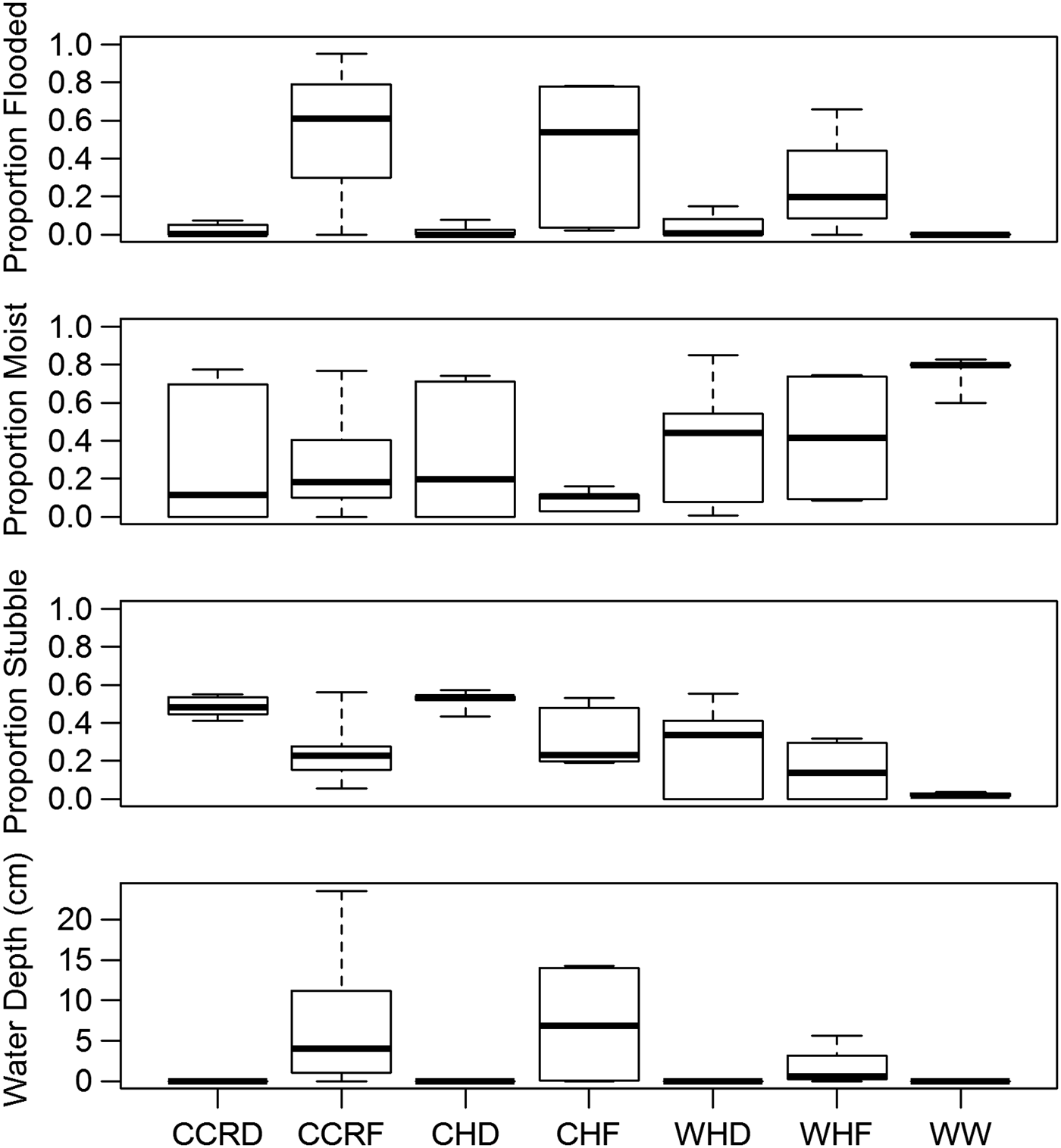
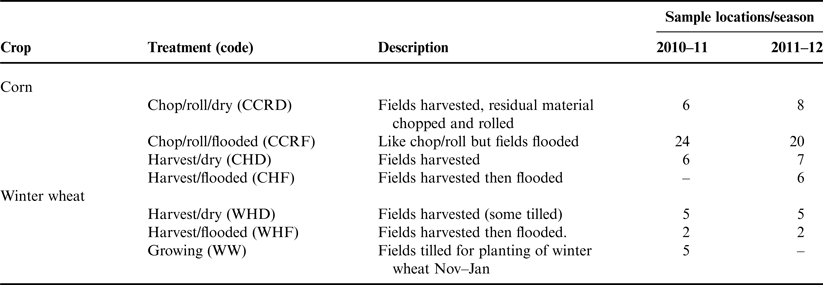
Based on prior knowledge, our expectation was that many waterbird species would preferentially use flooded fields and fewer would use dry fields regardless of the crop type. It also seemed that the amount of residual crop stubble and water depth in flooded fields were likely to influence species’ use of particular agricultural habitats. To evaluate evidence for these hypotheses, bird use was quantified for seven treatments, i.e., combinations of crop types (corn and winter wheat) and management practices (Table 1). There was substantial variation within and between crops and treatments in the amount of flooding, moist soil, residual stubble and water depth (Table 1, Fig. 2).
Distribution of survey area characteristics in each crop treatment during winter surveys of waterbirds at Staten Island, 2010–2012. Box-and-whisker plots represent the median value of the distribution, the location of the first and third quartiles, and the minimum and maximum values observed. See Table 1 for crop treatment codes.

Crops and treatments surveyed for waterbirds at Staten Island in winter (November–February) 2010–11 and 2011–12.

Considerable variation occurred within and between crops in the timing of field management relative to crop phenology or post-harvest practices. Managers and the authors were particularly interested in evaluating the chop-and-roll (mulching) and harvest-only practices in corn. After corn is harvested in September and October, the primary practice on Staten currently is to chop and roll the remaining stubble. Tractors pull machinery, with rotating blades, that cuts the stubble close to the ground and then rolls over it, leaving crop residues on the soil surface as a layer of mulch. These residues contain residual grain and provide habitat for the growth of invertebrates, both of which are food for some wintering birdsReference Ivey, Herziger and Gause 23 . To facilitate our study design, the farm manager was asked to leave some corn fields as is after harvest (harvest-only) so bird use could be compared between chop-and-roll and harvest-only practices. About 25% of the corn is flooded from October or November into February, the remainder is left dry except for surface moisture and scattered puddles from winter rains.
Winter wheat is typically planted between November and January and harvested in June or July, with some fields left as is after harvest and others finely tilled. Some of both types of fields are flooded post-harvest to provide habitat for early arriving cranes, waterfowl and shorebirds; the period of flooding varies among years from about 1–4 months. Winter wheat is seeded with a 20% increase above the ‘normal’ seeding rate to account for loss to foraging cranes and other waterbirds (primarily geese foraging on growing wheat). Moisture for wheat growth comes from seasonal rains and occasional flood irrigation during extended dry periods.
Sampling bird abundance and habitat conditions
A random sample of 48 fields was selected in both 2010–11 and 2011–12 using Generalized Random Tessellation Stratified (GRTS) sampling methodology (Table 1), which enabled the selection of a set of 96 spatially balanced random sampling areas with respect to crop type and treatmentReference Stevens and Olsen 24 . Sampling areas were surveyed from a specific location, typically half way along one accessible edge of the field. Because distance can reduce detections and thus negatively bias bird counts, sampling areas were restricted to the area within a 200-m arc from the survey point (often truncated by the field edge). Marked stakes were placed 25 and 200 m into, and along the center line of, each sampling area to enable measurement of water levels.
Over two winters, we conducted 19 surveys of waterbirds (10 in 2010–11 and 9 in 2011–12) at approximately 14-day intervals from November through February. Over this period, the surveys were conducted by five observers. Given the very open habitats and the relatively small sampling areas in fields, it seems unlikely that inter-observer bias contributed much to variation in the counts of waterbirds. To minimize the effects of time of day on waterbird counts, observers were instructed to start surveys in early morning, if possible, and to vary the order in which they counted at individual survey points among survey dates. Survey were not conducted during high winds (>20 mph), steady rain or dense fog (frequent in the morning in mid-winter). Binoculars and spotting scopes were used to scan each sampling area for at least 2 min or until all birds (excluding flyovers) had been counted; birds flying in or leaving were counted as long as they were on the ground in the survey area at some point during the counting period. That said, time to count birds (minutes; min. = 2, median = 5, max. = 38) was largely a function of the total birds present at the beginning of the count given observers counted birds a rapidly as possible to minimize changes in abundance during the survey.
With few exceptions, all individual waterbirds (waterfowl [Anatidae], shorebirds [Recurvirostridae, Chardriidae, Scolopacidae], herons and egrets [Ardeidae], ibis [Threskiornithidae], coots [Rallidae], cranes [Gruidae], grebes [Podicipedidae] and gulls [Laridae]) were identified to species. Forty-six species of waterbirds were recorded, 37 of which were included in analyses (see below). The most numerous species used in analyses were Cackling Goose (Branta hutchinsii; 28,484 detections over all surveys), Canvasback (Aythya valisineria; 13,556), Sandhill Crane (G. canadensis; 6654), Northern Shoveler (Anas clypeata; 4706), Least Sandpiper (Calidris minutilla; 3109), Long-billed Dowitcher (Limnodromus scolopaceus; 3041), Northern Pintail (Anas acuta; 2646), Greater White-fronted Goose (Anser albifrons; 1906), Killdeer (Charadrius vociferus; 1859), Ruddy Duck (Oxyura jamaicensis; 1307), Dunlin (Calidris alpina; 1080) and Wilson's Snipe (Gallinago delicata; 918).
To avoid confounding factors or small sample sizes, several species or species groups were excluded from analyses: the Tundra Swan (Cygnus columbianus) because it was the only large species of waterfowl that occurred only in flooded fields, unlike geese, which occurred regularly in both flooded or dry fields; grebes (two species) and gulls (five species) because so few were recorded; and the American Coot (Fulica americana) because birds also grazed extensively in grassy areas between fields and roads making it difficult to determine if birds’ preferences pertained to crop type, adjacent grassy edges or a combination of the two.
On each survey, water depth was recorded at 2.5-cm intervals on both stakes, and these measurements were used to estimate the average water depth in each sampling area. A visual estimate was made of the proportion of the sampling area that was flooded, moist or dry, and the proportion that consisted of residual crop stubble (cut and standing or lying on the ground) or green vegetative growth.
Analyses of abundance and richness
We evaluated the effect of each crop treatment on the relative abundance and species richness of waterbirds pooled by guild (long-legged waders [herons/egrets/ibis; five species], cranes [one species], shorebirds [12 species], dabbling ducks [eight species], diving ducks [seven species] and geese [four species]), sampling area, and visit within each year. We used the total count summed across multiple visits to a sampling area as the response variable to prevent pseudoreplication due to repeated visits. We included the total area surveyed at the sampling area (ha of the sampling area x number of visits) as an offset term to account for varying sampling area sizes. Comparisons were made of the fit of both zero-inflated, over-dispersed Poisson (ZIP) models and simpler over-dispersed Poisson (ODP) models without the zero-inflation parameterReference Kery 25 using the Deviance Information Criterion (DIC) to identify the most parsimonious model for the data. The model (ZIP or ODP) with a lower DIC, indicating it was a relatively better fit to the data, was used for inferenceReference Hooten and Hobbs 26 . The area of each sampling area was calculated using ArcMap Version 9.3.1 (© 1999–2009 ESRI Inc.).
All models were fit using the R2WinBUGS package in RReference Sturtz, Ligges and Gelman 27 ; Markov Chain Monte Carlo (MCMC) simulations were completed in WinBUGS softwareReference Spiegelhalter, Thomas, Best and Lunn 28 . Non-informative normal priors were used for all covariate parameters (mean = 0, var = 1000), and diffuse uniform priors (0–20) for all variances. Each model run included 3 Markov chains of 5 million iterations. The first 4 million iterations of each chain were discarded, and sampling of every 100th value of the remaining 1 million estimates within each chain was done to reduce autocorrelation in the parameter estimatesReference Kery 25 . The combined 30,000 samples were used to make inference. To ensure that models had reached convergence, the Rhat statistic for each parameter had to be ≤1.1 before the posterior parameter estimates were used for inferenceReference Kery 25 , Reference Gelman and Hill 29 . We further assessed model fit through evaluation of traceplots to ensure adequate mixing of parameters, autocorrelation plots of parameters and residual plots of the fitted models.
The fitted model was used to estimate the mean bird density (birds per ha) for treatments in each iteration of the MCMC model-fitting process, and the 95% credible intervals of the mean were calculated using the percentile methodReference Spiegelhalter, Thomas, Best and Lunn 28 . Simultaneous pairwise comparisons of the estimated difference in densities between each treatment were also conducted during each iteration of the MCMC simulation. The values for treatments within avian groups were considered to be significantly different if the 95% credible interval of the simultaneous pairwise difference between densities did not overlap zero. For geese, it was not possible to achieve model convergence using MCMC due to severe overdispersion in the data caused by the clustering behavior of these birds. Consequently, a non-parametric bootstrap procedureReference Manly 30 was applied to estimate the mean density and 95% confidence intervals for each treatment. For geese, the values for treatments were considered significantly different when the 95% confidence interval of estimated mean goose density for each did not overlap.
For shorebirds, waders, cranes and geese, all seven crop treatments were evaluated. Because no dabbling or diving ducks were recorded in dry fields, treatments for these guilds were compared only if they were intentionally flooded. Since shorebird densities were so low (generally ≤0.05 birds ha−1) in dry fields they are not discussed further with respect to dry treatments.
Four variables were evaluated that were judged to likely be the driving mechanisms influencing variation in waterbird abundance by crop treatment: water depth, and the proportion of the survey area that was flooded, moist soil and residual stubble. Field data highlighted the variation in the distribution of these variables by crop treatment (Fig. 1). To better understand the influence of these mechanisms, five models were fit for each guild. Four models each included one of the potential driving mechanism variables, and, because optimal water depths have been identified for some of the guilds in our studyReference Strum, Reiter, Hartman, Iglecia, Kelsey and Hickey 12 , a non-linear (quadratic) model was also evaluated for the influence of water depth. For diving ducks, a model with only a linear association between count and water depth was evaluated on the expectation that their abundance would increase with increasing water depth over the ranges of depth in this study (<50 cm). Species richness was also modeled as a function of the variance in these four variables across the season. It was hypothesized that species richness would be related to variation in the type rather than the amount of habitat within a field. Model covariates were evaluated in separate models due to high correlation among covariates (Spearman rank correlation coefficients often >0.60) and overall low sample sizes. Model covariates were considered to have significant support if their 95% credible interval did not overlap zero.
Results
Patterns of bird use of crop treatments
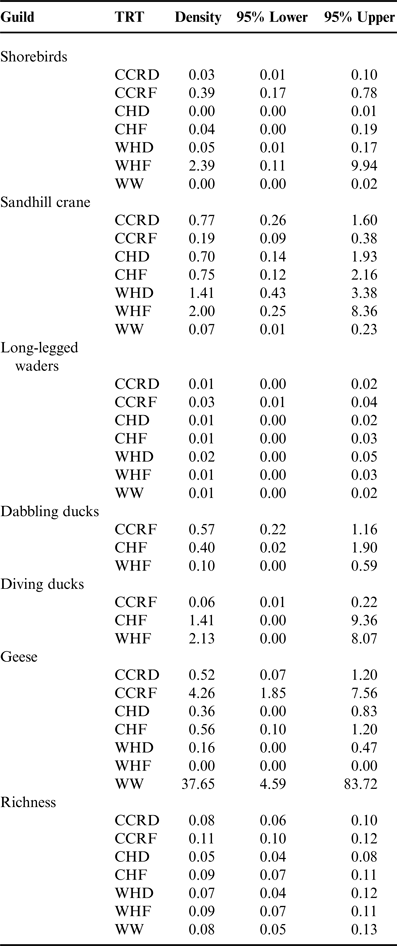
Bird groups varied considerably in their use of crops and post-harvest treatments (see Table 2 for densities, accounts below).
Density estimates (birds per ha) and 95% credible intervals for six waterbird guilds and species richness for seven crop and post-harvest treatments at Staten Island during winter surveys (November–February), 2010–2012 1 .

Mean density and 95% confidence intervals for geese were estimated with a non-parametric bootstrap procedure.
1 See Table 1 for crop treatment codes.
Shorebirds
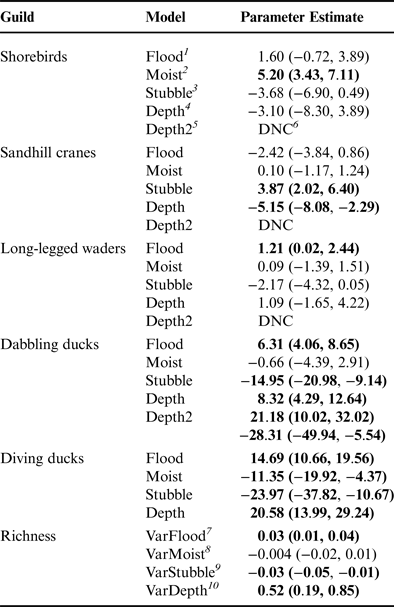
Shorebirds were most strongly associated with flooded treatments of post-harvest wheat and corn (Table 3). Flooded chop-and-roll corn had a significantly higher shorebird density compared with flooded harvest-only corn but not flooded winter wheat. Although shorebird density in flooded chop-and-roll corn was considerably lower than in flooded post-harvest fields of winter wheat this difference was not significant (Table 3; see Table 2 for density estimates and 95% credible intervals). Still, densities were significantly higher in post-harvest winter wheat than in most other treatments. Shorebirds had a significant positive association with the amount of moist soil (Table 4). Models representing a non-linear association with water depth would not converge.
Pairwise difference in mean shorebird density (per ha) between all winter (November–February) crop and post-harvest combinations of corn and winter wheat on Staten Island, 2010–2012 1 .

Values are based on the column means minus the respective row means. Values in bold have a 95% credible interval that does not overlap zero.
1 See Table 1 for crop treatment codes.
Summary of parameter estimates and 95% credible intervals for single-factor models fit to winter (November–February) waterbird survey data at Staten Island, 2010–2012. All models contained an intercept and overdispersion parameter.

Shorebird, sandhill crane and long-legged wader models also included a zero-inflation parameter. Parameters in bold have credible intervals that do not overlap zero; all parameters are reported on the non-transformed scale. For example, shorebird abundance is expected to be e1.60 (4.95) times greater in an entirely flooded field than in an unflooded field.
1 Flood = parameter for proportion of survey area flooded.
2 Moist = parameter for proportion of survey area with moist soil.
3 Stubble = parameter for proportion of survey area with residual stubble.
4 Depth = linear parameter for linear water depth (cm)/100 model.
5 Depth2 = linear and quadratic parameters for non-linear water depth (cm)/100 model.
6 DNC = parameter did not converge (Rhat >1.1), so was removed from inference.
7 VarFlood = parameter for variance in proportion of survey area flooded.
8 VarMoist = parameter for variance in the proportion of survey area with moist soil.
9 VarStubble = parameter for variance in proportion of survey area with residual stubble.
10 VarDepth = parameter for the variance in water depth.
Cranes
Overall, the densities of sandhill cranes were higher in dry than in flooded crop treatments (Tables 2 and 5). Crane density was significantly higher in dry than in flooded chop-and-roll corn, but there was no significant difference between densities in dry and flooded harvest-only corn. Crane density was significantly lower in flooded chop-and-roll corn than in both flooded and dry post-harvest wheat, but crane density in growing winter wheat was significantly lower than in other treatments in five of six pairwise comparisons. Predictably, based on the comparisons above, mechanism models indicate that crane abundance had a significant positive association with the amount of stubble (Table 4), which was itself associated with dry fields (Fig. 1), and cranes were negatively associated with water depth.
Pairwise difference in mean sandhill crane density (per ha) between all winter (November–February) crop and post-harvest treatment combinations of corn and winter wheat on Staten Island, 2010–2012 1 .

Values are based on the column means minus the respective row means. Values in bold have a 95% credible interval that does not overlap zero.
1 See Table 1 for crop treatment codes.
Waders
Densities of long-legged waders varied little across the range of crop–treatment combinations (0.01–0.03 birds ha−1). The only significant pairwise difference was a higher density in flooded chop-and-roll corn than in dry harvest-only corn (Table 6). Mechanisms models identified a significant positive association with the abundance of long-legged waders with the proportion of the survey area that was flooded (Table 4).
Pairwise difference in mean long-legged wader density (per ha) between all winter (November–February) crop and post-harvest treatment combinations of corn and winter wheat on Staten Island, 2010–2012 1 .

Values are based on the column means minus the respective row means. Value in bold has a 95% credible interval that does not overlap zero.
1 See Table 1 for crop treatment codes.
Geese
Geese had high densities in some flooded and some dry crop treatments (Table 2). The density of geese was significantly higher in flooded chop-and-roll corn than in any of the other corn treatments and post-harvest winter wheat, flooded or non-flooded (Table 7). Overall growing winter wheat had the highest density of geese (significantly higher in five of six comparisons).
Pairwise comparison of mean density (per ha) of geese between all winter (November–February) crop and post-harvest treatment combinations of corn and winter wheat on Staten Island, 2010–2012 1 .

Values are based on the column means minus the respective row means. Values in bold when the 95% confidence intervals of the mean of the two treatments compared do not overlap. Estimates of mean density and 95% confidence intervals were derived using a non-parametric bootstrap procedure.
1 See Table 1 for crop treatment codes.
Ducks
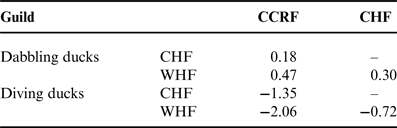
Dabbling and diving ducks both had large differences in densities between some crop treatments, but there were no significant relationships in comparisons of corn and wheat treatments (Table 8). Dabbling ducks had a significant positive association with the amount of survey area flooded, a negative association with the amount of stubble, and a significant non-linear association with water depth (Table 4); density increased up to a depth of about 34 cm, and then declined above that threshold. Diving ducks had a significant positive association with flooding and water depth, but a significant negative association with stubble and moist soil (Table 4).
Pairwise comparison of mean density (per ha) of dabbling ducks and diving ducks between winter (November–February) crop and post-harvest treatment combinations in flooded corn and winter wheat on Staten Island, 2010–2012 1 .

Values are based on the column means minus the respective row means. All values have a 95% credible interval that overlaps zero.
1 See Table 1 for crop treatment codes.
Species richness
The number of waterbird species observed was positively associated with flooded chop-and-roll corn, which had significantly higher mean richness in comparison with both of the dry corn treatments (Table 9). Likewise, flooded harvest-only corn and flooded post-harvest wheat both had significantly higher mean richness in comparison to dry harvest-only corn. Species richness was not significantly different between the two dry corn treatments. Dry harvest-only corn, however, had significantly lower species richness in three of the remaining five comparisons; hence, it represented the lowest value for species richness of waterbirds of any of the winter corn and wheat treatments. There was a significant positive effect of variation in water depth and the proportion of the survey area flooded across the season on species richness (Table 4) but a negative association with variation in the amount of stubble.
Pairwise difference in mean species richness (per ha) between all winter (November–February) crop and post-harvest treatment combinations in corn and winter wheat on Staten Island, 2010–2012 1 .

Values are based on the column means minus the row means. Values in bold have a 95% credible interval that does not overlap zero.
1 See Table 1 for crop treatment codes.
Discussion
We documented significant variation in bird abundance among crop treatments at Staten Island in the Delta. As expected, most waterbirds were common in flooded treatments; however, geese, cranes and long-legged waders also were numerous in some dry treatments. Our data suggest that maintaining a mosaic of habitats on the landscape at Staten Island will promote a diverse community of waterbirds during winter.
Relative value of crops and field management practices
A primary interest of this study was to better understand how waterbird use is influenced by post-harvest management of corn, the dominant crop used by waterbirds at Staten Island and elsewhere in the Delta. Comparisons of densities among waterbird guilds for individual crop treatments and between different treatments for each guild documented the importance of the chop-and-roll treatment, particularly when flooded. In addition, on broad-scale surveys of all of Staten Island, the proportion of both cranes and geese that were foraging versus loafing was higher in dry chop-and-roll corn than in dry harvest-only corn (Point Blue unpublished data). Collectively, this evidence supports promotion of the chop-and-roll practice in corn, whether the fields are subsequently flooded or not.
The Central Valley Joint Venture 20 considered winter-flooded rice and corn as the primary crop resources for shorebirds and waterfowl in the Central Valley. Our data confirm that both bird groups will use flooded corn, although, along with long-legged waders, they occur in lower densities in flooded corn at Staten than in winter-flooded rice in the Sacramento Valley north of the DeltaReference Strum, Reiter, Hartman, Iglecia, Kelsey and Hickey 12 .
Winter wheat, the other crop type evaluated at Staten Island, also provided substantial benefits for waterbirds. In winter, shorebird densities in flooded wheat fields were six times higher than in flooded corn, and were more comparable to those found in flooded rice fields in the Sacramento ValleyReference Elphick and Oring 11 , Reference Strum, Reiter, Hartman, Iglecia, Kelsey and Hickey 12 . Densities of dabbling and diving ducks also were higher in flooded wheat than in flooded corn. Growing winter wheat had some of the highest use by geese relative to other crop treatments.
Although we documented significant waterbird use of winter wheat fields flooded after harvest, we caution against extrapolating these results given the low sample size from a single farm. Also, despite its observed benefits on Staten, winter wheat is not typically flooded during any season elsewhere in the Delta. Still, it would be valuable to consider the benefits of winter wheat in conservation planning given it can support high levels of bird use, particularly if growers can be given incentives to flood that crop after harvest.
Post-harvest flooding of other crops, including corn, might provide benefits to waterbirds comparable to those observed in wheat if fields of various crops were tilled in a similar manner. The tilling practice for wheat on Staten Island greatly reduces the extent of exposed residual stubble, which should be advantageous to dabbling ducks and shorebirds given both groups’ negative association with stubble. Because tilling buries waste grain, an important food resource for geese and cranes, the extent and timing of such tilling should be carefully evaluated before implementation.
Multispecies management
Our study highlights the challenges associated with managing for multiple waterbird species on an individual farm and thus in setting conservation priorities across a broader landscape. Beyond providing habitat for multiple bird species with varying patterns of use among crop treatments during daytime activities, it will be important to meet the needs of species with specific nighttime habitat requirements. For example, management for cranes should include some flooded habitat of suitable depth essential for night roostingReference Shaskey 31 , Reference Ivey, Dugger, Herziger, Casazza and Fleskes 32 . The differential value of crop treatments across bird groups emphasizes the importance of adequately defining waterbird population objectives and then establishing the needed composition of crop treatments to meet those objectives.
Some field characteristics helped explain differential waterbird use of certain crop treatments and by extension identified potentially valuable management practices. Our analyses support managing for a variety of water depths and minimizing residual stubble to support a diversity of waterbirds. Dabbling ducks had a significant non-linear association with water depth, similar to the relationships observed for both shorebirds and dabbling ducks in winter-flooded rice in the Sacramento ValleyReference Elphick and Oring 11 , Reference Strum, Reiter, Hartman, Iglecia, Kelsey and Hickey 12 . Waterbird abundance increased with water depth up to a depth threshold beyond which the value of the habitat declined. Unlike in the Sacramento ValleyReference Strum, Reiter, Hartman, Iglecia, Kelsey and Hickey 12 , we did not find a significant association of water depth with long-legged waders at Staten Island. Cranes at Staten had a negative association with water depth during daytime activities, likely reflecting a preference for foraging and loafing mostly in dry or shallowly flooded fields; similarly, nocturnal roosting cranes in the northern Sacramento Valley avoided roosting in wetlands when water depths exceeded a certain thresholdReference Shaskey 31 . Other studies have also found that above certain depths dabbling ducks responded negatively and diving ducks responded positively to water depthReference Baschuk, Koper, Wrubleski and Goldsborough 33 , with divers in winter consistently occurring at depths higher than found in flooded fields in our studyReference White and James 34 .
Field characteristics also appeared to influence species richness of waterbirds. Our mechanism models showed that species richness increased significantly with increasing variation in both water depth and the percent of the survey area that was flooded. These results—similar to those in rice in the Sacramento ValleyReference Elphick and Oring 11 , Reference Strum, Reiter, Hartman, Iglecia, Kelsey and Hickey 12 —suggest that managing for a diversity of depths, no matter the crop type, will likely maximize waterbird diversity.
Future directions
Although our study evaluated the value to waterbirds of current management practices on Staten Island, more work is needed to refine practices for greater benefit to waterbirds and to assess their effectiveness across a larger set of farms across the landscape. It would be particularly valuable to better document the mechanisms that drive bird use of particular crops and practices. In-depth studies of individual species might uncover more habitat use patterns like those of sandhill cranes, which forage and loaf in different areas or habitats at particular times of dayReference Ivey 35 . Future studies should quantify how the island's food resources may vary seasonally and thereby influence patterns of bird use. To broaden the suite of potential management options, we also recommend assessing the value of different practices used on other nearby farms to see if any of these might have wildlife benefits on Staten. Regardless of the best management practices identified, it will be important to implement them on a broader scale, as the area of ‘sympathetically-managed land’ required to effect population-level changes in bird abundance is likely to be considerableReference Vickery, Bradbury, Henderson, Eaton and Grice 36 .
Given the wide-ranging nature of many waterbirds, and the diversity of crops and management practices across the Delta, comparable surveys throughout the Delta are needed to more thoroughly assess the value of crop treatments to waterbirds in this region. Such research would evaluate to what degree the patterns of bird use in particular areas are explained solely by local crop treatment practices versus the extent and distribution of crops and other habitats on the surrounding landscape. Studies in the Sacramento Valley suggest that waterbird use of winter-flooded rice fields increases when those fields are located near managed wetlandsReference Elphick 37 .
Lastly, there is a need to quantify the overall prevalence of different post-harvest practices in the Delta and their associated agronomic costs and benefits. This would enable an evaluation of the potential to advance conservation by incentivizing Delta farmers to more widely adopt practices beneficial to waterbirds.
Acknowledgements
The authors are very grateful for the support of B. Tadman and the staff of Conservation Farms and Ranches at Staten Island and G. Page throughout the development and execution of this work. The authors also thank T. Guida and C. Gregory for conducting surveys and entering data; R. DiGaudio and J. Roth for occasional help on surveys; S. Sweet for providing a research permit; N. Seavy for helpful discussions on study design; G. Ivey for sharing insights on bird use from prior studies on Staten Island; and G. Ballard, M. Eaton, G. Ivey, L. Shaskey, M. Savino, S. Sweet, P. Tebbel, S. Wirth and two anonymous reviewers for valuable comments on an earlier version of the manuscript. Funding was provided by The Nature Conservancy, Chico, California, matched in part by the S. D. Bechtel, Jr Foundation. This is Contribution No. 1938 of Point Blue Conservation Science.