1. Introduction
The pace of the spread of invasive plant species (IPS) has increased with trade, travel and technology (Meyerson and Mooney, Reference Meyerson and Mooney2007). As spillovers of economic globalization, invasive plants are widely heralded as one of the greatest threats to native forest ecosystems and species richness (Wilcove et al., Reference Wilcove, Rothstein, Dubow, Phillips and Losos1998; Moore, Reference Moore2000; D'Antonio and Kark, Reference D'Antonio and Kark2002). Undoubtedly, their introduction brings a change in the supply of ecosystem services through the modification of structure and functions of host ecosystems. An assessment of the economic impacts of IPS on ecosystem services is sought for the efficacy of invaded area management programmes, as ecosystem services approaches to conservation are central to environmental decision-making (Pejchar and Mooney, Reference Pejchar and Mooney2009).
A review of the literature on the economic impacts of invasive species highlights the need for non-market valuation to capture a comprehensive account of the impacts of IPS (Born et al., Reference Born, Rauschmayer and Brauer2005; Holmes et al., Reference Holmes, Aukema, Holle, Liebhold and Sills2009; Pejchar and Mooney, Reference Pejchar and Mooney2009). This is because most of the economic impact assessments are based on control costs, ex post evaluation and lost market products such as timber. These methods are criticized as estimates of the impacts associated with invasive species as they overlook the costs and benefits beyond the market system (Hoagland and Jin, Reference Hoagland and Jin2006). For instance, many control strategies tend to fail or become ineffective when more effective alternatives become available and the impacts may be overestimated (Curnutt, Reference Curnutt2000). On the other hand, imperfect assessment of the external effects is likely to undervalue the impacts of invasive species on invaded habitat (Born et al., Reference Born, Rauschmayer and Brauer2005).
Empirical studies have shown that invasive plants have both positive and negative externalities; management of an invaded forest is considered a challenging task (Shackleton et al., Reference Shackleton, McGarry, Fourie, Gambiza, Shackleton and Fabricius2007; García-Llorente et al., Reference García-Llorente, Martín-López, Nunes, González, Alcorlo and Montes2011). In this context, public awareness regarding the costs and benefits of IPS management becomes an important tool in winning public support for the management process (Pimentel et al., Reference Pimentel, Zuniga and Morrison2005; Xu et al., Reference Xu, Ding, Li, Qiang, Guo, Han, Huang, Sun, He, Wu and Wan2006). There is also a risk of supporting flawed policies, if information regarding costs associated with IPS management is based on rough estimations. The level of social awareness has a strong association with the management of invasive species (Nuñez and Pauchard, Reference Nuñez and Pauchard2010). In order to overcome such situations, empirical data is required to capture the full impacts of IPS on human wellbeing, including the magnitude of this impact on communities (Pejchar and Mooney, Reference Pejchar and Mooney2009).
Stated preference (SP) methods are considered viable tools for exploring social preferences and gauging public support related to IPS management (García-Llorente et al., Reference García-Llorente, Martín-López, Nunes, González, Alcorlo and Montes2011). The contingent valuation method (CVM), one of the widely used SP methods, has been employed to estimate the value associated with invasive species (Jetter and Paine, Reference Jetter and Paine2004; Nunes and van Den Bergh, Reference Nunes and van Den Bergh2004; Nunes and Markandya, Reference Nunes and Markandya2008; García-Llorente et al., Reference García-Llorente, Martín-López, Nunes, González, Alcorlo and Montes2011). The choice experiment (CE) method of SP techniques poses several advantages relative to CVM, including facilitation of benefits transfer, estimation of the marginal values of attributes and avoidance of the ‘yes-saying’ problem (Hanley et al., Reference Hanley, Wright and Adamowicz1998; Rolfe et al., Reference Rolfe, Bennett and Louviere2000). The CE has received considerable attention from applied economists in SP studies (Hanley et al., Reference Hanley, Wright and Adamowicz1998; Lehtonen et al., Reference Lehtonen, Kuuluvainen, Pouta, Rekola and Li2003; Wang et al., Reference Wang, Bennett, Xie, Zhang and Liang2007; Do and Bennett, Reference Do and Bennett2009; Birol and Das, Reference Birol and Das2010).
However, one of the limitations of SP methods including CE is the reliance on money as a mode of contribution and measure of willingness-to-pay (WTP). In many subsistence economies, where there are significant cash constraints, the use of money as a payment vehicle risks underestimating the willingness of communities to contribute towards the mitigation of invasive species. In part, labour has been used occasionally as a numéraire to address the problem of the cash constraints of households in subsistence economies and capture their concerns and preferences (Mekonnen, Reference Mekonnen2000; Alam, Reference Alam2006; Hung et al., Reference Hung, Loomis and Thinh2007). In this context of using a labour numéraire, the sum of labour days declared by respondents is an estimate of the social benefits of a Mikania management programme. However, the estimation of willingness to contribute (WTC) in terms of labour creates the challenge of converting this WTC to a monetary value. This theoretical complexity arises as placing monetary values on the number of labour days declared by the respondents is confounded by the fact that the opportunity cost of time varies across individuals. The issue is: which conversion rate for each labour hour should be used so that, based on the estimated shadow value of time, WTC labour can be converted into dollar values?
This paper focuses on the mitigation of invasive plants, particularly mile-a-minute (Mikania micrantha) in the buffer zone (BZ) of Chitwan National Park (CNP), Nepal. The research addresses the question of estimating the willingness of members of subsistence forest-based communities to contribute to invasive species mitigation. In exploring this question, value has also been placed on contributions in terms of labour as well as money. A CE was undertaken where respondents were provided with choice sets which included both a monetary contribution attribute and a labour contribution attribute.
The paper is structured as follows. Section 2 outlines the methodology of the research. The results are presented in section 3 and discussed in section 4. The paper concludes with a discussion of the policy implication of the findings in section 5.
2. Methodology
2.1. Study area
There are two reasons why this study was carried out in Nepal. Firstly, developing countries are in the front line of the invasion of exotic plants. With economic globalization and governments' priority to promote tourism, Nepal is hosting an increasing number of tourists annually. This is considered one of the major sources of the diffusion of exotic species. Lack of infrastructure to prevent the introduction of exotic species is resulting in developing countries being the hosts of unwanted guests (Nuñez and Pauchard, Reference Nuñez and Pauchard2010). Once introduced, these plants are more likely to establish in disturbed and fragmented habitats (Moore, Reference Moore2000). The phenomena of rapidly growing populations coupled with the increasing fragmentation of habitat resulting from land-use changes are pushing developing countries in general and rural areas in particular towards previously non-invaded habitats.
Admittedly, the control of IPS could be more beneficial in developing countries because these countries tend to have highly diverse habitats and low-cost labour is available (Myers et al., Reference Myers, Mittermeier, Mittermeier, da Fonseca and Kent2000; Nuñez and Pauchard, Reference Nuñez and Pauchard2010). However, research on bio-invasion is primarily focused on developed countries (Pyšek et al., Reference Pyšek, Richardson, Pergl, Jarošík, Sixtová and Weber2008). Usually, large non-market economic impacts of IPS can occur in forested landscapes close to population centres (Holmes et al., Reference Holmes, Aukema, Holle, Liebhold and Sills2009). This indicates that rural populations in developing countries are the ultimate victims of IPS, as the rural area is attributed to scattered human settlements with forest patches and farmlands.
Secondly, non-market valuation has not received significant attention as a policy tool in developing countries. To the authors' knowledge, a handful of CE studies in developing economies are limited to urban areas (e.g., Wang et al., Reference Wang, Bennett, Xie, Zhang and Liang2007; Do and Bennett, Reference Do and Bennett2009; Birol and Das, Reference Birol and Das2010). Rural communities, which constitute a large part of the population and have regular interaction with natural resources, are consistently being excluded from non-market valuation studies. In the absence of considered evaluation of the concerns and contributions of rural communities, the establishment of good environmental governance is unlikely (King, Reference King2007). In this context, the environmental Kuznets curve can be interpreted, as environmental protection is the outcome of economic development, and this may overshadow environmental conservation (for details, see Bennett and Birol, Reference Bennett and Birol2010).
Our choice of the BZ of CNP for this study was motivated by three reasons: (i) the intensity of the colonization of Mikania, (ii) the importance of CNP as a biodiversity hotspot, and (iii) the reliance of the rural population on the forest as a source of income. The BZ covers 750 square kilometres, including 37 village development committees and the two municipalities of Chitwan and Nawalparasi districts (see appendix 1). A total of 21 user committees with 44,918 households manage the BZ (DNPWC, 2011). Forest patches in the BZ are managed by the residents of the BZ as members of buffer zone community forest user groups (BZCFUGs).
A programme or policy to constrain the spread of invasive plants has not been formulated in Nepal. An ex ante assessment of the possible measure for one target species can serve as an aid to decision making for policy advice (Born et al., Reference Born, Rauschmayer and Brauer2005). Since the BZ aims to reduce the local pressure on the core area of the national park, controlling the spread of Mikania is essential to facilitate a conservation programme inside the national park. BZCFUGs have shown their willingness to invest in the control and management of plant invaders (Rai et al., Reference Rai, Scarborough, Subedi and Lamichhane2012).
2.2. Choice experiments
In CE surveys, respondents are asked to select an option among the available alternatives in a choice set assuming that they prefer the alternative with maximum utility subject to the resource constraint (Ben-Akiva and Lerman, Reference Ben-Akiva and Lerman1985). The alternatives are hypothetical scenarios which constitute a set of attributes. These attributes are outcomes of the proposed programme or policy under investigation, and alternatives are distinguished by the levels of the attributes. The choice is known as a function of the attributes, as CE is founded on Lancaster's theory of characteristics, stating that usefulness of goods for the consumer depends on their properties (Lancaster, Reference Lancaster1966), and individuals implicitly make trade-offs between attributes (Alpizar et al., Reference Alpizar, Carlsson and Martinsson2001).
The alternative j will be chosen over some option g, if expected utility for individual i (U ij) exceeds the expected utility (U ig) for all alternatives. This implies that the probability of selecting an option is likely to increase with utility from the option and the probability (P) that individual i will choose option j over other options g in a complete choice set R is given by
 $$P \lpar j \vert R\rpar = P\lcub \lpar U_{ij} \gt U_{ig}\comma \; \hbox{s.t.} \forall g \in R\comma \; \hbox{ and } j \ne g\rpar \rcub .$$
In general, the likelihood of selecting an alternative increases with the level of the desired attributes and vice versa. A change in the level of an attribute can lead to a discrete switch from one alternative to another; therefore CE links Lancaster's theory with the model for consumers' demand for discrete choices (Hanemann, Reference Hanemann1984). The utility derived from the alternatives is not restricted to the presented attributes and it is considered that unobservable components unknown to the analysts lead to inconsistency (Hanemann and Kanninen, Reference Hanemann, Kanninen, Bateman and Willis1999). The choices made in CE are analyzed based on random utility theory and the framework links the deterministic model with a statistical model of human behaviour to address those inconsistencies (McFadden, Reference McFadden and Zarembka1974).
The utility of a choice is comprised of two components: a deterministic component (β x), and an error component (ɛ). The former component is related to the attributes, x, included in the choice sets. A random model with the utility function that individual i is associated with alternative j (e.g., IPS management programme option) models the consumer choice behaviour as
 $$U_{ijt} = V \lpar x_{ijt}\rpar + \varepsilon_{ijt}$$
where individual  $\underline{i} \lpar i = 1\comma \; \ldots\comma \; N\rpar $ obtains utility (U) from choosing alternative j (j = alternative I, alternative II, status-quo) in each of the choice sets t (t = 1, …, n) presented to them. Following Lancaster's theory, the utility derived from any alternative depends on its attributes, x, such as forest products collection time. The error terms, ɛ, are assumed to have identical and independent distribution (IID), and relationships between utility and attributes are linear in the parameters and variables function. Therefore, equation (2) is usually estimated with a conditional logit (CL) model (McFadden, Reference McFadden and Zarembka1974).
The indirect utility function for estimation is
 $$V_{ijt} = ASC + \beta_{i}x_{ijt}$$
where alternative specific constant (ASC) captures the effects on utility of variables not included in the choice set, and β is the coefficient of attributes x presented in table 1.
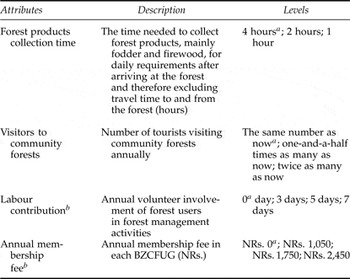
Attributes and levels used in choice sets

Notes: aLevels use in status-quo. Annual visitors in status-quo are 20,000. NRs. is Nepalese currency, US$1 ~ NRs. 71.00.
bContribution for a five-year period.
The CL model based on IID error terms implies a number of restrictions including the property of independence of irrelevant alternatives (IIA), and limitation in modelling variation in taste among respondents. The IIA property states that the choice probability ratio for any two alternatives in any choice set is constant for an individual, which is considered too restrictive in many practical situations. The CL model can be generalized into a random parameter logit (RPL) model, which relaxes the IIA constraints (Train, Reference Train1998).
In an RPL model, the observed component (βix ijt) given in equation (3) is expressed as the sum of the population mean (β′) and individual deviation  $\lpar \acute{\eta}\rpar $. The coefficient vector captures a random, unconditional and unobserved type of taste heterogeneity of each random parameter β′. The utility is:
 $$V_{ij} = \hbox{ASC} + {\beta^{\prime}}_{i} x_{ijt} + \acute{\eta}_{i}x_{ijt}.$$
In order to explain the sources of heterogeneity, socioeconomic characteristics, s, enter into the utility function. After including socioeconomic variables, the indirect utility function estimated becomes:
 $$V_{ij} = \hbox{ASC} + {\beta^{\prime}}_{i} x_{ijt} + \acute{\eta}_{i}x_{ijt} + \gamma S_{i}$$
where γ is the coefficient of socioeconomic variables (s). The respondents' characteristics do not vary over choices and capture conditional type of preference heterogeneity by interacting with given attributes. Socioeconomic variables enter as interaction terms with the attributes and ASC. These interaction terms examine the impacts of individual specific characteristics on participation in the IPS management programme.
2.3. Questionnaire development
The CE requires two separate components to capture the preferences of respondents, a statistical design plan to create the hypothetical scenarios and a statistical method to analyze the responses (Louviere et al., Reference Louviere, Hensher and Swait2000). The first step is to define the attributes and their levels. In this study this was finalized after thorough discussions with the local villagers in five focus group discussions, consultation with local experts, and reviewing community forest user groups' records, reports and literature. Focus group participants were asked to prepare a list of the impacts of Mikania on the forest and their livelihoods and to rank the impacts in terms of severity. Based on majority voting, the top four impacts were selected as attributes for the study (Bergmann et al., Reference Bergmann, Hanley and Wright2006). In addition, a draft questionnaire was tested and a payment vehicle was selected.
The selected attributes (table 1) are similar to the motivational factors influencing individuals to pay in a hypothetical market and support IPS management-related factors such as impacts on ecosystems, native species, ecosystem services and tourism (García-Llorente et al. Reference García-Llorente, Martín-López, Nunes, González, Alcorlo and Montes2011). In CE, the implicit price (IP) of a particular attribute can be directly obtained from the ratio between the coefficients in a logit regression of the individuals' binary response for accepting/rejecting offers with given costs (Hanemann, Reference Hanemann1984). The social opportunity cost of labour in terms of the IP is the negative ratio of the labour attribute coefficient and the coefficient of the monetary attribute. Hence, two-payment attributes, labour contribution and annual membership fee, were included in the choice set.
An efficient design created the unlabelled CE with three alternatives: status-quo, Option A and Option B. The D-efficient design strategies are considered to be efficient in the context of discrete CEs, as responses are analyzed in logistic models (Ferrini and Scarpa, Reference Ferrini and Scarpa2007; Scarpa and Rose, Reference Scarpa and Rose2008; Bliemer and Rose, Reference Bliemer and Rose2010). An efficient design was generated using Ngene (1.0.2) and the 24 choice situations were blocked into six versions of the questionnaire (see appendix 2 for an example of choice set). The number of attributes and choice sets in each version were determined based on the observation of piloting. The number of alternatives, their levels and choice sets are important considerations in reducing task complexity, particularly in the context of developing countries (Bennett and Birol, Reference Bennett and Birol2010). In addition, visualization of the choice cards enhances the efficacy of the choice task in low-literate communities (Jae and Delvecchio, Reference Jae and Delvecchio2004; Brouwer et al., Reference Brouwer, Haider, Gunaratne, Beardmore, Bennett and Birol2010).
The questionnaire included the following three sections. Firstly, it introduced IPS and the existing situation in the BZ. In addition, this section described the proposed plan to manage the invaded forest, the need to raise funds to implement mitigation policies, and asked respondents to select their preferred option from policy alternatives presented in the choice sets. Each option presented two policy attributes with labour contribution and an annual membership fee in each BZCFUG for the next five years. Follow-up questions were asked in order to understand how individuals become aware of the need to make the decision, search information on alternatives and attributes, construct choice sets and make decisions (Do and Bennett, Reference Do and Bennett2009). Secondly, the questionnaire asked respondents what changes they were experiencing following the colonization of Mikania. Finally, the questionnaire also collected information about the sociodemographic characteristics of respondents.
2.4. Survey implementation
A face-to-face survey and the appropriate training of enumerators are crucial in ensuring the success of a CE in developing settings (Bennett and Birol, Reference Bennett and Birol2010). Recruitment of local enumerators was beneficial as approaching female respondents by outsiders is not socially acceptable and the local ethnic community has its own dialects. The team of enumerators were given intensive training and monitored by the research team. In addition, each enumerator was given a folder containing choice sets on coloured sheets so that they could show them while describing the scenarios. A plain language statement was read before the respondent was asked whether s/he would like to participate in the research.
Considering the relationships between households' dependency on forest products and distance to the forest (Sapkota and Oden, Reference Sapkota and Oden2008), the households were stratified into three strata based on their proximity to the forest: less than 1 km, 1–2 km and more than 2 km. A systematic random sampling was employed to select households and every 10th household was interviewed. To establish a consensus about the species to be discussed, a photograph and a specimen of the vines were shown to the respondents before the interview. The household heads of either gender were interviewed because they hold decision-making power in household expenditure. The interviews were conducted in Nepali and Tharu (local dialects).
3. Results
3.1. Sample characteristics
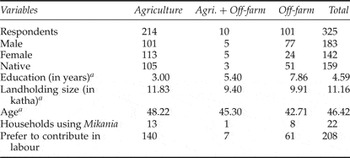
Of the total (325) households interviewed, two-thirds were farmers (table 2). This indicates that the study area is agro-based and rural households are diversifying their livelihood strategies due to tourism, a trend of going abroad for employment, and access to education. The average education level of the interviewed household heads was not above the primary level. Respondents having agriculture as their main income source have higher average land-holdings and age compared to their neighbours who depend on off-farm income. As expected, farmers have a lower average educational level and annual income.
Sociodemographic characteristics of the sampled households

Notes: aAverage of the variables. A katha is a unit of area approximately equal to 67 square meters.
Unlike the focus group participants, a small fraction of respondents (~7%) were using Mikania, particularly for goat fodder during the dry season, when other grass and fodder were not available. To compensate for a reduction in forest products availability, the households were executing different strategies whether they were using Mikania or not. Such compensating strategies included: plantation in private land; exploring more areas, particularly core areas of the national park, to collect forest products; using alternative energy such as bio-gas, liquefied petroleum gas, and purchasing firewood and fodder from the local market.
3.2. Model selection
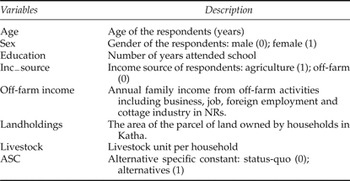
The choice data set was analyzed using LIMDEP 9.0 NLOGIT 4.0. Follow-up questions are helpful to understand respondents' decision-making strategies and heuristics (Carlsson et al., Reference Carlsson, Kataria and Lampi2010). Only three respondents (~1% of total respondents) selected the option that the government should pay for the invasive plant management programme, not citizens. They were considered as protest respondents. Out of the remaining respondents, 36 per cent (117) showed their preference for participating in monetary terms, and 63 per cent (205) preferred to participate in labour contribution. Sociodemographic variables used in the models and their coding are specified in table 3. These variables are introduced to investigate the source of preference heterogeneity by interacting with the ASC and attributes.
Definition of variables

Note: A katha equals approximately 67 square meters.
Individual specific characteristics including age, gender, income and occupation of respondents have a significant influence on selecting alternatives for forest management programmes (Lehtonen et al., Reference Lehtonen, Kuuluvainen, Pouta, Rekola and Li2003; Wang et al., Reference Wang, Bennett, Xie, Zhang and Liang2007). In addition, household characteristics including proximity to forests, landholding size, education, livestock holdings and wealth status are crucial determinants for forest products collection in rural parts of Nepal (Adhikari et al., Reference Adhikari, Di Falco and Lovett2004; Sapkota and Oden, Reference Sapkota and Oden2008).
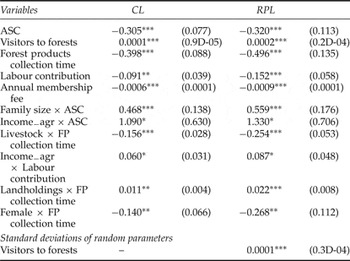
The CL model was estimated including the selected socioeconomic variables interacting with the ASC and attributes to examine the variations in effects of the IPS management programme (table 4). Only the significant interactions between sociodemographic variables and the attributes have been included. The Hausman test was performed to confirm the IIA/IID condition. It was found that the data did not support the test, as the difference matrix was not positive definite. Further analysis was conducted to address the limitations of the CL model including the IID assumption and absence of preference heterogeneity. To this end, the RPL model was estimated to relax the IID assumption and investigate heterogeneity in respondents' preferences.
Results of conditional logit and random parameter logit models

Notes: *, **, *** denote statistical significance at 10%, 5% and 1% level, respectively. Standard errors in parentheses.
The CL and RPL models were compared to determine the superiority between these two. A Swait–Louviere log-likelihood ratio test was carried out following Rolfe et al. (Reference Rolfe, Bennett and Louviere2000) for the test of the significance of log-likelihood values and pseudo R 2 change. The log-likelihood (LL) decreased from −598.54 in the CL model (LL 1) to −587.38 in the RPL model (LL 2). The calculated statistics χ2 = −2(LL1 − LL2) = 22.32, was greater than a statistic χ2 of 3.84 at one degree of freedom. The degrees of freedom are given by the difference in the numbers of parameters estimated in the two models. This indicates that the RPL model provides a significant improvement in model fit over the CL model. Hence, this model was used for further analysis and discussion.
In RPL models, taste parameters are considered to have statistical distributions arising from potentially different parameters for each individual (Hensher et al., Reference Hensher, Rose and Greene2005). Usually, random parameters are assumed to have log-normal and normal distributions, and these distributes are used for estimation (Carlsson et al., Reference Carlsson, Frykblom and Liljenstolpe2003). Following Hensher et al. (Reference Hensher, Rose and Greene2005), firstly, all attributes except payment attributes were estimated as random parameters. Then random parameters having insignificant standard deviations were re-estimated as non-random parameters. Different distributions were used to estimate the model and resulted in minimal differences. The results reported in table 4 are estimated with a normal distribution as the normal distribution sets no constraints on the signs of the parameters (Train, Reference Train2003).
The model is statistically significant overall with Chi-square statistics of 1,459.69 with 12 degrees of freedom and p-value equal to zero. The overall model fits with pseudo R 2 of 0.31. Values of pseudo R 2 between 0.2 and 0.4 are considered extremely good fits (Hensher and Johnson, Reference Hensher and Johnson1981). The RPL model with 1,000 random draws and random parameters with normal distributions shows that respondents have heterogeneous preferences over the visitors to forest attributes, significant at the 1 per cent level (table 4).
As expected, the results of both models show that respondents have a preference towards less forest products collection time, more visitors, and as outcomes of the Mikania management operation, which they want to have less labour contribution and a lower annual membership fee. The negative sign of the ASC, which is coded with 0 for the status quo, indicates that there are still some respondents who prefer to live with the current situation. This needs further investigation to be understood.
Family size is positively associated with selecting the alternatives. Households with more livestock and female respondents are likely to prefer the options with less forest products collection time. On the contrary, less forest product collection time is not the preferred attribute for households with larger parcels of land. Likewise, households with agriculture as the main source of income selected the policy alternatives more frequently. In addition, these farm households have shown interest in more labour contribution. However, these variables are significant only at 10 per cent levels.
3.3. Estimation of willingness-to-pay
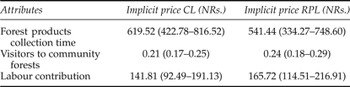
The marginal value of a change in an invasive species management attribute can be estimated as a ratio of the coefficients between IPS management attributes in the choice set. If it is estimated as a ratio with the monetary attribute (in this case, annual membership fee), then it is known as marginal WTP or IP for a change in that attribute. Confidence intervals for IP for attributes resulting from a Mikania mitigation programme were calculated from both CL and RPL models using the Krinsky and Robb (Reference Krinsky and Robb1986) bootstrapping procedure. A vector of 1,000 sets of parameters is drawn for each model to re-estimate the welfare changes. These results are reported in table 5.
Estimated implicit price and confidence intervals (in NRs./year)

Notes: Confidence intervals at 95% in brackets.
Across the whole sample, an average WTP for an hour's decrease in forest products collection time was NRs. 541.44 (US$7.62) and for an increase of 1,000 tourists was NRs. 240 (US$4.78). However, the opportunity cost of labour is estimated to be NRs. 165.72 (US$2.33) for every day involved in IPS management activities. The estimated value of labour contribution is about 47 per cent of the local agriculture labour wage, which was NRs. 350 per labour-day during the interview period.
Welfare measures for changes in IPS management attributes can be calculated by using the following formula (Hanemann, Reference Hanemann1984):
 $$\hbox{CS} = \lpar V_{1} - V_{0}\rpar /\beta_{c}$$
where CS is the compensating surplus welfare measure, V 1 is the utility of the change scenario, V 0 is the utility from the status-quo, and βc is the coefficient of annual membership fee. The value includes improvement in forest products collection time and annual visitors to community forests, and the ASC.
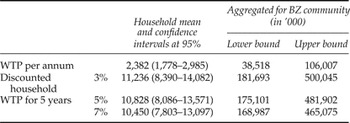
The status quo is indicated in table 1 and the change scenario for this estimation was based on the operational plan and records of BZCFUGs. The change scenario for this estimation was considered as the average time for forest products collection being reduced to two hours, the number of tourists increasing to 27,000 and no labour contribution for IPS management. The annual household WTP for the expected outcome is NRs. 2,382 (US$33.55). The estimated annual household WTP is 3.6 per cent of the average annual household income (Chakrabarty et al., Reference Chakrabarty, Grote and Lüchters2011). Greater WTP as a percentage of households' income is expected in low-income communities. Generally, income elasticity of WTP is less than unity, indicating that WTP as a percentage of income decreases with income (Kristrom and Riera, Reference Kristrom and Riera1996; Khan, Reference Khan2009). The estimated WTP for watershed restoration in rural China was 8 per cent of household income (Zhongmin et al., Reference Zhongmin, Loomis, Zhiqiang and Hamamura2006).
Table 6 reports the present values of the CS, calculated using a range of discount rates. In 2011, the present value of the average WTP per BZ household for the specified forest improvement was NRs. 11,236 (US$158.25) at a 3 per cent discount rate. The lower bound is total benefits of households who expressed their WTP in monetary terms, and the upper bound is only respondents who believed that the government should pay for the IPS management programme. These results clearly illustrate the underestimation of the value of mitigation of IPS to the forest dependent community if WTP estimation does not include the opportunity to contribute in terms of labour.
Estimates of WTP (NRs.)

4. Discussion
4.1. Invasive species management
The abundance of Mikania is likely to reduce the availability of indigenous plant species. However, Mikania is not a preferred resource, as the vines used during the dry season are only suitable for goats (Rai et al., Reference Rai, Scarborough, Subedi and Lamichhane2012). In order to maintain daily livelihoods, respondents of the BZ of CNP are implementing different coping strategies. The situation clearly indicates that colonization of Mikania is imposing costs to the BZ households. Therefore, respondents are willing to pay in monetary terms and, if not, are willing to contribute labour for improved forest conditions resulting from an invasive species management programme.
The family size is positively associated with selecting the alternatives. In general, large family size means more labour for farming and can supply more labour in forest management (Dolisca et al., Reference Dolisca, Carter, McDaniel, Shannon and Jolly2006). In this case, this is expected as a majority of the respondents have shown their willingness to contribute labour for the proposed programme. The households with more livestock and female respondents have high demand for fodder. In developing countries like Nepal, women tend to have more responsibility for household chores including small livestock production. Hence, they showed their preference for less forest products collection time. On the contrary, households with larger parcels of land do not value the alternatives with less forest products collection time. Literally, these households can fulfil their demand for forest products from their own land. They are less dependent on community forests for basic forest products (Sapkota and Oden, Reference Sapkota and Oden2008).
The number of farm households using Mikania, however not preferred, indicates their dependency on forest products, so they are more sensitive to a change in the availability of forest products (Nuñez and Pauchard, Reference Nuñez and Pauchard2010). In this context, higher WTP of farmers to control the spread of plant invaders is expected. Usually, users of forest ecosystem services have higher valuations for forest ecosystem services than non-users (Hanley et al., Reference Hanley, Wright and Adamowicz1998).
The main aim of non-market valuation is to estimate social benefits. This can be derived by aggregating households' WTP. The social benefits of the IPS management programme were calculated using the following equation:
 $$\hbox{WTP}_{\rm total} = \Sigma \hbox{WTP}^{\ast}H^{\ast}R\comma$$
where WTPtotal is total social benefits, WTP is the mean household WTP, H is households in BZ and R is proportion of respondents willing to pay.
The estimated WTP for the BZ community was between NRs. 38.51 million (US$542,508) and NRs. 106 million (US$1.49 million). The present value of total WTP for a five-year period, as respondents were asked to select the alternative IPS management outcomes that would happen in five years, is reported in table 6.
In comparison, the annual budget for BZ management in CNP was NRs. 80 millionFootnote 1 in the fiscal year 2011/2012. However, the allocated budget amount does not include any specific programme for Mikania management. Hence, the gap between estimated social benefits and the annual budget indicates that there is potential to improve the social welfare of the BZ community through the IPS management programme. The social benefits could be higher if global WTP for IPS management is also taken into account; this is because CNP is listed as a World Heritage Site (Do and Bennett, Reference Do and Bennett2009). The estimated WTP suggests that governments should respond to the problem associated with invasive plants, particularly Mikania, as soon as possible. If not the cost associated with IPS increases over time (Shackleton et al., Reference Shackleton, McGarry, Fourie, Gambiza, Shackleton and Fabricius2007).
4.2. Choice experiments in a subsistence economy
The majority of the respondents were subsistence farmers who have a willingness to contribute labour so that they can minimize any cash payment. Their estimated value for IPS management programmes, therefore, depended not only on outcomes of forestry operations but also on the number of days they were willing to be personally involved in the implementation phase. Providing only a monetary attribute as a cost of the bundle of outcomes may increase the chance of respondents selecting the status quo. Using a non-monetary term can address the cash constraints problem in a subsistence economy which potentially impacts the valuation of non-market benefits (Mekonnen, Reference Mekonnen2000; Alam, Reference Alam2006; Hung et al., Reference Hung, Loomis and Thinh2007). If not, a high protest rate is likely as respondents have limited ability to pay due to budget constraints (Bennett and Birol, Reference Bennett and Birol2010).
The implementation of CEs in the rural communities of developing countries, particularly to elicit WTP for environmental services, is in its infancy. The results show that the inclusion in the choice sets of a non-monetary payment attribute along with a monetary attribute is effective in eliciting rural farmers' WTP for IPS management activities. In addition, this also addresses – with the variance of the opportunity cost of time across individuals – the associated challenges of aggregating individual preferences elicited in labour terms to derive social benefits (Ahlheim et al., Reference Ahlheim, Frör, Heinke, Duc and Van Dinh2010). Hence, the extension of CE using two different payment attributes facilitates the participation of the rural poor with budget constraints in environmental decision making.
The estimated value of the labour contribution of respondents indicates that farm households would have a shadow value of family labour that is less than the market wage rate. This could be because farm households may enjoy farm activities as a lifestyle, and they make trade-offs between time and other benefits received from being involving in forestry activities (Ahearn et al., Reference Ahearn, Korb, Yee, Dunne, Jensen and Roberts2009). In addition, in agricultural households labour is valued by its marginal worth to the household rather than as an opportunity cost derived from a market wage rate (Edmeades et al., Reference Edmeades, Smale, Karamura and Smale2006). Therefore, the marginal rate of labour involvement in forestry activities can be used to pragmatically estimate the cost and benefits of forestry programmes in the context of rural economies of developing countries.
5. Conclusions
The benefits from the management of the BZ of CNP can be increased by implementing a Mikania management programme. The benefits resulting from the Mikania management programme in the BZ of CNP were estimated to be between US$2.38 million and US$7.04 million. This range is the net present value at 7 per cent of lower-bound aggregate WTP and at 3 per cent of upper-bound aggregate WTP. This suggests that, if more resources were allocated to an IPS management programme in the BZ of CNP, social welfare would improve by up to 1.2 times the current benefits from CNP in terms of royalty. Revenue from CNP in the fiscal year 2010/2011 was NRs. 83.14 million (DNPWC, 2011).
This study sheds light on the implementation of CE surveys in developing countries, particularly in rural areas. The estimated value of the IPS management programme not only focuses on the overall value of the forest ecosystem but also on the WTP for each attribute. This informs policy in allocating available resources in forest improvement by controlling the growth of Mikania in the BZ of CNP. The results of the CE survey have also demonstrated the impact of socioeconomic factors on the IPS management programme. This can help to minimize controversy surrounding the IPS management programme, particularly as the impacts of IPS on rural livelihoods are ambiguous (Pasiecznik, Reference Pasiecznik1999; Shackleton et al., Reference Shackleton, Kirby and Gambiza2011; Rai et al., Reference Rai, Scarborough, Subedi and Lamichhane2012).
In addition, provisioning of participation in the IPS management programme in labour contribution can increase the socioeconomic benefits. This also includes the concerns of approximately two-thirds of the rural population, whose values may otherwise be overlooked, in forest management. The inclusion of a non-monetary payment attribute with a monetary attribute not only reduces the task complexity but also estimates the social opportunity cost of time in a subsistence economy. This is helpful in converting the value of contributed labour into monetary terms, which facilitates social benefit-cost analysis of environmental programme in low-income areas.
In conclusion, for the first time, the non-market values of the IPS management programme have been quantified and can be used to justify the IPS management programme in Nepal. This study shows that a CE can be applied in a low-income community to estimate the non-market values of the forest ecosystem. The application of CE in rural areas of developing economies may have a significant contribution to sustainable development. The use of CE to estimate the value associated with invasive species not only focuses on ecosystem services but also informs policy about the impacts on rural livelihoods.
Appendix 1. Study area

Appendix 2. Example of choice set