
Introduction
Recent global climate changes have garnered much attention due to their impact on free-living and parasitic animals both at individual and population levels (Harvell et al., Reference Harvell, Mitchell, Ward, Altizer, Dobson, Ostfeld and Samuel2002; Walther et al., Reference Walther, Post, Convey, Menzel, Parmesan, Beebee, Fromentin, Hoegh-Guldberg and Bairlein2002). Temperature is a powerful factor affecting parasite transmission in aquatic ecosystems (Marcogliese, Reference Marcogliese2001, Reference Marcogliese2016). It positively influences the growth of parasite larvae in poikilothermic hosts (reviewed in Chubb, Reference Chubb1979, Reference Chubb1980; Barber et al., Reference Barber, Berkhout and Ismail2016). Temperature effects can be modified by the within-host factors controlling parasite development, among which the density of parasite infrapopulation is of particular importance (Holmes, Reference Holmes1961; Poulin, Reference Poulin1994; Brown, Reference Brown1999; Kuris, Reference Kuris2003; Parker et al., Reference Parker, Ball and Chubb2015). For example, many parasites grew slower when abundant due to ‘crowding effect’, i.e. stronger intraspecific competition for resources (Read, Reference Read1951; Bush and Lotz, Reference Bush and Lotz2000; Parker et al., Reference Parker, Ball and Chubb2015; Fong et al., Reference Fong, Moron and Kuris2017). At high infrapopulation densities, crowding could diminish the stimulating effect of warming on parasite growth (parasites may benefit less from higher temperatures than in smaller infrapopulations). Therefore, opposite impacts of temperature and parasite density on growth of parasites could be expected, but to our knowledge, there is lack of quantitative experimental studies on the combined effect of these factors.
However, temperature and parasite density do not necessarily influence parasite growth in opposite directions. In a few studies of trophically transmitted, manipulating, small-sized trematode larvae, the ‘crowding effect’ was not detected or even a positive density-dependence was reported (Weinersmith et al., Reference Weinersmith, Warinner, Tan, Harris, Mora, Kuris, Lafferty and Hechinger2014; Gopko et al., Reference Gopko, Mikheev and Taskinen2017a), probably due to a weak competition for resources and cooperation between conspecifics sharing costs of host manipulation and/or defence against host's immunity (Weinersmith et al., Reference Weinersmith, Warinner, Tan, Harris, Mora, Kuris, Lafferty and Hechinger2014; Gopko et al., Reference Gopko, Mikheev and Taskinen2017a). Therefore, growth of such parasites can potentially be jointly stimulated by higher temperature and parasite densities. The positive density-dependent growth can be considered as an example of a component Allee effect, defined as ‘a positive relationship between any component of individual fitness and either numbers or density of conspecific’ (Stephens et al., Reference Stephens, Sutherland and Freckleton1999). This is because metacercariae size/growth rate is tightly connected with the shorter maturation time/probability of successful transmission to the next host in trematodes. The component Allee effect refers to a certain fitness-related trait whose mean (per capita) value increases with population size, in contrast to the demographic Allee effect, which is observed at the level of overall population dynamics (Stephens and Sutherland, Reference Stephens and Sutherland1999; Stephens et al., Reference Stephens, Sutherland and Freckleton1999; Angulo et al., Reference Angulo, Luque, Gregory, Stephen, Wenzel, Bessa-Gomes, Berec and Courchamp2018).
Numerous field studies concern seasonal dynamics of different parasitic worms (Chubb, Reference Chubb1977, Reference Chubb1979, Reference Chubb1980). Growth rates of macroparasite larvae in poikilothermic hosts are suggested to increase with temperature, similarly to free-living organisms (Schmidt-Nielsen, Reference Schmidt-Nielsen1997). It has been supported by in vitro studies on Cestoda plerocercoids (Wikgren, Reference Wikgren1966; Sinha and Hopkins, Reference Sinha and Hopkins1967) and in vivo experiments on larvae of different helminths within invertebrate hosts (Chubb, Reference Chubb1980; Tokeson and Holmes, Reference Tokeson and Holmes1982; Lv et al., Reference Lv, Zhou, Zhang, Liu, Zhu, Yin, Steinmann, Wang and Jia2006; Studer et al., Reference Studer, Thieltges and Poulin2010). However, for parasite larvae in vertebrate poikilotherms (e.g., fish), experimental evidence of faster growth at higher temperatures is still scarce (reviewed in Chubb, Reference Chubb1979, Reference Chubb1980; Voutilainen et al., Reference Voutilainen, Taskinen and Huuskonen2010; Macnab and Barber, Reference Macnab and Barber2012; Franke et al., Reference Franke, Armitage, Kutzer, Kurtz and Scharsack2017). In most of the studies, the growth of larvae was assessed by the presence of certain developmental stages and the size of larvae was measured (if measured) only at the end of experiments, while data on growth rates were not provided. The only exception is the study of trematode growth under low temperatures (10–15°C) (Voutilainen et al., Reference Voutilainen, Taskinen and Huuskonen2010), while information about growth rates of parasite larvae within the fish hosts at higher temperatures is absent. Further investigations of temperature effects on parasite growth are important for predicting the consequences of climate change for parasite transmission (Marcogliese, Reference Marcogliese2001, Reference Marcogliese2016; Cable et al., Reference Cable, Barber, Boag, Ellison, Morgan, Murray, Pascoe, Sait, Wilson and Booth2017).
In this study, we aimed to experimentally study the growth of trematode larvae at different parasite densities and temperature conditions. As a host−parasite study system, we chose rainbow trout infected with the eye fluke Diplostomum pseudospathaceum, a common fish parasite that impairs vision and alters fish behaviour in natural freshwater ecosystems and fish farms (Karvonen et al., Reference Karvonen, Seppälä and Valtonen2004; Seppälä et al., Reference Seppälä, Karvonen and Valtonen2004; Mikheev et al., Reference Mikheev, Pasternak, Taskinen and Valtonen2010; Gopko et al., Reference Gopko, Mikheev and Taskinen2015, Reference Gopko, Mikheev and Taskinen2017b). This study system shows the evidence for positive effect of both temperature (Voutilainen et al., Reference Voutilainen, Taskinen and Huuskonen2010) and infrapopulation density (Gopko et al., Reference Gopko, Mikheev and Taskinen2017a) on parasite growth. Diplostomum metacercariae are interesting objects to study the influence of temperature on host−parasite interactions since they localize in eye lenses, where the confounding effect of host immunity is minimal (Dittmar et al., Reference Dittmar, Janssen, Kuske, Kurtz and Scharsack2014) or absent (Höglund and Thuvander, Reference Höglund and Thuvander1990; Wegner et al., Reference Wegner, Kalbe and Reusch2007).
We hypothesize that: (1) both temperature and parasite' infrapopulation density have a positive influence on the growth of D. pseudospathaceum metacercariae; (2) a positive interaction between these two factors exists.
Materials and methods
Study objects
Experiments were conducted at the Konnevesi Research Station (University of Jyväskylä) in July–August 2019. Rainbow trout, Oncorhynchus mykiss, was used as the host for D. pseudospathaceum. Young-of-the-year rainbow trout, free of macroparasites, were obtained from a fish farm and acclimated to laboratory conditions (temperatures 14–15 °C) in 165 L flow-through tanks filled with water from Lake Konnevesi for 2 weeks. Cercariae for infection were obtained from six infected pond snails Lymnaea stagnalis (the first intermediate host of D. pseudospathaceum) collected from Lake Konnevesi. The procedures of snail maintenance in the laboratory, identification, and counting of cercariae were similar to those described previously (e.g., Gopko et al., Reference Gopko, Mikheev and Taskinen2017a, Reference Gopko, Mikheev and Taskinen2017b). All cercariae used for infection were not older than 5 h.
Experimental design
Fish were placed in two 165 L tanks (132 fish in each) at acclimation temperatures (15 °C) and exposed to low and high doses of cercariae (120 and 250 cercariae/fish, respectively) for 30 min without water flow (Seppälä et al., Reference Seppälä, Karvonen and Valtonen2004). These exposure doses were chosen to get a larger variation in the infection intensities and were similar to the ones used earlier (Karvonen et al., Reference Karvonen, Seppälä and Valtonen2004; Seppälä et al., Reference Seppälä, Karvonen and Valtonen2004; Gopko et al., Reference Gopko, Mikheev and Taskinen2017a, Reference Gopko, Mikheev and Taskinen2017b). Infection intensities (4–94, mean = 36 metacercariae ind−1) were similar to that of the natural ones (Shigin, Reference Shigin1986; Valtonen and Gibson, Reference Valtonen and Gibson1997; Valtonen et al., Reference Valtonen, Holmes and Koskivaara1997). The same mixture of cercariae obtained from six snails was used to infect all fish.
After exposure, the fish were placed in eight identical flow-through tanks (31–35 fish in each), and two temperature treatments were set up (with two replicates for each of the two infection doses). Four tanks were heated to 18°C, while other four were kept at 15°C. Heating started 1 h after the exposure and took 9 h to reach the target water temperature. Then, during the whole experiment (17 days), the average temperature (±s.d.) was 15.1 ± 0.54°C and 18.0 ± 0.54°C in non-heated and heated tanks, respectively. Fish were fed ad libitum with food flakes. Water temperature and oxygen concentration were measured three times a day.
Maintenance temperatures were similar to summer temperatures in Lake Konnevesi (Kuha et al., Reference Kuha, Arvola, Hanson, Huotari, Huttula, Juntunen, Järvinen, Kallio, Ketola, Kuoppamäki, Lepistö, Lohila, Paavola, Vuorenmaa, Winslow and Karjalainen2016) and temperate lakes in general (mean ± s.e. = 16.8 ± 0.52°C), calculated using the ‘laketemps’ package (Sharma et al., Reference Sharma, Gray, Read, O'Reilly, Schneider, Qudrat, Gries, Stefanoff, Hampton, Hook, Lenters, Livingstone, McIntyre, Adrian, Allan, Anneville, Arvola, Austin, Bailey and Woo2015; Gopko et al., Reference Gopko, Mironova, Pasternak, Mikheev and Taskinen2020). The temperature in our heated tanks was in the range of growth temperatures (18–19°C) of rainbow trout (Coutant, Reference Coutant1977; Eaton et al., Reference Eaton, McCormick, Goodno, O'Brien, Stefan, Hondzo and Scheller1995), and the oxygen saturation was kept high (>86%).
To study metacercariae abundances and sizes, we dissected fish on the 12th and 17th day after the exposure (half of the fish were randomly chosen from each tank each time). Metacercariae of D. pseudospathaceum stop growing on reaching maturation (Parker et al., Reference Parker, Ball and Chubb2015), which takes about a month at 18°C in salmonids (Sweeting, Reference Sweeting1974; Shigin, Reference Shigin1986); therefore, we tried to catch the period of active growth for dissections. Fish were killed with an overdose of MS 222 (Sigma Chemical Co., St Louis, USA), weighed and measured (fork length). In each dissection, fish were killed simultaneously (120 fish), stored at 4°C, and examined in a balanced order from different tanks during a period of 2 days. The number and length of metacercariae in eye lenses were estimated under the microscope Olympus SZX12 (magnifications ×40 –×90). Metacercariae for measurements were chosen randomly. The first ten individuals from the central upper part of the microscopic field were measured clockwise in each eye. When metacercariae moved, their maximum lengths in the stretched state were measured.
Data analysis
Metacercariae size
Given that the body temperature of the fish host reflects water temperature, we calculated the thermal constant (Q 10) for metacercariae growth for a 5-days period between the 12th and 17th day post-infection, using the Van't Hoff' formula (Schmidt-Nielsen, Reference Schmidt-Nielsen1997):

where k 1 and k 2 are growth rates at temperatures 1 (18 °C) and 2 (15 °C), respectively.
We used ‘lmerTest’, ‘ggplot2’, ‘lme4’, and ‘gridExtra’ R packages in data analysis (Bates et al., Reference Bates, Maechler, Bolker and Walker2015; Wickham, Reference Wickham2016; Auguie, Reference Auguie2017; Kuznetsova et al., Reference Kuznetsova, Brockhoff and Christensen2017). To study the influence of temperature and metacercariae densities on the metacercariae growth, we used linear mixed models, where tank, fish, and eye IDs were nested random factors, while metacercariae age (12th vs 17th day post-infection), temperature treatment, fish weight, within-eye infrapopulation size and double interactions were included as fixed factors. We did not consider higher-order interactions because of their complicated interpretability and lack of a priori hypotheses (but see below the triple interaction Time × Temperature × Infection intensity). Then, the model was simplified using a ‘step’ tool (Kuznetsova et al., Reference Kuznetsova, Brockhoff and Christensen2017; R Core Team, 2019). The resulted model included all main effects we were interested in and the interaction between metacercariae age and temperature. The response variable was log-transformed.
We plotted within-eye infection intensity vs length of metacercariae separately for each treatment. The parasite numbers for each eye were considered separately and were not summarized because metacercariae sizes depends on metacercariae abundance in the respective eye (Gopko et al., Reference Gopko, Mikheev and Taskinen2017a). The overlapping data points were showed as proportionally larger ones. Pearson' correlation coefficients were also added to the plots for illustrative purposes. These correlations, in contrast to the stricter mixed-model, do not account for potential non-independence; however, intraclass correlation was quite low (0.10 at the highest level). Degrees of freedom in all mixed models were obtained using Satterthwaite's approximation (Kuznetsova et al., Reference Kuznetsova, Brockhoff and Christensen2017).
We also aimed to test whether there was an interaction between temperature and infrapopulation size, i.e. a modifying influence of temperature on the relationship between the length of parasites and infrapopulation size. However, these modifying effects could change with time, and, indeed, when the triple interaction Time × Temperature × Infection intensity was added to the model, it was significant (Estimate = −0.0082, s.e. = 0.0028, df = 38.7, t = −2.926, P = 0.0036). Since triple interactions are hardly interpretable, we checked the interaction between temperature and infection separately for both time points. We fitted two models similar to that described above; all variables were the same excluding the time of the dissection, and all interactions between the fixed factors were included. Then, we simplified them as described above. The exclusion of random effects was suppressed. Both resulted models included temperature and infection intensity as predictors. The model for the 17th day also included the interaction between these variables.
Infection intensity
We started with a linear model that considered fish weight as a continuous predictor, and the temperature treatment and metacercariae age as factors of interest. Tank ID and infection dose (high/low) were also included in the initial model as factor variables along with double interactions. Then, we simplified the model. The most parsimonious model was the following: log(Infection intensity) ~ Weight + Temperature + Metacercariae age + Infection dose + Temperature × Weight + Infection dose × Temperature. Model residuals were checked for normality visually on QQ-plots and formally checked using Shapiro−Wilk' test (W = 0.99, P = 0.22).
Variation in metacercariae size
Our initial linear mixed model included a log-transformed coefficient of variation (CV) in metacercariae size for each eye as a dependent variable, Fish ID nested within Tank ID (random factors), metacercariae age and temperature treatment (fixed factors), and a mean metacercariae length within the eye as a continuous variable. Based on the visual inspection of the data, we concluded that a three-way interaction between the predictor variables is likely and included all interactions in the initial model. However, neither fish nor tank ID explained the substantial amount of variance; therefore, we continued with a simple linear model without random factors. Triple interaction was significant as expected (Estimate ± s.e. = 0.16 ± 0.034, t 206 = 4.80, P < 0.0001). We split our data into two parts as per the age of metacercariae (12th and 17th day post-infection) to get more interpretable models. These models included the same predictors as the initial model, and fish weight and infection intensity were added as covariates. We started with the models that included all double interactions and then simplified them. Finally, we created a separate model with Metacercariae age, temperature treatment, and their interaction as predictors, and tank ID as a random factor.
Fish body condition
We used GLM ANOVAs to check whether temperature treatment and Tank ID influenced the condition (Fulton' condition factor) of fish. In both cases, we added the time of dissection (12- or 17-day post-infection) as an additional factor.
Results
Metacercariae growth
There was a positive relationship between number and size of D. pseudospathaceum metacercariae within the eye (Table 1, Fig. 1). The positive density-dependent growth was seen in all treatments excluding the 15 °C treatment on 12th day post-infection, where the relationship was slightly non-significant (Fig. 1).
Within-eye infection intensity vs metacercariae size taken separately for each metacercariae age × temperature treatment. The shaded area represents the 95% confidence intervals.

Influence of predictors (metacercariae age, within-eye abundance, temperature) on the size of D. pseudospathaceum metacercariae estimated from the GLMMs

(A) Results of a model, where parasites measured on the 12th and 17th day post-exposure were taken together. (B) Results of the models fitted separately for the 12th and 17th day post-exposure (are presented since there was a marginally significant triple interaction between metacercariae age, infrapopulation size and temperature)
The temperature had a substantial positive influence on the growth of metacercariae. Metacercariae at 18°C were larger than at 15 °C (Fig. 2, Table 1). The 3 °C higher temperature led to 2-fold increase in the size of metacercariae in 17 days (mean ± s.d. sizes at 15 °C and 18 °C: 221 ± 32 and 460 ± 58 μm, respectively). The difference in parasite sizes grew with time, i.e. the interaction between temperature and time was significant (Fig. 2). The largest metacercariae (maximal length 757 μm, mean ± s.d. 460 ± 58 μm) were observed in the heated tanks at the end of the experiment. Average growth rates of metacercariae between 12th and 17th day constituted 14 and 35 μm day−1 at 15 °C and 18 °C, respectively. The thermal constant calculated from these growth rates was very high (Q 10 = 21).
Difference in metacercariae sizes at different temperatures. ‘Boxes’ represent a median with the interquartile range (IQR), whiskers extend from the highest to lower values within 1.5*IQR.

Models fitted separately for the 12- and 17-day time points also showed that parasites grew faster at higher temperature and abundances (Table 1). However, the interaction temperature × infrapopulation size was significant only at 17th day. Under higher temperature, the influence of infrapopulation size on metacercariae growth was still positive though less pronounced than under lower temperature. Effects of fish weight and its interactions with other predictors were not significant in all the tested models and were, therefore, excluded from the final models.
Infection intensity
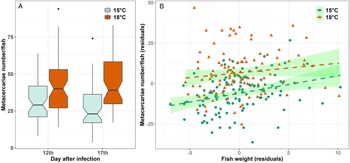
As expected, infection dose influenced the infection intensity positively (Table 2). More interestingly, fish in the high-temperature treatment were more infected compared to the low-temperature treatment (Table 2, Fig. 3). Holding other variables constant, the mean infection intensity at 18°C was 16 additional eye flukes higher than at 15°C. There was a positive relationship between fish weight and infection intensity. With 1 g increase in fish weight, the mean infection intensity increased roughly by one metacercaria (Fig. 3). There was no difference in the parasitic load in fish dissected on 12th and 17th day post-infection (Table 2).
Difference in infection intensities at different temperatures (A). The relationship between fish weight and infection intensity taking into account different infection doses is presented in the residual plot (B). ‘Boxes’ represent a median with the IQR, whiskers extend from the highest to lower values within 1.5*IQR, the shaded area represents the 95% confidence intervals.

Effect of metacercariae age, fish weight, temperature, infection dose on the infection intensity of D. pseudospathaceum in rainbow trout estimated from the GLMM

Data for 219 fish were used
Variation in metacercariae size
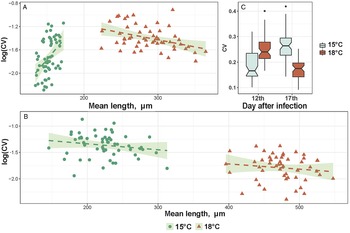
After the simplification, the model for 12th day post-infection included the temperature treatment, metacercariae size (centred) within the fish eye, their interaction and tank ID as predictors, while the model for the 17th day post-infection included only metacercariae size as a predictor. On the 12th day post-infection, the main effect of metacercariae size was positive (Estimate ± s.e. = 0.14 ± 0.03, t 107.73 = 4.53, P < 0.0001), reflecting the increase in CV with the mean metacercariae length under lower temperature. However, a significant interaction between the temperature and metacercariae size indicated that this effect disappeared at 18 °C; the relationship was even slightly negative (Estimate ± s.e. = −0.16 ± 0.03, t 103.00 = −5.05, P < 0.0001; Fig. 4a). On the 17th day, there was a negative correlation between metacercariae size and size variability at both temperatures (Estimate ± s.e. = −0.15 ± 0.02, t = −9.84, P < 0.0001; Fig. 4b).
Mean metacercariae length vs log(CV) of metacercariae length in fish dissected on the 12th (A) and 17th (B) day after infection. (C) Variability of metacercariae length in fish from different temperature treatments. The shaded area represents the 95% confidence intervals.

In the model, where Metacercariae age, Temperature treatment were the predictors, there was a significant positive influence of both main effects on the CV of metacercariae size (Estimate ± s.e. = 0.37 ± 0.047, t 209.84 = 7.96, P < 0.0001 and Estimate (17 days) ± s.e. = 0.34 ± 0.050, t 19.74 = 6.72, P < 0.0001). However, the interaction between variables was also significant (Estimate ± s.e. = −0.77 ± 0.067, t 210.07 = −11.38, P < 0.0001). Variation in sizes was higher in the heated treatments on the 12th day than in the non-heated treatments, but the relationship was inverse on the 17th day (Fig. 4c).
Effects of temperature and parasite density on fish condition
There was no influence of temperature, time, or interaction between these factors on fish condition (F 1, 215 < 3.41, P > 0.07 in all cases). Fish also did not differ in Fulton' condition factor between the tanks on 12th and 17th day post-infection (F 1, 215 < 3.46, P > 0.06 for all main effects and the interaction). Fish body condition was found to be slightly positively correlated with metacercariae numbers (r s = 0.171, P = 0.008) and did not correlate with metacercariae sizes (r s = 0.058, P = 0.374), so there was no indication of negative effect of the infection on the host.
In most of the tanks, fish mortality was low (share of dead individuals <6%), but in three heated tanks from different infection treatments mortality, was rather high (15–22% by the end of the experiment). Meanwhile, in the last heated tank, only 3% of fish died, calling into question that mortality simply increased with temperature. In addition, the temperature did not influence fish condition and did not exceed maximum growth temperatures for rainbow trout (Coutant, Reference Coutant1977; Eaton et al., Reference Eaton, McCormick, Goodno, O'Brien, Stefan, Hondzo and Scheller1995). The majority of fish died in the first week, and we did not find any obvious signs of concomitant infections. Dead individuals did not differ by body condition from fish that remained alive in the respective tanks and were dissected on the 12th day post-exposure (F 1, 55 = 1.3, P = 0.28). The log-transformed infection intensities were also similar (interaction infection dose × fish status (dead/alive), F 1, 70 = 2.0, P = 0.16, ns). Therefore, it is unlikely that selective mortality influenced our results.
Discussion
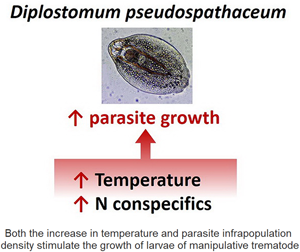
Our study provides the first quantitative data about the joint effect of temperature and parasite density on the growth of parasite larvae. Both heating and larger infrapopulation size stimulated the growth of D. pseudospathaceum metacercariae in the rainbow trout. There is no surprise in the increase of growth rates under higher temperature, but the extent of this increase (Q 10 = 21) is unusual. The observed positive density-dependence of parasite growth (Allee effect) supports the results of earlier studies of this system (Gopko et al., Reference Gopko, Mikheev and Taskinen2017a), contrary to the common expectation of resource competition in parasites (Read, Reference Read1951; Fong et al., Reference Fong, Moron and Kuris2017), including trematode metacercariae (Sandland and Goater, Reference Sandland and Goater2000; Brown et al., Reference Brown, De Lorgeril, Joly and Thomas2003; Fredensborg and Poulin, Reference Fredensborg and Poulin2005; Saldanha et al., Reference Saldanha, Leung and Poulin2009; Stumbo and Poulin, Reference Stumbo and Poulin2016).
Surprisingly, there was a negative interaction between temperature and infrapopulation density of parasites – at higher temperature, the positive effect of infrapopulation size on parasite growth was less pronounced. However, this interaction was significant only at the later time point (17th day post-infection) when metacercariae were the largest and variation in their sizes decreased. This can be probably explained by growth arrest at larval maturity to avoid overexploitation and/or mobilization of host responses (Parker et al., Reference Parker, Ball and Chubb2015) – under high temperatures and infrapopulation densities, parasites slowed down growth earlier because they almost reached their maximal size. It is likely that warming did not change the Allee effect but affected its timing, making the effect evident earlier. Thus, at 15°C, the Allee effect was observed not until 17th day, while at 18°C, it became obvious at 12th day.
Stimulating effects of heating on development of parasite larvae were found in a variety of helminths within poikilothermic hosts (review by Chubb, Reference Chubb1979, Reference Chubb1980; Tokeson and Holmes, Reference Tokeson and Holmes1982; Lv et al., Reference Lv, Zhou, Zhang, Liu, Zhu, Yin, Steinmann, Wang and Jia2006; Studer et al., Reference Studer, Thieltges and Poulin2010; Voutilainen et al., Reference Voutilainen, Taskinen and Huuskonen2010; Macnab and Barber, Reference Macnab and Barber2012; Franke et al., Reference Franke, Armitage, Kutzer, Kurtz and Scharsack2017) and can be explained by increased metabolic rates. These effects are important for parasite transmission because warming shortens the period when parasite larvae are non-infective (Barber et al., Reference Barber, Berkhout and Ismail2016). During this period, if the fish host of D. pseudospathaceum metacercariae is consumed by any predator, the parasites will perish. Immature metacercariae can overwinter in the fish and continue growing in the next warm season (Valtonen and Gibson, Reference Valtonen and Gibson1997; Hakalahti et al., Reference Hakalahti, Karvonen and Valtonen2006). Therefore, the infection of the definitive host can be postponed, especially in boreal aquatic environments (Hakalahti et al., Reference Hakalahti, Karvonen and Valtonen2006). Metacercariae of D. pseudospathaceum need about 700–1000 degree-days to reach infectivity in salmonids (Sweeting, Reference Sweeting1974; Shigin, Reference Shigin1986), but these assessments are based on larvae morphology and were not tested experimentally. In our experiment, metacercariae grew up to the sizes (average 460 ± 58 μm) similar to the maximum values (ranging from 390 to >500 μm) reported for D. pseudospathaceum (Niewiadomska, Reference Niewiadomska1986; Shigin, Reference Shigin1986; Voutilainen et al., Reference Voutilainen, Taskinen and Huuskonen2010) in 306 degree-days. However, it does not necessarily guarantee their maturity. To avoid confusion, it is important to note that, in the cited studies, other species names were used instead of D. pseudospathaceum (D. spathaceum, D. chromatophorum, D. spp. in Sweeting (Reference Sweeting1974), Shigin (Reference Shigin1986), Voutilainen et al. (Reference Voutilainen, Taskinen and Huuskonen2010), respectively). However, the fact that parasites were obtained from L. stagnalis snails, which are typically infected by D. pseudospathaceum (Rellstab et al., Reference Rellstab, Louhi, Karvonen and Jokela2011), indicates that these studies most likely dealt with D. pseudospathaceum.
We showed that even a small (3°C) increase in water temperature led to 2.5-fold rise in growth rates of D. pseudospathaceum and eventually (17 days post-infection) resulted in the twice larger size of metacercariae. The thermal constant calculated for growth rates of metacercariae was much higher (Q 10 = 21) than expected following the Q 10-rule, predicting a 2 to 3-fold rise in metabolic rates of poikilothermic animals for every 10°C (Schmidt-Nielsen, Reference Schmidt-Nielsen1997). This could mean that small and actively growing immature metacercariae are much more sensitive to temperature shifts than their hosts and many other poikilothermic organisms. However, it may not be necessarily so, since the thermal constant was initially formulated for relatively simple chemical processes and the values obtained in biological systems often differ (Vernberg, Reference Vernberg, Florkin and Scheer1968). Information about thermal response in helminths is controversial, varying from being extraordinarily high (cercariae: Poulin, Reference Poulin2006) to slightly elevated (cestode plerocercoids: Sinha and Hopkins, Reference Sinha and Hopkins1967) and limited response (cercariae and miracidia: Morley, Reference Morley2012; Morley and Lewis, Reference Morley and Lewis2013; Marcogliese, Reference Marcogliese2016; adult trematodes: Vernberg, Reference Vernberg, Florkin and Scheer1968). This can be explained not only by differences between parasite species, strains, and life stages but also by acclimation conditions and temperature history of the host (Paull et al., Reference Paull, Raffel, LaFonte and Johnson2015).
Our results showed a positive relationship between temperature and infection intensity, similarly to the results of previous studies of D. pseudospathaceum (Lyholt and Buchmann, Reference Lyholt and Buchmann1996; Gopko et al., Reference Gopko, Mironova, Pasternak, Mikheev and Taskinen2020). This cannot be a result of temperature-dependent exposure rate since the temperature was increased only after the exposure to cercariae, but it indicates that the number of parasite larvae that reached eye lenses after penetration into the host was higher under higher temperature. It could be explained by the immediate suppression of fish immune response under warming (Dittmar et al., Reference Dittmar, Janssen, Kuske, Kurtz and Scharsack2014), which increases chances of parasites to reach the eye lens safely. In the eye lens, parasites are inaccessible for the host immunity (Höglund and Thuvander, Reference Höglund and Thuvander1990; Wegner et al., Reference Wegner, Kalbe and Reusch2007) and, therefore, the temperature−host immunity interaction unlikely influences their development. Since temperature in the heated treatments was set up before (~9 h post-infection) the parasites possibly reached the eye lens (~15 h at 15°C) (Lyholt and Buchmann, Reference Lyholt and Buchmann1996), parasites could be less influenced by the immune system on their way to the final localization in the heat-stressed hosts.
Variation in sizes of D. pseudospathaceum larvae increased under warmer conditions at early growth stages (on 12th day post-infection), but this pattern disappeared later, on 17th day, when metacercariae approached their maximum size. Expression of the possible initial inter-clonal differences in the growth rates could be promoted by heating and reduced later, as the growth of the most developmentally advanced larvae was arrested (Parker et al., Reference Parker, Ball and Chubb2015). Therefore, temperature can potentially influence the growth variation and the size structure of metacercariae infrapopulations, but it is unclear whether this influence is direct or mediated by metacercariae development.
In general, an increase in environmental temperature may benefit the completion of the life cycle in D. pseudospathaceum, similarly to other parasite species (Barber et al., Reference Barber, Berkhout and Ismail2016). In addition to faster development of parasite larvae, warming may promote the release of infective stages, enhance their infectivity for a short period (Poulin, Reference Poulin2006) and alter biology of the hosts, making them more accessible to parasites (Hakalahti et al., Reference Hakalahti, Karvonen and Valtonen2006; Barber et al., Reference Barber, Berkhout and Ismail2016).
The positive correlation between the average size of D. pseudospathaceum metacercariae and their abundance in fish eye (Allee effect) found in our study contradicts the large majority of the studies that showed the ‘crowding effect’ (Read, Reference Read1951) in parasite infrapopulations (Holmes, Reference Holmes1961; Jones and Tan, Reference Jones and Tan1971; Yao et al., Reference Yao, Huffman and Fried1991; Poulin et al., Reference Poulin, Giari, Simoni and Dezfuli2003; Fong et al., Reference Fong, Moron and Kuris2017), including studies on trematode metacercariae (Sandland and Goater, Reference Sandland and Goater2000; Brown et al., Reference Brown, De Lorgeril, Joly and Thomas2003; Fredensborg and Poulin, Reference Fredensborg and Poulin2005; Saldanha et al., Reference Saldanha, Leung and Poulin2009) and in particular, diplostomids (Stumbo and Poulin, Reference Stumbo and Poulin2016). Situations when the presence of conspecifics does not influence parasite fitness or even benefits them may happen when parasite−host size ratio is small, infection intensity is low, in manipulative parasites with similar transmission goals or when some form of public goods is produced (Poulin, Reference Poulin1994; Brown, Reference Brown1999; Kuris, Reference Kuris2003; Bashey, Reference Bashey2015). However, experimental evidence of a such positive density-dependence relationship in macroparasites is, to our knowledge, limited to a previous study on the same host−parasite system (Gopko et al., Reference Gopko, Mikheev and Taskinen2017a). A field study of trematode Euhaplorchis californiensis infecting the California killifish also reported a possible mild positive density-dependent growth in metacercariae (Weinersmith et al., Reference Weinersmith, Warinner, Tan, Harris, Mora, Kuris, Lafferty and Hechinger2014).
The Allee effect found in these trematode species can be explained by similar reasons. First, their metacercariae are small relative to the fish host, suggesting no resource limitation (Weinersmith et al., Reference Weinersmith, Warinner, Tan, Harris, Mora, Kuris, Lafferty and Hechinger2014; Gopko et al., Reference Gopko, Mikheev and Taskinen2017a), which typically restricts the growth of larger parasites (nutrients, physical space, attachment sites) (Holmes, Reference Holmes1961, Reference Holmes1962; Heins et al., Reference Heins, Baker and Martin2002; Parker et al., Reference Parker, Ball and Chubb2015). When abundant, metacercariae of D. pseudospathaceum may feed more effectively because of more perforations in the eyeball covers created during the penetration, which leads to a higher amount of tissue fluid entering the eye. It is unlikely that metacercariae in our study were involved in the strong exploitative competition since positive density-dependence remained even when metacercariae reached sizes close to their maximum. In addition, parasite densities and sizes did not correlate with fish body condition; therefore, there is a lack of obvious signs of host depletion by the parasite.
The second possible explanation of the Allee effect in these trematodes is their ability to manipulate host behaviour and share the manipulation costs among metacercariae (Weinersmith et al., Reference Weinersmith, Warinner, Tan, Harris, Mora, Kuris, Lafferty and Hechinger2014; Gopko et al., Reference Gopko, Mikheev and Taskinen2017a). Immature D. pseudospathaceum larvae manipulate fish behaviour to suppress the predation risk for the host fish, while mature larvae enhance it (Mikheev et al., Reference Mikheev, Pasternak, Taskinen and Valtonen2010; Gopko et al., Reference Gopko, Mikheev and Taskinen2015, 2017b) similarly to mature metacercariae of E. californiensis (Lafferty and Morris, Reference Lafferty and Morris1996).
The suppression of defensive behaviour in fish infected by mature D. pseudospathaceum larvae was supposed to be caused by vision deterioration due to cataract formation (Karvonen et al., Reference Karvonen, Seppälä and Valtonen2004; Seppälä et al., Reference Seppälä, Karvonen and Valtonen2005, Reference Seppälä, Karvonen and Valtonen2012). However, it could not explain manipulations of small immature metacercariae (Gopko et al., Reference Gopko, Mikheev and Taskinen2015) before the start of active cataract formation, which typically begins after the full maturity of the parasite (Karvonen et al., Reference Karvonen, Seppälä and Valtonen2004; Seppälä et al., Reference Seppälä, Karvonen and Valtonen2005) and parasite manipulations at low infection intensities. Altering host vision by diel migrations of metacercariae, similarly to diplostomid Tylodelphys sp., actively moving to certain sites within vitreous humour of fish eye (Stumbo and Poulin, Reference Stumbo and Poulin2016) is unlikely to be possible for D. pseudospathaceum metacercariae inhabiting much denser lens matrix. Therefore, we suggest that another mechanism of manipulation, e.g., the release of chemicals by parasites or by-products of infection also could be important in D. pseudospathaceum, similarly to many other parasites (Adamo, Reference Adamo, Hughes, Brodeur and Thomas2012). The fact that the extent of behavioural changes caused by immature D. pseudospathaceum metacercariae does not increase with infection intensities also supports this assumption (Gopko et al., Reference Gopko, Mikheev and Taskinen2015). The manipulations may be costly (if special chemicals are released) and the total cost of manipulation is likely to be constant in D. pseudospathaceum; therefore, parasites may benefit from cost sharing when abundant (Gopko et al., Reference Gopko, Mikheev and Taskinen2015). We suggested that immature eye fluke metacercariae can cooperate with conspecifics and, when abundant, invest less energy in host manipulation but more in growth (Gopko et al., Reference Gopko, Mikheev and Taskinen2017a). Sharing costs of defence against host immune system is unlikely to be important for Diplostomum larvae because they are unaffected by the host' immunity in the fish eye (Höglund and Thuvander, Reference Höglund and Thuvander1990; Wegner et al., Reference Wegner, Kalbe and Reusch2007). For this reason, the found Allee effect cannot be explained by individual differences in host susceptibility to parasites, which are supposed to influence parasite growth in other hosts (Weinersmith et al., Reference Weinersmith, Warinner, Tan, Harris, Mora, Kuris, Lafferty and Hechinger2014).
To our knowledge, the present study together with the previous one on this object (Gopko et al., Reference Gopko, Mikheev and Taskinen2017a) provides the first experimental evidence of positive density-dependent growth in macroparasites. The results on E. californiensis (Weinersmith et al., Reference Weinersmith, Warinner, Tan, Harris, Mora, Kuris, Lafferty and Hechinger2014) were based on field data therefore, the influence of previous life history on hosts and parasites cannot be disregarded in that study. Since the infection intensities in our experiment were similar to the natural intensities (Shigin, Reference Shigin1986; Valtonen and Gibson, Reference Valtonen and Gibson1997; Valtonen et al., Reference Valtonen, Holmes and Koskivaara1997), we suggest that positive density-dependent growth in this trematode species could also take place in natural conditions. We suppose that D. pseudospathaceum provides a useful study system for investigation of ‘pure’ costs of parasite manipulation because the costs of defence against the host immunity can be ignored here. Evidence of manipulation costs remains elusive, although indirect indications are presented in a few studies (reviewed in Gopko et al., Reference Gopko, Mikheev and Taskinen2017a, Hafer-Hahmann, Reference Hafer-Hahmann2019).
In conclusion, the obtained results demonstrate that the moderate temperature increase influences important traits of individual parasites and their infrapopulations. Under higher temperature, D. pseudospathaceum infects fish more successfully and grows faster, which most likely increases parasite transmission success in freshwater ecosystems. Higher densities of parasites within the eye stimulate parasite development (Allee effect), in contrast to almost all other host–parasite systems. Importantly, our study provided the first data on the joint effect of temperature and infrapopulation densities on parasite growth. Warming did not substantially change the magnitude of Allee effect but affected its timing. The impact of these effects on natural freshwater ecosystems is likely to become more pronounced under current climate changes. These effects might take place also in fish farming, where relatively high parasite abundances often occur.
Data
The data that support the findings of this study are openly available in ‘figshare’ at https://doi.org/10.6084/m9.figshare.14184770.v1.
Acknowledgments
We thank the technical staff of the Konnevesi research station (University of Jyväskylä, Finland) for their assistance.
Author contributions
EM and MG contributed equally to this paper. All authors conceived the ideas and designed the methodology; EM, AP and VM collected the data; EM and MG analysed the data and led the writing of the manuscript. All authors contributed critically to the drafts and gave final approval for publication.
Financial support
The research was supported by the Academy of Finland (J. T., mobility grants 318511, 326047); the Russian Foundation for Basic Research (V. M., grant 20-04-00239); the Russian Science Foundation (V. M., M. G., grant 19-14-00015) and the Ministry of Science and Higher Education of the Russian Federation (state assignment theme A.P. 0128-2021-0007).
Conflict of interest
The authors declare there are no conflicts of interest.
Ethical standards
The experiments were conducted with the permission of the Centre for Economic Development, Transport and Environment of South Finland (license number ESAVI/13097/2018).