Introduction
The Nguni breed is increasingly attracting international interest, mainly due to its resilience to tick-borne diseases, high reproductive performance, good walking and foraging ability and low maintenance requirements, acquired through centuries of natural selection (Schoeman, Reference Schoeman1989; Strydom et al., Reference Strydom, Naude, Smith, Kotze, Scholtz and Van Wyk2001; Ndlovu et al., 2007). The Nguni cattle have also been reported to have low internal parasite loads (Ndlovu, 2007). They can be reared on natural pasture without the use of acaricides, internal parasite remedies or dietary supplementation in the communal areas of South Africa. Communal grazing involves the grazing of cattle from different households on the same piece of land (Bester et al., 2001). Although individual households own the cattle, grazing is owned by the community. Normally limited livestock and rangeland management principles are applied, resulting in rangeland deterioration and poor livestock conditions. Although feed quantity and quality is adequate during the rainy season, biomass yield declines during the dry season, resulting in cattle losing weight (Muchenje et al., 2007). To counter the need for dietary supplementation, farmers sometimes sell their animals for slaughter before marked weight losses begin. With its desirable characteristics and the cattle production systems in communal areas, where no acaricides, internal parasite remedies or dietary supplementation is used, the Nguni has the potential for organic beef production as prescribed by Africa’s Farms Certified Organic (2001) for the South African market.
Among the AFRISCO (2001) organic beef production guidelines are that ‘organic livestock when available and in the choice of breeds or strains account must be taken of the capacity of the animals to adapt to local conditions, their vitality and resistance to disease, and specific diseases or health problems associated with some breeds or strains used in intensive production must be avoided.’ It is also expected that the animals will be fed 100% organic feed and will not be given synthetic hormones. Furthermore, the use of acaricides and internal parasite control remedies are not allowed. Animal welfare, especially stocking density and the way they are transported, is also very important.
Despite the possible limitations associated with the production of naturally produced beef, modern consumers are increasingly concerned about the production systems and animal welfare requirements for the growing animals (Andersen et al., Reference Andersen, Oksbjerg, Young and Therkildsen2005). This concern has also been accompanied by an increased preference for naturally or organically produced beef. A considerable amount of work on tick infestation and beef production has been conducted on cultivated pastures and in feedlots (Gertenbach and van Henning, Reference Gertenbach and van Henning1995; Collins-Luswet, Reference Collins-Luswet2000). Very little, if any, work has been done under natural grazing conditions, as is commonly practised in the rural areas. Furthermore, most studies in South Africa on ticks (Spickett et al., Reference Spickett, De Klerk, Enslin and Scholtz1989; Webb and David, Reference Webb and David2002; Schwalbach et al., Reference Schwalbach, Greyling and David2003), growth and beef production (Collins-Luswet, Reference Collins-Luswet2000; Strydom et al., Reference Strydom, Naude, Smith, Scholtz and Van Wyk2000 and Reference Strydom, Naude, Smith, Kotze, Scholtz and Van Wyk2001) tended to cover these aspects separately, yet ticks have been reported to affect animal productivity (Scholtz et al., Reference Scholtz, Spickett, Lombard and Enslin1991; Jonsson, Reference Jonsson2006; Kivaria, Reference Kivaria2006) and ultimately meat production.
Although it is small to medium sized, the indigenous Nguni cattle breed of South Africa is reported to be adapted to harsh environments (Collins-Luswet, Reference Collins-Luswet2000). The Bonsmara breed, which is a composite South African breed with 3/16 Hereford, 3/16 Shorthorn and 5/8 Afrikaner (Porter, Reference Porter1991), is said to be a hardy, heat-resistant beef producer. In terms of live weight, the Bonsmara competes favourably with European beef cattle while withstanding subtropical conditions, such as high temperatures, ticks and most tick-borne illnesses. They are well muscled with high meat yield and quality. However, they are not as well adapted to harsh conditions as the Nguni breed. The Angus is a Scottish breed with desirable meat-related characteristics, such as early maturity and marbling (Andersen et al., Reference Andersen, Oksbjerg, Young and Therkildsen2005). However, it tends to be susceptible to ticks and tick-borne diseases.
Ticks limit animal productivity as a result of reduced growth and death associated with tick-borne diseases (Mugisha et al., Reference Mugisha, McLeod, Percy and Kyewalabye2005; Jonsson, Reference Jonsson2006; Kivaria, Reference Kivaria2006). Farmers commonly use acaricides to control ticks. Indiscriminate use of acaricides may, however, lead to the development of resistance, environmental contamination and limited success in the control of ticks and tick-borne diseases (Frisch, Reference Frisch1999; Kamidi and Kamidi, Reference Kamidi and Kamidi2005). The use of acaricides and other chemicals is also discouraged in organic beef production. Furthermore, regular dipping to prevent tick infestation is a costly exercise for the farmer as it results in increased veterinary and labour costs, possible resistance to ticks, animal movement and handling. Rearing of adapted indigenous cattle breeds (Meltzer, Reference Meltzer1996) can be a possible solution in such cases. In most communal areas of South Africa, cattle are rarely or less frequently dipped. The Nguni Society of South Africa discourages the dipping of the Nguni cattle because they need the stimulus of infection to maintain solid immunity (Hobbs, Reference Hobbs2005). The Nguni can therefore play a significant role in the production of high-value organic beef because it needs little, if any, chemical tick control and dietary supplementation. However, no studies have been carried out on tick tolerance, growth and carcass characteristics of dipped and non-dipped indigenous cattle under communal grazing systems in rural areas. The objective of this study was, therefore, to compare tick loads, growth and carcass characteristics of non-dipped Nguni, dipped Nguni, Bonsmara and Angus steers that were kept on natural pasture without dietary supplementation. It was hypothesised that, when grazing on natural pasture and under similar tick control measures, growth and carcass characteristics of the indigenous dipped and non-dipped Nguni cattle breed is similar to that of Bonsmara and Angus.
Material and methods
Description of study site
The study was conducted at the University of Fort Hare farm. The farm is 520 m above sea level and is located 32.8° North and 26.9° East. It is situated in the False Thornveld of the Eastern Cape, with an average annual rainfall of 480 mm. Most of the rainfall is from November to end of March. The mean annual temperature of the farm is 18.7°C. The vegetation is composed of several trees, shrubs and grass species. Acacia karroo, Themeda triandra, Panicum maximum, Digitaria erientha, Eragrostis spp., Cynodon dactylon and Pennisetum clandestinum are the dominant species. The topography of the area is generally flat with a few steep slopes.
Animal management and measurements
A total of 100 steers were used in the current study. Thirty 7-month-old weaners each of Bonsmara and Angus breeds and forty 7-month-old weaners of Nguni were used. The experimental animals were purchased from neighbouring commercial farms within 3 weeks from weaning. The animals had to be of the same age and similar live weights. All the steers had been castrated using the burdizzo at 3 months of age. The Nguni weaners had not been dipped since they were born. The steers were raised from April till slaughter after 12 months of the commencement of the trial. The slaughter date was chosen to coincide with the beginning of the decline in the quantity of grasses in the pasture as has been reported in a previous study (Muchenje et al., 2007). The animals rotationally grazed on natural pasture with a grazing period of 14 days. The stocking rate applied was 12 ha per livestock units (LU). To simulate communal grazing systems, the natural pastures had the original tree and grass species and had never been disturbed in terms of ploughing, reinforcement or any other land manipulation except being used for grazing. The steers were not given any dietary supplementation. In the study area, the pasture was lush from the end of October to the beginning of January. The quantities of grass began to decline from March and were at the lowest around August and September. The crude protein (CP) level of grasses in the studied area is highest (15%) at the beginning of November and lowest (7%) between July and August (Dean and McDonald, Reference Dean and McDonald1994). The steers were not put into a kraal at night.
Half the Bonsmara, Angus and 14 Nguni steers were dipped in a conventional spray race using a commercial acaricide, Decatix 3® (Cooper Veterinary Products (Pty) Ltd, registration no. 2002/021376/07, Pretoria, Republic of South Africa), every 2 weeks. Decatix® contained deltamethrin as an active agent. A state veterinary surgeon was available for consultation on animal health issues throughout the study period. Tick counts were performed under the tail, on the belly, the ear, the scrotum and the sternum before each dipping. Monthly weights of all animals were recorded to compute growth rates of the steers. Average daily gain (ADG) (g/day) between weaning (initial weight) and slaughter (slaughter weight) was calculated as the difference between slaughter weight and initial weight divided by the number of days from weaning to slaughter.
Carcass characteristics
All the animals were slaughtered at 19 months of age at the East London abattoir, 120 km from the University of Fort Hare Farm. On the day prior to slaughter, the animals were weighed off-pasture and were kept overnight at the abattoir holding pens without food. Water was available at all times. Animal slaughter and dressing were done following usual commercial procedures. The captive bolt method was used to stun the animals, which were inspected by a state veterinary inspector before and after slaughter. The dressed carcass included the body after removing the skin, the head at the occipito-atlantal joint, the fore feet at the carpal–metacarpal joint, the hind feet at the tarsal–metatarsal joint and the viscera. Warm carcass weight and carcass classes were recorded. The grade classification used in South Africa considers age (A = 0 teeth, AB = 1 to 2 teeth, B = 3 to 6 teeth and C = more than 6 teeth) and fatness (fatness scale 0 to 5, with 0 = no visual fat cover, 1 = very lean, 2 = lean, 3 = medium, 4 = fat, 5 = overfat and 6 = excessively overfat) (South African Meat Industry Company (SAMIC), 2006). The SAMIC (2006) uses a conformation scale of 1 to 5 (with 1 = a very flat carcass, 2 = a flat carcass, 3 = medium carcass, 4 = a round carcass and 5 = a very round carcass). The dressing-out percentage was calculated as warm carcass weight expressed as a percentage of the live weight. Carcasses were split, weighed and then chilled at between 0°C and 3°C for 24 h. The eye muscle area was measured by tracing the muscle area between the 10th and 11th thoracic vertebrae. The surface area was then determined by video image analysis (VIA, Kontron, Germany).
Statistical analyses
A total of 23 steers were excluded from the analyses for various reasons. Two Nguni and two Angus steers were stolen from the natural pastures. Since this was a study on organic meat production any steers that were treated for any disease were removed from the trial. Fourteen Angus (six dipped and eight non-dipped) and one non-dipped Bonsmara steers that showed clinical signs of tick-borne diseases were treated and removed from the trial. Although there were records indicating ages of steers from the farms where we bought the steers, four Nguni steer carcasses were removed from the grading analyses and further meat quality analyses after they were detected to be older than the target age (18 months) at grading at the abattoir.
After testing for normality, ADG, carcass characteristics and tick counts were analysed using GLM procedures of Statistical Analysis Systems (SAS) Institute (2000). A repeated measures model with monthly weight as a repeated measure and steer as a random variable was fitted for monthly weights of the steers in SAS (2000). For tick counts, the main factors fitted in the model were breed (Nguni, Bonsmara and Angus), position of tick on the steer (under tail, scrotum, belly, sternum and ear), dipping (whether the steers were dipped or not), month and their interactions. For ADG and carcass characteristics, breed and dipping was considered as the main factor. Comparison of means was performed using the PDIFF procedure (SAS, 2000). A χ 2 test (SAS, 2000) was used to test whether any associations existed between breed and carcass classification grade.
Results
Effect of breed and dipping on tick counts
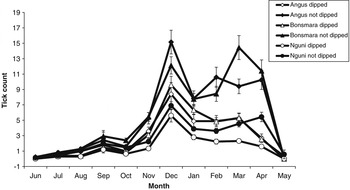
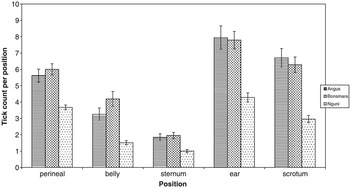
The most common tick species in this study were the Blue tick (Boophilus annulatus) and the Bont tick (Ambylomma hebraeum) with each representing 38% of the total ticks counted and identified. The other species found were the Red-legged and tick (Rhipicephalus evertsi evertsi) (19%) and the Bont-legged tick (Hyalomma spp.) (5%). There were isolated cases of the Brown ear tick (Rhipicephalus appendiculatus). Tick counts were significantly (P < 0.05) influenced by the breed, position of ticks on the steer and month. All the interactions among the main factors were significant (P < 0.05). There were more (P < 0.05) ticks during the warm wet months (November to March) than during the cool dry months (May to July) (Figure 1). As shown in Figure 1, the dipped Nguni steers had the lowest (P < 0.05) tick counts among the three breeds. The non-dipped Angus steers had the highest (P < 0.05) tick counts. Ears had the highest (P < 0.05) tick infestation, followed by the scrotum and the perineal (Figure 2). The belly and sternum had the lowest (P < 0.05) tick infestations.
Least square means ± s.e. of tick counts by month in dipped and non-dipped Nguni, Bonsmara and Angus steers.

Least square means ± s.e. tick counts by position of all Nguni, Bonsmara and Angus steers.

Live weights and growth of steers
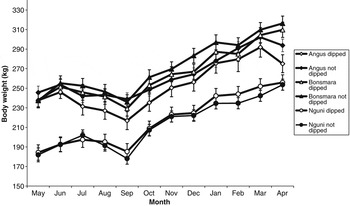
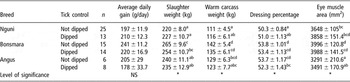
There were significant (P < 0.05) breed effects on live weight, with the Nguni being the lightest (P < 0.05) while the Bonsmara was the heaviest (Figure 3). There were no breed effects (P > 0.05) on ADG (Table 1). Within each breed, the dipped and non-dipped steers had similar (P > 0.05) live weights and ADG despite the non-dipped steers having significantly higher (P < 0.05) tick counts than the non-dipped steers.
Least square means ± s.e. of monthly weights of dipped and non-dipped Nguni, Bonsmara and Angus steers.

Least square means ± s.e. of daily gain and carcass characteristics of dipped and non-dipped Nguni, Bonsmara and Angus steersFootnote †

a,b,c,d Mean values in the same column with different superscripts are significantly different at *P < 0.05; NS = not significant.
† Average daily gain = growth rate from weaning to slaughter, slaughter weight = weight of steers 24 h before slaughter; warm carcass weight = weight of carcass within 20 min of slaughter; dressing percentage = proportion of warm carcass to live weight and expressed as a percentage.
Carcass characteristics of steers
Carcass characteristics of the three breeds are presented in Table 1. There were significant (P < 0.05) breed group effects on all carcass characteristics. The Bonsmara steers were the heaviest (P < 0.05) at slaughter, had the heaviest (P < 0.05) carcasses and had the highest (P < 0.05) dressing percentage while the Nguni steers were the lightest (P < 0.05). However, there were no significant (P > 0.05) differences in most slaughter and carcass characteristics between the dipped Nguni and the Angus steers, except that the non-dipped Nguni steers had lower (P < 0.05) warm carcass weight, dressing percentage and eye muscle area than the non-dipped Angus steers.
The carcass age and fat classes were not affected (P > 0.05) by breed. All the carcasses were generally lean. Eighty-one per cent of the carcasses were classified as A0 with the remaining carcasses being classified as A1. Table 2 shows that the Nguni had poorer (P < 0.05) carcass conformation as compared with the other two breeds with Bonsmara having the best confirmation.
Frequency of carcass conformation classes in Nguni, Bonsmara and Angus steersFootnote †
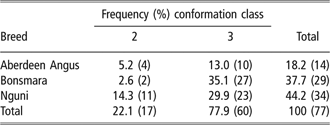
† Values in parentheses indicate the number of cases.
Discussion
The higher tick infestations in the warm wet season than in the dry cold season could be ascribed to the more conducive conditions for their breeding (Webb and David, Reference Webb and David2002). Our findings agree with Webb and David (Reference Webb and David2002), Schwalbach et al. (Reference Schwalbach, Greyling and David2003) and Wesonga et al. (Reference Wesonga, Orinda, Ngae and Grootenhuis2006), who observed seasonal fluctuations in tick burdens, with high tick counts being recorded during the rainy season. The presence of more ticks on the ear, the scrotum and the perineal area than on the belly and the sternum may be ascribed to the fact that ticks prefer warm and moist predilection sites that also provide protection from the environment and predation from birds. Our findings, however, are in contrast with Webb and David (Reference Webb and David2002) in the Tswana, Simmental and the Brahman, where higher tick counts were observed on the belly, the sternum and the perineal areas. These positions tend to have long hairs, suggesting sites with longer hair are prone to tick infestation.
The observation that Nguni steers harboured the fewest ticks suggests that the indigenous Nguni could be naturally less susceptible to ticks. This agrees with Spickett et al. (Reference Spickett, De Klerk, Enslin and Scholtz1989) and Scholtz et al. (Reference Scholtz, Spickett, Lombard and Enslin1991) who reported differences in tick resistance between Hereford, Bonsmara and Nguni cattle in feedlots, with the Nguni having the lowest tick counts. Some animals consistently carry fewer ticks than others kept in the same environment because of their abilities to respond immunologically to tick infestation (Mattioli et al., Reference Mattioli, Pandey, Murray and Fitzpatrick2000; Das et al., Reference Das, Ghosh and Ray2005; Jonsson, Reference Jonsson2006). The mechanisms involved in tick tolerance are, as yet, not clearly understood although there is clear evidence of adaptation (Spickett et al., Reference Spickett, De Klerk, Enslin and Scholtz1989). Meltzer (Reference Meltzer1996) argued that tick-avoidance behaviour, skin sensitivity and increased grooming activity by zebu, Sanga and Bos indicus breeds may account for the lower numbers of ticks when compared with tick numbers on exotic Bos taurus breeds. The higher tick counts on the non-dipped Nguni steers than on the dipped Nguni steers imply that dipping still has a role to play in tick control in communal areas.
The Nguni steers had the lightest carcasses while the Bonsmara were the heaviest at slaughter. Live weight is largely a result of size at maturity, biological type and growth rate (Hoving-Bolink et al., Reference Hoving-Bolink, Hanekamp and Wastra1999; Short et al., Reference Short, Grings, MacNeil, Heithschimdt, Williams and Bennett1999; Alberti et al., Reference Alberti, Ripolli, Goyache, Lahoz, Olleta, Panea and Sanudo2005). The Nguni, however, had similar ADG from weaning to slaughter as the other two breeds. This demonstrates the Nguni’s ability to perform well under natural pasture, particularly if the quality of grazing is not that good as is the case in the dry season in most parts of the rural areas of the Eastern Cape. Although tick infestation can lead to body weight losses (Byford et al., Reference Byford, Craig and Crosby1992; Meltzer, Reference Meltzer1996; Jonsson, Reference Jonsson2006) and can cause substantial economic losses on cattle production (Kivaria, Reference Kivaria2006), this was not the case in the current study as the non-dipped steers had similar live weights and ADG besides having higher tick counts than the dipped steers.
Weight losses of between 0.6 and 63 g per engorged female tick have been reported and acaricide-treated animals gain more weight than those left untreated (Mattioli et al., Reference Mattioli, Pandey, Murray and Fitzpatrick2000; Jonsson, Reference Jonsson2006). However, Norval et al. (Reference Norval, Sutherst, Kurki, Gibson and Kerr1988) reported no weight losses in Sanga cattle with tick infestation. The Nguni, with its tolerance of ticks, showed less difference in weaning weight between dipped and non-dipped cattle (Scholtz et al., Reference Scholtz, Spickett, Lombard and Enslin1991). Further studies to determine tick load threshold of economic importance (tick load level that results in economic losses, e.g. decreased live-weight or milk yield) per given breed is warranted.
Carcass weights followed a similar trend as slaughter weight. The Nguni had the lowest dressing percentage while the Bonsmara had the highest. This may be ascribed to the fact that the Nguni is a multi-purpose breed, which has not been solely developed for beef production. Dual-purpose breeds have been reported to have lower dressing percentage than pure beef breeds because coefficients of growth for non-carcass fat are higher than those for carcass fat (Kempster et al., Reference Kempster, Chawick and Charles1982; Keane et al., Reference Keane, More O’Ferrall, Conolly and Allen1990; King et al., Reference King, Morgan, Miller, Sanders, Lunt, Taylor, Gill and Savell2006). Purchas et al. (Reference Purchas, Banton and Hunt1992) found that carcasses from large-framed and late-maturing breeds have less fat, higher conformation scores, dressing percentage and proportion of first category cuts. The eye muscle area of the Nguni and the Bonsmara were similar and better than that of the Angus. However, eye muscle area tends to be higher in large-framed than in small-framed beef breeds (Keane et al., Reference Keane, More O’Ferrall, Conolly and Allen1990; Chambaz et al., Reference Chambaz, Scheeder, Kreuzer and Dufey2003). Tick control methods did not affect the carcass characteristics of the steers.
Although management measures to improve the natural pasture, such as rotational grazing, were undertaken in this study, deterioration of grazing lands in the dry season normally occurs. Furthermore, the fact that the steers had no supplementary lick could be one of the main reasons for the poor condition as they were in their prime growth phase. It may be argued that the natural pasture may not support the growth of young animals sufficiently to produce carcasses with fat cover. Dietary supplementation using organically or naturally produced material, such as hay from natural pastures or leguminous tree leaves, is recommended.
The poorer conformation for the Nguni carcasses than that of the other two breeds was expected since bigger breeds tend to have better carcass conformation than smaller breeds. Continental beef breeds are generally better conformed than traditional breeds (Purchas et al., Reference Purchas, Banton and Hunt1992; Alberti et al., Reference Alberti, Ripolli, Goyache, Lahoz, Olleta, Panea and Sanudo2005; Vieira et al., Reference Vieira, Cerdeño, Serrano, Lavín and mantecón2006). Continental beef breeds have been selected for meat production over a long period. Despite being an indicator of potential meat yield, carcass conformation is not critical in carcass classification in South Africa.
The overall results of this study can be used to formulate an organic meat production system using Nguni cattle. In this system, a herd of breeding cow and bulls that is dipped is kept. Their progeny that is finished off-grass is however not dipped.
Conclusions
Nguni steers were less susceptible to ticks than Bonsmara and Angus steers. While the non-dipped steers had more ticks than the dipped steers, non-dipping did not cause any differences in live weight and carcass characteristics of the steers. Under adverse conditions, which are common during the dry season in the rural areas of the Eastern Cape, the Nguni had similar weight gains to the large-framed beef breeds. Therefore, despite being a smaller and multi-purpose breed the Nguni can compete favourably with established breeds in terms of beef production. The Nguni, therefore, has a potential for organic beef production. However, there is need to also compare its meat quality characteristics against these large-farmed breeds under natural grazing.
Acknowledgements
This research was funded by the Kellogg Foundation under the Nguni Cattle Project. The steers were raised at the University of Fort Hare and slaughtered at the East London Abattoir. Eye muscle area measurements were carried out at the Agricultural Research Council (ARC), Irene, Pretoria.