The Basin of Mexico provides a rich archaeological setting for assessing social, political, and economic responses to state collapse. The temporal focus of this study spans the Epiclassic period (a.d. 650–850), which immediately follows the collapse of Teotihuacan, and the rise of the Early Postclassic period (a.d. 850–1150) states of Tula and Cholula in neighboring valleys. Teotihuacan maintained territorial control of the first extensive state in the basin until its political demise. Although the underlying Early Classic Teotihuacan state infrastructure no longer facilitated institutional interactions among basin sites (after a.d. 650), it is possible that informal relationships persisted into the Epiclassic period. The Epiclassic and Early Postclassic periods in central Mexico represent an extended era of political fragmentation and reorganization following the collapse of the Early Classic states. However, there has been debate and uncertainty on two important issues: the initial formation of Postclassic city-states in the Epiclassic period and the size and nature of the Toltec state expansion into the Basin of Mexico.
This study aligns with literature invoking processes of secondary state formation, and, as such, highlights the concept of “regeneration,” which is defined as “the reappearance of societal complexity (states, cities, etc.) after periods of decentralization, not the reappearance of specific complex societies” (Schwartz Reference Schwartz, Schwartz and Nichols2006:7). Recognizing the general regional cycling between political centralization and decentralization in archaeological studies (Blanton et al. Reference Blanton, Feinman, Kowalewski and Peregrine1996; Marcus Reference Marcus1992, Reference Marcus, Feinman and Marcus1998; Yoffee Reference Yoffee1979), there is further opportunity to identify the local impacts of shifting regional patterns of sociopolitical and economic organization in post-collapse periods. Processes employed in regeneration might emphasize the importance of trade, shifting interaction networks, social mobility, and participation in sociopolitical ideologies. Cerro Portezuelo, a small regional center in the Basin of Mexico, was impacted and reacted to shifting political, cultural, and economic interactions in the wake of the breakup of the Teotihuacan state.
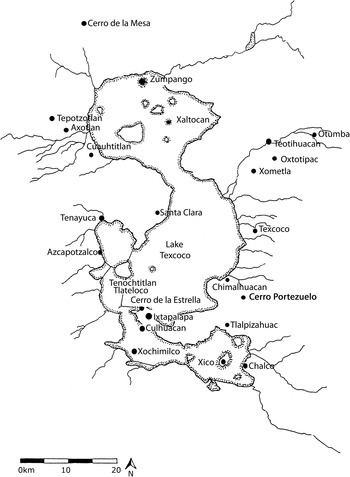
My analysis takes a diachronic view of Epiclassic and Early Postclassic production and consumption patterns of pottery complexes at Cerro Portezuelo (Figure 1). Stylistic analysis provides evidence for assessing the degree of local participation in regional cultural complexes. Form and decorative traditions communicate knowledge of, and membership in, broader shared traditions, perhaps reflecting a desire to express a shared sociopolitical identity among regional participants. Compositional analysis provides evidence for direct exchange of pottery products between neighboring regions. The combination of stylistic and compositional patterns can help differentiate shared identity, emulation, and direct trade. Similar techniques have been employed for the Basin of Mexico, which indicate that the extent of stylistic and compositional patterns are meaningful measures of social interaction (Hodge and Minc Reference Hodge and Minc1990; Nichols et al. Reference Nichols, Brumfiel, Neff, Hodge, Charlton and Glascock2002; see also Parkinson Reference Parkinson2005 for a nonstate example of boundary formations). I consider evidence from exchange and local production to reflect on alternative models of interaction between Cerro Portezuelo and neighboring areas within the Basin of Mexico. My approach provides consideration of interregional relations for peer polities (Hansen Reference Hansen and Hansen2000; Renfrew Reference Renfrew, Renfrew and Cherry1986) in some periods and ranging from small polities to large expansionist states in other periods (Stark Reference Stark and Isaac1990:Table 2).
Basin of Mexico site locations.

THE EPICLASSIC IN THE BASIN OF MEXICO
Following the collapse of the Teotihuacan state, the Basin of Mexico fragmented into a series of smaller political units, or city-states, each with a small regional center (Charlton and Nichols Reference Charlton, Nichols, Nichols and Charlton1997:190–194; García Chávez Reference García Chávez2004; Manzanilla Reference Manzanilla and Manzanilla2005; Nichols et al. Reference Nichols, Brumfiel, Neff, Hodge, Charlton and Glascock2002; Parsons Reference Parsons and Valverde2006; Rattray Reference Rattray, Mastache, Parsons, Santley and Puche1996). Due to the lack of historical records, specific boundaries for Epiclassic city-state polities are not easily identified from archaeological context alone (see Hodge Reference Hodge, Nichols and Charlton1997). Distinct Epiclassic settlement clusters in the Basin of Mexico suggest boundaries between city-state polities, some separated by several kilometers of unoccupied area (García Chávez Reference García Chávez2004:352–354; Rattray Reference Rattray, Mastache, Parsons, Santley and Puche1996; Sanders et al. Reference Sanders, Parsons and Santley1979:129–137). Cross-cultural comparison of city-state systems suggests that “Because of their proximity and economic interdependence, city-states also tended to be culturally interdependent and to share religious beliefs, artistic conventions, and symbolism, especially as these related to upper-class culture” (Trigger Reference Trigger2003:101). The Coyotlatelco Epiclassic ceramic complex is evidence of a shared material culture that was distributed throughout the Basin of Mexico and adjoining regions of Tula and Toluca (Crider et al. Reference Crider, Nichols, Neff and Glascock2007:127–129). The distribution of the Coyotlatelco pottery tradition indicates interaction among settlement clusters across the region, but regional variation in vessel form and artistic conventions suggest numerous locales of production.
Most agree that the decorative style of Coyotlatelco (i.e., the use of red painted geometric designs) originated northwest of the basin (Beekman and Christensen Reference Beekman and Christensen2003; Brambila Paz and Crespo Reference Brambila Paz, Crespo and Manzanilla2005; Braniff Cornejo Reference Braniff Cornejo and Manzanilla2005; Cobean Reference Cobean1990; Cowgill Reference Cowgill1996:329; Hirth Reference Hirth1998:459; Hirth and Cyphers Guillén Reference Hirth and Guillén1988:150; López Pérez and Nicolás Careta Reference López Pérez, Nicolás Careta and Manzanilla2005; Manzanilla Reference Manzanilla and Manzanilla2005; Manzanilla and López Reference Manzanilla and López1998; Manzanilla et al. Reference Manzanilla, López and Freter1996: Mastache and Cobean Reference Mastache, Cobean, Diehl and Berlo1989; Mastache et al. Reference Mastache, Cobean and Healan2002:70–71; Nelson and Crider Reference Nelson, Crider and Manzanilla2005; Paredes Gudiño Reference Paredes Gudiño1998, Reference Paredes Gudiño and Manzanilla2005; Rattray Reference Rattray, Mastache, Parsons, Santley and Puche1996, Reference Rattray1998). Some feel that the presence of Coyotlatelco decorated pottery signals the movement of northern migrants into the basin just preceding or following Teotihuacan's decline, marking an ethnic shift and displacement of local populations (García Chávez et al. Reference García Chávez, Cabezas, Saldaña, Segura and Valverde2006; Rattray Reference Rattray, Mastache, Parsons, Santley and Puche1996; see also Beekman and Christenson 2003:144–145). Others are hesitant to correlate the regional adoption of Coyotlatelco pottery with ethnic replacement by non-basin immigrants (Blanton et al. Reference Blanton, Kowalewski, Feinman and Finsten1993:137–138; Sanders Reference Sanders2002; Sanders et al. Reference Sanders, Parsons and Santley1979:129).
Ceramics alone will not resolve the debate regarding ethnic population replacement, but local variations in Coyotlatelco ceramics may provide clues about relations among the resulting Epiclassic polities. García Chávez (Reference García Chávez1991, 2004:351–354) defines distinct stylistic variants of Coyotlatelco that may represent political divisions in the basin: the Tula area, the Azcapotzalco area, Toluca, the Teotihuacan area that incorporates the northern Texcoco region, and the southeastern basin. The stylistic and compositional patterning observed by García Chávez (Reference García Chávez2004:353) indicates more intensive interactions among closely neighboring polities and assigns Cerro Portezuelo affiliations with the southern Basin. By comparing multiple lines of evidence, including other material classes, we may further elucidate regional connections (compare against Simon and Gosser Reference Simon, Gosser, Rice and LeBlanc2001). In the basin, the obsidian core-blade industry and exchange network was dramatically altered from the Classic to the Epiclassic (Carballo Reference Carballo2005; Charlton and Spence Reference Charlton, Spence, Weigand and Gwynne1983:66; Healan Reference Healan1997; Kabata Reference Kabata2009; Parry and Glascock Reference Parry and Glascock2013; Pastrana Reference Pastrana1998:240–254). Implications of changing procurement and production networks need further examination, but it is likely that the competitive political environment of the Coyotlatelco Epiclassic city-state system set the stage for later Postclassic city-state confederacies and alliances (Hirth Reference Hirth and Hirth2000:247).
Outside the basin, in other areas of central Mexico, Classic to Epiclassic political and economic configurations were also transforming. Cholula, located in the nearby state of Puebla, was an active Early Classic political capital for its region that might have undergone a hiatus after its Classic period state collapse; however, there is continued debate on the nature of the Classic to Postclassic transition at the center (Dumond and Müller Reference Dumond and Muller1972:1209; McCafferty Reference McCafferty2001; Plunket and Uruñuela Reference Plunket and Uruñuela2005:103). Other large centers in the central highlands emerged, such as Xochicalco (Cyphers Reference Cyphers and Hirth2000; Hirth and Cyphers Guillén Reference Hirth, Guillén, Sanders, Mastache and Cobean2003), Cantona (García Cook Reference García Cook, Sanders, Mastache and Cobean2003), Cacaxtla-Xochitecatl (Serra Puche and Lazcano Arce Reference Serra Puche, Arce, Mastache, Cobean, García Cook and Hirth2008; Serra Puche et al. Reference Serra Puche, Arce and Mendoza2004), and Tula Chico (Mastache and Cobean Reference Mastache, Cobean, Diehl and Berlo1989). Most of these centers have monumental architecture and civic-ceremonial core areas located on prominent hilltops, most having I-shaped ball courts, murals, and sculpture. With the exception of Tula Chico, Coyotlatelco pottery was not used in significant quantities at these large Epiclassic centers. Curiously, the Epiclassic regional centers of the Basin of Mexico never achieved the scale of monumental investment as other central highland centers. To date, in the Basin of Mexico Epiclassic, there is no evidence for ball courts, large sculpted temples, or large-scale investment in hilltop defensive locations with terrace residences. There is evidence for Epiclassic investment in civic-ceremonial structures like temples and large mounds among the basin's settlement clusters (Rattray Reference Rattray, Mastache, Parsons, Santley and Puche1996); however, these do not appear to be on the same scale of other highland centers. For instance, Cowgill estimates that Teotihuacan continued to maintain an Epiclassic occupation on the order of 10,000–20,000 (Crider et al. Reference Crider, Nichols, Neff and Glascock2007), although settlement was dispersed into several heavily concentrated areas throughout the Teotihuacan Mapping Project (TMP) survey area (Crider Reference Crider2002; Diehl Reference Diehl, Diehl and Berlo1989). Some small civic construction projects may have been realized (such as a small temple mound located at the TMP coordinate of 1:N4W3), but no significantly large monumental building occurred.
Compositional characterization of archaeological pottery from Teotihuacan supports the hypothesis that Epiclassic city-states, balkanized fragments of the Teotihuacan state, operated commercially through independent solar markets in which the production and distribution of each variant is restricted to the economic boundaries of each center (Crider Reference Crider2002; Crider et al. Reference Crider, Nichols, Neff and Glascock2007; Nichols et al. Reference Nichols, Brumfiel, Neff, Hodge, Charlton and Glascock2002). Because Teotihuacan was the capital and the center of that state's cataclysmic collapse, its residents may have been faced with unique challenges in reestablishing regional interactions, as compared to more distant Epiclassic city-states. For other parts of the basin, the loosening of the political bonds from the Teotihuacan state opened new opportunities for local choices of participation in local and regional networks of interaction. It is likely that the leaders of the basin were aware of the changing political and economic landscape beyond the Epiclassic Coyotlatelco city-states. However, it is unclear to what extent basin polities were directly interacting with the large Epiclassic centers elsewhere in the central highlands.
THE EARLY POSTCLASSIC IN THE BASIN OF MEXICO
After approximately 250 years of Epiclassic city-state configuration, two competing polities emerged on the periphery and expanded influence into the basin. These two Early Postclassic states, Tula to the northwest and Cholula to the southeast, may have vied for economic influence and allegiance from polities within the basin (Brumfiel Reference Brumfiel and Blanton2005a; Parsons Reference Parsons1971:250). Charlton and Nichols (Reference Charlton, Nichols, Nichols and Charlton1997:196) identify several demographic trends that indicate incorporation into the Tula state. The Early Postclassic population density is highest in the northern basin, the area closest to Tula (Parsons Reference Parsons2008). Those settlements tend toward more large nucleated communities, as compared to more hamlets and rural occupations in the southern basin. Within the basin, the large Epiclassic regional centers were dramatically reduced in size and were replaced by a series of smaller administrative centers. The thinly settled landscape between Epiclassic centers underwent a process of “ruralization” whereby small hamlets and farmsteads filled in many of the previously unoccupied lands (Sanders et al. Reference Sanders, Parsons and Santley1979:138).
The Coyotlatelco Red-on-Buff pottery tradition included the area from Tula into the basin, but in the Early Postclassic period this was replaced by Mazapan and Tollan pottery complexes. Just as the pottery styles and demographic shifts occured, sometime during the Terminal Corral phase (ca. a.d. 850–900), Tula underwent an urban transformation, shifting focus from the Tula Chico ceremonial complex to Tula Grande. The population covered an area in the urban center of almost 16 km2 that amounted to about 50,000 to 60,000 residents with another 60,000 in its immediate hinterland in the Mezquital Valley (Healan et al.Reference Healan, Cobean, Diehl and Healan1989:245; Mastache and Cobean Reference Mastache, Cobean, Mastache, Cobean, Cool and Hirth2003:217; Sanders et al. Reference Sanders, Parsons and Santley1979). Although Red-on-Buff pottery continued as an important serving and food preparation ware, the introduction of cream slip bowls marks a significant new pottery tradition of the Early Postclassic. Tula's urban zone was supported by workshop production of various craft goods, including pottery of many forms and styles (Hernandez et al. Reference Hernandez, Cobean, Mastache and Suárez1999; Mastache et al. Reference Mastache, Cobean and Healan2002:167).
Archaeological investigation of the southern basin indicates a cultural divide in the basin during the Early Postclassic (García Chávez Reference García Chávez2004; Hodge Reference Hodge2008; O'Neill Reference O'Neill1962; Sanders et al. Reference Sanders, Parsons and Santley1979). Aztec I Black-on-Orange pottery and the earliest of the Chalco-Cholula polychromes most commonly occurs within the southern basin in an area extending at least from Chalco to Culhuacan, with a single outlier at the northern island settlement at Xaltocan (Brumfiel Reference Brumfiel and Blanton2005a, Reference Brumfiel2005b; Parsons and Gorenflo Reference Parsons, Gorenflo, Martinez, Martos and Cobean2013). Cholula, to the southeast of the basin, reemerged as an important religious and political center by the Early Postclassic (McCafferty Reference McCafferty, Nicholson and Quiñones Keber1994). The political and economic extent of Cholula's political and economic influence into the basin is not well understood. However, there are strong stylistic affiliations between the southern basin's Early Postclassic pottery complex and pottery traditions of Puebla (discussed below and in Hodge Reference Hodge2008; Parsons et al. Reference Parsons, Brumfiel, Parsons and Wilson1982:Appendix 1).
Chemical characterization of Aztec I Black-on-Orange pottery established that there were multiple locales of manufacture in the basin, with differing distribution areas for specific stylistic variants of the ware (García Chávez Reference García Chávez2004; Hodge and Minc Reference Hodge and Minc1990; Minc et al. Reference Minc, Hodge, Blackman, Hodge and Smith1994; Brumfiel Reference Brumfiel2005b). Three distinct zones based upon Aztec I variants (Mixquic, Culhuacan, and Chalco) may represent neighboring city-states with small-scale market interaction (Minc et al. Reference Minc, Hodge, Blackman, Hodge and Smith1994). Most settlements containing sizable amounts of Aztec I Black-on-Orange pottery do not appear to have significant quantities of Tula-related pottery (Brumfiel Reference Brumfiel and Blanton2005a; Crider Reference Crider2011; Hodge Reference Hodge2008; Parsons and Gorenflo Reference Parsons, Gorenflo, Martinez, Martos and Cobean2013) and may suggest political and economic boundaries between northern and southern basin Early Postclassic polities.
Aztec I pottery has been traditionally grouped with Aztec II-type pottery under the umbrella term “Early Aztec” and conventionally correlated to the Middle Postclassic period (ca. a.d. 1150/1200–1350/1430). There appears to be growing evidence for significant chronological overlap between the Aztec I Chalco-Cholula and the Mazapan-Tollan complexes in the Early Postclassic period. Hodge (Reference Hodge, Nichols and Charlton1997:224) reports that radiocarbon dating places the Aztec I pottery complex at Mound 65 excavations of Chalco to start at a.d. 1100 (calibrated intercept), but at other sites, such as Ch-Az-195, the date is much earlier at a.d. 690 (calibrated intercept), and at a.d. 880 (calibrated intercept) for Xaltocan (Brumfiel Reference Brumfiel and Blanton2005a:75; Parsons et al. Reference Parsons, Brumfiel and Hodge1996:225). Portions of the Aztec I pottery tradition may persist in the southern basin well beyond the downfall of the Tula state. At this time, I advocate for the definition of separate pottery complexes, where possible, that are related to Aztec I (beginning within the Early Postclassic period and likely extending into the Middle Postclassic period) and Aztec II (correlating to the Middle Postclassic period) rather than the more general term Early Aztec (Garraty Reference Garraty2013).
CERRO PORTEZUELO
The Cerro Portezuelo settlement is located on the north flank of a series of east-west ridges near the southeastern shore of Lake Texcoco (Figure 1) (Hicks and Nicholson Reference Hicks and Nicholson1964; Nicholson and Hicks Reference Nicholson and Hicks1961). George Brainerd, of the University of California, Los Angeles (UCLA), completed two field seasons (1954–1955), excavated about 65 pits and trenches at the site (Branstetter-Hardesty Reference Branstetter-Hardesty1978:2), and collected nearly 500,000 ceramic sherds and 100 complete vessels. Henry B. Nicholson and Frederic Hicks continued the UCLA archaeological investigation into the 1960s. Parsons revisited the Cerro Portezuelo area during a regional survey (Parsons Reference Parsons1971:75) and mapped Epiclassic and Early Postclassic occupation mounds and concentrations, including and outside of the earlier UCLA study area.
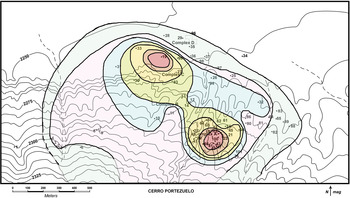
UCLA excavations and survey at Cerro Portezuelo identified an Early Classic temple platform. The center may have been operating as a Teotihuacan-controlled/influenced regional center (Clayton Reference Clayton2013; Hicks Reference Hicks2013). After a possible hiatus (Hicks Reference Hicks2013), the center grew to prominence in the Epiclassic period (Sanders et al. Reference Sanders, Parsons and Santley1979:131–132) as an autonomous regional center that covered 400 ha, with 22 pyramid mounds and an estimated population of 12,000 (Parsons Reference Parsons1971:71). The occupation of the center was the largest in Epiclassic times, as numerous test trenches throughout the Cerro Portezuelo settlement area contain Epiclassic materials (Figure 2). These excavations and test pits did not uncover any sizable area of Epiclassic residential architecture; however, fill from test trenches from throughout the study area indicate participation in the Coyotlatelco ceramic sphere. The densest concentrations of Epiclassic materials are located around Complex A, an area with several mounds in a central complex. Parsons (Reference Parsons1971:76) labels this cluster as Mounds 117, 118, 119, 126, and 128 for site TX-ET-18, and his maps include a wider area than that of the UCLA project area. A second concentration occurs nearby Complex C, in close proximity to Trench 93 where UCLA excavations uncovered several Epiclassic burial caches and whole vessels intrusive to the exterior wall of the Early Classic platform.
Intensity of Epiclassic period occupation in study area at Cerro Portezuelo. Sherds per cubic meter fill (from Hicks Reference Hicks2005:Figure 2-2). The darker, smaller circles represent higher concentrations.

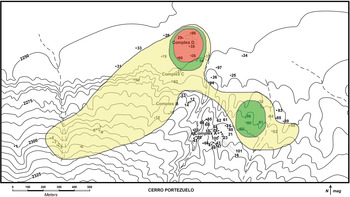
Subsequent Early Postclassic construction at Cerro Portezuelo occurs on the plain near the abandoned Epiclassic precinct and is identified as Complex D (Hicks Reference Hicks2013; Nicholson Reference Nicholson1962:16). A light spread of Early Postclassic materials occurs southwest and southeast of Complex D (Figure 3), but appears to be absent in Complex A, the area of highest Epiclassic concentrations in the UCLA study area. Excavations in Complex D include an extensive set of adjoining trenches numbered 35, 96, and 29 (Hicks Reference Hicks2013). The combined extent of excavation exposed an area of approximately 350 m2 and uncovered a small residential temple, numerous adobe walls, and a large number of Early Postclassic burial caches and whole vessels. Parsons (Reference Parsons1971:71) suggests that Early Postclassic pottery covered an area of about 125 ha. The site may have served as one of eight probable Early Postclassic regional centers in the Basin of Mexico (Parsons Reference Parsons1971; Sanders et al. Reference Sanders, Parsons and Santley1979:137–149). Although much reduced in population and area as compared to the Epiclassic settlement, Cerro Portezuelo continued to serve as an administrative center for the surrounding rural populations into the Postclassic period.
Intensity of Early Postclassic period occupation in the study area at Cerro Portezuelo. Sherds per cubic meter of fill (from Hicks Reference Hicks2005:Figure 2-3). The darker, smaller circles represent higher concentrations.

CERAMIC COMPLEXES BY TIME PERIOD
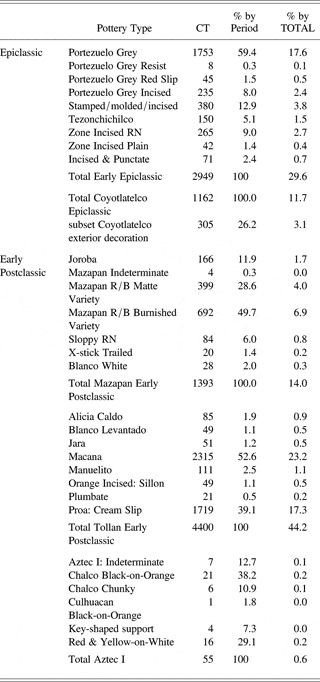
Archaeological studies have long recognized co-occurrences of certain ceramic decorated traditions that include a selection of named ceramic types. The co-occurrences of these categories are termed ceramic complexes and are used here to provide a framework for objective comparisons of ceramic assemblages among city-state and regional settlement clusters. The specific pottery complexes under consideration in this study span the Epiclassic to Early Postclassic periods. I provide a chronological sequence of pottery complexes that identify the most diagnostic decorated pottery types for each period and subphase. The Epiclassic is divided into the Early Epiclassic and Coyotlatelco Epiclassic. The Early Postclassic is divided into the Early Postclassic Mazapan, Early Postclassic Tollan, and Early Postclassic Aztec I Chalco-Cholula pottery complexes. These divisions allow me to explore the presence and distribution of specific pottery types grouped by relative chronological placement and allow for both synchronic and diachronic evaluation of the resulting patterns. In the following section, I describe each complex and its affiliated decorated pottery types. Table 1 provides the amounts of each pottery type analyzed for this study. An effort was made to identify complete counts of the types used in this study.
Amount of pottery types by complex, counts (CT) and percentages within periods

Early Epiclassic Complex
Based on the results of my analysis, I propose a distinction between an Early Epiclassic ceramic complex at Cerro Portezuelo that has a rough temporal correspondence with Sanders' (1986) Oxtoticpac phase at Teotihuacan and a later Coyotlatelco Epiclassic (what Sanders calls the Xometla phase at Teotihuacan). To date, this complex has only been identified from a limited number of excavations. Researchers have debated the validity of the Oxtoticpac subphase and its transitional pottery features (Rattray Reference Rattray, Mastache, Parsons, Santley and Puche1996:213; Sanders Reference Sanders and Sanders1986:367–375). It is likely that there is no single set of Early Epiclassic attributes that can be regionally defined; rather, site-specific traits might identify continuity or discontinuity from Early Classic to Epiclassic pottery complexes due to local variation. The Early Epiclassic at Cerro Portezuelo likely occurred after the collapse of the Teotihuacan state but prior to the widespread use of Coyotlatelco painted pottery at Cerro Portezuelo. Therefore, this pottery complex is particularly important to evaluate social interactions that were characterized by the immediate absence of Teotihuacan.
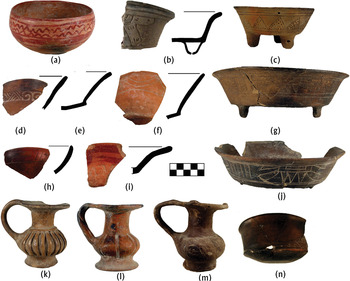
The following pottery types are derived from initial studies and definitions developed by Frederic Hicks (Reference Hicks2005). In some cases I have further refined and divided his original categories. The types discussed here include Portezuelo Grey, Tezonchichilco Stamped, Zone Incised, and Incised & Punctate (Figure 4).
Selected examples of Early Epiclassic pottery from Cerro Portezuelo: (a) Coyotlatelco Red-on-cream; (b–c) Heavy Line Incised & Punctate; (d) Portezuelo Grey Ware Stamped; (e and n) Composite Silhouette (Plain); (f) Portezuelo Grey Ware Incised; (g and j) Incised & Punctate Light Line; (h) Zone Incised RN; (i) Tezonchichilco RN Incised; (k–l) handled florero.
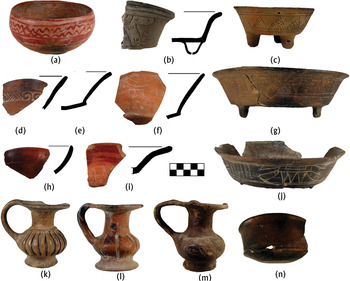
Portezuelo Grey is characterized by a fine brownish paste, thin walls, and is typically a composite silhouette vessel form with a basal ridge (Figure 4d–f, n). The Cerro Portezuelo vessels are similar in form and finish to those found in the Oxtoticpac Cave excavations in the Teotihuacan Valley (Sanders Reference Sanders and Sanders1986). These vessels are generally plain with an uneven surface burnish (Figure 4n), but a small portion are decorated by a repeating scallop pattern (Figure 4f) thinly incised on the vessel exterior, stamped-carved designs of scrolls and hatched triangles (Figure 4d), and, in rare instances, a thin red slip or resist design of large fuzzy edged circles (perhaps due to an organic residue resist technique). Portezuelo Grey comprises 59.4% of the Early Epiclassic complex pottery assessed in this study. Personal inspection of Sanders' Oxtoticpac collections in the Teotihuacan Valley indicates that the composite silhouette form there is virtually identical to that of Portezuelo Grey bowls in form, finish, paste, and size (Crider Reference Crider2011).
Zone Incised bowls have exterior incising in a horizontal band just below the rim. Designs are geometric patterns, often with zones of red paint (RN) outlined by incising (Figure 4h). Identical vessels with no paint (Plain) are also common. Bowls are most likely hemispherical in shape, although no clear base parts or whole vessels have been identified in this collection. Additional examples are illustrated in Hodge (Reference Hodge2008:390) and Séjourné (Reference Séjourné1983:Lámina IX). This type represents about 10% of the Early Epiclassic pottery complex considered here.
Tezonchichilco Stamped is light brown in color with a horizontal band of stamping on the exterior wall of the vessel (Figure 4i). The flared rim is often decorated with zone incising of red painted geometric patterns, located just above the zone of stamping. These flat-based vessels have squared hollow tripod supports. The stamped designs include serpent heads, one of the few naturalistic motifs in the Epiclassic decorative canon. Although no whole vessels have been recovered from Cerro Portezuelo, similar vessels are illustrated elsewhere (Hodge Reference Hodge2008:392; Parsons et al. Reference Parsons, Brumfiel, Parsons and Wilson1982:426; Pérez Negrete Reference Pérez Negrete2004:51; Séjourné Reference Séjourné1983:Lámina III, Figure 40).
Incised & Punctate vessels have exterior incised decoration characterized by alternating zones of punctation. Examples have been illustrated elsewhere (Pérez Negrete Reference Pérez Negrete2004:51; Séjourné Reference Séjourné1983:Figure 38). For Cerro Portezuelo, I define two primary variants of this style, the Heavy Line (Figures 4b and 4c) and Light Line (Figures 4g and 4j) versions based upon the depth and quality of the incision. Vessel forms vary and include outcurving bowls with nubbin supports (strongly associated with Light Line), straight walled flat bottom bowls (strongly associated with Heavy Line), and ring-base floreros with handles (Figures 4k and 4l). There is a great amount of stylistic variety in this group, and the type is well represented in the Trench 93 burial caches. Incised & Punctate and Tezonchichiclo vessels have been suggested as temporally “Classic-Epiclassic Transitional” at the nearby site of Cerro de la Estrella (Pérez Negrete Reference Pérez Negrete2004:51).
The Early Epiclassic pottery complex, as defined here, finds its strongest similarity with other southern basin pottery, notably at Cerro de la Estrella, Chalco, Xico, and the greater Chalco and Ixtapalapa Regional Survey areas (Crider Reference Crider2011). Stylistically, Cerro Portezuelo is consistent with a southern basin culture zone (García Chávez et al. Reference García Chávez, Cabezas, Saldaña, Segura and Valverde2006). This suggests that a southern basin network of interaction emerged in this area very early in the Epiclassic period.
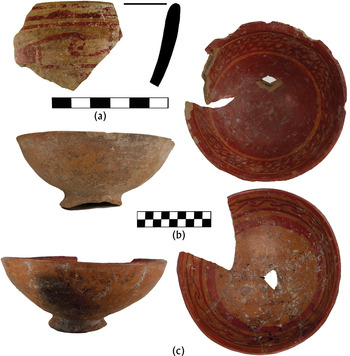
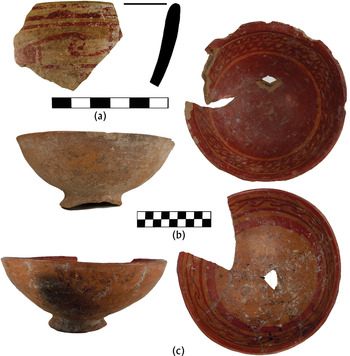
Distributions within Cerro Portezuelo indicate a strong relationship between Coyotlatelco and Early Epiclassic complex patterns. Trenches containing Epiclassic materials are likely to have both complexes present. Stratigraphic divisions between the Early Epiclassic and Coyotlatelco materials are not discernible due to mixing throughout most excavation trenches. One notable exception is the Trench 93 excavations of the Early Classic platform temple, which uncovered a significant Epiclassic intrusion of a cemetery containing primary and secondary burials of approximately 14 or 15 individual caches. These deposits contain whole vessels of Portezuelo Grey, Incised & Punctate, and handled floreros, typical of the Early Epiclassic pottery complex with limited associations with later Coyotlatelco pottery. Also present in these caches are matte sahumadores with black and red paint. Burial 93-10 includes a Red-on-Cream hemispherical bowl provisionally classified as a proto-Coyotlatelco style (Figure 4a). Its decoration is unusually crude in design for typical Coyotlatelco Epiclassic pottery; the thin white slip covers a wide band below the exterior rim and is overlaid by a pair of undulating parallel lines. Only one Coyotlatelco Painted whole vessel (Figure 5c) occurs in the Trench 93 caches, and it is found overturned on a cremation above and separate from the burial containing floreros and Incised & Punctate vessels. Again, this red painted ring base bowl is characteristic of Coyotlatelco, but it is a simply decorated vessel. This cremation cache could be intrusive into this earlier cemetery.
Selected examples of Epiclassic Coyotlatelco pottery from Cerro Portezuelo: (a) Coyotlatelco Red-on-Cream, exterior decoration, and (b–c) Coyotlatelco Red-on-Natural ring-base bowl.
These trends suggest two possibilities: (1) Early Epiclassic and Coyotlatelco decorated ceramics are temporally sequential, suggesting continuity in occupation throughout the Epiclassic, or (2) Early Epiclassic and Coyotlatelco decorated ceramics are temporally coeval, supported by the general co-occurrence of types within excavation units, which represents a more generalized Epiclassic occupation.
Coyotlatelco Epiclassic Complex
The term Coyotlatelco is somewhat problematic, as it is used variably to describe (1) a particular cultural complex predominant in the Basin of Mexico (Crider et al. Reference Crider, Nichols, Neff and Glascock2007; García Chávez Reference García Chávez2004; Rattray Reference Rattray1966, Reference Rattray, Mastache, Parsons, Santley and Puche1996), Tula (Cobean Reference Cobean1990; Cobean and Mastache Reference Cobean, Mastache and Healan1989), and the Valley of Toluca (Sugiura Reference Sugiura1990, Reference Sugiura and Manzanilla2005) during the Epiclassic period that includes a distinct set of relatively consistent architectural, lithic, and ceramic assemblages; (2) a particular archaeological phase in the Teotihuacan Valley; and, (3) a variety of specific decorated pottery type (or set of types)—Coyotlatelco Red-on-Buff, Coyotlatelco Red-on-Cream, and Coyotlatelco Red-on-Natural. Only the Coyotlatelco painted pottery is considered here. It includes hemispherical bowls with a ring base, solid tripod supports, or no supports (Figure 5). There are also a smaller number of slightly restricted incurving rim bowls, or straight wall cups. Decorative motifs include repeated geometric design elements contained in a horizontal band below the rim on either the interior or exterior of the rim, depending on vessel form. Well over 1,100 sherds of Coyotlatelco occur in the Cerro Portezuelo collections. Attribute level analyses indicate that both Red-on-Natural and Red-on-Cream variants occur in significant quantities. Cream slip variants tend to be decorated on the exterior of the vessel with an incurved vessel rim.
As discussed earlier, a cursory look across all of the trenches indicates that most excavation trenches contain both Early Epiclassic and Coyotlatelco decorated ceramics. Excavation of trenches generally was conducted in 30 cm levels, and there appears to be significant mixing of cultural complexes.
Other Epiclassic Pottery
There is additional Epiclassic period pottery that is not yet determined to be specific to either the Early Epiclassic or Coyotlatelco Epiclassic pottery complexes, including Xolhuango Plain, which occurs in various forms like sahumador censers, jars, ladles, and amphoras; Thin and Thick Matte Appliqué tri-prong censers; and other stamped and painted types not previously discussed. There is evidence that sahumador censers begin at least by the Early Epiclassic period due to their presence in the Trench 93 burials associated with Early Epiclassic complex whole vessels, but this vessel form persists throughout the Epiclassic period. There may be temporal distinctions between early and later comal, olla, and censer forms, but these are not yet firmly ascribed to either the early or latter Epiclassic subphase at Cerro Portezuelo (compare against Bennyhoff Reference Bennyhoff1967; Cobean Reference Cobean1990; Gamboa Cabezas Reference Gamboa Cabezas1998; Hicks Reference Hicks2005; Manzanilla and López Reference Manzanilla and López1998; Nicolás Careta Reference Nicolás Careta2003; Rattray Reference Rattray1966; Sanders Reference Sanders and Sanders1986; Tozzer Reference Tozzer1921).
Early Postclassic Mazapan Complex
The term Mazapan is used variably to describe: (1) a cultural complex predominant in the Basin of Mexico immediately following the Coyotlatelco complex (Linné 1934; López Pérez Reference López Pérez2003; Vaillant Reference Vaillant1932, Reference Vaillant1938), which includes consistent use of a specific pottery complex particularly common in the eastern Basin of Mexico; (2) an archaeological phase at Teotihuacan around a.d. 850–1000/1050 (Cowgill Reference Cowgill1996:327, Reference Cowgill, Adams and MacLeod2000:295–296, Reference Cowgill and Linné2003:xvi; Manzanilla et al. Reference Manzanilla, López and Freter1996); and, (3) a red painted decorated pottery called “Mazapan,” which can include various red-on-natural types (for example, Mazapan Wavy Line, Sloppy/Toltec, and Wideband) found throughout the basin (Branstetter-Hardesty Reference Branstetter-Hardesty1978; Elson and Mowbray Reference Elson and Mowbray2005; Hicks Reference Hicks2005; Linné 1934; Parsons Reference Parsons1971; Sanders Reference Sanders and Sanders1986).
Comparison of Cerro Portezuelo's Early Postclassic Mazapan ceramic complex shows a great stylistic similarity with northern basin areas, especially Teotihuacan (Crider et al. Reference Crider, Nichols, Neff and Glascock2007; Elson and Mowbray Reference Elson and Mowbray2005; Linné 1934; López Pérez Reference López Pérez2003; López Pérez and Nicolás Careta Reference López Pérez, Nicolás Careta and Manzanilla2005; Nicolás Careta Reference Nicolás Careta2003; Sanders Reference Sanders and Sanders1986), Zumpango (Parsons Reference Parsons2008), and Tula (Acosta Reference Acosta1945, Reference Acosta1956–1957; Bey Reference Bey1986, Reference Bey, Pool and Bey2007; Cobean Reference Cobean1978, Reference Cobean1990; Mastache et al. Reference Mastache, Cobean and Healan2002). The Mazapan pottery complex ceramics, specifically Wavy Line, Sloppy Red-on-Natural, and Joroba cream slip vessels are all present at Teotihuacan, Tula, and Cerro Portezuelo, although proportions may differ from region to region depending upon the type (Crider Reference Crider2011). This group corresponds with the Mazapan archaeological phase defined at Teotihuacan (Sanders Reference Sanders and Sanders1986) and the Terminal Corral and/or Early Tollan phases at Tula (Bey and Ringle Reference Bey, Ringle, Kowalski and Kristan-Graham2007; Cobean Reference Cobean1978, Reference Cobean1990). Temporally, this complex occurs after the Coyotlatelco Epiclassic and prior to the Early Postclassic Tollan.
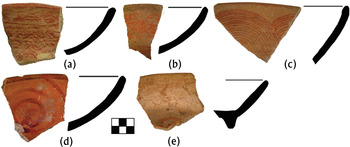
Joroba Cream slip bowls (Cobean Reference Cobean1978, Reference Cobean1990), also called Toltec Orange-on-White (Hicks Reference Hicks2005), are typically flat bottom cajete bowls (straight out-flared wall), often with nubbin supports. Vessels are decorated with a base coat of cream slip with red painted wide line geometric designs (Figure 6e). Joroba Cream slip vessels are popular at Cerro Portezuelo and also occur in burial and cremation contexts in Complex D excavations. The most common decorative motifs include four or five parallel lines in a panel set extending either vertically from the rim or horizontally in short bands repeated in multiple zones on the vessel interior, large “S” scrolls either singly in the interior base or in multiples on the interior side walls, and/or other scroll variants. The most significant technological characteristic of the Cerro Portezuelo Joroba vessels, as compared to those of Tula, is the nature of the base cream slip. Cerro Portezuelo vessels are inconsistent in the quality, texture, and color of the cream slip. In many occurrences, the slip is sparse and at times so thin as to be barely visible. These inconsistencies suggest small scale production, perhaps at the household level, that did not maintain standard levels of slip production (Crider Reference Crider2010). Joroba Cream slipped vessels occur as only 2% of the overall Early Postclassic collection, but 12% within the Mazapan pottery (Table 1).
Selected examples of Mazapan Early Postclassic pottery from Cerro Portezuelo: (a) Wavy Line Burnished Variant, (b–c) Wavy Line Matte Variant, (d) Sloppy RN, (e) Joroba Cream Slip.

Wavy Line Red-on-Natural (RN) is usually a large open bowl painted on the interior with a multi-prong brush that created patterned lines (Figure 6a–c). Rarely, Wavy Line RN can occur as an incurving bowl with exterior painted decoration. Hicks (Reference Hicks2005) defined two variants of the Wavy Line type: Matte (Figures 6b and 6c) and Burnished (Figure 6a). There are notable technological differences between these two variants in surface treatment and application of decorative motif. The Wavy Line RN Matte variety has a nonglossy surface with a distinctive multi-prong brush used to paint on the designs. The motif and layout are varied and include crossed panels, waves, repeating scallops, and numerous others. The Wavy Line RN Burnished variety has a glossy and streaky burnish surface treatment more similar to Coyotlatelco surface quality than to the Matte variant. In addition, the single motif of horizontal parallel wavy lines is painted by a single brush with wider line width than the Matte variety. Mazapan Wavy Line decorated pottery was once postulated to have its origin in the Basin of Mexico (Cobean Reference Cobean1978, Reference Cobean1990) due to its limited occurrence outside the basin. However, Wavy Line RN is far more common in Tula than once believed (Bey Reference Bey1986) and may have antecedents northwest of that area (Braniff Reference Braniff Cornejo1999), although the duration of its use may have varied in different parts of central Mexico (Parsons et al. Reference Parsons, Brumfiel and Hodge1996).
Sloppy Red-on-Natural (RN), also called Toltec RN, are large open bowls similar in form to Wavy Line RN but decorated with sloppily executed painted spiral motifs with a high burnish that causes streaks in the paint (Figure 6d). Sloppy RN vessels do not occur in any of the Complex D burials but are present in the general excavation fill. The Sloppy RN type is rare at Cerro Portezuelo, especially when compared to the Teotihuacan Valley (Elson and Mowbray Reference Elson and Mowbray2005; Nicolás Careta Reference Nicolás Careta2003; Sanders Reference Sanders and Sanders1986).
X-stick Trailed (Hicks Reference Hicks2005) is an unpainted flat bottom, brown paste bowl with pattern polish design in the interior base that is similar to a Wavy Line motif. Very few of these vessels are recorded for Cerro Portezuelo, and the type is not reported in the general literature as an abundant type in other areas of the basin. It is believed to co-occur with Wavy Line vessels due to the similarity of motif and paste characteristics (Hicks Reference Hicks2005).
Early Postclassic Tollan Complex
A shift in ceramic complexes occurs toward the latter part of the Early Postclassic period, called either Atlatongo Phase at Teotihuacan (Sanders Reference Sanders and Sanders1986) or Tollan Phase at Tula (Cobean Reference Cobean1978, Reference Cobean1990; Mastache et al. Reference Mastache, Cobean and Healan2002). The Tollan pottery complex includes a number of diagnostic types.
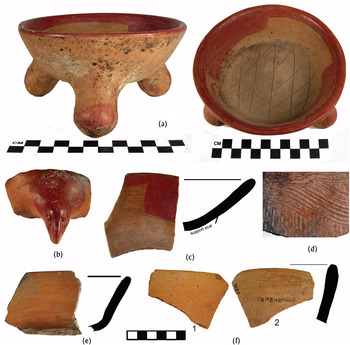
Macana Red-on-Natural (RN) (Cobean Reference Cobean1978, Reference Cobean1990) is alternatively described as Tula RN (Hicks Reference Hicks2005) or Wideband RN (Sanders Reference Sanders and Sanders1986). Macana is distinctive in form as a tripod molcajete (Figures 7a–c). There is also an unpainted version of this vessel type called Manuelito Brown (Cobean Reference Cobean1978, Reference Cobean1990). This tripod form always has large hollow supports occurring in a range of bulbous shapes that usually taper to a point. Especially popular at Cerro Portezuelo is a molded raptor bird head support. The surface is painted red and polished on those areas that are painted. The interior base has a matte finish and often has shallow incised diamond cross-hatching (Figure 7a) or punctates and provides a gentle grater surface. Macana RN in all its varieties is the most prominent decorative type in the Early Postclassic at Cerro Portezuelo, representing almost 52.6% of the Tollan Early Postclassic decorated ceramics. Macana RN is here considered part of the later Tollan pottery complex, but it may have origins in the earlier Mazapan complex. Further attribute analysis may support a stylistic separation of an earlier and later variant (Hicks Reference Hicks2005).
Selected examples of Early Postclassic pottery from Cerro Portezuelo: (a–c) Macana RN molcajete, (d) close-up of Blanco Levantado brush pattern, (e) Jara Pulido, (f1) Cream Slip of local production, interior of vessel, (f2) Cream Slip of local production, exterior of vessel.
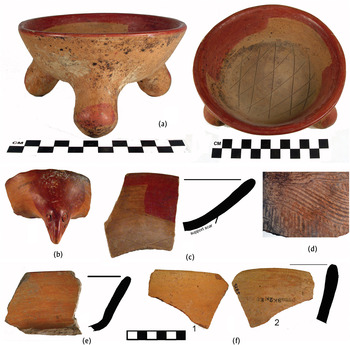
A suite of Cream Slip types continues from the earlier Joroba tradition. Most cream slipped vessels at Cerro Portezuelo are similar to each other in form and occur in various sizes, often with tripod nubbin supports. Cream slipped bowls at Cerro Portezuelo contain mainly sherds with a pure cream pigment slip like that of Proa Cream Slip of Tula. Proa is a solid cream base slip with a red painted rim band (Cobean Reference Cobean1978, Reference Cobean1990), without the painted spirals and scrolls of Joroba. In the Cerro Portezuelo analysis, the local variant of Proa has a more fugitive nature to the thin cream slip (Figure 7f), which is different in quality from the highly polished thick white slip used at Tula. The Cerro Portezuelo cream slip pottery can at times take on a pinkish tint due to the higher concentration of iron in the slip as compared to Tula Proa Cream Slip (Crider Reference Crider2010). Because Joroba type vessels could easily be misclassified as Proa Cream Slip if painted design were absent on an individual sherd, it is possible that Proa Cream Slip numbers are somewhat elevated in this accounting. Future analysis may indicate other distinguishing attributes between the two cream slip types. Nevertheless, this type has a high occurrence in the collection, at 39.1% of the Tollan Early Postclassic decorated pottery (Table 1).
Both Macana RN and cream slip types are also present at Teotihuacan to the north, Tlalpizahuac (Tovalin Ahumada 1998) to the south, and inspection of the Chalco Survey materials shows that both types are represented throughout the Chalco Survey area—even in small amounts in the Yautepec Survey area of Morelos (Smith Reference Smith2006; Smith and Montiel Reference Smith and Montiel2001).
Jara Pulido (Cobean Reference Cobean1978, Reference Cobean1990) is a cream slipped bowl that has been painted with an orange overslip and red rim (Figure 7e). This surface is then polished to make the colors more vibrant. The orange paint brush marks are often still visible despite the subsequent surface treatment. This accounts for the provisional name of “Orange Brushed” often applied to the type (Hicks Reference Hicks2005). A related type, Ira Stamped, is similar to Jara Pulido but with a raised molded design on the exterior of the vessel. Jara Pulido is a very popular and prominent pottery type (along with Ira Stamped) at Tula in the Late Tollan phase (Mastache et al. Reference Mastache, Cobean and Healan2002:224–225). A surprising result of the ceramic analysis shows that Cerro Portezuelo was using very small amounts of Jara Pulido cream slip vessels, 1.2% of the Tollan Early Postclassic decorated pottery (Table 1). The limited occurrence of this cream slip variant at Cerro Portezuelo suggests that the type never reached the level of popularity in the basin that it did in Tula.
Other types appearing in the Tollan pottery complex, but in less frequency at Cerro Portezuelo, include Blanco Levantado amphoras, on which a cream slip is applied and then removed with a multi-prong brush or comb, creating a hatched or lattice design (Figure 7d), and Orange Slipped (also called Sillón in the Tula sequence) and various red slipped vessels, likely related to Tula's Rebato type. Additionally, there are a number of foreign imports or imitations of foreign wares, specifically Plumbate and Imitation Huastec Orange. These represent only a small proportion of the Early Postclassic assemblage, and these foreign goods may have been acquired via Tula's long-distance trade networks. The placement of these types in the Tollan versus the Mazapan pottery complex is tentative and may occur earlier at the site.
The Early Postclassic Aztec I Chalco-Cholula Complex
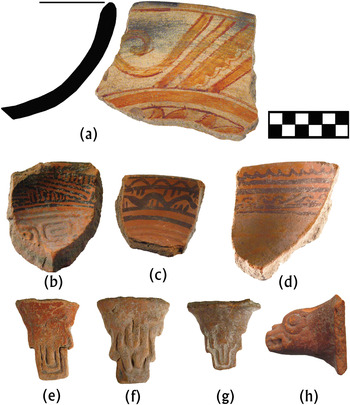
This complex is defined for the Basin of Mexico by the presence of Aztec I Black-on-Orange (B/O) and/or early variants of the Chalco-Cholula Polychromes used in the Early Postclassic period (Figure 8). Aztec I B/O is predominant in the southern basin (Minc et al. Reference Minc, Hodge, Blackman, Hodge and Smith1994; O'Neill Reference O'Neill1962) and at Xaltocan (Brumfiel Reference Brumfiel2005b; Hodge and Neff Reference Hodge, Neff and Brumfiel2005), and in trace amounts in other parts of the basin. There are three distinct stylistic variants—Chalco, Mixquic, and Culhuacan (Hodge Reference Hodge2008; Hodge and Minc Reference Hodge and Minc1991; Minc et al. Reference Minc, Hodge, Blackman, Hodge and Smith1994)—and a strong pattern of locally focused exchange systems in the Early Postclassic period (Minc et al. Reference Minc, Hodge, Blackman, Hodge and Smith1994). This ceramic type has some affiliations with pottery from Cholula (McCafferty Reference McCafferty2001:57; Noguera Reference Noguera1954:282). The materials most likely corresponding with the Early Aztec Chalco-Cholula pottery complex comprise only 3% of the Early Postclassic assemblage at Cerro Portezuelo. These include Chalco varieties of Aztec I Black-on-Orange and stepped vessel supports related to Mixquic varieties of Aztec I (Figure 8). No Chalco-Cholula Polychromes for the Early Postclassic period have been identified, although the somewhat related Black-Red-Yellow may be considered here. Further definition of nondecorated and utilitarian vessel forms for this complex (as differentiated from those of the Tollan complex) is needed to better identify the presence of the southern basin domestic traditions at Cerro Portezuelo.
Selected examples of Early Postclassic Aztec I and Chalco-Cholula pottery from Cerro Portezuelo: (a) Polychrome, (b–d) Aztec I Black-on-Orange, Chalco Variant, (e–g) Aztec I, Mixquic Variant stepped supports, (h) turkey head support.

COMPOSITIONAL CHARACTERIZATION
To examine changing interactions at Cerro Portezuelo in the Epiclassic and Early Postclassic periods, specimens representing major and minor diagnostic types were submitted for instrumental neutron activation analysis (INAA) to the Missouri University Research Reactor (MURR). Standard methods for deriving chemical data (see Glascock Reference Glascock and Neff1992; Neff Reference Neff, Ciliberto and Spoto2000) and Neff's statistical assessment for assigning compositional groups are discussed by Nichols et al. (Reference Nichols, Neff and Cowgill2013). It is important to note that the geologic environment of the basin presents significant challenges to provenance research. While there clearly are systematic changes in composition from one location to another, these tend to be gradual rather than abrupt, thus creating a large number of specimens that show resemblances to more than one compositional group. Despite these challenges, research over the past two decades (Branstetter-Hardesty Reference Branstetter-Hardesty1978; Brumfiel and Hodge Reference Brumfiel, Hodge, Mastache, Parsons, Santley and Puche1996; Crider et al. Reference Crider, Nichols, Neff and Glascock2007; García Chávez Reference García Chávez2004; Garraty Reference Garraty2006; Hodge and Neff Reference Hodge, Neff and Brumfiel2005; Hodge et al. Reference Hodge, Neff, Blackman, Minc and Neff1992, Reference Hodge, Neff, Blackman and Minc1993; Ma Reference Ma2003; Minc Reference Minc2006; Minc et al. Reference Minc, Hodge, Blackman, Hodge and Smith1994; Neff and Glascock Reference Neff and Glascock1998, Reference Neff and Glascock2000; Nichols et al. Reference Nichols, Brumfiel, Neff, Hodge, Charlton and Glascock2002; Nichols and Charlton Reference Nichols and Charlton2002) has consistently found that chemically coherent groups show strong associations with consumption locations and with decorative characteristics. Hector Neff performed quantitative analyses for all the Cerro Portezuelo specimens submitted to MURR for INAA analysis, and the resulting compositional groups are on file with MURR (Neff Reference Neff2009). These data include the reassessment of samples discussed by Nichols et al. (Reference Nichols, Brumfiel, Neff, Hodge, Charlton and Glascock2002). The current assessment assumes that locally produced pottery at Cerro Portezuelo is subsumed within the Chalco source group, as might be expected from the site's location so far south in the central portion of the eastern basin. Interestingly, the Texcoco source group is not well represented in the Cerro Portezuelo materials until the Middle Postclassic period at the earliest (Garraty Reference Garraty2013). The following discussion summarizes the resulting trends for the Epiclassic and Early Postclassic ceramic samples by period and pottery complex.
Epiclassic
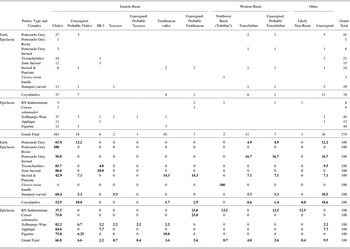
From among the various types including some not discussed above, 274 Epiclassic specimens were selected for INAA (summary results are provided in Table 2). Specimens were selected to represent the common types and forms present at the site, including decorated serving vessels and other utilitarian forms. The resulting analysis indicates that the majority occurs in the Chalco compositional group, indicating a southeastern basin source area that likely includes Cerro Portezuelo local production.
Epiclassic ceramics by INAA composition group; counts and percentages within type

The Early Epiclassic types (Portezuelo Grey, Tezonchichilco, Zone Incised, Incised & Punctate) are all well represented in the Chalco source group. Production of these types is largely confined to the southeastern basin and perhaps was mostly local. A small amount of Tezonchichilco and Zone Incised specimens are included in the SB-3 source group, which is highest in transition metals and may represent an extreme “southerly” group (Neff Reference Neff2009:3). Thus, Cerro Portezuelo's interactions might have extended further south than Chalco, into the Amecameca region. Interestingly, these same two types do not have any western basin source assignments, which, although the sample size is small, suggests that Tezonchichilco and Zone Incised production may be a specialty of the southeastern basin. Testing of Ixtapalapa peninsula samples are needed to explore this hypothesis.
Portezuelo Grey and Incised & Punctate both have specimens assigned to the western Basin Tenochtitlan compositional group. The spatial extent of the Tenochtitlan compositional group here is generally representative of Azcapotzalco, Tenayuca, and Tenochtitlan. Because Tenochtitlan and Azcapotzalco sites do not have concentrations of these pottery types (compare against García Chávez Reference García Chávez1991, 2004), I propose that the likely area of production for these wares is located around the center of Cerro de la Estrella, located on the western edge of the Ixtapalapa peninsula. If this hypothesis is correct, it suggests some interaction between these important Epiclassic centers in the southern basin.
Incised & Punctate is the only Early Epiclassic type occurring in the Teotihuacan Valley compositional group. Two specimens are small jar or florero body sherds that are very similar in paste and surface decoration. The other two specimens are different in color and decorative quality. This result is surprising given that Incised & Punctate is not known to be a common type in the Teotihuacan area. These results indicate multiple production zones of Incised & Punctate pottery in the eastern and western portions of the basin as evidenced by considerable variation in vessel form, surface treatments, and decoration. The limited percentage of the type at Cerro Portezuelo and elsewhere, combined with the widely varying range of forms and decorative qualities, suggests that the type may be limited to occasional production, perhaps for special use in gifting or burial ceremonies.
Coyotlatelco is the most sampled of the Epiclassic period specimens. Of the 70 Coyotlatelco painted specimens (Table 2), the highest proportion is assigned to the southeastern Chalco source group (63%), with smaller amounts assigned to Tenochtitlan (10%) and Teotihuacan Valley (9%) compositional groups. Samples ranged in vessel form (incurving and hemispherical bowls, cups) and placement of decoration (interior, exterior, cream slip).
Five Tenochtitlan assigned specimens are exterior decorated bowls with a distinct horizontal design panel located just below the red rim band (specimens AZC 446, AZC 454, AZC 455, AZC 457, AZC 458). The panel forms a repeating scallop motif (Figure 5a); however, the scallops are formed by the empty space between the red paint. Several of these specimens also have a white underslip to the red painted design. Below the scallop panel are typical Coyotlatelco motifs, such as repeating “S” scrolls, horizontal banding, and other geometric designs. Only two other Coyotlatelco specimens sampled for INAA (AZC 456 and AZC 459, both classified in the Chalco compositional group) have a similar design feature. These two are notably different in the size and shape of the peak and do not have the white underslip of the Tenochtitlan group specimens. Five of the six vessels confidently placed in the Tenochtitlan compositional group have this design characteristic while only two of the remaining 70 Coyotlatelco specimens repeat this design. This may be a stylistic marker of western basin exterior decorated Coyotlatelco bowls that is copied or emulated only occasionally in Cerro Portezuelo. Coyotlatelco pottery is very common in the Azcapotzalco and Tenayuca area (García Chávez Reference García Chávez1991; Rattray Reference Rattray1966; Tozzer Reference Tozzer1921), and it may be a production area contributing to the Tenochtitlan compositional group for this part of the Epiclassic complex (see also Ma Reference Ma2003).
Four of the Teotihuacan Valley-assigned specimens are typical of form and motif common to Teotihuacan (Crider Reference Crider2002). Included is a hemispherical bowl with ring base, two additional interior painted rim sherds, and one exterior decorated bowl rim. The motif on each is simplistic with alternating horizontal bands of straight parallel lines and wavy lines or “S” scrolls. The remaining two specimens (one interior and one exterior decorated) are consistent in form and finish with Teotihuacan Coyotlatelco but appear to have somewhat more complex designs. The remaining Coyotlatelco specimens are unassigned at this time.
Previous INAA of Epiclassic pottery from Chalco, the Teotihuacan Valley, and Cerro Portezuelo found that most were locally produced with limited exchange between production zones in the basin (Nichols et al. Reference Nichols, Brumfiel, Neff, Hodge, Charlton and Glascock2002; Crider et al. Reference Crider, Nichols, Neff and Glascock2007; Hodge Reference Hodge2008). For this project we have been able to do INAA on a much larger sample of Epiclassic ceramics than in previous studies. As we suspected, of the 274 Epiclassic specimens in this study, at least 73% were grouped with the southeast basin/Chalco group. The larger sample revealed minor imports from the Texcoco, Teotihuacan, Tenochtitlan/western basin, and the extreme southern area. As it had in the Early Classic, Cerro Portezuelo continued to obtain imports of pottery from the western basin and Teotihuacan Valley, but the percentages declined significantly in the Epiclassic period. The proportion of pottery from the local production zone at Cerro Portezuelo was higher in the Epiclassic than in the Early Classic or at any time in the Postclassic period. At this time, Cerro Portezuelo's most intense economic and political interactions were with the southeast Basin, possibly representing a city-state confederation. Perhaps hostilities between competing city-states curtailed more intensive exchange of pottery among central Mexican Epiclassic polities.
Early Postclassic
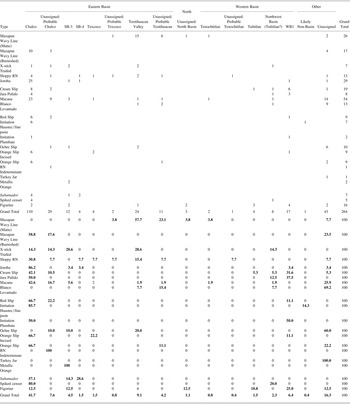
INAA was done on 264 specimens of Early Postclassic ceramics from among the various types (summary results presented in Table 3). Specimens were selected to represent common pottery types and forms from the site. The majority occur in the Chalco compositional group, indicating a southeastern basin source area and likely including Cerro Portezuelo local production. Further discussion is focused upon the decorated pottery types discussed above.
Early Postclassic ceramic types by composition group

The Early Postclassic Mazapan complex types (Mazapan Wavy Line, Joroba Cream, Sloppy RN, and X-stick Trailed) are all well represented in the Chalco source group. Perhaps the most striking pattern is within the Mazapan Wavy Line type. The two variants, Matte and Burnished, have differing compositional groups, indicating specialized production areas of the type. The Wavy Line Matte has 85% of specimens assigned to the northeast basin, mainly to the Teotihuacan Valley. None of the Matte variant is assigned to the southeastern basin compositional groups. Conversely, the Wavy Line Burnished variant is predominantly assigned to the Chalco compositional group (77% of the type variant). The Matte variety represents the largest import to Cerro Portezuelo in the Early Postclassic period. Considering that the Matte variety makes up 36% of the total Mazapan Wavy Line type at Cerro Portezuelo, this indicates significant access to Teotihuacan-produced pottery. As discussed above, the Mazapan Wavy Line Burnished variant differs from its Matte counterpart in several important ways. Based upon the compositional data, the Burnished variant is likely locally produced or produced nearby. The burnished finish that smears the red painted design is similar in quality and finish to Coyotlatelco pottery and may indicate continuity in Epiclassic technique by local potters. The Mazapan Wavy Line Burnished motif is not implemented with the multi-prong paint brush that is standard for the Matte variant designs. The design motifs are typically horizontal parallel wavy lines, possibly an emulation of the Wavy Line Matte aesthetic.
Joroba Cream is the second most common type for the Early Postclassic Mazapan pottery complex. Only four of the 29 specimens are not from the Chalco compositional group. One of each is from the southern groups of SB-3, SB-4. One is assigned to the western basin. This indicates that Cerro Portezuelo may be predominantly supplied by local or nearby sources within the southeastern basin for Joroba Cream pottery.
Sloppy RN and X-stick Trailed, the least common of the decorated pottery for the Mazapan complex at Cerro Portezuelo, both have multiple source assignments. These are largely affiliated with eastern basin compositional groups. The variety of compositional groups for these types is unexpected given the low amounts found in the Cerro Portezuelo collections.
The Early Postclassic Tollan pottery complex maintains a strong proportion of specimens assigned to the Chalco compositional group across four prominent types (Macana RN, Proa or Cream Slip, Red Slip, and Jara Pulido). However, a significant increase in assignments to western and northwestern basin compositional groups occurs in this complex. The highest occurrence is in the Proa Cream Slip and the Jara Pulido types. The Cream Slip vessels are a very common type at Cerro Portezuelo, about 17% of the Early Postclassic Tollan decorated wares. The significantly high amount of western and northwestern basin proportions is artificially inflated due to sample selection. In an effort to sample vessels representing different thickness and quality of slip finish, I selected those vessels with thin and poorly finished slips and those of thick and highly burnished slips (representing a higher quality surface finish). The higher quality, thick-slipped Cream Slip is not common at Cerro Portezuelo. Those vessels typically more poorly finished and with thinner slips are assigned to the Chalco compositional group, and those of finer finish are of the western and northwestern basin groups. Those non-Chalco Cream Slip specimens are more similar in form and finish to vessels in the Tula region than to the southeastern basin products. At the time of this analysis, a Tula compositional source group had not been well defined, and it is possible that these are Tula-produced vessels. In a sample of ceramics from sites in the eastern and northern Basin selected by Raúl García Chávez, Macana Red-on-Brown and Polished Orange jars, types diagnostic of the Tollan phase when Tula was at its height, were placed in a Tollan group. García Chávez (Reference García Chávez2004:364) suggested that they were made in the Tula area: “En este caso implicaría un fuerte control de la producción de esta mercancia.” In a separate study I support the proposition that the western and northwestern Basin groups are in part representative of a formal Tula compositional group (Crider Reference Crider2011). The high proportion of non-Chalco assignment for Jara Pulido is significant due to the low overall amounts of the type at Cerro Portezuelo.
Macana RN assigned to Chalco is 59% of the type sample, and specimens include a range of design motifs, support shapes, and negative resist combinations. The surface finish tends to be highly burnished and glossy over the red painted areas of the designs. Another 6% are assigned to the SB-3 group, which tends to be less finely finished and has a full red panel on the interior wall of the vessels. Only five specimens are assigned to other basin compositional groups, but these represent eastern, northern, and western basin sources. Both western basin-assigned specimens are negative resist variants of the type. The eastern basin-assigned specimens (Teotihuacan and Texcoco) are typical of the “Wideband” design motif common to the northeastern basin.
Blanco Levantado poses a challenge for compositional assignment. Of the 13 specimens, 69% are unassigned. Only three probably fit into the Teotihuacan compositional group. There are no assignments to the Chalco group. The type, typically of amphora form, is a common product in the region around Tula and perhaps used in the storage and serving of water or pulque (Bey Reference Bey, Pool and Bey2007). The compositional data suggest that Blanco Levantado was not locally produced. The contents of the jars may have been the primary objective of the importation of the vessels, although the unique decorative traditional of the type may have been significant as well. The distinctive crossed-lattice motif of the design and the collared rim is easily recognized from a slight distance and could signify special status goods.
These stylistic and compositional results indicate that there were multiple production zones in the basin for Early Postclassic pottery. Almost half (49%) of the overall Early Postclassic pottery sampled for compositional analysis is assigned to the Chalco (and probable Chalco) compositional group. It is possible that many of these vessels were produced nearby, since ethnographic studies indicate that distribution zones tend to move no more than 8–12 km from the location of production (Minc Reference Minc2006). The styles and pottery types are strongly affiliated to northern basin and Tula pottery complexes. Cerro Portezuelo imported decorated vessels from the Teotihuacan Valley in the earlier Mazapan phase, including Mazapan Wavy Line Matte, Sloppy RN, X-stick Trailed, and Blanco Levantado pottery. Sanders (Reference Sanders and Sanders1986:525) proposed that the entire Teotihuacan Valley was part of a small state centered at Teotihuacan that Tula incorporated into its sphere. Perhaps this accounts for the early appeal of Teotihuacan goods. By the later part of the Early Postclassic, there is an increase in access to north and northwestern basin pottery, an area strongly connected to the city of Tula. There is a corresponding decline in access and importation of Tenochtitlan-Tenayuca area products. This continuing decline that began in the Epiclassic period may indicate political and economic independence from Azcapotzalco by the Early Postclassic period.
Aztec I
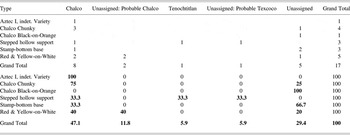
INAA was done on 17 specimens of Aztec I style pottery (summary results presented in Table 4). The Aztec I Black-on-Orange specimens are Chalco style. There are three stepped-shaped hollow vessel supports that are associated with the Mixquic Aztec I pottery complex that is associated most commonly with the island of Xico (Minc et al. Reference Minc, Hodge, Blackman, Hodge and Smith1994). These specimens occur across three different compositional groups and are the only sample outside the Chalco compositional group. Hicks (Reference Hicks2005) identified a polychrome that he provisionally named Red &Yellow-on-White. I have tentatively placed these polychrome vessels in the Aztec I/Chalco-Cholula complex due to the use of cream base slip and fine line design work. The majority occurs in the Chalco compositional group (59%), indicating a southeastern basin source area and likely from the area around the shores of Lake Chalco. Only a limited amount of this pottery complex is identified at Cerro Portezuelo. The Early Postclassic period marks a break in the strong affiliation of the site to the cultural complexes of the southern Basin of Mexico.
Early Postclassic Aztec by composition group

CONCLUSIONS AND DIRECTIONS FOR FUTURE RESEARCH
This study provides an opportunity to evaluate the interactions of Cerro Portezuelo within a regional context. The scale and direction of economic and social interactions shifted following the collapse of the Teotihuacan state and again with the expansion of influence from the Tula state. Yet through the Epiclassic and Early Postclassic periods, Cerro Portezuelo persisted as an important political and economic center in the southeastern basin.
Hansen (Reference Hansen and Hansen2000:16) notes that in periods of decline, “an urbanized macro-state disintegrates in such a way that each of its major urban centres becomes a city-state.” In this case, the basin fragmented into at least four or five smaller and independent city-states following the collapse of the Teotihuacan state (García Chávez et al. Reference García Chávez, Cabezas, Saldaña, Segura and Valverde2006; Parsons Reference Parsons and Valverde2006; Rattray Reference Rattray, Mastache, Parsons, Santley and Puche1996). Cerro Portezuelo, perhaps after a brief hiatus due to Teotihuacan withdrawal, emerges in the Epiclassic period to become one of the basin's largest regional centers. Very early in the Epiclassic period, the people of Cerro Portezuelo used a pottery complex that shared stylistic traits with other southern basin centers such as Xico, Chalco, and Cerro de la Estrella. A small contingent of people in the Teotihuacan Valley also used some pottery types reflective of this southern basin cultural complex, specifically the composite silhouette bowls at Oxtoticpac. Chemical characterization of Early Epiclassic pottery types suggests that only a small amount was arriving in Cerro Portezuelo from western basin sources and even fewer from Teotihuacan Valley sources. The Chalco composition group accounts for the majority of pottery from this complex. The spatial extent of the Chalco group is not clear, but it likely includes southern Texcoco, including Cerro Portezuelo, the sites of Chalco and Xico, and the areas around the shores of Lake Chalco in the southeastern Basin. It is possible that the Cerro Portezuelo pottery was produced in numerous locations within this area, suggesting an interaction zone throughout the area. Further exploration of the geological variation of the zone and compositional trends provide further subdivisions within this compositional group (see Crider Reference Crider2011).
Nevertheless, Cerro Portezuelo interactions based upon stylistic and compositional evidence indicate that the strongest relationships are with the nearest neighbors to the west toward Cerro de la Estrella and to the south toward Xico and Chalco. Trigger (Reference Trigger2003:101) states that adjacent city-states were largely self-sufficient in food production and looked to neighboring centers for access to luxury goods and prestige items. He goes on to say that “[t]he closer city-states were to each other and the smaller they were, the more readily regional economies emerged.” This may describe the relationship between the southern basin polities and the emergent Early Epiclassic pottery complex. As the largest center in the southern basin following the breakup of Teotihuacan, Cerro Portezuelo forged its strongest relations with other small polities in neighboring areas to the west and the south. Teotihuacan was more distant and perhaps still unstable from the collapsing city economy. The southern basin sites could have become dependent upon one another for economic and political security very early in the Epiclassic period. The emergent material culture of specialized pottery forms and styles may have reinforced social relations between centers.
García Chávez et al. (Reference García Chávez, Cabezas, Saldaña, Segura and Valverde2006) suggest that peoples from the southern basin, perhaps Cerro Portezuelo, moved to the Teotihuacan Valley and used Oxtoticpac Cave and nearby settlements. It is curious that not all of the southern basin Early Epiclassic pottery types are present in the Teotihuacan Valley sites. Portezuelo Grey Ware composite silhouette bowls are likely utilitarian vessels used for daily cooking and serving. Based upon their decorative motifs and lower frequency of use, the other Early Epiclassic decorated pottery types defined here may be related to elite or ceremonial use. If the Oxtoticpac peoples moved from the southern basin, it is possible that the differences in pottery use is reflective of relative status of the people and differing site functions of the two settlements.
The distribution of Early Epiclassic and Coyotlatelco Epiclassic ceramic types throughout the test trenches at Cerro Portezuelo indicates that decorated ceramics of the Epiclassic period were accessible to residents across the area, and it also supports continuity of occupation from the Early to the later subphases of the Epiclassic. Additional archaeological investigation is needed, however, to confirm the relative temporal ordering of the Cerro Portezuelo Early Epiclassic and the latter Coyotlatelco Epiclassic pottery complexes. Nevertheless, Coyotlatelco style pottery at Cerro Portezuelo indicates participation in the basin-wide Coyotlatelco city-state system. Coyotlatelco pottery at Cerro Portezuelo continues to be produced in the southeastern basin. Small amounts are assigned to western basin (Cerro de la Estrella and Azcapotzalco are likely producers) and Teotihuacan Valley compositional groups. This evidence supports earlier propositions that Epiclassic interactions most strongly occur between nearest neighbors.
The temporal and cultural transition from the Epiclassic to Early Postclassic is a poorly evaluated phenomenon. For this study, the Mazapan pottery complex at Cerro Portezuelo marks the shift from close stylistic affiliation with the southern basin to the northern basin. The Mazapan Wavy Line Burnished variety shares some important production characteristics with Coyotlatelco pottery, including paint color, single-brush painting of decoration, and sloppily burnished surface finish that smears a still-wet paint. However, the decorative motif is consistently a multiple-line horizontal panel on the interior of the vessel. This motif is more similar to the popular Mazapan Wavy Line Matte variety to the north in Teotihuacan and Tula. Teotihuacan-produced vessels of this type are present in large amounts at Cerro Portezuelo, indicating some market access to these goods. However, the methods of production, including the multi-prong brush and matte smoothing of the vessel surface, are not widely adopted by local potters. I suspect that the Burnished variant is a case of local emulation of the northern potting tradition. It may be that the local potters were not trained and apprenticed into the specialized tools and techniques used to make the Matte variety of Wavy Line pottery. These potters may have persisted in using techniques typical of Coyotlatelco pottery into the Early Postclassic period for some time.
Throughout the Early Postclassic period, however, Cerro Portezuelo acquires many more pottery types typical of Teotihuacan and Tula complexes. Cream Slipped vessels in all their varieties are made in the southeastern basin, likely in or near Cerro Portezuelo. Southern basin produced cream vessels are similar in form and decoration to their Tula equivalents; however, the quality of cream slip and surface polish is much reduced. Chemical characterization confirms a northwestern basin source area for the higher quality cream slip vessels at Cerro Portezuelo, perhaps reflecting access to Tula-produced goods. And although the quantities are not great, the west and northwest Basin compositional groups are represented in the Cerro Portezuelo interactions for the first time in the latter part of the Early Postclassic period as part of the Tollan pottery complex. Corresponding to the increase in interactions to the north, access to other southern and western basin compositional groups drops dramatically, suggesting a significant change in the direction and intensity of Cerro Portezuelo interactions.
Macana RN vessels, popular throughout the Early Postclassic period, are of excellent quality and comparable in form, finish, and design to Teotihuacan and Tula versions. Interestingly, Cerro Portezuelo vessels have a much higher amount of bird head effigy supports within this type as compared to elsewhere. This reflects a local preference in design and perhaps a marker of southeastern basin production. It appears that the potters of Cerro Portezuelo became fully versed in the tools and techniques of Tula and Teotihuacan. Additional evidence suggests that Cerro Portezuelo served as an administrative center for parts of the southern basin at this time. This is supported by excavation of a small temple and burial goods of Tula style and perhaps origin, such as Plumbate vessels and Mazapan-style “cookie cutter” figurines. The low amount of northwestern basin imports to Cerro Portezuelo indicates that the center was not fully integrated into a regional market system. However, even the limited access to nonlocal goods suggests some important interactions within the regional political system. The high quality of many of the nonlocal goods suggests that these may be gift exchanges occurring among the elite residents of Cerro Portezuelo.
The emphasis on locally produced pottery at Cerro Portezuelo that was emulative of a distant large center suggests indirect administration (see Stark Reference Stark and Isaac1990:Table 2) on the part of Tula and/or the neighboring Teotihuacan Valley. Cerro Portezuelo continued its access to pottery from other southern basin producers (and extreme southern areas extending toward Morelos) in the Early Postclassic period. Excavations at nearby Tlalpizahuac, to the south of Cerro Portezuelo, and on the Chalco lake shores indicate a similar affiliation to a Mazapan/Tollan Early Postclassic complex (Tovalín Ahumada Reference Tovalín Ahumada1998, Tovalín Ahumada et al. Reference Tovalín Ahumada, Jacinto, Vázquez, Ríos, Wachtel and Hernández1992). Tlalpizahuac may have been established near the southernmost boundary of Tula's influence in the southeastern basin.
Further temporal definition is needed in the Early Postclassic period to clarify the nature of Jara Pulido distribution in the basin. This cream slip ware becomes one of the most popular types at Tula during the city's height in the Tollan phase. But at Cerro Portezuelo and the southern basin, use of this type is significantly limited. It is not clear if there is a comparable drop in the entire suite of Late Tollan phase pottery types typical of Tula or if this is a unique pattern for just this type. But the implications for such a dramatic reduction in access and local production of Tula style wares are tantalizing. Did Tula's influence on the material culture begin to wane in the southern Basin well before the final collapse of the Toltec state? A similar pattern is notable in the final years of the Early Classic Teotihuacan state. Metepec phase diagnostic pottery is notably absent at Cerro Portezuelo and in much reduced amounts at other prominent centers in the basin (García Chávez et al. Reference García Chávez, Cabezas, Saldaña, Segura and Valverde2006; Hicks Reference Hicks2005; Rattray Reference Rattray, Mastache, Parsons, Santley and Puche1996). The drop in Jara Pulido may indicate a similar phenomenon of Tula withdrawal in the further reaches of the basin prior to the close of the Early Postclassic period.
The southern basin cultural complex related to Aztec I and Chalco-Cholula pottery emerges in the latter part of the Early Postclassic. The small amounts of Aztec I and Chalco-Cholula-related pottery at Cerro Portezuelo indicates that the site was peripheral to the core development of this complex in the southern basin and Xaltocan. Conversely, the Aztec I centers of Culhuacan, Chalco, and Xaltocan (among many) did not use and acquire Mazapan- and Tollan-related pottery to any large degree. This southern block of Early Postclassic Aztec I pottery users may have formed an economic and political wedge between the eastern and western Basin in such a way as to limit the interactions between the Tula-associated sites of Azcapotzalco and Cerro Portezuelo, as indicated by the limited exchange of pottery in the Early Postclassic period. Perhaps Cerro Portezuelo began to lose its economic and political edge in southern basin interactions as new alliances were configured that could secure better access to routes extending into Morelos and Puebla. Did Tula respond so as to limit its support of its distant administrative center bordering these emergent city-states of the southern basin in the latter part of the Early Postclassic?
Following the collapse of the Tula state, the political and military volatility of the subsequent Middle Postclassic period ended Cerro Portezuelo's position as a city-state center (Nichols et al. Reference Nichols, Neff and Cowgill2013). Perhaps this was connected with Tula's decline as suggested by ethnohistoric sources and/or the growing importance of lakeshore trade and lacustrine resources that gave Chimalhuacan an advantage. The current study provides baseline regional comparison as a foundation for future studies into these sites.
RESUMEN
Este análisis se enfoca en los cambios diacrónicos en los patrones de producción y consumo en Cerro Portezuelo desde el punto de vista de la cerámica de los periodos epiclásico (hacia 650–850 d.C.) y posclásico temprano (hacia 850–1150 d.C.). Los resultados de los estudios de carácter estilístico y químico indican un cambio dramático en la influencia de diversos grupos en el intercambio de bienes cerámicos en la Cuenca de México durante estos periodos. La característica química fue identificada a través del análisis instrumental de activación de neutrones en el reactor investigativo de la Universidad de Missouri (MURR, por sus siglas en inglés) y los grupos composicionales fueron determinados por Hector Neff (Nichols et al. Reference Nichols, Neff and Cowgill2013). Se identificaron dos complejos cerámicos distintos durante el epiclásico, designados como el epiclásico temprano y el epiclásico Coyotlatelco. Al principio del periodo epiclásico, los habitantes de Cerro Portezuelo intercambiaron bienes cerámicos con sitios en la parte sur de la Cuenca de México, como se indica la presencia de cerámica de los tipos Portezuelo gris, Tezonchichilco, Inciso en zonas e Inciso y Puntiforme. Los habitantes también importaron vasijas de áreas vecinas durante esta fase. Posteriormente, la gente de Cerro Portezuelo intercambió cerámica Coyotlatelco, un estilo que se encuentra en varias partes de la región. Los componentes característicos indican que las vasijas Coyotlatelco decoradas con pintura roja fueron producidas y utilizadas localmente, aunque también se recuperaron cantidades pequeñas de cerámica importada de Teotihuacan y de sitios ubicados en el occidente de la Cuenca de México. Durante el periodo posclásico temprano, los habitantes de Cerro Portezuelo utilizaron cerámica Mazapa y Tollan, un estilo característico durante este periodo de sitios del norte de la Cuenca de México, tales como Tula y Teotihuacan. Al principio del periodo posclásico temprano, los habitantes de Cerro Portezuelo importaron una variante mate de la cerámica Mazapa de líneas onduladas del valle de Teotihuacan y, además, produjeron una versión local conocida como la variante bruñido de la cerámica Mazapa de líneas onduladas. Posteriormente para la fase Tollan, la gente de Cerro Portezuelo produjo grandes cantidades de cerámica con engobe color crema (cerámica Proa) y cerámica Macana. Durante esta fase se importó muy poca cerámica de otras áreas. Es posible que Cerro Portezuelo fuera un pequeño centro administrativo del estado de Tula durante el periodo posclásico temprano donde la gente utilizó cerámica del estilo de la capital, pero hizo la mayoría de la cerámica localmente. Hay algunas indicaciones del uso de cerámica Azteca I en Cerro Portezuelo, el cual sugiere que el centro estaba involucrado, aunque de forma menor, en los desarrollos importantes en Culhucan, Xaltocan y Chalco-Xico al fin del periodo posclásico temprano. En este estudio se utilizan los tipos de cerámica decorada para identificar afiliaciones estilísticas entre Cerro Portezuelo y sitios en otras partes de la cuenca. Además, este estudio aumenta de forma significativa la muestra de datos sobre las características de la cerámica de los periodos epiclásico y posclásico temprano en Cerro Portezuelo. La identificación de distintos complejos cerámicos en Cerro Portezuelo indica que durante el periodo epiclásico los habitantes de este centro intercambiaron bienes cerámicos con otros sitios de la parte sur de la Cuenca de México mientras disminuía la influencia de Teotihuacan. La transición al uso de cerámica en el estilo de Tula en la parte norte de la Cuenca de México indica que Cerro Portezuelo dejó de ser un centro regional durante el epiclásico para convertirse en un centro administrativo del estado de Tula durante el periodo posclásico temprano.
ACKNOWLEDGMENTS
This material is based upon work supported by the National Science Foundation under Grant numbers 0514187 (Dartmouth College), 0513979 (Arizona State University), and 0504015 (Missouri University Research Reactor). Additional support has been provided by the Claire Garber Goodman Fund, Dartmouth College, Rockefeller Center Urban Studies Grant, the School of Human Evolution and Social Change at Dartmouth College, Arizona State University, and the Archaeological Research Institute at Arizona State University. I gratefully acknowledge the assistance of the Fowler Museum at UCLA for use of the Cerro Portezuelo collection. I am indebted to several readers for comments on the text, including Ron Bishop, Robert H. Cobean, Deborah L Nichols, George L Cowgill, Arleyn W. Simon, Alanna Ossa, J. Heath Anderson, and an anonymous reviewer. Many ASU student assistants have provided data collection and inventory assistance. I especially thank Laura Burghardt, Kallista Bernal, Tony Magana, and Benjamin Muth.