Introduction
Heteronybelinia Palm, Reference Palm1999 is one of the most diverse genera in the Tentaculariidae, represented by 14 valid species (Palm, Reference Palm2004; Pereira & Boeger, Reference Pereira and Boeger2005). Palm (Reference Palm1999) erected Heteronybelinia for species with homeoacanthous, heteromorphous, metabasal, tentacular armature with or without characteristic basal armature and heteromorphous hooks (Palm, Reference Palm1999, Reference Palm2004). At that time, Palm transferred to the genus 14 species that were originally described in Nybelinia Poche, 1926 (namely, N. alloiotica Dollfus, Reference Dollfus1960; N. cadenati Dollfus, Reference Dollfus1960; N. elongata Shah & Bilqees, Reference Shah and Bilqees1979; N. estigmena Dollfus, Reference Dollfus1960; N. eureia Dollfus, Reference Dollfus1960; N. karachii Khurshid & Bilqees, 1988; N. nipponica Yamaguti, Reference Yamaguti1952; N. palliata [Linton, Reference Linton1924]; N. perideraeus [Shipley & Hornell, Reference Shipley and Hornell1906]; N. punctatissima Dollfus, Reference Dollfus1960; N. robusta [Linton, Reference Linton1890]; N. rougetcampanae Dollfus, Reference Dollfus1960; N. senegalensis Dollfus, Reference Dollfus1960; and N. yamagutii Dollfus, Reference Dollfus1960), and described H. heteromorphi Palm, Reference Palm1999, and H. minima Palm, Reference Palm1999. Six of the 14 species originally included by Palm (Reference Palm1999) in Heteronybelinia have subsequently been synonymized with other species, four with H. estigmena (i.e. H. alloiotica, H. cadenati, H. punctatissima and H. senegalensis), one with H. nipponica (i.e. H. rougetcampanae), and one with Parotobothrium balli (Southwell, 1929) (i.e. H. karachii) (see Palm, Reference Palm2004). Four species of Heteronybelinia have since been described (namely, H. australis Palm & Beveridge, Reference Palm and Beveridge2002; H. pseudorobusta Palm & Beveridge, Reference Palm and Beveridge2002; H. overstreeti Palm, Reference Palm2004; and H. annakohnae Pereira & Boeger, Reference Pereira and Boeger2005).
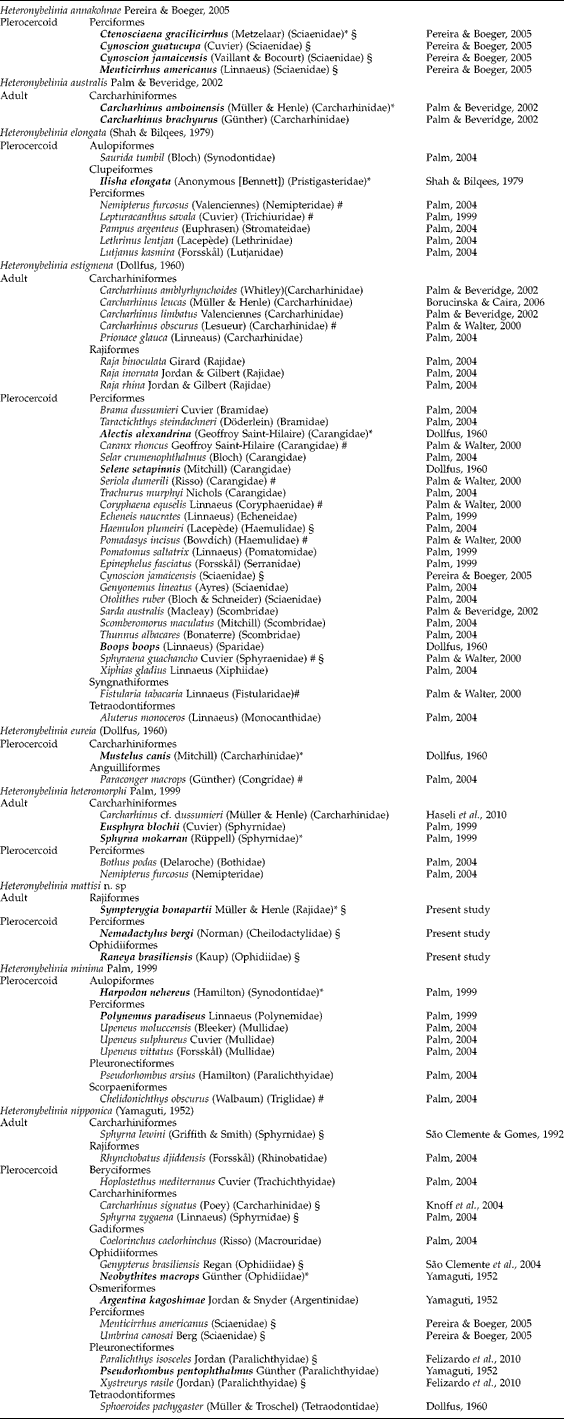
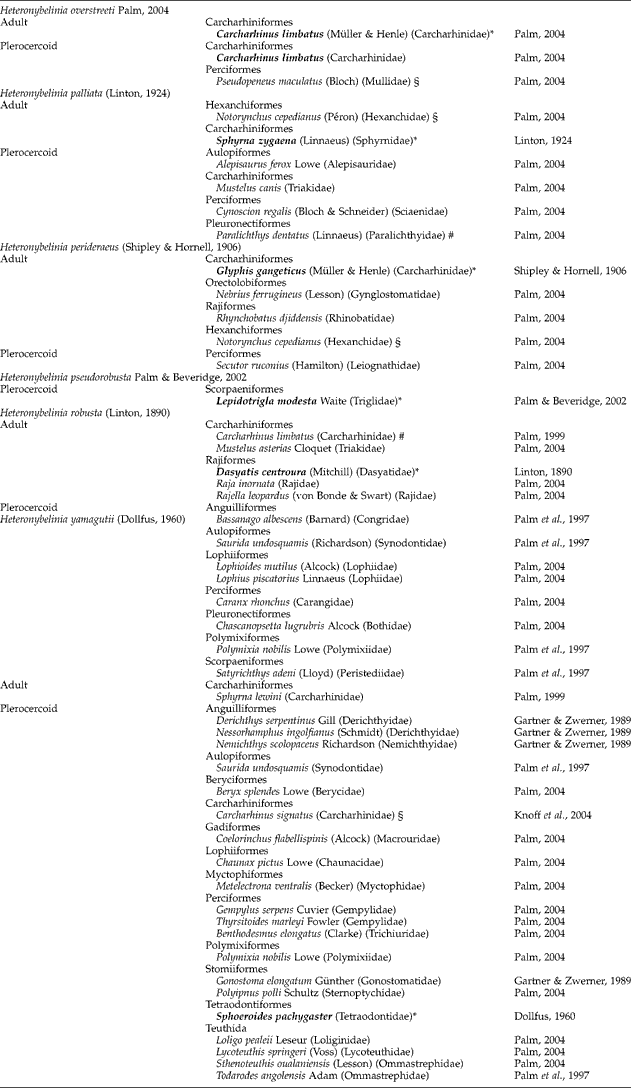
Most species of Heteronybelinia have been described on the basis of plerocercoids and adults (tables 1 and 2). The type species, H. estigmena, was originally described as plerocercoids from the perciform Selene setapinnis (Mitchill, 1815) (see Dollfus, Reference Dollfus1960). Later, Palm & Beveridge (Reference Palm and Beveridge2002) redescribed the plerocercoid and added the description of the adult. Only the plerocercoid stage is known for H. annakohnae, H. elongata, H. eureia, H. minima and H. pseudorobusta, whereas the description of H. australis was just based on adult worms (tables 1 and 2).
Host associations of adults and/or plerocercoids of Heteronybelinia including H. annakohnae, H. australis, H. elongata, H. estigmena, H. eureia, H. heteromorphi, H. mattisi n. sp., H. minima and H. nipponica.

In bold, hosts included in the original descriptions. # Hosts reported in redescriptions of species based on type material and newly collected specimens. § Host reported in the south-western Atlantic.
* Type host.
Host associations of adults and/or plerocercoids of Heteronybelinia including H. overstreeti, H. palliata, H. perideraeus, H. pseudorobusta, H. robusta and H. yamagutii.
In bold, hosts included in the original descriptions. # Hosts reported in redescriptions of species based on type material and newly collected specimens. § Host reported in the south-western Atlantic.
* Type host.
Seven species of Heteronybelinia have been reported from the south-western Atlantic (tables 1 and 2). Among them, adults of H. palliata and H. perideraeus were recovered from the broadnose sevengill shark, Notorynchus cepedianus (Péron, 1807), and H. nipponica from Sphyrna lewini (Griffith & Smith, 1868) (see São Clemente & Gomes, Reference São Clemente and Gomes1992; Palm, Reference Palm2004). Other records in the south-western Atlantic, including H. nipponica, were found as plerocercoids in a diverse array of hosts (tables 1 and 2).
In a recent survey, several specimens of Sympterygia bonapartii Müller & Henle, 1841 (Rajidae) and teleosts, examined for parasites along the Argentine coast, were found to be parasitized by a new species of Heteronybelinia. Adults and plerocercoids of this new species are described below.
Materials and methods
Collection and examination of cestodes
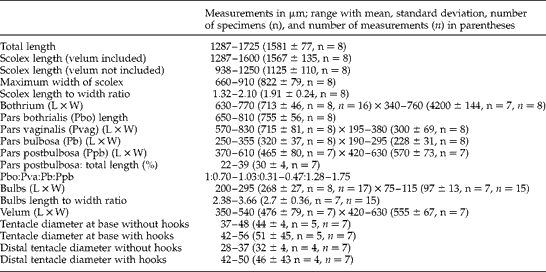
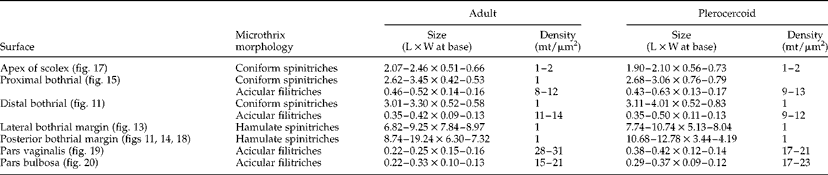
During 2008–2011 specimens belonging to 24 species of teleosts and 19 species of elasmobranchs captured along the Argentine Sea were examined for cestodes. These included Acanthistius brasilianus (Cuvier, 1828) (Serranidae), Cottoperca gobio (Günther, 1861) (Bovichtidae), Cynoscion guatucupa (Cuvier, 1830) (Sciaenidae), Genypterus blacodes (Forster, 1801) (Ophidiidae), Merluccius hubbsi Marini, 1933 (Merlucciidae), Micropogonias furnieri (Desmarest, 1823) (Sciaenidae), Mullus argentinae Hubbs & Marini, 1933 (Mullidae), Nemadactylus bergi (Norman, 1937) (Cheilodactylidae), Pagrus pagrus (Linnaeus, 1758) (Sparidae), Patagonotothen brevicauda (Lönnberg, 1905) (Nototheniidae), Patagonotothen ramsayi (Regan, 1913) (Nototheniidae), Porichthys porosissimus (Cuvier, 1829) (Batrachoididae), Pseudopercis semifasciata (Cuvier, 1829) (Pinguipedidae), Prionotus nudigula Ginsburg, 1950 (Triglidae), Prionotus punctatus (Bloch, 1793) (Triglidae), Raneya brasiliensis (Kaup, 1856) (Ophidiidae), Salilota australis (Günther, 1878) (Moridae), Serranus auriga (Cuvier, 1829) (Serranidae), Stromateus brasiliensis Fowler, 1906 (Stromateidae), Trachurus lathami Nichols, 1920 (Carangidae), Trichiurus lepturus Linnaeus, 1758 (Trichiuridae), Umbrina canosai Berg, 1895 (Sciaenidae), Urophycis brasiliensis (Kaup, 1858) (Phycidae), and Xystreurys rasile (Jordan, 1891) (Paralichthyidae), Atlantoraja castelnaui (Miranda Ribeiro, 1907) (Rajidae), Atlantoraja cyclophora (Regan, 1903) (Rajidae), Bathyraja magellanica (Philippi, 1902) (Rajidae), Carcharhinus brachyurus (Günther, 1870) (Carcharhinidae), Discopyge tschudii Heckel, 1846 (Narcinidae), Galeorhinus galeus (Linnaeus, 1758) (Triakidae), Mustelus schmitti Springer, 1939 (Carcharhinidae), Mustelus fasciatus (Garman, 1913) (Carcharhinidae), Notorynchus cepedianus (Péron, 1807) (Hexanchidae), Psammobatis bergi Marini, 1932 (Rajidae), Psammobatis extenta (Garman, 1913) (Rajidae), Rioraja agassizi (Müller & Henle, 1841) (Rajidae), Squalus acanthias Linnaeus, 1758 (Squalidae), Squalus mitsukurii Jordan & Snyder, 1903 (Squalidae), Squatina guggenheim Marini, 1936 (Squatinidae), Sympterygia acuta Garman, 1877 (Rajidae), Sympterygia bonapartii Müller & Henle, 1841 (Rajidae), Schroederichthys bivius (Müller & Henle, 1838) (Scyliorhinidae) and Zearaja chilensis (Guichenot, 1848) (Rajidae).The specimens of the new species of Heteronybelinia described below were collected from S. bonapartii, N. bergi and R. brasiliensis caught off Puerto Quequén, Buenos Aires Province, Argentina (38°37′S, 58°53′W), with the help of commercial trawlers. Additional specimens of R. brasiliensis and N. bergi were caught by line on board the Oceanographic Vessel Puerto Deseado off Necochea (39°03′S, 59°05′W) and San Clemente del Tuyú (36°09′S, 55°53′W), respectively.The plerocercoids were removed from the pyloric stomach of two specimens of S. bonapartii and the visceral mesentery of N. bergi and R. brasiliensis. Gravid and mature specimens found in the spiral intestine of S. bonapartii were relaxed in seawater.All cestodes were fixed in 10% formalin and transferred to 70% ethanol for storage. A total of 14 specimens (8 plerocercoids, 1 mature and 5 gravid worms) were prepared for light microscopy, hydrated in a graded ethanol series, stained with Harris' haematoxylin, dehydrated in a graded ethanol series, cleared in methyl salicylate and mounted in Canada balsam. All worms prepared for scanning electron microscopy (SEM) were hydrated in a graded ethanol series, post-fixed in 1% osmium tetroxide overnight at room temperature, dehydrated in a graded ethanol series, and dried using hexamethyldisilazane. After dehydration, the specimens were mounted on a stub with carbon tape, coated with 40 nm of gold/palladium in a Thermo VG Scientific Polaron SC 7630 (Quorum Technologies Ltd, East Grinstead, West Sussex, England) and examined in a Philips XL 30 scanning electron microscope (Fei Company, Eindhoven, The Netherlands). Terminology for the morphology of microtriches follows Chervy (Reference Chervy2009). Gravid proglottids were embedded in paraffin and serial cross-sections were cut at a thickness of 8 μm. Sections were stained with Harris' haematoxylin and counterstained with eosin and mounted in Canada balsam. Tentacles were removed from the scolex of five worms (4 plerocercoids and 1 adult) and temporarily mounted in glycerine to study the tentacular armature in detail. Terminology for the morphology of hooks follows Campbell & Beveridge (Reference Campbell, Beveridge, Khalil, Jones and Bray1994). Whole and temporary mounts and sections were observed and measured using a Zeiss Axioskop and an Olympus BX 51 compound microscope (Olympus Corporation, Tokyo, Japan). Drawings were made with the aid of a drawing tube attached to a Zeiss Axioskop compound microscope. Measurements include the range, followed in parentheses by the mean, standard deviation (when n ≥ 3), number of worms examined (n), and the total number of observations when more than one measurement per worm was taken (n). Host specificity categories follow Palm & Caira (Reference Palm and Caira2008). Labels AMPD-003, AMPD-012, AMPQ-162, AMPQ-211 and VIPQ-048 refer to individual host specimens in our database. All measurements are in micrometres unless otherwise stated. Museum abbreviations used are as follows: MACN-Pa, Museo Argentino de Ciencias Naturales, Colección Parasitológica, Buenos Aires, Argentina; NHMUK, Natural History Museum, London, United Kingdom. The description below includes only the measurements of the adults, as follows: scolex features were based on mature and gravid specimens; worm length, maximum width and number of immature, mature and gravid proglottids refer only to gravid worms. Measurements of plerocercoids are provided in table 3, measurements and shape of hooks in specimens studied (holotype and paratypes) are detailed in table 4, microthrix patterns in adults and plerocercoids are described in table 5.
Measurements of plerocercoids of Heteronybelinia mattisi n. sp. from both species of teleosts, N. bergi and R. brasiliensis, and the skate S. bonapartii.
L, Length; W, width.
Morphology and measurements of hooks of Heteronybelinia mattisi n. sp. from both species of teleosts, N. bergi and R. brasiliensis, and the skate S. bonapartii.
Measurements are given in μm as range, with mean and standard deviation in parentheses. Ab, Antibothrial; Ba, basal; Bo, bothrial; MBa, metabasal armature.
Microthrix pattern on the surface of the scolex of Heteronybelinia mattisi n. sp.
L, Length; mt, microtriches; W, width. Measurements given in μm.
Heteronybelinia mattisi n. sp
Description
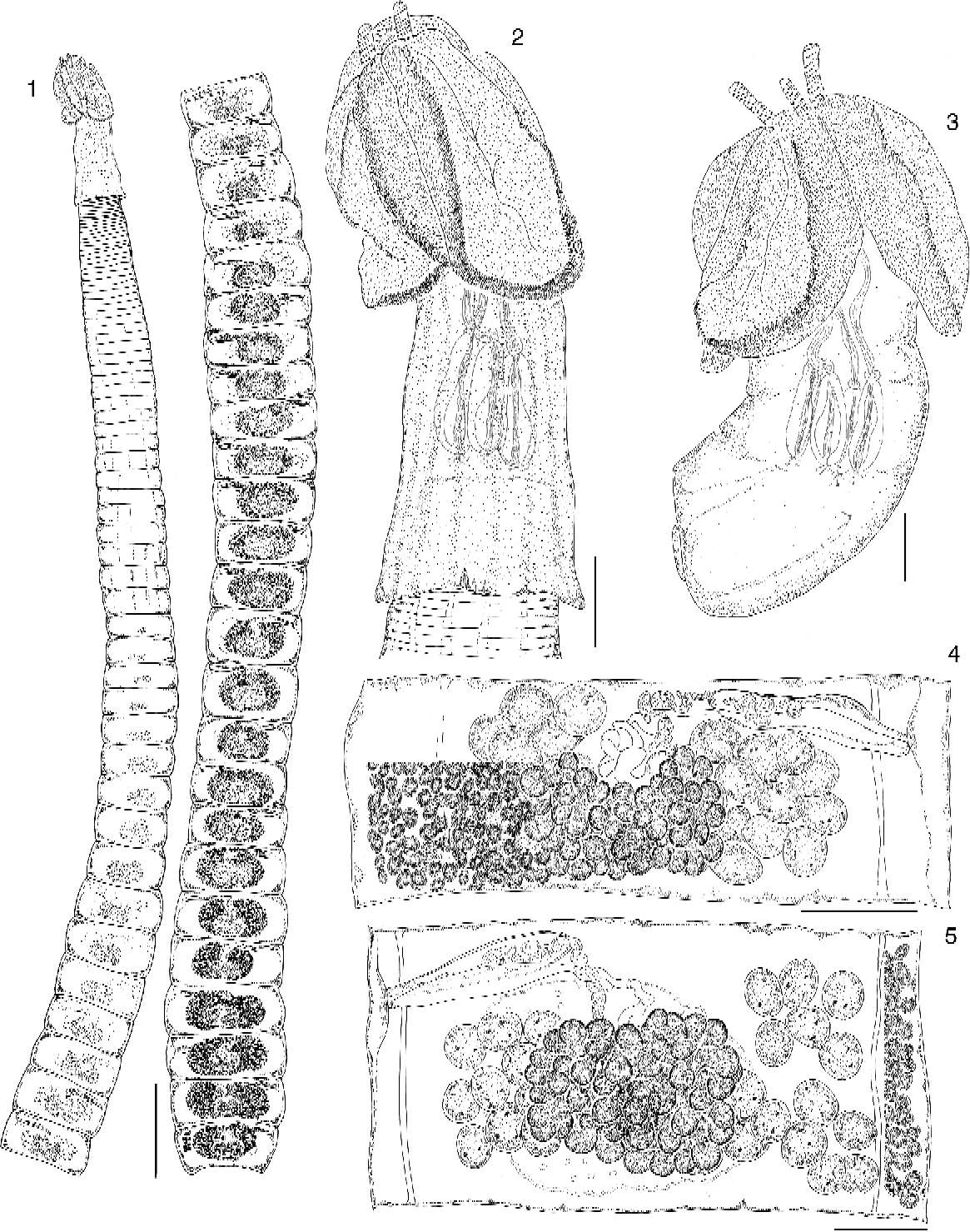
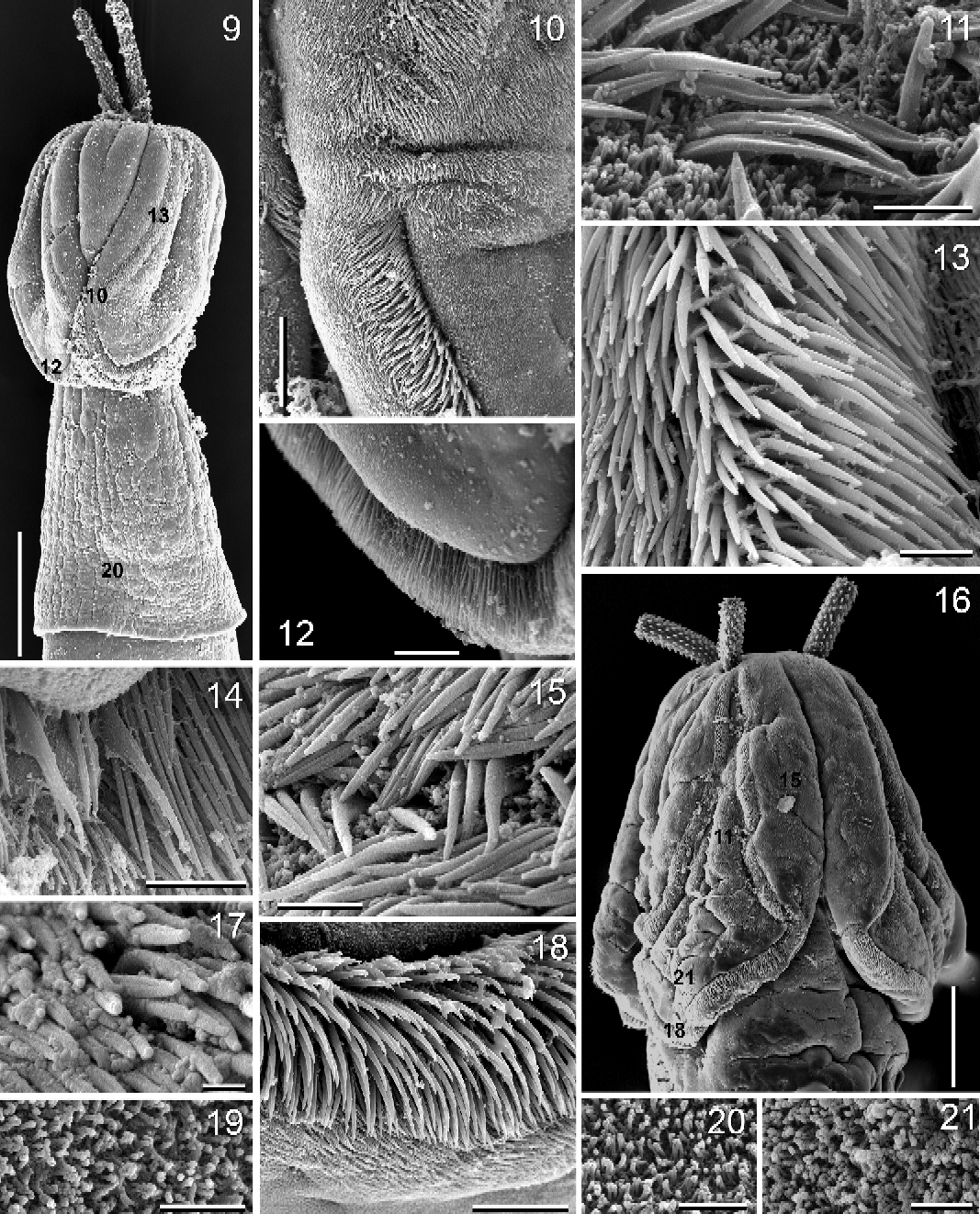
Based on 10 complete plerocercoids and 7 adult specimens prepared as follows: 14 whole mounts (8 plerocercoids and 6 adults) and 3 specimens observed with SEM (2 plerocercoids and 1 adult). Adult worms apolytic, 12.4–23.6 (19.4 ± 5.3, n = 4) mm long, maximum width at level of gravid proglottids; proglottids acraspedote, 67–91 (77 ± 11, n = 5) per worm (fig. 1). Scolex 975–1330 (1120 ± 127, n = 6) long, maximum width at the level of pars bothrialis. Apex of scolex covered with coniform spinitriches (see fig. 17). Four oval bothria, tapering posteriorly, 610–760 (710 ± 43, n = 6, n= 10) long, 320–362 (343 ± 19, n = 3, n= 3) wide (figs 2, 3, 9, 16), lateral bothrial margins covered with hamulate spinitriches with broad bases (figs 10, 13), posterior bothrial margins covered with elongate hamulate spinitriches with slender bases (figs 10, 12, 14, 18). Proximal bothrial surface covered with coniform spinitriches interspersed with acicular filitriches (fig. 15). Anterior two-thirds of distal bothrial surface covered with coniform spinitriches with ridging surface interspersed with acicular filitriches (figs 10–11), posterior third covered with acicular filitriches only (figs 10, 12, 21). Pars bothrialis 700–830 (762 ± 47, n = 6) long, 510–700 (617 ± 64, n = 6) wide, tentacle sheaths weakly sinuous. Pars vaginalis 610–860 (785 ± 72, n = 6) long, 105–215 (152 ± 41, n = 6) wide; covered with acicular filitriches (fig. 19). Pars bulbosa 250–325 (298 ± 26, n = 6) long, 255–360 (288 ± 31, n = 6) wide; covered with acicular filitriches (fig. 20). Bulbs short, 235–305 (277 ± 23, n = 6, n= 18) long, 90–110 (103 ± 7, n = 6, n= 18) wide, length to width ratio 2.14–3.39 (2.70 ± 0.32, n = 6, n= 18):1. Retractor muscle originates at base of bulb (figs 2, 3). Ratio of pars bothrialis:pars vaginalis:pars bulbosa 1:0.87–1.10:0.33–0.45. Tentacles short and tapered, without basal swelling, up to 550 long, diameter at base without hooks 25–47 (40 ± 7, n = 5, n= 6), diameter at base with hooks 33–57 (50 ± 7, n = 5, n= 6). Distal diameter of tentacles without hooks, 30–37 (33 ± 3, n = 3, n= 5), distal diameter with hooks 42–52 (48 ± 4, n = 3, n= 5).
Heteronybelinia mattisi n. sp.: 1, entire worm, circum-medullar vitelline follicles not drawn to allow the view of internal organs (scale bar = 1 mm); 2, scolex of adult worm (scale bar = 200 μm); 3, plerocercoid (scale bar = 200 μm); 4, mature proglottid, dorsal view, circum-medullar vitelline follicles partially drawn (scale bar = 150 μm); 5, gravid proglottid, ventral view, circum-medullar vitelline follicles partially drawn (scale bar = 150 μm).
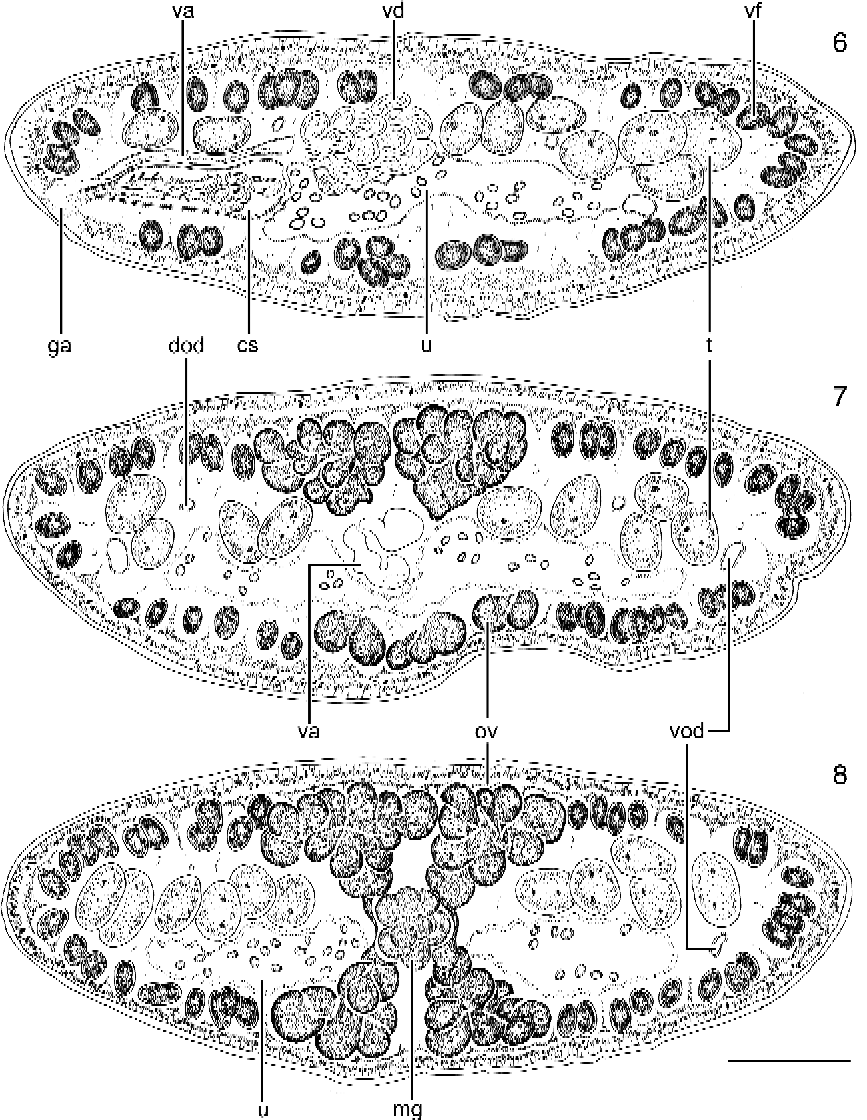
Heteronybelinia mattisi n. sp., cross-sections of a gravid proglottid (scale bar = 150 μm): 6, at the level of the genital pore; 7, at level of the ovary, anterior to ovarian isthmus; 8, at level of Mehlis' gland, posterior to ovarian isthmus. cs, Cirrus sac; ga, genital atrium; dod, osmoregulatory duct; mg, Mehlis' gland; ov, ovary; t, testis; u, uterus; va, vagina; vd, vas deferens; vf, vitelline follicles; vod, ventral osmoregulatory duct.
Heteronybelinia mattisi n. sp., scanning electron micrographs. 9, Dorso-ventral view of the scolex, adult (scale bar = 300 μm), small numbers indicate locations of details shown in figs 10, 12, 13 and 20; 10, lateral and posterior bothrial margins, adult (scale bar = 30 μm); 11, distal bothrial surface, plerocercoid (scale bar = 2 μm); 12, posterior margin of bothria, adult (scale bar = 25 μm); 13, detail of lateral bothrial margin, adult (scale bar = 5 μm); 14, hamulate spinitriches on the posterior bothrial margin, adult (scale bar = 10 μm); 15, proximal bothrial surface, plerocercoid (scale bar = 3 μm); 16, lateral view of the scolex, plerocercoid (scale bar = 150 μm), small numbers indicate locations of details shown in figs 11, 15, 18 and 21; 17, apex of scolex, plerocercoid (scale bar = 1 μm); 18, hamulate spinitriches in the posterior margin of bothria, plerocercoid (scale bar = 15 μm); 19, pars vaginalis, plerocercoid (scale bar = 2 μm); 20, surface of pars bulbosa, adult (scale bar = 1.5 μm); 21, distal bothrial surface near posterior margin of bothria, plerocercoid (scale bar = 2 μm).
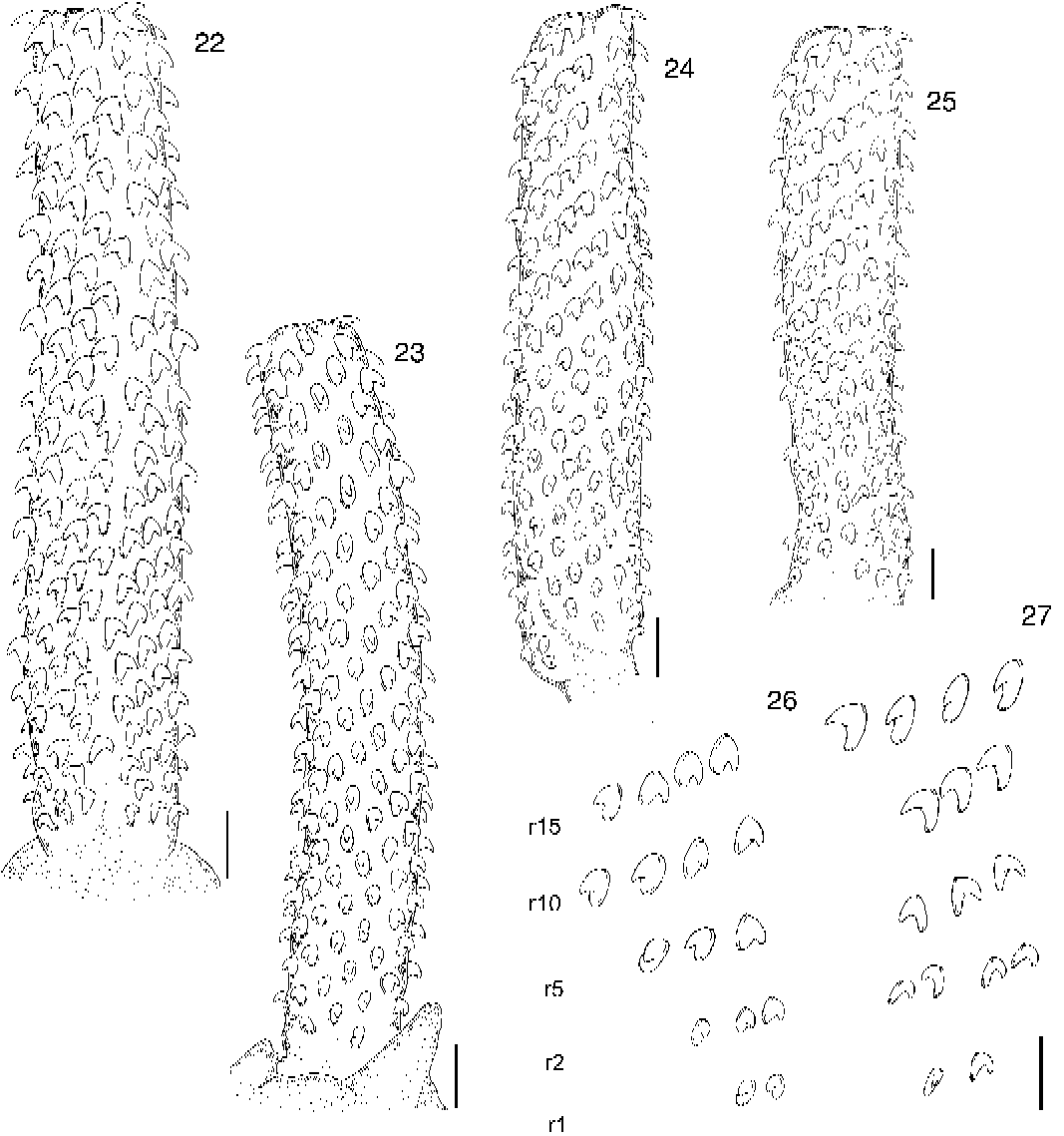
Armature homeoacanthous, weakly heteromorphous; hooks solid, arranged in ascending continuous spiral rows, up to 32 rows. Basal hooks arranged in 1–2 rows, basal antibothrial hooks uncinate with elongate bases (figs 22, 27, 33, table 4), basal bothrial hooks uncinate with rounded bases (figs 23, 26, 31, table 4). Basal hooks begin at very base of tentacle in bothrial and internal surfaces (figs 23, 25); small inverted V-shape area devoid of hooks in basal antibothrial and external surfaces (figs 22–24).
Heteronybelinia mattisi n. sp., tentacular armature. 22, Antibothrial surface of the tentacle, plerocercoid (scale bar = 25 μm); 23, bothrial surface of the tentacle, plerocercoid (scale bar = 25 μm); 24, external surface of tentacle, plerocercoid (scale bar = 25 μm); 25, internal surface of the tentacle, plerocercoid (scale bar = 25 μm). 26–27, Profiles of hooks of basal and metabasal armature of Heteronybelinia mattisi n. sp. (scale bar = 20 μm): 26, bothrial surface, uncinate hooks with rounded bases; 27, antibothrial surface, uncinate hooks with elongate bases. r1, row 1; r2, row 2; r5, row 5; r10, row 10; r15, row 15.
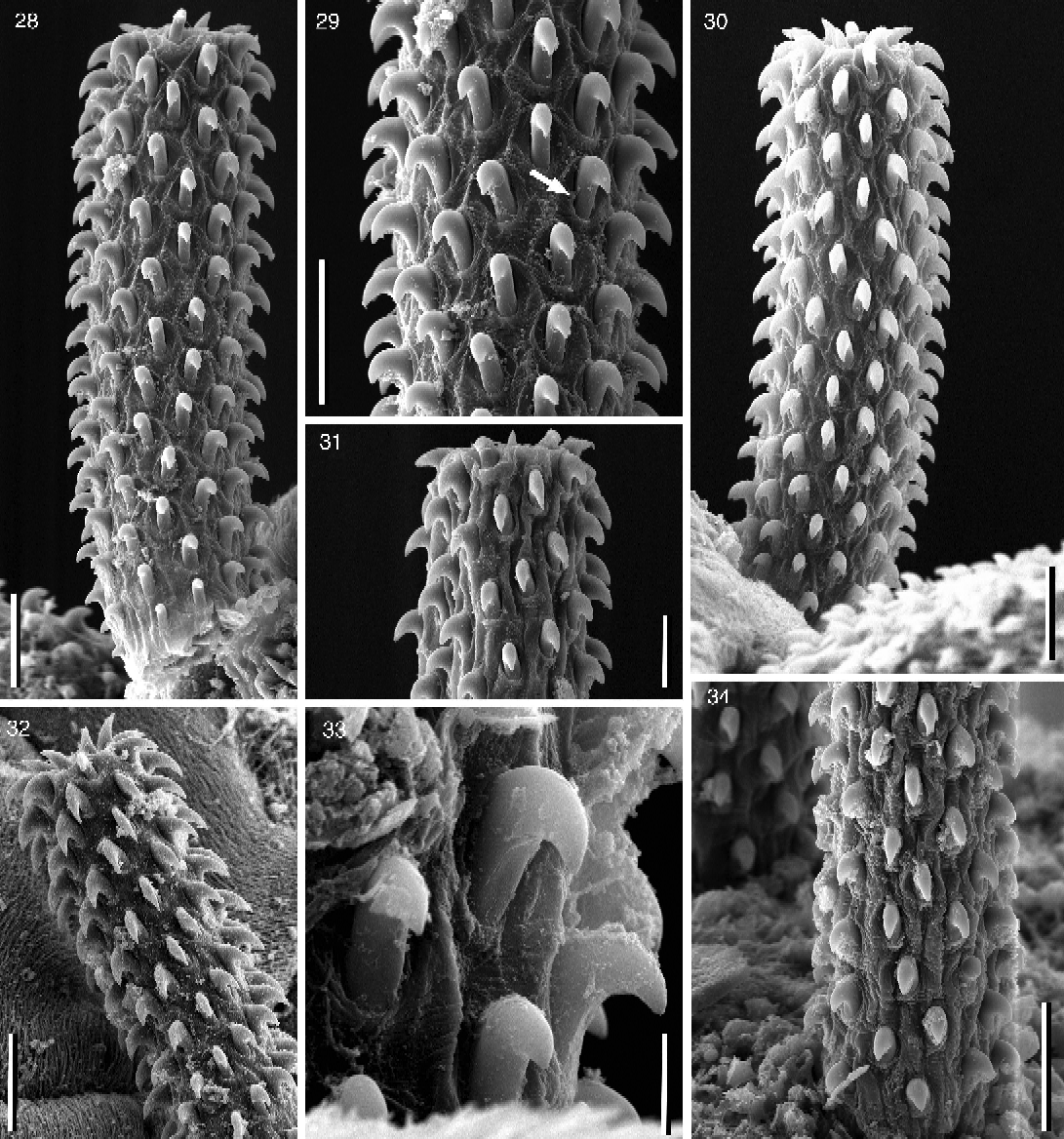
Heteronybelinia mattisi n. sp., scanning electron micrographs: 28, antibothrial surface of the tentacle, plerocercoid (scale bar = 20 μm); 29, detail of the metabasal armature, antibothrial surface showing an interrupted row of hooks at the level of row 8 (arrow), plerocercoid (scale bar = 7 μm); 30, bothrial surface of the tentacle, plerocercoid (scale bar = 20 μm); 31, metabasal hooks, bothrial surface, plerocercoid (scale bar = 15 μm); 32, metabasal region, antibothrial surface, adult (scale bar = 7 μm); 33, basal hooks, antibothrial surface, plerocercoid (scale bar = 5 μm); 34, bothrial surface of the tentacle, plerocercoid (scale bar = 20 μm).
Metabasal armature (from row 3) consists on ascending rows, 6–7 hooks per half row (figs 22–25, 32). Antibothrial surface consists of uncinate hooks with elongate bases (figs 2229, table 4), bothrial surface with uncinate hooks with rounded bases (figs 23, 26, 34, table 4). Hooks gradually increase in size from bothrial to antibothrial surface of tentacle, showing transitional shape and size of hooks on internal and external surfaces in basal and metabasal armature (figs 24–27).
Immature proglottids wider than long, 48–57 (50 ± 4, n = 5) in number (fig. 1). Mature proglottids wider than long, 260–410 (310 ± 38, n = 4, n= 31) long, 710–1000 (856 ± 68, n = 4, n= 31) wide, length to width ratio 0.30–0.49 (0.36 ± 0.05, n = 4, n= 31):1; 9–14 (11 ± 2, n = 5) mature proglottids per worm. Gravid proglottids wider than long, 325–670 (476 ± 92, n = 4, n= 72) long, 860–1350 (1114 ± 128, n = 4, n= 72) wide, length to width ratio 0.26–0.61 (0.43 ± 0.08, n = 4, n= 72):1; 12–29 (21 ± 7, n = 5) gravid proglottids per worm (figs 1, 4, 5).
Genital pore ventrosubmarginal, 15–26% (23 ± 3, n = 4, n= 28) from anterior margin of mature proglottid. Testes spherical, 26–38 (31 ± 3, n = 4, n= 24) per proglottid, 50–95 (72 ± 9, n = 4, n= 79) long, 33–80 (58 ± 7, n = 4, n= 79) wide, extending from level of cirrus sac to posterior margin of proglottid on poral side, throughout entire proglottid on aporal side (fig. 4), overlapping ovary in between dorsal and ventral ovarian lobes, one irregular row deep in cross-section (figs 4, 7, 8). Cirrus sac elongate, slender, 210–280 (239 ± 18, n = 4, n= 26) long, 40–80 (56 ± 9, n = 4, n= 26) wide, length to width ratio 3.12–6.25 (4.37 ± 0.79, n = 4, n= 26):1, containing unarmed cirrus (figs 4, 6). Vas deferens coiled, extending to mid-proglottid (figs 4, 6). Vagina thin walled, opening into genital atrium posterior and dorsal to cirrus sac, running parallel to cirrus sac, descending posteriorly to ootype region (figs 4, 6). Ovary lobulated, two-lobed in dorsoventral view, four-lobed in cross-section at level of ovarian isthmus, 230–325 (280 ± 31, n = 4, n= 22) wide (fig. 8). Seminal receptacle present, anterior to ovarian isthmus (figs 4, 7). Vitelline follicles circum-medullary, extending throughout entire proglottid, interrupted dorsally and ventrally at level of ovary and genital atrium (figs 4, 6, 8), follicles 15–37 (28 ± 5, n = 4, n= 76) long, 15–30 (23 ± 4, n = 4, n= 76) wide. Mehlis' gland 68–105 (84 ± 11, n = 4, n= 14) in diameter, posterior to ovarian isthmus (figs 4, 8). Uterus saccate, extending throughout length of gravid proglottids (fig. 5), uterine pore not observed.
Measurements of plerocercoids and adults are similar in most features (figs 1–3, table 3).
Taxonomic summary
Definitive host. Sympterygia bonapartii Müller & Henle, 1841, smallnose fanskate (Rajiformes: Rajidae) (AMPQ-162, VIPQ-048).
Intermediate hosts. Plerocercoids from Raneya brasiliensis (Kaup, 1856), banded cusk eel (Ophidiiformes: Ophidiidae) (AMPD-03), and Nemadactylus bergi (Norman, 1937), hawkfish (Perciformes: Cheilodactylidae) (AMPD-012).
Site of infection. Adults in spiral intestine, plerocercoids in pyloric stomach of S. bonapartii and visceral mesentery of teleosts.
Type locality. Puerto Quequén, Buenos Aires Province, Argentina (38°37′S, 58°53′W).
Other localities. Off Puerto Quequén (39°03′S, 59°05′W), off San Clemente del Tuyú (36°09′S, 55°53′W), Buenos Aires Province, Argentina.
Specimens deposited. Holotype (adult) and three paratypes (1 plerocercoid and 2 adults) deposited at MACN-Pa No. 537/1–4, two paratypes (1 plerocercoid and 1 adult) deposited at NHMUK No. 2012.9.11.1-2. Additional specimens (whole mounts, histological sections and specimens prepared for SEM) are retained in the personal collection of the senior author (V.I.).
Etymology. The species is named in memory of Tom Mattis, in recognition of his work on the development of trypanorhynchs.
Prevalence and intensity of infection. Adult prevalence 4.8% (2 of 42 skates examined); intensity, 4 worms per host (in each of the 2 infected skates). Plerocercoid prevalence in R. brasiliensis 33.3% (1 of 3 specimens examined), in N. bergi 20% (1 of 5 specimens examined); intensity, 3 worms per host in R. brasiliensis, 5 worms per host in N. bergi.
The presence of homeoacanthous, heteromorphous, metabasal armature, basal heteromorphous hooks and the absence of a distinctive basal armature places this new species unequivocally in Heteronybelinia. Heteronybelinia mattisi n. sp. can be clearly distinguished from H. yamagutii and H. nipponica in lacking a characteristic basal armature consisting of bill hooks and spiniform hooks. The new species has metabasal armature consisting of uncinate hooks rather than the rosethorn-shaped hooks, as seen in H. robusta and H. pseudorobusta, or falcate hooks, as seen in H. eureia. Whereas in H. overstreeti, H. estigmena and H. minima the metabasal hooks decrease in size toward the tip of the tentacle, in H. mattisi n. sp. the hooks increase in size in that direction, thus, the largest hooks are in the distal region of the tentacle. In H. elongata and H. perideraeus the antibothrial hooks are conspicuously smaller than the bothrial hooks on the basal armature, but in H. mattisi n. sp. they differ slightly in shape and size on both surfaces. Whereas the metabasal hooks of H. palliata differ in shape on the internal and external surface (rosethorn-shaped and more slender and spiniform, respectively), in H. mattisi n. sp. they differ in size and shape on antibothrial and bothrial surfaces (uncinate with elongate bases and uncinate with rounded bases, respectively). Additionally, H. heteromorphi has quite larger metabasal hooks than H. mattisi n. sp. (21–28 versus. 8.8–15.7).
In H. annakohnae the bulbs completely overlap the pars bothrialis, resulting in a very short pars vaginalis (115–125 long), but in H. mattisi n. sp. the pars bothrialis only slightly overlaps with the pars bulbosa (0–19%), having a longer pars vaginalis (570–830 long). In addition, there exists a conspicuously long pars postbulbosa in H. annakohnae (65% of the plerocercoid length), which is rather shorter in H. mattisi n. sp. (22–39% of the plerocercoid length).
Finally, all four tentacles on a scolex have the same armature pattern in H. mattisi n. sp., differing far from the unique pattern found in H. australis, which has the largest hooks on the bothrial surface of two tentacles, and on the antibothrial surface of the other two tentacles.
Discussion
The tegument of all cestodes, including the Trypanorhyncha, is highly specialized and has been considered useful for taxonomic and phylogenetic studies (Palm, Reference Palm2004; Tyler, Reference Tyler2006; Chervy, Reference Chervy2009). Studies on the ultrastructure of the tegument of trypanorhynchs, using SEM, have demonstrated a high morphological variability in form and size of the microtriches (Palm, Reference Palm2004; Chervy, Reference Chervy2009). The microthrix pattern of a single species of Heteronybelinia, H. estigmena, had been examined until now (Palm, Reference Palm2004; Borucinska & Caira, Reference Borucinska and Caira2006; Chervy, Reference Chervy2009). The microtriches described in H. estigmena are similar in morphology to the pattern observed in H. mattisi. Both species have filiform microtriches on all surfaces of the scolex, in addition to coniform spinitriches on the apex and part of the distal bothrial surface (Figs 5 and 7 in Borucinska & Caira (Reference Borucinska and Caira2006); figs 11 and 17 of the present study), and hamulate spinitriches on the bothrial margins (Fig. 7 in Borucinska & Caira (Reference Borucinska and Caira2006); figs 12–14, 18 of the present study). They essentially differ in the distribution of the hamulate spinitriches, which might be absent on the posterior margin of the bothria in H. estigmena (see Borucinska & Caira, Reference Borucinska and Caira2006). More species of Heteronybelinia should be examined with SEM to determine whether this pattern is consistent throughout all members of the genus.
The anatomy of the proglottids is consistent in all species of Heteronybelinia described as adults, having ventrosubmarginal genital pores, ovary in a central position, elongate cirrus sac, unarmed cirrus and the absence of seminal vesicles (Linton, Reference Linton1890, 1924; Palm, Reference Palm1999, 2004; Palm & Overstreet, Reference Palm and Overstreet2000; Palm & Walter, Reference Palm and Walter2000; Palm & Beveridge, Reference Palm and Beveridge2002). In the diagnosis of Heteronybelinia, Palm (Reference Palm2004) included the presence of postovarian testes and testes anterior to the cirrus sac as a feature of the genus. However, H. palliata and H. mattisi lack postovarian testes (Fig. 7 in Palm & Overstreet (Reference Palm and Overstreet2000); figs 4 and 5 of the present study), and in H. robusta and H. mattisi the testes extend anterior to the cirrus sac only on the aporal side of the proglottid (Fig. 8C in Palm & Walter (Reference Palm and Walter2000); figs 4 and 5 of the present study). In most species the ovary does not overlap with the testicular field, however, in H. australis, H. estigmena and H. mattisi there are some testes between the dorsal and ventral ovarian lobes (Figs 53H and 55D in Palm (Reference Palm2004); figs 4 and 7 of the present study). As a consequence, Palm's (Reference Palm2004) diagnosis of Heteronybelinia should be emended as follows: strobila craspedote or acraspedote, anapolytic; proglottids wider than long or longer than wide; cirrus unarmed; cirrus sac lateral; genital pores ventrosubmarginal, alternating irregularly, in first third of the proglottid; seminal vesicles absent; testes numerous in single or multiple layers, medullary; postovarian testes present or absent on poral side; testes anterior to cirrus sac present or absent; uterine pore present or absent.
It is worth mentioning that even if all species of Heteronybelinia have continuous spiral rows of hooks along the tentacle, in some species there are rows interrupted by the absence of a single hook, giving the appearance of discontinuous rows. This was observed on different surfaces of the tentacle in H. mattisi (figs 22, 23, 25, 28, 29), and illustrated in the bothrial surface of H. eureia (Figs 33 and 35 in Dollfus (Reference Dollfus1960)), in the internal surface of H. perideraeus (Fig. 50G in Palm (Reference Palm2004)), and in the metabasal armature of H. pseudorobusta (Fig. 39 in Palm & Beveridge (Reference Palm and Beveridge2002)).
The host specificity of adults of Heteronybelinia is widely variable among species, ranging from very high (oioxenous, such as H. overstreeti and H. yamagutii, which are restricted to a single host species (table 2)), to very low (euryxenous, as H. robusta, H. perideraeus, H. estigmena, H. nipponica and H. palliata, which have been reported for hosts in different orders (tables 1, 2)). Heteronybelinia australis, a mesostenoxenous species, is restricted to a particular host genus (Carcharhinus spp.), and the metastenoxenous species H. heteromorphi is found in hosts of the same family (Sphyrnidae). Regardless of their degree of host specificity, with the exception of H. mattisi, the definitive hosts of all species of Heteronybelinia for which adults are known, include carcharhiniform sharks (Sphyrnidae, Carcharhinidae and Triakidae) (tables 1 and 2). Some species are restricted to carcharhiniform hosts (i.e. H. australis, H. heteromorphi, H. overstreeti and H. yamagutii), others include either a rajiform (i.e. H. estigmena, H. nipponica and H. robusta) or an hexanchiform host (i.e. H. palliata), and H. perideraeus has been found in hosts belonging to four different orders of elasmobranchs (Carcharhiniformes, Rajiformes, Orectolobiformes and Hexanchiformes) (tables 1 and 2). So far, adults of H. mattisi seem to have oioxenous specificity for their definitive batoid host, S. bonapartii. Even though species of some carcharhiniform and hexanchiform genera, reported as hosts for other species of Heteronybelinia, have been examined for cestode parasites in the same area (i.e. M. schmitti, M. fasciatus, G. galeus, C. brachyurus, S. bivius and N. cepedianus), no specimens of H. mattisi have yet been found.
Palm (Reference Palm2004) proposed an oceanic complex life cycle involving at least four hosts for the tentaculariids. These included copepods as first intermediate hosts, euphausiids or schooling fishes as second intermediate hosts, teleosts as third intermediate or paratenic hosts, and oceanic sharks as definitive hosts. In general, the plerocercoids of Heteronybelinia have a very low specificity for their third intermediate hosts, being reported from a diverse array of teleosts in 16 orders and in cephalopods (tables 1 and 2). Even so, the specificity is variable among species, from species that were reported from a single host species (i.e. H. eureia, H. perideraeus, H. pseudorobusta and H. overstreeti) to species that are parasites of several unrelated hosts (e.g. H. yamagutti from hosts in 12 families and nine different orders of teleosts) (tables 1 and 2). Heteronybelinia mattisi seems to be more specific for its intermediate hosts than most of its congeners. This new species has only been found in two species of teleosts (R. brasiliensis and N. bergi) out of the 24 species examined for parasites in the same area. Nineteen species of elasmobranchs, including ten species that have been reported to prey on R. brasiliensis and/or N. bergi, have been examined for parasites during this survey (Koen Alonso et al., Reference Koen Alonso, Crespo, García, Pedraza, Mariotti, Berón Vera and Mora2001, Reference Koen Alonso, Crespo, García, Pedraza, Mariotti and Mora2002; Gosztonyi et al., Reference Gosztonyi, Kuba and Mansur2007; Belleggia et al., Reference Belleggia, Mabragaña, Figueroa, Scenna, Barbini and Díaz de Astarloa2008; Barbini, Reference Barbini2011; Froese & Pauly, Reference Froese and Pauly2012). However, H. mattisi was only found in S. bonapartii, reinforcing the idea of a strict specificity for its definitive host.
Acknowledgements
Thanks are due to Leandro Tamini, Santiago Silveira, Jimena San Martín, Ana Massa, Juan Martín Diaz de Astarloa, Matías Delpiani and Daniel Bruno for their help in the identification of hosts; to Gustavo Chiaramonte, who made laboratory facilities at the Estación Hidrobiológica Quequén, Museo Argentino de Ciencias Naturales- CONICET available to us; to Roque Bruno from Pescadería Santa Cecilia, Puerto Quequén; to Daniel Fernández (CADIC-CONICET), who made laboratory facilities and specimens of elasmobranchs available to us. Special thanks are due to Dr Jorge Tezón, Ing. Arturo Martínez, Lic. Laura Leff, Dr Pablo Penchaszadeh and Dr Guido Pastorino (CONICET) for the opportunity to work on board the Oceanographic Vessel Puerto Deseado – CONICET, to Captain Pablo Bonuccelli for organizing a fish tournament on board, to Captain Maximiliano Mangiaterra and all the crew for their help and endless patience. We especially thank Janine Caira, whose review greatly helped to improve the manuscript. This work has been funded by grant Préstamo BID PICT 2006 No. 825 from Agencia Nacional de Promoción Científica y Tecnológica (ANPCyT, Argentina), grant UBACyT X01/2529 (2010-2012) from Universidad de Buenos Aires (Argentina), grant PIP No. 236 from Consejo Nacional de Investigaciones Científicas y Técnicas (CONICET, Argentina) to V.A.I., and NSF PBI Nos. 0818696 and 0818823 (USA).