I. INTRODUCTION
In the pursuit of fabricating high-quality optical ceramics which are notably better than their glass and single-crystal counterparts, calcium fluoride ceramics have been gaining tremendous research attention.Reference Lyberis, Stevenson, Suganuma, Ricaud, Druon, Herbst, Vivien, Gredin and Mortier1–Reference Samuel, Ishizawa, Ezura, Ueda and Babu5 Due to advancements in nanotechnology the viability of the raw materials for producing superior optical ceramics has vastly increased. With their superior optical and chemical properties, calcium fluoride ceramics are highly suitable for a wide range of industrial and scientific applications such as laser technology,Reference Lyberis, Stevenson, Suganuma, Ricaud, Druon, Herbst, Vivien, Gredin and Mortier1,Reference Šulc, Doroschenko, Jelínková, Basiev, Konyushkin and Osiko4,Reference Lucas, Smektala and Adam6 scintillators,Reference Blasse7 photolithographic processing,Reference Samuel, Ishizawa, Ezura, Ueda and Babu5 and specialized window production.Reference Madding8 Hot pressing single-crystal deformation-fabricated yttrium-doped CaF2 ceramics have been demonstrated to have higher slope efficiency than that of single-crystal materials.Reference Šulc, Doroschenko, Jelínková, Basiev, Konyushkin and Osiko4 A decade ago, europium-doped CaF2 ceramics were examined and determined to possess high light output and energy resolution with alpha particle excitation, making them useful for low transmittance applications.Reference Viday, Grinyov, Zagarij, Zverev, Chernikov, Tarasov and Kudin9 Furthermore, substantial mechanical strength enhancements have been recently achieved, inexorably improving the suitability of these specialized ceramics for more industrious infrared window applications.Reference Basiev, Doroshenko, Konyushkin, Osiko, Fedorov, Demidenko, Dukel´skii, Mironov and Smirnov10
Calcium fluoride ceramic sintering research has been conducted for more than half a century. In the mid-1960s, Kodak developed the first fluoride ceramic laser (CaF2: Dy3+) by hot pressing coarse pulverized powder with a particle size distribution around 150 μm.Reference Hatch, Parsons and Weagley11 To remove any potential contaminants, hazardous dry hydrogen fluoride was repeatedly used throughout the fabrication procedure. With the sintering temperatures ranging from 800 to 1000 °C, no significant grain growths were observed because the starting grain domains were already very big. A little earlier than the work from Kodak Company, using different sintering temperatures, initial particle size distributions, and forming pressures, the dimensional changes of CaF2 ceramics were studied dilatometrically.Reference Allison and Murray12 The green body shrinkages at different temperatures and dwelling times were collected; and the conventional sintering activation energy of CaF2 was calculated to be 305 kJ/mol. By using two different particle size powders and analyzing the shrinkage time of the green bodies at temperatures below 950 °C, plastic flow was confirmed to be the material transport mechanism, but the equation calculation was not believed to be a fruitful way to determine the sintering mechanism. Burke claimed that the diffusion model was a better fit; more specially, sintering effectively proceeded by the migration of vacancies from the surface of pores to the grain boundaries, inexorably inducing shrinkage.Reference Burke13
In recent years, high-quality CaF2 transparent ceramics have been fabricated via different methodologies. One process involves the chemical synthesis of nanosized powder using HF as the starting material, and then hot pressing this powder at 900 °C and 60 MPa.Reference Lyberis, Stevenson, Suganuma, Ricaud, Druon, Herbst, Vivien, Gredin and Mortier1 When using this fabrication technique, the average grain size varies in the range of 500 nm to 1 μm as a function of the doping ion concentration. Another method used for high-quality CaF2 transparent ceramic production mentioned in the literature involves deforming single-crystal CaF2 into polycrystalline ceramics via hot pressing with high pressure.Reference Šulc, Doroschenko, Jelínková, Basiev, Konyushkin and Osiko4 However, in both these studies, the focus remained predominately on optical and lasing-property characterization, while a systematic investigation and explanation of the sintering and transport mechanisms remained entirely unexplored. In this work, the CaF2 ceramics sintered via spark plasma sintering (SPS) at varying temperatures were systematically analyzed to determine their relative density, specific grain size, overall transmittance, and their microstructural properties. Since the SPS process uses high-pulsed DC current to quickly generate heat by Joule effect, along with uniaxial pressure to consolidate powders, many materials that were previously difficult to sinter via conventional sintering techniques can now be fully consolidated into transparent (or translucent) ceramics with the desired fine grain size via fast SPS sintering; examples of this include materials such as noncubic phase alumina,Reference Kim, Hiraga, Morita and Yoshida14 fluorapatite,Reference Chen and Wu15 and Lu2SiO5.Reference Boatner, Neal, Jellison, Ramey, North, Wisniewska, Payzant, Howe, Lempicki, Brecher and Glodo16 Here, at different sintering stages, new transport and grain growth mechanisms were proposed for CaF2 ceramics, and an unexpected sintering trajectory was also presented for this particular sintering technology.
II. EXPERIMENTAL
The raw material CaF2 powder with 97% purity was purchased from Alfa Aesar and used directly for SPS sintering without any ball milling or further purification. Then, 2 g of the powder was weighed out and put into a 0.74 inch diameter graphite mold, and graphite foil and BN spray coatings were used to effectively prevent the sample from adhering to it. The powder was then sintered in a FCT System SPS furnace, with a heating rate of 100 °C/min, 30 min dwelling time, cooling rate of 10 °C/min, and 70 MPa loading pressure. Sintering temperatures were systematically varied between 500 and 850 °C.The sintering temperature was monitored by a pyrometer set on the side of the furnace chamber. Since the thickness of the mold was 0.5 inch, there existed a temperature gradient between the actual temperature on the sample and the monitored temperature on the exterior wall of the graphite mold.
The density of the specimens was measured by the Archimedes technique using DI water as the immersion liquid; and the theoretical density of 3.182 g cm−3 was used. Using Cu Kα radiation with a Bruker D2 Phaser diffractometer (Madison, WI), the x-ray diffraction (XRD) data of the ceramic sample was recorded. The microstructure and element analysis of the samples coated with carbon were acquired from a FEI Quanta 200F environmental scanning electron microscope. Infrared transmittance of the SPS-sintered ceramic was measured from 2.5 to 12 μm with a Nicolet 6700 spectrometer from Thermo Electron (Waltham, MA).
III. RESULTS AND DISCUSSION
Calcium fluoride is a naturally abundant ionic compound with a face-centered cubic structure. The XRD patterns of the raw powder and the 700 °C SPS-sintered ceramic samples are shown in Fig. 1 with every peak indexed to the standard CaF2 diffractions (JCPDS 89-4794, Fm-3m). It can be clearly observed that the full width at half maximum (FWHM) of the raw powder was much larger than that of the sintered ceramic. From the XRD data, with the help of the Scherrer equation, the crystalline size of the CaF2 raw powder was estimated to be around 79.3 nm. The SEM images in Fig. 2 showed the micrographs of the raw CaF2 powders before and after ZrO2 ball milling. The identifiably well-dispersed powder after ball milling indicated that the raw powders used as a starting material for the SPS sintering were only soft agglomerates. The impurities present in the CaF2 raw powder were not readily detectable via XRD. Furthermore, the EDS spectrum seen in the inset of Fig. 2(a) also barely reveals any significant impurity elements – only very small peaks are observed.
XRD of raw powder and 700 °C SPS-sintered ceramic.

SEM image of raw powder (a) and powder after ball milling (b), and EDS spectrum of raw powder (inset of a).
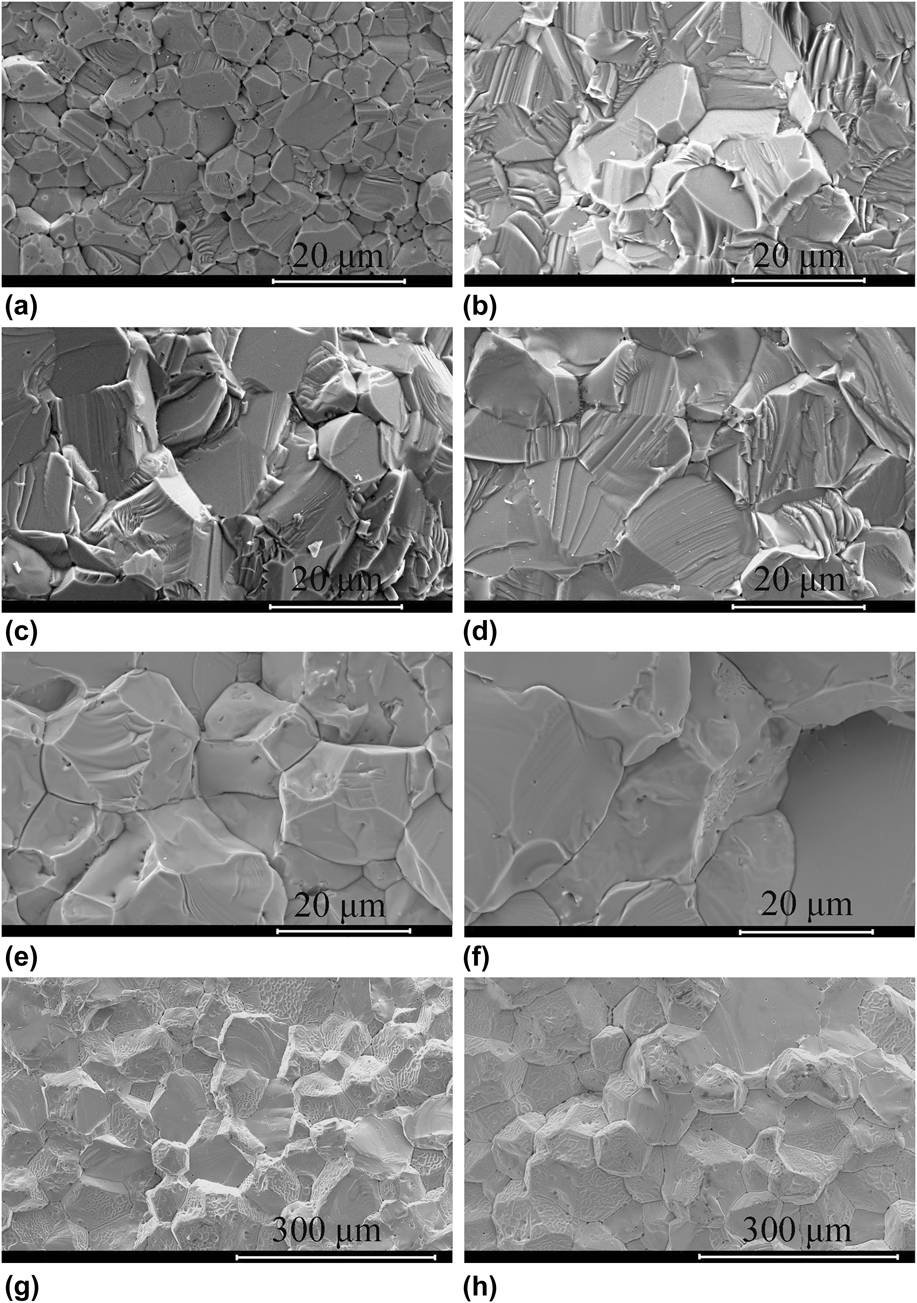
The SEM images of the CaF2 ceramics, sintered at different temperatures, were exhibited in Fig. 3 to investigate the microstructure of the ceramic fracture surface. As the sintering temperature increased from 500 to 850 °C, it is clear that the most distinctive change was the grain size, which increased from several to hundreds of micrometers. For the larger and smaller grains, respectively, the microstructure image of the sample sintered at 500 °C in Fig. 3(a) showed both transgranular and intergranular fracture features. Both intergranular and intragranular – but predominately intragranular – pores with sizes as large as 0.6 μm can also be observed in Fig. 3(a). Some of the larger void spaces with faceted shapes were actually small grains pulled off by the other side of the ceramic sample. Based on the readily identifiable residual pores at the center of the grains, it is apparent that the rate of grain growth from the nanosized crystallites was actually significantly faster than the densification process. The minuscule flaws present, such as pores inside the grains, had the effect of amplifying the applied stress and ultimately resulting in transgranular fractures. As shown in Figs. 3(b)–3(d), all the small grains grew bigger from sintering temperature increases (550, 600, and 650 °C); only transgranular fracture features were observed. However, despite this observable trend, both intergranular and intragranular porosity significantly decreased – which is not consistent with the pertinent phenomenon describing the general atom diffusion mechanism for matter transport during densification. Pores which lie close to grain boundaries should disappear more rapidly than those which lie in the centers of grains which instead tend to remain after the diffusion densification process.Reference Burke13 Therefore, in this stage of SPS sintering CaF2 ceramic, the predominant sintering mechanism may actually involve other matter-transport mechanisms acting alongside diffusion. Besides the clearly observable quickly grown grain sizes in Figs. 3(e)–3(h), with the temperatures further increased to 700, 750, 800, and 850 °C, the grains actually showed irregularly patterned surface morphologies and ultimately started to strip apart from each other. These morphologies appear as if they were formed via condensation.
SEM images of the fracture surface of the CaF2 ceramics sintered at 500 °C (a), 550 °C (b), 600 °C (c), 650 °C (d), 700 °C (e), 750 °C (f), 800 °C (g), and 850 °C (h).
Different grain growth mechanisms can be represented by the numeric value of the grain growth exponent.Reference Rahaman17 The original grain size at all the SPS temperatures and prior to beginning the SPS process altogether, was assumed to be a constant (G 0 = 1.3 μm) – determined via analyzing the average grain size of a sample heated to 500 °C without dwelling. Using the grain size data over the entire empirical temperature range, the Arrhenius-type plot was generated and is shown in Fig. 4. Then, for low, medium, and high temperatures, respectively, the best linear regressions (R) with an exponent of 4 were found to have activation energies (Q) of 276, 98, and 449 kJ/mol. Therefore, the grain growth was actually controlled by surface diffusion. Because of the multitude of concurrently enacting complicated parameters during SPS sintering, such as temperature, pressure, and plasma, it is very difficult to accurately estimate the activation energy associated with the densification process.Reference Lu18
Arrhenius plots of the grain size versus the reciprocal SPS temperature.
The relative density and average grain size for the CaF2 ceramics sintered between 500 and 850 °C are shown in Fig. 5. Surprisingly, with these samples, the density did increase with increasing sintering temperatures, however only before a certain point (around 600 °C); after this point the density actually decreased, with an even more rapidly plummeting density rate at temperatures 750 °C and higher. However, as the sintering temperature increased, the average grain size continued to grow, regardless of the declining density values. This sintering behavior has not been reported before and is most likely attributed to the starting materials and the particular sintering technology involved. In SPS the large pulse electric current used and apparent discharge-induced plasma formation ultimately produces a nonequlibrium electrothermal effect, effectively stimulating the evaporation/condensation of the surface material.Reference Orru, Licheri, Locci, Cincotti and Cao19 The sintering trajectory of CaF2 ceramics is presented in Fig. 6. For the CaF2 ceramics sintered at temperatures below 600 °C, the continued relative-density-increasing behavior indicates that the bulk transport mechanism was actually either plastic flow or grain-boundary-diffusion-aided densification – acting as the predominant mechanism for this stage as labeled in Fig. 6 (stage A). As stated previously, when sintering temperatures were increased above 600 °C, the curves actually went along the opposite direction from the general and well-documented classical sintering trajectory. In the literature it is currently believed that an evaporation condensation process cannot lead to the densification of a ceramic compact.Reference Kingery and Berg20 However, for the pressure-assisted high-temperature plasma sintering, surface transport with evaporation condensation was actually proposed as the predominant mechanism for the sintering stage B in Fig. 6.
Densification and grain growth behavior of different temperature SPS-sintered CaF2 ceramics.
Sintering trajectory of SPS-sintered CaF2 ceramics.
The IR transmittance spectra of the CaF2 ceramics sintered at different temperatures are all consolidated and compared in Fig. 7. Porosity/relative-density, secondary phase, and double refractions were identified as the most important factors governing the final transmittance of polycrystalline ceramics. As the sintering temperature increased, the porosity of the ceramics ultimately reached their lowest point at 600 °C; and since pores act as light-scattering centers/sources, decreasing the porosity inexorably improved IR transmittance. Interestingly, despite this correlation, when the sintering temperature was increased above 600 °C and the porosity began to increase again, the IR transmittance did not decrease until the temperature was higher than 750 °C. This could be explained by the role of a secondary phase. As barely detected from the EDS signal in Fig. 2(a), there existed some impurity in the raw CaF2 powder. As the sintering temperature increased, the amount of the low-melting-point secondary phases was reduced. Therefore, although the relative density of the sintered ceramics dropped a little bit, the transmittance of these CaF2 ceramics kept increasing. Because of the special mechanism involved in the SPS sintering of CaF2 ceramics, the transmittance was ultimately much lower than that of other hot pressedReference Lyberis, Stevenson, Suganuma, Ricaud, Druon, Herbst, Vivien, Gredin and Mortier1 and hot isostatic pressedReference Aubry, Bensalah, Gredin, Patriarche, Vivien and Mortier3 CaF2 ceramics. The digital image of CaF2 ceramic sintered at 700 °C is presented in Fig. 8. The printed letter under the 2 mm thick ceramic was visible. It is commonly found that the natural CaF2 mineral is often deeply colored due to the presence of F centers. It is more likely that the SPS-sintered CaF2 ceramics possessed many color centers due to the lower valence ion doping from the 3% impurity. Therefore, annealing in a fluorine-related atmosphere would be a proper way to improve the transmittance.Reference Fedorov, Osiko, Kuznetsov and Garibin21 It is difficult to prove whether original impurity is left in grains or on grain boundaries after SPS sintering and fluorine atmosphere annealing. However, from the image of the sample after annealing, the area at the center showed stronger colorations than that on the edge. The annealing after the densification of ceramic is rather slow in defusing out impurity or defects in the bulk.
IR transmittance of different temperature SPS-sintered CaF2 ceramics.
Digital image of SPS-sintered CaF2 ceramics at 700 °C.
IV. CONCLUSION
Using low-purity commercial powder at various sintering temperature values, SPS sintering of CaF2 ceramics was carefully conducted and methodically investigated. Surface diffusion was proposed to be the grain growth mechanism involved and activation energy values were determined for different sintering periods. By increasing the sintering temperatures, the average grain size kept increasing while the relative density increased until 600 °C – after this point the relative density greatly decreased. The grain growth and relative density data presented ultimately revealed an unconventional sintering trajectory. Surface transport with evaporation condensation mechanism was proposed to be the predominant mechanism for higher-temperature sintering. The transmittance of the sintered CaF2 ceramics was also meticulously compared and studied – more specifically, analyzing the temperature-induced porosity and purity changes.
ACKNOWLEDGMENTS
We gratefully acknowledge the Air Force Office of Scientific Research (AFOSR) (Contract FA9550-10-1-0067) for funding and supporting this research.