INTRODUCTION
In amphipods a pelagic larval phase is lacking and, as a consequence, secondary long-distance dispersal of introduced species of this group is mainly anthropogenic. Human-mediated introductions in general have a highly stochastic character, resulting in patchy distribution patterns for species without a dispersive larval phase (Chapman & Carlton, Reference Chapman and Carlton1991, Reference Chapman and Carlton1994). Smaller and larger leaps to new areas may be recorded by regularly surveying potential recipient areas. Three harbour regions and one location with shellfish trade and culture in The Netherlands were surveyed several times, which yielded a new introduced amphipod species and revealed probable leaps from one region to the other.
MATERIALS AND METHODS
Study area
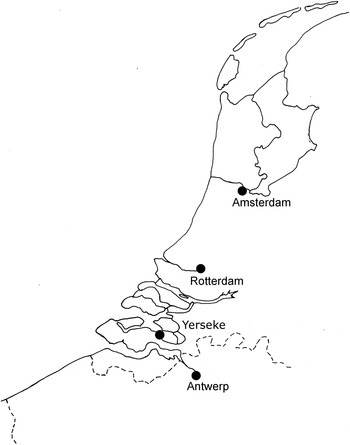
Surveyed locations are, from north to south (Figure 1):
-
(1) IJmuiden, Noordzeekanaal, gateway to the port of Amsterdam (52°27′47.04″N 4°37′53.02″E);
-
(2) Rotterdam, Calandkanaal in port (51°56′17.80″N 4°11′14.51″E);
-
(3) Yerseke, along the Oosterschelde embayment, centre of shellfish trade and culture (51°29′43.36″N 4°03′14.39″E);
-
(4) Vlissingen, mouth of Westerschelde estuary, gateway to the port of Antwerp (Belgium) (51°26′25.70″N, 3°36′30.59″E).
In the Noordzeekanaal, a canal connecting the port of Amsterdam to the North Sea near IJmuiden, horizontal and vertical salinity gradients exist, but tidal movement is absent due to sluice docks at the North Sea end. Surface water is brackish along the entire length of the canal; full salinity only occurs in deeper water at the seaward end. The Calandkanaal in the port of Rotterdam has a semi-estuarine character, with mixing of seawater and freshwater, and some tidal influence. Yerseke is situated along the Oosterschelde, a fully marine, tidal embayment. The Westerschelde estuary, despite heavy dredging and reinforcement of the shores, has retained a significant part of its estuarine character. The mouth of the estuary near Vlissingen is almost fully-marine. Years in which locations were surveyed are indicated in Table 1.
International ports and shellfish trade centre (Yerseke) in the surveyed area.

Years in which locations were surveyed, with indication of results. P, Ptilohyale littoralis found; –, P. littoralis not found.

Collecting methods
The principal method of collecting was overturning of boulders in the littoral zone. The underside of the boulders was inspected and hyalids were induced to jump into a sample container. Clumps of mussels were taken apart. In Rotterdam also cobbles and seaweeds were sampled. In Yerseke hyalids were collected with other invertebrates living under Pacific oysters Crassostrea gigas (Thunberg, 1793), after detaching the oysters. Specimens were preserved in 70% ethanol.
Identification
Specimens were dissected, parts mounted on temporary slides in glycerine and examined with a compound microcope. Photographs were taken with a consumer-grade digital single-lens reflex camera attached to the microscope. Specimens were identified using species descriptions in Bousfield & Hendrycks (Reference Bousfield and Hendrycks2002) and works cited therein. Specimens were also compared with preserved specimens of P. littoralis from Rudee Inlet, Virginia Beach, Virginia, North America (36°49′48.80″N 75°58′05.50″W).
RESULTS
Records
Ptilohyale littoralis (Stimpson, Reference Stimpson1853) was found to be abundant in the port of Rotterdam on 11 July 2009. On 6 August 2009, 2 October 2009, 2 April 2010 and 9 July 2011 the species was found equally abundant, with hundreds of specimens seen. Ptilohyale littoralis was found in the littoral zone under boulders, between cobbles and under the seaweed Fucus vesiculosus L. The first record of P. littoralis from a different location in The Netherlands is from Yerseke. Two specimens were found under Pacific oysters C. gigas (Thunberg, 1793) dislodged to collect the invertebrates underneath on 16 July 2013 and 5 specimens on 5 December 2013. Further records are fromVlissingen (29 November 2013) and Borssele (30 November 2013) at the mouth of the Westerschelde estuary leading to the port of Antwerp. At the latter two locations, 41 and 13 specimens were collected, respectively, from the underside of boulders and between blue mussels (Mytilus edulis Linneaus, 1758).
Fifteen specimens of P. littoralis, collected on 11 July 2009 in Rotterdam have been deposited in the collection of Naturalis Biodiversity Center: Leiden, with No. RMNH.CRUS.A.5046.
Identification
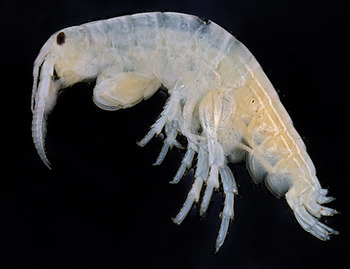
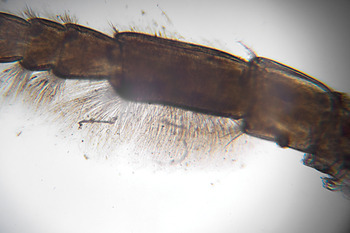
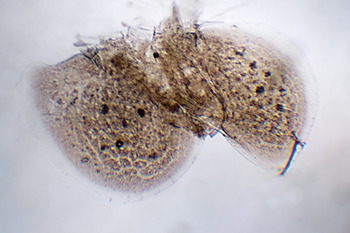
In species of Ptilohyale the posterior margins of the proximal part of the flagellum and the fifth segment (in the female only the distal half) of the peduncle of the antenna are densely covered with plumose setae (Bousfield & Hendrycks, Reference Bousfield and Hendrycks2002) (Figures 2 & 3). No European genus of the family Hyalidae shares this character. In the Mediterranean species Parhyale plumicornis (Heller, 1866), in addition to segment 5 of the peduncle and the proximal part of the flagellum, the posterior margin of peduncular segment 4 bears long setae as well (Krapp-Schickel, Reference Krapp-Schickel and Ruffo1993).
Ptilohyale littoralis, male, 6 August 2009, Rotterdam.

Ptilohyale littoralis, male, left second antenna, peduncle articles 3 (part), 4 and 5, and 3 proximal articles of flagellum, 11 July 2009, Rotterdam.

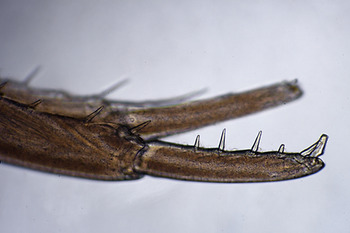
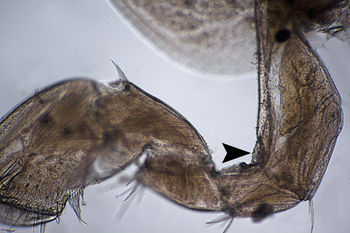
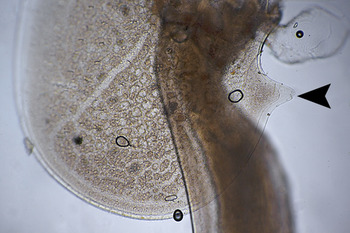
A key for the genus Ptilohyale is given by Bousfield & Hendrycks (Reference Bousfield and Hendrycks2002). The most important characters used to identify the Ptilohyale specimens from The Netherlands as P. littoralis are illustrated in Figures 4–7. The number of spines on the margin of the outer ramus of uropod 1 is usually 3, sometimes 4 (Figure 4), seldom 5. The rami of the second uropod are subequal in length. The posterior lobe of coxa 5 is distinctly smaller than the anterior lobe (Figure 5). Gnathopod 1 basis (male) is lacking a distinct anterodistal lobe (Figure 6). Coxae 1–4 hind margins are provided with quite distinct cusps (Figure 7).
Ptilohyale littoralis, male, left first uropod revealing 4 marginal spines, 11 July 2009, Rotterdam.

Ptilohyale littoralis, male, left fifth coxa, lateral view (hind lobe to the right), 11 July 2009, Rotterdam.

Ptilohyale littoralis, male, left first gnathopod, basis without anterodistal lobe (arrow), 11 July 2009, Rotterdam.

Ptilohyale littoralis, male, left second coxa, with pronounced marginal cusp (arrow), 11 July 2009, Rotterdam.

The number of marginal spines on the outer ramus of uropod does not fully agree with the key of Bousfield & Hendrycks (Reference Bousfield and Hendrycks2002), who gave a figure of 2(3), but this character is variable. The only consistent difference with their key is the broadly rounded basis of the fifth pereiopod. However, this rounded basis of pereiopod 5 is in agreement with specimens from Virginia.
DISCUSSION
Identification
The genus Ptilohyale Bousfield & Hendrycks, Reference Bousfield and Hendrycks2002 contains mainly estuarine, hopping amphipods that were formerly assigned to the genera Hyale and Parhyale.
The species of Ptilohyale are very similar morphologically and several of the named species may be synonyms. Bousfield & Hendrycks (Reference Bousfield and Hendrycks2002) mention 7 named species. The describer of P. iole (Barnard, 1970) himself says it is a synonym of P. crassicornis (Haswell, 1880) (as Hyale crassicornis): ‘can only be relegated to subspecific level and may not actually deserve this distinction’ (Barnard, Reference Barnard1974). According to Chapman (Reference Chapman and Carlton2007) P. crassicornis (as P. crassicorne) and P. plumulosa (Stimpson, 1857) are synonyms of P. littoralis (Stimpson, Reference Stimpson1853). Ptilohyale plumulosa had already been synonymized with P. littoralis by Bousfield (Reference Bousfield1973). However, Bousfield & Hendrycks (Reference Bousfield and Hendrycks2002) reversed this decision. The presence of P. littoralis in the north-west Atlantic, as well as the north-east Pacific and south-east Australia is explained by introduction by man (Chapman, Reference Chapman and Carlton2007). Ptilohyale plumulosa (as Hyale plumulosa) has also been recorded from southern Africa (Griffiths, Reference Griffiths1976). Species of the genus Ptilohyale have been recorded from Hong Kong several times. Moore (Reference Moore and Morton1990) mentions ‘Hyale B (aff. iole/barbicornis) from Victoria Harbour and/or Cape d'Aguilar, Hong Kong’. Tsoi & Chu (Reference Tsoi and Chu2005) recorded P. crassicornis from Tolo Harbour in Hong Kong. Horton (Reference Horton2008) recorded Ptilohyale aff. barbicornis from Cape d'Aguilar, Hong Kong. The lack of records of Ptilohyale species from surrounding areas (Lowry, Reference Lowry2000) suggests introduction to Hong Kong by man may be involved.
Ptilohyale explorator (Arresti, Reference Arresti1989) has been described (as Parhyale explorator) from the Bassin d'Arcachon in south-west France, the sole locality in the north-east Atlantic whence it has been recorded. This first record from a faunistically well-known area of shellfish culture, where many alien species have been introduced, strongly suggests the species concerned has been introduced by man as well. Ptilohyale explorator has been subsequently recorded from a single bay in the north-east Mediterranean Sea, i.e. Iskenderun Bay in Turkey (Bakir et al., Reference Bakir, Katağan and Sezgin2008). The amphipod fauna of the Mediterranean is well known (Bellan-Santini & Ruffo, Reference Bellan-Santini, Ruffo and Ruffo1998) and Iskenderun is a large port; it is likely the species has been introduced to Iskenderun Bay by man. The identity of P. explorator merits further investigation.
Introduction to The Netherlands
As P. littoralis is a littoral species occurring, for example, under cobbles it may have been carried around the world already in the days of wooden ships, in dry ballast. However, the presence of suitable hard substratum habitat in ports of The Netherlands is of relatively recent origin. The most likely route of introduction of Ptilohyale littoralis to The Netherlands is with ballast water or hull fouling in the port of Rotterdam. The species was found there abundantly in 2009, while in other locations it was only found in much lower numbers in 2013, in spite of surveys in previous years (Table 1). A species of the genus Ptilohyale has been recorded from hull fouling. Davidson et al. (Reference Davidson, Brown, Sytsma and Ruiz2009) found Ptilohyale sp. in the hull fouling of a containership in California. This Ptilohyale sp. could even be P. littoralis, as the north-east Pacific P. plumulosa is considered a synonym by Chapman (Reference Chapman and Carlton2007).
Introduction with imported shellfish is less likely. In The Netherlands, release into the environment of shellfish imported from outside Europe is forbidden. If this rule is strictly adhered to, it would preclude the direct introduction of P. littoralis from North America to The Netherlands with imported shellfish. The possibility that the amphipod has been previously introduced to a different part of Europe unnoticed cannot be ruled out. Thus, imports of shellfish from such a region to The Netherlands could account for its introduction here. However, numbers of P. littoralis found in Yerseke are very low, compared to Rotterdam. Furthermore, the species has not been recorded from samples of shellfish imported from European countries (A. Gittenberger, personal communication) and we are not aware of records of Ptilohyale from transported shellfish in general. However, P. explorator has been described from the Bassin d'Arcachon, an area of intensive shellfish farming.
Without further research it is impossible to distinguish between secondary introductions and multiple primary introductions of P. littoralis to The Netherlands. Secondary introduction is a more likely explanation for instances in which an alien species shows up at nearby localities within a short time, although the possibility of more than one introduction from the region of origin cannot be ruled out completely. Secondary introduction from Rotterdam to the Westerschelde estuary could result from ballast water release or hull fouling of coasters visiting both harbour regions or from the heavy inland ship traffic between the harbours of Antwerp and Rotterdam along the Schelde-Rijnkanaal. Secondary introduction from the port of Rotterdam to the shellfish trade centre in Yerseke is very hard to explain, unless P. littoralis is already widespread over the south-west of The Netherlands. Although the origin of the first population in The Netherlands is most likely the Atlantic coast of North America, any region where P. littoralis has been introduced can be the donor region and even introduction from elsewhere in Europe cannot be ruled out completely. Population genetics could help resolve the question of the origin of the different local populations.
Surveying early invasion histories
Similar leaps of introduced peracarid crustaceans between widely separated harbour regions are common. The first European record of the amphipod Grandidierella japonica Stephensen, 1938 is from Southampton Water on the south coast of the UK in 1997/1998 (Smith et al., Reference Smith, Perrett, Garwood and Moore1999). In 2004/2005 it was collected in the Orwell estuary on the east coast (Ashelby, Reference Ashelby2006). Caprella mutica, first recorded in Europe from The Netherlands, probably hopped to Scotland and Norway by human interference (Cook et al., Reference Cook, Jahnke, Kerckhof, Minchin, Faasse, Boos and Ashton2007). Disjunct distribution of cryptogenic species has been advocated as evidence of an alien origin (Chapman & Carlton, Reference Chapman and Carlton1991, Reference Chapman and Carlton1994). Especially in groups without or with a short-lived dispersive larval phase (e.g. certain ascidians, bryozoans and gastropods), distribution of introduced species may long remain patchy in receptor regions. Introduced peracarid crustaceans, having no dispersive larvae and adults with restricted mobility, are ideal organisms to study the development of disjunct distributions by surveying harbours, marinas and shellfish culture areas. The early invasion history of aliens which do have dispersive larvae is much more difficult to track.
Ecology
Several indigenous amphipods of the family Gammaridae, the melitid Melita palmata (Montagu, 1804) and the hyalid Hyale nilssoni (Rathke, 1843) partly live in the same habitat as P. littoralis in The Netherlands. Near Vlissingen and Borssele P. littoralis was the only amphipod species found. In Rotterdam P. littoralis and H. nilssoni were mutually exclusive, H. nilssoni living more seaward. In Yerseke the latter two species and Melita palmata occurred together; therefore it is not yet clear whether competition between them occurs.
ACKNOWLEDGEMENTS
I am indebted to C. d'Udekem d'Acoz (RBINS, Brussels, Belgium), who provided me with a paper not easily available to me. J.M. Turbeville (Virginia Commonwealth University, Richmond, USA) provided me with preserved specimens of Ptilohyale littoralis from Virginia. Comments of two referees that enabled me to improve the manuscript are gratefully acknowledged.