In three thousand years the West has abandoned values, beautiful and significant things, that in toto are at least as important as what we have preserved. But it is tough—no instruments, the culture, the milieu are absent. But they can be re-created or imagined. With Oriental music you don't have to re-create or imagine. In either case what you come up with is something new.
—Harry Partch in a letter to Peter Garland, 14 April 1973Harry Partch was born on 24 June 1901. This much, at least, is certain because Partch always agreed with the date printed on official documents. Beyond this one fact, however, the story of his conception and birth is a bit fuzzy. His California-issued birth certificate registers his birthplace as his parent's home at 5861 Occidental Street in Oakland, a fact that would, by both nation and the strange coincidence of street address, place Partch firmly in the Western world. However, throughout his life, Harry Partch claimed—and obviously believed—that he had been conceived in China, either in “a Boxer prison camp in Shantung Province” or on “the broad Pacific.”Footnote 1 This notion of conception in China and birth in the United States would have been fortuitous for a composer later recognized as straddling the line between East and West, but reality was not so kind to Harry Partch. His parents Jennie and Virgil Partch were Presbyterian missionaries who lived for more than a decade in China, where Harry's older brother and sister were born, but they fled during the Boxer Rebellion in the summer of 1900, almost a full year before the composer's birth. Partch was obviously conceived in California, and thus a basic question emerges: Why did he assert this tenuous connection to a nation he never even visited and from which, most scholars believe and Partch claimed, he never musically quoted?
Exploring this tension between created perception and the reasons behind it is particularly relevant when scholars regularly inquire, “How is it possible to represent another culture musically?” and “What is the relationship between political domination and the production of culture?” Although scholars first asked these questions of Western Europe's relationship with Eastern Europe, North Africa, and the Middle East, recently interest has surged in the relationship between East Asian music and Western composers, especially those in the United States. The results of these studies offer a panoramic view of the history of adaptations of Asian music as well as in-depth explorations of singular influences, specifically those of American composers in the experimental tradition such as Henry Cowell, John Cage, and Lou Harrison. These examinations, however, have remained silent about Harry Partch. That silence, reasonable in light of Partch's adamant assertions that he never quoted Asian music, has caused scholars to view the composer only as an iconoclastic instrument builder interested in nonstandard tunings. However, Partch also engaged deeply in this East-West dialogue. He claimed never to have used Chinese music directly, but he certainly placed the music and performance styles of Chinese opera at the heart of his aesthetic, particularly in his large-scale music theater works of the 1950s and 1960s. Yet few musicians have examined the manner in which Partch appropriated Chinese influences and the delicate dance those influences perform within his compositions. Exploring Partch's relationship and experiences with Chinese music and charting his evolving use of both the music and the associated aesthetics demonstrates how Chinese music shaped his own music and musical personality and offers a fuller description of the tense dialectic between East and West that ultimately produced the unique philosophies of Monophony and Corporeality.
In his graceful biography of Harry Partch, Bob Gilmore penetrates to the heart of the composer's aesthetic conundrum when he notes that “Partch's mature creative work springs from the clash between his view of an implanted culture for which he had little use—the concert tradition of eighteenth- and nineteenth-century European music—and what he liked to call ancient values, a ‘deep and abiding tie with peoples and animals and things removed in time and space.’”Footnote 2 How this clash played out on the Western coast of the United States, primarily in Los Angeles and San Francisco in the early years of the twentieth century, brings the source of some of these “ancient values” into focus.
In 1960 David Bowen began corresponding with Partch concerning an article he wanted to write on the composer. Seeking to delve deeper into a composer he knew only by reputation, Bowen eventually sent a letter simply enumerating a series of questions he needed Partch to answer, including, about midway through the list, “Do you admit to any oriental influence on your work?” Partch renumbered the questions and tackled this particular question first in his October 3rd reply:
Well, there were Oriental objects, furniture, pictures all around me. We had a larger library in Chinese than in English. My father read and even wrote Mandarin, and corresponded for a number of years with Chinese friends. I remember seeing him write. My mother sang Chinese songs, and the only lullaby she ever sang was Chinese. (I thought I could never forget it—and even in the twenties after she was long dead I remembered it. Now it has left me completely.)
Finally, on records, I heard Chinese music. Also at the Mandarin Theater in San Francisco. And there was nothing strange about it.Footnote 3
Although he carefully dodged the intent of Bowen's question, neither admitting nor denying direct Asian influence, Partch did provide some of the earliest clues as to why the notion of Chinese music kept resurfacing throughout his life and career by pointing to his parents and the atmosphere of his childhood home.
When Jeannie and Virgil Partch fled the Boxer Rebellion and returned to the United States, they settled first in California. They were not the first to make this journey. Since the Gold Rush first lured them in 1848, Chinese immigrants had come to the United States to work, particularly in California's industries and mining operations.Footnote 4 Although they were welcomed at first, many Californians quickly became concerned by their number. In 1850, two years after the first Chinese arrived, 500 immigrants to California were from that nation. By 1852, 11,794 Chinese were living in California, and estimates put the number arriving that year at around 20,000. Although the annual number of immigrants soon dropped to 8,000 per year, in the decade of the 1870s alone, 123,201 Chinese came to California. The panic of white Californians over a perceived invasion combined with the sour labor market conditions in the recession of the 1870s and the resulting competition between Chinese and white-owned firms and workers to prompt the federal government to pass the Chinese Exclusion Act in 1882.Footnote 5 The Act, which attempted to freeze the size of the large Chinese community that had already immigrated, was the United States' first large-scale restriction on immigration and was the first of many such laws.Footnote 6 However, Chinese immigrants continued to be a significant force shaping California's culture, even though Congress continued to tighten immigration restrictions well into the twentieth century. Consequently the East Asian culture that young Harry Partch encountered at home through his parents' proclivities was reinforced in the community at large through performances. Indeed, even though information on Partch's childhood is scant, he later mentioned that he attended the Chinese theater as a teenager.Footnote 7 This exposure, which ranks as one of his earliest musical experiences, strengthened his predilection for the cadence and tones of the Chinese language and the flow of Chinese calligraphy. Although his mother sang Christian hymns to him and insisted that her children all learn a musical instrument (Harry learned the organ, mandolin, and cornet),Footnote 8 the composer absorbed most deeply the undulations of Chinese culture that flowed through the house.
Although this current of Chinese culture buoyed Partch through his childhood and teenage years, when he first arrived in Los Angeles in 1919 to pursue musical study he gravitated toward the more reputable European tradition. He began attending the Los Angeles Philharmonic's inaugural season under the baton of Walter Henry Rothwell, a conservative Englishman, and leapt at the chance to hear performances by the small opera companies that traveled among the orange groves that filled the Los Angeles basin and San Fernando Valley.Footnote 9 He wrote music designed to fit onto these stages, including a piano concerto (of which he finished two movements) and an orchestral tone poem that he submitted to the Philharmonic for a competition. In his own words, as he reached the threshold of his twenties, Partch had “a desire to understand the mechanics or the intricacies of concert music, so called, of absolute music; and that was when I began to train myself in the disciplines of concert music.”Footnote 10 He quickly grew disillusioned with the performances he attended, however. By the end of his life, the one fact about the Philharmonic's season that stood out over decades of memory was the “sea of blue-haired ladies” he witnessed night after night.Footnote 11 He was put off by the elitist atmosphere those “blue-haired ladies” represented to him and that he found bubbling up even in that first season, where gossip and the compulsion to see and be seen were more important than the music. He came to believe that the form of symphonic presentation delivered during those 1919–20 evenings was a musical dead end.
Searching for answers to his uneasiness with typical Western performances, Partch abandoned his music studies at the University of Southern California only two years into the program and by April 1923 was working as a proofreader for the California State Legislature in Sacramento.Footnote 12 During his off hours, Partch scoured the local library, ultimately stumbling across Hermann Helmholtz's On the Sensations of Tone in 1923. This book provided him the first answers to his dissatisfaction with Western music by explicitly connecting music with its roots in the natural world. Helmholtz returned to the Pythagorean concept that musical intervals are constructed of nothing more than the proportional division of a vibrating string into small-number ratio relationships. The book caused Partch to reconsider tuning, the first truly revolutionary idea he adopted, and, ultimately, to turn to just intonation.
Partch's Encounters with Chinese Music in San Francisco
By the mid-1920s Partch had wearied of life in Los Angeles and Sacramento. He had tried and abandoned compositions, piano teachers, and formal music training at the USC Music School and was ready to let those frustrating few years fade into memory. He decided to move to the more cosmopolitan San Francisco at a fortuitous time in the city's history for the impressionable young composer. After two decades without a permanent home, Chinese opera was regaining its foothold in Chinatown in the 1920s.Footnote 13 The 1906 San Francisco earthquake and subsequent fire leveled the city's Chinatown, and although Chinese immigrants quickly returned to the area and began rebuilding, reconstruction continued into the 1930s.Footnote 14
Helping the rebuilding efforts was a new wave of immigration brought about by the fire's destruction of local public records. Because the Exclusion Act allowed Chinese merchants, diplomats, and students as well as the wives of U.S. citizens to enter the country legally, and because records of those with exemptions and citizenship vanished in 1906 along with the last tendrils of smoke, many Chinese already in the United States claimed that they had been born in San Francisco and worked to bring their wives to California. Similarly, children born to citizens were automatically granted citizenship, even if those children were born in another country. Therefore, many young men purchased birth certificates of United States citizens born in China and attempted to enter the country. These “paper sons and daughters” accounted for a large number of the more than 175,000 Chinese immigrants who entered San Francisco through Angel Island between the great earthquake and the Exclusion Act's repeal in 1943 by the Magnuson Act.Footnote 15 Flocking to a newly revitalized Chinatown, these immigrants helped transform the district into one of the city's biggest tourist attractions (and into the largest concentration of Chinese anywhere in the world outside China), peddling Otherness to a population eager to purchase it.Footnote 16 The immigrants also brought with them a desire for entertainment from home, a desire musicians and touring companies eagerly filled as Chinatown prospered.
In 1852 San Francisco had hosted the first performance of Cantonese opera in the United States. A troupe arrived from China that year and played for five months, entertaining those who had sailed the Pacific with dreams of gold guiding them, as well as anyone else curious or simply seeking musical entertainment.Footnote 17 Cantonese opera flourished from this early start until the 1890s, when the San Francisco Chinese population plummeted, and the well-established theaters shuttered their doors every other week. Although performances were held sporadically following the 1906 fire, Cantonese opera did not experience a renaissance in the city until the 1920s, when traveling Chinese troupes packed houses; two Chinese-opera theaters were built, the Mandarin Theater in 1924 and the Great China Theater the following year; and the Nam Chung Musical Society, an amateur music club, was founded to perform the genre.Footnote 18 Over the next decade, critics began paying attention to the genre, and Chinese luminaries such as Mei Lanfang (one of the most renowned performers in the Peking opera tradition) and Ma Shizeng (often rendered Mah See Don in the1930s United States, who transformed Cantonese operatic conventions through his performances) toured the United States in 1930 and 1931–32, respectively. They were enthusiastically received by officials and aficionados in both dance and music. Other virtuosos followed in their wake, regularly crisscrossing the nation or establishing residence in Chinatown theaters, and brought with them innovations and large audiences.Footnote 19 These factors combined to set off a vogue for Chinese opera in the 1930s.Footnote 20 This period was a new golden age for the genre, unconnected to the ore that lured early immigrants.
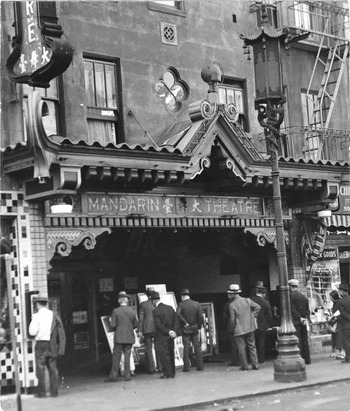
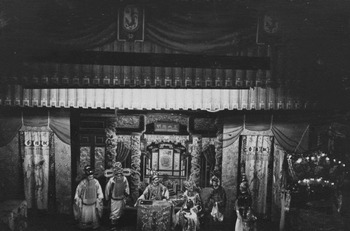
Harry Partch arrived in the Bay Area virtually simultaneously with the opening of the Mandarin and Great China theaters. Once there, he eschewed the traditional concert scene and quickly began attending performances of Cantonese opera at the Mandarin, one of the premier venues for Cantonese opera from the moment it opened its doors at 1021 Grant Avenue in June 1924 (Figure 1). The Mandarin was built according to Western practices with a sloping main floor, individual wooden chairs, a balcony, and two viewing boxes flanking the stage. The stage itself followed Chinese tradition, however. Although the theater featured a proscenium, instead of an arch the architects designed a rectangular frame with a stage apron extending out toward the audience.Footnote 21 Musicians were seated stage right in three rows in a railed-off box complete with a shell-shaped board to project their sound into the auditorium in full view of the audience (Figure 2).Footnote 22 This capitulation to and mingling of Western practices was found not only in the Mandarin's architecture, but also in the schedule of performances. The Mandarin focused on Cantonese opera, but in reviewing the tide of new Chinese opera theaters for the San Francisco Chronicle, Idwal Jones noted that “vaudeville of a sort, or rather, humorous tabloid drama, enlivens the patrons three evenings a week.”Footnote 23 The Mandarin was also wired for sound and by the 1930s showed films on a drop-down screen in addition to live entertainment. However, even though it produced shows other than Cantonese opera, the manner of operatic performances, like the changes to the proscenium, were designed to follow Chinese tradition.
Entrance to the Mandarin Theater at 1021 Grant Avenue, San Francisco, in October 1931. Photograph from the digital collection of the San Francisco History Center, San Francisco Public Library, used with permission.

Stage set for a palace scene at the Mandarin Theater in the early 1940s. Photograph from the Lois Rather Papers, San Francisco Museum of Performance & Design, used with permission.

The Mandarin's marquee on Grant Avenue advertised a long list of performances that began at 6:30 in the evening and lasted until midnight. Most patrons arrived around 9:00 at night, and a sizeable number left before midnight; thus, there was constant traffic coming and going throughout the performances, although a printed outline of the plot for that night's and the following night's opera were distributed, so audiences could follow the stage action no matter when they arrived.Footnote 24 Audience members not only moved around at will, but also were able to eat throughout the performance, as a refreshment stand sold oranges, candy bars, chewing gum, and pink lemonade along with Chinese delicacies.Footnote 25 In fact, the audience's behavior was notable enough to Westerners that almost every newspaper review or magazine article of the time mentioned it in some way, such as Idwal Jones's description of men drying out their socks on seatbacks, women nursing their babies, youths reading the sports section of newspapers, and children running around while vendors hawked food.Footnote 26 In this aspect, at least, performances at the Mandarin remained true to those held in China.
Although no one recorded what specific performance Harry Partch attended at the Mandarin, he was present at the long evening productions there and imbibed the atmosphere and the music, as we have seen above.Footnote 27 Understanding the impact that this theatrical style had on Partch's aesthetic and music requires an understanding of Cantonese opera's most salient characteristics.
Lasting over five hours, performances included not only the singing and instrumental music Westerners expect from a genre labeled “opera,” but also dance, miming, magic, acrobatics, and martial arts.Footnote 28 The orchestra remained on stage the entire time and often set the scene visually as well as musically because there were few theatrical sets or elaborate props as commonly understood. The Mandarin Theater orchestra generally consisted of numerous percussion instruments—including cymbals, gongs, and drums, which led the orchestra—as well as the dizi (a transverse-blown bamboo flute with a membrane hole that gives the instrument's sound a buzzing timbre), the gaohu (a two-stringed instrument bowed between the legs that is similar to but higher pitched than the erhu), the yueqin (a four-stringed guitar whose sound box is shaped like the full moon), the yangqin (a hammered dulcimer), and up to seventy-five other instruments as needed.Footnote 29 Musicians played unnotated music; in Cantonese opera, performers draw from a wellspring of orally transmitted melodies that are shaped according to long-established conventions and matched to the tones of the given aria being performed.Footnote 30
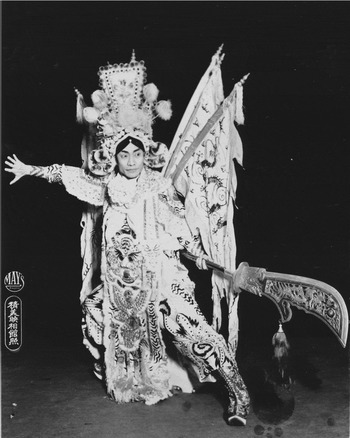
Instead of specific characters, actors played broad dramatic categories called “role-types,” such as martial male, virtuous female, clown, and so on, expressing each role-type through facial makeup, gait, gesture, posture, vocal range, vocal quality, and ornamentation (Figure 3).Footnote 31 These role-types acted out stories from Chinese history, heightened by the complex web of symbolic associations among music, actor movements, stage props, and the audience's prior knowledge. This opera was one of stylization, abstraction, and intense theatricality,Footnote 32 as noted by renowned music critic Alfred Frankenstein, who attended a performance at the Mandarin in 1936 and wrote about his experience for the 19 January 1936 edition of the San Francisco Chronicle. He attended a performance of The Uniting of the Twelve Kingdoms and, though a musician, was most drawn to the production's stylized visual aspects:
These young men in their gorgeous embroidered robes of canary yellow and ultramarine, wearing headdresses of pearls run riot with tufted pompoms and long, dashing plumes, spoke and enacted no language of the theater known to us in the Western world. Faces were enameled masks. Those of the men were fierce with black bushy slants of eyebrows and splotches of raw color on the cheeks. Those of the women were dainty and shell-like as the faces of Oriental dolls, and steadfastly lacquered in expression. Both women and men revealed complete sets of gold teeth when their lips parted, an inescapable tribute, Mr. Chan told us, to a recent but now outmoded fad in China.Footnote 33
After this visual description dripping with Orientalist tropes, Frankenstein devoted most of his article to minutely describing the plot, relegating his comments on the music to the fact that, “played by the shirt-sleeved orchestra at the side of the stage, [the music] was a constant pentatonic whine, relieved on occasion by a prodigious din of enormous cymbals and clatter of sticks on baked clay.”Footnote 34
Ma Shizeng (Mah See Don) as a general in a 1932 production at the Mandarin Theater. Photograph from the Lois Rather Papers, San Francisco Museum of Performance & Design, used with permission.

Frankenstein's disregard of the music mirrored that of many writers who covered the genre in the 1930s. In a book on San Francisco's Chinatown released the same year that Frankenstein visited the Mandarin, Charles Caldwell Dobie described his impressions of Chinese opera. Praising Mei Lanfang's artistry as unique, he comments that, to most Americans, Chinese opera is a curiosity:
There are poseurs who insist that they find it exceedingly profound and enjoyable. But do not trust them. It touches our racial consciousness at no point except when it turns acrobatic or slap-stick. . . . Which is not to claim that our drama is more profound. Our drama is less aesthetic and more social, perhaps. But in any event, it is too different, ever to achieve a rapprochement.Footnote 35
The music that others ignored virtually captivated Partch—along with the manner in which the audience related to the music. He found immersion in this environment a tonic after Los Angeles's stifling atmosphere. Instead of an audience sitting in straight-backed silence, Partch saw people coming and going as they pleased, commenting forcibly during the performance while eating snacks peddled by venders in the aisles. Instead of precision and uniformity of performance being the elusive aim, he heard instruments glide among intervals, playing nontempered pitches. Instead of black and white formality, he experienced color and dance and a variety of artistic forms working together toward the common goal of communication.Footnote 36 In other words, he found a performance that encouraged its audience to engage physically, mentally, and emotionally.
Partch saw performances of Cantonese opera as it was undergoing intense transformation. The Mandarin's physical structure was, as seen above, a compromise between Chinese and Western traditions. This compromise extended not only to the performance schedule but also to the performances themselves. The Mandarin featured curtains operated by rigging to signal the opening and closing of acts instead of accomplishing those changes in full view of the audience. Behind those curtains rested fully painted, realistic backdrops instead of the blank stage traditional in Cantonese opera. The incongruity between the stylized, representational gestures and the new backdrops was noted in the Federal Theatre Project's study of Chinese opera in the United States:
An official of the imperial court, in a particularly gorgeous and striking costume and a long beard, appeared on the stage with that beautiful stylistic “manner” of Chinese actors, carrying in his hand the much-tasselled [sic] wand which indicates that he is riding on horse-back. The scenario evidently called for a street scene. Hence the back drop was a painted representation of a modern city with boulevard lamps and contemporary vehicles in the street. One American spectator remarked, as a comment was made on the significance of the “whip,”—“Why does he ride a horse when he could take the bus?”Footnote 37
Beyond these physical innovations, the Mandarin also took part in shifts in operatic performance occurring throughout China as well. In the years Partch attended the theater, the highest paid star was Cheung Sook Kun, an actress. For centuries men had played all roles on the operatic stage, but in the early twentieth century, women were allowed on the stage and became some of the most sought-after stars.Footnote 38 Western instruments likewise appeared onstage, particularly violin, saxophone, and Hawaiian-style steel guitar. Although these three instruments were the most popular, some theater troupes used banjo, cello, xylophone, mandolin, cornet, guitar, and drum set as well.Footnote 39 Many of these alterations benefited from, and are often attributed to, the most popular Cantonese opera performer of the time, Ma Shizeng (Mah See Don). Ma was unique in not specializing in any particular role-type; he played all roles with equal ease. He was also an iconoclast by performing occasionally in Western dress instead of traditional costuming and by encouraging the adoption of Western instruments and of female performers. Although Ma did not receive the same amount of media attention lavished upon Mei Lanfang, he too toured the United States in the early 1930s and spent eighteen months in residence at the Mandarin beginning in 1931, energizing the theater with his innovative performances (Figure 3).Footnote 40
Chinese Music's Influence on Partch's Theoretical Thinking
Although Partch was in San Francisco during Ma's residence (he returned to the city in the spring of 1931, following time in New Orleans), there is no evidence that Partch saw Ma perform. However, the shifts in performance practice that Ma helped initiate and that Partch certainly did witness at the Mandarin became part of Cantonese opera's appeal. When he wrote his all-encompassing history of music in the first chapter of Genesis of a Music, Partch wrote extensively of Chinese music, noting that
For them, the idea of “purity” and “independence” in music and art simply did not exist. Present-day Cantonese music-theater, which one can hear in San Francisco and New York if he can succeed in filtering the continuous percussion from his senses, is certainly a far cry from the classic Chinese type, yet even here there is frequent and illuminating evidence that the audience understands the words, despite the percussion and the tiresome cracking of peanut shells.Footnote 41
In the Mandarin Theater among the ebb and flow of spectator movement and conversation, as well as the abstraction and stylization of stage action and music, Partch found a music that asked its audience members to participate, to call out when they enjoyed something and leave when they did not, to help create the atmosphere of performance instead of pretending not to be present, and to engage in a way the blue-hairs would find scandalous. He found direction.
Perhaps because of the closeness of finding Helmholtz's Pythagorean tuning and soon thereafter rediscovering Chinese music, the ideals of music in ancient Greece and China became irrevocably linked in Partch's thinking during the 1920s and 1930s. Because he based so much of his theoretical thinking on Pythagoras, he began to probe Chinese history for similar examples of connections between music and mathematics. That history is replete with examples, from Ching Fang's exploration in the first century BCE of the spiral of perfect fifths and fourths to create a tuning system based on sixty tones by reducing the resulting comma, to Ch'ien Lo-chih's theoretical enlargement of that system to the limit of 360 tones four hundred years later. Ho Ch'eng-t'ien even postulated a cyclic twelve-tone tuning system during the fifth century, the first approximation of equal temperament.Footnote 42 However, Partch evidently found few of these examples, as he never mentioned them by name and misdated their discoveries many centuries after they actually occurred. Still, one sees again and again in Partch's writings his desire to find similarities between the two ancient societies. Responding to Peter Yates's questions about equal intervals in 1963, Partch commented:
The theorists did, but this, I think, was a mathematical-intellectual exercise, as it certainly was with the ancient Chinese. If they discovered the 53-tone cycle in the 3rd century B.C. they must also have discovered the 12 and 19-tone cycles. The discovery would be ipso facto. But it took them many more centuries to give exact mathematical formulas, apparently.Footnote 43
Partch's early career, both in writings and compositions, focused on the practical application of just intonation through a system he called Monophony in which all intervals emerge from one fundamental pitch, rhythm and melody have their origin in the spoken inflection of the text, and performance is based on one voice. At first Helmholtz, and subsequently Pythagoras (once Partch discovered his writings), formed the basis of his Monophonic system, and he used Pythagorean references to explain both the mathematical basis of his music and the reason that he wrote his music in small, whole-number ratios.Footnote 44 Because he never uncovered a similar underpinning for just intonation in ancient China, as he did in ancient Greece, early in his career his notions of China were vague and unspecific. Consequently, when he did invoke China, it was usually in relation to ancient Greece. For instance, in an article written for the Carmel Pine Cone in 1941 during a Bach festival, Partch used the two cultures to present an alternative to the modern Western stream of music he saw originating with J. S. Bach: “The ancient Greek and Chinese conception—as old as history—that music is poetry has deteriorated until now; even when words are used, they are merely a vehicle for tones.”Footnote 45
Most of Partch's references to China from the 1930s through the 1940s were similar to this one. China had a tradition of poet/musicians, men who wrote and then performed their own poetry and were skilled performers on the qin. This form of expression, similar to his own Monophonic solo performances on first the Adapted Viola and later the Adapted Guitar, helped Partch show an historical precedence that existed outside the Western tradition for his compositions, and so he would posit a strong connection between words and music, the singer and the poet. At the same time, he rarely went beyond such general allusions to the struggle between modern musical forms and their ancient forebears.
Musically, Partch's evocations of Chinese music and aesthetics are more concrete. In 1930, desiring a clean break with his former manner of composing, Partch destroyed all of his compositions up to that point by burning them in a pot-bellied stove. He called the act “a kind of adolescent auto-da-fé.”Footnote 46 He then turned his attention toward crafting compositions that embodied principles of music drawn from both Greece and China and that utilized his microtonally expanded system of just intonation.
Partch began the composition process by building instruments to play in his new scale system, starting with the Monophone (which in 1933 became known as the Adapted Viola),Footnote 47 an instrument that fused a viola body with a cello neck-board and was played with the body held between a player's legs. A composition for this instrument came next, a setting for voice and the Adapted Viola of poems by the T'ang poet Li Po, also known today as Li Bai.
Commonly acknowledged in the West as one of the greatest Chinese poets, Li Po experienced something of a vogue in the early twentieth century, and his verses served as the basis of Arthur Bliss's The Ballads of the Four Seasons (1923), Constant Lambert's Four Poems by Li-Po (1927), and, most famously, Gustav Mahler's Das Lied von der Erde (1909). Although Partch was reading deeply in the works of Chinese antiquity at the time and had long admired Mahler's composition, Peter Garland has suggested that there may be more to Partch's use of this particular poet. Garland ruminated that the two artists were “both wild romantics, poets of nature and the wine-bottle, their verse/music both lyrical, violent and well crafted simultaneously. Their absolute lifelong quest for the living moment, the instant of wine-intoxicated enlightenment.”Footnote 48 Partch may have seen a bit of himself in Li Po.Footnote 49
Partch's Li Po Settings
Between 1930 and 1933, Partch set seventeen of Li Po's poems using translations published by Shigeyoshi Obata. As he had a long history with Chinese music, from exposure at home through his nights at the Mandarin Theater, it is reasonable to expect that Partch quoted directly from Chinese music at some point during the work. After all, later in his life he followed this pattern, writing “Olympos's Pantatonic” and “Archytas's Enharmonic,” re-creations of Greek scales while working on his setting of Oedipus.Footnote 50 However, Partch always vehemently denied any such quotation. Late in his life, he was sent a questionnaire for composers who used Asian music in their works. As was often the case when he felt misrepresented, Partch returned a prickly response:
I cannot answer your questionnaire. . . . I grew up on Chinese lullabys [sic] and heard the Cantonese music hall in my 'teens or before. I adored Kabuki on records very early and became passionate about it when I finally say [sic] it also. But I have never consciously used an Oriental theme, rhythm, scale. (I have used American Indian themes consciously.) I've been deeply influenced, philosophically, by Oriental culture. . . . Themes, never, in the sense of using them.Footnote 51
In fact, when he discussed the Li Po settings, Partch always framed the works with Western terminology, as though afraid his music would be discounted for its Chinese influence. Promoting his settings throughout the 1930s, he focused on their musical Greek heritage through Pythagorean use of just intonation in whole number ratios instead of their textual and aesthetic Chinese heritage through Li Po.
Partch's assertion that Chinese music influenced him philosophically but that he never musically copied the style runs through most of his writing of the period. However, such an assertion seems far-fetched when examining the works' performance aesthetic, let alone the music itself. Partch set poems originally written in Chinese, a tonal language. Because he was attempting to create a melody based on the rhythm and intonation of the spoken word, the natural, musical inflections of the original language must have influenced his compositional process, even though he set Li Po in translation. His typical practice for composing his early works began by notating the inflections used by skilled speakers of whatever text he was using. Although there is no evidence that he sought out a native Chinese speaker to intone Li Po for him, he did hunt down Cantor Reuben Rinder of the Congregation Emanu-El in San Francisco to recite Psalm 23 when he set it, and he approached an actor/singer to do the same for “The Potion Scene” from Shakespeare's Romeo and Juliet.Footnote 52 The inflections of Chinese may well have been in his ear when he began setting Li Po, whether from the bits of Mandarin he learned from his parents as a child or from the Cantonese he heard on the stage and from fellow patrons during his evenings at the Mandarin.
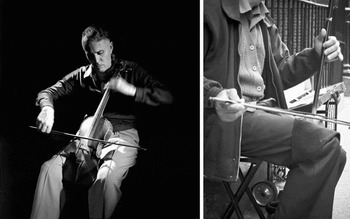
Similarly, he set the work for voice and Adapted Viola, an instrument he described as similar to a viola da gamba (Figure 4). In practice, however, the instrument bears a striking resemblance to the Chinese erhu, and in his manual on playing the Adapted Viola he called for a technique he termed “one-finger” in which the musician does not “perform like a pipe organ,” hitting notes in “precise, discrete steps,” but instead glides between notes, sometimes moving so slowly, “that one is not sure as to the point where rest has been achieved.”Footnote 53 The resulting sound is remarkably similar in tone and effect to the erhu. (Sound examples demonstrating the erhu and the Adapted Viola are given at www.journals.cambridge.org/sam2010001 and www.journals.cambridge.org/sam2010002.)
Partch's Adapted Viola (seen here on the left with Partch playing) bears a striking resemblance visually and in performance technique to the Chinese erhu (seen here on the right.) Photographs used with permission, Adapted Viola photograph courtesy of Fred Lyon; erhu photograph courtesy of Justin Kelley.

Beyond these issues, there is the music itself. These songs are not an attempt to put Partch's theoretical ideas into music. As Gilmore observes, they are “not so much ‘about’ particular ways of combining musical tones as they are ‘about’ a particular kind of performance projection or bearing.”Footnote 54 They are a first attempt to pull an audience into performance emotionally and have them participate in an intimate dialogue. Undoubtedly the music was inspired by Cantonese opera, an aesthetic influence to which Partch readily admitted; but they also feature quotations of Chinese music, a fact Partch denied repeatedly.
Chinese Musical Elements in “On Hearing the Flute in the Yellow Crane House” and “On Hearing the Flute at Lo-Cheng One Spring Night”
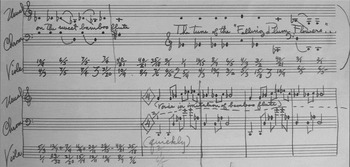
Exploring the songs reveals that Partch did indeed thread Chinese allusions throughout the works. The most obvious on first listening is found in the 1932 setting “On Hearing the Flute in the Yellow Crane House.” Immediately following the lyric, “I heard some one in the Yellow Crane House / Playing on the sweet bamboo flute / The tune of the ‘Falling Plum Flowers,’” Partch instructs the singer to sing pure pitches “in imitation of bamboo flute” (Figure 5). The melody the singer performs is not “Falling Plum Flowers,” but rather “Mo Li Hua,” a famous Chinese folk song that entered Western consciousness through the Belgian J. A. van Aalst's 1884 publication Chinese Music, where he titled it “Jasmine Flower Song.” Perhaps best known from its use in Puccini's Turandot, this work is quite possibly the Chinese lullaby Partch cited as the one Chinese melody he remembered from his childhood. At first glance, it appears that in this instance he used the quotation as a type of decoration; the text mentions a song played on a bamboo flute and, suddenly, that song appears.
Partch's manuscript for “On Hearing the Flute in the Yellow Crane House.” Following the voice's intoning of the line “The tune of the ‘Falling Plum Flowers,’” Partch asks the singer to sing pitches “in imitation of bamboo flute.” Note that the instrumental part between the voice and the Adapted Viola provides the exact vocal pitches on the Chromelodeon; the voice part as given is a guide for the singer in performance. Manuscript excerpt used by permission of Schott Music GmbH & Co KG, Mainz, Germany.

Through this description, Partch's use of “Mo Li Hua” seems to have much in common with the manner in which earlier composers appropriated non-Western music, as a mere spice added to a traditionally Western composition to give it an Orientalist kick that does not impact the work's structure. Through the thick layers of aesthetical, philosophical, musical, and performative engagement with Chinese culture demonstrated earlier, however, Partch joined Henry Cowell, whose own multiple layers of engagement with, and use of, Asian music had an important impact on the development of music in the United States, as one of the first Western musicians to engage music from another culture beyond a surface manner.Footnote 55 He could have easily resorted to chinoiserie, where, in many compositions of the period, pentatonicism and parallel fourths signify East Asia.Footnote 56 He could have easily written the entire melodic line as imitation of the song. Instead, he set it in the voice with no accompaniment. Here is a purely Monophonic performance where the music rises out of the human body through the one voice without an intermediary.
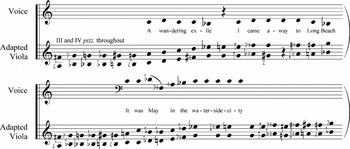
Partch also used “Mo Li Hua” as a structural lynchpin. Although there is only one small line of text after “Mo Li Hua” enters, the number of pitches given to the voice is almost equal before and after its beginning—sixty-three tones before and sixty-two after, including the voice's presentation of the song. Partch based fully half of “On Hearing the Flute in the Yellow Crane House” on “Mo Li Hua,” bringing it to the fore instead of relegating it to decorative status. He further highlighted the song's placement through harmony and performance style. Harmonically, “On Hearing the Flute in the Yellow Crane House” is constructed of parallel sixths moving up an almost stepwise pattern through Partch's forty-three-tone scale, although some pitches that appear are chromatically outside that pitch collection.Footnote 57
Because Partch used pitches remote to the traditionally equally tempered scale, he notated them using ratio notation based on his study of Helmholtz. This “language of ratios,” as he called it, shows the relationships between adjacent overtones in a manner similar to the proportional lengths of a vibrating string. It begins with the smaller whole number ratios that produce intervals familiar to Western ears—the octave (2/1), the perfect fifth (3/2), the major third (5/4)—before moving up the harmonic series to more complex relationships represented by larger ratios such as the stacked 40/21 and 8/7 that open “On Hearing.” These intervals are played pizzicato on the Adapted Viola and sequenced up roughly a whole step three times before sequencing back to the opening pitches immediately before “Mo Li Hua” enters (Figure 5). Partch mirrored this harmonic motion from the outset of “On Hearing” almost interval for interval following “Mo Li Hua's” presentation, creating balance through a framing device that sets the Chinese song in relief (Example 1). The performance indication of pizzicato likewise brings out the song, as “Mo Li Hua” is the only traditionally lyrical passage in the piece; all the music around it is plucked (in the Adapted Viola) or intoned (in the voice), styles that bring attention to the words instead of the music. As a result, “On Hearing the Flute in the Yellow Crane House” falls out of balance structurally and apart musically without the use of “Mo Li Hua.” (An audio example is given on www.journals.cambridge.org/sam2010003.)
The opening line and the line immediately following the quotation of “Mo Li Hua” in “On Hearing the Flute in the Yellow Crane House.” For ease of reading, this excerpt is transcribed into the notational system Ben Johnston developed for writing justly tuned pitches, although Partch's original used ratio notation. I am indebted to Janet Garcia Cameron's pioneering work in Partch transcription and to David McIntire for his help in preparing this example.

“Mo Li Hua's” importance becomes more apparent in the next setting, “On Hearing the Flute at Lo-Cheng One Spring Night,” composed on the same day as “On Hearing the Flute in the Yellow Crane House.” This setting opens with further use of the voice as a bamboo flute. When the voice enters, the audience expects that it will be singing a Chinese melody. That expectation is heightened at the setting's end when the voice proclaims “Hark! The plaintive tune of ‘Willow-breaking.’” All textual signs point to another use of a folk song. Partch's act of transference in the first “On Hearing,” where he used the cultural resources of China in a Western setting, has accomplished its task. The appearance of “Mo Li Hua” conditioned the audience to participate, to expect through similarity of titles a similarity of experience. Instead, because Partch knew Chinese music well enough to avoid chinoiserie tropes, he crafted a realistic approximation. There is no quotation in “On Hearing the Flute at Lo-Cheng One Spring Night.” At this moment Partch's use of Chinese music lifts above decoration into an equality of musical materials. He manages to use both Chinese and Western influences to forge a new musical ritual in a manner that preserves the aesthetic qualities of both.
These two songs were composed in San Francisco on 17 February 1932. The time and place of their composition is important in understanding their relationship to each other. In San Francisco Partch had become reacquainted with Chinese music through Cantonese opera and solidified his knowledge of its styles. These two settings were also two of three that he finished during that entire year before completing his seventeen settings in two bursts of inspiration in January and August of the following year. Their isolation and proximity argue for considering them as two parts of a whole. They balance each other, and only by considering both can one grasp the implications of Partch's transference of Chinese music. They represent the beginning of a new way of dealing with the musical world.
Chinese Musical Aesthetics and Corporeality
Although Partch began using Chinese musical materials early in his career, his application of them changed drastically when he began crafting his theatrical works in 1951. Beginning with his setting of King Oedipus, his thinking moved beyond Monophony to involve the entire human body and all the arts. In refining his new vision, he returned to the East Asian theater he had enjoyed in San Francisco thirty years earlier. This time, however, he wrote about it in a new way. When he considered applying to the Conference Board of Associate Research Councils to study in Japan in 1959, he wrote:
I am drawn to the Oriental attitudes because, in the Orient, there has never been any great separation of the theater-music arts, therefore no need to conceive of integration. I am also drawn because of my studies into, and my appropriation of, the ancient Greek musical philosophies. Despite our direct inheritance of Greek culture, despite the prevalence of Greek roots in our music-theater technical terms, the ancient spirit of integration has long since disappeared in the West. Through many centuries of Western specialization the forms of “theater” and “concert” have become separate and divorced entities. Probing beyond what I consider superficial differences, I see the ancient spirit, in virtually unadulterated form, in the Orient.Footnote 58
Notice the reversal that has occurred in this passage—Partch undermines the Greek aesthetic from which he drew in the 1930s and begins to use specific examples drawn from Chinese music and lore in its place. Also noteworthy is that Partch is now viewing Chinese music as part of the broader artistic heritage of East Asia, a much more global view of Asian art than he had assumed twenty years earlier. Whereas in the 1920s and 1930s he privileged Greek ideas and was vague in his discussion of Chinese influences, in the 1950s he complained primarily about how Greece's heritage has been manipulated by those who followed. Partch, long a student of music history, argued that every period has looked back to claim some form of descent from Greco-Roman society. In doing so, however, every age then twisted Greek culture to satisfy its demands and understandings. Even the Florentine Camerata, who Partch felt had come the closest to reviving the spirit of Greek music, ultimately succumbed to the trap of interpreting the past through the present. Partch believed that “the prime obligation of the artist is to transcend his age, therefore to see it in terms of the eternal mysteries, to use its materials at the same time that he transforms them into magic.”Footnote 59 By espousing the claim that he relied exclusively on Greek culture for his ideas, Partch must have felt that he was perpetuating the cycle of endlessly using that culture for validation. No one would take his call for renewal seriously if it were seen as more of the same. Instead he began to look for ways to integrate the Greek influences more fully with East Asian impulses. He realized that he needed to go outside his own society for a more powerful call for renewal, to find the magic he hoped to create to revitalize music.
Part of that magic came from the lack of compartmentalization Partch felt that he saw in Eastern music. The history of the West for the last 500 years has been one of increasing division and discrete cataloging, born of men and women attempting to emulate what had survived from the Greeks and Romans.Footnote 60 This exploration of minutia caused Westerners to describe the universal in general terms, as theories arising from observed data. Partch believed that the Chinese, on the other hand, used metaphors grounded in specific attributes of nature and personality to describe the universal and gave the following example to explain his point: “A Tang poet of the 8th Century, a Chinese, uses one little specific to indicate something. ‘Lady,’ says he, ‘where do you live? There are 10,000 houses among the bamboo trees.’”Footnote 61
Hearing that koan-sounding explanation would tempt one to ascribe an impulse similar to that of John Cage to Partch's adoption of East Asian music and thought. Partch, however, was still after universal connections between ancient and modern societies; he simply had found a new aspiration beyond attempts to ally music with mathematics and performance. Showing this change in his thinking as he entered the 1950s, he wrote about the connections among the arts he was attempting to create in his essay “No Barriers,” published in Impulse in 1952.
That there is, in total experience, a deep and abiding tie with peoples removed both in time and space, seems to me beyond argument. In this regard music alone, of the elements that we ordinarily call culture, has all but been ignored by the Western world. Consider the ancient cultures of the Orient, where the synthesis mentioned is more or less constant practice.Footnote 62
The synthesis he mentioned was a way of performing that merged not only music and drama, but also dance, literature, and visual art. This notion of a music essentially connected to its performance is at the root of Partch's conception of Corporeality, the foundational aesthetic principle of his music crafted over the course of the 1950s and 1960s. Partch drew this notion directly from Chinese music (perhaps informed by his evenings at the Mandarin Theater) as well as Greek theatrical ideals, Japanese Kabuki and Noh, and even medieval chant. He described the concept in this manner:
For the essentially vocal and verbal music of the individual—a Monophonic concept—the word Corporeal may be used, since it is a music that is vital to a time and place, a here and now. The epic chant is an example, but the term could be applied with equal propriety to almost any of the important ancient and near-ancient cultures—the Chinese, Greek, Arabian, Indian, in all of which music was physically allied with poetry or the dance.Footnote 63
The Corporeal is a holistic combination of the visual and the aural in performance, using the medium of drama to favor integration over abstraction in an attempt to engage performers and audiences at a visceral level. Partch finds musical meaning in the act of creating music, not in the musical object itself.
In many ways this idea is similar to Christopher Small's notion of “musicking.” Small bluntly notes that “there is no such thing as music.”Footnote 64 Instead, he conceives of music as a verb, pointing anyone interested in the action's nature and meaning to performance, whether as listener or performer. In his view, the purpose of composing is not to create a significant work of art that will stand the test of time, but instead to fashion moments that facilitate performing and listening and communicating among all those involved. Suddenly, not only how the sounds are made, but also the place of performance, the behavior of those present, and the physical gestures (or lack of them) of performers and audience members are charged with meaning. Partch found a glimmer of this approach to music as a verb when, watching Chinese drama, he was startled to realize that his actions as part of the audience were part of the performance. Reflecting on his epiphany as he planned his own music theater works, Partch began to desire the same level of bodily engagement in his own compositions.
Although only a few musicians, such as Henry Cowell, had thought along these lines before him, Partch was not alone among artists attempting to pull East Asian conceptions into Western theater to renew it. Bertolt Brecht remarked in his 1936 “Alienation Effects in Chinese Acting” that
the Chinese artist never acts as if there were a fourth wall besides the three surrounding him. He expresses his awareness of being watched. This immediately removes one of the European stage's characteristic illusions. The audience can no longer have the illusion of being the unseen spectator at an event which is really taking place. A whole elaborate European stage technique which helps to conceal the fact that the scenes are so arranged that the audience can view them in the easiest way, is thereby made unnecessary. The actors openly choose those positions which will best show them off to the audience, just as if they were acrobats.Footnote 65
Broadening Brecht's comments to include all Western stage presentations, it is clear that Brecht, like so many Western artists looking East, wanted to remember the audience. Indeed, like Harry Partch, Brecht believed that only by wiping away the illusion of reality could one communicate with one's audience.
Although the connection between Partch and Brecht's theatrical aesthetics is striking, Partch mentioned Brecht only at the end of his essay “Monoliths in Music”; he never actively engaged with Brecht's theories. There was, however, another playwright and poet with whom Partch did feel an intense kinship—William Butler Yeats. In Genesis of a Music, Partch called Yeats “a voice in the wilderness” because he was concerned in his writings with the “inherent musical beauty of spoken words, unburdened by symphony orchestras and the Abstract beauty of sustained ‘word’ tones.”Footnote 66 Partch saw in Yeats a dramatist in search of a like-minded composer, and so, in the fall of 1934, he traveled to Dublin to visit Yeats and ask his blessing on a proposed setting of the playwright's King Oedipus. During the week Partch spent in Dublin, he took four days to talk with Yeats, left with letters of introduction to Arnold Dolmetsch and Edmund Dulac, and likely used Yeats's name a month later when he visited Ezra Pound in Rapallo, Italy.Footnote 67
Partch's encounters with these men and their work must have stimulated his thinking on the relationship between Greek drama and East Asian music and impacted the aesthetic change he was then, only a year after finishing his last setting of a Li Po poem, contemplating from Monophony to Corporeality. Yeats and Pound, although their relationship was strained by 1934, had both attempted to reinvigorate the dramatic arts through excursions not only into ancient Greek drama, but also into the Japanese tradition of Noh for much of the early twentieth century. Pound discovered Noh by editing Ernest Fenollosa's papers, which contained the Tokyo Imperial University professor's first-hand observations on Noh, which were admittedly romanticized representations of the dramatic form.Footnote 68 Pound introduced the dramatic form to Yeats, who in turn supplied an introductory essay to Pound's publication of four of Fenollosa's Noh translations.Footnote 69 In that essay Yeats follows precisely the artistic progression Partch was to follow thirty years later. He begins by noting that “I love all the arts that can still remind me of their origin among the common people, and my ears are only comfortable when the singer sings as if mere speech had taken fire, when he appears to have passed into song almost imperceptibly.”Footnote 70 In Partch's terminology, he desired the Monophonic, where singing grew out of speech, out of the one voice without an intermediary. In the very next paragraph, Yeats moves into a discussion of Noh, ultimately saying that “therefore it is natural that I go to Asia for a stage convention, for more formal faces, for a chorus that has no part in the action, and perhaps for those movements of the body copied from the marionette shows of the fourteenth century.”Footnote 71 Although Yeats conflates Japan with all of Asia and confuses Noh with Kabuki in the influence of Bunraku, the notion of finding influences for staging, for actors' physical movements, and for metaphoric conceptions of drama in Asian theater certainly resonates with Partch's notion of Corporeality. Partch's formulation of Corporeality took root in his writings in the years immediately following his time spent with Yeats and in his music with the completion of King Oedipus: Music-Dance Drama in 1951, his first full-scale musical theater work, which was based on Yeats's translation.
Partch, Brecht, Yeats, Pound, and many other artists shared a desire to go beyond engrained patterns of creative production to recapture ritual. Although the word “ritual” is often invoked to label a repeated pattern performed without meaning and without thought—ritual as thoughtless routine—most ritual scholars define it as a regular pattern of events and motions that contain meaning in their construction as well as in the gestures and thoughts performed by participants. In other words, ritual is “a way of doing things to trigger the perception that those practices are distinct and the associations that they engender are special.”Footnote 72 This definition would be enough to attract Harry Partch, but one additional feature of ritual drew him toward this conception of theater.
Victor Turner, in one of the earliest works of scholarship on theater as ritual, noted that “ritual is, in its most typical cross-cultural expressions, a synchronization of many performative genres.”Footnote 73 Ritualized theater is Corporeal theater.Footnote 74 It is a conception of the genre that asks the audience to be as engaged as the performers (albeit in a different manner) and uses all aspects of the arts—from dancing to music to lighting to wordcraft to costuming—to achieve that engagement. Exploring the features of Chinese opera writ large quickly reveals a cross-disciplinary synchronization because of the genre's multiplicity of facets. It features song, dance, mime, speech, slapstick, and even acrobatics in an effort to engage and entertain its audience, and each of those elements is delivered in prescribed ways packed with meaning. Audience members knowledgeable about the tradition, for example, can decode and find power in an actor's simple gesture of pulling an extended finger slowly down from one eye. The gesture requires neither props nor words.
Still, words are necessary to Chinese opera, and they pulled Partch to the genre as surely as did its integration of multiple art forms. In both ritual and Corporeal conceptions of art, words have a primacy of place. In ritual, words invite and signal participation; in Corporeality, words convey meaning. In both cases words provide additional layers of symbolism and are often dispensed by music. In Chinese opera that musical language is one that Alfred Frankenstein, in language typical of most reviewers of the time, could only describe as a “whine” relieved by the “din of percussion” when he encountered it at the Mandarin Theater.Footnote 75
Partch's own musical language often had similar labels applied to it to warn away potential listeners. His notion of Corporeal music not only encompassed engaging an audience on a bodily level, but also creating a music that began with the performer's body. He felt that Western music had rejected its power over human emotion by focusing on the mathematically precise, cerebral organizational principle of intonation known as equal temperament. Because that artificial system tunes musical instruments to intervals that do not occur naturally in harmonic overtones, Partch proposed replacing it with a forty-three-tone scale that allowed him to capture the rise, fall, and subtle gradations of human communication. In their understated pitch glides and sideways glances at standard intervals, Partch's vocal lines speak with a force similar to that of Chinese opera, and when joined to a dramatic language rooted in ritual, they rise from abstraction into concrete meaning.
Adopting a ritualized, Corporeal performance attitude was not just an elevation of Chinese performance aesthetics over contemporary Western ones; it was a refutation of the musical system into which, until that point, Partch had been inculcated. He mocked the Kantian notion, outlined in the “Critique of the Aesthetic Judgment,” of the dispassionate observer and instead embraced his audience's and performers' participation.Footnote 76 Ritualistic actions were Corporeal for Partch because they naturally included a basis in the body and were encased in a music that was emotive and unpretentious. Ritual could never be abstract for Partch, and neither could his music. Desiring a ritualistic, Corporeal, participatory, collaborative, integrated art, he remembered his nights at the foot of the Cantonese operatic stage. Instead of fighting to transform centuries of Western tradition, he elected to borrow from a tradition that he felt already featured the artistic elements he admired.
Like Brecht, Partch certainly did not comprehend the full implications of all aspects of Chinese opera. Instead, his experience can best be illuminated through metaphors. It was like watching a film in a foreign language with no subtitles, where the power of the movement and the vocal inflection communicate plot without a word being said. It was also like observing the Latin Mass, where the music's power comes from the mystery of the proceedings and the congregation's participation as much as from the actual words spoken. The veil drawn between Partch and the music by his lack of facility in the language allowed him to see in the music what he urgently needed to see. It offered him a new aesthetic stance and a new way to compose.
In Partch's Corporeal works after 1950, then, East Asian music and aesthetics play a role fully equal to the Greek heritage found in his tuning system. Part of this move must have been practical; although Greek drama did incorporate all the desired elements, few examples survived, and the presentation style could only be reconstructed based on written accounts. In East Asian theater, including Noh, Kabuki, and Peking and Cantonese Opera, Partch found a living tradition from which to draw. In fact, as he began working on The Bewitched in 1954, Japan made its first appearance among his writings. After that point, China, it seems, came to symbolize more broadly Eastern music theater and was used to show opposition to the West. Japan took the role of providing specifics, such as instruments (the Koto was used in Partch's Delusion of the Fury) and practices (Partch regularly attempted to leave the audience with a strong last image through a final tableau, as is common in Kabuki).
The clearest exposition of his desire for an integration of Greek musical theory in a ritualistic theater based on East Asian models can be found in Partch's numerous writings concerning his dance-satire The Bewitched, which premiered in 1957. Perhaps because it was a satire (Partch felt that Westerners were notoriously slow to comprehend satire), the composer wrote a number of essays describing his intent in writing the work and the impulse behind each scene. The Bewitched largely concerns the power of the ancient magic of ritual to free Westerners from the debilitating effects of the modern machine age. That Partch drew broadly from both Chinese traditions and those of Ancient Greece to release and renew modern Western music is clear simply from the titles of some of the individual scenes: “Three Undergrads Become Transfigured in a Hong Kong Music Hall,” “Exercises in Harmony and Counterpoint Are Tried in a Court of Ancient Ritual,” and “A Soul Tormented by Contemporary Music Finds a Humanizing Alchemy.”
At the same time, Partch wished to go beyond simply naming his scenes; he had an axe to grind concerning specialization, and this key concept reveals why Chinese music was so important in his thinking. Partch strongly believed that only in the West had music become a means of communication without reliance on any other artistic form. Music was kept separate from painting, which was kept separate from dance, which was kept separate from drama. The result was a constellation of independent artistic forms that lacked the deep, visceral impact they once commanded. In the East, Partch found that performers and audiences valued nonspecialization, the integration of the arts. Asian theater, Partch argued,
demands that the musician remain undismayed when he is asked to act, sing, dance, tumble, even to help design and light a stage. . . . Herein lies the chief barrier to such a philosophy, since our tendency toward a precious ‘purity’ in the arts has created departmentalized schools in everything. And the ancient value is buried under hegemonies and hierarchies and bureaucratic administerings.Footnote 77
Partch's desire to rekindle the “ancient value” of holistic art is an important background to the layout of the various scenes of The Bewitched. Immediately following the “Prologue,” during which the “Lost Musicians” summon the Witch to rouse humanity from its humdrum life, Partch places “Three Undergrads Become Transfigured in a Hong Kong Music Hall.” When he surveyed the state of society in general and musical society in particular, Partch wanted first to “divest the undergrads of the confirmed xenophobia that once blanketed them so lovingly in their cradles.”Footnote 78 The most important “unwitching” his composition could accomplish would be opening those minds involved in music's future at the moment of their inculcation into Western musical practices. If the renewal of Western music by East Asian practices were to occur, it would have to begin with those starting their musical careers. Therefore, he prioritized his vision of a musical world where “the exotic—East or West—does not hold more mystery than it ought.”Footnote 79 He wanted to upend completely the concept of the exotic and ultimately banish it by making non-Western music familiar through integration with Western musical concepts.
To accomplish his fusion of East and West musically, Partch returned for the first time in his music since the Li Po settings to a direct evocation of Chinese sound. Roughly one minute into the movement, the music pauses and a Chinese-sounding melody floats through the texture played on the Kithara and Chromelodeon. This melody alternates with the opening percussion patterns until, after a shout of “Hey!” by the Lost Musicians, a flute countermelody enters, both lines underscored by the Chromelodeon. As further percussion enters and the melody is passed around the ensemble, the resulting heterophony aurally resembles traditional Cantonese operatic and musical practices. Unlike in “On Hearing the Flute in the Yellow Crane House,” Partch never quotes any popular or famous Cantonese music pieces; yet he replicates the microtonal “whine” of those evenings almost thirty years earlier in the Mandarin Theater as assuredly as he manufactured a Chinese melody for “On Hearing the Flute at Lo-Cheng One Spring Night.” Then, as the movement's opening percussion patterns merge with the constructed Cantonese music, both subside into the Witch's vocalizations as she frees the undergrads from any preconceived notions. Having created a successful musical hybrid of East and West, of China and Greece, Partch brings out the Witch to highlight his achievement. With his integration of musical cultures, accomplished in a setting where neither one is given primacy and both are newly composed, Partch is now ready to move on to the other areas of society that need fixing. Reinvigorating music through ritual and the “ancient value” of integration, and therefore a return to Corporeality, Partch has laid the foundation for future musical development, both his own and others'.
This Corporeal concept of theater dominated Partch's thinking and output for the remainder of his life, as did this newer, more specific conception of China. Following The Bewitched, his theatrical works became more complex and ambitious, culminating in the 1966 Delusion of the Fury, where he based the first act on a Japanese Noh drama from the eleventh century and the second act on an African folk tale, weaving music from those cultures as well as Western and Chinese together in a mammoth tapestry. Even in his final interviews made for the documentary The Dreamer That Remains, Partch was still identifying with and appropriating Chinese aesthetics, as it was during those interviews that he uttered the quotation about living in 10,000 houses among the bamboo trees to demonstrate how to construct metaphorically the universal from the specific.
Harry Partch's bold claim that he was conceived in China and born in California was a baldly Romantic notion, but it is easy to see why he would desire such a connection, especially during his life's final three decades. Like all Westerners, he could legitimately claim a connection with ancient Greco-Roman civilization; unlike most of them, he could also claim a tenuous link to the other civilization that formed the basis of his aesthetic. Even though documentation conclusively proves that Partch was conceived, as well as born, in the United States, his association with China did begin even before his advent of self-awareness and obviously shaped his musical personality as well as his music. It is no wonder that, when he became dissatisfied with the state of Western music and, like so many others before him, turned to ancient Greece in order to save it, he also turned to China for a model of vital, relevant art.
For Partch, Greece came to symbolize a path to return to the way things should have been, a method by which to revitalize Western culture from within. Because he originally sought to return Western music to its roots, he naturally based his tuning system on Pythagoras and re-created Greek instruments such as the kithara to legitimize his attempts. As his aesthetic developed, however, he began to desire change in addition to renewal and encountered strong resistance from the university musical establishment that supported him at first. Ultimately that establishment kicked him out of one position after another and shuffled him from one institution to another. In the face of his desires and musical society's reaction, Partch began to concentrate outside the tradition into which he had been born. China came to represent an alternate way of practicing music. In the theater of East Asia, Partch found a sense of integration among the arts that he believed the West had lost or discarded. He shifted his attempts from renewing Western culture from inside, represented by ancient Greece, to trying to revitalize it from outside. The evolution of Partch's use of Chinese music and its impact on his aesthetic therefore mirrors his movement from Monophony to Corporeality, from the one voice to many working as one, and from repeating a path many had trod to stretching his legs and starting out on his own. The history of Partch's interactions with, and use of, Cantonese operatic practices is the history of his development as a composer. Only by tracing the interplay of his Asian influences with his Western ones can we begin to understand how he used those various “ancient values” to create something truly new.