Multidrug-resistant Acinetobacter baumannii is a significant hospital-acquired pathogen that is associated with considerable morbidity and mortality, as well as the ability to persist on environmental surfaces for prolonged periods. Reference Hota1,Reference Jawad, Seifert, Snelling, Heritage and Hawkey2 Patients in intensive care units (ICUs) are highly vulnerable to colonization and infection by A. baumannii and other multidrug-resistant organisms (MDROs), and previous studies have demonstrated colonization in at least a one-third of all ICU patients. Reference Vincent, Rello and Marshall3 Of the various resistance patterns of A. baumannii, one grave concern is carbapenem-resistant A. baumannii (CRAB), as highlighted by the World Health Organization (WHO) list of priority pathogens requiring research and development of new antibiotics. 4
In our center, the rate of CRAB was stable with no clear evidence of outbreaks; hence the possible nosocomial transmission of CRAB in an endemic setting was poorly characterized. Thus, infection prevention and control (IPC) resources were preferentially concentrated on other MDROs. In May 2015, an increase in CRAB infections occurred in the medical intensive care unit (MICU). A point-prevalence study (PPS) was carried out, involving screening of all admitted inpatients and environmental surfaces. Reference Ng, Marimuthu and Lee5 Whole-genome sequencing (WGS) showed clustering of isolates within rooms (patient and environmental samples) but not across rooms. However, an additional 1-month genomic surveillance of clinical cultures revealed onward clonal transmission of CRAB.
Thus, we determined that an ongoing genomic surveillance was needed to investigate the extent and identity of potential routes of nosocomial transmission of CRAB within the hospital. We report our experience in combining WGS and epidemiologic data to identify the burden of nosocomial transmission CRAB and guide targeted IPC interventions.
Materials and methods
Study design and participants
We conducted prospective genomic surveillance on all available CRAB clinical isolates from Tan Tock Seng Hospital, a 1,700-bed teaching hospital in Singapore, from May 1 until November 2, 2016. All patients with CRAB isolates from clinical cultures (eg, blood, urine, swab, or tissue culture ordered by primary managing physicians for diagnosis of an infection) within the study period were included. Sequencing results were analyzed together with epidemiological analyses (ie, evaluated in reference to phylogenetic linkage information) from October 12, 2016, onward. Historical CRAB isolates, including those from the previous PPS in 2015, Reference Ng, Marimuthu and Lee5 were also included in the analysis to determine the persistence of genomically linked transmissions.
Study procedure
From the electronic medical records, we collected demographic information (age and sex) and movement data, including wards occupied, duration of stay in each ward, and dates of interward transfers. Each patient’s epidemiological risk of CRAB transmission was classified into either spatio-temporal overlap (sharing the same ward at the same time) or spatial only overlap (sharing the same ward at different times). These overlaps had to be present before or on the date of sample collection of the index CRAB isolate. The epidemiological risk was correlated with the genomic analyses to identify the opportunities for horizontal CRAB transmission, as evidenced by having genomically linked CRAB isolates in addition to having a potential epidemiologic risk (ie, spatiotemporal or spatial overlap).
Laboratory methods
Clinical isolates were identified as A. baumannii using matrix-assisted laser desorption ionization–time-of-flight mass spectrometry (MALDI-ToF MS, Bruker Daltonics GmbH, Germany). Susceptibility testing was performed on all isolates of A. baumannii using the Kirby-Bauer disk diffusion test, and carbapenem resistance was defined as those with a meropenem zone ≤14 mm based on the Clinical Laboratory and Standards Institute criteria.
Genome sequencing methods
Sequencing libraries for each isolate were prepared according to the manufacturer’s recommendation using the Illumina Nextera XT kit (Illumina, San Diego, CA) and sequenced using Illumina technology. The Illumina reads were assembled de novo using SPAdes Genome Assembler version 3.9 with default parameters and pipeline options (–careful). Reference Bankevich, Nurk and Antipov6 Bacterial species were identified using Kraken version 0.10.5-β, with default parameters. Reference Wood and Salzberg7 Multilocus sequence types (STs) were identified using SRST2 version 0.2.0 with default parameters (available at https://github.com/katholt/srst2). Reference Inouye, Dashnow and Raven8 Isolates with discordant phenotypic and genotypic species identification were removed from subsequent analysis. Core genome alignments were performed with ParSNP Harvest version 1.1.2 using the de novo assemblies of the bacterial isolates, as well as a reference sequence from GenBank (accession no. NC_009085.1). Recombination filtering was performed on the core genome alignments using Gubbins version 1.4.9 with default parameters. Reference Croucher, Page and Connor9 Pairwise single-nucleotide polymorphisms (SNPs) between the isolates were calculated using an in-house R script (https://github.com/ramadatta/Scripts/blob/master/R/dnaDist.r).
Transmission clusters were defined using the R igraph package (https://github.com/igraph/rigraph). The pairwise SNP threshold used to define these clusters was 21, which was derived from the maximum pairwise SNP count between CRAB isolates from the same patient (excluding environmental samples). Reference Ng, Marimuthu and Lee5
IPC interventions
Findings from the study were regularly presented to the hospital IPC and ICU committees, and follow-up actions were documented. The incidence rate of patients with positive CRAB clinical cultures were prospectively collected based on data provided by the hospital microbiology laboratory. The rate of adherence to enhanced cleaning measures, including hydrogen peroxide vapor (HPV) disinfection was recorded by the IPC team.
Ethical approvals
This study was approved by the National Health Group of Singapore Domain Specific Review Board (NHG DSRB 2019/01071). Collection and sequencing of the retrospective isolates from 2015 was part of a separate study (NHG DSRB 2014/00046).
Results
Sample details and genomic sequencing
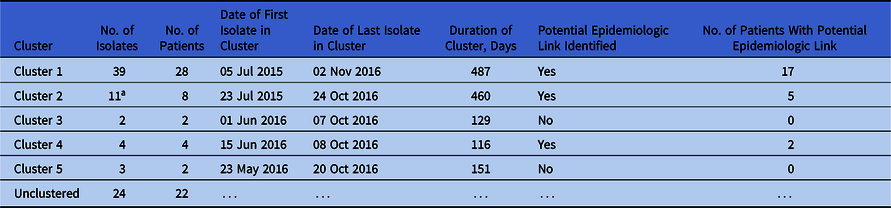
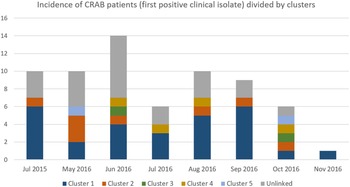
Within the study period, 141 clinical isolates of CRAB were identified, of which 66 isolates were available for WGS. Including 22 historical isolates from a previous study comprising 12 clinical and 10 environmental isolates, Reference Ng, Marimuthu and Lee5 a total of 88 isolates were subjected to WGS. We excluded 4 isolates that were genomically classified as non–A. baumannii based on genomic sequence data and 1 sample that failed sequencing. The resulting 83 isolates (66 unique patients) were used for the subsequent analysis. The breakdown of specimen types of these 83 isolates is reported in Supplementary Table 1 (online). Of these 66 patients, 49 (68.1%) were male, and the median age was 71.5 years (interquartile range, 62–78). We identified 5 distinct genomically linked clusters. The final clustering comprised 59 isolates involving 44 patients (66.7%) ranging in size from 2 to 28 patients (Table 1). Two clusters (clusters 1 and 2) were genomically linked to historical isolates from 2015, indicating persistent clonal transmission lasting >1 year. Clusters 3, 4, and 5 were identified in 2016 and continued for 129, 116, and 151 days respectively (Table 1). Also, 24 samples (from 22 patients) were not genomically linked with CRAB isolates from other patients. The incidence of positive CRAB isolates across the different months, divided by clusters and unlinked isolates, is shown in Figure 1.
Clustering of Carbapenem-Resistant Acinetobacter baumannii Isolates After Phylogenetic Analysis

a Including 1 retrospective environmental sample from 2015.
Incident cases of positive CRAB patients by month (first positive clinical isolate), divided by clusters and unlinked isolates. aNo data were available between August 2015 (after the end of the previous 2015 study) and April 2016 (before the start of genomic surveillance). bFor patients with >1 isolate, the date of the first isolate was taken for depiction in this graph.

Epidemiologic investigation
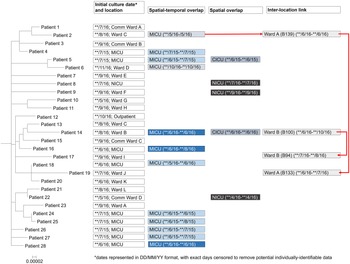
After correlation with epidemiologic data, genomic transmissions were explained by spatiotemporal overlap in 12 patients (27.3%) and by spatial overlap only in 12 patients (27.3%). The detailed epidemiologic and genomic linkage analysis of the largest cluster of 28 patients, cluster 1, is illustrated in Figure 2. Of these 28 patients, 14 (50%) were admitted to the MICU, of whom 2 were also admitted to the cardiology ICU during the same hospitalization period. Also, 3 patients were admitted to the neurology ICU and were never admitted to the MICU. Epidemiologic investigation demonstrated potential transmission routes for 17 patients (60.7%; 12 patients with spatiotemporal overlap and 5 patients with spatial overlap). Among the patients who were never admitted to the ICU, 2 patients were in the same general ward as CRAB patients transferred from the ICU, demonstrating dissemination of CRAB from the ICU to the general ward. However, the involvement of 9 patients in the cluster could not be explained by the epidemiological investigation.
Phylogenetic tree of Cluster 1 with concurrent epidemiologic information. Phylogenetic tree is depicted on the left with the patients numbered within this cluster. Similar coloured boxes represent clusters of either spatio-temporal overlap or spatial overlap. For example, all “dark blues” had spatial-temporal overlap at a different time from all “greys.” Red arrows represent routes of transmission between different locations. Note. MICU, medical intensive care unit; CICU, cardiology intensive care unit; NICU, neurology intensive care unit; comm ward = community ward (ward in an adjacent rehabilitation facility located in another building from the main hospital); other wards refer to general wards.

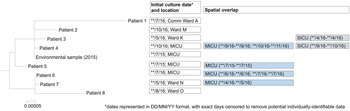
The epidemiologic and genomic linkage analysis of cluster 2, involving 8 unique patients, is depicted in Figure 3. Although there was no spatiotemporal overlap in this cluster, spatial overlaps were identified in both the MICU (4 patients) and the surgical ICU (2 patients, including 1 who was also admitted in the MICU at different points during the hospital admission). Additionally, 1 retrospective environmental sample from 2015, taken from the MICU, was genomically linked to the clinical isolates in this cluster, suggesting the presence of persistent reservoirs. The other 9 retrospective environmental samples were not genomically linked to any of the 5 clusters.
Phylogenetic tree of cluster 2 with concurrent epidemiologic information. Phylogenetic tree is depicted on the left with the patients numbered within this cluster. There were no patients with spatiotemporal overlap in this cluster. Similar coloured boxes represent patients with spatial overlap. For example all “blues” had spatial overlap at a different location from all “greys.” Note. MICU, medical intensive care unit; SICU, surgical intensive care unit; comm ward, community ward (ward in an adjacent rehabilitation facility located in another building from the main hospital); other wards refer to general wards.

Of the 3 smaller clusters, no areas of spatiotemporal or spatial overlap were identified between the patients in clusters 3 and 5 (2 unique patients each). In cluster 4, involving 4 unique patients, 2 patients had an area of spatial overlap in a general ward (Supplementary Fig. 1 online).
Infection prevention and control actions
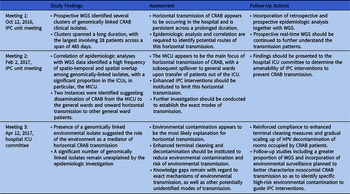
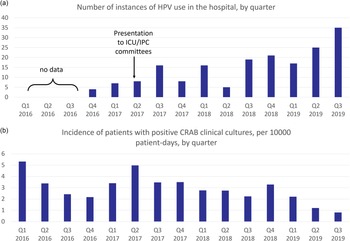
Results from the ongoing investigation were presented at regular meetings with the hospital IPC committee and subsequently, the hospital ICU committee. Findings, recommendations, and follow-up actions at these meetings are summarized in Table 2. By demonstrating evidence of horizontal transmission, especially within the ICUs and onward transmission to other wards, we highlighted the presence of ongoing transmission of CRAB and the need for enhanced IPC measures. Identification of a genomically linked environmental isolate, together with the high frequency of spatial overlaps that centered around the MICU pointed toward environmental contamination as the most likely explanation for horizontal transmissions in the ICUs. The presentation of these findings at the IPC and ICU meetings resulted in recommendations to step up measures for environmental decontamination which included strengthening of existing IPC measures, including enhancement of compliance to hand hygiene and transmission-based precautions. Additionally, terminal environmental cleaning of rooms occupied by CRAB patients was enhanced with the addition of hydrogen peroxide vapor (HPV) disinfection. We detected a clear upward trend in the utilization rate of HPV in the hospital after this study (Fig. 4A), with a concomitant decline in the incidence of patients with positive CRAB cultures (Fig. 4B).
Summary of Key Findings, Assessment, and Follow-Up Actions After Regular Meetings With IPC and ICU Committees

Note. IPC, infection prevention and control; ICU, intensive care unit; WGS, whole-genome sequencing; CRAB, carbapenem-resistant Acinetobacter baumannii; ICU, intensive care unit; MICU, medical intensive care unit.
Trend of (a) number of patients with positive CRAB clinical cultures isolated and (b) number of instances of HPV use in the hospital. Note. HPV, hydrogen peroxide vapor; ICU, intensive care unit; IPC, infection prevention and control; Q, quarter; CRAB, carbapenem-resistant Acinetobacter baumannii.

Discussion
In this study, WGS was used to demonstrate ongoing transmissions of CRAB in a hospital endemic for CRAB. By correlating the clinical and epidemiologic data, actionable routes of transmission were identified and targeted IPC interventions were implemented. WGS was utilized as a “tool of persuasion” in IPC, resulting in changes in IPC practices. As sequencing technologies and analytic tools develop, with improvements in output, speed, and costs, WGS can be utilized more often in the investigation and management of not only hospital outbreaks but also the endemic pathogens.
WGS has been demonstrated to be useful in outbreak investigations in previous studies by delineating routes and mechanisms of transmission in both hospital and community settings. Reference Harris, Cartwright and Torok10–Reference Snitkin, Zelazny and Thomas12 It has also been used in surveillance for monitoring and detecting MDROs, as an adjunct to or replacement for conventional culture or narrow-spectrum PCR techniques. Reference Pecora, Li and Allard13,Reference Zankari, Hasman and Kaas14 WGS is superior to conventional phenotypic or molecular characterization methods because it provides more sensitive genomic analysis, higher discriminatory power, and greater taxonomic resolution; allowing for more accurate characterisation of genetic linkages between various bacterial isolates.
This study had several limitations. First, only 46.1% of CRAB clinical samples were available for sequencing via WGS. Nevertheless, we managed to identify several clusters and demonstrated routes of transmission. If all clinical samples were sequenced, we would have likely identified more clusters or broadened the size of the detected clusters, and may have uncovered more routes of transmission. Second, although we identified clear overlapping spatiotemporal relationships between genetically related CRAB isolates, there was no conclusive evidence to demonstrate the exact mechanism of transmission, either directly from patient to patient, or indirectly (eg, environmental fomites, healthcare workers, or other unknown mechanisms). We did not evaluate healthcare worker factors such as presence of shared healthcare providers between genomically linked patients. Further work could be carried out to identify the exact mechanism of transmission by sampling these various sources (eg, through environmental sampling, screening of healthcare personnel) and by subjecting positive samples to WGS to determine relatedness to clinical samples. Third, a large proportion of patients within clusters with genomically linked transmission remained, but we did not detect evidence of epidemiologic linkage (ie, spatiotemporal overlap). The mechanisms of transmission between these patients remain unknown, and we postulate that they could be mediated via other means not picked up by the epidemiologic investigation.
A major gap in surveillance of only positive clinical cultures is not detecting asymptomatic carriers of CRAB, who may potentially play an important role in nosocomial transmission. Reference Harris, Johnson, Pineles, O’Hara, Bonomo and Thom15 Further study could include screening of close contacts for asymptomatic CRAB carriage to further delineate the possible role of asymptomatic transmission. Another potential route is via patient exposure to common areas or sources outside the ward, for example, in radiology facilities or operating and/or procedure rooms, which have been implicated in previous CRAB outbreaks in other settings. 16 Because the wards in our center are geographically and functionally separate from each other, interward transmission of CRAB without patient transfers were deemed less likely, and hence we did not study this. Nonetheless, we were unable to rule out CRAB transmission in such common service areas. These additional epidemiologic data should be included in future epidemiologic investigations to identify other potential routes of transmission.
Lastly, although the findings from our study have influenced infection control practices, it is unclear whether the institution of these interventions directly led to a reduction in the incidence of CRAB infections. Although there appeared to be an inverse correlation between an increase in HPV utilization and incidence of CRAB infections, causality cannot be directly inferred due to the potential impact of numerous other factors, such as changing patient demographics or antibiotic utilization rates, both of which were not analyzed in this study. Further study will be needed to evaluate the impact of such infection control interventions and assess their efficacy.
Although concerns have been raised about the cost-effectiveness of WGS, these operational costs are expected to fall over time as the technology advances and becomes more commonly utilized. The use of WGS has even been shown to result in cost savings in a study by Mellmann et al, Reference Mellmann, Bletz and Boking17 as a result of reduced workloads and isolation requirements by excluding nosocomial transmission with its more precise typing methods.
In conclusion, WGS is a tool that can be used effectively in characterizing nosocomial transmission of MDROs. Correlating phylogenetic relationships of bacterial isolates with concomitant epidemiologic information can identify previously unseen routes of transmission, allowing for precise targeting of infection control measures, as well as serve as a “tool of persuasion” for the implementation of these interventions.
Supplementary material
To view supplementary material for this article, please visit https://doi.org/10.1017/ice.2022.115
Acknowledgments
Financial support
Funding for this study was provided by the National Medical Research Council (NMRC) Collaborative Grant CoSTAR-HS (grant no. NMRC CGAug16C005), NMRC Clinician Scientist Award (grant no. MOH-000276), NMRC Clinician Scientist Individual Research Grant (grant nuo. MOH-CIRG18nov-0006), National Healthcare Group (NHG)-Lee Kong Chian School of Medicine (LKC) Clinician Scientist Preparatory Programme (grant no. CSPP-20003), and German Federal Ministry of Health (BMG) COVID-19 Research and Development funding to the World Health Organization (WHO).
Conflicts of interest
All authors report no conflicts of interest relevant to this article.