Introduction
This paper reports a psychometric evaluation of the Swedish version of the Person-Centered Care Assessment Tool (P-CAT), an instrument aiming to measure the extent to which staff in aged care facilities rate the care provided as being person-centered. Person-centered care is a complex and multidimensional concept describing care that takes the person's subjective experience of well-being and ill-being as its starting point (McCormack, Reference McCormack2004; Chappell et al., Reference Chappell, Reid and Gish2007; Edvardsson et al., Reference Edvardsson, Winblad and Sandman2008b). Tom Kitwood's book, Dementia Reconsidered (Reference Kitwood1997), is considered seminal in conceptualizing person-centered dementia care in a concrete way. The concept has been further developed and is commonly used to describe good care, especially within aged care and in care for persons with dementia (Brooker, Reference Brooker2003; Slater, Reference Slater2006; Edvardsson et al., Reference Edvardsson, Winblad and Sandman2008b), and it is expected that a person-centered approach will promote well-being for those being cared for and their families (Edvardsson et al., Reference Edvardsson, Winblad and Sandman2008b).
Although there is no total consensus on the definition of the concept, some common aspects of person-centered care have been described: striving to maintain personhood in spite of declining cognitive ability; collecting and using personal experiences of life and relationships to individualize care and the environment; creating a positive social environment; prioritizing relationships as much as care tasks; striving to see behavior from the person's point of view; involving family members in care and offering shared decision-making (Brooker, Reference Brooker2003; McCormack, Reference McCormack2004; McCormack and McCance, Reference McCormack and McCance2006; Slater, Reference Slater2006; Edvardsson et al., Reference Edvardsson, Winblad and Sandman2008b). Most authors seem to acknowledge the humanistic and ethical value of person-centered care, even if some have questioned the achievability of person-centered care in practice (Brooker, Reference Brooker2003; Dewing, Reference Dewing2004).
A number of research studies have recently been published which show a positive outcome for older people, persons with dementia, family members and staff from various interventions to promote person-centered care. Some interventions include part of the underlying understanding of the concept of person-centered care – for example, life story work (Moniz Cook et al., Reference Moniz Cook, Stokes and Agar2003; McKeown et al., Reference McKeown, Clarke, Ingleton, Ryan and Repper2010). Other interventions include different individualized care aspects and/or multi-method interventions (Sloane et al., Reference Sloane2004; Chenoweth et al., Reference Chenoweth2009; Dilley and Geboy, Reference Dilley and Geboy2010; McCormack et al., Reference McCormack2010; Palese et al., Reference Palese, Granzotto, Broll and Carlesso2010). For older people and persons with dementia, it has been reported that person-centered care increases well-being (McKeown et al., Reference McKeown, Clarke, Ingleton, Ryan and Repper2010), reduces ill-being and discomfort (Sloane et al., Reference Sloane2004), reduces the prevalence of difficult behavior (Moniz Cook et al., Reference Moniz Cook, Stokes and Agar2003; Sloane et al., Reference Sloane2004; Chenoweth et al., Reference Chenoweth2009), reduces the prevalence of neuroleptics without increasing levels of agitation (Fossey et al., Reference Fossey2006), improves skin condition with regard to showering (Sloane et al., Reference Sloane2004), and lessens the prevalence of constipation with fewer residents receiving laxantia (Palese et al., Reference Palese, Granzotto, Broll and Carlesso2010). In addition, family members have been reported to feel more content and supported (McKeown et al., Reference McKeown, Clarke, Ingleton, Ryan and Repper2010) when involved in care that is person-centered.
For staff, higher job satisfaction, an increased sense of pride and satisfaction with the care given, professional growth, and less work stress have been reported (Dilley and Geboy, Reference Dilley and Geboy2010; McCormack et al., Reference McCormack2010), as well as more effective and supportive teamwork (McCormack et al., Reference McCormack2010). However, the differences in the design of interventions and outcome measures make it hard to compare and draw conclusions from the results. Few of the studies included direct assessment regarding whether or not the intervention actually increased the person-centeredness of care as perceived by staff, residents or family members.
The first structured tool developed in relation to person-centered care was Dementia Care Mapping (DCM; Brooker and Surr, Reference Brooker and Surr2006), which is a staff-based, dementia-specific observational tool. Today, a number of additional instruments have been developed for measuring person-centered care or dimensions of the concept. Some examples are the Person-Centred Inpatient Scale (PCIS; Coyle and Williams, Reference Coyle and Williams2001) and the Person-Centred Climate Questionnaire – Patient version (PCQ-P; Edvardsson et al., Reference Edvardsson, Sandman and Rasmussen2008a). Other tools focus on family members’ perceptions of care, for example, family involvement (F-INVOLVE) and the importance of family involvement (F-IMPORTANT) (Reid et al., Reference Reid, Chappell and Gish2007). There are also a number of staff-based tools; for example, the Nursing Context Index (Slater et al., Reference Slater, McCormack and Bunting2009), the Person-Centered Climate Questionnaire–Staff version (PCQ-S; Edvardsson et al., Reference Edvardsson, Sandman and Rasmussen2009), the Person-Directed Care measurement tool (PDC; White et al., Reference White, Newton-Curtis and Lyons2008), the Individualized Care Inventory (ICI, Chappell et al., Reference Chappell, Reid and Gish2007) and the Person-Centered Care Assessment Tool (P-CAT; Edvardsson et al., Reference Edvardsson, Fetherstonhaugh, Nay and Gibson2010). In a recently published review article of existing instruments measuring person-centered care, Edvardsson and Innes (Reference Edvardsson and Innes2010) concluded that most of the instruments had been developed recently, and thus most had not been used in outcome-research with a focus on the effects of person-centered care. In addition, the psychometric properties of existing instruments need to be further tested.
The P-CAT was chosen as it was suitable for use in a residential aged care population, and considered feasible by being shorter than other available tools while still capturing essential elements of Person-Centered Care as described in the literature.
In this study we further evaluate the psychometric qualities of the P-CAT when used in a Swedish sample, with the following research question: Is the Swedish version P-CAT a valid, reliable and feasible tool to investigate person-centeredness in residential aged care facilities?
Methods
Procedure
Data collection was conducted in two phases. First, the questionnaire was distributed to a pilot sample of 638 staff members in 44 residential care units for older people in northern Sweden. Secondly, the questionnaire was distributed to an additional 1300 staff in 151 residential care units for older people throughout Sweden to enlarge the sample size and thereby increase power and sample representativeness. The care facilities were chosen to provide variation in terms of urban/rural location, traditional residential care facilities (n = 74) and special care units for people with dementia (n = 121). In total, 1938 questionnaires were distributed and 1527 were returned, giving a response rate of 78%. We excluded 62 questionnaires due to more than 10% of the items not being completed, which resulted in a final sample of n = 1465. A subsample of 32 staff in six special care units for people with dementia in the north of Sweden participated in test-retest evaluation, completing the questionnaire twice within a two-week interval.
Sample
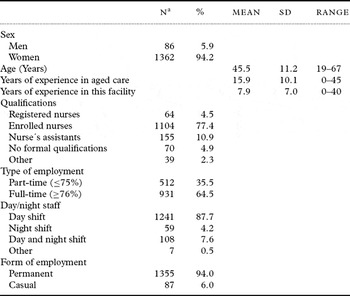
The sample consisted mostly of women (94.2%), with a mean age of 45.5 years ± 11.2 (range 19–67 years), who had considerable work experience within aged care (mean 15.9 years ± 10.1; range 0–45 years). Most participants were qualified as enrolled nurses, 77.4 %; see Table 1.
Characteristics of the sample

a n does not add up to 1465 in all variables due to missing data.
Description of the P-CAT
The purpose of the P-CAT is to measure the extent to which staff members rate the care provided as being person-centered. The P-CAT consists of 13 items formulated as statements about the content of care, the environment, and organization. Participants are asked to respond on a five-point Likert-type scale ranging from 1 (disagree completely) to 5 (agree completely). The total score of the scale ranges from 13 to 65, where higher values indicate a higher degree of person-centeredness. No cut-off values for high and low person-centeredness were described in the original publication.
The P-CAT was originally developed through a process of review of research literature, qualitative interviews and expert panel consultations. Interviews were conducted with people with early onset dementia, their family members and staff working in long-term aged care facilities in Victoria, Australia (Edvardsson et al., Reference Edvardsson, Fetherstonhaugh, Nay and Gibson2010). The questionnaire was tested for psychometric qualities in a sample of 220 staff in ten care facilities across Victoria. The exploratory factor analysis resulted in a three-factor solution: extent of personalizing care; amount of organizational support, and degree of environmental accessibility. Internal consistency was satisfactory except for subscale 3 (Cronbach's α 0.31), and test-retest reliability was also found to be satisfactory. The authors (Edvardsson et al., Reference Edvardsson, Fetherstonhaugh, Nay and Gibson2010) suggested that the dimensionality and internal consistency of the scale needed further investigation in other samples.
Translation
The P-CAT was translated into Swedish in a cyclic process of translation and back-translation by two independent bilingual persons. An evaluation of conceptual equivalence, cultural relevance and comprehensiveness between the original English version and the translated Swedish version was conducted by the research team, resulting in some minor changes in the wording of some items. A group of pilot readers with various experiences of caring for people with dementia, consisting of one teacher, one registered nurse, and two care workers without formal qualifications, was consulted to evaluate the readability of the items, which also resulted in some minor changes.
Statistical analysis
PASW statistics version 18 was used to analyze data. Normality was investigated by calculating skewness and examining histogram and Q-Q-plots. The total score was symmetric and normal distributed and parametric analyses were thus deemed appropriate. Construct validity was evaluated by confirmatory factor analysis using AMOS 17.0 with ML estimation and further investigated by explorative factor analysis, using Principal Component Analysis (PCA) with both oblique (direct oblimin) and orthogonal (varimax) rotation. The result of the oblique rotation is presented as the components in the scale are assumed to be correlated. The decision of the optimal numbers of factors to retain was investigated using parallel analysis and Velicer's MAP test (O'Connor, Reference O'Connor2000). Internal consistency of the scale was investigated by calculating Cronbach's α and item-total correlation. Test-retest reliability was tested with the dependent t-test, Pearson product-moment correlation coefficient and intra-class correlation coefficient. Relations between item score, subscale score, and total score were evaluated using the Pearson product-moment correlation coefficient. Differences between groups were evaluated using the independent t-test.
Missing items (<10%) in questionnaires were replaced with the mean value of the item (cf. Streiner and Norman, Reference Streiner and Norman2008). Five items were negatively worded and all statistical calculations were conducted after reversing those items (items 7, 8, 9, 10, 12). This means that higher scores in each item, in subscale scores and total scale scores indicate a higher level of person-centeredness.
Ethics
Ethics approval for the study was obtained from the Regional Ethical Review Board in Umeå (Dnr 2010-135-32).
Results
The mean score of the P-CAT in this sample was 48.8±7.37 (range 22–65). The skewness for the whole scale was −0.30.
Construct validity
Confirmatory factor analysis (CFA) was computed based on the assumed structure in which items loaded upon one of three factors (extent of personalizing care, amount of organizational support, and degree of environmental accessibility) according to the model originally reported (Edvardsson et al., Reference Edvardsson, Fetherstonhaugh, Nay and Gibson2010). ML estimation was used in the CFA since research suggests that ML estimation is fairly robust to categorical data (Lei and Lomax, Reference Lei and Lomax2005). Model fit evaluation was based on normed χ2 (χ2/df), the comparative fit index (CFI), the standardized root mean square residual (SRMR), and the root mean square error of approximation (RMSEA). The findings show that χ2/df = 11.7, CFI = 0.8, SRMR = 0.09 and RMSA = 0.09. According to guidelines for those measures by Schweizer (Reference Schweizer2010), the originally presented three-factor solution was not acceptable. This means that the CFAs based on our sample did not confirm the dimensionality of the P-CAT as suggested by the original study. Parallel analysis and Velicer's MAP test were then performed in order to determine the optimal number of factors to retain. Those methods are known to give optimal solutions in deciding the number of factors (O'Connor, Reference O'Connor2000) and both supported a two-factor solution. The 13 items of the scale were then subjected to a Principal Components Analysis (PCA). The correlation matrix showed a number of items with correlation ≥0.3. Bartlett's test of sphericity was significant (3767.846, p<0.001) and Kaiser-Meyer-Olkin was satisfactory (0.83) so it was considered appropriate to conduct a factor analysis. PCA suggested three components with eigenvalues above 1, with factor three loading just above 1 (1.04).
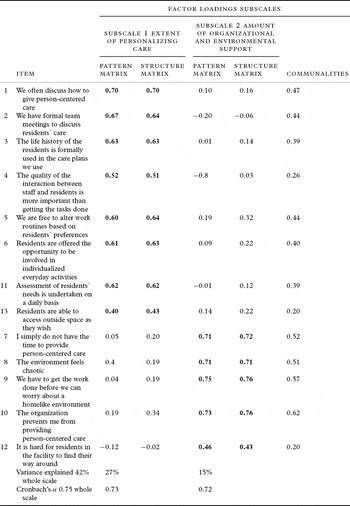
With regard to the results of parallel analysis and Velicer's MAP test, it was decided to retain two factors for further investigation. The PCA with two factors resulted in a solution explaining 42% of the variance. As shown in Table 2, after direct oblimin rotation, the structure matrix showed factor 1 including eight items and factor 2 including five items all loading above 0.43. The rotated solution showed a simple structure according to Thurston's criteria (cf. Nunnally and Bernstein, Reference Nunnally and Bernstein1994). Both factors also had a number of items loading above 0.60 indicating that these items have captured more definitively the interpretation of the underlying construct. The two dimensions were interpreted as (1) extent of personalizing care, and (2) amount of organizational and environmental support.
Factor loadings, communalities, Cronbach's α and variance explained for the Swedish version of the P-CAT

Reliability and homogeneity
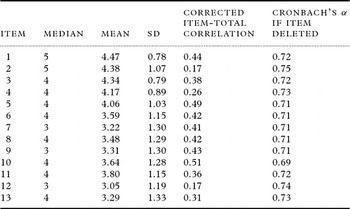
The internal consistency of the P-CAT was found satisfactory as Cronbach's α = 0.75 for the whole scale, 0.73 for subscale 1 and 0.72 for subscale 2, and thus exceeded the commonly recommended α value for scale reliability of >0.7 (Nunnally and Bernstein, Reference Nunnally and Bernstein1994; Streiner and Norman, Reference Streiner and Norman2008). If an item was deleted, Cronbach's α ranged between 0.69 and 0.74, indicating that all of the items contribute to the overall reliability. Item-total correlations ranged between 0.17 and 0.51. Three items (items 2, 4, 12) did not meet the commonly suggested cut-off level for item-total correlation, of > 0.3 (Nunnally and Bernstein, Reference Nunnally and Bernstein1994). Item performance is presented in Table 3.
Item performance for the Swedish version of the P-CAT

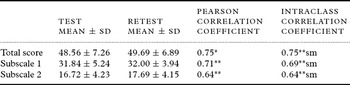
Test-retest reliability was investigated by calculating differences in mean between test and retest using paired sample t-test. There were no significant differences in mean between test and retest for the total scale or the subscales, thus indicating temporal stability. The Pearson product-moment correlation coefficient and intraclass correlation (ICC) were also calculated on test-retest total scores, indicating good test-retest reliability (r = 0.75, ICC = 0.75). The Pearson product-moment correlation coefficient and ICC were also satisfactory on subscale 1 (r = 0.71, ICC = 0.69) and subscale 2 (r = 0.64, ICC = 0.64). Test-retest reliability is shown in Table 4.
Test-retest reliability measures for the Swedish version of the P-CAT (n = 32)

* Correlation is significant at a level of 0.01 (two-tailed); ** significant at 0.001; sm = single measures.
Endorsement frequency and item discrimination
To investigate endorsement frequency, all items were dichotomized: 1–3 coded as low and 4–5 as high. For each item, the proportion of staff who scored high and low was calculated. Eight items showed endorsement frequencies in the preferred range between 0.2 and 0.8 (cf. Streiner and Norman, Reference Streiner and Norman2008). However, five items (items 1–5) showed endorsement frequencies less than 0.20 or above 0.80 (meaning that more than 80% scored high and less than 20% scored low). In addition, item discrimination was investigated by dividing all respondents into four groups according to the quartiles of the total score distribution. For each item, the mean scores were compared for respondents in the top quartile and respondents in the lowest quartile by using the independent t-test. All items showed a significant difference in mean value between the high scoring and the low scoring groups (item means were consistently higher in the high scoring group, p<0.001).
Discussion
This study aimed to evaluate the psychometric properties of the Swedish version of the P-CAT, and the findings have confirmed the reliability, discrimination ability, and practical usefulness of the tool. However, confirmatory factor analyses did not confirm the dimensionality of the tool as suggested in the original publication. A two-factor solution was strongly suggested in this sample. In contrast to the somewhat limited sample of the original publication, this study represents a large sample which increases the ability to generalize the results, at least across Sweden. The sample represents different areas of Sweden, both urban and rural regions and also different kinds of settings, although there is a predominance of special care units for people with dementia. The high response rate also contributes to the quality of this study, which indicates that the P-CAT is feasible and applicable for clinical use.
The reliability and homogeneity of the scale were deemed satisfactory with Cronbach's α above 0.7 for the whole scale and subscales. Moreover, Cronbach's α if item deleted did not rise by excluding any item. The item to total correlation was satisfactory for most of the items, even if three items did not meet the recommended cut-off criterion of >0.3. These items were item 2 (“We have formal team meetings to discuss residents’ care”), item 4 (“The quality of the interaction between staff and residents is more important than getting the tasks done”), and item 12 (“It is hard for residents in the facility to find their way around”). In addition, items 4, 12, and 13 (“Residents are able to access outside space as they wish”) showed lower communalities in the factor analysis, suggesting that the variance of these items is not very well explained by its factor. These items are thus candidates for further analysis in additional testing of the scale. The test-retest reliability was satisfactory, as evidenced through correlations and tests for mean differences. The scale showed stability between test sessions. A limitation of the test-retest evaluation might be the small sample size, compared with the sample size of the whole study, even if the main interest lies in temporal stability and not generalizability. Another limit on reliability is the fact that test-retest evaluation was performed in special care units only. Further studies are needed of test-retest reliability in other samples for reliability purposes.
All items showed good discrimination ability as there was a logical and significant difference in item mean between the group with the highest total score and the group with the lowest total score. This suggests that the scale will have the ability to discriminate between different groups of staff, different settings, and/or organizations. The endorsement frequency was satisfactory for most of the items, even if five items did not meet the criterion of 0.2–0.8. These were items 1 (“We often discuss how to give person-centred care”), 2 (“We have formal team meetings to discuss residents’ care”), 3 (“The life history of the residents is formally used in the care plans we use”), 4 (“The quality of the interaction between staff and residents is more important than getting the tasks done”), and item 5 (“We are free to alter work routines based on residents’ preferences”). This suggests that it can be predicted how staff will respond to these items. For example, with item 1 (“Person-centred care is often discussed”), staff were likely to score high, and it remains unknown whether this is the actual case or a desirable and/or politically correct answer.
The factor structure in this study differs from the original Australian study. This might be explained by differences in sample size, sample characteristics, and/or cultural issues. In the original study, the sample was quite small (n = 220), the response rate was limited (21%), and data were collected in the state of Victoria only. This study contributes with a large, nation-wide sample with a high response rate. However, it could be the case that the concept of person-centered care is understood differently in different cultures, settings, and/or organizations. Further studies examining how cultural differences may influence the understanding of person-centered care and how this is applied in practice would be a welcome addition to the international research in this field.
How do the items and subscales of P-CAT relate to theoretical aspects of person-centered care as described in the literature? The aspect “striving to maintain personhood in spite of declining cognitive ability” is the basis of the concept of person-centered care. Kitwood (Reference Kitwood1997) described personhood as “a standing or status that is bestowed upon one human being, by others in the context of relationship and social being” (p. 8). Kitwood further argued that recognition, respect, and trust are needed to maintain personhood, but also to take the unique experience of the person as valid even in dementia. This theoretical aspect is present in the underlying understanding of virtually all the items of the P-CAT, with the exception perhaps of item 12 “it is hard for residents in the facility to find their way around”. “Creating a positive social environment” as described by Brooker (Reference Brooker2003), is also represented in the P-CAT, and especially so in items 4 (“the quality of the interaction between staff and residents is more important than getting the tasks done”), 5 (“we are free to alter work routines based on residents’ preferences”), and 6 (“residents are offered the opportunity to be involved in individualized everyday activities”). “Striving to see behavior from the person's point of view” as described by Brooker (Reference Brooker2003), McCormack and McCance (Reference McCormack and McCance2006), and Slater (Reference Slater2006), is reflected in items 3 (“the life history of the residents is formally used in the care plans we use”) and 4(“the quality of the interaction between staff and residents is more important than getting the tasks done”). The aspect “collecting and using personal experiences of life and relationships to individualize care and the environment” as described by Brooker (Reference Brooker2003) and Slater (Reference Slater2006) is captured through items 3 (“the life history of the residents is formally used in the care plans we use”), 5 (“we are free to alter work routines based on residents’ preferences”), and 6 (“residents are offered the opportunity to be involved in individualized everyday activities”). Furthermore, “prioritizing relationships as much as care tasks” as described by Brooker (Reference Brooker2003) and Slater (Reference Slater2006) is focused in item 4 (“the quality of the interaction between staff and residents is more important than getting the tasks done”); “offering shared decision-making” as described by Brooker (Reference Brooker2003), McCormack and McCance (Reference McCormack and McCance2006), and Slater (Reference Slater2006) appears in items 6 (“residents are offered the opportunity to be involved in individualized everyday activities”), and 13 (“residents are able to access outside space as they wish”).
The first subscale of P-CAT – extent of personalizing care – reflects the intentions and actions of the staff to personalize care, prioritize the interaction and also the possibility for residents to make their own decisions. Subscale 1 reflects the elements described by Brooker (Reference Brooker2003) in the VIPS model: valuing people, treating people as individuals, and looking at the world from the perspective of the person. Subscale 1 also includes content relating to person-centered processes, prerequisites and care environment from the Person-centred Nursing/Practice Frame-work (McCormack and McCance, Reference McCormack and McCance2006; McCormack et al., Reference McCormack2010). The second subscale – amount of organizational and environmental support – includes factors in the environment and organization that can support or hinder personalization of care and the creation of a positive psychosocial culture, aspects which relates to the care environment (McCormack and McCance, Reference McCormack and McCance2006; McCormack et al., Reference McCormack2010), and the social environment (Brooker, Reference Brooker2003). It seems fair to conclude that the P-CAT covers the most common aspects of person-centered care as described in theory.
In the ecological theory of aging, Lawton (Reference Lawton1986) stated that human behavior is a product of personal competence and environmental demand. There is a person-environment fit when the demands of the environment are aligned to the competence of the person. This theory is useful in dementia, as loss of competence to some extent can be compensated by easing the demands of the environment to facilitate adequate behavior. Even though the findings of this study indicated a two-construct dimensionality of the P-CAT which includes the person and the environment, it does not capture the dimension of person-environment fit. The P-CAT items relating to the environment simply consist of aspects known to be influential in providing high quality person-centered care to older people and people with dementia, such as the extent to which the environment is calm or chaotic, homelike or institutionalized, supporting way-finding and facilitating outdoor visits (Edvardsson et al., Reference Edvardsson, Winblad and Sandman2008b).
Do these findings provide evidence enough to agree on the adequacy of the P-CAT? This study provides tentative evidence to support a valid and reliable use of the P-CAT in a Swedish residential aged care sample when the purpose is to measure the extent to which staff perceive the care provided as being person-centered. However, we acknowledge the limitations of translating a complex multidimensional theoretical concept into a short measurement tool. It seems reasonable to conclude that in waiting for further cross-validation studies between tools, settings, and samples, the P-CAT is one valid and reliable option for operationalizing the concept of person-centered care in residential aged care settings. However, further research is needed to explore the psychometric properties and empirical relationships between available scales aiming to measure person-centered care. Exploring criterion-related validity of the P-CAT in relation to other existing scales with similar purpose and content would contribute to provide further arguments for, or against, the relative uniqueness of the P-CAT.
Several interventions have been published reporting person-centered interventions and the outcome of these interventions on residents. Very few studies provide an insight into the black box of the intervention – that is, if the intervention actually increased the person-centeredness of care or if it was the increased attention or anything else that facilitated beneficial patient outcomes. Without a measure of whether or not the person-centeredness was perceived to increase, we cannot be certain that it was increased person-centeredness that facilitated beneficial outcomes. This is where the P-CAT can be of clinical use and how it can benefit the current literature.
Conclusions
This study supported the psychometric properties of the Swedish version of the P-CAT. However, some questions remain regarding the endorsement frequency of some items and the underlying construct of the scale. On the basis of this study, we recommend applying a two- subscale/two-factor structure when using the Swedish version of the P-CAT.
Conflict of interest
None.
Description of authors’ roles
K. Sjögren participated in designing the study, collected and analyzed the data, and wrote the paper. M. Lindqvist participated in analyzing the data and in writing the paper. P-O Sandman participated in designing the study and writing the paper. K. Zingmark participated in writing the paper. D. Edvardsson was the main supervisor, designed the study, participated in data analysis and helped write the paper.
Acknowledgments
This study was funded by Swedish Brain Power and Umeå University, Sweden.