Introduction
Prain (Reference Prain1889, Reference Prain1890) described Pedicularis oederi var. heteroglossa (Orobanchaceae) from specimens collected in the Himalayan mountains of Kumaon (India) and Nepal. He distinguished it from the typical variety by floral characters, namely galea as long as corolla tube, median lobe of lower lip of corolla prominent, calyx lobes linear-lanceolate and expanded terminally with elliptic lamina and curved margins. Later Pennell (Reference Pennell1943), after studying more material of the taxon from Garhwal and Kumaon Himalaya, Uttarakhand (India), in the herbarium of the Forest Research Institute, Dehradun (DD), raised it to subspecific rank and provided some additional distinguishing characters. Later taxonomists have placed it at either varietal or subspecific rank (Hara et al., Reference Hara, Chater and Williams1982; Yamazaki, Reference Yamazaki, Ohba and Malla1988; Yang et al., Reference Yang, Holmgren, Mill, Wu and Raven1998; Khanna et al., Reference Khanna, Mudgal, Uniyal and Sharma1999; Uniyal et al., Reference Uniyal, Sharma, Choudhary and Singh2007). The characters used by Pennell to distinguish Pedicularis oederi subsp. heteroglossa from the typical subspecies are as follows (Pennell, Reference Pennell1943: 140):
1a. Calyx-lobes attenuate, entire or distally dentate; galea 7–9 mm long, at apex rounded, so that the most distal point is near the posterior bend; capsule 15 mm long; leaf-blades 2–6 cm long; pinnae plane, evidently dentate with rounded lobules P. oederi subsp. typica
1b. Calyx-lobes with spatulate, dentate-lobulate tips; galea 9–11 mm long, at apex with the most distal point frequently toward anterior side; capsule 13 mm long; leaf-blades 3–9 cm long, the pinnae with the dentate-lobulate margin so incurved as to appear superficially triangular-acute P. oederi subsp. heteroglossa’
Typification
Pennell (Reference Pennell1943), while discussing the typification of Pedicularis oederi subsp. heteroglossa, mentioned that although Prain (Reference Prain1890) selected Duthie 232 from Damdar Valley, Tehri Garhwal for illustration, that specimen was not included in the protologue (Prain, Reference Prain1889). Of the specimens studied by Prain (Reference Prain1889, Reference Prain1890), he himself made it clear in both works that Dr Scully's Nepal specimen differed considerably from the Kumaon (typical) specimens and could form a distinct variety. As for the four Kumaon collections, the specimens of Royle and Wallich were without precise localities, so Pennell shortlisted the choice of lectotype to Collett's collection at Pindar, Kumaon, 14,000 ft and Duthie's collection at Bidang in Dhauli Valley, Kumaon, 14–15,000 ft. As none of the specimens could be located by Pennell in DD, he thought the specimens must be in the Calcutta herbarium (CAL), where Prain worked, and hence left the choice for researchers who could examine that material. During the present study none of this material could be located in CAL. However, Duthie's specimen collected at Bidang in Dhauli Valley has been found at DD. Even though Prain (Reference Prain1890) highlighted Wallich's collection from Kumaon, we find it preferable to choose a specimen with precise locality information, which could easily be recollected from the type locality. In view of this Duthie 3228 (DD) is here selected as the lectotype.
Status
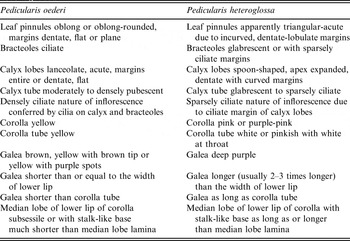
Based on a study of a large number of fresh and dried herbarium specimens, including the lectotype and other material studied by Prain, it was observed that Pedicularis oederi var. oederi and Pedicularis oederi var. heteroglossa differ in many important morphological characters (see Table 1). Some of the distinguishing characters listed by Prain (Reference Prain1889, Reference Prain1890) and Pennell (Reference Pennell1943) were found not to be exclusive, and are therefore not included. Many of the characters in Table 1 were not noted by Prain (Reference Prain1890) and the flower colour previously given is erroneous (see note below). Therefore, an emended description of Pedicularis oederi var. heteroglossa is provided here. At the same time we believe that the distinguishing characters of these two taxa are enough to raise the variety to species rank, as suggested but not implemented by Prain (Reference Prain1890).
Comparison of diagnostic characters of Pedicularis oederi and P. heteroglossa

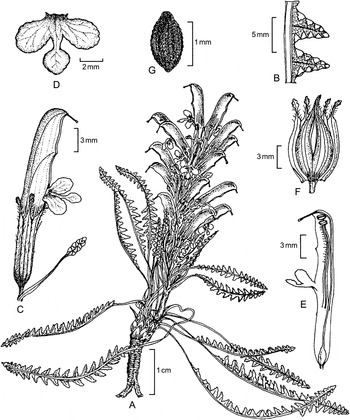
Pedicularis heteroglossa (Prain) Pusalkar & D.K.Singh, comb. et stat. nov. – Pedicularis oederi Vahl var. heteroglossa Prain, J. Asiat. Soc. Bengal 58: 276 (1889); Prain, Ann. Roy. Bot. Gard. Calcutta 3: 182, pl. 34B (1890). – Pedicularis oederi Vahl subsp. heteroglossa (Prain) Pennell, Scroph. W. Himal. 140 (1943). – Type: Bidang in Dhauli Valley, Kumaon, 14–15,000 ft, 4 ix 1884, Duthie 3228 (lecto DD!, designated here). Fig. 1.
Pedicularis heteroglossa (Prain) Pusalkar & D.K.Singh. A, habit; B, lower leaf surface showing recurved lobules; C, flower; D, lower petal lip; E, flower (vertical section) showing stamens and carpel; F, capsule with calyx cut open; G, seed.

Perennial herb, 3–18 cm high; rootstock with many fusiform branches fused apically; stems erect, solitary or many from rootstock; base covered with purplish scales or sometimes with remains of petiole bases. Leaves basal and cauline; basal leaves rosulate, spreading, 2–13 cm long, petiolate; petiole 1–5 cm long, glabrous or sparsely ciliate; lamina narrowly elliptic in outline, 1–10 × 0.3–1.2 cm, pinnatisect; pinnae apparently triangular due to curved margins, opposite to alternate, up to 7 mm long, up to 3 mm broad, toothed, crenate or lobed, downcurved, surface glabrous above, pustulate, glabrous to ciliate beneath; rachis channelled/grooved above, narrowly winged beneath; cauline leaves few, alternate, similar, smaller upwards. Flowers pink or purple-pink with deep purple galea and white or pinkish corolla tube with white throat, 18–25 mm long, in moderately dense racemes with lower flowers distantly arranged; lower bracteoles like reduced upper leaves; upper bracteoles smaller, somewhat spoon-shaped, with linear-lanceolate stalk and terminal expanded oblong lamina, often with lobed and curved margin, bracteoles smaller upwards, glabrous or sparsely ciliate along margins; pedicels 2–5 mm long, glabrous or sparsely ciliate. Calyx tubular, linear-cylindric, 9–15 mm long; tube 7–10 mm long, glabrous or rarely with sparse cilia; lobes unequal to subequal, 2–5 mm long, somewhat spoon-shaped, 1.5–3.5 mm long, margins ciliate with linear-lanceolate base terminating into expanded, oblong, 0.5–1.2 mm long lamina with toothed, curved margins, sometimes one of the calyx lobes (usually the shortest one) simple, lanceolate, without expanded terminal lamina. Corolla 18–29 mm long; tube 7–14 mm long, equally broad throughout or somewhat broadened at throat, glabrous, equalling or slightly exceeding the calyx; galea (compressed upper lip) 8–14 mm long, 2–3 mm broad, glabrous, apex acute or subacute, sometimes somewhat mucronate, longer (usually 2–3 times) than the width of the lower lip; in a straight line with the tube or not, somewhat obliquely curved forward, nearly as long as tube; lower lip 3-lobed, 4–5 × 4–6.2 mm; median lobe orbicular, oblong-elliptic or obovate, 2–4 × 2.5–4 mm, apex acute to rounded, margins entire or undulate, prominent with stalk-like base as long as or longer than lamina; lateral lobes suborbicular to obovate, 2–3 × 2.5–4 mm with rounded or undulate margins, larger than mid-lobe. Filaments inserted at the middle or slightly above the middle of corolla tube, anterior pair ciliate, posterior glabrous; anthers (in galea hood) horizontally placed, yellow, oblong, 1.2–2 mm long. Ovary elliptic, style slender, glabrous, exserted from galea tip; stigma punctate. Capsule ovate or ovate-lanceolate, 9–18 mm long, acuminate or apiculate at top, slightly exceeding the calyx, glabrous; seeds many, brown or black, elliptic, 1.5–2.2 mm long, reticulate.
Distribution. India (Uttarakhand: Garhwal and Kumaon Himalaya), Nepal.
Habitat and ecology. Locally common in moist places along streams, grassy slopes and alpine meadows at 3000–4573 m altitude. Flowering and fruiting May–September.
Additional specimens examined. India.Uttarakhand: Garhwal: Uttarkashi, Har ki Dun, 12,000 ft, 13 vi 1891, C.G. Rogers s.n. (DD×2); Har ki Dun, 14,000 ft, vi 1893, J.S. Gamble s.n. (DD); Tehri Garhwal, Damdar Valley, 13–14,000 ft, 3 vii 1883, Duthie 232 (DD); Tehri Garhwal, Dudu Gad under Srikanta, 15–16,000 ft, 9 viii 1883, Duthie 563 (DD); Jamna-Bhagirathi watershed, 13–14,000 ft, 28 vi 1949, A.C. Joshi s.n. (DD); Har ki Dun, 12,000 ft, 1 vii 1955, R.B. Mathur s.n. (CAL); Uttarkashi Forest Division, 12,000 ft, 30 v 1956, K.C. Sahni 24910, acc. no. 140056 (DD); Jamuna Forest Division, Digdara, 12,500 ft, 5 viii 1960, K.C. Sahni 26926 (DD); Uttarkashi, Barasu Pass, 20 viii 1996, B. Balodi 92194 (BSD); Uttarkashi, Deokyar, May–June 1997, B. Balodi 86526 (BSD); Uttarkashi, on way to Saptarishi Kund, Kalindi Base, 4200 m, 10 viii 2007, Pusalkar 110113 (BSD). Kumaon: Shaba Udiyar, Ralam Valley, 16 viii 1900, Inayat 24791 (DD); Palang Garh, Byans, 21 vii 1886, Duthie 5838A (DD); Almora, Laptal, Head of Ganges, 14,750 ft, 16 vii 1924, H.G. Champion 68 (DD); Ralam Valley, 13,000 ft, 24 viii 1884, Duthie 3225, p.p. (DD); East Almora, Primula Valley, 10–14,000 ft, A. Charlton Thomas 20767 (DD); East Almora, Balate glacier, 12,500 ft, A. Charlton Thomas 20928 (DD).
Nepal. Opposite Budhi Village, 10–11,000 ft, 18 vii 1886, Duthie 5838 (DD).
Prain's (Reference Prain1890) statement that the flowers in Pedicularis oederi var. heteroglossa are uniformly yellow was undoubtedly based on his assumption that the illustration of P. versicolor in Royle (Reference Royle1839), with yellow flowers, was drawn from a Kumaon collection, named P. versicolor by Royle, but which Prain referred to Pedicularis oederi var. heteroglossa. Pennell (Reference Pennell1943) correctly stated that no note of flower colour accompanied any of the collections of Pedicularis oederi var. heteroglossa seen by him and relied on Prain's observation regarding the flower colour. During a recent study in Garhwal and Kumaon Himalaya, the first author collected specimens referable to what we shall now call Pedicularis heteroglossa, but with pink or purple-pink flowers with a deep purple galea and a pinkish or white tube. Herbarium material of Pedicularis heteroglossa in BSD, CAL and DD (Index Herbariorum: http://sweetgum.nybg.org/ih/) also had label data referring to purple-pink flowers. All collections from Garhwal and Kumaon referable to Pedicularis heteroglossa have pink or purple-pink flowers and none have yellow flowers. The pink or purple-pink flowers in Pedicularis heteroglossa usually become brown with the deep purple galea turning purplish-black or maroon-tinged black after drying. They are never yellow. The flowers of Pedicularis oederi var. oederi, however, remain more or less yellow even after drying. The herbarium specimens studied by Prain, including the lectotype, have flowers which are brownish with a purplish-black galea. This would suggest that the fresh flowers in these specimens must have been pink or purple-pink and not yellow. It is thus clear that Prain's statement that the flowers in his Pedicularis oederi var. heteroglossa were uniformly yellow was not correct. Other authors such as Li (Reference Li1949), Yamazaki (Reference Yamazaki, Ohba and Malla1988) and Yang et al. (Reference Yang, Holmgren, Mill, Wu and Raven1998), attributing yellow flowers to this taxon, have clearly misapplied the name or relied on previous descriptions.
The clarification of the flower colour in Pedicularis heteroglossa is all the more significant in view of the fact that this is only the second taxon in the P. oederi complex with non-yellow flowers. Yang et al. (Reference Yang, Holmgren, Mill, Wu and Raven1998), in the Flora of China, mention a red-flowered taxon within the Pedicularis oederi complex, which in the original Chinese version of the Flora (Tsoong, Reference Tsoong1963) was called P. oederi var. oederi f. rubra (Maxim.) P.C.Tsoong, based upon P. versicolor Wahlenb. var. rubra Maxim. (Maximowicz, Reference Maximowicz1888). It differs from the Kumaon plants (Pedicularis heteroglossa) in having red flowers and entire (not dentate) calyx lobes (Li, Reference Li1949). This Sino-Russian taxon should be the focus of further attention, as suggested by Vvedenskii (Reference Vvedenskii, Shishkin and Bobrov1955), and might deserve species rank, as suggested by Li (Reference Li1949), although it does not appear to have been raised so far.
Under Pedicularis oederi var. heteroglossa Prain cited P. versicolor Royle (non Wahlenb.) as a synonym. Royle's illustration of Pedicularis versicolor was based upon a specimen collected in Pir Panjal, Kashmir (Royle, Reference Royle1839). However, Prain suggested that Royle's illustration could have been based upon a specimen collected in Kumaon and not Pir Panjal. The reason behind Prain's suggestion was the shorter lower lip of the corolla in Royle's illustration, which is too small even for Pedicularis oederi var. heteroglossa, but which Prain still considered could be conspecific with his new variety. From the flower colour and the oblong, flat leaf lobes Royle's illustration is clearly not of Pedicularis oederi var. heteroglossa but of the typical variety. The unusual smaller lower petal lip, however, is surprising and must have been an unintended error. It is smaller than the size reported for both Pedicularis oederi var. oederi and P. var. heteroglossa. Thus it is clear that Pedicularis versicolor sensu Royle is not conspecific with Pedicularis heteroglossa and was correctly excluded from synonymy by Pennell (Reference Pennell1943).
Based on recent molecular evidence (Olmstead et al., 2001; Bennett & Mathews, Reference Bennett and Mathews2006) Pedicularis and the other ‘hemiparasitic scrophs’, which were previously included in the family Scrophulariaceae, are now to be placed in the family Orobanchaceae.
Acknowledgements
We are grateful to the Director, Botanical Survey of India for providing facilities, the Chief Wildlife Warden, Uttarakhand State, India for permitting floristic explorations in Upper Yamuna Valley, Uttarkashi District, and the authority of the herbarium of the Forest Research Institute, Dehradun (ICFRE) for permitting the study of the specimens housed in DD. We are also grateful to the anonymous reviewer for critical comments, important suggestions and significant input. The first author also thanks the Additional Director, Northern Circle, BSI, Dehradun for encouragement and facilities.