INTRODUCTION
Recency discrimination (RD), also referred to as memory for temporal order, involves the ability to distinguish which of two events occurred closest in time (Romine & Reynolds, 2004). An example is remembering whether one wrote a check before or after depositing money into an account. Neurological evidence suggests the involvement of both the prefrontal cortex and the hippocampus in temporal memory (Mayes et al., 2001; Milner et al., 1991; Parkin, 1992), although the roles they play remain unclear.
Patients with frontal lobe lesions often fail to remember contextual details, such as the time and place of an event (Janowsky et al., 1989). These contextual memory failures are associated with impaired memory for temporal order (Milner et al., 1991; Shimamura et al., 1990). In patients with dorsolateral prefrontal cortex (DLPFC) lesions, Mangels (1997) found that the inability to recall the temporal order in which semantically related words were presented resulted from failure to employ information processing strategies rather than failure to encode temporal information. Based on these findings, Shimamura (2002) developed the dynamic filtering theory of memory retrieval and executive control. According to this theory, the prefrontal cortex does not store memory but plays a central role in the encoding of temporal information. From this perspective, RD may best be understood as an aspect of memory retrieval that is mediated by prefrontal cortex through these executive processes.
Other investigators have reported impairment of memory for temporal order in patients without frontal lobe damage (Downes et al., 2002; Mayes et al., 2001). These investigators have argued that the hippocampus plays a crucial role in temporal order memory. For example, Patient Y.R., who suffers from amnesia caused by bilateral hippocampal lesions, showed clear disruption of temporal memory, but she did not demonstrate impairment on tests that are closely associated with the DLPFC, including verbal fluency (FAS) and the Wisconsin Card Sorting Test (WCST; Grant & Berg, 1948). Moreover, Y.R.'s temporal memory impairment was just as severe when she was given strategic instructions to encode information as when she was not, arguing against the view that her impaired RD is because of frontal/executive dysfunction (Mayes et al., 2001). Downes et al. (2002) found similar results in patients with amnesia caused by medial temporal lobe damage. These patients showed temporal memory impairments that were as severe as those of patients with Korsakoff amnesia, and the temporal memory performance for both groups was unrelated to their performance on the FAS or a modified WCST (Nelson, 1976). Thus, an alternative theory of RD proposes that memory for temporal order is an aspect of explicit memory rather than executive functioning (Kopelman, 1989; Parkin et al., 1990).
Based on these findings, it remains unclear whether RD is best understood as an executive aspect of memory that is mediated by prefrontal cortex or a contextual aspect of episodic memory that is mediated by the hippocampus. Few investigators have examined RD in healthy adults. Fabiani and Friedman (1997) found that poor RD performance correlated with errors and perseverative responses on the WCST, but only in the oldest participants, in a sample of 14 women. Whereas these investigators emphasized executive aspects of RD and its association with frontal circuits, there is little evidence that RD is more closely associated with executive functioning than explicit memory. In fact, Schmitter-Edgecombe and Wright (2003) found no significant associations between RD and performance on measures of executive functioning or explicit memory in 30 healthy adults. These results replicated the findings of an earlier study using a smaller sample of control participants (Shaw & Aggleton, 1995).
Because memory for temporal order is such a common aspect of everyday memory but remains so poorly understood, we examined RD in relation to executive functioning and explicit memory. We administered a recency discrimination task (RDT) that was developed for this study together with tests of verbal and visual explicit memory, executive functioning, and fluency to participants in a study of normal aging. We reasoned that if RD represents an executive function that is subserved primarily by the frontal cortex, then RDT performance should correlate more closely with performance on measures of card sorting and fluency than explicit memory. Conversely, if it represents an aspect of explicit memory that is subserved by the hippocampus, then RDT performance should correlate more closely with performance on tests of verbal and visual learning/memory than executive functioning and fluency.
METHOD
Participants and Procedure
Participants were recruited from the Baltimore, Maryland area primarily via random-digit dialing or calling randomly selected telephone numbers from the residential directory for participation in the Johns Hopkins Aging, Brain Imaging and Cognition (ABC) Study. Each participant received a medical and psychiatric assessment that included neuropsychological testing. Of 301 persons assessed, 40 (13%) were found to have a history of Parkinson's disease, dementia, stroke, multiple sclerosis, current drug or alcohol dependence, schizophrenia, or traumatic brain injury with >1 hr loss of consciousness, or scored below 24/30 on the Mini-Mental State Examination (MMSE; Folstein et al., 1975) and were excluded from further analysis. This left 261 participants who ranged from 20 to 92 (M = 55; SD = 18) years of age. The sample included 138 women and 123 men who completed 3 to 20 (M = 13.8; SD = 3.2) years of education. Most (195) were non-Hispanic white; the rest included persons of African American (60) or “other” (6) racial/ethnic background. Based on a seven-subtest form (Ward, 1990) of the Wechsler Adult Intelligence Scale, Revised (WAIS-R; Wechsler, 1981), the participants produced a mean (± SD) full scale IQ of 103.1 ± 14.8 (range = 74–146). The Johns Hopkins University Institutional Review Board approved this study, and all participants gave written informed consent to participate.
Cognitive Measures
A recency discrimination test was developed for this study. Subjects first completed a 30-item version of the Boston Naming Test (BNT; Goodglass & Kaplan, 1983). Participants were shown all 30 test stimuli and received either a semantic or phonemic cue in response to naming errors1
Semantic and phonemic cues were provided in alternating sequence in order to determine whether type of cue affected lexical retrieval. However, participants made too few errors for meaningful analysis.
In addition to the RDT, we used 15 measures derived from six other tests for the present analysis. These included Word Fluency for which we recorded the total numbers of acceptable words beginning with the letters S and P (Letter Fluency) and the total number of animals and supermarket items (Category Fluency) reported in consecutive one-minute trials. Following Jones-Gotman and Milner (1977), we recorded the total number of acceptable designs drawn in four minutes as a measure of design fluency (Kingery et al., 2006). Next, the total numbers of category sorts and perseverative errors on Nelson's (1976) modified Wisconsin Card Sorting Test (mWCST) were used to assess executive functioning. This version differs from the original (Grant & Berg, 1948) in that only the 48 response cards that match a single feature of the key cards are used. Further, the sorting rule shifts after the respondent makes 6—rather than 10—correct sorts, and the respondent is forewarned of rule shifts. Perseverative errors are defined as erroneous sorts that follow the same rule as the immediately preceding response. Other investigators have demonstrated the sensitivity of the mWCST to neurological pathology, and found it to be an ecologically valid measure of executive functioning (Burgess et al., 1998). We found that mWCST performance correlated significantly with frontal, but not non-frontal, lobe volumes derived from magnetic resonance imaging in healthy adults (Schretlen et al., 2000), and that it distinguished patients with schizophrenia from healthy controls as well as the standard version (Schretlen et al., 2006). Learning over trials 1–3, delayed recall, and delayed discrimination were recorded for the Hopkins Verbal Learning Test-Revised (HVLT-R; Brandt & Benedict, 2001) and Brief Visuospatial Memory Test-Revised (BVMT-R; Benedict, 1997). Finally, we recorded immediate and delayed recall for the Wechsler Memory Scale, Revised (WMS-R; Wechsler, 1987) Logical Memory and Visual Reproduction subtests as additional measures of verbal and visual explicit memory.
Data Analysis
After examining the relationships between RDT performance and demographic variables using t- and F-tests (sex, race) and Pearson r correlations (age, education), we constructed four cognitive indices based on factor analysis with Varimax rotation of the measures described previously. This analysis yielded five factors with eigenvalues greater than unity, although the fifth factor's eigenvalue was 1.005 and the scree plot showed an inflection between the fourth and fifth factors. Therefore, we rotated four factors, which accounted for 68.9% of the total variance. The first factor was defined by primary loadings of 0.65 to 0.81 for the five measures derived from the BVMT-R and WMS-R Visual Reproduction. The second factor was defined by primary loadings of 0.53 to 0.86 for the five measures derived from the HVLT-R and WMS-R Logical Memory. The third was defined by primary loadings of 0.71 to 0.84 for the three measures from the Word and Design Fluency tests. The fourth was defined by primary loadings of 0.85 and 0.89 for the categories achieved and perseverative error scores from the mWCST. Except for the three HVLT-R scores, which showed secondary loadings of 0.4 to 0.5 on factor 1, none of the other cognitive measures had secondary loadings greater than 0.35 on any factor.
Based on these findings, we constructed four cognitive indices for correlation with RD. After transforming the raw scores for all 15 cognitive measures into z-scores, we computed the mean of the measures that defined each factor. Thus, the visual explicit memory index is the mean of each participant's z-scores for the BVMT-R and WMS-R Visual Reproduction subtests. The verbal explicit memory index is the mean of each participant's z-scores for the HVLT-R and WMS-R Logical Memory subtests. The executive function-shifting index is the mean of z-scores for the mWCST category sorts and perseverative errors. And the executive function-fluency index is the mean of z-scores for the three Word and Design Fluency tests.
The internal consistency of each index was examined using Cronbach's coefficient alpha. We then computed Pearson correlations between RDT performance, the four cognitive indices, and the individual measures that comprised them. The resulting correlations were compared using t-tests for dependent correlations (Bruning & Kintz, 1987). Finally, we conducted a series of multiple regression analyses with three different orders of variable entry to elucidate the relationship between RD and other cognitive abilities.
RESULTS
Performance on the RDT correlated significantly with age (r = −.28; p < .001) and marginally with years of education (r = .12; p < .057). It did not differ significantly between men and women (t(259) = −1.87; p = .063) or as a function of race (F(2,258) = 2.36; p = .096). Finally, RDT performance also correlated significantly (r = .23; p < .001) with the total number of spontaneously named BNT items (M = 28.1; SD = 2.9).
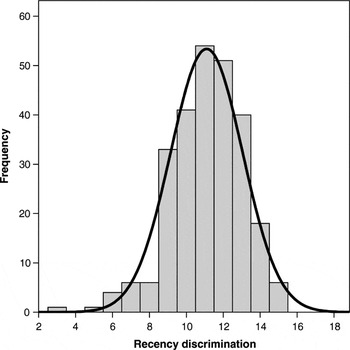
All four cognitive indices showed adequate internal consistency. Coefficients alpha for the measures comprising each index were as follows: visual explicit memory, α = .87; verbal explicit memory, α = .84; executive functioning-fluency, α = 0.71; and executive functioning-shifting, α = .87. Raw scores on the RDT task were normally distributed and ranged from 3 to 15 (M = 11.1; SD = 2.0). Median and modal scores were both 11. The RDT distribution showed minimal skewness (−.59) and kurtosis (.93). A histogram depicting the distribution of raw scores, with a superimposed Gaussian curve, appears in Figure 1.

Frequency distribution of Recency Discrimination Test (RDT) scores produced by 261 neurologically healthy adults, with superimposed Gaussian curve.
When they were presented as part of the Boston Naming Test, stimuli that comprised 7 of the 15 RDT item pairs were separated by 9 or more BNT items, and stimuli that comprised the remaining 8 RDT item pairs were separated by 3 or 6 items. We hypothesized that it would be harder to make recency judgments for RDT item pairs with fewer BNT items between them than for RDT item pairs with more BNT items between them. Therefore, we calculated the percent correct recency judgments as a function how many BNT items were interposed between RDT pairs (≤6 vs. ≥9). As hypothesized, a matched-sample t-test showed that participants made significantly (t(260) = 14.2; p < .0001) more accurate recency judgments for RDT item pairs with 9 or more BNT items between them (M = 82.5; SD = 15.1) than for RDT items pairs with 6 or fewer BNT items between them (M = 66.4; SD = 16.4). More precisely, mean accuracy rates were 92% and 74% respectively for RDT pairs with 19–21 or 9 items between them; they were 65% and 67% respectively for RDT pairs with 6 or 3 items between them.
Supporting the hippocampal hypothesis of temporal memory, RDT performance correlated more strongly with performance on the visual (r = .32; p < .001) and verbal (r = .25; p < .001) explicit memory indices than with the fluency (r = .16; p < .05) and shifting (r = .13; p < .05) EF indices. The correlation of RDT performance with visual memory significantly exceeded those of RDT with fluency (t(259) = 2.52; p <.05) and shifting (t(259) = 2.83; p < .01). The correlation of RDT performance with verbal memory was not significantly larger than those of RDT with fluency (t(259) = 1.44; n.s.) or shifting (t(259) = 1.81; n.s.). These correlations are shown together with those between the RDT and the individual cognitive test measures that comprised each index in Table 1. As mentioned, RDT performance significantly correlated with age and the total number of spontaneously named BNT items. When we controlled for their effects, the partial correlation between RDT and both executive function shifting (r = .09) and executive function-fluency (r = 0.10) were no longer significant. However, the partial correlations between RDT and both visual (r = .25; p < .001) and verbal (r = .19; p < .001) memory remained significant.
Pearson r correlation of RDT performance with z-transformed raw scores for each cognitive measure and the indices they define

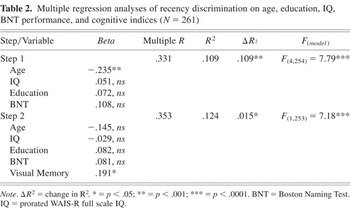
We next conducted a series of multiple regression analysis to examine the contributions of explicit memory and executive functioning to RDT performance. We first regressed RDT performance on age, education, IQ, and BNT performance en bloc. This analysis yielded a significant model (multiple R = .33; F(4,254) = 7.79; p < .0001), but the only significant beta weight was for age (β = −.24; p < .0001; see Table 2). Next, we entered terms for visual and verbal explicit memory, EF-shifting, and EF-fluency using a stepwise method of entry. This step of the analysis increased the variance explained by the overall model (multiple R = .35; F(1,253) = 7.18; p < .0001), but the only predictor that met entry criteria was visual explicit memory (β = .19; p < .05). Fluency, shifting, and verbal memory failed to enter into the model, and the beta weight for age was attenuated to a non-significant level (β = −.15; n.s.). In short, even after controlling for the effects of age, education, intelligence, and BNT accuracy, visual explicit memory was the only cognitive factor to explain significant variance in recency discrimination.
Multiple regression analyses of recency discrimination on age, education, IQ, BNT performance, and cognitive indices (N = 261)

To further elucidate this relationship, we varied the order of variable entry in another set of regression analyses. Here we first regressed RDT performance on the visual and verbal explicit memory indices. This yielded a significant model (multiple R = .33; F(2,257) = 15.88; p < .0001; not shown in Table), again with a significant beta weight only for visual memory (β = .27; p < .001). Thereafter, adding terms for executive functioning and fluency did not improve the model or substantially attenuate the beta weight for visual memory (β = .26; p < .001). Then we reversed the order of variable entry for a second set of analyses and obtained very different results. Specifically, we first regressed RDT scores on the fluency and executive function indices. This yielded a significant model (multiple R = .19; F(2,257) = 4.59; p < .02) with a significant beta weight only for fluency (β = .13; p < .04). Thereafter, adding terms for visual and verbal memory significantly improved the model and reduced the beta weight for fluency to a non-significant level (β = .02; p > .8). In short, even after we forced terms for fluency and executive functioning into the equation, adding terms for explicit memory explained significant additional variance in recency discrimination, whereas the reverse was not true.
DISCUSSION
The main finding of this study was that performance on a newly developed test of recency discrimination correlated more strongly with tests of explicit memory than executive functioning. The strongest correlations were with tests of figural learning and memory. As hypothesized, recency judgments were better for RDT item pairs that initially were presented with more BNT items interposed between them than for RDT items pairs with fewer BNT items between them. In addition, RDT performance was normally distributed. Regression analyses revealed that explicit memory explained significant incremental variance in RDT performance, even after accounting for age, education, IQ, and BNT performance. Individual differences in explicit memory also accounted for significant additional variance in RDT performance after accounting for executive functioning. However, the reverse was not true: individual differences in executive functioning did not account for additional variance in RDT scores after accounting for explicit memory. The major implication of these findings involves the conceptualization of RD.
Recency discrimination likely depends on the encoding of temporal aspects of episodic memory. This is thought to involve automatic and effortful processing (Schacter, 1987). Based primarily on lesion studies, RD has been conceptualized as an executive aspect of memory formation (Mangels, 1997; Shimamura, 2002). However, the present study is more consistent with an alternative theory of RD; namely, that memory for temporal order is an aspect of explicit memory rather than executive functioning (Kopelman, 1989; Parkin et al., 1990). Our findings are consistent with those of Beatty and Monson (1991), who found that more variance in RD was explained by individual differences in recognition memory than executive functioning, although RD showed an even stronger relation with free recall than recognition memory in our study. Dumas and Hartman (2003) also found that memory for temporal order was more closely related to free recall than recognition memory, but these investigators did not assess executive functioning for comparison. Furthermore, they used verbal stimuli for their temporal memory tasks, whereas we used visual stimuli derived from the BNT. This might explain why we found that RD was more closely associated with visual than verbal explicit memory. Whereas the correlations were not significantly different, we cannot exclude the possibility that RD would be more closely associated with verbal memory if our RDT had consisted of verbal stimuli.
The present results provide convergent validity of the RDT as a test of explicit memory and discriminant validity insofar as it does not assess executive functioning. However, because it was the only RD task administered, the obtained results might not generalize to other tests of RD or temporal order memory. Mayes et al. (2001) argued that other tests of temporal order memory, such as list discrimination, might differ from RD in important ways, although Dumas and Hartman (2003) demonstrated their essential similarity. Nor can we exclude the possibility that performance on the RDT would correlate more strongly with aspects of explicit memory or executive functioning that we did not assess. Finally, we cannot exclude the possibility that differences in duration of exposure to BNT items contributed to the correlation between RDT performance and visual explicit memory. This seems unlikely, however, because the relationship between visual explicit memory and RDT performance remained significant after accounting for BNT performance, whereas the reverse was not true. Altogether, these findings suggest that this RD task might be useful for studies investigating the contributions of hippocampal and prefrontal circuits to temporal memory. For clinical purposes, it is simple, easily administered, and requires very little time beyond that required for the 30-item BNT. Efforts to examine performance on the RDT in relation to individual differences in cerebral morphometry currently are underway.
ACKNOWLEDGMENTS
Financial support for this research was provided by NIH/NIMH grants MH60504, MH52886, MH43775, and MH068522, the Therapeutic Cognitive Neuroscience Fund, and the Benjamin & Adith Miller Family Endowment on Aging, Alzheimer's and Autism Research.