Introduction
Globally, life expectancy is projected to reach 77.1 years in 2050 from the current estimate of about 72.6 years (United Nations Department of Economic and Social Affairs (UN DESA), 2019). This increase will certainly contribute to the unprecedented growth of persons aged 65 years or older (He et al., Reference He, Goodkind and Kowal2016). Although ageing is pervasive globally, notable differences exist between countries. Generally, developed countries have higher proportions of older people. However, low- and middle-income countries (LMICs) have the fastest growth rate of older persons and are projected to contribute more to the global ageing population, albeit having the least amount of time to adjust to associated consequences (He et al., Reference He, Goodkind and Kowal2016; UN DESA, 2017). Among these consequences, health outcomes and health-care access rank prominently due to increasing demand for specialised care usually associated with ageing populations. Generally, older persons tend to have health-care needs that are different from the rest of the population, due to increased frailty, higher rates of disability or easy susceptibility to diseases (Prince et al., Reference Prince, Wu, Guo, Gutierrez Robledo, O'Donnell, Sullivan and Yusuf2015). Studies emanating from highly industrialised countries confirm a health–survival paradox (where men although physically stronger have higher mortality than women) at all ages, including among older persons (Nusselder et al., Reference Nusselder, Cambois, Wapperom, Meslé, Looman, Yokota, Van Oyen, Jagger and Robine2019; Oksuzyan et al., Reference Oksuzyan, Juel, Vaupel and Christensen2008). Aside biological explanations, scholars argue that behavioural differences including risk-taking and health utilisation practices of men and women are important determinants of the existing gendered health–survival paradox. Some evidence shows that financial circumstances play a more crucial role for the health behaviours of women than men (Gajovic et al., Reference Gajovic and Janicijevicin press), suggesting that in locations with relatively high poverty levels among older persons, wealth status may impact health behaviours.
Pensions and health insurance schemes are important for supporting and providing for the health-care needs of older people in many parts of the world. These schemes are necessary because older persons are generally not expected to remain active in the labour market. As a result, universal health coverage has become important for meeting the needs of older people, as indicated in the United Nations’ post-2015 Sustainable Development Goals (SDGs) (Scheil-Adlung, Reference Scheil-Adlung2015; He et al., Reference He, Goodkind and Kowal2016). The SDG's focus on universal health coverage (Goal 3.8) is occurring at a time when new evidence suggests that a growing older population per se may not substantially increase the costs of health care. Rather, increases in health-care costs are the result of severity of illness and time to death (Zweifel et al. Reference Zweifel, Felder and Meiers1999; Geue et al., Reference Geue, Briggs, Lewsey and Lorgelly2013; Yu et al., Reference Yu, Wang and Wu2015). Health insurance schemes help provide access to quality health-care services required by older persons to maintain functional capacity and optimise their wellbeing – making health insurance even more salient at a time when the world is experiencing growth in its older population.
Although access to health care for older persons via health insurance is common in the developed world, it is not the same for LMICs, where older people are either unable to access health care or have to incur higher costs in satisfying these needs (Parmar et al., Reference Parmar, Williams, Dkhimi, Ndiaye, Asante, Arhinful and Mladovsky2014b; Bloom et al., Reference Bloom, Chatterji, Kowal, Lloyd-Sherlock, McKee, Rechel, Rosenberg and Smith2015). Some studies have explored the effects of health insurance on unmet health-care need (as a proxy for health-care access) among older persons, but these works have focused solely on samples from Western advanced countries (Parslow et al., Reference Parslow, Jorm, Christensen, Jacomb and Rodgers2004; Vadla et al., Reference Vadla, Bozikov, Akerstrom, Cheung, Kovacic, Masanovic, Merilainen, Mihel, Nummelin-Niemi, Stefanaki and Stencrantz2011; Mcdonald and Conde, Reference Mcdonald and Conde2017). To date, very few studies have examined unmet health-care need among older persons in sub-Saharan Africa. The paucity of scholarship in this area reflects the lack of focus on older persons in sub-Saharan Africa, given the fact that the majority of populations on the continent are disproportionately young (Aboderin, Reference Aboderin2017). Furthermore, although studies show that health-care access among older persons may be gendered (Parslow et al., Reference Parslow, Jorm, Christensen, Jacomb and Rodgers2004), no such attempts have been made to document gender differences in African settings (Stokes et al., Reference Stokes, Berry, Mchiza, Parker, Labadarios, Chola, Hongoro, Zuma, Brennan, Rockers and Rosen2017). This paper fills these important research gaps using data collected by the World Health Organization (WHO) on the health of older populations in Ghana.
Health insurance and bridging health-care access gap in Ghana
Globally, health insurance schemes are important for bridging the health-care access gap between the rich and poor and for improving overall population health. In the last decade, governments in a few countries in sub-Saharan Africa have pioneered population-wide health insurance schemes. Following the example of legislations in other countries, Ghana implemented the Ghana National Health Insurance Scheme (NHIS) in 2003 to replace the ‘Cash and Carry’ system that required out-of-pocket payment for health care at the point of use. Before the implementation of the NHIS, a significant section of the population (i.e. women, children, rural dwellers, older people and the poor) had limited access to health-care services due to user fees – prompting policy makers to make special provisions for these groups within the NHIS. Thus, the NHIS has been described as a pro-poor scheme because of the differentiated premium payment based on the location of residence (i.e. residents of richer locations pay higher rates) as well as the premium exemption policies for vulnerable groups. These vulnerable groups include children under 18 years, pregnant women, persons 70 years or older and those classified as extremely poor. People in these groups do not pay insurance premiums but are required to pay a one-time registration fee and an annual renewal fee (the equivalent of about US $1) to be able to access health care, free of charge at the point of use. However, the findings of some studies show that Ghanaians living in poor households have difficulties paying for the registration fee and the annual renewal fee, thus limiting their ability to enrol in the scheme even though they may be exempt from paying the insurance premium (Jehu-Appiah et al., Reference Jehu-Appiah, Aryeetey, Spaan, de Hoop, Agyepong and Baltussen2011; Kusi et al., Reference Kusi, Enemark, Hansen and Asante2015).
Premiums constitute only 4 per cent of the cost of NHIS coverage and the remaining funds are obtained from a value-added tax (72%), Social Security and National Insurance Trust (17%) and investments (5%). The benefits of NHIS include no charges for outpatient services, inpatient care, emergency care, maternal health services, dental care and essential drugs covering over 95 per cent of the diseases in Ghana. Due to the pro-poor orientation of the NHIS, disparities in health insurance coverage based on wealth status should be relatively rare but available evidence suggests otherwise (Dixon et al., Reference Dixon, Tenkorang and Luginaah2011; Kuuire et al., Reference Kuuire, Tenkorang, Rishworth, Luginaah and Yawson2017).
Since the implementation of the NHIS a decade ago, the majority of studies examining the effectiveness of this social protection scheme have focused on enrolment disparities (Sarpong et al., Reference Sarpong, Loag, Fobil, Meyer, Adu-Sarkodie, May and Schwarz2010; Jehu-Appiah et al., Reference Jehu-Appiah, Aryeetey, Spaan, de Hoop, Agyepong and Baltussen2011; Akazili et al., Reference Akazili, Welaga, Bawah, Achana, Oduro, Awoonor-Williams, Williams, Aikins and Phillips2014; Kuuire et al., Reference Kuuire, Tenkorang, Rishworth, Luginaah and Yawson2017). As a pro-poor scheme with exemptions for vulnerable populations, the NHIS has come under criticism due to its inability to bridge the enrolment gap between the rich and poor. These enrolment disparities exist at the national level (Dixon et al., Reference Dixon, Tenkorang and Luginaah2011) and in locations with a high incidence of poverty. Recent evidence from Ghana's poorest regions – the three northern regions (Derbile and Van Der Geest, Reference Derbile and Van Der Geest2013; Dixon et al., Reference Dixon, Luginaah and Mkandawire2014a) and the Central region (Kotoh and Van der Geest, Reference Kotoh and Van der Geest2016) – demonstrate that premium exemptions in the NHIS have not addressed equity concerns of health-care access disparities.
In the last few years, a growing number of studies are beginning to investigate the role of health insurance in bridging the health-care utilisation gap which existed before the implementation of the NHIS – usually focusing on specific population groups. Maternal health issues dominate the literature on the influence of NHIS in bridging the health utilisation gap between the rich and poor (Dixon et al., Reference Dixon, Tenkorang, Luginaah, Kuuire and Boateng2014c; Fenny et al., Reference Fenny, Asuman, Crentsil and Odame2019). Some studies have found that NHIS is positively associated with prenatal/antenatal visits, delivery in a health facility and postnatal check-ups. Irrespective of socio-economic factors, women with NHIS coverage have been found to undertake more antenatal care visits (Dixon et al., Reference Dixon, Tenkorang, Luginaah, Kuuire and Boateng2014c) and utilise skilled birth attendants during delivery (Johnson et al., Reference Johnson, Frempong-Ainguah and Padmadas2016; Khan and Singh, Reference Khan and Singh2016). Women with NHIS have also been found to utilise postnatal care services regardless of demographic and other socio-economic factors (Banchani and Tenkorang, Reference Banchani and Tenkorang2014). Together, the evidence demonstrates that the NHIS has made positive contributions to maternal health services utilisation.
However, evidence emerging from studies among populations with high poverty incidence suggests wealth status/socio-economic differences remain an important determinant of health facility use. Some previous studies expressed concern that these socio-economic differences may even persist in health-seeking behaviours among insured individuals (Derbile and Van Der Geest, Reference Derbile and Van Der Geest2013). In a study in the Upper West region, Kuuire et al. (Reference Kuuire, Bisung, Rishworth, Dixon and Luginaah2016) demonstrated that among individuals who were currently enrolled in the NHIS, poor people did not seek treatment from health facilities during their last illness. Beyond insurance coverage, other factors such as unavailability of health facilities and lack of transport may inhibit the poor from seeking health care from health facilities (Atuoye et al., Reference Atuoye, Dixon, Rishworth, Galaa, Boamah and Luginaah2015). Rural areas may not have basic health-care facilities, limiting the ability of residents to seek care in times of need, particularly among seniors or older adults living in rural areas (van der Wielen et al., Reference van der Wielen, Channon and Falkingham2018). Consequently, not having insurance coverage and living in poverty may interact and hinder individuals from meeting their health needs in times of illness. The forgoing literature suggests that in spite of the pro-poor orientation of the NHIS, it is important to examine how wealth status (measured by income quintiles) moderates the effects of insurance coverage on health-care access, especially among older persons who are mostly poor in Ghana.
Gender disparities in health access
Previous studies have established clear gender differences in health-care access and unmet health-care need among several populations (Ojeda and Bergstresser, Reference Ojeda and Bergstresser2008; Bryant et al., Reference Bryant, Leaver and Dunn2009). However, not many have explored how access differs for men and women with insurance, especially for older people in sub-Saharan Africa. To bridge this gap, we employed a gendered approach in assessing the relationship between health insurance and unmet health-care need among older persons.
We expect the determinants of health access (measured using unmet health-care need) to differ by gender among older people in Ghana because several studies demonstrate gender disparities exist in access to several health-care services among the general population in Ghana, including seeking treatment in health facilities and health insurance enrolment (Buor, Reference Buor2004; Dixon et al., Reference Dixon, Luginaah and Mkandawire2014b). The existing evidence from the literature in Ghana indicate that women's access to health care is affected by geographical factors such as distance to health facilities. This is related to place of residence where urban residents tend to be proximally located to health facilities relative to residents in rural locations. Socio-economic factors, particularly lower wealth status, is also a hindrance to health-care access among Ghanaian women. Lower educational attainment among women in Ghana relative to men restricts women to economic activities in the informal sector which are often associated with low and insufficient income, thereby limiting their ability to access health-care services (Dixon et al., Reference Dixon, Luginaah and Mkandawire2014b). For men in Ghana, educational status and health facility factors such as cost of health care and quality of service have been identified as important determinants of health service use (Buor, Reference Buor2004; Dixon et al., Reference Dixon, Luginaah and Mkandawire2014b). Recent research that relied on nationally representative data collected among rural dwellers showed that NHIS membership is positively associated with consulting a health practitioner and hospitalisation among older persons in Ghana (van der Wielen et al., Reference van der Wielen, Channon and Falkingham2018). Importantly also, van der Wielen and colleagues demonstrated that wealth status was an important determinant of health care service use. Despite these important contributions, it is unclear whether the factors that influence unmet health-care need among older persons in Ghana vary across geographical space (i.e. rural and urban) and by gender.
It is important to note that scholars have criticised gender-based analysis by suggesting that such endeavours result in focusing on differences between men and women while ignoring their similarities (Hankivsky, Reference Hankivsky2012). Other critiques highlight the problems with binary categorisations of gender in health research by indicating their inadequacy in capturing the nuances that exist in the gender spectrum. To address some of these critiques, several studies engage in analyses that involve cross-classification of gender with one or two other categories such as ethnicity and social class. Irrespective of such attempts, limitations of many secondary data sources (such as the one used in this) make it nearly impossible to capture complex relations across the gender spectrum and other categories which tend to also be embedded within multiple place-scales from local to regional and beyond. Thus, in this study, we attempt to move the single axis design critique and overstressing of gender-based differences that tend to characterise such analyses (Hankivsky, Reference Hankivsky2012), by emphasising areas of similarities between men and women. We enrich the discussion by undertaking statistical tests to determine whether men and women are similar or differ on all the factors employed in examining unmet health-care need in our study. In addition to this we, attempt to capture how geographical scale may impact the unmet health-care need of men and women by accounting for place-proxy variables.
Materials and methods
We obtained data for this study from the first wave of the WHO's Study on Global Ageing and Health (SAGE) conducted for five countries, including Ghana. In the absence of data from the second wave of SAGE, Wave 1 data remain the only nationally available data for researching ageing-related topics in Ghana. The data collection for Ghana occurred between January 2007 and December 2008 using face-to-face interviews. Although SAGE is nationally representative and focuses on persons 50 years and older, it includes a small sample of adults between the ages of 18 and 49 for the purposes of comparison. It employs a multi-stage design in recruiting participants for the study. Samples were first stratified by all ten administrative regions and by rural/urban location. Primary sampling units consisting of 235 enumeration areas (EAs) were then selected. EAs which did not have persons who are 50 years or older were eliminated. Some 20 households were further selected within each EA. Each of these households had at least one resident who was 50 years or older and four residents between the ages of 18 and 49. In total, 5,573 individuals (men = 2,799, women = 2,764) nested within 5,269 households participated in the survey. The estimated response rates at the household and individual levels were 86 and 80 per cent, respectively (Biritwum et al., Reference Biritwum, Mensah, Yawson and Minicuci2013).
Since we were interested in examining the relationship between unmet health-care need and insurance status, the inclusion criteria for this study was men and women who are 70 years or older – as this is the age at which older persons are exempt from premium payment for enrolling in the NHIS. Additionally, we eliminated all respondents who answered ‘never’ to the screening question: ‘When was the last time that you needed health care?’ Thus, the analytic sample used in this study was comprised of 1,245 individuals (men = 562, women = 683) who reported they needed health care in the last three years.
Measures
Dependent variable
Our dependent variable for this study was a measure of unmet health-care need in the past three years. The variable was derived from the question: ‘The last time you needed health care, did you get health care?’, with ‘yes’ and ‘no’ response categories. We recoded the ‘yes’ responses as respondents with ‘realised health need’ (realised health access = 0) and ‘no’ responses as those with ‘unmet health-care need’ (unmet health-care need = 1).
Independent variables
We obtained our focal independent variable for this study, health insurance coverage, from the following question: ‘Do [you] have health insurance coverage?’ The question had the following response categories: ‘yes, mandatory insurance’, ‘yes, voluntary insurance’, ‘yes, both mandatory and voluntary insurance’ and ‘no, none’. We recoded these responses to indicate whether participants had health insurance or not (coded 0 = uninsured and 1 = insured). We included demographic and socio-economic factors as controls. The demographic factors were: age, ethnicity (coded 1 = Akan, 2 = Ewe/Ga-Adangbe, 3 = Gruma/Mole-Dagbani, 4 = other ethnic groups) and religion (coded 1 = Christian, 2 = Muslim, 3 = traditional, 4 = other religion/none). The following socio-economic factors were included: education (coded 0 = no formal education, 1 = primary, 2 = secondary/higher), sector of current or sector of former occupation if currently retired (coded 1 = self-employed, 2 = public/private sector, 3 = informal sector), current employment status (coded 0 = unemployed/retired, 1 = employed), marital status (coded 1 = married, 2 = separated/divorced, 3 = widowed), income quintile as an asset-based measure (coded 0 = richest, 1 = richer, 2 = middle, 3 = poorer, 4 = poorest), location of residence (coded 1 = urban, 2 = rural) and region of residence (coded 0 = Greater Accra, 1 = Ashanti, 2 = Brong-Ahafo, 3 = Central, 4 = Eastern, 5 = Northern, 6 = Upper East, 7 = Upper West, 8 = Volta, 9 = Western).
Analytical strategy
We estimated separate models for men and women. The dependent variable had missing cases for both men and women, prompting us to conduct sensitivity analysis to investigate the pattern underlying the missing data. Missing cases for the dependent variable for women was around 14 per cent while for men it was about 10 per cent. We observed that data were missing completely at random using Little's test implemented in Stata 14 (Li, Reference Li2013). It was not surprising, therefore, that the results for models with and without missing data were not significantly different. Thus, we analysed the observed data without imputation since imputing data could by itself be a potential source of bias.
Our dependent variable – unmet health-care need – was asymmetrically distributed between the dichotomous categories for both men (realised health access = 85%, unmet health-care need = 15%) and women (realised health access = 89%, unmet health-care need = 11%). Thus, using the logistic link function which assumes a symmetrical distribution may produce biased parameter estimates. Consequently, we used the negative log–log link function which adjusts for the skewed distribution between the categories in the dependent variable. Two separate analyses using logit models and negative log–log models showed differences in results, suggesting that the use of the former may produce biased parameter estimates. The Akaike information criteria further showed a better model fit for negative log–log models relative to the logit models. Since the data are hierarchical in nature with respondents nested with households, we handled the potential violation of the independence of observation assumption in standard regression models by imposing respondents’ identification numbers as a ‘cluster’ variable in our models. The models were estimated separately by gender because of our interest in investigating gender-based differences in health access. In Model 1 for each group, we estimated the relationship between unmet health-care need and insurance status, controlling for demographic factors. Model 2 controlled for socio-economic factors and geographical location in addition to Model 1. In the final model (Model 3), we include interaction effects between insurance coverage and income quintile.
We further employed the equality of coefficient test to determine whether there were significant differences between the magnitude of coefficients for men and women (Paternoster et al., Reference Paternoster, Brame, Mazerolle and Piquero1998). We present results from descriptive analysis and negative log–log regression bivariate and multivariate models with odds ratios and robust standard errors. Z-scores from the equality of coefficient tests are also presented. All analysis adjusted for sampling weights is available in the data.
Results
Descriptive
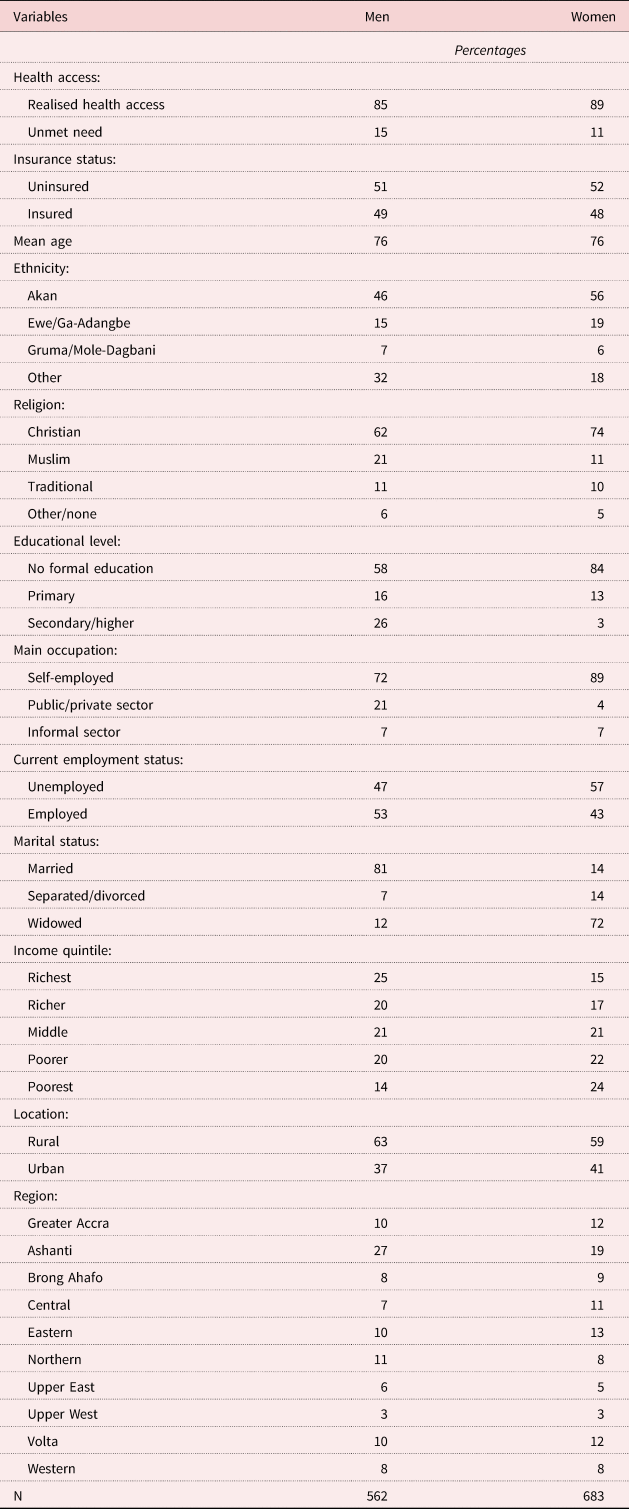
A little over half of both men and women do not have health insurance coverage, although an overwhelming majority of respondents could access health care at the last time they needed health care (Table 1). The mean age of respondents was about 76 years and Akans made up the largest proportion of respondents. A majority of both men and women are Christians, representing 62 and 74 per cent, respectively. More women (84%) than men (58%) had no formal education and women also had higher rates of self-employment (89%) than men (72%). However, a relatively higher proportion of men (53%) than women (43%) indicated they were currently actively engaged in the labour market. A disproportionately high number of men were currently married (81%) while most women reported they were widowed (72%). Most men (63%) and women (59%) reside in rural areas.
Descriptive statistics of study respondents

Bivariate
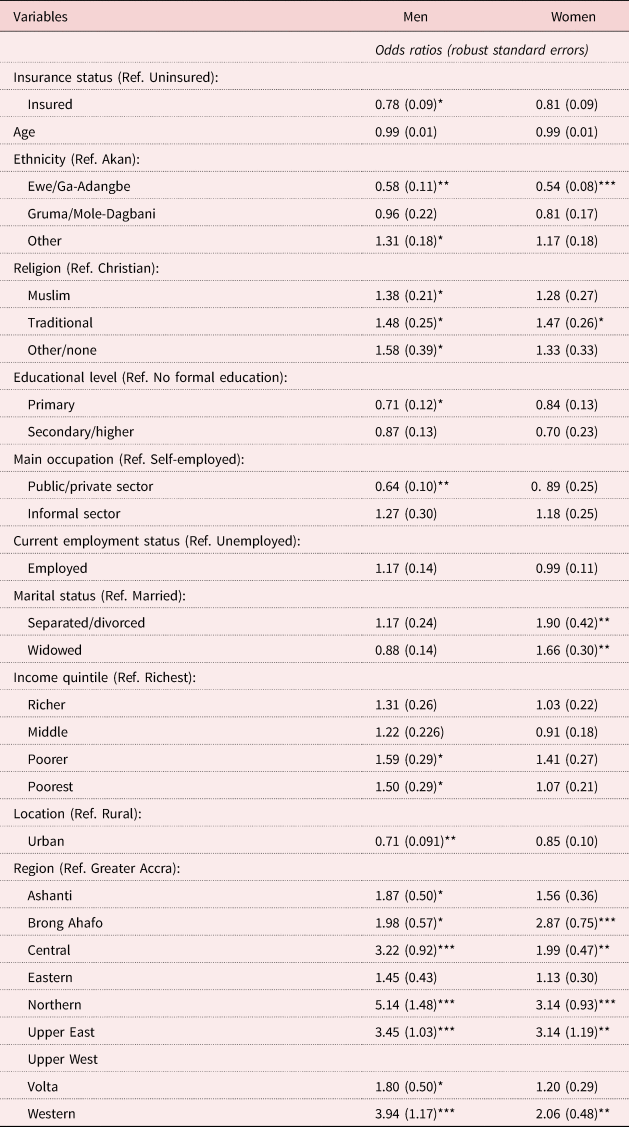
Table 2 shows the results of the bivariate relationships between unmet need and each independent variable. At the bivariate level, the relationship between health insurance coverage and unmet health-care need was significant only for men and not women. Men with insurance coverage were significantly less likely to have unmet need. Among the selected demographic and socio-economic factors, only ethnicity, religion and region of residence were significant predictors of unmet health-care need for both men and women. For men, those classified as ‘other ethnicity’ were 31 per cent more likely to have unmet health-care need relative to Akans. In the case of both sexes, Ewe/Ga-Adangbes were less likely to have unmet health-care need compared to Akans.
Zero-order negative log–log regression models of unrealised access to health care

Note: Ref.: reference category.
Significance levels: * p < 0.05, ** p < 0.01, *** p < 0.001.
Men who reported they were Muslim, adherents of traditional religion or had other/no religious affiliations were all more likely to have unmet health-care need relative to their Christian counterparts. Women who are traditional believers were 1.47 times more likely to have unmet health-care need relative to Christians. Men with primary education were less likely to have unmet health-care need relative to their counterparts who had no education. Also, men who worked in the public or private sector were less likely to have unmet health-care need compared to the self-employed. Women who were separated/divorced as well as those who were widowed had higher odds of unmet health-care need relative to their counterparts who were currently married. Income quintile was statistically related to unmet health-care need among men and not women. Specifically, respondents in the poorer income quintile were 59 per cent more likely to have unmet health-care need compared to those in the richest, while those in the poorest income quintile were 50 per cent more likely to have unmet health-care need relative to those in the richest.
Male urban dwellers were significantly less likely to have unmet health-care need compared to those who reside in rural locations. Residents in several regions (seven in the case of men and five in the case of women), were more likely to have unmet health-care need compared to those in Greater Accra region.
Multivariate
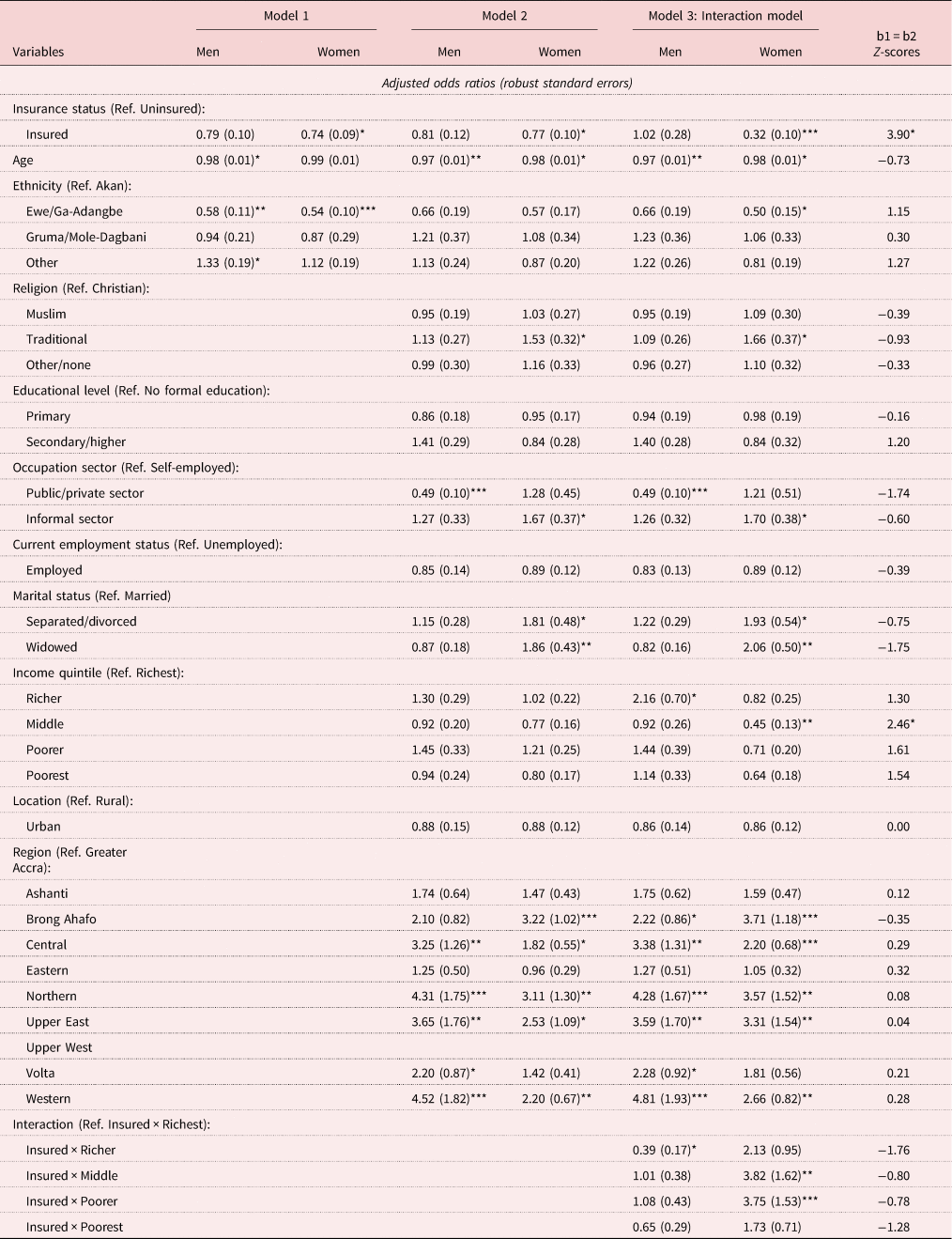
In Table 3, we show multivariate results of the relationship between unmet need and the selected study variables. In Model 1, the focal independent variable was significantly associated with unmet health-care need for women not men. Women with health insurance were 26 per cent less likely to have unmet health-care need compared to uninsured women. In Model 1, demographic factors were significant predictors of unmet health-care need for men but only ethnicity was a significant predictor for women. Among men, an increase in age is significantly associated with 2 per cent less likelihood in unmet health-care need. Compared to Akan men, Ewe/Ga-Adangbe men were less likely to have unmet health-care need. Men who were categorised as belonging to ‘other ethnicity’ were 1.33 times more likely to have unmet health-care need relative to Akan men. Ewe/Ga-Adangbe women were 46 per cent less likely to have unmet health-care need relative to Akan women.
Multivariate negative log–log regression models of unrealised access to health care

Note: Ref.: reference category.
Significance levels: * p < 0.05, ** p < 0.01, *** p < 0.001.
Model 2 for both men and women adjusts for selected socio-economic factors. The results for our focal independent variable were similar to Model 1; that is, the association between unmet health-care need and insurance status remained significant only for women. Insured women were 23 per cent less likely to have unmet health-care need relative to their counterparts without health insurance coverage. For both men and women, age was the only demographic factor that remained significantly associated with unmet health-care need after adjusting for the selected socio-economic variables adjusted for in Model 2. An increase in age resulted in a 3 and 2 per cent decrease in unmet health-care need among men and women, respectively.
For socio-economic and geographical location variables, occupation sector and region of residence were concurrently significantly associated with both men and women's unmet need. Men who worked in the public/private sector were 51 per cent less likely to have unmet health-care need; while women who worked in the informal sector were 67 per cent more likely to have unmet health-care need compared to those who were self-employed. Men in the Central, Northern, Upper East, Volta and Western regions were more likely to have unmet health-care need, compared to those in the Greater Accra region; while women in Brong-Ahafo, Central, Northern, Upper East and Western regions were more likely to have unmet health-care need compared to those in Greater Accra region. Other socio-economic factors had different associations with men and women's unmet health-care need. While religion and marital status were significant predictors of women's unmet health-care need, they were not significant for men. Women who are traditional believers had higher odds of unmet health-care need relative to Christian women. Separated or divorced and widowed women were 81 and 86 per cent, respectively, more likely to have unmet health-care need compared to married women.
In the final model (Model 3), we introduced the interaction term between insurance status and income quintile (Table 3). The interaction term was significantly associated with unmet health-care need among both men and women. Insured men in the richer income quintile were 0.39 times less likely to have unmet health-care need compared to insured men in the richest income quintile. Women with insurance who are in the middle- and poorer-income quintiles were 3.82 and 3.75 times, respectively, more likely to have unmet health-care need compared the richest women who had insurance. The significant relationships observed between demographic, socio-economic factors and unmet health-care need which were observed in Model 2 all remained robust with some changes in the magnitudes of the estimates. Additionally, ethnicity became a significant predictor of unmet health-care need among women in Model 3. Ewe/Ga-Adangbe women were 0.50 times less likely to have unmet health-care need.
Results from the equality of coefficient test (Table 3) showed statistically significant differences between men and women for two of the variables used in the study. These variables were health insurance status, and income quintile. For example, for the relationship between coefficients for our focal independent variable and unmet need for the two groups, insured men on average reported they had more unmet health-care need than insured women (Z = 3.90). There were also significant differences between coefficients for men and women on the impact of income quintile on unmet health-care need. Men in the middle-income category on average reported higher unmet health-care need than women in middle-income category (Z = 2.46). The results of the equality of coefficient test between men and women re-emphasise that there are significant differences between the two groups in terms of how insurance status and some socio-economic factors impact unmet health-care need but not demographic factors. Specifically, these findings highlight the importance of structural factors that are economic in nature as determinants of unmet need among older men and women in Ghana.
Discussion and conclusion
In this study, we examined gendered nuances in how health insurance coverage influenced unmet health-care need among older persons in Ghana, adjusting for selected demographic and socio-economic factors. Health access for many vulnerable groups, including older persons, remain a challenge in many LMICs; and health insurance coverage is recognised as critical for bridging the gap between the poor and rich (Derbile and Van Der Geest, Reference Derbile and Van Der Geest2013; Parmar et al., Reference Parmar, De Allegri, Savadogo and Sauerborn2014a, Reference Parmar, Williams, Dkhimi, Ndiaye, Asante, Arhinful and Mladovsky2014b). As the numbers of older persons continue to increase in many LMICs, it is imperative to understand gender-based access to health care due to inherent disparities between men and women which result from socio-cultural influences. In addition to demographic differences, understanding how socio-economic factors impact health access of men and women is salient for designing social protection programmes which improve the health of vulnerable populations, including older persons.
The exemption policy of NHIS for vulnerable groups, including older persons, is important for safeguarding and improving population health access in Ghana. Overall, the findings from our study show that health insurance offers some protection for older persons with coverage. We found that possessing insurance enabled access to health care at the time of need. Our study conforms with existing evidence which demonstrates that even with insurance, certain barriers still prevent some vulnerable groups – such as older persons – from accessing needed health care (Argintaru et al., Reference Argintaru, Chambers, Gogosis, Farrell, Palepu, Klodawsky and Hwang2013). In this study, wealth status emerged as an important barrier of health access even for those with insurance coverage. Consequently, we argue that even though insurance coverage might help improve access to health care, in the case of Ghana, vulnerability based on wealth/economic resources makes it more difficult for older people to access health care. This is demonstrated in the specific case of women where the results showed that poorer and middle-income women with health insurance (which should guarantee health access) still had unmet health-care need relative to the richest women with health insurance. This finding suggests that, at least in the case of women, health insurance does not necessarily translate into health-care access during time of need – income remains an important determinant. Recent evidence of the NHIS’ indebtedness to service providers means some members of the scheme are denied access to treatment in times of need; in such situations, insured persons may be required to pay out-of-pocket directly in order to receive treatment (Owusu-Sekyere and Bagah, Reference Owusu-Sekyere and Bagah2014). The significant difference between men and women in health-care access provides further justification for employing a gendered perspective in refining social protection policies, such as the NHIS, with the aim of improving the health of vulnerable groups, including older persons.
In addition to gendered differences in the relationship between insurance and health-care access, our findings show that older men and women in Ghana exhibit some similarities in access to health care. In terms of similarities, demographic factors (i.e. age and ethnicity) were both associated with access to health care for men and women. We found that older men and women had access to health care at the time of need. Older people tend to be aware of their need for regular and specialised care and may be likely to take measures that ensure continued access to health care whenever needed (Kassebaum et al., Reference Kassebaum, Bertozzi-Villa, Coggeshall, Shackelford, Steiner and Heuton2014). Ethnicity has long been identified as an important determinant of health-care access. The Akan ethnicity practices a matrilineal system of inheritance unlike the other ethnicities in Ghana. Importantly, the different ethnic groups tend to be geographically concentrated within specific locations. For example, locations such as the three northern regions are predominantly occupied by Gurma/Mole-Dagbani and other ethnicities while the eastern coastal communities are dominated by Ewes and Ga-Adangbes. Both geographical locations and the respective dominant ethnic groups tend to be associated with non-cash crop agricultural activities. These economic activities have lower financial rewards relative to cash crop farming which tends to be the mainstay in Akan-dominated areas such as the middle and western sections of Ghana. Consequently, the physical environments in different geographical locations dominated by respective ethnicities may present challenges such as poverty and lower incomes which limit access to health care at the time of need. Such circumstances may even be more pronounced for women who tend to have less control over economic resources within households.
The impact of socio-economic factors on access to health care is noteworthy because they affected men and women differently. While occupation was the only socio-economic factor which emerged as important for men's access to health care, religion, marital status and income quintile were all associated with women's health-care access. The findings show that men who presently or formerly worked in the public/private sector did not have challenges accessing health care during time of need. Studies from other parts of the world show that people whose occupation does not provide regular income tend to have unmet need relative to those employed in occupations which provide a regular income (Lee et al., Reference Lee, Kim, Kang and Seo2015; Park et al., Reference Park, Kim and Kim2016). In Ghana, employees in the male-dominated formal public and private sectors have regular incomes and are enrolled in pension schemes which can be relied on at older age. The self-employed – who tend to operate in the informal economy – on the other hand generally do not to have pensions for later life and incomes tend to be low and irregular; and this sector tends to be female dominated (Besamusca and Tijdens, Reference Besamusca and Tijdens2012). Higher income levels, regular source of income and availability of pensions in retirement for men in the formal public/private sector provide an advantage over older men who were self-employed, thereby accounting for the differences in unmet health-care need based on occupation.
For women, factors such as religion and marital status played important roles in health-care access relative to men. For example, we found that religion was associated with unmet health-care need, where women who adhere to traditional religious beliefs experienced unmet health-care need. Several studies from different parts of the world have established a link between religion and health-care access due to the ability of religious beliefs and practices to influence health-seeking behaviours (Ransford et al., Reference Ransford, Carrillo and Rivera2010; Huang et al., Reference Huang, Shang, Shieh, Lin and Su2011). Our finding on the relationship between traditional religion women and unmet health-care needs corroborates evidence from previous studies in Ghana which show that adherents of the traditional religion, unlike Christians, tend to have a lower patronage of Western medical services (Gyimah et al., Reference Gyimah, Takyi and Tenkorang2008). In addition to the potential of norms of traditional religion discouraging the uptake of Western medical services, the observed difference with Christian women may be due to socio-economic inequalities which exist between believers in the two religions (Kuuire et al., Reference Kuuire, Tenkorang, Rishworth, Luginaah and Yawson2017). Christian women in Ghana relative to women who belong to traditional religion tend to be more educated, have employment and have regular incomes. This creates an income gap between the two groups which may be translated into differences in the ability to afford health insurance and transportation costs to access health care during times of need.
Marriage tends to offer protection for the health of individuals in such unions (Koball et al., Reference Koball, Moiduddin, Henderson, Goesling and Besculides2010) and this emerged in our findings for women and not men. The finding that widowed women and women who were separated or divorced had unmet health-care need relative to the married corroborates existing evidence in the literature which shows collective family resources (including financial) are important for obtaining health services such as health insurance coverage – which can influence access to health care (Rieker and Bird, Reference Rieker and Bird2005; Peters et al., Reference Peters, Simon and Taber2014). Evidence in the literature suggests that women are more likely to lose health insurance coverage due to non-payment of premiums after divorce and this disruption tends to drag on for long periods (Lavelle and Smock, Reference Lavelle and Smock2012). This situation may lead to limiting divorced and separated women's access to health care during times of need. In the specific context of divorced or separated women in Ghana, certain cultural-laden notions and perceptions result in the stigmatisation of divorced women (Oppong Asante et al., Reference Oppong Asante, Osafo and Nyamekye2014). In addition to the stigma, divorced women also encounter property rights violation due to a long tradition of property regime separation which fails to recognise wives as contributors to the accumulation of marital property (Deere et al., Reference Deere, Oduro, Swaminathan and Doss2013). Similarly, violation of the property rights of widowed women in Ghana is common irrespective of existing laws (Korang-Okrah and Haight, Reference Korang-Okrah and Haight2015). These practices may increase women's poverty situation, diminish the availability of financial resources and make it difficult to afford incidental costs (e.g. transportation) associated with accessing health care even if they have insurance coverage.
Regardless of the important findings in the study, it is not without limitations. The data are cross-sectional in nature since this is the first wave of the SAGE data. This makes it impossible to establish causal linkages between our study variables. The nature of the question that was used to elicit responses for the dependent variable does not take into consideration the causes of unmet need. Additionally, the question does not take into account the temporal spectrum and frequency at which respondents needed health care. Respondents’ answers to questions on unmet health-care need may also be subject to recall bias. Finally, it is important to indicate that the decision to enrol in health insurance as well as the utilisation of Western health facilities during times of illness are both subject to self-selection which may impact the relationships between our study variables.
Based on the findings of this study, some policy options are apparent in order to enhance health-care access among older Ghanaians. Policy makers need to incorporate gender-specific policies which improve health access of men and women. For example, the important role of income, particularly in the case of women, indicates that there is the need to deploy programmes which aim to improve the economic situation of older people, particularly women. In most cases, seeking treatment from health facilities during times of health-care need comes with incidental costs including transportation. Consequently, the poor and those located in areas with transport accessibility challenges may be unable to access care even when they have health insurance. Again, it is necessary to recognise that broad-stroke strategies such as a blanket premium exemption policy for older persons may not produce equal benefits for men and women since such an approach does not account for the circumstances and socially constructed difference between men and women.
Ethical standards
The data used in this study do not contain information from human participants performed by the authors. The SAGE was approved by the WHO and the Ghana Statistics Services institutional ethics review board. Ethical approval is not required for a secondary analysis of the public use microdata files of SAGE.