Though it is often overlooked as a systematic variable in grammars of English and in dialectological research, one of the richest sources of dialect differentiation in Modern English is the treatment of foreign (a). This variable involves the pronunciation of the large class of words transferred to English from other languages, in which the stressed vowel is spelled, either in the source-language orthography or in the conventional English transliteration, with the letter <a>. Examples of foreign (a) include potato, tobacco, and spa. As these examples suggest, the main variants of this variable are /ey/, /æ/, and /ah/, the face, trap, and bath vowels, respectively, of Wells's (Reference Wells1982) lexical sets, or the vowels of fate, fat, and father for those who have /æ/ in bath. Even though major dialects of English agree on the pronunciation of the majority of such words, including those just cited, they diverge on the pronunciation of many others. Pronunciation entries for drama and pasta in standard dictionaries of major national varieties of English indicate the general pattern of national divergence. In Standard Southern British English, drama has /ah/ and pasta has /æ/; in American English, both words have /ah/; whereas in Canadian English, both words potentially have /æ/. As will be shown, variation of this type involves hundreds or even thousands of words used on a daily basis all over the English-speaking world, thereby constituting a phonolexical variable of considerable frequency and importance. As the degree of contact between English and other languages continues to grow over the course of the 21st century, the frequency and importance of this variable are likely to increase rather than decrease. Foreign (a) words are implicated not only in linguistic but in social and cultural variation and change.
In addition to lexical and regional variation, Boberg (Reference Boberg1997), the first major study of foreign (a), found that it displays social variation and change over time. Attitudinal factors underlying the social variation in American English—the evaluation of /ah/ as the more “correct” pronunciation of the letter <a> in a foreign word—were explored in Boberg (Reference Boberg1999); see also Shapiro (Reference Shapiro1997:438). A diachronic shift toward more frequent use of /ah/ in Canadian English, evident in apparent-time data and presumably reflecting the northward diffusion of the American foreign (a) pattern, was reported by Boberg (Reference Boberg2000). The diffusion appeared to be establishing a Canadian echo of the American pattern of lexical variation in the distribution of the two vowels. In general, Americans and Canadians agreed on which words were most likely to have /æ/ or /ah/, but the overall frequency of /ah/ in Canada was much lower.
This article returns to the special consideration of Canadian English, in particular to the issue of tokens of foreign (a) that cannot be confidently classified as instances of either of the main variants, /æ/ or /ah/. It presents a new set of data on Canadian and American nativization of foreign (a), in which recorded spoken productions are subjected to acoustic phonetic analysis. This analysis confirms the general trends of the earlier self-report data (Boberg, Reference Boberg2000), but also reveals a surprisingly high frequency of extraphonemic productions that appear to be intermediate between /æ/ and /ah/. The acoustic data also illuminate the reason for both extraphonemic productions and the traditional Canadian preference for /æ/: a hole in the low-central region of the Canadian English vowel space where other dialects have /ah/. In Canadian English, /ah/ is merged with /o/ and /oh/, lot and thought, in the low-back corner of the vowel space, rather than occupying the low-central region, as in other dialects. Yet many Canadian foreign (a) productions occupy this low-central region, rather than the fields of dispersion of /æ/ or /ah/, on either side. It is suggested that one possible result of extensive extraphonemic treatment of foreign (a) is the integration of a new, low-central vowel phoneme in Canadian English, halfway between /æ/ and /ah/. These data present striking counterevidence to the expectation that adaptation of foreign phones will follow a phoneme-matching model, or assignment of each foreign phone to the most suitable native phoneme (Hock, Reference Hock1986:390). Evidently, many speakers of Canadian English are not bound in this way by the strictures of their native phonemic systems, though their tendency to violate these strictures shows both variation and change.
PHONOLOGICAL TREATMENT OF LOAN WORDS
Canadian English treatment of foreign (a) words presents a case study in one of the most pervasive effects of language contact: the incorporation of words from other languages into the lexicon and the pronunciation of these words using their original foreign sounds, native phonemes, or a mixture of both. Such “lexical transfer,” or “borrowing” of “loan words,” is well documented in every general account of language change (e.g., Anttila, Reference Anttila1989:154–178; Baugh, Reference Baugh1935:205–214, 262–281; Hock, Reference Hock1986:380–425; Thomason & Kaufman, Reference Thomason and Kaufman1988:77–78). It can occur in close contact, through bilingualism, as between French and English in medieval England or modern-day Montreal, or in distant contact, through travel, cultural contact, and trade, as between English and many languages around the world over the last millennium.
English has been massively affected by both types of contact: through intimate contact and extensive bilingualism in its relations with North Germanic dialects during the Viking age (Baugh, Reference Baugh1935:110–126) and with French following the Norman Conquest (205–226); through less pervasive but influential contact with Dutch in late medieval trade relations (231–232); through moderately close contact at higher social levels with Latin and Greek from the Middle Ages through to the Early Modern period (227–231, 262–281); and through distant, cultural contact with a wide range of languages spoken around the globe in the Modern period (373–374). Over the last thousand years, this history of contact, together with a comparative willingness on the part of English-speakers to accept foreign words rather than try to do away with them, has created what has been claimed to be the largest vocabulary of any language in the world (McCrum, Cran, & MacNeil, Reference McCrum, Cran and MacNeil1986:1).
Because in most cases of lexical transfer the languages involved differ in phonological and phonetic terms (phonemic inventory, phonotactic constraints, phonetic realization of phonemes, etc.), transfer is usually accompanied by a process of adaptation (Hock, Reference Hock1986:390; Van Coetsem, Reference Van Coetsem1988:10), or nativization (Hock, Reference Hock1986:390). In nativization, each source-language segment is identified with a phonetically similar or orthographically equivalent recipient-language phoneme, depending whether the foreign word is heard or read. Modern cases of distant contact often involve written language, so that orthographic and transliteration conventions can play an important role in the input to nativization. More rarely, transfer involves adoption (Hock, Reference Hock1986:408) or imitation (Van Coetsem, Reference Van Coetsem1988:10), whereby a foreign phone is reproduced in the recipient language in something like its original form, without being identified with a native phoneme (i.e., extraphonemically). This usually results either from a lack of phonetically appropriate native substitutes or from the high social prestige of the source language, as when English speakers imitate the nasal vowel and uvular /r/ of a French word like genre, or the voiceless velar fricative of the German name Bach. Occasionally, repeated imitation leads to integration (Van Coetsem, Reference Van Coetsem1988:10), whereby the foreign phone becomes a new recipient-language phoneme. Perhaps the most frequently cited example of integration is the development from French words of the English voiced palato-alveolar fricative, /Ʒ/, first through palatalization of /z/ in medieval, Anglo-French words such as confusion, measure, and usual, then more directly in more recent lexical transfers such as beige, genre, mirage, and rouge. Another English phoneme with its origins in French loanwords is /oy/, the development of Anglo-French words such as espuiller (spoil), joie (joy), real (royal), and veiage (voyage). This article presents data on both nativization and imitation of foreign (a) in Canadian English, the latter raising the possibility of the integration of a new low-central vowel phoneme, albeit one occurring only in foreign vocabulary.
FOREIGN (A) LOAN WORDS IN ENGLISH
In keeping with the complex relationship between sound and spelling in English, the letter <a> corresponds to not one but three vowel phonemes in English orthography:
the “short” <a> of fat;
the “long” <a> of fate;
the “broad” <a> of father.
These phonemes are rendered as /æ/, /ey/, and /ah/, respectively, in the broad transcriptional practice of the most influential body of work on variation and change in modern North American English, a practice established by Trager & Smith (Reference Trager and Smith1951) that was adopted by Labov, Yaeger, & Steiner (Reference Labov, Yaeger and Steiner1972) and in all of Labov's subsequent work, culminating in the Atlas of North American English (Labov, Ash, & Boberg, Reference Labov, Ash and Boberg2006). In the British variationist tradition, /æ/, /ey/, and /ah/ are represented as the trap, face, and bath vowels, respectively, of Wells's (Reference Wells1982) lexical sets. This article will follow the American practice of Labov.
No matter how it is transcribed, the multiple phonographemic relationship between the letter <a> and the English vowel system has made the nativization of foreign words spelled with <a> a variable process, with outcomes dependent on a complex interplay of regional, social, lexical, and diachronic constraints, first studied in detail by Boberg (Reference Boberg1997).Footnote 1 Adopting the parentheses traditionally reserved for the identification of variables in sociolinguistics, this variable process will be labeled foreign (a) nativization, with the English phonemes /æ/, /ey/, and /ah/ as its main historical variants. The third of these, while straightforward in standard Southern British English, shows regionally variable phonemic relations with other back vowels in North America. The /ah/ vowel is merged with “short” <o> or /o/ (the lot vowel) in most North American English dialects outside Eastern New England, so that father and bother rhyme and balm and bomb are homophones. For most North American English, then, the nonfront target for foreign (a) phoneme-matching might be labeled /ah-o/, rather than simply /ah/. In a subset of these dialects, including the standard variety of Canadian English studied here, there is a second merger of both /ah/ and /o/ with /oh/ (the thought vowel), so that /ah/ can be understood to represent not one historical word class but three, all of which occupy the low-back corner of the vowel space. A fourth, extraphonemic outcome in Canadian English will also be considered here, with a phonetic quality intermediate between low-front /æ/ and low-back /ah/, in the low-central region of the vowel space. Being extraphonemic, this will be represented with the square brackets conventionally reserved for narrow, phonetic transcription, as [a].
Of the three main nativization outcomes, Boberg (Reference Boberg1997) found that only two are generally attested as productive processes today. The first foreign (a) words, transferred from Latin or French into Old or Middle English, went through the regular developments of short and long <a> in Middle and Early Modern English, in particular the Great English Vowel Shift. Thus, early foreign (a) treated as a short vowel is now /æ/ (e.g., cap, tobacco, track), and when treated as a long vowel, it is now /ey/ (cave, face, potato). Foreign (a) words transferred to Modern English, however, are generally identified with either /æ/ or /ah/, not /ey/. Thus, paste, borrowed from Middle French in the 14th century, became /peyst/, but pasta, borrowed from Italian in the 19th century, can have either /ah/ or /æ/ but not /ey/. Similarly, tornado, borrowed from Spanish in the 16th century, has /ey/, but enchilada, borrowed in the 19th century and popularized in the 20th, has /ah/ rather than /ey/. A third illustration is the contrast between marmalade, borrowed from Portuguese in the 17th century and now pronounced with anglicized word-initial stress and a final vowel /ey/, and tapenade, a much newer gourmet import of the late 20th century, from Occitan via French, which still has its final stress and a final vowel /ah/; to pronounce it on the model of marmalade would be gauche. Moreover, some originally short foreign (a) words (pass, vast), which remain /æ/ in North American English today, were lengthened in Southern British English along with native words featuring <a> before voiceless fricatives, but too late to undergo the Great English Vowel Shift, so that these now have /ah/ in Southern British English but /æ/ in North America.Footnote 2
Foreign (a) nativization is not a minor matter affecting a small, marginal class of words. On the contrary, based on a random sample of Merriam-Webster's Collegiate Dictionary (10th edition), Boberg (Reference Boberg1997:4) estimated the size of the English foreign (a) vocabulary at approximately 10,000 words. A large proportion of these are older loans that came overwhelmingly from French or Latin, including words that have completely lost their foreign identity, such as cap or face. The stock of newer foreign (a) words comes increasingly from languages all over the world: Arabic (hijab, Ramadan, safari); German (angst, dachshund, ersatz); Hindi/Urdu/Sanskrit (khaki, nirvana, veranda); Italian (lava, paparazzi, regatta); Japanese (kamikaze, karate, tsunami); Russian (apparatchik, glasnost, samovar); Spanish (aficionado, macho, plaza); and many others. They naturally include thousands of proper nouns, such as non-English personal names (Hans, Pablo, Vladimir); famous people (Gandhi, Kafka, Picasso, or the current American president, Barack Obama); commercial brand names (Armani, Saab, Yamaha); overseas geographic features (Ganges, Pampas, Sahara); and names of foreign cities, regions, or countries (Dhaka, Gaza, Slovakia). However, they also include many common nouns. Whereas some of these retain a foreign character, such as exotic flora and fauna (koala, taro, yak), many others are no longer explicitly associated with the non-English-speaking world and can now be thought of as part of the English vocabulary. These include abstract concepts (coup de grâce, éclat, élan); concrete objects (anorak, carafe, vase); words used in the arts (drama, gouache, sonata) or entertainment (anime, maracas, samba); new lifestyle trends (Pilates, shiatsu, spa); and the ever-growing category of originally foreign food items, many of which now feature in the regular diet of at least some English-speakers.Footnote 3 A sample of foreign (a) food words borrowed since 1500, with Merriam-Webster's dates of first attestation, appears in Table 1.
A selection of food terms with foreign (a) borrowed since 1500, with date of first attestation in English from Merriam-Webster's Collegiate Dictionary (11th ed.)

The large number of words even in the single, fairly narrow semantic domain of Table 1 gives some sense of the overall size of the lexical set defined by foreign (a). Whereas some of these food items appeal mostly to gourmets or particular ethnic groups (caviar, foie gras, gravlax, latkes, matzo), others have become a central part of popular North American cuisine, eaten regularly by millions of ordinary people (lasagna, nachos, pasta, salsa, tacos and, increasingly, falafel, latte, and teriyaki). In Britain, where Mexican food is less common, South Asian food takes its place in the popular diet: basmati rice, chapati, kebabs, masala, and naan are standard “take-away” items. Though most people, if they thought about it, would still identify taco and chapati as foreign words, many of the words in Table 1 have been so thoroughly integrated into the English vocabulary that they would not be thought of as foreign by anyone other than a linguist. This is true of fruits and vegetables first imported in the Early Modern period (apricots, bananas, potatoes) but also of hamburger, a more recent German import that now seems quintessentially American. Not surprisingly, the group of older and better integrated words comprises all of the instances of the older nativization outcome /ey/: apricot, champagne, potato, tomato. Even these tend to be variable. Apricot can have /æ/ and tomato, famously, has /ah/ in Southern British English, an instance of foreign (a) variation immortalized in song by Ira Gershwin (“Let's Call the Whole Thing Off”). The newest loans—falafel, focaccia, kalamata, nachos, ramen, teriyaki—all have /ah/ in American English, whereas their variants in other dialects have /æ/ rather than /ey/. This suggests that <a> = /ey/ is a closed category, a historical creation of the Great Vowel Shift. Against these newer loans we can compare food words borrowed before 1500—basil, cabbage, cake, grape, mackerel, paste, saffron, sage, salmon, etc.—which all have /æ/ or /ey/ rather than /ah/.Footnote 4
NATIONAL PATTERNS OF NATIVIZATION: BRITISH, AMERICAN, CANADIAN
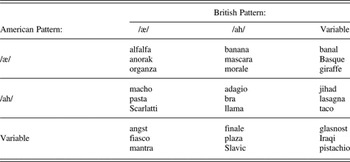
In addition to diachronic shifts in the likelihood of nativization outcomes, foreign (a) nativization exhibits regional variation in the outcomes associated with particular words. To a large extent, this regional variation shows regular patterns that are aligned with the major national varieties of English (Boberg, Reference Boberg1997). With three principal outcomes—/æ/, /ah/, and variation between /æ/ and /ah/—in two national dialects, there are nine possibilities in a comparison of British and American nativization patterns. All of these are attested, as shown in Table 2.
British vs. American nativization of foreign (a)

Closer inspection reveals the nativization of foreign (a) to be somewhat less chaotic than is initially implied by Table 2. Boberg (Reference Boberg1997:58–60) found that, even in words borrowed after 1700, an approximate date for the start of the Present-day English period but also for the split of British and American English, the two national varieties agree on 72% of nativizations. Moreover, even the disagreements show a pattern. British English shows a greater tendency to nativize with /æ/, whereas American English, though displaying more variability than British English, generally prefers /ah/. The most common disagreements therefore involve British /æ/ vs. American /ah/ (the pasta type), or British /æ/ vs. American variation between /æ/ and /ah/ (the mantra type). Together, these account for 21% of recent loans (Boberg, Reference Boberg1997:60), or three quarters of the disagreements. Additional examples of these patterns from the food words in Table 1 include asti, bratwurst, focaccia, gravlax, kebab (often actually spelled [shish] kabob in North America, emphasizing its association with /ah-o/), lasagna (often the Italian plural lasagne in Britain), matzo, salsa, scampi, tapas, and tilapia (also /ey/ in Britain).
The predominance of these patterns suggests that British English has /æ/ as the default nativization of foreign (a), using /ah/ only where syllabification puts the foreign (a) in stressed position without a consonantal coda, thereby requiring a long vowel. By contrast, American English appears to have /ah/ as a default nativization, based perhaps on the model of Spanish. As /ah/ is merged with /o/ for most Americans (unlike in British English), it can be used as either a short or a long vowel, making syllabification less important in the American nativization process. Moreover, as Shapiro (Reference Shapiro1997:438) also suggests, /ah/ has the added advantage of sounding more foreign to Americans than /æ/, which is considerably fronted and even raised compared with its typical value in British English, thereby making it less phonetically appropriate as a rendering of foreign (a). This consideration—preserving the foreign character of the word—appears to be less important to British English speakers, who further demonstrate their greater tendency to nativize in their use of Germanic initial stress in loans from French, where Americans preserve French stress (ballet, cachet, frontier, garage, pâté, souvenir, etc.) Nevertheless, despite the general patterns, a great deal of variability remains, both within and among dialects. A few words can even have all three of the historical outcomes in at least some dialects. For example, Amish, data, and gala alternate among /æ/, /ey/, and /ah/, depending on the place and the speaker.
In Canadian English, Boberg (Reference Boberg2000:17) showed yet a third national pattern, previously noted by Avis (Reference Avis and Sebeok1973:65) but not in several other studies of English in Canada, such as the major sociolinguistic surveys of Vancouver (Gregg, Reference Gregg, De Wolf, Fee and McAlpine2004:50–64) and of Ottawa (Woods, Reference Woods1999:32–37). Canadians use much more /æ/ and less /ah/ in foreign (a) nativization than either British or American English speakers. Not only do older Canadians align themselves largely with British use of /æ/ in words where Americans prefer /ah/, such as macho and pasta, but they often use /æ/ even where both British and American speakers agree on /ah/, as in llama or saga. Indeed, traditional Canadian English resorts to /ah/ only where /æ/ cannot be licensed phonologically, that is, in stressed, word-final position (bra, éclat, spa), though this could just as well be analyzed as the use of /oh/ (thought) rather than /ah/, because these vowels are merged in Canada (spa rhymes with paw). This unique pattern likely results from a legacy of British default /æ/ without the Southern British option of /ah/ for long vowels, because the British “broad-a”/bath class (pass, cast, staff, path, dance, etc.) has /æ/ in Canada, making /ah/ an extremely marginal word class in Canadian English. Moreover, the American strategy of using /ah/ is not easily applied in Canada because Canadian English /ah/, merged with /o/ and /oh/, is phonetically too far back to sound appropriate as a rendering of the low-central vowel associated with foreign languages.
However, while establishing the greater Canadian preference for /æ/, Boberg (Reference Boberg2000:18) also found that American-style /ah/ nativizations were becoming more common in Canada. They rose from an average of 2.7 /ah/ nativizations out of 15 tokens of foreign (a) for speakers over 60 (18%) to 3.2 out of 15 for speakers aged 40–59 years (21%) to 4.3 out of 15 for speakers under 40 years old (29%). This represents an increase of 60% of the oldest group's frequency over two generations. In order to confirm this trend, a set of 20 tokens of foreign (a) was included on a word list designed to study variation and change in the vowels of Canadian English and was subjected to acoustic phonetic analysis in the present study. This yielded a large set of new data, which are reported in this article. The following sections describe the method and results of this study.
FOREIGN (A) LOAN WORDS IN THE PHONETICS OF CANADIAN ENGLISH PROJECT
In 1999, a project called the Phonetics of Canadian English (PCE) was undertaken by the author at McGill University. Its purpose was to collect and analyze data on regional and gender variation in the production of the vowels of Canadian English within a socially uniform group of university students from across the country. The project involved tape-recorded sociolinguistic interviews conducted by McGill undergraduate students with their peers. The interviewers were students of Linguistics, but the participants were not. Several different interviewers were used and no attempt was made to match interviewers and participants in terms of regional origin, sex, or other factors, though some interviewers recruited personal friends as participants. The interviews included the elicitation of demographic information on each participant, the reading of a word list, a period of unscripted conversation, and a written opinion survey. The word list contained 180 items, most of which were chosen to represent all of the vowel phonemes of English, with several tokens of each vowel and its most important allophones; an analysis of regional variation in these data is presented in Boberg (Reference Boberg2008). In addition to these items there were 20 tokens of foreign (a) interspersed throughout the list, so that the identity of the words as part of a set featuring foreign (a) was not discernible.
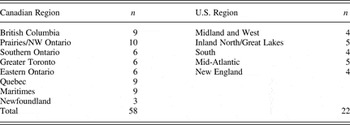
This article reports on acoustic analysis of these 20 word list tokens from each of 58 Canadian and 22 American English speakers from dialect regions across North America. The number of speakers from each dialect region is given in Table 3. Considering the wider variety of American vowel systems identified by Labov, Ash, & Boberg (Reference Labov, Ash and Boberg2006), the regional origin of speakers within the United States might be hypothesized to have a more important influence on nativization patterns than in Canada (in fact, an example of this influence is described in note 5). However, given the small sample of American speakers recruited for this study and the focus of this article on Canadian English, an analysis of this factor will not be attempted here.
Regional origin of PCE participants

The 20 tokens of foreign (a) included on the word list are shown in Table 4, with their dates of first attestation in English, their source languages, and their pronunciations as given in major national dictionaries of English. The dates, source languages, and American pronunciations are taken from Merriam-Webster's Collegiate Dictionary, 11th edition; the British pronunciations from the Oxford Encyclopedic English Dictionary, 3rd edition; and the Canadian pronunciations from the Canadian Oxford Dictionary, 1st edition. The word list tokens were chosen to represent a wide range of dates, source languages, semantic fields, and phonological factors while excluding words that are unusual, obscure, or difficult to pronounce. Whereas Pakistani and panorama contain two tokens of foreign (a), only the vowel in the primary-stress syllable is analyzed here.
Twenty foreign (a) words included in the Phonetics of Canadian English word list, with date of first attestation in English, source language, and pronunciation entries from British, American, and Canadian dictionaries

METHOD OF ANALYSIS
All 1700 tokens of foreign (a) from the word list were analyzed acoustically, using both spectrograms and linear predictive coding formant trajectories produced by Kay Elemetrics Corp.'s CSL program. Procedures were identical with those for the larger acoustic analysis reported in Boberg (Reference Boberg2008) and very similar to those used by Labov, Ash, & Boberg (Reference Labov, Ash and Boberg2006). Synchronous, nuclear measurements of F1 and F2 were taken at the maximal value of F1 or in the middle of a steady-state identified auditorily with the nucleus. The resulting data were normalized according to the procedure developed by Nearey (Reference Nearey1978). The scaling factors for each speaker were computed from the larger acoustic analysis reported in Boberg (Reference Boberg2008) rather than from the foreign (a) measurements themselves, so that the normalization could rely on the entire vowel space rather than on the smaller space occupied by foreign (a). The foreign (a) data were therefore directly comparable with mean formant data on the surrounding native vowels for each speaker, particularly the two normal targets of foreign (a) assignment, /æ/ in the low-front quadrant and /ah-o/ in the low-back quadrant (for the mean positions of these vowels in Canadian English, see Boberg [2008:136]). The mean positions of these vowels for each speaker were established using data from the same word list that contained the foreign (a) tokens: six tokens of /æ/ (bad, sack, sad, sat, tally, and tap), four of /ah/ (father, spa, calm, and palm) and seven of /o/ (bother, cot, sock, sod, top, collar, and Don).
In order to measure the phonemic status of each foreign (a) production, the F2 space between each speaker's mean positions of /æ/ and /ah-o/ was divided into thirds. The third nearest /æ/, with the highest F2 values, was assigned to the back portion of the field of dispersion of that vowel, so that tokens falling within this highest third would be classified as variably retracted tokens of /æ/. Similarly, the third nearest the mean position of /ah-o/, with the lowest F2 values, was assigned to the front portion of the field of dispersion of that vowel, so that tokens falling within this lowest third would be classified as variably fronted tokens of /ah-o/.Footnote 5 Only tokens falling within the middle third of the F2 distance between the means of /æ/ and /ah-o/, representing an intermediate low-central space, were classified as extraphonemic, as their phonemic identity could not be clearly established. A script using the IF function of Excel was used to make these assignments automatically in the spreadsheet containing the formant data.
To some extent, dividing the F2 range into thirds was an arbitrary analytical decision. Taking the central half of the space would have produced more extraphonemic tokens, whereas taking the central fifth would have produced fewer. The central third appeared to be the best compromise between being too strict and too liberal in judgments about extraphonemic status, and accorded well with the author's experience in examining the distributions of individual vowel tokens around their means in the low vowel space. Whereas in some dialects the most advanced tokens of /ah-o/ can be quite close to the most retracted tokens of /æ/, there is generally a gap between the fields of dispersion of these vowels approximately equivalent to the radius of each dispersion. This is certainly true of Canadian English. Tokens in the central third of the /æ/–/o/ range would indeed be atypical representatives of either /æ/ or /ah-o/. It was also decided that using the means of neighboring vowels would be a more reliable procedure than using the innermost individual tokens of those vowels as representatives of the inner boundaries of their fields of dispersion, because measurements of individual tokens are subject to many sources of potential error. Making phonemic classifications by means of an automated routine such as that described here may expose the analysis to some risk of misclassification, but it was felt that this risk was smaller than the risks associated with making subjective judgments about vowel quality in an auditory-impressionistic analysis, given the nature of the data reported herein.
RESULTS
The results of the acoustic analysis described previously are presented in Table 5, which shows the frequency of productions classified as /æ/, /ah-o/, and intermediate for each word for both the Canadian and American groups of participants. In general, Table 5 agrees with the main finding of Boberg (Reference Boberg2000). Canadian use of /ah-o/ is substantially lower than American use but follows a broadly similar lexical pattern. As shown more clearly in the graph in Figure 1, the relative proportions of front and back nativizations for Canadian and American participants are reversed. Not only do Americans use twice as much /ah-o/ as Canadians, but they use three times more /ah-o/ than /æ/, whereas Canadians use substantially more /æ/ than /ah-o/. The clear national difference stands up easily to statistical tests: a chi-squared test of the national proportions of /æ/ and /ah-o/ produces a value of 124.1 @ 1 df; p < .005. Alternatively, a t test of the difference between the mean /ah-o/ proportions of Canadian and American participants shows p = .000. That said, the nativization patterns are not unrelated. Far from it. A Pearson correlation test of the 20 pairs of /ah-o/ frequencies returns an r statistic of .63, indicating a strong correlation. Though Canadians use much less /ah-o/ than Americans, when they do use it they tend to favor it in the same words.
Canadian and American proportions of /æ/, /ah-o/, and intermediate productions in the total set of data from 20 foreign (a) words.

American and Canadian percentages of /æ/, /ah-o/, and intermediate productions by word (no-data cases excluded)

Note: Results of acoustic analysis, with F2 distance between means of native /æ/ and native /ah/ divided in thirds. Intermediate tokens occupy middle third.
Turning to individual words, there is binational agreement that Iraq, Pakistani, panorama, and soprano have /æ/ (only a minority of the Americans pronounced Iraq to rhyme with rock), whereas lager, lasagna, macho, and mafia have /ah/, a pattern with which the dictionaries substantially concur. This pattern is more easily discerned in Table 6, which reranks the words of Table 5 according to their frequency of /ah-o/ in the American data. The remaining 12 words do show important national discrepancies, indicated in the third column of Table 6, which gives the absolute difference in percentage between the American and Canadian frequencies of /ah-o/ for each word. In every case, the major discrepancies involve a much lower frequency of /ah-o/ in Canada. The most extreme examples are avocado, drama, lava, pasta, plaza, and Slavic, where the spread between American majority usage of /a-oh/ and Canadian minority usage is greater than 50%. Use of /æ/ in these words continues to be a clear indicator of Canadian English linguistic identity, even among the sample of young participants examined here.
Words ranked by frequency of /ah-o/ in American data, with absolute difference between American and Canadian frequencies

It is also evident from Tables 5 and 6 that foreign (a) nativization is much more variable in Canadian than in American English, insofar as the set of 20 words examined here is representative of the foreign (a) vocabulary as a whole.Footnote 6 Although at least the sample of Americans analyzed here appears to be relatively unanimous in its treatment of particular words, the equivalent sample of Canadians shows a much greater degree of variation. Ten words produced frequencies of /ah-o/ between 20% and 80% for Canadians, compared with only four for the Americans. The unanimity of American productions for the first 12 words in Table 6—with frequencies of /ah-o/ consistently over 80%—is unmatched in the Canadian data. This suggests that the American nativization pattern is fairly well established, whereas the Canadian one is currently subject to change.
Even though changes in progress are often constrained by a range of social and linguistic factors, correlations between Canadian nativization outcomes and date of attestation, source language, speaker region, or speaker sex could not be established in these data. A t test of male vs. female proportions of each outcome in the Canadian data, for which the means were never more than 4% apart, showed no significant differences aligned with speaker sex. The effect of region on proportions of the three outcomes in Table 5 was tested with a multivariate analysis of variance in SPSS, which showed no overall effect (F = 1.704 @ 8 df; p = .107). Nevertheless, tests of between-subjects effects showed that there was a significant effect on the proportion of /ah-o/ (F = 2.945 @ 4 df; p = .029). The only regional distinction that showed this effect at a significant level, however, was that between Quebec and Ontario (p = .023). The probability of /ah-o/ nativizations is significantly higher in Ontario (41%) than in Quebec (28%). The regional means are shown in the graph in Figure 2. For this analysis, Newfoundland was omitted and the three Ontario regions of Table 3 were combined into one, in order to avoid regions that had too few participants for effective analysis. The graph indicates that Ontario is the only region where the frequencies of /ah-o/ and /æ/ are approximately equal; in the other regions, the general Canadian pattern of preference for /æ/ prevails, particularly in Quebec.
Proportions of /æ/, /ah-o/, and intermediate productions by Canadian region. BC = British Columbia; PR = Prairies and Northwestern Ontario; ON = Ontario; QC = Quebec; MT = Maritimes.

Though most of the PCE participants' foreign (a) productions were clearly identified with either /æ/ or /ah-o/ by the algorithm described previously, a substantial number of the Canadian productions were not. This proportion, labeled intermediate, is shown as the third column of each national set of data in Table 5, and as the third pair of bars in Figure 1. It is twice as high for the Canadian group (22%) as for the American (11%). In fact, for the Americans, extraphonemic productions appear to be a fairly rare phenomenon, whereas for the Canadians, they comprise a substantial proportion of the data and represent a more general pattern. The 20 words are reranked in Table 7 according to their frequency of intermediate productions in the Canadian data. The American proportion rises to 20% or more in only three words: Colorado, panorama, and taco. The Canadian proportion reaches this level in 10 words, half of the set examined here, and is over 30% in 7 of them, a level never reached in the American data. Nearly half of the Canadian productions of plaza, for instance, were identified with neither /æ/ nor /ah-o/, compared with only 9% of the American productions. In addition to lexical variation, the frequency of extraphonemic productions shows interspeaker variation, ranging from 0% to 56%. Of the 12 participants with the highest individual proportions of intermediate productions—those with over a third—11 are Canadian. The only American in this group is a westerner from Colorado (PCE MWM83), a region that shares the low-back merger with Canada and might therefore be expected to show a similar pattern.
Words ranked by frequency of intermediate (extraphonemic) productions in Canadian data

In order to examine the extraphonemic treatment of foreign (a) in greater detail, individual vowel charts for three of the Canadian participants with high proportions of intermediate productions are presented in Figures 3–6. These indicate more concretely the location of intermediate tokens in the interstitial region between /æ/ and /ah-o/. In the charts, nonforeign vowel means are shown as open diamonds, whereas foreign (a) tokens are shown as solid squares.
Foreign (a) tokens and low vowel means for PCE EOM78.

Foreign (a) tokens and low vowel means for PCE PRM80.

Foreign (a) tokens and low vowel means for PCE SOM77.

Low vowels and foreign (a) tokens of PCE PRM80.

Figure 3 shows the productions of a man from Ottawa, born in 1978. The three low-back vowels, /o/, /oh/, and /ah/ (cot, caught, and father, respectively), are solidly merged in lower-mid-back position, whereas /ʌ/ (cut) is halfway between the low-back merger and a low, slightly front-of-center /æ/ (cat). As is typical of Ontario English, there is a wide separation between the main distribution of /æ/ and its prenasal allophone, which is raised to lower-mid-front position. The foreign (a) tokens divide into three sets. One set, comprising pajamas, Pakistani, Picasso, and soprano, is clearly identified with /æ/. A second, comprising lager and Colorado, is just as clearly identified with the low-back phoneme. The remaining tokens—the largest set—occupy a region exactly intermediate between /æ/ and /ah-o-oh/ and cannot be confidently identified with either phoneme, though some are close enough to /ʌ/ to suggest that this may be a third alternative for phonemic identification for some words.
Figure 4 shows the productions of a man from Weyburn, Saskatchewan, born in 1980. As with the previous speaker, the three low-back vowels are solidly merged in lower-mid-back position, but /ʌ/ remains in mid position well above the line between /o,oh,ah/ and /æ/, and the main distribution of /æ/ is less centralized, situated clearly in the lower-front quadrant. The foreign (a) tokens divide again into three sets. The /æ/ set for this speaker includes pajamas and Pakistani, which show the prenasal raising typical of native words, and Iraq and soprano, the former with a prototypical /æ/ that would be identical with that of rack. The low-back set includes two phonetically similar words, macho and mafia, which differ only in height. The remaining tokens—again the largest group—occupy an intermediate region, in this case just as far from /ʌ/ as from /æ/ and /o,oh,ah/.
Figure 5 shows the productions of a man from Peterborough, Ontario, born in 1977. The distribution of his low vowel phonemes is very similar to that of the Weyburn man in the previous figure, though with /ʌ/ somewhat lower and fronter and the low-back vowels less lowered; nevertheless, /ʌ/ remains above the low-back perimeter of the vowel space. The foreign (a) tokens are less clearly divided into three sets than in the last two examples, though there is a closer and more consistent identification of the prenasal tokens with prenasal /æN/, only drama and llama being excluded from this group. The latter is fairly clearly identified with the low-back vowel instead, as in American English, a set that appears to include Slavic and mafia as well, though the last of these is much lower than the main low-back vowel distribution. The /æ/ set for this speaker includes Colorado, Iraq, and Picasso. The remaining tokens are intermediate, though pasta is close enough to /ʌ/ to look like /′pʌstə/, perhaps showing phonetic shortening before a voiceless obstruent cluster, with associated raising of the vowel.
So far, in order to reduce clutter in the vowel charts, individual tokens of foreign (a) have been compared with mean positions of native vowels, without displaying the fields of dispersion of individual tokens that make up those means. Clear identification of tokens as extraphonemic requires a demonstration that they do not fall within the field of dispersion of a neighboring phoneme. Although this was handled somewhat abstractly in the preceding analysis by restricting intermediate classifications to the central third of the low vowel space, Figure 6 gives a concrete demonstration of this. It shows once again the foreign (a) productions of the Weyburn man from Figure 4, but with individual tokens rather than means of the surrounding native vowel phonemes. As before, foreign (a) tokens are shown as solid squares, but the other symbols in this chart represent individual tokens of native vowels, as indicated in the legend below the chart.
Figure 6 makes it clear that much of the foreign (a) production of this speaker is truly extraphonemic. The tokens identified as extraphonemic in the discussion of Figure 4 clearly fall outside the normal field of dispersion of the surrounding phonemes. The central foreign (a) distribution shows an almost perfect separation from tokens of /æ/, /ʌ/, and /o,oh,ah/, with virtually no overlap.
DISCUSSION
Figure 6, together with the data in Table 5 and Figure 1, provides direct counterevidence to the hypothesis that treatment of foreign phones normally follows a pattern of nativization through phoneme-matching. Whereas most Canadian foreign (a) productions can be classified as instances of a native phoneme, a substantial number—a fifth of the productions reported here—cannot. Instead, some Canadian foreign (a) productions appear to be clear instances of imitation rather than nativization. This pattern results from a number of linguistic, historical, and cultural forces.
Canadian English begins with a vowel system ill-adapted for the handling of foreign low-central vowels. Where other dialects have a low-central /ah/ that is a natural match for foreign [a], traditional varieties of Canadian English have an empty space in their vowel systems between low-front /æ/ and low-back /ah/, a state of affairs brought about by the merger of /o/ and /oh/. Rather than descending and advancing into low-central space, /o/ has joined /oh/ in the low-back region. The merger of /o/ and /ah/ has taken place in Canadian English as in other North American varieties, but this merger, too, is in the low-back region, effectively removing /ah/ from the phonetic range corresponding to foreign [a].
As a new set of foreign (a) words began to enter the language in the 19th century, it appears that a basically British pattern of foreign (a) lexical assignment was then superposed onto this Canadian system through institutional channels such as schools, dictionaries, and, eventually, broadcasters (with the advent of radio), and possibly also as a result of the arrival of millions of immigrants directly from Britain during the century following the end of the Napoleonic Wars. Even though these institutional and immigrant influences appear to have had little effect on the basic phonological and phonetic patterns established by initial American Loyalist settlement, the less systematic domain of the lexical incidence of phonemes was comparatively open to such influence (variable British phonemic incidence in Canadian English has been well-documented by Avis [1956] and Scargill & Warkentyne [Reference Scargill and Warkentyne1972], among others). There was one crucial difference, however, in how the British pattern was applied in Canada. British instances of /ah/ were converted to /æ/ on the model of native words. If British /ah/ in bath, staff, and dance corresponded to Canadian /æ/, so, logically, did British /ah/ in lava, llama, or plaza. Indeed, this would account for the minority pronunciation of tomato with /æ/ in Canada, beside the more common /ey/ associated with American English. It represents a choice of the British over the American variant without recourse to British /ah/. This adaptation of the British system produced a nativization pattern in which virtually all foreign (a) words had /æ/. Only where /æ/ was impossible, in bra and spa, was /ah/ used, and then it was equivalent to /oh/ in raw and paw.Footnote 7
Meanwhile, across the border, Americans were matching the new words to their low-central /ah/, merged outside New England with /o/, without an equivalent British influence on lexical assignment. In the choice between a low-back /oh/, a low-central /ah-o/, and a low-front-to-lower-mid-front /æ/, /ah-o/ was the natural match for foreign [a]. The growing influence of Spanish after the Second World War, both through immigration and as a subject widely taught in school, making it the only foreign language many Americans have any knowledge of, probably reinforced this pattern. Spanish has a categorical relation between <a> and /a/, with the sound of Spanish /a/ being closest to the /ah-o/ of most American English speakers. This relation can be seen in respellings of foreign (a) words with <o>, as in the example of kebab > kabob cited earlier, or in German Knackwurst becoming American knockwurst.
By the late 20th century, the main influence on Canadian English had switched from Britain to the United States. While cultural relations between an increasingly non-British Canada and its former colonial parent grew ever more distant, relations with the United States were continually strengthened along a north-south axis by patterns of travel and communication. Following the Second World War, spoken American English was carried by radio, television, and film into virtually every Canadian household and many Canadians had sufficient disposable income to allow frequent travel to the United States; some even worked in industries alongside Americans in a branch-plant economy that saw American companies open production facilities in Canada.
Amid this stream of American English came tokens of American foreign (a) nativization. These began to influence Canadian treatment of foreign (a), as shown by Boberg (Reference Boberg2000). Canadian use of /ah/ in some foreign (a) words has begun to rise, even in cases like macho, where it is not supported by British usage. In fact, lexical assignment of words such as mafia, taco, or Vietnam was far more likely to be influenced by American than by British usage for purely cultural reasons. These are words largely associated with the American cultural context. The incoming American pronunciations sounded neither like Canadian /æ/ nor like Canadian /ah-o-oh/. In an effort to accommodate them, some Canadians, such as those whose speech produced Figures 3–6, gave up trying to assign foreign (a) tokens to a native phoneme. They simply used a new, low-central vowel in imitation of what they heard in the American (or in some cases foreign) input. For instance, Canadian use of /ah/ in drama has more than doubled from the 17% reported by Avis (Reference Avis1956:52) in his mid-century survey of Ontario English to the 36 percent reported here in Table 5, but Table 5 also shows that drama is sometimes pronounced with an intermediate vowel somewhere between /æ/ and /ah/, indicating that, whereas /æ/ may no longer be as heavily favored as it once was, some speakers are not comfortable saying draw-ma either.
On a first analysis, it may seem inevitable that increasingly frequent imitation of foreign (a) as [a] will lead to the integration of these tokens as a new low-central vowel, which we might label /ah2/ or /ahf/ (with f for foreign), intermediate between native /æ/ and /ah-o/. This would imply a two-way phonemic contrast among the vowels of laggard, lager, and logger; of rack, Iraq(i), and rock(y); of stab, Saab, and sob; of sad, façade, and sod; or of dally, Dalí, and dolly. Whether this contrast is regularly attested is a question that will be left for future research. The evidence presented here can address it only indirectly. Earlier accounts of Canadian English suggest that the two-way contrast has at least some historical precedent, meaning that imitation of foreign (a) may contribute not so much to the emergence of a new phoneme as to the demarginalization of an old one. Gregg (Reference Gregg1957:22) suggested that the vowel of balm, father, amen, and almond varies between a separate, low-central quality and the vowel of bomb, bother, and such, in Vancouver English, whereas Avis (Reference Avis and Sebeok1973:64) reported a distinction between balm and bomb in his own speech but says it is “by no means common” in “General Canadian.”
The maintenance of the contrast between /æ/ and a new or demarginalized /ahf/ is clearly subject to another, much better-documented development in contemporary Canadian English: the Canadian Shift. This chain shift, first conceived by Clarke, Elms, & Youssef (Reference Clarke, Elms and Youssef1995), analyzed acoustically by Boberg (Reference Boberg2005) and used by Labov, Ash, & Boberg (Reference Labov, Ash and Boberg2006:219–224) to distinguish Canadian English in a continental context, involves, among other elements, the retraction of /æ/ from low-front to low-central position.Footnote 8 If /æ/ continues to retract, the choice between extraphonemic [a] and native /æ/ may become moot. Treatment of pasta or façade with low-central [a] will be phonetically and therefore phonemically identical with production of native tokens of /æ/ such as past or sad. The lower vowel system would then revert to a one-way contrast between low-central /æ/ and low-back /ah-o-oh/, with foreign (a) words such as pasta assigned to the former and those such as macho to the latter. Nevertheless, the data presented indicate that this has not yet happened. Even retracted tokens of /æ/ produced by the three speakers examined here are more advanced than many tokens of foreign (a). This state of affairs may indicate yet another possibility: that the presence of a new /ahf/ in low-central position will prevent a further development of the Canadian Shift, perhaps even reversing it, as speakers seek to differentiate /ahf/ from /æ/.
CONCLUSIONS
The issue of foreign (a) nativization in Canadian English will likely intensify in the future, rather than fade away, as the exposure of English speakers to foreign languages and the objects and concepts they designate increases in an increasingly global world. Either a new phoneme, /ahf/, will become firmly established, though with the theoretically problematic specification of its lexical membership as exclusively foreign, or the protophoneme /ahf/ will merge with an increasingly retracted native /æ/, resolving the issue in a different way. Either of these outcomes will serve to further distinguish Canadian from neighboring varieties of American English, which will maintain a different set of lexical-phonemic relations in the lower portion of the vowel space. Canadian public awareness of this difference will in part determine its future. Canadians wishing to distinguish themselves culturally or linguistically from Americans may intensify their use of /æ-ahf/ in foreign words, rather than accept new assignments to /ah-o-oh/ that conform to an American model. The same issue may arise in Britain, which has also, since World War II, been subject to increasing exposure to American English. As pasta solidifies its position as a new dietary staple of the English-speaking world, will it be called or /′pah.stə/ everywhere, under American influence, or will /′pæs.tə/ survive in Britain and Canada? Whatever the answer, foreign (a) nativization is an excellent example of the close interaction of social and linguistic change, and of the value of examining language in its social context, a context in which developments in global culture can have a direct impact on the phonological structure of varieties of English.
The range of issues arising from variation in the nativization of foreign (a) extends well beyond those examined here. One of them concerns the treatment of foreign (a) in dialects other than Canadian English and the standard varieties of American and British English discussed previously. The nativization patterns found in Australia, New Zealand, or South Africa, for instance, might be assumed to resemble that of Southern British English, but this has yet to be investigated. There are also many other dialects of British and North American English that could be examined in this respect, particularly those that resemble Canadian English in the structural properties of their low vowel systems. Western Pennsylvania and parts of the American West, for example, also have low-back mergers in low-back position, making /ah-o/ less phonetically appropriate as a match for foreign (a) than in other dialects. Do extraphonemic outcomes arise in those dialects as well? Are there dialect differences in nativization patterns within North American English that do not align with structural phonological differences? On the British side, the split of Middle English /a/ into short and long classes, modern /æ/ and /ah/, occurred only in southern dialects, leaving northern dialects with a highly constricted /ah/ class similar to that of Canadian English. Do northern British dialects show a similarly divergent nativization pattern?
A further issue that arises is the phonetic, phonological, and orthographic factors that condition nativization outcomes in particular dialects. The 20 words examined here are far too small a sample to provide reliable evidence of such factors, but an examination of hundreds or thousands of foreign (a) words might identify systematic factors in particular dialects that help to illuminate the mechanisms of nativization and lexical assignment. Finally, to what extent has foreign (a) nativization developed sociosymbolic value in various dialects of English? The relatively small sample here revealed no robust sociolinguistic correlations, but a larger sample of speakers might show that vowel choice is correlated with social, stylistic, or attitudinal factors within certain speech communities. The results of research along any of these lines will broaden and deepen our understanding of the effects of language contact, the nature of linguistic variation, and the mechanism of language change.