


Introduction
At the intersection of history, culture, psychology, and politics lies national identity – a profound and often contentious concept that fundamentally influences how citizens perceive themselves, their co-citizens, and their relationship to the state. This collective self-understanding provides legitimacy for state actions (Almond and Verba Reference Almond and Verba1963), underlies support for redistributive policies (Esping-Andersen Reference Esping-Andersen1990), and creates what Miller (Reference Miller1995) describes as unique social obligations between citizens that do not extend to non-citizens. Yet while national identity shapes political behaviour, we know surprisingly little about how profound political events might reshape national identity itself. This question has become particularly salient in an era when constitutional referendums increasingly ask citizens to make binary choices about complex questions of sovereignty and belonging.
The United Kingdom offers an especially revealing window into this dynamic. As Rose (Reference Rose1971) observed, it has always been a distinctively multinational state, where citizens routinely navigate overlapping identities; British alongside English, Scottish, Welsh, Irish, and, in recent years, an emerging ‘Northern Irish’ identity (Hayward and McManus Reference Hayward and McManus2019).Footnote 1 Against this backdrop, the United Kingdom has experienced two seismic constitutional votes in the past decade: the 2014 Scottish independence referendum, which threatened to dissolve a three-century-old union, and the 2016 Brexit referendum, which ended Britain’s membership in the EU. These votes did not merely test existing national attachments but fundamentally challenged citizens’ understanding of what it means to be British. Traditional approaches to studying national identity have treated it largely as an independent variable. That is, a stable attribute that helps explain political behaviour rather than an outcome that might be shaped by political events. This assumption of identity as exogenous to politics has influenced decades of research on voting behaviour, policy preferences, and institutional legitimacy. However, a growing body of literature has begun to question this premise (Campbell et al. Reference Campbell, Layman, Green and Sumaktoyo2018; Egan Reference Egan2020; McCrone and Bechhofer Reference McCrone and Bechhofer2015), suggesting that the relationship between political events and identity formation may be more dynamic than previously understood. This study adds to this latter evidence and examines two critical questions about this relationship: first, do citizens change their national identifications in response to highly salient political outcomes? Secondly, if they do, are these changes temporary fluctuations or enduring transformations that reshape the identity landscape of the polity?
Previous research in the United Kingdom has documented correlations between political events and national identity using post hoc data (Anderson and McGregor Reference Anderson and McGregor2016; Kenny et al. Reference Kenny, Heath and Richards2023) or examined changes in the immediate aftermath of the EU referendum (Sczepanski Reference Sczepanski2023). This study provides the first long-term causal evidence of how constitutional referendums reshape national identity by leveraging high-frequency panel measurements covering two referendums (Fieldhouse et al. Reference Fieldhouse, Green, Evans, Mellon, Prosser, de Geus, Bailey, Schmitt, van der Eijk and Griffiths2026). This methodological advance allows us to move beyond correlational speculation to establish two key causal mechanisms and their boundary conditions: first, constitutional salience: only referendums explicitly challenging national community boundaries (sovereignty questions) trigger lasting identity change, unlike policy referendums or standard elections, which operate within accepted constitutional frameworks. Secondly, implementation asymmetry: referendums preserving the status quo allow identity reversion once the threat passes, while those implementing constitutional change create persistent identity shifts through ongoing institutional reinforcement of the contested outcome. These causal findings generate testable predictions: sovereignty referendums in other multinational contexts (Quebec, Catalonia, future Scottish votes) should produce changes to national identity, but policy referendums or standard elections should not. The mechanism should extend to other politically salient social identities (regional, ethnic, religious) when explicitly contested in high-stakes votes, with persistence depending on continued institutional reinforcement. By establishing causal evidence where only correlational inferences existed before, we transform empirical observations about post-Brexit identity divisions into a generalizable theory of how democratic processes can inadvertently undermine their own legitimacy foundations – a critical insight for constitutional design in diverse democracies.
Our findings reveal striking patterns. Both referendums precipitated identity changes, but contrary to our expectations, primarily among referendum losers, who distanced themselves from identities associated with the winning side. Moreover, these effects varied in persistence: Scottish referendum changes proved temporary, while Brexit catalysed enduring transformations. Comparison with the 2024 general election suggests constitutional referendums represent a distinct class of critical juncture, producing permanent rather than temporary identity realignments. This poses particular challenges for political systems already managing multiple constitutional pressures, as each divisive vote risks further eroding the shared national sentiment that undergirds state legitimacy.
Theoretical Foundations
The study of political and social identities stands as a fundamental pillar of political science research, yet questions about their stability and formation remain surprisingly contested. These identities include those that are impossible to change (such as someone’s place of birth or parental ancestry), those that are difficult to change (such as one’s gender or skin colour), those that can change but often do so slowly (such as socio-economic status or linguistic ability), and institutionally derived identities such as party affiliation (Campbell et al. Reference Campbell, Miller and Stokes1960; Chandra Reference Chandra2012; Egan Reference Egan2020). Many of the attributes associated with these social identities are acquired and crystallize early in life through processes of parental and community socialization (Paterson Reference Paterson2008). This early formation has led scholars to focus primarily on between-group rather than within-individual variation, treating identities as largely fixed once established in adulthood.
This framework has profoundly influenced how political scientists conceptualize the relationship between identity and behaviour. Social identities are understood to shape political choices through dual mechanisms: the psychological processes of in-group favouritism and out-group discrimination, and the transmission of associated values and attitudes. Indeed, this assumed directionality from identity to behaviour is so deeply embedded that it appears routinely as an unstated premise in empirical political science research (Abdelal et al. Reference Abdelal, Herrera, Johnston and McDermott2006). The influence of Campbell et al. (Reference Campbell, Miller and Stokes1960) remains particularly strong; their ‘funnel of causality’ explicitly positions group identities as causally prior to both issue positions and vote choice. This assumption persists in contemporary work, with scholars like Galais and Serrano (Reference Galais and Serrano2020, 487) asserting a clear dependency relationship flowing from national identity to ideological self-placement.
National identity operates within this theoretical framework but carries distinct characteristics that merit special attention. Like other social identities, it involves what Tajfel (Reference Tajfel1981) describes as conscious group membership and categorical exclusion. Through the lens of social identity theory, national identity emerges when individuals cognitively categorize themselves as members of a national group and incorporate this membership into their self-concept (Tajfel and Turner Reference Tajfel, Turner, Worchel and Austin1985). This categorization process shapes both self-perception and behaviour toward fellow nationals and non-nationals (Turner et al. Reference Turner, Hogg, Oakes, Reicher and Wetherell1987). Yet national identity stands somewhat apart from other forms of social identification in its unique combination of conscious category membership and deeply embedded value orientations transmitted through families, communities, and institutions (Paterson Reference Paterson2008; Stubager Reference Stubager2008). The presumed stability of national identity has particularly strong theoretical foundations. The ‘primordial school’ of national identity argues that nations represent inherited ethnic and cultural ties (Gil-White Reference Gil-White1999), while everyday experiences of national symbols, rituals, and institutions Breuilly (Reference Breuilly and Balakrishnan1996); Coakley (Reference Coakley2018) create what Fearon and Laitin (Reference Fearon and Laitin2000, 848) term ‘everyday primordialism’ – the taken-for-granted assumption that national membership represents a fixed aspect of personal identity. These assumptions gain empirical support from aggregate stability in national attachment across western Europe (Antonsich Reference Antonsich2009), aligning with Anderson (Reference Anderson1991, 6–7)’s conceptualization of nations as ‘imagined communities’ characterized by deep horizontal solidarity.Footnote 2
However, an emerging body of research challenges these assumptions about identity stability. Studies have demonstrated that even characteristics traditionally viewed as fixed or highly resistant to change can be influenced by political factors. Several scholars have shown how respondents’ political preferences and politically salient characteristics lead to changes in religious identity and participation (Campbell et al. Reference Campbell, Layman, Green and Sumaktoyo2018; Djupe et al. Reference Djupe, Neiheisel and Sokhey2018; Egan Reference Egan2020; Margolis Reference Margolis2018). Similar malleability has been documented in reported sexuality (Egan Reference Egan2012), both self-reported and externally perceived racial identification (Davenport Reference Davenport2016; Saperstein and Penner Reference Saperstein and Penner2012), and ethnic identity (Posner Reference Posner2005). These findings raise crucial questions about the conditions under which national identity might be similarly dynamic.
The literature suggests several potential mechanisms for national identity change. Some scholars emphasize structural factors, such as industrialization (Gellner Reference Gellner1983), communication technology (Anderson Reference Anderson1991), or electoral systems (Posner Reference Posner2005). Others focus on the role of elite political rhetoric in shaping popular national sentiment (Hadler and Flesken Reference Hadler and Flesken2018). Alternatively, individual-level positions can change when specific political events prompt citizens to re-evaluate their attachments. Birkland (Reference Birkland1998, 54) identifies these as ‘focusing events’: sudden, uncommon, and harmful occurrences whose impact concentrates in particular areas or groups and attracts both elite and public attention. Such moments can constitute what Capoccia and Kelemen (Reference Capoccia and Kelemen2007) term ‘critical junctures’, precipitating lasting changes in political and social structures.
Constitutional referendums represent a theoretically distinct class of such critical junctures. Unlike the policy debates, electoral competitions, or even the routine political processes examined in much of the identity malleability literature, referendums on fundamental institutional arrangements explicitly ask citizens to reconsider the boundaries and meaning of their political community. While the evidence reviewed above demonstrates identity change during periods of normal politics, constitutional referendums directly challenge the institutional foundations of the national community itself, potentially triggering identity reconsideration through mechanisms – such as focused elite mobilization, heightened salience of national categories, and explicit contestation of community boundaries – that may operate with particular intensity during such moments of constitutional crisis.
Constitutional Salience and Potential Identity Responses
We theorize that constitutional referendums may trigger national identity change through processes of constitutional salience – the degree to which political contests explicitly challenge the boundaries, membership criteria, and institutional expression of national communities. Unlike policy referendums or general elections, constitutional referendums force citizens to make binary choices about fundamental questions of political community membership and organization, potentially activating national identity considerations in distinctive ways.
Constitutional salience operates through three pathways. First, boundary activation occurs when referendum questions explicitly invoke national community membership, compelling citizens to consider who belongs to ‘us’ and what the collective ‘we’ represents. Secondly, institutional stakes become elevated when referendum outcomes directly determine how national identities will be institutionally expressed – independence referendums threaten existing state–identity alignments, while EU membership referendums alter the supranational context within which national identities operate. Thirdly, symbolic polarization intensifies as referendum campaigns frame policy choices in explicitly national terms, transforming technical debates into conflicts between competing visions of national community.
The psychological dynamics of constitutional referendums, however, remain theoretically ambiguous. Several competing possibilities exist regarding how citizens might adjust their national identifications following such events. Drawing on social identity theory (Tajfel and Turner Reference Tajfel, Turner, Worchel and Austin1985) and research on intergroup dynamics, one possibility is symmetric polarization: both winners and losers adjust their identifications, with winners strengthening attachment to identities associated with their position and losers strengthening attachment to identities associated with theirs. This pattern would reflect in-group solidarity responses to salient intergroup competition.
Alternatively, identity threat theory suggests the possibility of asymmetric responses. When political outcomes contradict individuals’ core values, existing national identities may become psychologically threatening if those identities become strongly associated with rejected positions (Branscombe et al. Reference Branscombe, Ellemers, Spears, Doosje, Ellemers, Spears and Doosje1999). Individuals facing such threats might resolve cognitive dissonance by distancing themselves from the threatening identity (Festinger Reference Festinger1957; Mummendey et al. Reference Mummendey, Kessler, Klink and Mielke1999), while those whose values align with the outcome experience no equivalent pressure to change. This mechanism, if operative, would produce identity shifts concentrated among referendum losers, with minimal corresponding changes among winners.
A third possibility is uniform salience effects, where constitutional referendums heighten national identification across all participants regardless of vote choice, similar to how major national events can increase patriotic sentiment generally. The high stakes and national focus of constitutional campaigns might strengthen national attachments universally rather than producing divergent responses. Which of these patterns emerges, and whether constitutional referendums produce different dynamics from regular elections, remain empirical questions that motivate our investigation.
Scope Conditions and Empirical Expectations
If constitutional salience drives identity change, several scope conditions should influence when and where such effects emerge. First, issue-type effects: constitutional referendums addressing sovereignty or fundamental institutional arrangements should produce stronger identity effects than policy referendums. Secondly, implementation effects: referendums that successfully alter constitutional arrangements may produce more persistent identity changes than those preserving the status quo, due to ongoing institutional reinforcement of the constitutional shift. Thirdly, context effects: similar dynamics should be more pronounced in multinational contexts facing sovereignty referendums (Quebec, Catalonia) than in homogeneous nation-states where constitutional votes carry fewer identity implications.
Additionally, if identity responses vary within referendum coalitions, we might expect heterogeneity based on initial identity attachments. Effects could be strongest among individuals with moderate initial attachments, as those with very weak attachments have little room to decline while those with very strong attachments may be more resistant to change. Examining within-group distributions rather than purely mean-based changes can illuminate whether such heterogeneity exists.
By examining two constitutional referendums with different implementation outcomes – one preserving the status quo (Scottish independence) and one implementing constitutional change (Brexit) – we can test whether constitutional referendums trigger identity change, whether such effects prove temporary or enduring, and whether both referendum winners and losers adjust their identifications or whether changes concentrate on one side. This investigation promises to illuminate not only the malleability of national identity under specific conditions, but also the broader relationship between democratic choice and the psychological foundations of political community in multinational states.
Case and Hypotheses: The UK Context
In the United Kingdom, national identity serves as a critical explanatory factor for diverse political outcomes, largely due to its multilayered nature with Britishness functioning as a constructed identity that unified its constituent nations. This British identity emerged during the eighteenth and early nineteenth centuries, built upon three foundational pillars: opposition to Catholic France as the primary ‘Other’, participation in the British Empire’s economic and military endeavours, and shared Protestant religious and cultural traditions (Colley Reference Colley1992). This Britishness exists as a superordinate identity that operates above, yet does not subsume, the national identities of its constituent countries (England, Scotland, Wales, and Northern Ireland). The United Kingdom’s status as a multinational state (Rose Reference Rose1971) means citizens frequently identify with multiple ‘nations’ simultaneously (for example, Wales and Britain).Footnote 3 The strength of these dual identifications profoundly shapes citizens’ relationships with political parties, governmental institutions, and electoral decisions (see Balsom et al. Reference Balsom, Madgwick and Van Mechelen1983; Blondel Reference Blondel1963; Henderson et al. Reference Henderson, Poole, Jones, Wincott, Larner and Jeffery2021; Henderson and Wyn Jones Reference Henderson and Wyn Jones2021; Wyn Jones Reference Wyn Jones2001; Surridge and McCrone Reference Surridge, McCrone, Taylor and Thomson1999).
Research examining these identities reveals patterns of gradual evolution and rapid transformation. Tilley and Heath (Reference Tilley and Heath2007) argue that British identity shows particular vulnerability to modernization processes, as the institutional pillars that historically forged British identity – the Empire, welfare state, and shared experience of the Second World War – have either disappeared or significantly diminished.Footnote 4 Their research documents a marked decline in national (British) pride across generations, with particularly pronounced effects among younger cohorts. Additionally, this decline manifests unevenly across the United Kingdom’s territories, with devolution to Scotland and Wales frequently cited as catalysing the erosion of British identity within these nations (Wyn Jones Reference Wyn Jones2001; Rosie and Bond Reference Rosie and Bond2008; Surridge and McCrone Reference Surridge, McCrone, Taylor and Thomson1999). While these changes occurred more rapidly than the original formation of these identities, research has largely overlooked short-term fluctuations in individual identity.
National identity in England presents particular complexities due to the historical conflation of Englishness and Britishness. Unlike Scotland and Wales, where substate and state identities maintain clearer conceptual boundaries, English and British identities substantially overlap (Henderson and Wyn Jones Reference Henderson and Wyn Jones2021; Kumar Reference Kumar2010). This conflation stems from England’s demographic and political dominance within the United Kingdom, comprising 84 per cent of the population, which has historically enabled the ‘equation of Englishness with Britishness’ in everyday discourse (Kumar Reference Kumar2010, 471). While Scots and the Welsh can readily distinguish Scottish/Welsh identity from British identity, many English people use the terms interchangeably or view Britishness as merely ‘Greater Englishness’ (Fenton Reference Fenton2007). This conflation manifests empirically in respondents’ identity reports. Analysis of British Election Study data reveals that between 50 and 60 per cent of English respondents consistently rate their Britishness and Englishness identically across multiple waves, compared to between 20 and 30 per cent in Scotland and Wales (see supplementary materials). The political implications of this conflation became particularly salient during the Brexit referendum. While Leave campaigns explicitly invoked British sovereignty and control, the underlying appeal resonated strongly with English national sentiment (Henderson and Wyn Jones Reference Henderson and Wyn Jones2021). This pattern suggests that in England, both state and substate identities may respond similarly to constitutional events, unlike the more differentiated responses we might expect in Scotland and Wales.
What implications might this have for understanding the Scottish Independence and EU Referendums? A growing body of literature demonstrates both referendums’ transformative impact on British political behaviour, particularly regarding voting patterns (Fieldhouse et al. Reference Fieldhouse, Green, Evans, Mellon, Prosser, Schmitt and van der Eijk2020; Henderson and Mitchell Reference Henderson and Mitchell2018; Henderson et al. Reference Henderson, Johns, Larner and Carman2022). Fewer studies examine their influence on national identity, though emerging evidence suggests both events triggered identity shifts.
Fieldhouse et al. (Reference Fieldhouse, Green, Evans, Mellon, Prosser, Schmitt and van der Eijk2020) note temporary aggregate-level declines in British identification following the Scottish referendum. More recently, Kenny et al. (Reference Kenny, Heath and Richards2023) use post hoc survey data to find that Remain voters shifted away from prioritizing English identity between 2017 and 2019, though this observational approach cannot distinguish whether political events caused identity change or whether pre-existing identity differences drove responses to events. Most directly relevant to our analysis, Sczepanski (Reference Sczepanski2023) uses two-way fixed effects with short-term panel data to examine Brexit’s immediate impact, finding symmetric polarization among both Leave and Remain voters, with increases in European identity but no decline in British identity among Remainers. However, this short observation window (2016–17) cannot distinguish temporary volatility from enduring transformation, nor can it capture whether identities continue to evolve as referendum outcomes are implemented and their consequences become clearer.
Our research extends this work in two key ways. First, our extended time-frame (2014–24) encompasses two referendums with contrasting implementation outcomes – the Scottish referendum preserved the status quo while Brexit implemented constitutional change – allowing us to test why some identity effects prove temporary while others endure. Secondly, the high frequency of national identity questions in the British Election Study Internet Panel across this period is exceptional, allowing us to distinguish enduring identity shifts from temporary fluctuations. This temporal granularity proves crucial for testing competing theoretical expectations about referendum effects: whether they produce symmetric polarization (with both winners and losers adjusting identities), asymmetric alienation (with only losers distancing themselves from state identities), or stable reinforcement of pre-existing identity alignments.
The strong correlation between national identity and vote choice in both referendums frames our hypotheses. In Scotland, independence support peaked among ‘Scottish not British’ identifiers, while opposition concentrated among ‘British not Scottish’ (Henderson et al. Reference Henderson, Johns, Larner and Carman2022; Park et al. Reference Park, Bryson and Curtice2014). Henderson et al. (Reference Henderson, Poole, Jones, Wincott, Larner and Jeffery2021) found that in Scotland and Wales, stronger British identification predicted Leave voting, while stronger Scottish/Welsh identification predicted Remain. England displayed the inverse pattern, with Englishness associated with Leave and Britishness with Remain.Footnote 5 Given these robust relationships between identity and vote choice, we examine whether referendums in turn shaped national identities. Following Anderson and McGregor (Reference Anderson and McGregor2016), who found that electoral defeat negatively impacted partisans’ national identity, we test whether similar dynamics operate in referendum contexts through both ‘attraction’ (moving towards identities associated with one’s vote) and ‘distanciation’ (moving away from opposing identities). This provides more comprehensive analysis than existing research, testing patterns across two referendums, over a longer time-frame, and explicitly comparing changes among both winners and losers. Our four hypotheses are as follows.
HYPOTHESIS 1 The winners of the referendums (No/Leave) will feel closer to the national identity associated with their vote (English in England; British in Scotland and Wales).
HYPOTHESIS 2 The winners of the referendums (No/Leave) will distance themselves from the national identity opposed to their vote (British in England; Scottish/Welsh in Scotland and Wales).
HYPOTHESIS 3 The losers of the referendums (Yes/Remain) will feel closer to the national identity associated with their vote (British in England; Scottish/Welsh in Scotland and Wales).
HYPOTHESIS 4 The losers of the referendums (Yes/Remain) will distance themselves from the national identity opposed to their vote (English in England; British in Scotland and Wales).
Data and Approach
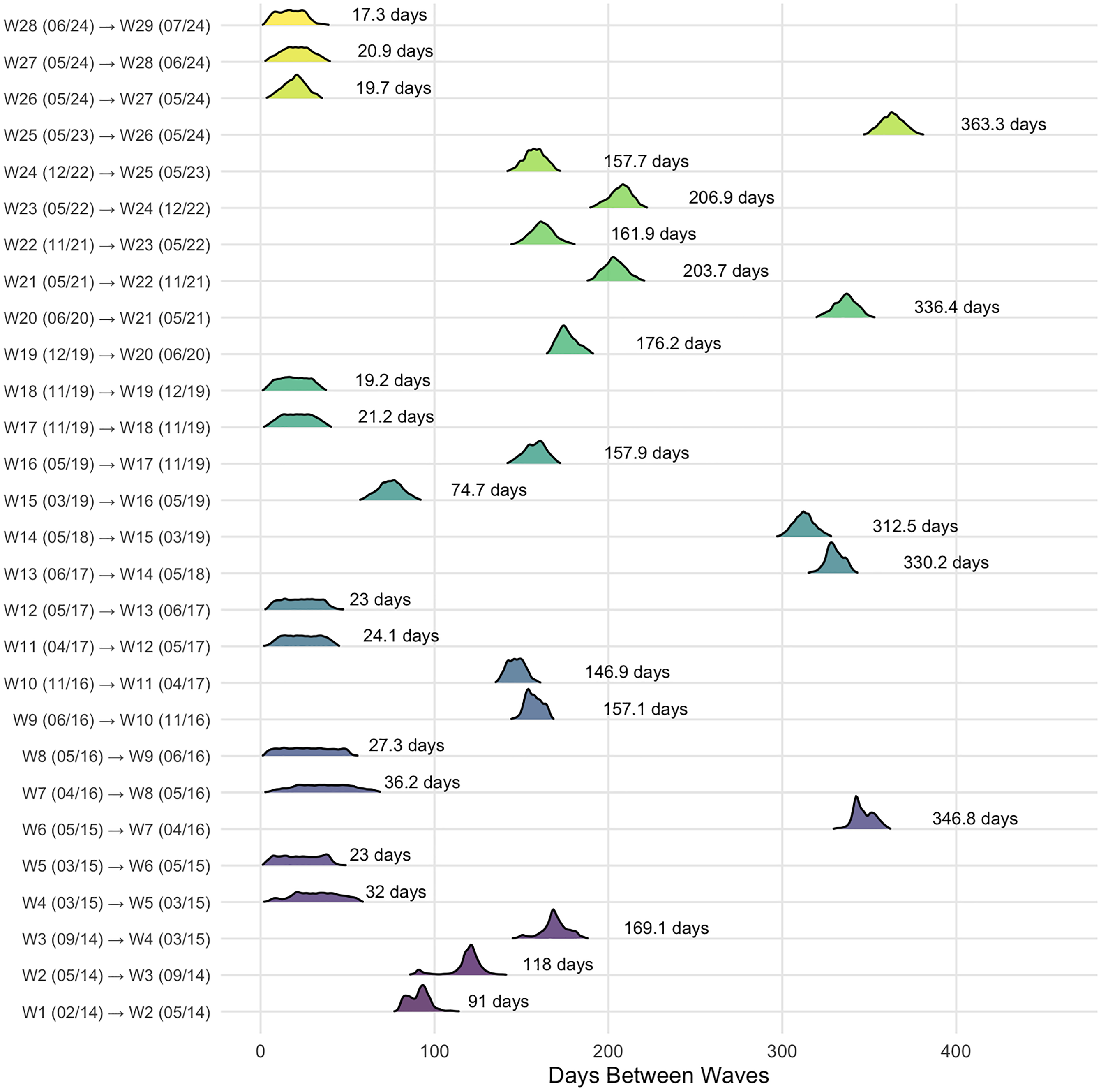
Data comes from the British Election Study Internet Panel (BESIP) (Fieldhouse et al. Reference Fieldhouse, Green, Evans, Mellon, Prosser, de Geus, Bailey, Schmitt, van der Eijk and Griffiths2026). We use the first twenty-nine waves, collected between February 2014 and July 2024. The BESIP panel provides a unique dataset that covers multiple major political events – including both referendums of interest – and includes large subsamples in Scotland and Wales. It also has the benefit of pre- and post-Scottish and EU referendum waves, allowing us to be more certain that any effect is a result of the referendum itself and not another confounding event. Figure 1 displays the dates of each wave of the BESIP and the length of time between waves.
Time intervals between consecutive BESIP survey waves.

Figure 1. Long description
The image contains multiple vertical bar graphs depicting the time intervals between consecutive BESIP survey waves. Each bar graph represents a specific time interval between two survey waves, with the horizontal axis labeled Days Between Waves and the vertical axis showing the sequence of survey waves. The graphs are arranged chronologically from bottom to top, starting with W1 (02/14) to W2 (05/14) and ending with W28 (06/24) to W29 (07/24). Each bar graph includes a label indicating the specific survey waves and the duration in days between them. The durations vary significantly, ranging from as short as 17.3 days to as long as 363.3 days. The graphs show a mix of short and long intervals, with some clusters of shorter intervals and some longer gaps. The overall pattern indicates variability in the time intervals between consecutive survey waves.
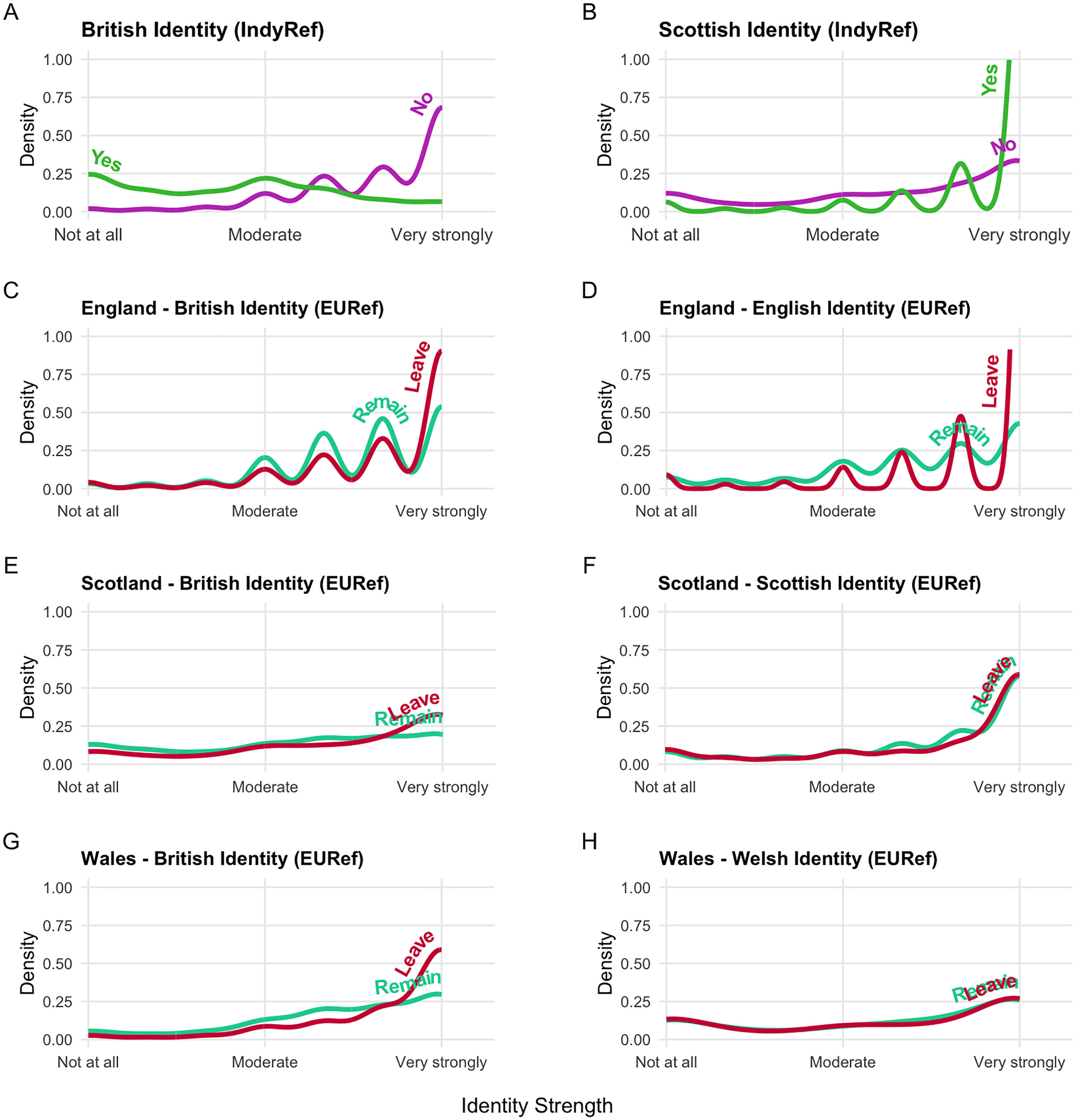
According to Citrin et al. (Reference Citrin, Sears, Muste and Wong2001), there are three dimensions of national identities: identification as a member of the group (self-categorization), identification with the group (attachment), and what it means to be a member of the group (normative content). In our study, we focus on the first element using the BESIP’s national identity questions, which ask respondents to indicate how British and English/Scottish/Welsh they feel on a scale from 1 (not at all X) to 7 (very strongly X). We normalize this variable between 0 (not at all) and 1 (very strongly) to improve interpretation. Respondents who answered ‘don’t know’ were recoded as missing. We present the distributions of these national identity variables by referendum vote choice in Figure 2.
National identity distributions by referendum vote. Pre-referendum waves: Scottish referendum (February 2014) and EU referendum (May 2016).

These national identity questions were asked in every wave of the BESIP bar waves 5, 6, 18, and 19 (the pre and post waves for the 2015 and 2019 UK general elections). We therefore have information about a respondent’s national identity at relatively frequent time-points either side of key critical electoral events in the previous six years in Britain. While scholars often focus on relative territorial identity (substate identity minus state identity), we focus on the separate national identities (British and English/Scottish/Welsh) to see whether any changes are isolated to the state or substate identity (or both), as per our hypotheses.
To examine changes in national identity following the referendums, we employ four complementary analytical approaches that distinguish short-term fluctuations from sustained identity shifts. For our analysis of immediate post-referendum effects, we use ordinary least squares (OLS) regression models with lagged independent variables. We calculate change scores by subtracting pre-referendum national identity measurements from post-referendum measurements, creating variables ranging from −6 to +6 on our seven-point scales. These scores serve as dependent variables, with referendum vote choice and sociodemographic controls as predictors.Footnote 6 We repeat this analysis across all available wave pairs from Wave 1 (February 2014) to Wave 30 (May 2025), allowing us to identify whether post-referendum identity changes differ meaningfully from typical wave-to-wave fluctuations.
To assess the persistence of identity changes over extended periods, we employ three additional approaches. Here, our analysis is limited to the EU Referendum and British identity due to sample size limitations in the panel. First, we extend our OLS framework to examine longer-term change by comparing identity levels between the pre-referendum campaign wave (Wave 8, May–June 2016) and a post-Brexit implementation wave (Wave 20, June 2020). Secondly, we implement latent growth curve models (LGCMs) that capture average within-individual trajectories in national identity across eight waves spanning April 2016 to June 2020, estimating both initial identity levels and rates of change separately for Remain and Leave voters. Thirdly, we employ two-way fixed effects (TWFE) models that isolate within-person changes by including individual-specific and wave-specific fixed effects, controlling for all time-invariant characteristics and period-specific shocks. By triangulating findings across these methods, we can assess both the robustness and temporal dynamics of referendum-induced identity change. Full model specifications are provided in the supplementary materials.
Do Voters Shift Their National Identity?
Our first analysis focuses on individual-level change in national identity between pairs of consecutive BESIP waves. Change is calculated by subtracting pre-referendum identity scores from post-referendum scores, creating a scale ranging from −6 to +6. These scores served as dependent variables in lagged OLS regression models. We then repeated this process for each pair of waves between waves 1 and 30, allowing us to capture identity changes in different voter groups. We exclude wave 8 (the campaign wave of the 2016 EU referendum) from our original analysis of the wave-on-wave change in identities by referendum vote because Scottish referendum vote intention was not asked in Wave 8, and there is no equivalent campaign wave for the Independence Referendum. Our goal was to analyse change over the same intervals for both referendums.Footnote 7
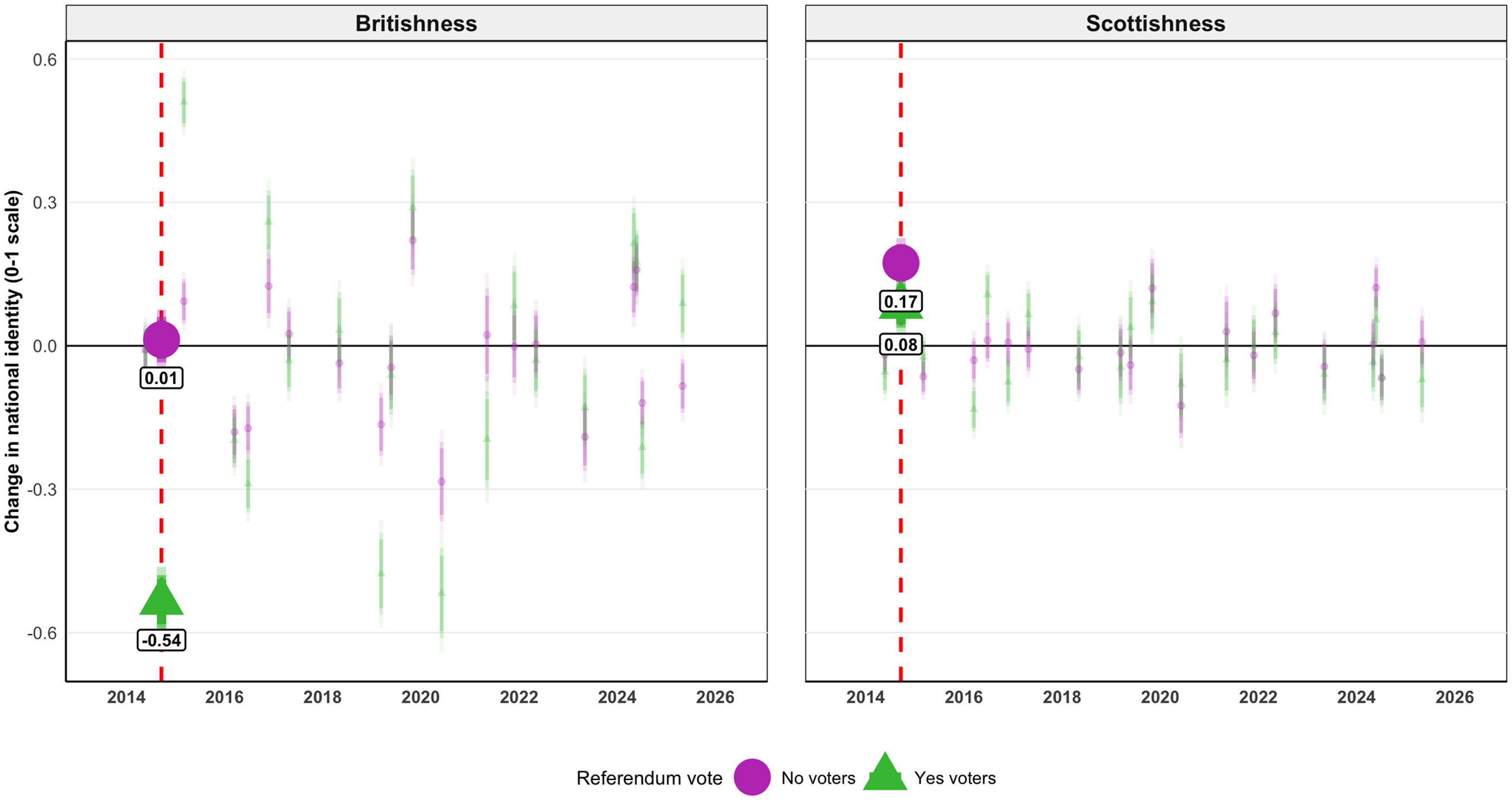
The Scottish independence referendum produced striking results in the immediate aftermath of the referendum (Figure 3). Yes voters showed substantial changes in national identity immediately following the vote, with their British identity declining by nearly 0.6 points on the seven-point scale, while their Scottish identity increased slightly. These results provide partial support for our hypotheses but reveal an asymmetric pattern. Yes voters (losers) show substantial identity changes consistent with H3 and H4, distancing themselves from British identity. However, No voters (winners) show no corresponding changes, providing no support for H1 and H2. The predicted symmetric polarization does not occur. These changes reverse in the following wave, which is consistent with Fieldhouse et al. (Reference Fieldhouse, Green, Evans, Mellon, Prosser, Schmitt and van der Eijk2020) aggregate-level finding that the changes in national identity among Yes voters were temporary.
Predicted change in national identities by lagged Scottish independence referendum position in Scotland over time.

Figure 3. Long description
Panel A: The line graph titled Britishness shows the change in national identity on a scale from 0 to 1. The x-axis represents the years from 2014 to 2026, and the y-axis represents the change in national identity. The red dashed vertical line marks the year 2016. A purple dot indicates a change of 0.01 for no voters, and a green triangle indicates a change of -0.54 for yes voters. The graph shows fluctuations in Britishness over time, with notable changes around the referendum years. Panel B: The line graph titled Scottishness shows the change in national identity on a scale from 0 to 1. The x-axis represents the years from 2014 to 2026, and the y-axis represents the change in national identity. The red dashed vertical line marks the year 2016. A purple dot indicates a change of 0.17 for no voters, and a green triangle indicates a change of 0.08 for yes voters. The graph shows fluctuations in Scottishness over time, with notable changes around the referendum years.
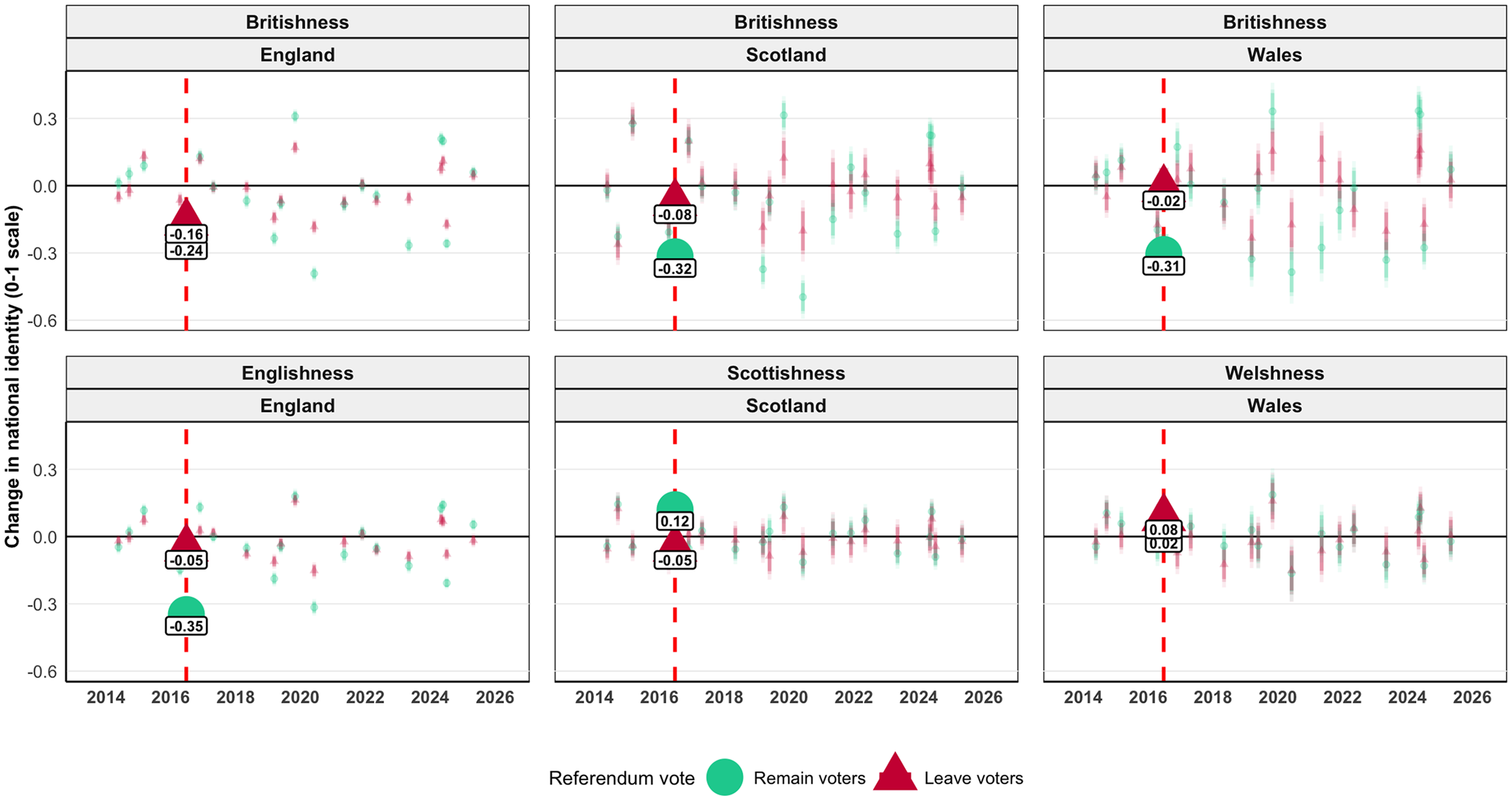
We now turn our attention to the EU Referendum vote, analysing its effects across England, Scotland, and Wales to capture the distinct national identity landscapes present in each country (Figure 4). As with the Scottish referendum, the EU referendum produces asymmetric rather than symmetric effects. Hypothesis 4 receives strong support: losers (Remainers in all three nations) distance themselves from identities associated with Brexit. However, H1 and H2 receive minimal support: winners (Leavers) show few significant changes. Hypothesis H3 also receives limited support, as Remainers do not consistently strengthen identification with substate identities in Scotland and Wales, nor with Britishness in England.
Predicted change in national identities by lagged EU referendum position in England, Scotland, and Wales over time.

As with the Scottish Independence Referendum, our results indicate that the change in national identity following the post-EU referendum wave is unlike the fluctuations in national identity present between most other waves. Rather than changing at the same rate, the change in national identity immediately following the referendum is strongest for those on the losing side of the EU Referendum. Starting with Scotland and Wales, the largest change is for those who said they would vote Remain prior to the referendum, who became significantly less British (around 0.3 points on the six-point scale) in both nations. Unlike the Scottish Independence Referendum, these changes are not reversed in the next wave (that is, Remainers and Leavers change their British identity at the same level), which suggests that this may represent a sustained shift in national identities among Remainers. In contrast, we do not find that Leavers became more likely to feel British after the referendum in Scotland and Wales, and the changes for substate identities are far more muted (although Remainers did become slightly more Scottish). Consequently, our results suggest that the primary change in national identity in Scotland and Wales comes from those who lost (Remainers) rejecting the identity that associates with Brexit in their nation (Britishness) (H4) rather than becoming far more Scottish/Welsh (H3), while there are few changes among those who won (Leavers) (H1 and H2).
When examining England, our results are, in some respects, surprising. They need to be considered with care. Consistent with our expectations (H4), Remain voters feel considerably less English after the vote (around 0.35 points on the 1–7 scale). However, the other changes do not provide clear-cut support for our hypotheses. First, neither Remain nor Leave voters move towards the identity hypothesized to associate with their side of the referendum (H1/H2). We find evidence of processes of distantiation from, rather than attraction towards, national identities in England. National identification declines in relation to both Englishness and Britishness for Leavers as well as Remainers. There are, even so, some important differences. Overall, we find a clear and enduring pattern that Remainers from English and British identities weaken much more than those of Leavers. Tempting though it might be, it would be misleading to treat the decline of Britishness among Leavers as support for our H2 expectations.
In contrast to Scotland and Wales, where there was a clear delineation (Scottish/Welsh Remain versus British and Leave), things were more complicated in England. Contrary to our hypotheses in relation to national identities in England, we find that Remain voters responded in a similar manner in relation to both English and British identities: they distanced themselves from both. This dual rejection means Remainers may have associated both identities with the other side of the vote. This pattern may reflect the conflation of these identities both historically (Kumar Reference Kumar2010) and in the implementation of the Brexit referendum result.
The smaller declines in Englishness and Britishness among Leavers are also noteworthy (and again contrast with some strengthening of Scottish and Welsh identification). Even as Remainers were moving away from both identities, perhaps their politicization in England by Brexit also made some Leavers uncomfortable. Overall, our understanding of the conflation of these identities would benefit from further empirical work (including in our appendix).
While most fluctuations in later waves reflect normal measurement variation, several specific moments show substantive changes. Most notably, gaps between Leave and Remain voters widen considerably from 2019 onward – coinciding with the election of an explicitly pro-Brexit government and Brexit’s implementation. This pattern suggests that identity divisions triggered by the referendum can be reinforced and amplified by subsequent political developments, consistent with our theoretical expectation that implementation crystallizes meaning and sustains identity threat among referendum losers.
Are the Changes Sustained?
Wave-by-wave analysis revealed significant shifts in national identity immediately following both the 2014 and 2016 referendums. The most pronounced changes occurred among referendum losers, who distanced themselves from identities associated with the winning side – British identity in Scotland and Wales, and both British and English identities in England (supporting Hypothesis H4). This raises a fundamental question: were these identity changes merely temporary fluctuations that eventually reverted to pre-referendum levels, or did they represent more permanent shifts in national self-perception? This persistence question takes on particular importance given the asymmetric patterns observed in immediate post-referendum changes. If constitutional events produce lasting identity transformations, we should observe sustained gaps between winners and losers rather than gradual convergence.
To investigate this question, we leverage the long-term panel element of the BESIP dataset, following the same individuals over a four-year period. This analysis is limited to the EU Referendum and changes in British identity across the whole of Britain due to panel attrition reducing the Welsh and Scottish subsamples. We extend our analysis from the immediate post-referendum period (Wave 9, June–July 2016) through to post-Brexit implementation (Wave 20, June 2020), employing three complementary analytical approaches: extended OLS regression, latent growth curve models, and two-way fixed effects models. Despite their different statistical assumptions and estimation strategies, all three approaches converge on a consistent finding: the EU referendum catalysed a persistent and widening gap in British identity between Remain and Leave voters.
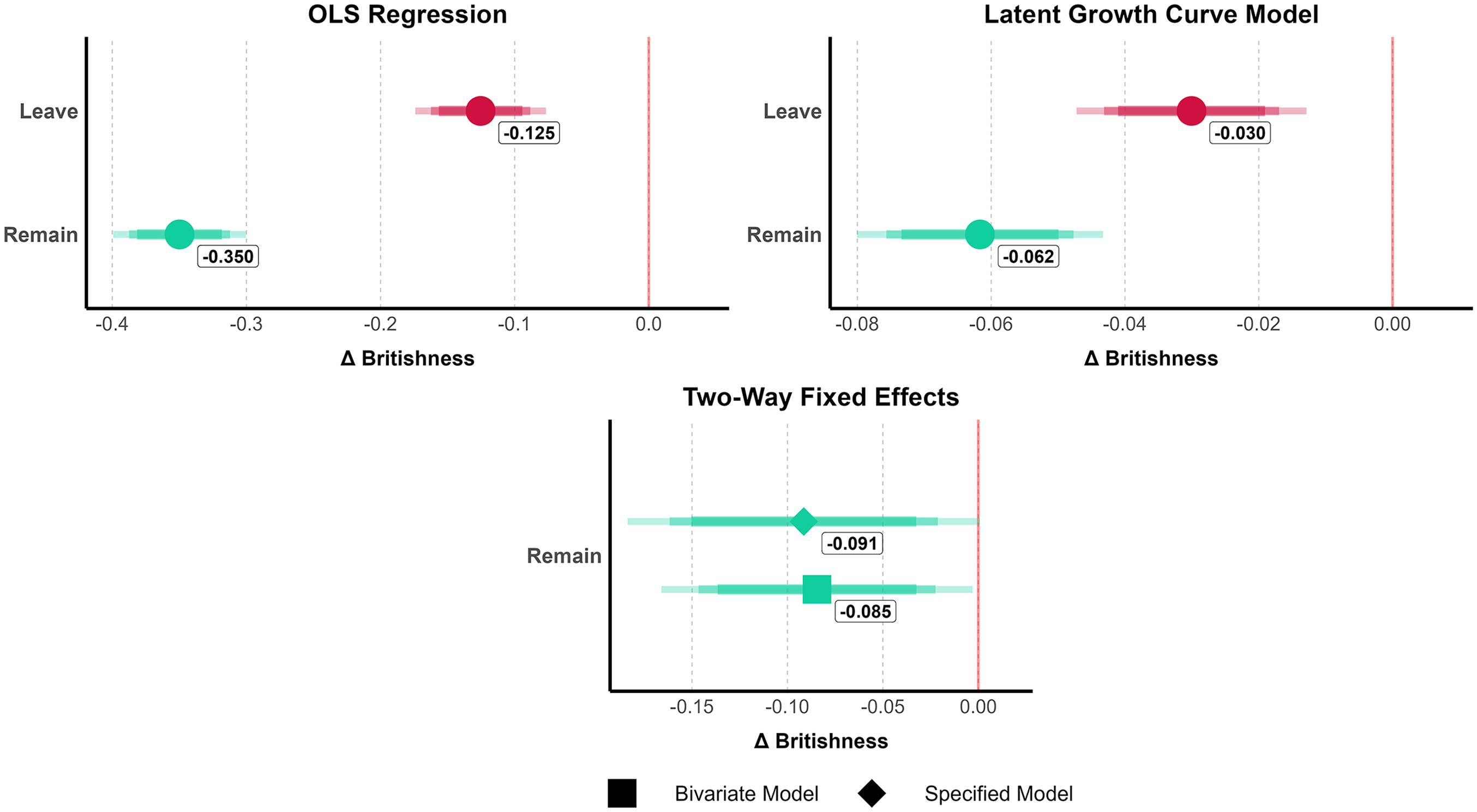
In Figure 5, we display the results of all three model specifications.Footnote 8 The top panel shows results from an OLS regression, with change in British identity (that is, Britishness in W20 minus Britishness in W8, −6 to +6) as the dependent variable, and EU referendum vote in W9 (immediately post-referendum) as the independent variable. The top panel shows the predicted level of the dependent variable (the amount of change in Britishness), with robust standard errors. Overall, Britishness declines far more for Remainers (−0.350) than it does for Leavers (−0.125).
Long-term change in identity across three model specifications.

Figure 5. Long description
Panel A: OLS Regression. This scatter plot shows the change in Britishness for Leave and Remain groups. The x-axis represents the change in Britishness, and the y-axis represents the groups Leave and Remain. The Leave group has a value of -0.125, and the Remain group has a value of -0.350. Panel B: Latent Growth Curve Model. This scatter plot shows the change in Britishness for Leave and Remain groups. The x-axis represents the change in Britishness, and the y-axis represents the groups Leave and Remain. The Leave group has a value of -0.030, and the Remain group has a value of -0.062. Panel C: Two-Way Fixed Effects. This scatter plot shows the change in Britishness for the Remain group across two models. The x-axis represents the change in Britishness, and the y-axis represents the Remain group. The Bivariate Model has a value of -0.091, and the Specified Model has a value of -0.085.
The middle panel shows results from a latent growth curve model (LGCM), with Britishness again as the the dependent variable of interest. For LGCMs, you need to manually set the factors assigned to each wave to calculate the intercept and the slope. We set the intercept to 1 and assigned the values for the slope to reflect time, coded as the fraction of a year between waves (for example, Wave 7 = 0; Wave 8 = 22/365 = 0.060273973). We use the maximum likelihood with robust standard errors estimator, and we do not constrain the variance to be equal across waves. In Figure 5 we plot the slope coefficient for Leave and Remain voters, which indicates the average change in Britishness experienced by both groups. We find that Britishness has declined further among Remainers (−0.062 per year) than among Leavers (−0.030 per year).
Finally, the bottom panel displays results from a two-way fixed effects regression that isolates the within-individual effect of the Brexit referendum on British identity. This model includes individual fixed effects (controlling for all stable characteristics of each person) and wave fixed effects (controlling for any time-varying factors affecting everyone equally). The key variable is an interaction between EU referendum vote choice and a binary indicator for whether the observation occurs before or after the referendum. Because individual fixed effects absorb the direct effect of referendum vote, the interaction term captures our quantity of interest: how much British identity changed before versus after the referendum for Remainers relative to Leavers. We estimate two specifications. The first includes only the vote-by-period interaction. The second adds interactions between the period indicator and potential confounding variables – gender, education, party identity, age group, country, ethnicity, EU knowledge, social class, and referendum interest – following Sczepanski (Reference Sczepanski2023)’s approach to account for compositional differences between Leave and Remain voters. Both specifications yield consistent results: British identity declined significantly more among Remainers than Leavers following the Brexit referendum (in contrast to Sczepanski (Reference Sczepanski2023)’s own analysis).Footnote 9
The convergence of findings across multiple analytical approaches, combined with their persistence across different territorial contexts, provides strong evidence that the EU referendum constituted a critical juncture that fundamentally transformed national identity, particularly among losing voters (H4). While this division remained relatively stable during the first two years after the referendum, it has progressively expanded, particularly after 2019 – likely influenced by the election of an explicitly pro-Brexit government. A complementary analysis of the Scottish referendum showed a more modest decline in British identity among No voters (see appendix), though this trend likely reflects the influence of anti-Brexit No voters rather than direct effects of the Scottish referendum itself.
A possible methodological concern here is whether observed identity changes reflect responses to referendum outcomes, or whether identities are changing in response to preference updating. To test this, we repeat our analysis but exclude those who changed their constitutional preferences. We find this concern is largely unwarranted: more than 80 per cent of respondents maintained stable referendum preferences throughout the panel period. Crucially, restricting our analyses to only those with stable preferences yields substantively identical results (see supplementary materials). This suggests that the identity shifts we document represent genuine responses to political defeat rather than reflecting concurrent preference change.
Discussion
Our findings make three significant contributions to understanding the relationship between political events and national identity formation. First, we demonstrate that constitutional referendums can systematically reshape citizens’ national identities. While recent research has shown that various social identities can respond to political factors (Egan Reference Egan2020; Margolis Reference Margolis2018; Posner Reference Posner2005), our high-frequency panel data extend this understanding to national identity in sovereignty contexts, providing causal evidence that traditionally stable identities adjust in very short periods in response to critical constitutional moments.
Secondly, and most significantly, we discover that constitutional referendums produce asymmetric rather than symmetric effects. While we hypothesized that both winners and losers would adjust their identities (H1–H4), our analyses reveal that identity change concentrates almost entirely among referendum losers. Yes voters in Scotland became less British following defeat; Remain voters across Britain distanced themselves from British (and in England, English) identities after losing the Brexit vote. Winners showed minimal corresponding changes. This asymmetry demonstrates that constitutional defeat, rather than constitutional participation per se, drives identity transformation.
Thirdly, we reveal crucial temporal variation in how constitutional events reshape identity. The Scottish independence referendum produced intense but temporary shifts, with Yes voters returning to pre-referendum British identification within months. The EU referendum catalysed enduring transformations, creating a persistent gap between Remain and Leave voters that has only widened since 2019. We attribute this variation to implementation asymmetry: the Scottish referendum preserved the status quo, facilitating identity reversion, whereas Brexit’s implementation created ongoing institutional reinforcement of identity threat among Remainers. Comparison with the 2024 general election (see supplementary materials) reinforces this interpretation: elections produced temporary, symmetric increases in national identification that quickly reversed, whereas constitutional referendums generated lasting asymmetric changes concentrated among losers. This contrast confirms that constitutional salience, not political salience generally, drives persistent identity transformation.
These patterns reveal how constitutional referendums produce lasting identity effects through two interrelated processes: constitutional salience creates the conditions for identity reconsideration by explicitly challenging community boundaries, while identity threat mechanisms explain why change concentrates among losers. When implemented, they persistently reinforce contested outcomes through institutional transformation. The identity threat mechanism explains asymmetry: when outcomes contradict individuals’ core values, existing national identities become threatening if strongly associated with rejected positions. Rather than abandoning deeply held values, individuals resolve this cognitive dissonance by distancing themselves from the threatening identity (Branscombe et al. Reference Branscombe, Ellemers, Spears, Doosje, Ellemers, Spears and Doosje1999; Festinger Reference Festinger1957; Mummendey et al. Reference Mummendey, Kessler, Klink and Mielke1999). Winners experience no equivalent threat, producing the asymmetric pattern we observe.
Temporal persistence depends on meaning crystallization through implementation. Brexit’s protracted negotiation, economic consequences, and political upheaval continuously reinforced for Remainers that the political community had been redefined against their values. Each implementation milestone strengthened the association between British identity and Brexit, sustaining identity threat. The Scottish referendum, preserving constitutional arrangements, generated no equivalent crystallization process, allowing temporary identity shifts to dissipate.
These results challenge the traditional conceptualization of national identity as an independent variable, demonstrating instead that critical constitutional moments fundamentally reshape citizens’ sense of belonging. Our findings do not suggest that treating national identity as an independent variable is fundamentally flawed. Rather, they demonstrate that the relationship between identity and political behaviour is reciprocal: identity shapes political preferences, and political outcomes reshape identity. This reciprocity does not invalidate research treating identity as exogenous; it simply means such research captures only part of the dynamic. The appropriate treatment of identity depends on the research question: for understanding vote choice in a single election, treating identity as predetermined may be reasonable; for understanding long-term political change, identity’s endogeneity to political events must be modelled explicitly.
For democratic governance in multinational states, our findings reveal a troubling paradox: mechanisms employed to resolve constitutional questions may simultaneously erode the shared identities underpinning democratic legitimacy. This dynamic appears especially acute in the United Kingdom, where Brexit steadily undermines British identity among Remainers, thereby potentially weakening support for the union itself (Johns Reference Johns2021; McMillan and Henderson Reference McMillan and Henderson2021). Simultaneous commitments to Brexit and ‘muscular unionism’ (Sandford Reference Sandford2024) may thus prove self-defeating. Political leaders should anticipate asymmetrical identity responses rather than assuming democratic votes automatically confer legitimacy. The widening gap in British identity from 2019 onward demonstrates that identity divisions can deepen during implementation, particularly when electoral victories reinforce losing voters’ sense of marginalization. Rhetorical appeals to national unity prove insufficient to bridge identity divides rooted in fundamental value conflicts over constitutional arrangements. Substantive policy accommodations addressing losers’ core concerns may be necessary to prevent lasting identity estrangement. As democratic societies increasingly employ referendums to resolve sovereignty questions, understanding these identity dynamics becomes crucial for maintaining the foundations of citizen–state relations that extend well beyond vote counting.
Supplementary materials
The supplementary material for this article can be found at https://doi.org/10.1017/S0007123426101653.
Data availability statement
Replication data for this article can be found in Harvard Dataverse at: https://doi.org/10.7910/DVN/LH4FM1.
Acknowledgements
The authors would like to thank the editor and three anonymous reviewers, colleagues in the Wales Governance Centre, British Election Study team, and Scottish Election Study team, as well as Rachel Statham, for their feedback on the paper. Early drafts of the paper were previously presented at Swansea University and Strathclyde University.
Financial support
The ESRC Governance after Brexit grant (ES/R007500/1) supported initial research for this article by Jac Larner and Daniel Wincott.
Competing interests
None to disclose.


 Open access

