




No CrossRef data available.
Article contents
Differences in attention, executive functioning, and memory in children with and without ADHD after severe traumatic brain injury
Published online by Cambridge University Press: 26 August 2005
Abstract
Although the development of Attention Deficit Hyperactivity Disorder (ADHD) after traumatic brain injury (TBI) has been described, it is unknown whether children with TBI and ADHD have greater neuropsychological impairments than children with TBI alone. This study examines attention, executive functioning, and memory in children with TBI-only and TBI + ADHD. Caregivers of 82 children with severe TBI completed structured psychiatric interviews at enrollment to diagnose premorbid ADHD and one-year after injury to diagnose post-injury ADHD. Children underwent neuropsychological testing one year after injury. One memory measure significantly differentiated children with TBI-only from children with newly developed ADHD [secondary ADHD (S-ADHD)] and those with premorbid ADHD that persisted after injury [persisting ADHD (P-ADHD)]. Compared with the TBI-only group, children with TBI + ADHD had worse performance on measures of attention, executive functioning, and memory. Results reveal that in children with severe TBI, the behavioral diagnosis of ADHD is associated with more difficulty in attention, executive functioning, and memory. Additionally, results suggest greater deficits in memory skills in the S-ADHD group compared with the P-ADHD group. Although findings provide preliminary support for distinguishing P-ADHD from S-ADHD, further research is needed to investigate neuropsychological differences between these subgroups of children with severe TBI. (JINS, 2005, 11, 645–653.)
Keywords
Information
- Type
- Research Article
- Information
- Journal of the International Neuropsychological Society , Volume 11 , Issue 5 , September 2005 , pp. 645 - 653
- Copyright
- © 2005 The International Neuropsychological Society
INTRODUCTION
Traumatic brain injury (TBI) is associated with acquired deficits in attention and executive functioning (e.g., Dennis et al., 1995; Kaufmann et al., 1993; Levin et al., 1995). Attention-deficit hyperactivity disorder (ADHD) is a neurodevelopmental disorder also associated with deficits in attention and executive functioning (e.g., Barkley, 1997; Grodzinsky & Barkley, 1999). In fact, Barkley (1997) argued that the essential impairment in children with ADHD is primarily executive dysfunction. Executive functions are thought to be mediated by frontal-subcortical circuits, and impairment of these circuits has been reported in both TBI (e.g., Auerbach, 1986) and ADHD (Durston, 2003). Thus, it is not surprising that, compared with typically developing children, similar deficits in attention and executive functioning may be found in children with ADHD and children with severe TBI.
Deficits in memory have also been reported in children with TBI and those with ADHD. In ADHD, memory problems are thought to be the result of inefficient organization and initial encoding due to underlying executive dysfunction (Cahn & Marcotte, 1995; Kaplan et al., 1998). Similarly, in TBI, problems with memory are commonly thought to be the result of executive dysfunction (Auerbach, 1986; Van Zomeren et al., 1984) and documented deficits in organization and initial encoding have been reported (Levin et al., 1993). Memory deficits resulting from difficulties with storage and retrieval of new information have also been noted subsequent to pediatric TBI (Yeates et al., 1995), suggesting that in some children, memory impairment may be attributed to damage in brain areas necessary for memory, such as medial temporal lobe structures.
From a behavioral perspective, symptoms of ADHD are apparent only in some children after TBI. Brown and colleagues were the first to describe ADHD symptoms in children with TBI (Brown et al., 1981). In that study of 31 children, three were described as having a “hyperkinetic syndrome” after injury. Gerring and colleagues systematically examined the development of ADHD symptoms following TBI and found that children with premorbid ADHD were disproportionately represented among those with moderate and severe TBI compared with the population rates of ADHD (Gerring et al., 1998). Additionally, also based on population rates, a greater number of children than expected developed ADHD following injury. In children with TBI, the development of ADHD has been found to be associated with both neurological and psychosocial variables including injury severity (Max et al., 1998), injury to specific brain regions, including thalamus and basal ganglia (Gerring et al., 2000), and family stressors (Gerring et al., 1998; Max et al., 1998).
Also, the presence of TBI accompanied by ADHD (TBI + ADHD) has been associated with greater problems with behavior and adaptive functioning and inconsistently with lower intellectual functioning. Gerring et al. (1998) found that children who had persisting ADHD (i.e., ADHD that was present premorbidly and persisted after injury; P-ADHD) and those with secondary ADHD (i.e., newly developed ADHD post injury; S-ADHD) had more reported problems with affective lability, aggression, socialization, and global functional skills than the children with TBI not accompanied by ADHD (TBI-only). No differences, however, were noted between the groups with and without ADHD on measures of general intellectual functioning. Moreover, no differences in attentional problems, affective lability, aggression, socialization, or general functional skills were found between the children with P-ADHD and those with S-ADHD. Similar results were reported by Max et al. (2004), who examined children with mild, moderate, and severe TBI. In that study, children with S-ADHD were found to have greater deficits in adaptive skills compared with children without S-ADHD. Unlike the Gerring study, however, intellectual functioning was significantly more impaired in the group of children with S-ADHD. The difference between the two studies may be related to the greater range of injury severity in the study by Max and colleagues. Moreover, in that study, IQ measures varied between the children and abbreviated IQ scores were used. Therefore, despite the robust differences in IQ between the TBI-only and S-ADHD groups, the results of this study need to be viewed cautiously. In addition, children with premorbid ADHD who sustained a TBI were not examined in this study. Thus, conclusions about children with P-ADHD cannot be made.
Only two studies have examined aspects of attention and executive functioning in children with TBI and comorbid ADHD (Schachar et al., 2004; Wassenberg et al., 2004). In both studies, children with preinjury ADHD were excluded. In one study, impaired response inhibition was noted in a group of children with S-ADHD after severe brain injury compared with children with mild or moderate injury and compared with children with severe injury who did not develop ADHD after TBI (Schachar et al., 2004). Most recently, Wassenberg et al. (2004) examined sustained attention (omission errors) and impulsivity (commission errors) in relation to the development of S-ADHD and found that omission errors immediately after TBI predicted later S-ADHD, whereas commission errors were not predictive of later S-ADHD. Also, in this study sample, the S-ADHD group had significantly greater omission errors at 3 and 24 months and greater commission errors were noted at 3 months (J.E. Max, personal communication, August 5, 2004). This study, however, had a very small sample size with data available for only 4 to 5 children with S-ADHD at each time point (3, 6, and 24 months after injury).
With the exception of these few studies examining overall intellectual and adaptive skills, inhibition, and attention, no studies have examined the differences in performance on a variety of measures of attention and executive functioning in children with severe TBI + ADHD compared with children with severe TBI alone. Also, no study to date has compared these groups on any measure of memory, a common area of concern following severe TBI. Moreover, only one study examined children who had P-ADHD following TBI (Gerring et al., 1998). Therefore, the relationship between a behavioral diagnosis of ADHD after TBI (especially in children with ADHD prior to the TBI) and performance on neuropsychological measures of attention, memory, and executive functioning remains unexplored. Because of the large number of children with severe TBI with P-ADHD, we felt it was important to examine the neuropsychological profiles of children with both P-ADHD and S-ADHD. A better understanding of the differences in neuropsychological outcomes in children who develop ADHD after TBI or who have persisting ADHD after TBI may help to guide recommendations for psychological, pharmacological, and educational management following TBI.
In the current study, children with severe TBI who have documented ADHD (either P-ADHD or S-ADHD) based on a structured psychiatric parent-interview, conducted one year after injury were compared with children with TBI who do not meet criteria of ADHD one year after injury (TBI-only group). Based on previous literature, we expected that children with P-ADHD and S-ADHD would perform worse on measures of attention, executive functioning, and memory compared with the TBI-only group. Additionally, because previous research examining differences between children with P-ADHD and S-ADHD is limited, we wanted to explore differences between these subsets of individuals on measures of attention, executive functioning, and memory. Lastly, because of the small number of children with ADHD in the sample, children with P-ADHD and S-ADHD were combined into one group (TBI + ADHD) and compared with children with TBI-only to explore the relationship between a behavioral diagnosis of ADHD after TBI (regardless of whether the children had ADHD prior to the TBI) and performance on these measures.
METHODS
Research Participants
The sample consisted of 82 children (ages 6–16 years) with severe TBI who were transferred from tertiary trauma centers to a university-affiliated pediatric center for rehabilitation. Families were recruited from consecutive admissions to the rehabilitation center and very few families chose not to enroll in the study. The average age at the time of injury was 10 years 2 months. There were 49 boys and 33 girls in the sample. Exclusion criteria included open head injury, previous hospitalizations or emergency room visits for TBI, premorbid mental retardation, documented child abuse, or premorbid central nervous system pathology (e.g., seizure disorder). The mean Hollingshead index score of socioeconomic status was 33.7 (range = 3 to 66). Initial Glasgow Coma Scale (GCS) scores ranged from 3 to 8 with a mean of 5.38. Because all children did not receive all neuropsychological measures, the specific number of children in each analysis varied slightly.
Neuropsychological Measures
Attention and executive functioning
The Freedom from Distractibility Index (FDI) score from the Wechsler Intelligence Scale for Children–III (WISC–III) was used to measure attention and working memory (Wechsler, 1991). FDI includes performance on the Arithmetic and Digit Span subtests.
Additionally, the Tests of Variables of Attention (TOVA) were used to measure sustained attention and impulse control. The TOVA is a 21.6-minute visual continuous performance test in which participants are presented with visual targets and nontargets on a computer screen (Leark et al., 1988). Variables included number of omission (missed targets) and commission errors (switch hits for nontarget), response time (time between stimulus presentation and switch pressing), and response time variability. Because the demands of the task were different for each half, each variable was examined separately for the first half (infrequent stimuli presentation) and second half (frequent stimuli presentation). Raw scores for each half of the test (frequent and infrequent presentation) were converted to age-corrected z-scores.
The 3-disk-transfer and 4-disk-transfer of the Tower of Hanoi (TOH) task was employed to evaluate the children's ability to plan and organize a sequence of moves. The quality of planning score, which reflected the number of trials required to solve problems of differing move lengths and difficulty was used in the analyses. A maximum of six points was assigned to a problem solved in the first two trials with point totals decreasing with number of trials required for solution. Thirty-six points was the highest score possible on the 3-disk version (TOH-3) and eighteen points was the highest score possible on the 4-disk version (TOH-4). Because normative data are only available for a restricted age range, ages 7 to 12 for the 3-disk version and 8 to 12 for the 4-disk version (Welsh et al., 1991), analyses were conducted using raw scores.
The Wisconsin Card Sorting Test (WCST) was used to assess categorization and ability to shift cognitive strategies in response to external feedback (Grant & Berg, 1948). Standardized administration instructions and normative data were obtained from Heaton and colleagues' revised and expanded manual (Heaton et al., 1993). Number of perseverative errors, defined as the inability to switch cognitive strategies, and number of nonperseverative errors, defined as all other errors, were the variables of interest. For this study, a computerized version of the WCST was created that interfaced with an adapted keyboard, which had four large keys to ensure that the results were not affected by motor impairment. Standard scores were generated based on a normative reference group of same-aged children.
The Controlled Oral Word Association Test (COWA), a letter fluency task (Benton et al., 1983), was employed. Total number of words, the sum of the words generated in three minutes for all three letters, was the variable of interest. Total number of words was converted into standard z-scores based on normative data for ages 7 through 15 years (Levin et al., 1991).
Learning and memory
The California Verbal Learning Test for Children (CVLT-C) was used to assess learning and memory (Delis et al., 1994). The CVLT-C is comprised of five recall trials of a 15-item word list; the list items belong to three semantic categories (Fruits, Clothing, Toys). The learning trials are followed by a single presentation of a distracter list. Learning and memory is assessed by number of words recalled over the five learning trials, after presentation of the distracter list (short-delay free and cued recall), after a longer 20-minute delay (long-delay free and cued recall), and on recognition. Learning, free recall, cued recall, and recognition and semantic organization was examined. Although age-corrected standard scores are available, standard scores are only provided in 0.5 z-score increments. Therefore, raw scores were used for all analyses.
ADHD measure
The diagnosis of preinjury Attention Deficit Hyperactivity Disorder (ADHD) was established by administration of the Diagnostic Interview for Children and Adolescents (DICA), a structured interview for children between 6 and 17 years of age (Welner et al., 1987). The DICA-P, or parent version, was administered to the parent as soon as possible after injury to obtain information about preinjury ADHD and was also administered one year later to diagnose persisting and secondary ADHD. The 14 DICA criteria for ADHD conform to the Diagnostic and Statistical Manual of Mental Disorders, Third Edition, Revised (DSM-III-R) (American Psychiatric Association, 1987).
Other measures
The Glasgow Coma Scale (GCS) was used to classify injury severity (Teasdale & Jennett, 1974). The GCS is a standardized severity scale that predicts mortality and morbidity in the acute phase after brain injury and functional outcome in the follow-up period (Zafonte et al., 1996). The initial GCS score on admission to the emergency room was used as the measure of injury severity (Massagli et al., 1996).
The Four Factor Index of Social Status was used to assess socioeconomic status (SES) by obtaining marital status, maternal and paternal occupations, and years of education (Hollingshead, 1975). Scores range from 3 to 66. Lowest scores correspond to parents with less education and who are unskilled laborers. Highest scores correspond to parents with professional degrees working in skilled, professional jobs.
Procedure
On the day of study enrollment, a board certified child and adolescent psychiatrist (J.P.G.) conducted a structured psychiatric interview with the parents to assess symptoms of preinjury ADHD. Enrollment typically occurred one to three weeks after injury. An initial neuropsychological evaluation was completed immediately following termination of posttraumtic amnesia, which occurred approximately two to four weeks after injury. A second neuropsychological evaluation and psychiatric interview was completed approximately one year from the date of injury. Initial GCS scores were obtained through a medical record review. Only results from the second neuropsychological evaluation are reported in this study.
Statistical Analyses
For all analyses, the three groups of interest (TBI-only, S-ADHD, and P-ADHD) were compared. Because of the small number of participants in the S-ADHD and P-ADHD groups, following the 3-group comparison, the ADHD groups were combined in one TBI + ADHD group and then compared with the TBI-only group. First, analyses of variance (ANOVAs) were employed to examine differences in demographic data (age, GCS, SES) and nonparametric tests (chi square tests) were used to examine categorical data (sex, ethnicity). ANOVAs were also performed to examine differences in the variables of interest between groups using the 3-group and then the 2-group comparison. For tests in which normative data were limited, raw scores were used. When raw scores were used, analyses of covariance (ANCOVAs) were employed to control for the possible effect of age of injury on each dependent variable (e.g., TOH and CVLT variables). Additionally, because the TOVA is divided into two halves, repeated measures ANOVAs were used to examine that data using group comparisons as the between-subjects factor and test half as the within-subjects factor. For all analyses, significance level was set at p < .05. Effect sizes were calculated for all differences on neuropsychological measures using partial eta squared.
RESULTS
Demographics
Fifteen of 82 children (13.5%) met the criteria for premorbid attention deficit hyperactivity disorder. Of those 15 children, 6 children did not meet the criteria for ADHD one year after injury and were excluded from further analyses, whereas the remaining 9 children had P-ADHD (11%). Fourteen children developed S-ADHD (17.1%). Fifty-three of 82 children (64.6%) did not meet criteria for ADHD either before injury or one year later. The TBI-only group consisted of these 53 children. The combined TBI + ADHD group included all 23 children who had a diagnosis of ADHD following injury (28.1%). When all three groups were compared, no differences were noted between the TBI-only, S-ADHD, and P-ADHD groups in age, sex, ethnicity, socioeconomic status, or severity of injury. When the S-ADHD and P-ADHD groups were combined into the TBI + ADHD group and compared with the TBI-only group, again no group differences were noted in age, sex, ethnicity, socioeconomic status, or severity of injury. Demographic information is provided in Table 1.
Differences in demographic variables between children in the TBI-only, Secondary ADHD (S-ADHD), and Persisting ADHD (P-ADHD) groups (means and standard deviations)

Attention and Executive Functioning
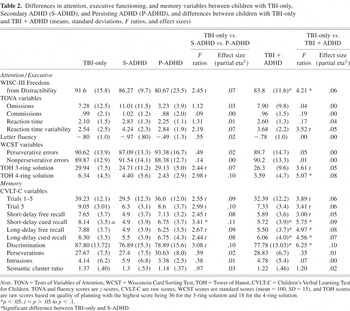
Using ANOVAs, the Freedom from Distractibility Index score of the WISC-III was not significantly different when comparing the TBI-only, S-ADHD, and P-ADHD groups (p = .09); however, when children with ADHD were combined into one group, the TBI + ADHD group performed significantly worse than the TBI-only group. Results are presented in Table 2.
Differences in attention, executive functioning, and memory variables between children with TBI-only, Secondary ADHD (S-ADHD), and Persisting ADHD (P-ADHD), and differences between children with TBI-only and TBI + ADHD (means, standard deviations, F ratios, and effect sizes)

Examination of the TOVA using repeated measures ANOVAs revealed no significant interaction or main effects for group when comparing all three groups or comparing the TBI + ADHD group to the TBI-only group, although in the two-group comparison, there was a trend towards greater reaction time variability in the TBI + ADHD group (p = .07). Between-subjects differences are presented in Table 2. There was a significant effect of test half, with greater omissions noted in the second half of the test [F = 9.70, p < .01, partial eta2 = .13, mean z-scores (first half) = 3.71 and (second half) = 8.36]. This effect was stronger when the ADHD groups were combined into the TBI + ADHD group (F = 14.70, p < .001, partial eta2 = .19). Additionally, when the ADHD groups were combined and compared with the TBI-only group, in addition to fewer omissions, there were also significantly fewer commissions [F = 4.74, p < .05, partial eta2 = .07, mean z-scores (first half) = 2.01 and (second half) = .45] and greater reaction time variability during the second half of the test [F = 6.56, p < .05, partial eta2 = .09, mean z-scores (first half) = 2.33 and (second half) = 2.87].
When controlling for age, there were no significant differences between the TBI-only, S-ADHD, and P-ADHD groups, although there was a trend towards group differences for both the TOH-3 and TOH-4. For the TOH-3, the S-ADHD group had the worst performance, whereas for the TOH-4, the P-ADHD group had the worst performance. When the S-ADHD and P-ADHD groups were combined and compared with the TBI-only group, the TBI-only group performed significantly better than the TBI + ADHD group on the TOH-4, and there was a trend toward better performance in the TBI-only group on the TOH-3 (p = .06). For the WCST and COWA, no significant differences were noted between the all three groups or when combining the ADHD groups and comparing TBI + ADHD and TBI-only groups. Results are presented in Table 2.
Learning and Memory
When comparing all three groups, only performance on short-delay cued recall was significantly different between groups. Post hoc analyses revealed a significant difference only between the TBI-only and S-ADHD groups (p < .05). There was, however, a trend towards group differences for trials 1–5, trial 5, short-delay free recall, long-delay free recall, long-delay cued recall, and discrimination. Examination of the means reveal that the TBI-only group had the best performance and the S-ADHD group had the worst performance on all of these variables. After combining the ADHD groups, the TBI + ADHD group had significantly worse performance on the short-delay cued recall, long-delay free and cued recall, and discrimination compared with the TBI-only group. Additionally, a trend towards worse performance in the TBI + ADHD group compared with the TBI-only group was noted on the total of the five learning trials, trial 5, and short-delay free recall. Results are presented in Table 2.
DISCUSSION
This study examines differences between children with severe TBI without a diagnosis of ADHD after injury and those with severe TBI who also have a post-injury behavioral diagnosis of ADHD, which may or may not have been present prior to injury. Few significant differences were noted when comparing children with TBI-only to children with S-ADHD or P-ADHD; however, the number of children in the S-ADHD and P-ADHD groups is small. When the children with ADHD are combined, as expected, children with TBI + ADHD one year after injury had worse performance on specific measures of attention, memory, and executive functioning than children with TBI-only.
In this study, attention and working memory, as measured by the FDI of the WISC-III, was significantly worse in the TBI + ADHD group. Working memory has been found to be significantly impaired in children with TBI (Roncadin et al., 2004) as well as in children with ADHD (Barkley, 1997). The results of this study suggest that following TBI, children with behavioral symptoms of ADHD have more difficulty on working memory tasks than children who do not display behavioral symptoms of ADHD after TBI.
In contrast to the recent study by Wassenberg et al. (2004), no differences were observed between the TBI + ADHD and TBI-only groups on variables of sustained attention, suggesting that ADHD in TBI does not impact sustained attention more than TBI alone. One reason for the lack of differences between TBI-only and TBI + ADHD may be that children with severe TBI, as a whole, had considerable difficulty on the TOVA. Importantly, although differences were not found between groups, performance was significantly worse in the second half of the test compared to the first half for the TBI sample as a whole. Examination of the mean z-scores reveals very poor performance in the TBI-only and TBI + ADHD groups, with a particularly large number of omission errors, especially during the second half of the test, indicating significant impairment compared with the normative sample. The high number of omission errors combined with the few number of commission errors (during the second half) and greater reaction time variability suggest that children with severe TBI were much less responsive to targets, as well as nontargets, over time and when the stimuli are presented more frequently. These results suggest that difficulties on measures of sustained, speeded responding are pervasive in children with severe TBI, such that the presence of a behaviorally-based diagnosis of ADHD following TBI may minimally impact performance on a continuous performance task above and beyond severe TBI alone.
Additionally, impaired response inhibition was not observed in this sample. These results are inconsistent with previous research, which revealed more impairment in speeded response inhibition in children with S-ADHD compared with children with TBI-only using a stop-signal task (Schachar et al., 2004) and a continuous performance task (Max, personal communication). In both of these studies, children with a range of TBI injury severity were examined. In the current sample of severely injured children, the high number of omission errors on the TOVA was accompanied by few commission errors, suggesting fewer responses in general, both to targets as well as nontargets. These findings suggest that the utilization of measures of sustained attention and response inhibition that do not rely as heavily on speed of responding may be necessary to examine differences in sustained attention and inhibition in children with severe TBI. Consistent with this view, greater executive dysfunction was observed in the TBI + ADHD group compared with the TBI-only group on one measure of complex planning (4-ring TOH). This task involves a degree of response inhibition, as the task involves careful, efficient problem-solving, but is not dependent on speed of responding.
Differences between the groups were not observed on other measures of executive functioning, including the 3-ring TOH, WCST, and COWA. These results suggest that less complex problem-solving, mental flexibility, and rapid generation of verbal output were comparable in both groups. Previous research examining children with severe TBI from this same research project revealed that other factors such as injury severity, age at injury, and volume of extrafrontal brain lesions significantly influenced performance on these measures of executive functioning (Slomine et al., 2002). Thus, it appears that for some tests of executive functioning, injury and age-related variables are more salient predictors of performance than the behavioral diagnosis of ADHD.
Children with TBI and ADHD had greater impairment than children with TBI-only in learning and memory. When all three groups were compared, children with S-ADHD had significantly more impaired performance on short-delayed cued recall compared with children with TBI-only. There was also a trend suggesting group differences on learning trials (trial 1–5 and trial 5), and the recall trials (short-delay free recall, long-delay free recall, and long-delay cued recall), as well as recognition (discrimination). Examination of mean scores revealed that for all of these variables the greatest impairment was noted in the S-ADHD group, followed by the P-ADHD, suggesting that S-ADHD may be associated with more difficulties in learning and memory than P-ADHD.
When children with ADHD were combined, the TBI + ADHD group had greater impairment than the TBI-only group in learning and memory with significantly worse performance in short-delay cued recall, long-delay free and cued recall, and discrimination. There was also a trend towards differences on the initial learning trials and the short-delay free recall. These results suggest that children with TBI + ADHD may have more difficulty encoding information than children with TBI-only and that they have more difficulty recalling information with and without the provision of semantic cues. The differences in scores cannot be clearly attributed to organizational difficulties, as there were no group differences in semantic clustering. Nevertheless, the largest difference between the groups was noted on short-delay cued recall and on subsequent delayed recall and recognition trials. This finding suggests that the TBI + ADHD group did not benefit from semantic cues to the same degree as the TBI-only group, and in fact, the provision of cues may have disrupted their learning and memory. Overall, these results suggest that even in a group of children with restricted severity of initial injury, the combined diagnoses of TBI and ADHD is associated with worse verbal memory.
Overall, there were no significant neuropsychological differences between children with P-ADHD and those with S-ADHD, which is consistent with Gerring and colleagues (1998) who found no differences between P-ADHD and S-ADHD in a larger group of participants from this same research project on a variety of behavioral indices, including parent-reported attentional problems, affective lability, aggression, and socialization. At the same time, examination of the group means reveal consistently, but not significantly, poorer scores on measures of learning and memory in the group with S-ADHD compared with the P-ADHD group. Also, the S-ADHD group had more impaired performance on some, but not all measures of attention and executive functioning. These observations suggest that there may be important neuropsychological differences in children who have developmental ADHD and then sustain a brain injury compared with children who develop the behavioral symptoms of ADHD after TBI.
It is important to note that these results should be considered preliminary. Specifically, because of the large number of comparisons examined, there is an increased risk of type I error. Several other limitations are noteworthy. First, this group of children was a referred sample of severely injured children admitted to an inpatient rehabilitation center. Therefore, the findings cannot be generalized to all children with severe injuries and clearly not to children with more mild or moderate injuries. Second, no information was available as to whether or not children with ADHD were receiving psychopharmacological or behavioral treatments at the time of evaluation. Thus, the impact of treatment on the manifestation of ADHD symptoms one year after injury and the neuropsychological deficits in children with TBI + ADHD remains unclear. Third, this study did not examine the change in ADHD over time and how that change related to neuropsychological functioning. Fourth, initial GCS on admission to the emergency room was used to assess injury severity. It is possible that TBI + ADHD is associated with other indices of severity (i.e., duration of impaired consciousness).
To sum, this study suggests that children with TBI + ADHD have more impaired attention, executive functioning, and memory than children with TBI-only. Further research examining children with TBI of varying severity is needed to help identify potential neuropsychological differences in P-ADHD and S-ADHD. Also, it will be important to examine children with TBI over time to identify changes in the course of ADHD symptoms after TBI. Additionally, various methods of behavioral and pharmacological treatments need to be examined to determine the most efficacious treatment options for children with P-ADHD and S-ADHD.
ACKNOWLEDGMENTS
This work was supported by NIMH grant K20 MH-00997 and the Mental Retardation Developmental Disabilities Research Center (P30 HD 24061).
References
REFERENCES
American Psychiatric Association
(1987).
Diagnostic and Statistical Manual of Mental Disorders
(3rd ed., revised)
Washington, DC:
American Psychiatric Association.
Auerbach, S.H.
(1986).
Neuroanatomical correlates of attention and memory disorders in
traumatic brain injury: An application of neurobehavioral subtypes.
Journal of Head Trauma Rehabilitation,
1,
1–12.Google Scholar
Barkley, R.A.
(1997).
Attention-deficit/hyperactivity disorder, self-regulation, and
time: Toward a more comprehensive theory.
Journal of Developmental and Behavioral Pediatrics,
18,
271–279.Google Scholar
Benton, A.L.,
Hamsher, K., &
Silvan, A.B.
(1983).
Multilingual Aphasia Examination
(3rd ed.).
Iowa City:
AJA Associates.
Brown, G.,
Chadwick, O.,
Shaffer, D.,
Rutter, M., &
Traub, M.
(1981).
A prospective study of children with head injuries, III: Psychiatric
sequelae.
Psychological Medicine,
11,
63–78.CrossRefGoogle Scholar
Cahn, D.A. &
Marcotte, A.C.
(1995).
Rates of forgetting in attention deficit hyperactivity
disorder.
Child Neuropsychology,
1,
158–163.CrossRefGoogle Scholar
Delis, D.C.,
Kramer, J.H.,
Kaplan, E., &
Ober, B.A.
(1994).
California Verbal Learning Test–Children's
Version.
San Antonio, TX:
Psychological Corporation.
Dennis, M.,
Wilkinson, M.,
Koski, L., &
Humphreys, R.P.
(1995).
Attention deficits in the long term after childhood head
injury. In
S.H. Broman &
M.E. Michel (Ed.),
Traumatic Head Injury in Children.
New York:
Oxford University Press.
Durston, S.
(2003).
A review of the biological bases of ADHD: What have we learned from
imaging studies?
Mental Retardation and Developmental Disabilities Research
Reviews,
9,
184–195.Google Scholar
Gerring, J.P.,
Brady, K.D.,
Chen, A.,
Vasa, R.,
Grados, M.,
Bandeen-Roche, K.J.,
Bryan, R.N., &
Denckla, M.B.
(1998).
Premorbid prevalence of ADHD and development of secondary ADHD after
closed head injury.
Journal of the American Academy of Child and Adolescent
Psychiatry,
37,
647–654.CrossRefGoogle Scholar
Gerring, J.,
Brady, K.,
Chen, A.,
Quinn, C.,
Herskovits, E.,
Bandeen-Roche, K.,
Denckla, M.B., &
Bryan, R.N.
(2000).
Neuroimaging variables related to development of Secondary Attention
Deficit Hyperactivity Disorder after closed head injury in children and
adolescents.
Brain Injury,
14,
205–218.Google Scholar
Grant, D.A. &
Berg, E.A.
(1948).
A behavioral analysis of degree of reinforcement and ease of
shifting to new response in a Weigl type card sorting problem.
Journal of Experimental Psychology,
38,
404–411.CrossRefGoogle Scholar
Grodzinsky, G.M. &
Barkley, R.A.
(1999).
Predictive power of frontal lobe tests in the diagnosis of attention
deficit hyperactivity disorder.
Clinical Neuropsychologist,
13,
12–21.CrossRefGoogle Scholar
Heaton, R.K.,
Chelune, G.L.,
Talley, J.L.,
Kay, G.G., &
Curtiss, G.
(1993).
Wisconsin Card Sorting Test Manual–Revised and
Expanded.
Odessa:
Psychological Assessment Resources.
Hollingshead, A.
(1975).
Four factor index of social status.
Unpublished manuscript,
Yale University,
New Haven, CT.
Kaplan, B.J.,
Dewey, D.,
Crawford, S.G., &
Fisher, G.C.
(1998).
Deficits in long-term memory are not characteristic of ADHD.
Journal of Clinical and Experimental Neuropsychology,
20,
518–528.CrossRefGoogle Scholar
Kaufmann, P.M.,
Fletcher, J.M.,
Levin, H.S.,
Miner, M.E., &
Ewing-Cobbs, L.
(1993).
Attention disturbance after closed head injury.
Journal of Child Neurology,
8,
348–353.CrossRefGoogle Scholar
Leark, R.A.,
Dupuy, T.R.,
Greenberg, L.M.,
Corman, C.L., &
Kindschi, C.L. (
1988–1996).
T.O.V.A. Test of Variables of Attention. Professional Manual Version
7.0.
Los Alamitos, CA:
Lawrence M. Greenberg.
Levin, H.S.,
Culhane, K.A.,
Hartmann, J.,
Evankovich, K.,
Mattson, A.J.,
Haward, H.,
Ringholz, G.,
Ewings-Cobbs, L., &
Fletcher, J.M.
(1991).
Developmental changes in performance on tests of purported frontal
lobe functioning.
Developmental Neuropsychology,
7,
377–395.CrossRefGoogle Scholar
Levin, H.S.,
Culhane, K.A.,
Mendelsohn, D.,
Lilly, M.A.,
Bruce, D.,
Flethcher, J.M.,
Chapman, S.B.,
Harward, H., &
Eisenberg, H.M.
(1993).
Cognition in relation to magnetic resonance imaging in head-injured
children and adolescents.
Archives of Neurology,
50,
897–905.CrossRefGoogle Scholar
Levin, H.S.,
Ewing-Cobbs, L., &
Eisenberg, H.M.
(1995).
Neurobehavioral outcome of pediatric closed head injury. In
S.H. Broman &
M.E. Michel (Ed.),
Traumatic Head Injury in Children.
New York:
Oxford University Press.
Massagli, T.L.,
Michaud, L.J., &
Rivara, F.P.
(1996).
Association between injury indices and outcome after severe
traumatic brain injury in children.
Archives of Physical Medicine and Rehabilitation,
77,
125–132.CrossRefGoogle Scholar
Max, J.E.,
Arndt, S.,
Castillo, C.S.,
Bokura, H.,
Robin, D.,
Lindgren, S.D.,
Smith, W.L.,
Sato, Y., &
Philip, M.
(1998).
Attention-deficit hyperactivity symptomatology after traumatic brain
injury: A perspective study.
Journal of the American Academy of Child & Adolescent
Psychiatry,
37,
841–847.CrossRefGoogle Scholar
Max, J.E.,
Lansing, A.E.,
Koele, S.L.,
Castillo, C.S.,
Bokura, H.,
Schachar, R.,
Collings, N., &
Williams, K.E.
(2004).
Attention deficit hyperactivity disorder in children and adolescents
following traumatic brain injury.
Developmental Neuropsychology,
25,
159–177.CrossRefGoogle Scholar
Roncadin, C.,
Guger, S.,
Archibald, J.,
Barns, M., &
Dennis, M.
(2004).
Working memory after mild, moderate, or severe childhood closed head
injury.
Developmental Neuropsychology,
25,
21–36.CrossRefGoogle Scholar
Schachar, R.,
Levin, H.S.,
Max, J.E.,
Purvis, K., &
Chen, S.
(2004).
Attention deficit hyperactivity disorder symptoms and response
inhibition after closed head injury in children: Do preinjury behavior and
injury severity predict outcome?
Developmental Neuropsychology,
25,
179–198.Google Scholar
Slomine, B.S.,
Gerring, J.P.,
Grados, M.A.,
Vasa, R.,
Brady, K.D.,
Christensen, J.R.,
and Denckla, M.B.
(2002).
Performance on measures of ‘executive function’
following pediatric traumatic brain injury.
Brain Injury,
16,
759–772.CrossRefGoogle Scholar
Teasdale, G. &
Jennett, B.
(1974).
Assessment of coma and impaired consciousness. A practical
scale.
Lancet,
2,
81–84.CrossRefGoogle Scholar
Van Zomeren, A.H.,
Brouwer, W.H., &
Deelman, B.G.
(1984).
Attention deficits: The riddles of selectivity, speed and
alertness. In
N. Brooks (Ed.),
Closed Head Injury: Psychological, Social, and Family
Consequences.
New York:
Oxford University Press.
Wassenberg, R.,
Max, J.E.,
Lindgren, S.D., &
Schatz, A.
(2004).
Sustained attention in children and adolescents after traumatic
brain injury: Relation to severity of injury, adaptive functioning, ADHD
and social background.
Brain Injury,
18,
751–764.CrossRefGoogle Scholar
Wechsler, D.
(1991).
Wechsler Intelligence Scale for Children
(3rd ed.).
San Antonio, TX:
Psychological Corporation.
Welner, Z.,
Reich, W.,
Herjanic, B.,
Jung, B., &
Amado, H.
(1987).
Reliability, validity, and parent-child agreement studies of the
Diagnostic Interview for Children and Adolescents (DICA).
Journal of the American Academy of Child and Adolescent
Psychiatry,
26,
649–653.CrossRefGoogle Scholar
Welsh, M.C.,
Pennington, B.F., &
Groisser, D.B.
(1991).
A normative-developmental study of executive functioning: A window
on prefrontal functioning in children.
Developmental Neuropsychology,
7,
131–149.CrossRefGoogle Scholar
Yeates, K.O.,
Blumenstein, E.,
Patterson, C.M., &
Delis, D.C.
(1995).
Verbal learning and memory following pediatric closed-head
injury.
Journal of the International Neuropsychological Society,
1,
78–87.CrossRefGoogle Scholar
Zafonte, R.D.,
Hammond, F.M., &
Mann, N.R.
(1996).
Relationship between Glasgow Coma Scale and functional
outcome.
American Journal of Physical Medicine and Rehabilitation,
75,
364–369.CrossRefGoogle Scholar

Differences in demographic variables between children in the TBI-only, Secondary ADHD (S-ADHD), and Persisting ADHD (P-ADHD) groups (means and standard deviations)
Differences in attention, executive functioning, and memory variables between children with TBI-only, Secondary ADHD (S-ADHD), and Persisting ADHD (P-ADHD), and differences between children with TBI-only and TBI + ADHD (means, standard deviations, F ratios, and effect sizes)
 You have
Access
- 43
- Cited by