Introduction
The control of the feed intake is widespread in animal breeding, such as for adjusting the ration to the nutrient requirements, or to manage the fattening and the meat quality. For example, an intake restriction is frequently applied for the young rabbit female, to avoid excessive fattening and reproduction troubles (Rommers et al., Reference Rommers, Meijerhof, Noordhuizen and Kemp2004). In return, after weaning the young rabbit is classically fed ad libitum. Nevertheless, several feed restriction techniques, often based on a time-limited access to the feeder or drinker, were studied to analyse their potential effects on growth, carcass characteristics and meat quality of the rabbit (Lebas and Delaveau, Reference Lebas and Delaveau1975; Perrier and Ouhayoun, Reference Perrier and Ouhayoun1996; Perrier, Reference Perrier1998). But these experiments were not designed to quantitatively explore the effects of a controlled intake reduction. More recently, an enquiry performed on a set of French rabbit farms mentioned that feed restriction is sometimes applied to reduce the incidence of digestive pathologies, such as rabbit epizootic enterocolitis (Larour et al., Reference Larour, Jobert, Balaine, Eono, Klein, Ledein, Le Bouquin and Guittet2002). Hence, to our knowledge, there is no objective information relating to the effects of a quantitative restriction on growth or health status of the growing rabbit.
Therefore, we designed a two-side study to analyse in the young rabbit after weaning, the effects of a quantitative linear reduction (four levels) of the feed intake, on digestive health, growth and carcass quality (present paper), and on digestive physiology (part 1 of this study, Gidenne and Feugier, Reference Gidenne and Feugier2009). The effects of feed intake on growth and health were analysed through a set of concerted experiments associating a research centre (INRA), an extension centre (ITAVI) and seven private feed manufacturers, to reach a large number of rabbits and assess more precisely the interactions between feeding level and health, as previously done to elaborate fibre or starch recommendations (Gidenne et al., Reference Gidenne, Mirabito, Jehl, Perez, Arveux, Bourdillon, Briens, Duperray and Corrent2004 and Reference Gidenne, Jehl, Perez, Arveux, Bourdillon, Mousset, Duperray, Stephan and Lamboley2005).
Material and methods
Animals, feeds and experimental conditions
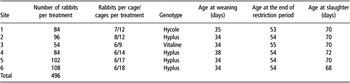
The concerted study was managed by the Groupe Experimentation Cunicole (GEC) network and consisted of replicating simultaneously the same protocol in six experimental sites in France (ITAVI Rambouillet, Euronutrition-SAS Sourches, Evialis St Nolff, INZO Montfaucon, PRIMEX Languidic, Trouw-Nutrition Vigny), to obtain results transposable to commercial breeding. In the six experimental sites, rabbits were housed in collective wire net cages, with the same density (0.06 m2 per rabbit, six to eight rabbits per cage), in closed units where the environment (temperature, ventilation) was controlled. However, in each location, the experimental conditions differed by the number of rabbits used, the genotypes and the housing conditions (Table 1). On the whole, 1984 rabbits were used (496 animals per treatment). In each site, animals were allotted to treatments according to litter origin (one litter is spread over the four treatments) and then to weaning weight.
Experimental conditions at the different sites

A monofactorial experimental design was used to produce a regressive reduction of the feed intake level (IL), from the ad libitum level (AL group) to 80%, 70% and 60% of AL (groups I80, I70 and I60, respectively). The restriction programme was applied, by giving a daily meal during 21 days after weaning. Rabbits were then fed at a level of 80% of the AL group for 4 days before to be fed ad libitum till 71 days of age. The quantity of feed distributed daily to each cage was adjusted from a theoretical ad libitum intake curve according to the live weight (Gidenne and Lebas, Reference Gidenne and Lebas2006), and verified at six time intervals (3 to 5 days long) between weaning and 54 days of age.
The experimental diet was manufactured and pelleted at one time (Euronutrition SAS, Sourches, France), using one batch of raw materials. The diet was formulated to cover the nutritional requirement of the growing rabbit, and is described in the first part of the study (Gidenne and Feugier, Reference Gidenne and Feugier2009). Briefly, the mean digestible energy level was 12.21 MJ/kg; the lignocellulose and crude protein concentrations reached 157 and 169 g/kg, respectively. It did not contain any drug supplementation (antibiotic or coccidiostatic). However, in case of a high mortality rate by diarrhoea (over 2% of losses/day), a curative treatment could be given in drinking water simultaneously for the four groups (Thiamuline® (CEVA France) at 0.5 ml/l for 5 days + Gentamicine® at 1.2 g/l for 3 days).
Intake, growth performances and health status measurements
Rabbits were individually identified and weighed at weaning, at 54 days of age and at slaughter. Feed consumption was measured per period and per cage. The eating activity of rabbits was noticed when feed was given each day (8:00–9:00). Mortality was measured daily. In the event of mortality, the food remaining in the feeder was weighed to calculate the real feed intake, taking into account the duration of presence and the number of rabbits remaining in the cage. Cages having mortality higher than 50% were not included in the statistical analysis of the growth performances or intake.
Morbidity was measured individually: at 42 and 54 days and at slaughter age. This consisted in an external observation of all clinical signs of digestive troubles or sickness: light or acute or finishing diarrhoea, caecal impaction that allowed identifying specific digestive pathologies such as colibacillosis or epizootic rabbit enteropathy (Licois et al., Reference Licois, Wyers and Coudert2005). In addition, animals without visible digestive troubles, but showing severe disturbances of growth (loss of weight during a week, or with abnormally low growth), were classed as morbid. The morbidity rate was the expression of the number of ill rabbits on the initial number of animals, and an animal was accounted morbid only one time (within a period), even if diarrhoea lasted several days. Dead animals were only accounted in mortality rate, even when they exhibited clinical signs of diarrhoea before death. Therefore, we calculated a health risk index (HRi) corresponding to the sum of morbid and dead animals, knowing that each animal was accounted for only once and categorised either dead or morbid (Gidenne et al., Reference Gidenne, Mirabito, Jehl, Perez, Arveux, Bourdillon, Briens, Duperray and Corrent2004).
Carcass and meat quality measurements
Thirty rabbits per treatment (from site no. 5) were slaughtered without prior fasting and transportation and in compliance with French national regulations. Commercial dressing procedures were followed, including removal of genitals, digestive tract and skin. After 24 h of chilling, weighed carcass was divided according to the recommendations of the World Rabbit Science Association (Ouhayoun and Dalle Zotte, Reference Ouhayoun and Dalle Zotte1996). Proportions of perirenal fat, and back- and hind-parts (weight/chilled carcass weight × 100) were calculated. The meat to bone ratio was determined in the hindleg. Cooking losses were determined on the hindleg placed in a vacuum plastic bag after heating at 80°C for 2 h in a humid electric oven. Colour was assessed on the surface carcass over longissimus lumborum (LL) and hindleg (biceps femoris). The lightness (L*), redness (a*) and yellowness (b*) were measured using a tristimulus analyser (Minolta chroma meter CR300, Osaka, Japan) with the CIELAB System (1976).
Statistical analysis
The results of feed intake and growth were initially analysed by experimental location, using monofactorial variance analyses (effect of ‘group’, GLM procedure SAS online®), and allowed detecting rabbits having abnormally low growth to class them as morbid. The measured IL was taken into account in the analysis (Table 3), not the initial theoretical IL. This analysis was followed by an overall data processing resulting from the six sites, taking into account the effects of ‘group’, ‘site’ and the interaction ‘site × group’, and using a covariate (proc GLM): the weight at weaning (nested within site effect) since it differed significantly according to sites (Table 3). Comparison of means among the groups was presented in tables as superscripts associated with means, using the test of Scheffe. Data from morbid animals were maintained in the performances analysis. Data of mortality and morbidity were analysed according to the method of Karl Pearson (distribution of χ 2, procedure CATMOD, SAS online®).
Results
Intake and growth performances
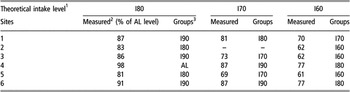
Divergences between planned and measured IL were observed since there were technical difficulties in adjusting precisely the IL for large numbers of animals. For instance, the restriction was not sufficient in some sites (Table 2), and therefore we re-allocated them to the really measured IL, and one further group was created corresponding to an IL of 90% of the ad libitum. This ‘real’ IL was used in all further tables.
Feed intake levels measured for each site

1Intake level of restricted groups in % of the ad libitum group (AL), as initially defined in the protocol.
2Intake level measured, in % of the AL group (within site), during the restriction period (i.e. for 21 days after weaning).
3Allocation to groups of restriction level.
Reducing the IL modified the eating activity of the animal at feeding time. Between 3 to 5 days after weaning, animals submitted to feed restriction began to eat immediately after feed distribution between 8:00 and 9:00, while at the same time animals fed ad libitum did not eat.
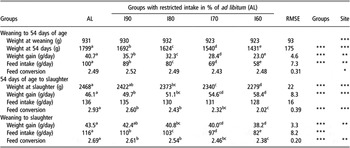
In the period of feed restriction, we observed a linear reduction of the daily weight gain (DWG) with the reduction of the IL (Table 3). A 1% decrease of IL led to a 0.5 g/day decrease of the DWG, and when expressed according to the digestible energy intake (DEI), we obtained the following equation: DWG (g/day) = 33.7 DEI − 0.52 (R 2 = 0.997, P < 0.001). If we expressed the weight gain of IL groups relative to that of the control group, we have the following equations: DWG (%) = 1.05 IL (%) − 5.26 (R 2 = 0.994, P < 0.001); DWG (%) = 82.7 DEI − 1.30 (R 2 = 0.997, P < 0.001). Thus, at the end of the restriction period, rabbits of the I60 group weighed 368 g less than the AL one. As growth was reduced proportionally to the intake, the feed conversion (FC) remained similar among treatments.
Growth, intake and feed conversion of the young rabbit according to the feed intake levelFootnote 1

RMSE = root mean square error.
Means are least-square means adjusted for the number of rabbit per group and per site (morbid animals included).
a,b,c,d,eMeans having a common superscript are not different at the level P = 0.05.
1 Intake restriction was applied from weaning to 54 days old.
When restricted rabbits were fed freely (after 54 days old) we observed a significant compensatory growth, which increased linearly with the level of restriction previously applied (Table 3). Thus, during this period, the relative DWG increased according to the following equation: DWG (%) = 0.64 IL (%) + 164.0 (R 2 = 0.98, P < 0.001). Therefore, the impact of the IL on the slaughter weight (SW) was significant (−4.5 g/% of restriction), but relatively moderate: SW (% of AL group) = 0.187 IL (%) + 81.3 (R 2 = 0.99, P < 0.001).
Contrary to what we expected, the compensatory growth was not associated with a higher IL. Consequently, we observed a significant linear decrease of the FC with reduction of the IL: FC = 0.021 IL (%) + 0.78 (R 2 = 0.97, P < 0.001).
Accordingly, on the whole fattening period (weaning to slaughter), a linear negative effect of a lower intake on DWG was observed: DWG (g/day) = −0.13 IL (%) + 30.6 (R 2 = 0.99, P < 0.001). However, the lower growth of restricted rabbits remained at a relatively high level (about 40 g/day). In parallel, the feed restriction (applied till 54 days) improved linearly and significantly the FC: FC = 0.0077 IL (%) + 1.92 (R 2 = 0.99, P < 0.001).
Carcass and meat quality traits
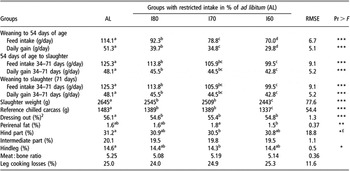
Carcass traits were measured on rabbits from site 5, where a similar linear negative effect of feed restriction on growth was observed (Table 4). For instance, despite a compensatory growth during the ad libitum period (+27% to +47%), feed restriction led to lighter SWs (−3.8% to −7.6%). The dressing percentage was significantly reduced in restricted groups, but without a linear effect: the mean decrease was 1.2 units between AL and the three I groups. Our results showed no clear effect of restriction on perirenal fat proportion, although the I60 group was significantly lower than the I70 one. Hind-part proportion and especially hindleg were higher in the AL group than in the I groups (P < 0.001 for the contrast AL v. I), while the meat to bone ratio (measured on hindleg) remained similar among treatments. Cooking losses measured on the leg were not affected by restriction level. Lightness, redness or yellowness parameters (respectively, L, a, b) of the hindleg and of the intermediate part were not significantly different according to the treatment. They averaged 55.5, 2.83 and 3.1, respectively, for L, a and b in the hindleg, and 57.5, 1.8 and −0.7 in the intermediate part.
Carcass traitsFootnote $ of 71-day-old rabbits, according to the feed intake levelFootnote 1

RMSE = root mean square error.
$ Data obtained in one site (no. 5), on 30 rabbits per group.
1 Intake restriction was applied from weaning to 54 days old.
2 Percent of reference chilled carcass.
£ P-value = 0.05 for the contrast AL v. (I80 + I70 + I60).
a,b,c,d : see Table 3.
Health status
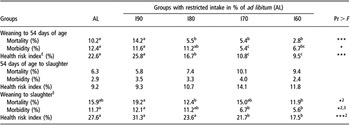
On the six experimental sites, mortality and morbidity were always caused by acute digestive disorders, namely diarrhoea and/or caecal impaction. Except for the identification of epizootic rabbit enterocolitis (ERE) in three sites, no specific pathology was identified at autopsy or by microbiological control in veterinary laboratory (such as coccidiosis or colibacillosis). Two of these three sites with ERE applied the curative procedure (antibiotherapy) planned in the protocol to limit the mortality rate (one at 50 days, the other at 53 days, and simultaneously for the four treatments). Independent of the treatment, the mortality rate strongly varied according to the site (between 7% and 18% from weaning to 54 days and for the AL group). Among rabbits remaining alive after a transitory diarrhoea or caecal impaction, 90% showed a significant lower growth rate compared to healthy animals. For AL and I90 groups, mortality and morbidity were significantly higher during the post-weaning period compared to the finishing period (54 days to slaughter): 12.2% v. 6.1% (P < 0.01) and 12.0% v. 3.2% (P < 0.01), respectively, for mortality and morbidity rates (Table 5).
Mortality and morbidity from digestive troubles according to the feed intake levelFootnote 1 of growing rabbit

1 Intake restriction was applied from weaning to 54 days old.
2 P-value < 0.05 for the contrast (AL + I90) v. (I80 + I70 + I60).
3 Significant linear effect (Maentel–Hentzel test for categorical data, Proc CATMOD).
£ Health risk index = mortality + morbidity rates.
§ For the whole experimental period, a morbid animal was accounted only one time, even if morbidity signs are detected during the two sub-periods; accordingly for morbidity and health risk index, the value for the whole period may not be equal to the sum of the two sub-periods.
a,b,c Means having a common superscript are not different at the level P = 0.05.
Mortality and morbidity rates did not differ between AL and I90 groups irrespective of the period considered. During the post-weaning period, mortality was significantly lower for I80, I70 and I60 groups compared to AL and I90 groups (mean: 4.6% v. 12.2%, respectively). After weaning, the morbidity was also reduced by six units for the two most restricted groups (I70 and I60). Therefore, the HRi was significantly reduced from a 20% reduction of the intake, and was half reduced in I60 and I70 groups compared to the AL + I90 one (Table 5). This favourable effect of a lower intake on health did not persist when rabbits were fed ad libitum (54 days to slaughter), since mortality and morbidity were not significantly different among the four treatments. Accordingly, over the whole fattening period (Table 5), the mean mortality rate reached 13.1% for I60–I70–I80 groups compared to 17.6% for the AL + I90 group (P < 0.05), while the morbidity rates were, respectively, 7.8% v. 11.9% (P < 0.05). The HRi was linearly improved with the reduction of the IL from a threshold of 90% of the ad libitum intake.
Discussion
The methodological interest of this study lies in the statistical reliability of the experimental design (496 animals per treatment), in the diversity of the breeding conditions (six sites) organised in a research network and in the application of a standardised protocol to control growth performances and health status. The study was performed under good breeding conditions, as attested by the relatively high level of performances, either for weight gain (mean: 43.5 g/day for the AL group) or for feed intake (116 g/day).
With the linear decrease of nutrient intake the growth was logically linearly reduced. Contrary to what was expected, this effect was not associated with an improvement of the FC or the digestive efficiency, although the rate of passage of digesta was increased (part I of the study, Gidenne and Feugier, Reference Gidenne and Feugier2009). Reversely, a clear compensatory growth was observed when rabbits were fed freely (after 54 days old). After a qualitative restriction, through a time-limited access to the feeder, a compensatory growth was previously found in the young rabbit (Perrier and Ouhayoun, Reference Perrier and Ouhayoun1996; Perrier, Reference Perrier1998; Dalle Zotte et al., Reference Dalle Zotte, Rémignon and Ouhayoun2005). In addition, Maertens and Peeters (Reference Maertens and Peeters1988) reported a higher compensatory growth with a high-energy diet compared to a lower one. With a shorter restriction period, Ledin (Reference Ledin1984) detected a weaker compensatory growth, suggesting that the importance of this phenomenon would be related to the level and to the duration of the intake restriction. But contrary to what was expected, here the compensatory growth was not associated with the behaviour of over-eating in previously restricted animals, thus leading to an improved FC. Similar results were previously obtained by several authors, using various restriction strategies (Maertens and Peeters, Reference Maertens and Peeters1988; Szendrö et al., Reference Szendrö, Szabo and Hullar1988; Perrier and Ouhayoun, Reference Perrier and Ouhayoun1996; Perrier, Reference Perrier1998). This highlights the economical interest of such a feeding strategy (20 days restriction then 18 days ad libitum) for the growing rabbit: reduced feeding costs without a sharp impairment of the SW, which was, in this study, only reduced by 3.8% for a 20% decrease of the intake during 20 days.
Our feeding programme did not greatly affect the carcass characteristics or meat quality (colour, cooking losses, etc.), as also observed by Dalle Zotte et al. (Reference Dalle Zotte, Rémignon and Ouhayoun2005) or Tumova et al. (Reference Tumova, Zita and Stolc2006) with different restriction strategies. The dressing percentage was slightly impaired, possibly originating in an overdevelopment of the digestive tract in restricted animal, as found by Lebas and Laplace (Reference Lebas and Laplace1982). A similar result was obtained by Perrier (Reference Perrier1998) with growing rabbits fed at 80% of ad libitum level as a consequence of a feed distribution three times a week. However, Tumova et al. (Reference Tumova, Zita and Stolc2006) did not find a significant impairment of the dressing percentage in rabbit after a moderate restriction (about −30%, during 1 or 2 weeks) and a refeeding period. But, they detected perirenal fat at 56 days old in ad libitum rabbits and 1 week later for restricted rabbits, and at 84 days old the perirenal fat was lower for rabbits restricted lately (between 56 and 63 days old). It is established that an increase in growth rate allowed during the ad libitum period increases the development of late-stage tissue, and especially adipose tissue, than the early ones (Ouhayoun, Reference Ouhayoun1998). However, in this study, no clear effect of the IL was observed on the percentage of perirenal fat. Besides, Gondret et al. (Reference Gondret, Lebas and Bonneau2000) showed that changes in the nutritional status (through a feed restriction) regulate intramuscular lipid deposition, without changing fibre-type composition. Finally, as previously observed by Perrier (Reference Perrier1998), the meat to bone ratio remained unaffected by the feeding programme.
The post-weaning period corresponds to an increased sensitivity to digestive troubles, with a higher mortality and morbidity compared to the finishing period, as reported in previous studies on fibre or starch effects (Gidenne et al., Reference Gidenne, Mirabito, Jehl, Perez, Arveux, Bourdillon, Briens, Duperray and Corrent2004 and Reference Gidenne, Jehl, Perez, Arveux, Bourdillon, Mousset, Duperray, Stephan and Lamboley2005). However, contrary to these previous studies, this higher post-weaning sensitivity to digestive trouble was not related to the highest expression of the growth potential (weight gain was higher after 54 days of age, in the AL group).
We clearly found a favourable impact of feed restriction on the digestive health of the young rabbit. Mortality and morbidity rates were sharply reduced from a 20% reduction of the IL. However, this effect was not persistent after returning to an ad libitum intake. This agrees with the higher resistance of the restricted young rabbit subjected to an experimental inoculation of ERE (Boisot et al., Reference Boisot, Licois and Gidenne2003). To our knowledge, similar phenomena were not reported in other domestic species, and the physiological mechanisms underlying this favourable impact of a short intake restriction on the digestive health of the young remained to be elicited.
Besides, we hypothesised that the digesta rate of passage would be implicated in the digestive health of the young rabbit. For instance, a higher supply in fibre is related to a lower HRi in the young rabbit (Gidenne, Reference Gidenne2003), and is associated with a shorter rate of passage of particle and liquids (Gidenne, Reference Gidenne1994). But here, restricted animals showed a quite longer rate of passage (Gidenne and Feugier, Reference Gidenne and Feugier2009) and a best health status, thus indicating that digesta transit would not play a key role in digestive health.
The favourable impact of dietary fibre on digestive health supports the hypothesis that the caecal microbiota would be implicated, for example through its fermentation activity controlling the physico-chemical characteristics of the ecosystem and its stability. Five hours after the meal distribution, we observed a peak of fermentation (with a lower caecal pH) compared to ad libitum animals (Gidenne and Feugier, Reference Gidenne and Feugier2009). This suggested that feed restriction modified the pattern of intake and correlatively the fermentation pattern, with a marked circadian cycle. Peak of fermentation and acidity in the caecum may be unfavourable to non-commensal flora, and thus may improve the resistance of the host to pathogens, as found for ERE (Boisot et al., Reference Boisot, Licois and Gidenne2003). Accordingly, low caecal pH (under 6.5) inhibits in vitro proliferation of pathogens such as Escherichia coli (Prohaszka, Reference Prohaszka1980) because volatile fatty acid (VFA) are not dissociated. Bacteriostatic effects of VFA were also shown for Clostridium difficile, with a special attention to the butyrate level (Rolfe, Reference Rolfe1984), and the latter tended to be higher in the caecal content of restricted animals (Gidenne and Feugier, Reference Gidenne and Feugier2009). When rabbits were again freely fed, the fermentation activity exhibits a smoother cycle and the ‘protection’ effect would be suspended, as we found here after 54 days of age.
However, several other mechanisms and digestive functions may be implicated in the gut resistance to pathogens, such as the stimulation of the local immune functions as outlined by Jolly (Reference Jolly2004), or the microbiota stability or biodiversity.
Conclusion
Such a concerted study within a research network is of high interest to obtain reliable results on the interactions between nutrition and digestive pathology of the rabbit. Our results show that reducing the intake after weaning logically impaired the growth, and also improved the digestive health of the young rabbit, however only when restriction is applied. We thus recommend applying at least a 20% reduction of the feed intake to reduce the post-weaning mortality and a 30% reduction to reduce the morbidity level.
For a feeding programme with 20 days’ restriction (−20%) and then 18 days ad libitum, the weight at slaughter was slightly reduced while the FC was improved. Consequently, such a feeding strategy represents a double benefit in terms of feed costs and lower losses of young rabbits. While studying the physiological mechanisms implicated in the favourable effect of a lower feed intake on digestive health of the young animal became a scientific priority, it is also necessary to promote studies to optimise the feeding programme according to the target: feed cost–digestive health–growth performances.
Acknowledgements
The authors thank the technicians of each experimental unit implicated. This study was partly supported by a grant from the OFIVAL.