Introduction
This paper examines the ways in which the experience of working in small to medium-sized innovative information technology (IT) firms influences the employees' expectations of either prolonged employment or an early exit. The central concern is how the nature of the IT industry and its work, along with assumptions about the capacities of different age groups of workers, influence the employees' continuity of employment and timing of exits, including those to retirement. Around a quarter-of-a-million people in Australia are employed in IT software development and one-quarter are aged over 45 years (Australian Bureau of Statistics 2006). The issue of retention or exit from employment will become increasingly important as the average age of the labour force increases.
The Australian data were collected during 2002–06 for the Workforce Ageing in the New Economy (WANE) project, a cross-national study of information technology employment in small and medium-sized firms (SMEs).Footnote 1 It examined the inter-relationships between workforce ageing, information technology employment, the ‘new economy’ of globalised IT production, and the lifecourse consequences of IT employment. The study sites included Canada, the United States, several European Union countries (the United Kingdom, Germany and The Netherlands) and Australia. This paper reports the analysis of qualitative interviews with 71 people in 10 Australian SMEs that were conducted during a late phase of the study. By comparison with the other WANE-study countries, Australia has a less developed IT sector and consequently it experienced a relatively minor (and belated) ‘dot com bust’. Since the ‘bust’, in common with the other WANE study countries, the Australian IT sector has begun a cautious resurgence. Also in common with the other countries, the Australian IT sector is characterised by many very small firms (at the beginning of this decade, 88 per cent employed 0–4 people) (Australian Bureau of Statistics 2002). The case study firms across all the WANE study countries shared the ‘life cycle’ of a start-up phase of IT innovation, followed by commercialisation.Footnote 2 As has been timelessly true of new industries, a small percentage of the new companies grow strongly but most expire, either through failure or by capitalisation; that is, by selling to another firm.
The lifecourse and information technology careers
The human lifecourse has been characterised as having three successive stages: school and further education, work and retirement (Elder Reference Elder1985; Marshall and Mueller Reference Marshall, Mueller, Heinz and Marshall2003; Moen, Sweet and Swisher Reference Moen, Sweet, Swisher and MacMillan2005). Individual lifecourses are however shaped by complex, commonly asynchronous and contradictory factors that interweave a person's biography with socio-historical circumstances. Moen and Spencer (Reference Moen, Spencer, Binstock and George2006: 127) noted that ‘the lifecourse also captures the historical times and cultural dynamics on which biographies unfold’. Tensions between asynchronous elements in the lifecourse manifest as structural lags, the mismatches ‘between rapidly changing human lives and surrounding social structures that have been resistant to changes that could accommodate these lives’ (Riley, Foner and Kahn Reference Riley, Kahn, Foner, Riley, Kahn and Foner1994: 7).
More specifically, the lifecourse has been defined as ‘the interdependent and variable sequences of social statuses across life domains (education, family, work, wealth, health and leisure) over the life span’ (O'Rand 2006: 146). The rapidly-evolving educational and occupational trajectories in IT work influence the timing of the ‘exit transitions’ from careers. As Marshall and Mueller (Reference Marshall, Mueller, Heinz and Marshall2003: xiii) stated, ‘there is agreement among lifecourse researchers that waves of cultural and institutional destandardization and re-regulation have been contributing to precarious sequences and extended pathways through the education and employment systems’. Recent theoretical contributions on career transitions have identified the incompatibility between the succession of discrete projects in IT work, the resulting abrupt iterative changes between work and non-work, and progressive and extended careers. Sackmann and Wingens (Reference Sackmann, Wingens, Heinz and Marshall2003: 103) defined transitions as complex, threaded, progressive sequences that express differential relationships and alignments between work and life stages, and that form ‘the pattern of societal connection between two states’. More recently, Moen and Spencer (Reference Moen, Spencer, Binstock and George2006: 127) noted that life choices have diversified and that more complex interpretations of age, and changing age and gender scripts, have led to heterogeneous retirement paths and a time of ‘converging divergences’.
Research has tended to focus on retirement transitions rather than to consider retirement more broadly as a form of exit from employment. Retirement transitions have been viewed as subject to multiple economic, political and social factors. Hardy (Reference Hardy, Binstock and George2006) maintained that predicting retirement paths depends on multiple contingencies, including labour markets, work trajectories, financial markets and political sentiments, all of which shape employment policies and retirement policy. Moen, Sweet and Swisher (Reference Moen, Sweet, Swisher and MacMillan2005: 238) observed that, despite the tendency towards the increased duration of employment, ‘changes in employer-employee contracts associated with the restructuring of corporations and a global economy increasingly means that seniority no longer guarantees job security’. Evidence regarding the effect of contingent employment on retirement pathways is emerging from recent analyses of large data sets. Cahill, Giandrea and Quinn (Reference Cahill, Giandrea and Quinn2006) showed that changes in the macro-environment had made early-retirement less secure, through contracting social security, the unreliability of superannuation investments, and decreased private savings (see also Marshall Reference Marshall, Clarke and Ballantyne2001). They suggest that ‘bridge jobs’ help span the gap between work and retirement, in conjunction with a range of individual socio-economic factors, supported by labour market policies and systems of social protection. During the early 1990s, a cross-national policy overview of retirement by Guillemard and Rien (Reference Guillemard and Rein1993: 496) concluded that ‘definitive withdrawal from the labour market has become variable, imprecise and contingent’.
Many large cross-occupation studies of retirement have demonstrated the primacy of financial and health factors in precipitating retirement, followed by low or decreased satisfaction with work. The cross-sectional, retrospective Cornell Retirement and Well-Being Study of the reasons for retirement indicated a shift from work-centred to non-work-centred reasons, for both men and women, and that financial incentives to leave were influential, particularly for men (Moen et al. Reference Moen, Erickson, Agarwal, Fields and Todd2000). The prospective study undertaken by the American Association of Retired Persons (2004) of the retirement of baby-boomers also showed that paramount concerns were financial security and health care in retirement. Millward and Brooke's (Reference Millward, Brooke, Denemark, Meagher, Wilson, Western and Phillips2007) analysis of a large 2005 dataset from the Australian Survey of Social Attitudes examined workers' reasons for staying in employment and for retirement. The analysis revealed that poor health was the predominant reason for retirement, and amongst workers who felt they would never retire, the major reasons for continuing in employment were financial security followed by being valued and challenged. The analysis also identified gendered pathways to retirement, with men prioritising financial factors while women were most concerned with work-family fit and a dearth of work challenges. Phillipson's (Reference Phillipson2004) review of British retirement research, which included analyses of the large retrospective Office of National Statistics' Retirement Survey, found many employer-instigated and individual reasons for retirement. Among the latter, ill health and financial reasons were common to men and women. Phillipson's critique noted the paucity of empirical retirement studies and pleaded for more fine-grained analyses of demographic factors, linked with occupational processes and macro-level policy drivers.
Exit to retirement has also commonly been studied at the meso-level of organisational policies. Hardy and Hazelrigg (Reference Hardy and Hazelrigg1999) conducted multi-level analyses of data from a probability sample of General Motors' employees in the United States and found that specific organisational contexts made a difference to individuals' decisions about early retirement. Retirement expectations varied by individual characteristics such as age, physical health and pension wealth. Workers employed in plants scheduled to close were more likely to elect for early retirement than in those not selected for closure. Henkens's (Reference Henkens2005) analysis of a survey of public-sector and private-sector managers' attitudes towards early retirement in The Netherlands revealed that they were influenced by negative age-stereotypes of older workers' productivity, reliability and adaptability. Retirement from local government employment was influenced by a context of strong job protection, seniority-based salaries, low job mobility and increasing competition for jobs. In summary, cross-sectional analyses of large data sets across occupations have commonly exposed the importance of financial and health factors, both as reasons for retirement and also for staying at work. The scope of enquiry has tended to concentrate on organisational-level retirement pathways, while comparatively scant attention has been given to occupational career trajectories which promote or restrain exit from employment.
Qualitative studies of exit from careers
Qualitative studies of the topic have similarly concentrated on retirement as the major exit pathway from occupational careers. As Moen and Spencer (Reference Moen, Spencer, Binstock and George2006: 131) stated, ‘occupational careers are at the intersection of micro-level (individual and family) and macro-level (e.g. political, demographic, medical and economic) phenomena’. The level of analysis and explanation has commonly been at the meso-level of organisational policies and practices rather than focusing on interpretations of the assessments in biographical accounts of the influences upon careers. Qualitative research has revealed non-standard and individual pathways to retirement. Phase 2 of the British Whitehall Study of 60 participants aged over 55 years who had variously taken early retirement, retired at the normal age, or were still working, identified individualised ‘fragmented’ retirement paths (Higgs et al. Reference Higgs, Mein, Ferrie, Hyde and Nazroo2003: 776). Vickerstaff's study of the transport and local government workforces similarly found that retirement decisions depended on management offers and decisions to accept or reject the early-retirement decision. The author observed that workers ‘typically did not provide clean linear narratives of their retirement plans or process’, and ‘exit from work is unpredictable and they hold some but not all the levers of the decision’ (Vickerstaff Reference Vickerstaff2006: 469–70). Similarly Robertson's (Reference Robertson2000) retrospective study of retirement that analysed data from focus groups with 219 retired technology employees found that early-retirement plans did not fall neatly into own choice versus non-choice (or voluntary versus involuntary). Although early-retirement packages and management offers were perceived as timely and of benefit, in many cases the over-riding incentive for exit was the worker's interpretations of technological developments and of cultural change in the employing organisation.
Occupational analyses of IT careers have commonly focused on labour-force issues and professionalisation rather than exit pathways. Benner's (Reference Benner2002) analysis of IT employment in the ‘new economy’ found that distinctive career trajectories lacked progressive transitions between the ‘core labour force’ and the larger ‘replaceable labour force’. The analysis of occupational identities in IT has focused on the differentiation of professional trajectories as a concomitant of technological development (Blok Reference Blok2003; Ensmenger Reference Ensmenger2003). More consistent attention has been given to interactions between gender and IT employment than to age. Analyses of gender and IT have attended to feminine and masculine working styles, and have uncovered numerous co-constructed tensions (see Faulkner Reference Faulkner2000). Accounts of IT employment have shown that age and gender attitudes and presumptions combine to support masculine technical specialisation (See Comeau and Kemp Reference Comeau and Kemp2007). The scarcity of studies of older workers' exits from IT careers may in part be attributable to their low number, but this will change.
The case study: methods and sample
The case study followed Marshall's (Reference Marshall1999) approach and rationale. The firms were sampled according to criteria informed by the WANE project's conceptual interests in the ageing workforce, information technology, ‘new economy’ firms and the lifecourse. Heterogeneity was sought to test concepts across diverse conditions, and the firms were purposefully varied by size, duration, the age structure of the labour force, technology type and organisational structure. The final sample included small web-based consultancies, customised software development firms, IT consultancy firms, an electronic billing firm, ‘virtual’ consultancies, innovative R&D firms, an online advertiser, and providers of packaged software products.
A typology was developed of the characteristics of firms by types of organisational structure, size, technologies and products. Four types were identified into which the 11 case firms were grouped: the first type was a virtual network, which consisted of ‘virtual’ micro-firms, with the Chief Executive Officer (CEO) and three other workers at the core, directing a contingent workforce of over 50 highly-skilled IT consultants. The range of consultancies included advanced IT systems design for businesses. The second type, high-end firms, were highly centralised small firms of around a dozen employees, working at the leading-edge of global IT invention, marketing transport and logistics software systems and robotics. The third type were stable brand-based consultancies, represented by medium and (one) large firms, marketing their own brand-based technologies in financial and enterprise management. The fourth type was a slow growth consultancy made up of micro-firms that marketed web-based technologies at the low-innovation and low-growth end of the market.
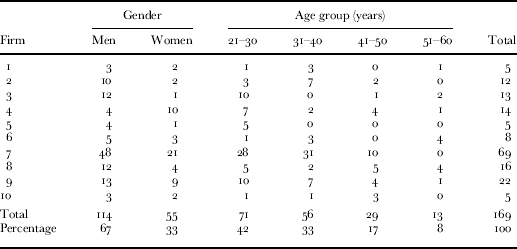
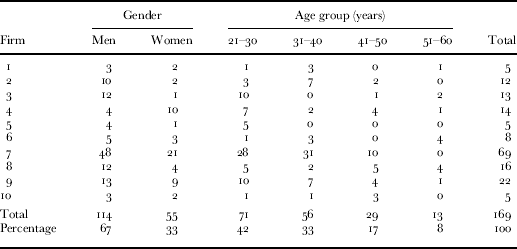
The Australian WANE project case study sample consisted of 11 firms with 362 IT workers. The large firm with around 193 workers was excluded from this analysis (the focus being on careers in SMEs), hence the analysis sample of 10 SMEs contained 169 IT workers (Table 1). The case study firms over-represented certain socio-demographic characteristics compared to the Australian population of IT workers. Although around one-quarter of their IT staff were aged 45 or more years, similar to that in the Australian IT workforce, one-third of the sample were women, a substantially higher fraction than the one-fifth of the national IT workforce (Australian Bureau of Statistics 2006). Age was the key socio-structural variable of interest, so the sample was stratified by age. Of the ‘universe’ of 169 IT workers, 71 (42%) were aged 21–30 years, 56 (33%) were aged 31–40 years, 29 (17%) were aged 41–50 years, and thirteen (8%) were aged 51–60 years. The sampled occupations and job-grades included lower-level programmers, software developers, software engineers, project managers and managers and chief executives. A sub-sample of 71 agreed to participate in face-to-face interviews, and among them 45 (63%) were men, while analysis by age showed that 26 (37%) were aged 21–30 years, 19 (27%) aged 31–40 years, 17 (24%) aged 41–50 years and 9 (12%) aged 51–60 years.
Age group and gender of the sampled employees of the case study firms
The identification and analysis of themes
The data were initially coded according to the common WANE study project ‘bucket’ codes. Additional recurrent themes were identified in the transcripts of both older and younger IT workers, and termed the ‘saturated’ codes (Strauss and Corbin Reference Strauss and Corbin1998).Footnote 3 The first theme identified was ‘normative’ age-based career trajectories; the second inter-connected theme was the intensity of IT work; and the third was issues associated with the restructuring of IT career trajectories in the firms.
‘Normative’ age-based career trajectories
An age-graded ‘normative career trajectory’ based on the perceived decline of specialist IT skills with increasing age was a recurrent theme in the data. Both ‘older’ workers aged in the forties and fifties and ‘younger’ IT workers aged in the twenties and thirties shared an understanding of the age-grading of different occupations in the industry: most of those employed for their technical skills and creativity were aged in the twenties and thirties, most project managers were aged in the thirties, and those responsible for generic management were generally aged in the forties. Many respondents perceived that their careers would be short, and projections of prolongation into their fifties and beyond were rarely articulated. Perceptions of normative career trajectories emerged from the interviews with senior older managers. In one small, stable, family consultancy firm, the general manager who was in his fifties articulated the commonly held view that IT workers progressed from programming to business-analyst positions. The general manager's version of his own career trajectory was that the size and life cycle of SMEs did not allow for successive roles in the career path, and hence the occupational context of small firms was antithetical to an extended career. As he commented:
Your skill-sets actually start waning in terms of your pure coding, but they increase in terms of your value to the organisation, in terms of more of a management role, or in terms of a middle-line management, or upper management, or strategy, or a consulting type of role, in terms of direction and customer-facing. However, the companies don't basically grow big enough and those skill-sets; you can't use them [in most].
Another chief executive aged in the fifties in a high-end, small company that produced globally-competitive enterprise software characterised the small firm as having a limited life. The speed at which IT firms transformed meant that their short existence did not span the duration of an entire career. He observed, ‘in fact, you know, we don't see this company necessarily lasting a lifetime; in fact, if we manage five years, I'll be happy. We are fundamentally interested in being on the edge’. Age-graded markers of career trajectories were also much in the minds of younger workers. A systems-architect aged in the thirties who worked in a medium-sized firm perceived that increasing age was accompanied by a shift of interest away from specialist IT work. This perspective ‘naturalised’ age-linked sequences of occupational roles and positions. As he said, those with years of experience ‘are over it … being “over it” is just part of getting older. You've done so much code in your life, you don't want to keep doing code anymore [and] you want to start doing other things. So in that regard, yes, I believe there is a natural progression’.Footnote 4 A young technical worker perceived that 30-years-of-age was at the oldest end of the range for IT specialists and that this effectively truncated technical careers. Being ‘old’ was redefined as no longer having the latest specialist skills, which in many cases refers to being able to write specialist code. As one informant said, ‘well I am one of the older people, as far as the tech people [are concerned], and I'm only getting on 30 now. That seems to be as far as the oldest that really come across my desk for working. I did have previously some older people but actually I [am] the only one’.
Compressed career trajectories
The redefinition of ‘experience’ in the narrow terms of the possession of competitive IT skills had the effect of shortening careers. Younger workers commonly interpreted ‘experience’ in these terms and disconnected the idea from seniority and vertical career progression. For instance, a software developer aged in the thirties who was employed in a small, high-end technology firm viewed ‘experience’ as vindicated by skill rather than age. This widespread interpretation is consistent with the competitive pressure to attract young people who are willing to learn about the latest technologies and code. When asked ‘how do you define older?’, one informant replied:
There's no strict borderline but I would say under – oh, probably, over – five years' experience would be my definition of older, [yes] beyond that. So you don't have to be particularly old to be ‘older’ in those terms. If you've got less than five years' experience in … in actual IT work, then I think you're still probably a little bit in a trainee role. You're not necessarily – depends a lot on what you've done – but you're not necessarily going to have a great breadth of experience.
Despite the uncertainty and equivocation in this statement, the idea that ‘peak ability’ is of short duration comes across clearly. At the older end of the age spectrum, several workers aged in the fifties and sixties were experiencing (and resisting) the pressure to retire. A consultant aged in the fifties working in an old-style family consultancy had expertise in applying on-site financial management technologies. He commented on the apparent assumption held by his peer group that he should retire, which he was resisting: ‘I've been in IT a long time and I don't intend leaving it at the moment, but I've reached an age where everyone tells me I should think about retiring – but I don't really want to retire’. A 60-year-old software-engineer whose job was to support an obsolescent IT-system had not received training in the replacement technologies. He enjoyed problem solving, as paid work rather than as recreation at home, and he wanted to continue until he reached the pension age of 65 years. This was the rationale by which he countered the age-linked expectations of retirement in the firm. He explained, ‘so I suppose I like … problem solving, you know, like one thing other people ask me is, “am I retired yet?” I say, “ah, okay, I could retire and do crosswords or whatever at home”, but well that's the same as you come in here and you get paid’.
There were few women IT workers aged in the fifties in the sampled firms. In a stable consultancy company, however, one of the longest serving employees (for over 25 years) was a female project manager aged in the fifties who worked in applications and business-processes. She explained that the dissonance of her situation from gender- and age-norms was because, although she was the age of a grandmother, she had to support her young daughter: ‘I can't imagine life … I have no plans to retire and, and start on. … I still have a 16-year-old who's at school, and I think when you're in that stage of your life it's very different than if I was a grandmother, which I could be … [if that was so] my needs and wants would be very different’.
ABSTRACT
Age-based perspectives in the information technology industry compress careers and define ‘experience’ in terms of possessing marketable skills rather than seniority and so are complicit in setting early-retirement norms. The career trajectories of older and younger workers were typified by technical specialisation in the early years and broader management roles in later years. New definitions of ‘experience’ based on skill rather than age have reset the boundary ages of many IT careers. At the level of the firm, the duration of an individual career depended on a worker's capacity to acquire and apply the latest skills rather than accumulated experience. The restricted opportunities and support for training meant that IT workers could ‘outgrow’ the small firm. Moreover, the short life of many firms truncated many careers, at least within one company. There is considerable research evidence of variations in the normative age of retirement by occupations (and era), and that the IT industry has an unusually young age (See Joulain and Mullet Reference Joulain and Mullet2001). The firms emphasised state-of-the-art technologies, learning new skills and young staff, attitudes that were underpinned by a bio-psychosocial perspective on ageing (Marshall and Mueller Reference Marshall, Mueller, Heinz and Marshall2003). Many of the older workers were finding it very difficult to prolong their careers.
Various interactions between age and gender compounded the pressures to exit early from IT work. Comeau and Kemp (Reference Comeau and Kemp2007: 229) suggested that older male workers were marginalised and winnowed out of the technical ‘play’ that are customarily associated in the industry with ‘young masculinity’. For an older woman, gendered ‘excuses’ of her economic responsibilities as a mother were used to reframe and rationalise her normative age and gender transgression as a grandmother. Careers were also cut short by the imperative in ‘new economy’ firms for rapid commercialisation. Castells (Reference Castells2000: 302) noted that, ‘age-segmented reward systems [have the purpose of] rewarding the latest technologies which could compete in the global marketplace. Skills were not enough, since the process of technological change accelerated its pace, constantly superseding the definition of appropriate skills’. The wider societal norm of early retirement converged with the high valuation of youth in information technology. Shih (Reference Shih2004: 242) noted that in Silicon Valley, California, ‘the consuming nature of work appears to be reconfiguring the standard conception of the life course’. In the IT industry, career opportunities concentrate early in a working life and demand full concentration on work rather than family. Shih observed that, ‘in this sense, the conception of career structure is changing, condensing into fewer years but at the same time agreeing to its intensification’. One consequence is much uncertainty about career trajectories and retirement pathways among those who had acquired ‘experience’.
The incompatibility of intense IT work with extended careers
IT work was generally seen to be ‘high pressure’ and inimical to the reducing capacities and inclinations of older workers. These attitudes were exemplified by a male software-developer aged in the mid-thirties who worked in a fast moving, high-end skills firm. He perceived that specialist technical skills demanded intense energy and application:
People in their thirties are driven to learn, where you don't want a job where you are just cruising. In the forties and fifties, you've worked hard all your life and you are less worried about career accomplishments and start to look at other things in life. As long as the job pays you at the end of the day and allows you to live a particular lifestyle, you're happy with it. If they got to 50 and were more interested in a job where they could just come in at nine and go home at five, and concentrate on what they're doing with the grandkids at the weekend, this probably isn't the job for them. This is a very, I'd say, high-energy job.
A rare case of an ‘older’ technical worker, a programmer aged in the mid-forties, exemplified the time pressures and conflicts of combining the constant skilling in his high-end firm required for IT work and family responsibilities. He explained his inability to continue to learn at a rapid pace by his family commitments: ‘I've got demands of family, they need my time, so I might try and spend time with them, but some people might say, “well, hang on, I'm a real techhead, I'm just going to learn about this [and not] care so much about family”. … I'm not able to stay abreast of technologies as much as I'd like to’. In this way, the technological imperatives of rapid skills transformation reinforced age-based perspectives and compressed the careers of older workers. A male software-developer aged in the mid-thirties perceived that high-pressure IT career trajectories demanded an intensity of work that became progressively less manageable with increasing age:
Younger people are working 60 hours week, but as people age they get families, other commitments and other priorities. [The work] is much more appealing to the younger people and harder to do, or less appealing, to older people, who don't feel its worth any amount of money. So I think that there is often a relationship between age and a wish to sort of lower the pressure and to do new things.
A female programmer aged in the forties in the high-end skills company currently relied on her husband, also an IT worker, to teach her new software. The need to stay on top of new skills limited her ability to extend her career into her fifties. She reflected, ‘the technology changes so fast. When I'm 50, 55-years-old, will I slow down? I can't compete again with younger people. That's the thing I'm scared of, so I say I love to stay in the industry but I don't know how competitive I am’.
Summary and reflections
Extended careers were perceived to be incompatible with the intensity of IT work. Age-segmentation led to the tendency for older workers to be seen as having obsolescent skills and unable to keep up with new developments. The tight gearing between learning and applying new skills intensified the conflicts between later working life and family responsibilities. The speed of change in global IT markets and the need for flexible specialisation also impacted on older workers' career choices. As Benner (Reference Benner2002: 221) commented, ‘as the pace of change increases, workers frequently discover that their skills are valued less by employers, pushing them to return to school for significant retraining or to develop an entirely new career’. Analyses of a large French data set on interactions between age and new technologies confirmed that innovative firms tend to be age-biased. Aubert, Caroli and Roger (Reference Aubert, Caroli and Roger2006) suggested that skills do not completely protect workers against the labour market consequences of ageing, and that careers are driven according to the skills demands of IT innovation. Promotions to project-management positions required evaluations of older workers previous technical capacities. This view of older workers as less trainable in state-of-the-art IT skills than younger workers was reinforced by age segmentation in innovative IT organisations (Valcour and Hunter Reference Valcour, Hunter, Kossek and Lambert2005). The nature of the global IT industry encourages the truncation of IT careers and the replacement of older with younger workers. Productivity and commercialisation pressures rationalised this age ‘churn’. As Carnoy (Reference Carnoy2000: 94) noted, ‘downsizing is largely a euphemism for reducing the number of “obsolete”, higher-priced older employees and replacing them with younger, more recently educated, and lower-wage workers’. Kohli (Reference Kohli, Riley, Kahn and Foner1994: 94) also noted the relationship between technological change and early exits from the labour force, which ‘makes it easier for firms to deal with the over supply of labor and with the need to increase productivity’.
The restructured career in IT firms
The episodic nature of IT careers made up of a succession of individual IT projects meant that IT workers had commonly been unable to achieve continuous employment and, by extrapolation, to envisage career continuity as they aged. Most respondents regarded their career paths as unpredictable, and some had begun looking for alternative work. A software-engineer aged in the late twenties in a high-end technology small firm perceived insecurity at both ends of the life span; he believed that young IT workers are increasingly vulnerable to global competition, and even argued that older workers were more likely to survive as the global out-sourcing of coding increased. The career trajectory was discontinuous and difficult to map and there were few role models from preceding cohorts. As one employee said, ‘older people move to consultancy which is a fairly lucrative area and seen as more secure, when there's a lot of out-sourcing happening because there will always be people solving individual customer problems on the spot, whereas the sort of more permanent positions are often more vulnerable to being sent en masse overseas’.
Neither sequences of short projects nor longer-term consultancies created progressive, hierarchical and predictable career paths. A software-developer aged in the thirties commented on the lack of vertical career progression: ‘you might not expect to go on service leave and all that sort of, you know, slowly working your way through hierarchies rather than sort of moving job to job’. Job insecurity was also a function of the rapid pace of change in the IT industry. As a software-engineer aged in the thirties in a high-end skills firm reflected, ‘no individual job is very safe, I think. In big companies, employees are seen as subject to retrenchment, while small companies can go bankrupt’. In a stable, medium-sized consultancy firm that employed around 70 people, the career pathways could branch into technical positions rather than ascend vertically. As a manager aged in the thirties commented, ‘the natural progression doesn't necessarily mean you become a team leader, so sometimes you become a technical expert’. Another software engineer in a stable niche technology consultancy firm commented, ‘there's no such thing as a standard IT career’.
Disconnected career sequences between IT specialisation and management
A view widely shared among the respondents was that there was a hiatus between specialist IT skills and management and that this led to disconnected and discontinuous career trajectories. A software engineer aged in the twenties who worked for a small stable consultancy firm with a niche market saw himself as under pressure to retain technical skills but too young to move to management. He said, ‘I don't want to be in a technical role for too long. It's too hard to keep up. You'd “go mental” trying to keep up with all the technical stuff these days. I'd rather move into a management role, perhaps in four or five years’ time. It's a bit hard to move into management at my age and be taken seriously'. At the older end of the age spectrum, a colleague aged in the fifties who had been in the industry for nearly 40 years could foresee the end of his career because his skills had become obsolete. As he explained, ‘one of the problems in IT is, you know, there's lots of things happening and when you get older you sort of think, “Ah, that's not important” … then, you know, you say that more and more, and then you suddenly realise, you know, that you haven't really got new technology skills anymore’.
The perspective of older workers as less trainable than that of younger workers in state-of-the-art IT skills was reinforced by age segmentation of work roles. One firm selectively developed the careers of its younger staff; they were perceived to have the capacity to multi-task and to integrate business and IT development. In a medium-sized, niche consultancy firm, a business-development manager aged in the thirties commented, ‘you know, this company that's been settled for 10 years, you've got all these younger ones coming in and sort of shaking it up. So it's now very much a division between the younger ones and the older ones’.
The career paths and morphology of SMEs were constantly being reconfigured to fast-track younger workers with the facility to develop new technologies. A director aged in the fifties who worked in a small, high-end skills firm perceived that IT inventiveness was enabled by recruiting young people from outside the firm and by passing over senior workers. He said, ‘we don't have a hierarchy here so we've just brought our first graduate on for all sorts of reasons – as to why we believe we should be developing new talent and those kinds of things. He has the same level of equality as our most experienced staff’. Because age had been de-coupled from career progression, having management skills was unlikely to protect older workers. An employee aged in the mid-forties in a high-skills, medium-sized firm (who had been a project manager in another firm) chose to be demoted to ‘programmer’ because he thought this would increase his marketability. As he reasoned, ‘they say, “hang on, we've got three bright sparks who do exactly what he does”. But because you have to spend as much time learning about new technologies, and that's where you begin to fall behind [but] by the time they are 45 it's too late, there are people who started at 20 and by the time they are this age they're CEOs’. Extended working lives did emerge through individualised self-protective strategies. The most effective against redundancy was to be a Chief Executive Officer (CEO) or general manager. Following mergers with larger firms, two CEOs had been able to create another career sequence that matched the ‘new life’ of the expanded firm, and they retained control over the firm's finances, networks and resources.
The reconfiguration of careers
Global-market demands for the latest skills to meet the instantaneous needs of the IT industry for productivity limited the security of career paths. Frequent changes in job roles were constantly reconfiguring the traditional vertical career. As Castells (Reference Castells2000: 71) noted, ‘what is distinctive to the configuration of the new technological paradigm is its ability to reconfigure, a decisive feature in a society characterized by constant change and organizational fluidity’. The ‘new economy’ firms were subject to constant adjustments and restructuring to adapt to ‘rapid change and unpredictability [that] is a key characteristic of information technology industries’ (Benner Reference Benner2002: 15). The new organisational configurations did not create, however, predictable career maps according to seniority and chronological age. While the older workers' competencies were restricted by their lack of exposure to the latest technologies, younger workers aged in the thirties faced comparable constraints in the limited opportunities to move into management. Several had experienced breaks in their careers because they were assessed as too inexperienced to be project managers. The reconfiguration of careers was perceived as challenging the security of older workers' career paths, with older permanent workers more vulnerable to global competition yet more likely to survive as contractors and consultants if they possessed the required skills. Sennett (Reference Sennett2006: 79) described the perspectives of younger workers who worked in cutting-edge organisations: ‘their point of reference is the fluid model, present-oriented, evoking possibility rather than progression’. For older workers employed in ‘youthcentric’ IT firms, career trajectories were disconnected and vaguely demarcated and few envisaged their continuation.
Prolonging employment or ‘default transitions’ to exit and retirement
This paper's interpretative approach to IT careers has shown that both discontinuous employment and early exits are a function of the ‘opportunity structures’ in the industry (Riley, Kahn and Foner Reference Riley, Kahn, Foner, Riley, Kahn and Foner1994), and the analysis of IT workers' career trajectories has identified three main inter-related processes that led to truncated careers. First, IT careers were calibrated by an age-based normative trajectory. This included a widespread expectation of an early end to an IT career, despite evident exceptions to the rule. The general rule was a lack of progression to seniority comparable to the customary ‘social clock’ in most sectors of employment (Marshall and Mueller Reference Marshall, Mueller, Heinz and Marshall2003: 18). Secondly, extended careers were generally seen as incompatible with the intense work in information technology firms, largely drawing on stereotypes of the declining capacities of older workers, and only young workers were seen as capable of ‘knowledge work’. The global scope and dynamic of research and development in new technologies demanded the rapid commercialisation of skills. Younger workers were perceived as having this capacity while older workers were commonly deployed to legacy systems which maintained earlier generations of IT structured within age-segmented organisations. Thirdly, most career paths were disjointed, age-segmented and unstable, reflecting the rapid successions of skills requirements in IT. The workers' capacity to envisage career futures was constrained by the constantly changing socio-technological pathways of IT firms. The short and unpredictable life cycles of firms also led to older workers' early exits. The careers of the few women in the sample indicated that they are ‘cumulatively disadvantaged’ in the industry (O'Rand 2006). Evidence was found of a lack of support for training a female software developer, and of an older female business manager making ‘excuses’ for transgressing the industry's age- and gender-norms.
Transitions to exit were influenced by the nature of IT work. Sennett (Reference Sennett2006: 185–6) described well the experience of individual IT workers: ‘Cutting edge institutions, short and erratic in their time frames, deprive people of a sense of narrative movement. Which means simply that events in time connect, experience accumulates’. As ‘experience’ was commonly redefined in terms of immediately applicable skill sets, rather than the accretion of seniority, older workers could not project a stable sense of their careers to carry them into the future. Most IT workers took for granted that their career trajectories would be discontinuous, erratic and uncertain. They were aware of the inter-related, multiple ‘push’ factors towards the early closure of their careers. In summary, the ability of IT workers to extend their working lives was fundamentally limited by age-graded norms of IT roles, which were magnified by the intensity of IT work and the unpredictable and discontinuous availability of work. Riley, Foner and Kahn (Reference Riley, Kahn, Foner, Riley, Kahn and Foner1994) noted the tendency of social structures to persist and become obsolescent rather than to respond to the changing needs and characteristics of individuals, and that this created tensions between people and the structures in which they lived and worked. In the absence of countervailing policies and actions by government, professional organisations and firms, older workers will continue to make ‘default transitions’ and premature exits from IT employment.
Policy and practice implications
Age-bound views of older workers' capabilities in the IT industry should be contested, not least to make better use of their skills and capacities as skilled-labour shortages mount. A concerted effort should be made by government, professional IT stakeholders and firms to change the current negativism about older workers' capabilities. Evidence from research on IT training has shown that exposure to multiple jobs that offer learning opportunities increases the level of cognitive functioning and possibly attenuates age-related decline (Marquié Reference Marquié and Rico Duarte2007). Foresight planning that links industry, labour-market opportunities and skills development is needed to connect discrete work episodes into careers. Co-ordination across stakeholders (such as government skills-agencies, professional IT organisations, unions, firms and individuals) is paramount if age discrimination in IT employment is to be overcome, and will create diverse skilling pathways and new entry points.
Human resources management policies can bridge the career disruption between IT specialisation, project management and management. Articulating work and life trajectories that bridge the present hiatuses between career stages would also be valuable (Schmid Reference Schmid2005). Promoting continuity in work could be achieved by wider use of flexible hours, contracting back to firms, and home-based ‘E-work’. As women are particularly under-represented in IT, intensive and multiple interventions are required to encourage their extended employment. New career structures and training which connect career sequences, and choices in working time and place that span the lifecourse would create a ‘special kind of narrative frame’ that promotes continuity (Sennett Reference Sennett2006: 186). Given the inevitability of the ageing of the IT workforce, both for individual workers and the firm's success, obsolete age stereotypes should be abandoned and new proactive human resources policies and practices introduced to prolong working lives.
Acknowledgements
The research on which this paper is based was funded by the Social Sciences and Humanities Research Council of Canada (Grant 124507). I would like to thank the 11 companies for making employees' time available in a work intensive industry and to especially thank the individuals who participated in the project.