ABBREVIATIONS
N – Nitrogen, P – Phosphorus, K – Potassium, Ca – Calcium, Mg – Magnesium, S – Sulpher, Al – Aluminum, Mn – Manganese, Zn – Zinc, Co – Cobalt, Cu – Copper, B – Boron
INTRODUCTION
Pearl millet [Pennisetum glaucum (L.) R. Br.] is the sixth most important world food crop (FAO, 2017) with 96% of the 27.8 million MT production in semi-arid tropical environments of Asia and Africa. In addition, it is a valuable forage crop in Australia and in the Americas, and recently has become widely used as a cover (mulch) crop in Brazil (Calegari et al., Reference Calegari, Guilherme de Araújo, Costa, Lanillo, Junior, dos Santos, Jat, Sahrawat and Kassam2014; Pacheco and Petter, Reference Pacheco, Petter and Ng2011). FAO (2017) indicates no pearl millet production in Brazil; however, França and Miyagi (Reference França and Miyagi2012) estimated pearl millet production area had increased to 5 million ha during the last 30 years due to expanded use as a cover (mulch) crop. Thus, pearl millet is a very important part of no-till cropping systems in the Brazilian Cerrado, and will continue to increase in importance especially in areas with nematode problems (Bastos Filho et al., Reference Bastos Filho, Nakazone, Bruggemann and Melo2007).
Pearl millet is broadly adapted in Brazil and easy to establish, has low input requirement, develops a vigorous and deep root system, and uses water and nutrients efficiently (Pereira Filho, Reference Pereira Filho and Pereira Filho2016). Consequences of projected climatic change in Brazil may lead to increased dry-season cover crop production of pearl millet to increase water use efficiency. At the same time, this could lead to increased opportunity for rainy-season production of pearl millet as a grain crop, perhaps as a substitute for maize (Zea mays L.) for livestock feed. Grain pearl millet is a promising crop for West-Central Brazil to meet demand for a profitable, low-risk livestock feed crop.
Pearl millet is grown in semi-arid climates characterised by limited and erratic rainfall, high temperatures and soils with low nutrient levels and low pH that often are too harsh for economical production of other cereal crops. For this reason, average pearl millet grain yields of 889 kg ha−1 worldwide are lower than for 5616 kg ha−1 for maize, 4557 kg ha−1 for rice (Oriza sativa L.), 3307 kg ha−1 for wheat (Triticum aestivum L.) and 1533 kg ha−1 for grain sorghum (Sorghum bicolor L. Moench) (FAO, 2017), but improved production practices and varieties/hybrids combined with integrated pest management results in the efficient use of photosynthetically active radiation (PAR), water and nutrients and greatly increased grain yields.
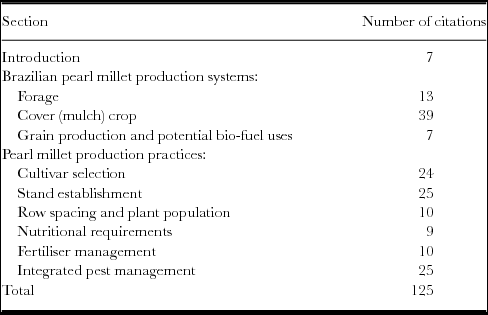
This article reviews the recommended crop management practices for pearl millet forage, cover crop and grain production systems in Brazil. Topics in the review include cultivar selection, stand establishment, row spacing and plant population, soil nutrient and water management, and integrated pest management for different agroecological regions and uses in Brazil (Table 1). Agroecological zones for pearl millet production in Brazil are broad and based on climate and soil conditions for rapid emergence and growth, and rotational crop requirements (Moraes et al., Reference Moraes, Oliveira, Silva and Castro2010; Pereira Filho, Reference Pereira Filho and Pereira Filho2016). Pearl millet is commonly grown in the ‘summer’ (prior to the fall crop called Safra) when night soil temperatures are > 20°C and at least 30 mm available stored soil water to promote rapid germination and pearl millet growth for up to four months (Landau and Guimarães, Reference Landau and Guimarães2013). Pearl millet can be grown prior to the second crop (called Safrinha) in parts of Brazil, but care is required to avoid climate problems of low soil temperature and drought, and to minimise production conflicts with the economic most important crops of soybean, maize, sugar cane (Saccharum officinarum L.) and cotton (Gossypium hirsutum L.).
Summary of article citations in this review based upon title and citation heading.

Most of the 125 cited research articles are published in Portuguese, thus it is hoped that this review will help pearl millet scientists worldwide access important literature sources, and also complement the recently published review of pearl millet production practices for semi-arid West Africa (Mason et al., Reference Mason, Maman and Palé2015).
BRAZILIAN PEARL MILLET PRODUCTION SYSTEMS
Forage production
Pearl millet is a minor, but important, forage crop in Brazil. Worldwide pearl millet grain is primarily consumed as human food, but in Brazil (as is also true in Australia, Canada and the United States), it has been historically produced as a high-yield and high-quality forage crop, either grazed, green chopped or harvested as silage for cattle (Bos Indicus and B. Taurus) or sheep (Oves aries) in high rainfall areas (Pereira Filho et al., Reference Pereira Filho, Ferreira, da, Coelho, Casela, Karam, Rodrigues, Cruz and Waquil2003). In southern Brazil, forage dry matter yields of 10 to 20 t ha−1 are commonly produced (Kichel et al., Reference Kichel, Miranda, Silva and Planaltina1999) with high protein concentration, high digestibility and free of prussic acid.
Forage pearl millet production has expanded into the northeast and other semi-arid regions of Brazil due to tolerance of water and soil stresses, and high water and nutrient use efficiencies (dos Santos et al., Reference Dos Santos, Neves, Pereira, Sollenberger, Rodrigues, Tabosa, Verneque, Oliveira, Jayme and Gonçalves2015). However, forage yields are 40 to 60% lower than in higher rainfall areas in southern Brazil (Assis et al., Reference Assis, Costa, Pires, Braz, Monteiro, Moreira and Cruvinel2011; Kollet et al., Reference Kollet, Diogo and Leite2006). Varietal variation in forage yield and quality is common, thus variety selection is an important management decision. Curvilinear increases in forage pearl millet yield and protein concentrations in response to nitrogen fertiliser application is common (Buso et al., Reference Buso, França, Miyagi and Corrêa2015; Heringer and Moojen, Reference Heringer and Moojen2002).
Delayed harvesting from 30 to 60 days after planting increases forage dry matter production, while reducing the crude protein, acid detergent fibre and neutral detergent fibre (Assis et al., Reference Assis, Costa, Pires, Braz, Monteiro, Moreira and Cruvinel2011; Frizzo Filho et al., Reference Frizzo Filho, Leite, Diogo and Ramos2006; Kollet et al., Reference Kollet, Diogo and Leite2006). Regrowth has higher forage value than the first harvest due to higher leaf: stem ratio. Energetic supplementation of pearl millet pasture with maize grain and citrus pulp can be used to increase the initial beef stocking rate and average daily gain (Roman et al., Reference Roman, Rocha, Genro, Santos, Freitas and Montagner2008).
Flexible use of pearl millet as a cover crop (next section) or supplemental forage source is becoming more common in central and Western Brazil. In some areas, pearl millet is grazed by cattle (Restle et al., Reference Restle, Roso, Aita, Nörnberg, Brondani, Cerdótes and Carrilho2002) and sheep (Schwartz et al., Reference Schwartz, Rocha, Véras, Farinatti, Pires and Cella Junior2003) prior to planting the succeeding crop. According to Barcellos et al. (Reference Barcellos, Viana Filho, Balbino, Oliveira and Okoyama1999), pearl millet in this system is usually over-seeded into soybean near the end of grain fill with the objective to provide soil cover and to feed animals during the drought period. To promote good regrowth and higher forage production, some farmers cut pearl millet at 6 and 10 cm above the ground surface. However, this cutting height has as a disadvantage as this removes most of the basal buds, while cutting at 20 cm height preserves these meristematic points and promotes regrowth (Bonamigo, Reference Bonamigo and Planaltina1999).
Cover (Mulch) crop
In 1980s, pearl millet use for biomass and soil cover crop in no-till soybean and maize production became important, and today is the largest use of pearl millet in Brazil (Bonamigo, Reference Bonamigo and Planaltina1999; Pereira Filho et al., Reference Pereira Filho, Ferreira, da, Coelho, Casela, Karam, Rodrigues, Cruz and Waquil2003). At present, pearl millet is used as a cover/mulch crop on approximately 5 million ha in the Brazilian Cerrado to protect the fragile soil and facilitate no-till production of soybean and maize (Boer et al., Reference Boer, Assis, Silva, Braz, Barroso, Cargnelutti Filho and Pires2008; Bonamigo, Reference Bonamigo and Planaltina1999; Brancalião, Reference Brancalião2004; Martins Neto and Bonamigo, Reference Martins Neto, Bonamigo, Neto and Durães2005; Pacheco et al., Reference Pacheco, Pires, Monteiro, Procopio, Assis, Carmo and Petter2008; Pacheco et al., Reference Pacheco, Barbosa, Leandro, Machado, Assis, Madari and Petter2011a; Reference Pacheco, Leandro, Machado, Assis, Cobucci, Madari and Petter2011b). Pearl millet is the most widely used cover crop due to its ability to grow in drought stress conditions in areas with less than 400 mm rain (Pereira Filho et al., Reference Pereira Filho, Ferreira, da, Coelho, Casela, Karam, Rodrigues, Cruz and Waquil2003) and adaptation to acid, infertile soils (Flores et al., Reference Flores, Clark and Gourley1991). Pearl millet has an extensive root system which gives high growth capacity to breakup compacted soil layers (Gonçalves et al., Reference Gonçalves, Jimenez, Araújo Filho, Assis, Silva and Pires2006; Guimarães et al., Reference Guimarães, Assis, Simon, Pires, Ferreira and Santos2013; Jimenez et al., Reference Jimenez, Gonçalves, Araujo Filho, Assis, Pires and Silva2008), and ability to take up nutrients from infertile soils (Rosolem et al., Reference Rosolem, Foloni and Tiritan2002), and thereby to produce high biomass yields (Boer et al., Reference Boer, Assis, Silva, Braz, Barroso, Cargnelutti Filho and Pires2008; Lupatini et al., Reference Lupatini, Moojen, Restle and Silva1996; Pacheco et al., Reference Pacheco, Barbosa, Leandro, Machado, Assis, Madari and Petter2011a; Reference Pacheco, Leandro, Machado, Assis, Cobucci, Madari and Petter2011b; Rosolem et al., Reference Rosolem, Foloni and Tiritan2002; Scaléa, 1998; Reference Scaléa, Neto, Amabile, Martins Netto, Yamashita and Gocho1999; Séguy and Bouzinac, Reference Séguy and Bouzinac2002). In addition, high biomass production reduces soil water loss, lowers soil surface temperatures, and contributes to soil organic matter. Pearl millet is relatively easy to manage, and has low potential to become a weed problem (Scaléa, Reference Scaléa, Neto, Amabile, Martins Netto, Yamashita and Gocho1999). Pearl millet mulch has been shown to effectively reduce water runoff from fields and reduce soil erosion (Silva et al., Reference Silva, Pinto, Scope, Corbeels and Affholder2006b), increase subsequent crop yields (Fontaneli et al., Reference Fontaneli, Santos, Vosso and Ambrosi2000; Pacheco et al., Reference Pacheco, Barbosa, Leandro, Machado, Assis, Madari and Petter2011a; Reference Pacheco, Leandro, Machado, Assis, Cobucci, Madari and Petter2011b; Santos and Lhamby, Reference Santos and Lhamby2001; Séguy and Bouzinac, Reference Séguy and Bouzinac2002) and improve grain quality (Nakagawa et al., Reference Nakagawa, Borges Lemos, Cavariani and Guido Penariol2006).
The Cerrado region of Brazil has a five-month off-season between soybean (and maize) crops with temperatures that can reach 40° C during the May to September dry season when rainfall seldom occurs and severe soil water deficits are common. In these production areas, soil nutrient levels are low and acid subsoils have high exchangeable Al levels. Thus, a successful cover crop must produce high yields of biomass with high C:N ratios and low decomposition rates under water and heat stress in acid, infertile soils with Al toxicity (Boer et al., Reference Boer, Assis, Silva, Barroso, Cargnelutti Fílho and Pires2007; Pacheco and Petter, Reference Pacheco, Petter and Ng2011; Torres et al., Reference Torres, Pereira and Favian2008). Pearl millet is one of the few plant species that meets these requirements (Boer et al., Reference Boer, Assis, Silva, Barroso, Cargnelutti Fílho and Pires2007).
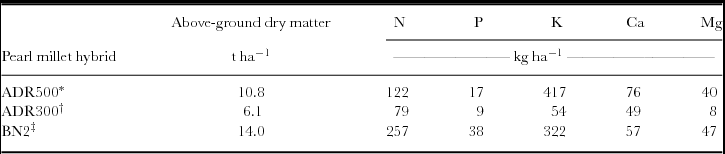
Pearl millet is also a useful cover crop due to the ability to take up 122 to 150 kg N ha−1, 17 kg P ha−1, 417 kg K ha−1, 76 kg Ca ha−1 and 40 kg Mg ha−1 by 51 days after planting (Boer et al., Reference Boer, Assis, Silva, Barroso, Cargnelutti Fílho and Pires2007; Torres et al., Reference Torres, Pereira, Andrioli, Polidore and Fabian2005). This is a valuable nutrient contribution to the following crop, and in the case of nitrogen, minimises potential for leaching losses. However, for maximum efficiency, the release of nutrients from pearl millet biomass should occur at the time when the succeeding crop needs of nutrients for growth (Braz et al., Reference Braz, da Silveira, Kliemann and Zimmermann2004). Research shows that pearl millet efficiently recycles P (Foloni et al., Reference Foloni, Tiritan, Calonego and Junior2008) and K (Boer et al., Reference Boer, Assis, Silva, Barroso, Cargnelutti Fílho and Pires2007) to succeeding crops.
The combination of no-tillage together with cover crops, including pearl millet, increase the soil organic matter content thereby increasing water and nutrient storage, nutrient cycling and minimises soil losses due to water and wind erosion (Silva et al., Reference Silva, Pinto, Scope, Corbeels and Affholder2006b). Pearl millet has root growth to a depth of 60 cm (Bordin et al., Reference Bordin, Neves, Francio Filho, Preti and Cardoso2008), even when the sub-soil has low pH and high Al concentrations. The pearl millet crop thereby reduces soil compaction as roots form channels for water infiltration and root growth for succeeding crops (Gonçalves et al., Reference Gonçalves, Jimenez, Araújo Filho, Assis, Silva and Pires2006).
Compared with other rotational cover crops, pearl millet reduces the amount of N fertiliser needed for the succeeding crop (Boer el al., Reference Boer, Assis, Silva, Barroso, Cargnelutti Fílho and Pires2007; Carpim et al., Reference Carpim, Assis, Braz, Silva, Pires, Pereira, Gomes and Silva2008; Silveira et al., Reference Silveira, Braz, Kliemann and Zimmerman2005) and increases the N use efficiency (Rosolem et al., Reference Rosolem, Pace and Crusciol2004), effectively smothers weeds and helps control Meloidogyne incognita, M. paranaensis, M. xenoplaz, Rotylenchulus reniformis and Pratylenchus brachyurus nematodes (Carneiro et al., Reference Carneiro, Moritz, Mônaco, Nakamura and Scherer2007; Gardiano et al., Reference Gardiano, Krzyzanowski and Saab2014; Gomez et al., Reference Gomes, Carvalho, Casagrande Júnior and Radmann2010; Inomoto, Reference Inomoto2011; Inomoto and Asmus, Reference Inomoto and Asmus2010; Landers, Reference Landers2007; Neves Reference Neves2013; Queiróz et al., Reference Queiróz, Fernandes, Verzignassi, Valle, Jank, Mallmann and Batista2014; Ribeiro et al., Reference Ribeiro, Silva, Meirelles, Craveiro, Parentoni and Santos2002), but can serve as a host to fall army worm [Spodoptera frugiperda (J.E. Smith)]. In general, the pearl millet cover crop serves as a rotation; thereby increasing biodiversity, reducing the need to apply pesticides and increasing the succeeding crop yields (Uemura et al., Reference Uemura, Filho and Netto1997). The use of a cover crop such as pearl millet in combination with no-tillage is a sustainable, efficient practice.
Grain production and potential bio-fuel uses
Pearl millet is produced for seed, and is used to a limited extent as a nutritious grain for poultry (Gallus gallus domesticus) (Murakami et al., Reference Murakami, Garcia de Souza, Massuda, Alves, de Holanda Guerra and Quiles Garcia2009), swine (Sus scrofa) (Bastos et al., Reference Bastos, Moreira, Murakami, de Oliveira, Paiano and Kutschenko2004) and beef (Cardoso et al., Reference Cardoso, Kling de Moraes, Soares de Oliveira, Zervoudaki, da Silva Cabral, Lopes da Rosa e Silva and Socreppa2013) diets. Pearl millet grain is desired due to higher digestible energy, higher protein concentration (Pereira Filho et al., Reference Pereira Filho, Ferreira, da, Coelho, Casela, Karam, Rodrigues, Cruz and Waquil2003) and better amino acid balance (Rodrigues et al., Reference Rodrigues, Rostagno, Albino, Gomes, Barboza and Nunes2001) than is true of other grain crops. The nutritional value of pearl millet grain is influenced by environment, soil fertility, cultural practices and the cultivar (Bergamaschine et al., Reference Bergamaschine, Freitas, Valério Filho, Bastos, Mello and Campos2011).
Brazil has a large bio-ethanol industry largely based on sugar cane. There is increasing interest to broaden ethanol feedstocks, possibly including pearl millet, as a high biomass-yielding crop. Pearl millet and sweet sorghum produce high yields of biomass with readily soluble sugars which could also be used for ethanol production (Pereira Filho et al., Reference Pereira Filho, Parrella, Moreira, May, Souza and Cruz2013).
PEARL MILLET PRODUCTION PRACTICES
Cultivar selection
Superior cultivars have been developed for producing grain, forage and straw for the no-tillage system (Guimarães et al., Reference Guimarães, Assis, Simon, Pires, Ferreira and Santos2013). The use of pearl millet hybrids became timely with the need for more productive cultivars for off-season grain and forage production (Dos Santos et al., Reference Dos Santos, Neves, Pereira, Sollenberger, Rodrigues, Tabosa, Verneque, Oliveira, Jayme and Gonçalves2015).
Pearl millet cultivar selection in Brazil is dependent upon the production system, end use and climatic conditions (Coimbra and Nakagawa, Reference Coimbra and Nakagawa2006; Costa et al., Reference Costa, Oliveira, Carmo, Pereira and Pimentel2005a; Reference Costa, Geraldo, Pereira and Pimentel2005b; Durães et al., Reference Durães, Magalhães, Lavinsky and Pereira Filho2016; Geraldo et al., Reference Geraldo, Rossiell, Araújo and Pimentel2000; Geraldo et al., Reference Geraldo, Oliveira, Pereira and Pimentel2002; Pereira Filho and Rodrigues, Reference Pereira Filho, Rodrigues and Pereira Filho2016). Desirable characteristics for use as a cover crop include high biomass yield, residue that does not decompose rapidly, capacity to extract and recycle nutrients and is photoperiod insensitive (Santos, Reference Santos and Planaltina1999). Maturity classification is based upon thermal unit accumulation between planting and physiological maturity (Gadioli et al., Reference Gadioli, Dourado-Neto, Garcia and Basanta2000), and influences cultivar adaptation, yield and crop management practices (Geraldo et al., Reference Geraldo, Rossiell, Araújo and Pimentel2000; Guideli et al., Reference Guideli, Favoretto and Malheiros2000).
Desirable characteristics for forage pearl millet is adaptation to grazing, green chop, silage or hay depending upon the intended harvest method; and high biomass yield and nutritional quality (Pereira Filho et al., Reference Pereira Filho, Ferreira, da, Coelho, Casela, Karam, Rodrigues, Cruz and Waquil2003). In the past, there were a limited number of cultivars produced in Brazil, but today cultivars with different maturity classifications, high yield and forage quality with production of fine stems and a high leaf-to-stem ratio (dos Santos et al., Reference Dos Santos, Neves, Pereira, Sollenberger, Rodrigues, Tabosa, Verneque, Oliveira, Jayme and Gonçalves2015), and low lignin (brown midrib) concentration are readily available from public institutions and private seed companies (Kichel and Miranda, Reference Kichel and Miranda2000; Sávio et al., Reference Sávio, Santana, Murça, Silva, Viana and Ruas2012; Souza Sobrinho et al., Reference Souza Sobrinho, Pereira, Ledo, Botrel, Oliveira and Xavier2005). During the past 10 years, plant breeding efforts have developed forage pearl millet hybrids for mechanised pearl millet production. In 2014, Adriana Seeds Company launched the Brazilian pearl millet forage hybrid ADRF6010 (Sementes Adriana, 2016).
EMBRAPA, the Brazilian national research institute, and private companies have developed varieties that produce large amounts of biomass in cover crop production conditions (Boer et al., Reference Boer, Assis, Silva, Braz, Barroso, Cargnelutti Filho and Pires2008; Pacheco et al., Reference Pacheco, Barbosa, Leandro, Machado, Assis, Madari and Petter2011a; Reference Pacheco, Leandro, Machado, Assis, Cobucci, Madari and Petter2011b; Pereira Filho et al., 2003; Reference Pereira Filho, Rodrigues, Karam, Coelho, Alvarenga, Cruz, Cabezas, Neto and Durães2007). The number of adapted varieties is minimal (Pereira Filho et al., Reference Pereira Filho, Rodrigues, Karam, Coelho, Alvarenga, Cruz, Cabezas, Neto and Durães2007), but all produce large quantities of biomass that does not readily decompose during the dry season and extracts large quantities of nutrients to be recycled to the succeeding soybean or maize crop (Boer et al., Reference Boer, Assis, Silva, Barroso, Cargnelutti Fílho and Pires2007; Carpim et al., Reference Carpim, Assis, Braz, Silva, Pires, Pereira, Gomes and Silva2008; Pacheco et al., Reference Pacheco, Barbosa, Leandro, Machado, Assis, Madari and Petter2011a; Reference Pacheco, Leandro, Machado, Assis, Cobucci, Madari and Petter2011b).
For pearl millet grain production, high grain yield and quality, resistance to rust (Puccinia sp.), early maturity, short plant height, uniform sized grain free of weathering damage and bright colour to meet market requirements is desired (Costa et al., Reference Costa, Oliveira, Carmo, Pereira and Pimentel2005a; Pereira Filho and Rodrigues, Reference Pereira Filho, Rodrigues and Pereira Filho2016). The first hybrid grain pearl millet in Brazil, ADR7010, was released in 2007, and in 2014, the hybrid ADRG 9050 with short plant height was released (Sementes Adriana, 2016).
Stand establishment
Pearl millet kernels are small, weighing from 0.4 to 0.12 g per 100 kernels, and poor seed vigour can result in half the seeds not producing mature plants (Gaspar and Makagawa, Reference Gaspar and Nakagawa2002). Availability of high-quality seed with high germination percentage and high vigour is essential in order to obtain a good, uniform stand in the field. Pearl millet seed should be planted into moist soil with soil temperatures between 18 to 24°C (Pereira Filho et al., Reference Pereira Filho, Cruz, Albuquerque Filho and Filho2016). Recommended planting depth is between 2 and 4 cm, depending upon the soil type and soil water content at the time of planting (Kichel and Miranda, Reference Kichel and Miranda2000; Pacheco et al., Reference Pacheco, Pires, Monteiro, Procopio, Assis, Carmo and Petter2009a; Reference Pacheco, Pires, Monteiro, Procopio, Assis, Silva, Filho, Carmo and Petter2009b; Pereira Filho et al., Reference Pereira Filho, Cruz, Albuquerque Filho and Filho2016). Planting depth is usually greater in sandy soils with low water-holding capacity, and shallower in heavier textured soils with greater water-holding capacity. Emerging seedlings can be damaged by presence of soil clods and soil crust formation (Pereira Filho et al., Reference Pereira Filho, Cruz, Albuquerque Filho and Filho2016).
The small and variable kernel size and shape creates difficulty in mechanically planting seed to assure good seed-to-soil contact and uniform emergence and plant spacing. Pelleting seed with a binder and coating increases and homogenises seed size thereby reducing these problems (Peske and Novembre, Reference Peske and Novembre2011). The best binder agents physically and physiologically are polyvinyl acetate and methyl cellulose, along with vermiculite or microcellulose as the coating.
Pearl millet has a flexible planting date due to its wide range of environmental adaptation and multiple uses (Pereira Filho et al., Reference Pereira Filho, Rodrigues, Karam, Coelho, Alvarenga, Cruz, Cabezas, Neto and Durães2007). The planting date varies greatly depending upon the growing season, soil temperature and end use. In temperate climates at higher latitudes (such as the United States), the growing season is short and single planting once adequate soil temperatures are reached, allowing the potential for multiple harvests. As one moves to more sub-tropical and tropical locations like Brazil, multiple plantings to provide forage for grazing over a longer period of time is common (Fontaneli et al., Reference Fontaneli, Sollenberger and Stapels2001). In these regions, planting dates are dictated by forage needs, and availability of rainfall or irrigation to obtain rapid emergence and growth. However, planting during the first growing season (called Safra, from Sept/Oct to Jan/Feb) results in greater pearl millet forage production than planting during the second growing season (called Safrinha) from Jan/Feb to May/June). However, planting date has little influence on forage quality (Guideli et al., Reference Guideli, Favoretto and Malheiros2000).
For planting pearl millet as a cover crop, the maturity of the previous crop is an additional consideration. Pearl millet planting as a cover crop in the no-tillage systems is commonly done in the ‘second growing season’, after the harvest of soybean or maize sometime between late Jan to mid-April (Boer et al., Reference Boer, Assis, Silva, Braz, Barroso, Cargnelutti Filho and Pires2008; Geraldo et al., Reference Geraldo, Oliveira, Pereira and Pimentel2002). Later, planting can result in soil temperatures between 45 and 47°C and low rainfall which are detrimental to stand establishment. Earlier planting has lower and more desirable soil temperatures, with optimal values between 20 and 35°C being common, and increased probability of rainfall facilitating stand establishment, thereby leading to production of greater biomass and grain yield than with late planting (Bonamigo, Reference Bonamigo and Planaltina1999; Pereira Filho et al., Reference Pereira Filho, Rodrigues, Karam, Coelho, Alvarenga, Cruz, Cabezas, Neto and Durães2007; Pires et al., Reference Pires, Assis, Silva, Braz, Santos, Vieira Neto and Sousa2007; Silva et al., Reference Silva, Erasmo, Sarmento, Santos and Aguiar2003; Simão et al., Reference Simão, Gontijo Neto, Santos and Wendling2015). Maciel and Tabosa (Reference Maciel and Tabosa1982) reported that a 7.5 mm or greater rainfall near planting was important to obtain a good stand of pearl millet. Temperature and interception of PAR during vegetative growth is closely related to pearl millet biomass and grain production (Landau and Guimarães, Reference Landau, Guimarães and Pereira Filho2016).
In Brazil, pearl millet as a cover crop is commonly planted in one of two seasons: in late winter/early spring and after the first growing season (Safra) crop and during the second growing season (Safrinha) (Geraldo et al., Reference Geraldo, Oliveira, Pereira and Pimentel2002; Martins Netto, Reference Martins Netto1998). Most commonly, the pearl millet cover crop is planted either in rows or broadcast with high seeding rates after soybean or maize harvest in late Jan to April. This is near the end of the rainy season, which allows production of a large amount of biomass (Boer et al., Reference Boer, Assis, Silva, Braz, Barroso, Cargnelutti Filho and Pires2008) and sometimes some grain before the crop runs out of water and dies (Scaléa, Reference Scaléa, Neto, Amabile, Martins Netto, Yamashita and Gocho1999). Pearl millet can be broadcast seeded manually or by airplane into a crop immediately before harvest of the previous crop, broadcast seed and incorporated by tillage after harvest (sometimes called semi-direct seeding), or mechanically no-till planted in rows immediately after harvest of the previous crop (Pereira Filho et al., Reference Pereira Filho, Ferreira, da, Coelho, Casela, Karam, Rodrigues, Cruz and Waquil2003; Reference Pires, Assis, Silva, Braz, Santos, Vieira Neto and Sousa2007).
An alternative planting date option is in Aug to Sept between before planting of soybean (Pereira Filho et al., Reference Pereira Filho, Cruz, Albuquerque Filho and Filho2016; Scaléa, Reference Scaléa1998). In this system, pearl millet is planted at the beginning of the rainy season, and then is killed with glyphosate to provide mulch before planting of soybean or maize (Muraishi et al., Reference Muraishi, Leal, Lazarini, Rodrigues and Gomes Junior2005; Scaléa, Reference Scaléa, Neto, Amabile, Martins Netto, Yamashita and Gocho1999) or cotton (Deuber, Reference Deuber, Cia, Freire and Santos1999).
Row spacing and plant population
Depending upon the end use, pearl millet can be broadcast or produced in rows from 15 to 80 cm apart in Brazil. It is recommended that forage pearl millet for grazing and hay be planted in rows of 17 to 40 cm spacing with seeding rates of 15 to 20 kg ha−1, giving a final plant population of approximately 200,000 plants ha−1 (Kichel and Miranda, Reference Kichel and Miranda2000; Maciel and Tabosa, Reference Maciel and Tabosa1982; Pereira Filho et al., Reference Pereira Filho, Rodrigues, Karam, Coelho, Alvarenga, Cruz, Cabezas, Neto and Durães2007; Pitol et al., Reference Pitol, Borges, Broch, Siede, Erber and Chirata1997; Scaléa, Reference Scaléa1998). If producers choose to use wider rows ≥40 cm, then the recommended seeding rate is reduced to 12 to 15 kg ha−1, or if broadcast seeding without incorporation is used, then seeding rates are commonly increased to 22 to 24 kg ha−1 to compensate for stand establishment problems caused by poor seed-to-soil contact after seeding.
Dry biomass production generally has been greater with narrower rows and higher seeding rates but this often leads to more lodging and a lower grain production per panicle. Pearl millet cover and forage crops are commonly planted in row 15 to 25 cm apart with seeding rate of 15 to 40 kg ha−1 (Pereira Filho et al., Reference Pereira Filho, Parrella, Moreira, May, Souza and Cruz2013), while grain crops are planted in rows 40 to 80 cm apart and a seeding rate of 8 to 12 kg ha−1 (Costa et al., Reference Costa, Geraldo, Pereira and Pimentel2005b; Pereira Filho et al., Reference Pereira Filho, Ferreira, da, Coelho, Casela, Karam, Rodrigues, Cruz and Waquil2003; Priesnitz et al., Reference Priesnitz, Costa, Jandrey, Fréz, Duarte Júnior and Oliveira2011). Differences in pearl millet biomass and grain production across plant populations is less than for other grain crops due to ability of pearl millet to tiller (Pereira Filho et al., Reference Pereira Filho, Cruz, Albuquerque Filho and Filho2016).
NUTRITIONAL REQUIREMENTS
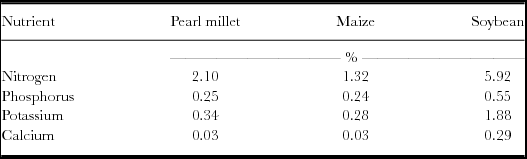
The nutritional requirement of any crop is determined by the amount of nutrients that it extracts during the growth cycle, found by the product of nutrient concentration, vegetative biomass and grain yields. The nutritional requirements pearl millet vary with age of the plant. Pearl millet grows slowly during early vegetative growth, but growth and nutrient needs increase dramatically during late vegetative and early reproductive stage. The demand for nutrients by pearl millet also depends on the productivity potential (i.e. expected yield) for forage, stover or grain depending upon end use. As the expected yield increases, the demand for nutrients increases proportionally. Pearl millet has higher concentrations of N (and protein) and K than for maize but lower than for soybean (Table 2). Phosphorus concentration for pearl millet is similar to maize. Soybean and corn remove more nutrients than pearl millet per unit yield, but removal increases with increased biomass yield (Table 3; Bastos et al., Reference Bastos, Moreira, Murakami, de Oliveira, Paiano and Kutschenko2004; Pauletti, Reference Pauletti and Fries1998; Resende et al., Reference Resende, Coelho, Santos, Assis and Pereira Filho2016), plant age and intended use (i.e. portion of plant harvested are used for soil cover (Boer et al., Reference Boer, Assis, Silva, Barroso, Cargnelutti Fílho and Pires2007; Resende et al., Reference Resende, Coelho, Santos, Assis and Pereira Filho2016)).
Nutrient concentrations in above-ground biomass of pearl millet, maize and soybean grains in Brazil (adapted from Rostagno et al., Reference Rostagno, Albino, Donzele, Gomes, Oliveira, Lopes, Ferreira and Barreto2005).

Examples of above-ground nutrient uptake and recycling by pearl millet in Brazil.

*Adapted from Boer et al. (Reference Boer, Assis, Silva, Barroso, Cargnelutti Fílho and Pires2007).
†Adapted from Pacheco et al. (Reference Pacheco, Barbosa, Leandro, Machado, Assis, Madari and Petter2011a).
‡Adapted from Soratto et al. (Reference Soratto, Crusciol, Costa, Ferrari Neto and Castro2012).
Forage utilisation often involves multiple plant harvests with removal of the above-ground biomass during vegetative growth, thereby removing greater quantity of nutrients than grain or cover crop production (Kollet et al., Reference Kollet, Diogo and Leite2006). Since pearl millet grain yields usually are lower than those of maize and soybean, nutrient removal per unit area is also usually lower (Coelho and França, Reference Coelho and França1995; EMBRAPA, 1993). Based on nutrient removal levels, the most important nutrients for pearl millet production are N and K, followed by Ca, Mg, P and S.
The production of pearl millet for grain and forage results in removal of nutrients in harvested plant parts, but one of the unique roles for pearl millet grown as a cover crop is to extract nutrients from lower depths of the soil profile and recycle these near the soil surface for use by the succeeding crop (Boer et al.,. Reference Boer, Assis, Silva, Barroso, Cargnelutti Fílho and Pires2007). Decomposition of pearl millet crop residues on the soil surface redistributes nutrients to the upper soil horizon to partially meet the nutritional needs of the succeeding crop and improve sustainability of the production system, which is particularly important for K, N, Ca and Mg in Brazil (Resende et al., Reference Resende, Coelho, Santos, Assis and Pereira Filho2016).
FERTILISER MANAGEMENT
Fertiliser recommendations for pearl millet vary depending upon the end use as forage, grain or cover crops in the common no-till production system (Heringer and Moojen, Reference Heringer and Moojen2002; Lupatini et al., Reference Lupatini, Moojen, Restle and Silva1996; Resende et al., Reference Resende, Coelho, Santos, Assis and Pereira Filho2016). Traditionally, pearl millet has been recognised to be nutrient use efficient with low fertiliser rates applied, but pearl millet forage, biomass and grain yields respond to high fertiliser application rates under favourable conditions (Resende et al., Reference Resende, Coelho, Santos, Assis and Pereira Filho2016). Pearl millet adapts well to stress conditions by reducing tiller production, and is known to efficiently remobilise N from vegetative to reproductive tissue and extract residual N and K present deep in soil profiles (Silva et al., Reference Silva, Muraoka, Buzetti, Veloso and Trivelin2006a). In general, recommended pearl millet fertiliser management is based upon soil test level and expected yield (Resende et al., Reference Resende, Coelho, Santos, Assis and Pereira Filho2016).
When pearl millet is produced for grazing, silage or grain with an expected yield of 2 to 3 ton ha−1, 20 to 30 kg N ha−1 is recommended at planting with 60 to 80 kg ha−1 N sidedress applied at the beginning of the tillering growth stage (Pereira Filho et al., Reference Pereira Filho, Ferreira, da, Coelho, Casela, Karam, Rodrigues, Cruz and Waquil2003; Resende et al., Reference Resende, Coelho, Santos, Assis and Pereira Filho2016). Split applications are recommended to reduce N losses and increase N use efficiency.
When Pearl millet is used as cover crop following maize or sorghum, 20 to 30 kg N ha−1 is recommended at planting (Resende et al., Reference Resende, Coelho, Santos, Assis and Pereira Filho2016). When produced after a legume crop such as soybean, N is not commonly applied due to the N credit from the previous soybean crop. In general, the pearl millet cover crop is grown on residual soil nutrients and expected to extract nutrients deep in the soil profile to be deposited with the residues on the soil surface for the succeeding crop.
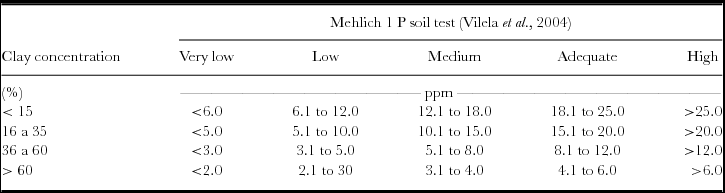
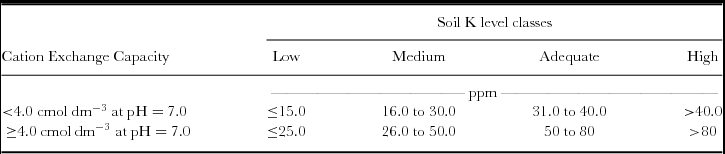
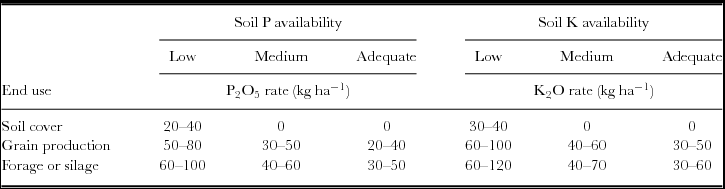
Potash and phosphate fertiliser applications are based upon the soil test levels (Tables 4 and 5) and end use (Table 6). Potash and phosphate fertiliser applications are recommended for pearl millet grown as a cover crop when soil test levels are low, and then only at low rates between 20 and 40 kg ha−1. Intermediate rates are recommended for pearl millet grain production, and higher rates for forage and silage production where multiple harvests of the entire plant is common.
Soil phosphorus availability classes for the Cerrado region of Brazil based on clay concentration level (Adapted from Sousa and Lobato, Reference Sousa, Lobato, Sousa and Lobato2004).

Soil potassium availability classes for the Cerrado region of Brazil based on cation exchange capacity at pH = 7.0 (Adapted from Vilela et al., Reference Vilela, Sousa, Silva, Sousa and Lobato2004).

Recommended phosphate and potash fertiliser rates for pearl millet based on end use and soil test level (Adapted from Cantarutti et al., Reference Cantarutti, Alvares, Ribeiro, Ribeiro, Guimaraes and Alvarez1999 and Sousa and Lobato, Reference Sousa, Lobato, Sousa and Lobato2004).

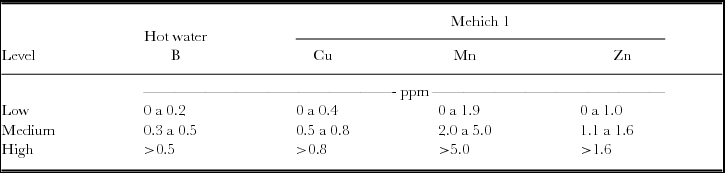
Micronutrient deficiency is common for the acid, infertile soils in the central part of Brazil (Table 6). Grass species, including pearl millet, are very sensitive to Zn deficiency, have intermediate sensitivity for Mn and Fe, and low sensitivity to B and Mo (Galrão, Reference Galrão, Sousa and Lobato2004). When soil micronutrient levels are at the low level (Table 7), it is commonly recommended to apply 6 kg ha−1 Zn, 2 kg ha−1 B, 2 kg ha−1 Cu, 6 kg ha−1 Mn and 0.4 kg ha−1 Mo (Galrão, Reference Galrão, Sousa and Lobato2004). These micronutrient applications are sometimes divided into three equal parts and applied in the planting furrow in three successive crops present within a year. When soil micronutrient levels are intermediate, it is commonly recommended to apply 25% of the recommended dose for a low soil test, and when the soil test level is high, no micronutrient application is recommended. In-season tissue sampling is sometimes used to determine deficiency and the potential need for foliar applications of micronutrients. When an in-season deficiency is detected, it is recommended to spray 0.5% ZnSO4, 0.5 to 3.0% borax or boric acid, 0.5% CuSO4, 0.5% MgSO4 and 2 g l−1 Ca hydroxide (slaked lime or hydrated lime).
Soil micronutrient availability classes for soils in the Brazilian Cerrados (Adapted from Galrão, Reference Galrão, Sousa and Lobato2004).

Integrated pest management
In order to reduce problems with weed infestation, it is recommended to plant pearl millet into a weed-free seedbed, preferably following a rotational crop with good grass weed control (Dan et al., Reference Dan, Barroso, Dan, Oliveira Junior, Procópio, Freitas and Correa2010). Pearl millet has a slow initial growth thus is vulnerable to early-season weed competition. As a result, weed management can become a limiting production factor during the growing season (Pacheco et al., Reference Pacheco, Pires, Monteiro, Procopio, Assis, Carmo and Petter2009a). High plant populations, narrow rows and practices leading to rapid growth help make pearl millet competitive with weeds (Dan et al., Reference Dan, Barroso, Dan, Oliveira Junior, Procópio, Freitas and Correa2010).
Herbicide development and availability in Brazil for weed control in pearl millet is limited, especially for grass weeds (Dias et al., Reference Dias, Gonçalves, Reis, Mendes, Carneiro, Melo and Pereira2015; Karam and Oliveira, Reference Karam, Oliveira and Pereira Filho2016). Triazine herbicides are commonly used and provide excellent weed control, but pearl millet tolerates only half the rate recommended for maize (Dan et al., Reference Dan, Barroso, Dan, Tannús and Finotti2009; Reference Dan, Barroso, Finotti, Dan and Assis2011; Karam and Oliveira, Reference Karam, Oliveira and Pereira Filho2016). The 4-hydroxy-phenylpyruvate dioxygenase (HPPD) enzyme herbicide tembotrione provides effective post-emergent control of grasses and broadleaf weeds in pearl millet (Dan et al., Reference Dan, Barroso, Dan, Oliveira Junior, Procópio, Freitas and Correa2010). Farinelli et al. (Reference Farinelli, Penariol and Lemos2005) reported that application rates of 536 to 670 g ha−1 2,4-D had no phytotoxic effect on pearl millet while giving 85% control of the broadleaf weed Raphanus raphanistrum. Pearl millet is very sensitive to carryover of many grass herbicides commonly used in cereal crops, thus planting after an oil-seed crop such as soybean not only increases stover and grain yield and facilitates weed control, it also reduces herbicide carryover problems.
In Brazil, pearl millet as a cover crop is usually grown between two other crops such as maize and soybean, thus pearl millet often is an intermediate host of insects and diseases thereby facilitating insect and disease migration between crops (Cruz et al., Reference Cruz, Viana, Mendes and Pereira Filho2016). Pearl millet has been shown to be a powerful tool in controlling nematodes and to reduce nematode infestations in the succeeding crops in Brazil (Bastos Filho et al., Reference Bastos Filho, Nakazone, Bruggemann and Melo2007; Carneiro et al., Reference Carneiro, Moritz, Mônaco, Nakamura and Scherer2007). In no-till soybean production, pearl millet has reduced infestations of Meloidogyne incognita, M. paranaensis and M. Javanica in soybeans, thereby increasing soybean yields and profitability (Carneiro et al., Reference Carneiro, Moritz, Mônaco, Nakamura and Scherer2007; Inomoto et al., Reference Inomoto, Antedomênico, Santos, Silva and Almeida2008; Ribeiro et al., Reference Ribeiro, Silva, Meirelles, Craveiro, Parentoni and Santos2002). In addition, pearl millet has been found to reduce M. xenoplax in peach (Prunus persica) orchards (Gomes et al., Reference Gomes, Carvalho, Casagrande Júnior and Radmann2010), Rotylenchulus reniformis in cotton and green manures (Asmus et al., Reference Asmus, Inomoto and Cargnin2008; Gardiano et al., Reference Gardiano, Krzyzanowski and Saab2014) and Pratylenchus brachyurus in Bracharia sp and Panicum maximum (Queiróz et al., Reference Queiróz, Fernandes, Verzignassi, Valle, Jank, Mallmann and Batista2014).
Labelled pesticides for insect control are limited for grain pearl millet. Therefore, early planting, production practices to promote rapid growth and development and planting into weed-free soils are recommended to minimise insect infestations. Under field conditions, pearl millet is subject to biomass and grain yield losses caused by insect pests (Fonseca et al., 2012; Reference Fonseca, Fernandes, Kassab, Mota, Paim and Silva2014; Martins et al., Reference Martins, Toscano, Tomquelski and Maruyama2009). The defoliating insects decrease pearl millet yields by 11 to 100%, especially if the occurrence of the pests coincides with vegetative growth between germination to flowering (Schmildt et al., Reference Schmildt, Amaral, Pratissoli and Reis2010). Pearl millet is a host of fall army worm (Spodoptera frugiperda) along with maize (Barros et al., Reference Barros, Torres and Bueno2010). It feeds on the leaves of plants and their injuries can cause defoliation, reducing the photosynthetic capacity of the plant (Fazolin and Estrela, Reference Fazolin and Estrela2003; Melo et al., Reference Melo, Lima Junior, Bertoncello, Suekane, Degrande and Fernandes2011). Limited information is available in Brazil for insect management and control in pearl millet (Pereira Filho et al., Reference Pereira Filho, Ferreira, da, Coelho, Casela, Karam, Rodrigues, Cruz and Waquil2003).
The primary disease problem of grain pearl millet in Brazil is rust (Puccinia substriata var. penicillariae). It must be emphasised that in the period of the second season from January to April, environmental conditions are favourable for rust development. Rust is a problem of great economic importance because the damage results in biomass and yield losses of grain (Pereira Filho et al., Reference Pereira Filho, Ferreira, da, Coelho, Casela, Karam, Rodrigues, Cruz and Waquil2003), and reduced biomass production and forge quality (Casela et al., Reference Casela, Sabato, Cota, Costa and Filho2016) due to premature senescence of leaves (Pereira Filho et al., Reference Pereira Filho, Ferreira, da, Coelho, Casela, Karam, Rodrigues, Cruz and Waquil2003). Cultivar selection is the key method to manage rust (Costa et al., Reference Costa, Oliveira, Carmo, Pereira and Pimentel2005a).
RECOMMENDATIONS AND CONCLUSIONS
Pearl millet is well adapted to low rainfall and low nutrient situations in the tropical semi-arid regions common in Brazil. Pearl millet production has undergone great expansion in Brazil during the last 30 years, primarily as a cover crop for no-tillage production of soybean and maize. Forage utilisation remains an important, but relatively small use of pearl millet in Brazil. Pearl millet is grown as a grain crop in areas with high risk of drought and water stress, especially in areas with acid, infertile soils with nematode problems, and in rotational production systems with soybean has great potential. Further expansion of Brazilian pearl millet grain production is dependent upon crop improvement and management research to increase grain yield potential under these marginal farmer conditions.
This article was written as a review of the production practices used for pearl millet cultivation in Brazil. Pearl millet is a small-seeded crop, thus soil preparation and planting practices are important for stand establishment and early season growth. Pearl millet has the capacity to tiller profusely, thereby influencing the recommended seeding rates/plant populations and spacing, hybrid/variety selection and the use of pearl millet as a forage, cover or grain crop. Nutrient, water and pest management is site specific, depending upon soil, climate and biotic conditions. The information contained in this article should help scientists, extension agents and others working with pearl millet in both the private and public sectors to better utilise pearl millet in Brazilian production systems. The following items are seen by the authors as important needs to promote pearl millet production in Brazil:
• Increased investment in research by the public sector and private companies to develop new high-yielding cultivars resistant to diseases (especially rust), and suitable for use as grain, forage and cover crops.
• Creation of a database on pearl millet production, marketing and utilisation in support of research and development activities.
• Research to refine recommendations for fertiliser and pest management practices.
• Development of new pesticides for pearl millet production, including adaption of pesticides approved for use in other summer annual grass crops, like maize and sorghum, for use in pearl millet production.
• Major research efforts to determine the most efficient manner to use pearl millet for integrated management of nematodes.
• Increased extension programming to promote production of pearl millet as part of agricultural systems throughout Brazil.
Improved production system research combined with improved policy can lead to further exploitation of pearl millet to contribute to Brazilian food security and economic growth.