Introduction
The impact of cognitive loss on everyday function is a major concern for older adults and the early detection and systematic characterization of functional loss has many important clinical and research applications. In clinical contexts, the identification of functional difficulties can lead to the provision of needed support and better care. From a diagnostic perspective, major functional disability is required to meet criteria for a dementia syndrome. More subtle functional changes are also now recognized to begin in the transitional stage of mild cognitive impairment (MCI) (Farias et al., Reference Farias, Mungas, Reed, Harvey, Cahn-Weiner and Decarli2006; Perneczky et al., Reference Perneczky, Pohl, Sorg, Hartmann, Tosic, Grimmer and Kurz2006) and prognostically, greater functional impairment in MCI is associated with a faster rate of subsequent disease progression and conversion to dementia (Daly et al., Reference Daly, Zaitchik, Copeland, Schmahmann, Gunther and Albert2000; Farias, Mungas, Reed, Harvey, & DeCarli, Reference Farias, Mungas, Reed, Harvey and DeCarli2009). Finally, everyday function is a critical outcome in longitudinally tracking disease progression (Rockwood, Reference Rockwood2007).
Advances in our ability to precisely understand the cognitive and other correlates of functional impairments in older adults have been hampered, in part, by the lack of rigorous methods to measure cognitively based functional abilities. In recent years, novel approaches to observing and measuring real-world functional abilities have begun to be developed through use of smart home technology and other methods. However, at the present time informant-based measures of everyday function remain most accessible and practical, and have demonstrable usefulness (Jorm & Korten, Reference Jorm and Korten1988; Morales, Bermejo, Romero, & Del-Ser, Reference Morales, Bermejo, Romero and Del-Ser1997; Schinka, Reference Schinka2010). Although several informant-rated instruments of everyday function have been previously developed, these older instruments lack good psychometric properties. Additionally, many functional instruments focus primarily on the loss of independence in global, rather coarsely defined domains of everyday life, referred to as instrumental and basic activities of daily living (ADL, e.g., the ability to drive or the ability to feed oneself, respectively). Although the assessment of traditional ADLs remains of value, a focus solely on broad ADL domains has limitations. For instance, ADL impairment can occur as a result of both cognitive and non-cognitive factors; additionally, more subtle functional changes characteristic of MCI may be missed when focusing strictly on ADLs (Burton, Strauss, Bunce, Hunter, & Hultsch, Reference Burton, Strauss, Bunce, Hunter and Hultsch2009; Jefferson et al., Reference Jefferson, Byerly, Vanderhill, Lambe, Wong, Ozonoff and Karlawish2008).
The Everyday Cognition (ECog) scale is an informant-rated instrument that was developed in response to these limitations. First, the ECog was designed to measure specific domains of everyday function across six neuropsychologically relevant domains: Everyday Memory, Everyday Language, Everyday Visuospatial abilities, and three everyday executive domains including Everyday Planning, Everyday Organization, and Everyday Divided Attention. Previous research using confirmatory factor analysis supports the proposed multidimensional structure of this instrument (Farias et al., Reference Farias, Mungas, Reed, Cahn-Weiner, Jagust, Baynes and DeCarli2008). Second, the ECog was designed to capture relatively mild functional changes that likely predate loss of independence in major ADLs and to this end it has been shown to be sensitive to early functional changes seen in MCI (Farias et al., Reference Farias, Mungas, Reed, Harvey, Cahn-Weiner and Decarli2006, Reference Farias, Mungas, Reed, Cahn-Weiner, Jagust, Baynes and DeCarli2008). The ECog is already being used in a variety of clinical and research contexts, including as an outcome in several clinical treatment trials (both behavioral interventions and medication trials), and several large-scale longitudinal studies including the Alzheimer's Disease Neuroimaging Initiative study (ADNI-GO and ADNI-2). Several recent reviews have also noted its potential as a useful measure of everyday function (Gold, Reference Gold2011; Schinka, Reference Schinka2010; Silverberg et al., Reference Silverberg, Ryan, Carrillo, Sperling, Petersen, Posner and Ferman2011).
The aim of the present study was to further examine the external validity of the ECog by formally evaluating its association with both objective measures of neuropsychological function and neurobiological markers of disease, as measured by brain MRI. With regard to its neuropsychological associations, we hypothesized that there would be both general and specific relationships between the ECog domains and neuropsychological domains. Based on previous work showing episodic memory and executive function to be most consistently related to a variety of functional abilities (see Gold, Reference Gold2011, for a review), in the present study we also expected that these two neuropsychological domains would have broad independent associations with many, if not all of the ECog domains. However, we also expected that there would be evidence of domain-specific relationships (e.g., neuropsychological measures of spatial abilities would be related to the ECog Everyday Visuospatial domain; neuropsychological measures of language/semantic memory would be related to Everyday Language).
To explore the neuroanatomical underpinnings of the ECog, we examined its association with both specific regional brain volumes and total brain volume. Given the presumed importance of episodic memory and executive function to everyday function, specific brain regions focused on the hippocampus and dorsolateral prefrontal cortex (DLPFC) because of their recognized importance to episodic memory and executive function, respectively. We hypothesized that total brain volume would have broad associations with the ECog domains. Alternatively, we predicted that hippocampal volume would have a more unique association with the ECog Everyday Memory domain when controlling for total brain volume, and DLPFC volume would be associated with the three ECog everyday executive domains (planning, organization, and divided attention) when simultaneously controlling for total brain volume. Finally, we examined whether the relationships between the ECog and the neuropsychological and imaging predictors varied by diagnosis (cognitively normal or MCI/dementia). Here we suspected that episodic memory and hippocampal volume, which are strongly associated with the clinical and neurobiological manifestations of Alzheimer's disease, would be more strongly associated with the ECog in those with cognitive impairment (MCI/dementia) than in cognitively normal older adults.
Methods
Participants
Data for this study was collected from individuals who were evaluated at a university-based Alzheimer's Disease Center (ADC) via clinical referral or recruitment from the community. To be recruited and included in the present study participants had to be older adults who spoke English, and had an informant with whom the participant had regular contact and could complete informant-based ratings. Exclusion criteria were an unstable major medical illness, a current severe/debilitating psychiatric disorder (milder forms of depression were acceptable), another existing neurologic condition outside of the target diseases [e.g., Alzheimer's disease (AD) and related disorders, and cerebrovascular disease], and active alcohol or drug abuse/dependence.
All participants underwent a multidisciplinary clinical assessment appropriate for the evaluation of dementia/MCI to establish study eligibility and diagnosis. This included physical and neurological exam, clinical exam, imaging, lab work and the neuropsychological testing from the Alzhiemer's Disease Uniform Dataset Neuropsychological Battery (Weintraub et al., Reference Weintraub, Salmon, Mercaldo, Ferris, Graff-Radford, Chui and Morris2009). Diagnoses were made completely blind to the neuropsychological tests used as predictors in this study. Dementia was diagnosed using DSM-III R (American Psychiatric Association, 1987) criteria, modified such that dementia could be diagnosed in the absence of memory impairment if there was significant impairment in any two or more other cognitive domains. Although no strict psychometric cutoff scores were used to define cognitive impairment, cognitive impairment was clinically identified by ADC neuropsychologists when a participant's performance fell approximately 1.5 standard deviations below age-matched norms and in reference to their educational and socioeconomic background. MCI was diagnosed according to standard criteria and in many cases was further subtyped according to current Alzheimer's Disease Centers Uniform Data Set guidelines (Morris et al., Reference Morris, Weintraub, Chui, Cummings, DeCari, Ferris and Kukull2006). Individuals with MCI could not have impairments in basic ADLs or be dependent in any instrumental ADL. For clinical diagnosis, functional impairment was assessed using a variety of standardized tests and a clinical interview with the patient and informant. Clinical diagnoses were made without knowledge of the ECog data.
All participants signed informed consent, and all human subject involvement was overseen by institutional review boards at University of California at Davis, the Veterans Administration Northern California Health Care System and San Joaquin General Hospital in Stockton, California.
Instruments/Measurements
The assessment of everyday cognition
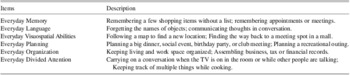
The ECog is an informant-rated measure of cognitively relevant everyday abilities comprised of 39 items, covering six domains: Everyday Memory, Everyday Language, Everyday Visuospatial Abilities, and Everyday Planning, Everyday Organization, and Everyday Divided Attention. Table 1 provides example items for each of the six domains. On each item, informants compare the participant's current level of everyday functioning with how he or she functioned 10 years earlier. In this way, individuals serve as their own control.
Example items from the ECog

Note. Information from this table is reprinted from Alzheimer's Disease and Associated Disorders, 20(4), Farias, S.T., Mungas, D., Breed, B.R., Harvey, D., Cahn-Weiner, D., & DeCarli, C., MCI is associated with deficits in everyday functioning, 217–223, 2006, with permission from Wolters Kluwer Health. Portions of this table are also reprinted from Farias, S.T., Mungas, D., Harvey, D., Simmons, A., Reed, B.R., & DeCarli, C., (2011). The measurement of everyday cognition (ECog): Development and validation of a short form. Alzheimer's & Dementia, 7(6), 593–601, with permission from Elsevier.
Ratings are made on a four-point scale: 1 = better or no change compared to 10 years earlier, 2 = questionable/occasionally worse, 3 = consistently a little worse, 4 = consistently much worse. The ECog was developed through a rigorous process that included initial pilot testing of a larger potential pool of items with the goal of discarding items with obvious poor psychometric properties. The ECog has been shown to have excellent psychometric properties including good test–retest reliability (r = .82; p < .001) as well as evidence of various aspects of validity including content, construct, convergent and divergent, and external validity (Farias et al., Reference Farias, Mungas, Reed, Cahn-Weiner, Jagust, Baynes and DeCarli2008).
Neuropsychological assessment
Neuropsychological functions were assessed using the Spanish and English Neuropsychological Assessment Scales (SENAS). The SENAS has undergone extensive development as a battery of cognitive tests relevant to diseases of aging (Mungas, Reed, Farias, & DeCarli, Reference Mungas, Reed, Farias and DeCarli2005; Mungas, Reed, Crane, Haan, & Gonzales, Reference Mungas, Reed, Crane, Haan and Gonzales2004; Mungas, Reed, Marshall, & Gonzales, Reference Mungas, Reed, Marshall and Gonzales2000). Modern psychometric methods based on item response theory were used to create psychometrically matched measures across different scales and across English and Spanish versions. This study used a subset of SENAS tests to measure four cognitive domains: episodic memory, semantic memory, visuospatial abilities, and executive function. The Episodic Memory Index is a composite score derived from a multi-trial word list learning test (Word List Learning I). The Semantic Memory Index is a composite of highly correlated verbal (Object Naming) and nonverbal (Picture Association) tasks. The Spatial Ability Index is a composite that included two SENAS subtests Spatial Localization and Pattern Recognition. Finally, the Executive Function Index was a composite measure constructed from component tasks of Category Fluency, Phonemic (letter) Fluency, and Working Memory. These measures do not have appreciable floor or ceiling effects for participants in this sample and have linear measurement properties across a broad ability range. The SENAS indices are psychometrically matched measures of domain specific cognitive abilities (i.e., the indices have comparable reliability and sensitivity to individual differences), which is critical to the identification of differential relationships between the ECog domains and specific neuropsychological domains.
Structural brain neuroimaging
Each participant received structural brain magnetic resonance imaging (MRI) at baseline using acquisition methods described previously (Carmichael et al., Reference Carmichael, Munas, Beckett, Harvey, Farias, Reed and Decarli2012). Briefly, MRI data was acquired on two 1.5 Tesla MRI scanners: a GE Signa machine located at UCD Medical Center (Sacramento, CA), and a Philips Eclipse machine located at the Veterans Administration Northern California Health Care System (Martinez, CA). High-resolution T1-weighted and fluid-attenuated inversion recovery (FLAIR) sequences required for measurement of MRI variables were acquired in each subject.
Total brain volume (BV) and intracranial volume (ICV) were measured from FLAIR images according to a previously reported analysis protocol (DeCarli, Massaro, et al., Reference DeCarli, Massaro, Harvey, Hald, Tullberg and Au2005; DeCarli, Fletcher, Rameny, Harvey, & Jagust, Reference DeCarli, Fletcher, Rameny, Harvey and Jagust2005). First, non-brain elements were manually removed from the image by operator guided tracing of the dura mater within the cranial vault including the middle cranial fossa, but excluding the posterior fossa and cerebellum. The volume of the traced region was defined as the ICV. Tissues outside the traced cranial vault were removed from the image, and image segmentation methods then identified the brain matter. To identify brain matter, image intensity nonuniformities were removed from the image, and the corrected image was modeled as a mixture of two Gaussian probability functions corresponding to brain tissue and non-brain tissue, respectively; the segmentation threshold between brain and non-brain image intensities was located at the minimum probability between these two distributions (DeCarli et al., Reference DeCarli, Maisog, Murphy, Teichberg, Rapoport and Horwitz1992; DeCarli, Murphy, Teichberg, Campbell, & Sobering, Reference DeCarli, Murphy, Teichberg, Campbell and Sobering1996). Voxels on the non-brain side of the intensity threshold were removed from the image, and the volume of the remaining brain voxels was taken as BV. Morphometric erosion of two exterior image pixels was then applied to the BV image to remove the effects of CSF contamination (DeCarli et al., Reference DeCarli, Murphy, Teichberg, Campbell and Sobering1996).
The hippocampus (HC) was manually traced on T1-weighted scans to include the CA1–CA4 fields, dentate gyrus, and the subicular complex using a protocol described previously (DeCarli et al., Reference DeCarli, Reed, Jagust, Martinez, Ortega and Mungas2008). Briefly, all scans were resliced perpendicular to the long axis of the left HC and HC borders were manually traced on contiguous coronal slices in the anterior to posterior direction. The HC was bounded anteriorly by the amygdala, and tracing ended posteriorly at the first slice where the fornices were completely distinct from thalamic gray and white matter. The inferior boundary of the HC was the white matter of the parahippocampal gyrus. The lateral boundary was the temporal horn of the lateral ventricle. The uncus was included in sections in which the uncus was ventral to caudal amygdala; the fimbria was excluded.
The dorsolateral prefrontal cortex (DLPFC) was manually traced as a region of interest (ROI) on a minimal deformation template (MDT: Kochunov et al., Reference Kochunov, Lancaster, Thompson, Woods, Mazziotta, Hardies and Fox2001). Referring to a human brain atlas on three-dimensional sectional anatomy (Duvernoy, Reference Duvernoy2005), Broadmann areas 9 and 46 were drawn by experts in neuroanatomy on the MDT. Once the ROI was traced, image analysis was performed to obtain DLPFC volumes for individual subject MRIs using a four-step process that has been described previously (Lee et al., Reference Lee, Fletcher, Martinez, Zozulya, Kim, Tran and Decarli2010). These steps included: Image registration, four-tissue image segmentation, and automatic fitting of the template ROI to subject T1-weighted scans. Subsequently, the DLPFC volume was obtained by counting voxels within the DLPFC ROI mapped to the subject.
Neuropsychological and neuroimaging measures were obtained within 6 months of the ECog assessment.
Statistical Analyses
Spearman correlations were used to assess simple correlations between the ECog domains and the neuropsychological and neuroimaging predictors. The logarithm of the ECog was used as the outcome to better meet model assumptions. Tobit regression models were used with a lower bound of zero because of the restricted range of the ECog domains (1-4; log(ECog): 0- log(4)) and the high frequency of ratings near 1 (0 on the log-scale). Multivariate models were constructed for each ECog domain separately. Independent variables were of two classes: neuropsychological function and neuroimaging. For each class of variable, models included demographics (age and education) and all of the independent variables of that class, analyzed simultaneously as potential independent predictors.
Specifically, in the models examining neuropsychological predictors of ECog domains, joint models included age and education and all four of the neuropsychological variables. For the neuroimaging predictors, we first examined two joint models adjusted for age and education: Model 1 including HC and BV and Model 2 including DLPFC and BV. Here, we sought to examine the unique contribution of each specific brain region over and above total brain volume. We then examined a final joint model that simultaneously included all three brain volumes. All brain variables were corrected for total head size by fitting linear regression models with ICV as the independent variable and HC, DLPFC, or BV as the outcome. Residuals from these models were used in future analyses as the part of the regional volume not explained by ICV.
Within a class of independent variables, the highest observed correlations were between executive and semantic (0.65), suggesting that the intercorrelations were sufficiently modest to include together as independent predictors. Correlations between neuroimaging measures were all relatively small (r < 0.3 for all pairs). A final set of models investigated interactions between diagnosis (MCI or dementia vs. Normal) and the neuropsychological and neuroimaging variables of interest. Each interaction was assessed individually and final models were generated that included all of the significant interactions.
Results
Sample Characteristics
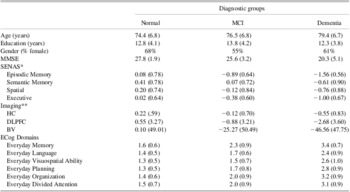
A total of 474 participants had ECog scores and neuropsychological test scores and/or imaging data collected within 6 months of the ECog. In the total sample, 88 participants had dementia, 142 had MCI and 244 were cognitively normal. Of those with dementia, 71 had possible or probable AD, 5 had possible or probable vascular dementia, 2 had Lewy Body dementia, 1 had Frontotemporal dementia, 7 had mixed AD/vascular dementia, and the presumed etiology was undetermined in 2 cases. The average age was 76.0 (7.0); average education was 13.0 (4.1) ranging from 20–0 years of education; and 62.6% were female. The racial/ethnicity breakdown was: 45.8% Caucasians, 26.6% African Americans, 23.0% Hispanics, 2.7% Asians, and 1.9% other/unknown. Table 2 provides demographic information, ECog and neuropsychological score, as well as imaging volumes by diagnostic group.
Demographic characteristics and ECog and SENAS scores across each diagnostic group

Note. *All of the neuropsychological outcomes are reported as z scores based on a normal sample. **Imaging variables are reported as cubic centimeter (CC) values corrected for intracranial volume. ECog = Everyday Cognition; MCI = mild cognitive impairment; MMSE = Mini-Mental State Examination; SENAS = Spanish and English Neuropsychological Assessment Scales.
The Association Between the ECog and Neuropsychological Function
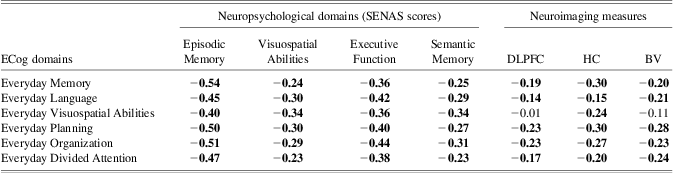
A total of 473 individuals (244 Normal; 141 MCI; 88 demented) had neuropsychological data collected within 6 months of the ECog. Table 3 presents simple bivariate correlations among the ECog domains and the neuropsychological domains. All of the correlations are statistically significant at p < .05. Overall, the strength of the relationships between the ECog domains and the neuropsychological scores were in the moderate range. In general, the ECog domains had the strongest associations with episodic memory and executive function, and relatively lower correlations with semantic memory and visuospatial abilities.
Spearman correlations between ECog, SENAS, and MRI measures
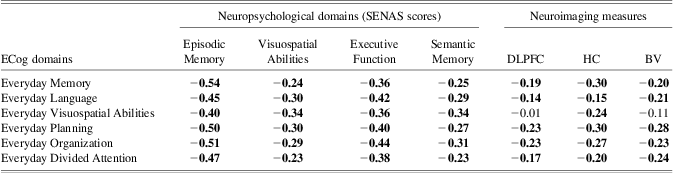
Note. BV = brain volume (total); DLPFC = dorsolateral prefrontal cortex; ECog = Everyday Cognition; HC = Hippocampal volume; MCI = mild cognitive impairment; MRI = magnetic resonance imaging; SENAS = Spanish and English Neuropsychological Assessment Scales.
Bolded values denote p < .05.
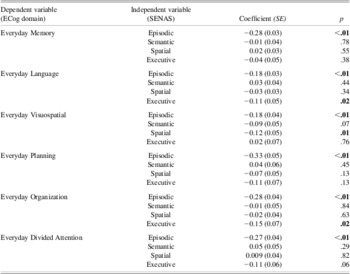
Next we examined joint models that included all 4 neuropsychological test scores (as well as age and education) as predictors of each ECog outcome. Table 4 presents the results of these multivariate models. All of the ECog domains were independently associated with episodic memory (with Everyday Memory and Everyday Planning uniquely associated only with episodic memory). The Everyday Visuospatial domain was also associated with the neuropsychological measures of spatial abilities. Everyday Language and Everyday Organization were also independently related to executive function and Everyday Divided Attention was also marginally associated with executive function. In all of these associations, better neuropsychological function (higher scores) was associated with better everyday cognition (lower scores).
Results of multivariate models using neuropsychological variables and demographics to predict ECog domains

The Association Between the ECog and Structural Brain Imaging
A subset of 224 individuals (128 Normal; 68 MCI; 28 demented) had structural brain imaging within 6 months of the ECog. Bivariate correlations between the ECog domains and the three imaging variables are presented in Table 3. All associations were in the anticipated direction such that lower scores on the ECog (less functional impairment) were associated with larger brain volumes. As would be expected, the correlations between the ECog and imaging variables were weaker than the correlations between the ECog and neuropsychological scores. HC was associated with all ECog domains. BV was associated with every domain except for Everyday Visuospatial ability. DLPFC was more strongly associated with Everyday Memory and the executive domains of Everyday Planning, Everyday Organization and Everyday Divided Attention than with Everyday Language or Everyday Visuospatial ability.
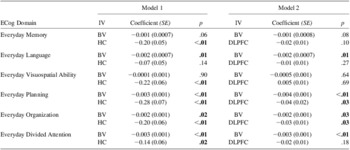
Next, we examined the independent association between each specific brain region, while simultaneously accounting for the effects of BV (Table 5). Specifically, “Model 1” included HC and BV volumes in addition to age and education. HC was associated with all domains, independent of BV volume, except for Everyday Language. In this model BV also had independent associations with all of the ECog domains with the exception of the Everyday Memory and Everyday Spatial domains (the latter two of which were uniquely associated with HC alone). As expected, in all cases larger BV and HC were associated with better (lower) scores on the ECog domains. “Model 2” included DLPFC volume along with BV, age and education. The DLPFC had independent associations with Everyday Organization, p = .03, and Everyday Planning, p = .03, even when accounting for BV. In these models, BV had the same independent associations as were seen in “Model 1.” However, in the final model that simultaneously included all three imaging variables as predictors of the ECog domains, results remained the same as in Model 1; that is, DLPFC was no longer independently associated with Everyday Planning or Organization when both BV and HC were also included as predictors.
Brain imaging variables independently associated with ECog domains

Note. BV = brain volume (total); DLPFC = dorsolateral prefrontal cortex; ECog = Everyday Cognition; HC = hippocampal volume; MCI = mild cognitive impairment; MRI = magnetic resonance imaging; SENAS = Spanish and English Neuropsychological Assessment Scales.
All models are corrected for age and education. Bolded values denote p < .05.
ECog Associations With Neuropsychological and Imaging Variable by Diagnosis
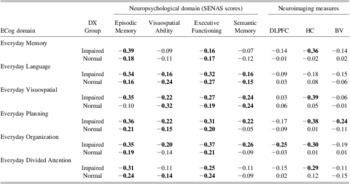
Finally, we examined whether the relationships between the ECog domains and the neuropsychological and neuroimaging variables differed as a function of clinical diagnosis. Participants were categorized as cognitively normal or “impaired”; the impaired group included individuals diagnosed with either MCI or dementia. Table 6 presents the bivariate correlations among the neuropsychological and imaging variables and the ECog domains by diagnostic category. In most cases, the associations between the ECog and neuropsychological domains were lower in the normal compared to the impaired group; none of the associations between the ECog and the neuroimaging variables reached statistical significance in the normal.
Spearman correlations between ECog, SENAS, and MRI by diagnosis

Note. BV = Brain volume (total); DLPFC = dorsolateral prefrontal cortex; ECog = Everyday Cognition; HC = hippocampal volume; MCI = mild cognitive impairment; MRI = magnetic resonance imaging; SENAS = Spanish and English Neuropsychological Assessment Scales.
Bolded values denote p < .05.
In models that directly compared the association between cognitive function and everyday cognition in the impaired and normal groups, adjusted for age, education, and all cognitive variables, the association between episodic memory and Everyday Visuospatial Ability differed between the two, with an association in the impaired group, b = −0.23, SE = 0.08, p < .01, and no unique association in the normals, b = −0.009, SE = 0.06, p = 0.89. There was also a trend for a difference in the association between episodic memory and Everyday Language, b = −0.11, SE = 0.06, p = 0.07, and Everyday Organization, b = −0.14, SE = 0.08, p = .07, with a non-significant association in the normal group (Everyday Language: b = −0.06; SE = 0.05; p = 0.19; Everyday Organization: b = −0.07, SE = 0.06, p = .24). For Everyday Memory, there was a significant association with episodic memory in the normal group, b = −0.12, SE = 0.04, p = .004, and there was a trend for an even greater association in the impaired group, b = −0.10, SE = 0.06, p = .08. None of the group by neuropsychological domain interactions for executive function (p > .15 for all ECog domains), semantic memory (p > .20 for all ECog domains), or spatial ability (p > .30 for all ECog domains) researched statistical significance.
In terms of imaging predictors, the associations between HC and Everyday Visuospatial Ability, b = −0.35, SE = 0.13, p < .01, Everyday Planning, b = −.32, SE = .14, p = .03, and Everyday Divided Attention, b = −.35, SE = 0.12, p < .01, differed between groups with no association in the normal (Everyday Visuospatial Ability: b = .03; SE = .10; p = .50; Everyday Planning: b = 0.02; SE = 0.11; p = .83; Everyday Divided Attention: b = 0.14; SE = 0.09; p = .12). There was also a trend for a difference in the association between HC and Everyday Memory (b = −0.16; SE = 0.09; p = .07) and Everyday Organization (b = −0.22; SE = 0.12; p = .07) by group, with no association in the normal (Everyday Memory: b = −0.02; SE = 0.07; p = .78; Everyday Organization: b = 0.03; SE = 0.09; p = .77). None of the diagnostic group interactions for DLPFC (p > .10 for all ECog domains) or BV (p > .10 for all ECog domains) reached statistical significance.
Discussion
A clear understanding of the neuropsychological determinants of functional abilities has been hampered, in part, by the lack of rigorous methods to measure cognitively relevant domains of everyday function. To this end, the ECog was developed to asses everyday functional abilities thought to be dependent on memory, language, visuospatial abilities and executive functions. The aim of the present study was to formally evaluate the degree to which these ECog domains relate to objective indices of neuropsychological function and proxies of brain pathology, as measured by structural MRI. Overall, our findings largely support the predicted global and domain-specific relationships between the ECog domains, neuropsychological function and brain integrity.
In the sample as a whole, episodic memory was the neuropsychological predictor most consistently related to the ECog, independently relating to all functional domains. The importance of episodic memory to everyday function is often under-recognized or under-appreciated, however such findings are consistent with a rather extensive body of literature demonstrating memory is important to everyday function (Brown, Devanand, Liu, Caccappolo, & Initia, 2011; Jefferson et al., Reference Jefferson, Byerly, Vanderhill, Lambe, Wong, Ozonoff and Karlawish2008; Tuokko, Morris, & Ebert, Reference Tuokko, Morris and Ebert2005). Not surprisingly, episodic memory was the sole neuropsychological predictor of the Everyday Memory domain; it was also the only independent predictor of Everyday Planning. For the other ECog domains, episodic memory demonstrated an independent association but was not the only unique predictor.
Executive function was independently associated with two of the ECog domains—Everyday Organization and Everyday Language—and marginally related to a third, Everyday Divided Attention (p = .06). The association between executive function and Everyday Organization and Everyday Divided Attention is consistent with the goals of these two subscales—to measure everyday executive abilities. Abilities measured by the Everyday Organization scale include keeping one's living and work space organized but also aspects of financial and medication management—the latter two of which have been previously associated with executive functioning (Okonkwo, Wadley, Griffith, Ball, & Marson, Reference Okonkwo, Wadley, Griffith, Ball and Marson2006; Sherod et al., Reference Sherod, Griffith, Copeland, Belue, Krzywanski, Zamrini and Marson2009; Stilley, Bender, Dunbar-Jacob, Sereika, & Ryan, Reference Stilley, Bender, Dunbar-Jacob, Sereika and Ryan2010). The association between executive function and the Everyday Language domain is less intuitively obvious. However, frontal-executive functions play a role in word retrieval (Whitney, Mossbarger, Herman, & Ibarra, Reference Whitney, Mossbarger, Herman and Ibarra2012). Furthermore, many of the items making up the Everyday Language subscale of the ECog tap higher-level communication abilities (e.g., “giving instructions to others”), which are undoubtedly influenced by various executive functions. Additionally, our neuropsychological composite measure of executive function included, among others, tests of verbal fluency, which obviously tap both executive and expressive language abilities.
One of the most domain-specific relationships between our neuropsychological predictors and the ECog was observed between Everyday Visuospatial domain and our neuropsychological measure of spatial ability. Previous studies, using more traditional instrumental ADL instruments, have also noted a relationship with spatial abilities (Jefferson, Barakat, Giovannetti, Paul, & Glosser, Reference Jefferson, Barakat, Giovannetti, Paul and Glosser2006; Sadek, Stricker, Adair, & Haaland, Reference Sadek, Stricker, Adair and Haaland2011). In particular, Glosser and colleagues found that a measure of spatial ability was significantly associated with “visually based” functional abilities but not with “non-visually based” functional abilities (Glosser et al., Reference Glosser, Gallo, Duda, De Vries, Clark and Grossman2002).
Finally, in terms of neuropsychological predictors of ECog domains, we did not find the Everyday Language domain to be related to our index of semantic memory. The semantic memory index included a measure of confrontation naming, however even replacing the global semantic memory index with this individual subtest (data not shown) it did not emerge as an independent predictor in the joint model.
Next, we examined some neuroanatomical correlates of the ECog. Both BV and HC volume had widespread associations with the ECog domains. However, there were also notable more specific relationships between several of the ECog domains and select brain regions. First, the Everyday Memory and Everyday Spatial domains were uniquely related only to HC. The association between HC volume and Everyday Memory is consistent with the large body of literature linking the hippocampus to various laboratory and neuropsychological measures of episodic memory (Van Petten, Reference Van Petten2004). The present study further extends these findings to link hippocampal integrity to informant ratings of functional memory abilities in the real world. Another recent study also found self-rated everyday memory to relate to the structural integrity of the medial temporal lobe (Bjornebekk, Westlye, Walhovd, & Fjell, Reference Bjornebekk, Westlye, Walhovd and Fjell2010). There is also a large body of literature linking spatial memory and navigation to the hippocampus (Nedelska et al., Reference Nedelska, Andel, Laczo, Vlcek, Horinek, Lisy and Hort2012). Again, findings from the present study suggest that this association extends to informant ratings of everyday spatial abilities and hippocampal integrity.
The DLPFC had quite specific relationships with the ECog domains when simultaneously controlling for total brain volume. This prefrontal region was independently related to Everyday Planning and Everyday Organization, supporting the idea that the functional abilities captured by these two everyday executive domains are associated with a brain region often linked to various executive functions (Chow & Cummings, Reference Chow and Cummings2007). However, in a model that simultaneously included DLPFC, BV, and HC, the DLPFC no longer remained independently associated with these two ECog domains. In this case, only BV and HC were uniquely associated with Everyday Planning and Everyday Organization. The association between HC volume and the everyday executive domains was relatively unexpected. However, this finding, along with the association between episodic memory and the ECog everyday executive domains, make some sense in light of recent work linking the hippocampus to planning future events (Addis, Cheng, Roberts, & Schacter, Reference Addis, Cheng, Roberts and Schacter2011; Schacter, Gaesser, & Addis, Reference Schacter, Gaesser and Addis2012). Additionally, prospective memory has also been linked to executive functions (Salthouse, Berish, & Siedlecki, Reference Salthouse, Berish and Siedlecki2004) and to hippocampal integrity (Gordon, Shelton, Bugg, McDaniel, & Head, Reference Gordon, Shelton, Bugg, McDaniel and Head2011).
Because white matter lesions have also been associated particularly with executive dysfunction, in follow-up analysis we also examined whether the addition of white matter hyperintensity volume would be associated with the everyday executive or other ECog domains. However, results remained unchanged and showed no association between the ECog domains and white matter hyperintensities in the multivariate models (data not shown).
Few previous studies have examined the association between everyday function and brain integrity, and those that have focused on global indices of everyday function, rather than on specific everyday cognitive domains. In some support of the present findings, a study using voxel-based morphometry found multiple cortical regions were associated with IADLs in an AD group (Vidoni, Honea, & Burns, Reference Vidoni, Honea and Burns2010). In another study both hippocampal volume and total gray matter volume were associated with instrumental ADLs, although in a joint model only hippocampal volume made an independent contribution (Cahn-Weiner et al., Reference Cahn-Weiner, Farias, Julian, Harvey, Kramer, Reed and Chui2007). A few functional neuroimaging studies also indicate that disability in AD is associated with brain dysfunction across frontal and medial temporal regions (Landau et al., Reference Landau, Harvey, Madison, Koeppe, Reiman, Foster and Jagust2011; Melrose et al., Reference Melrose, Ettenhofer, Harwood, Achamallah, Campa, Mandelkern and Sultzer2011; Nadkarni, Levy-Cooperman, & Black, Reference Nadkarni, Levy-Cooperman and Black2012).
Finally, we wanted to examine how the pattern of associations between the ECog, neuropsychological function, and brain structure differed as a function of disease state or diagnostic category. Participants were categorized as either cognitively normal, or impaired, the latter including MCI or dementia to represent the spectrum of disease. The primary finding here, with respect to the association between the ECog and the neuropsychological domains, was that episodic memory was less consistently associated with everyday function in the normal group as compared to the impaired group. A similar pattern emerged with the imaging predictors in that hippocampal volume was more consistently related to the ECog domains in the impaired group relative to the normal elderly group. While it is possible that the lack of associations in the normal group reflect, in part, restricted variability, the ECog and neuropsychological and imaging predictors do show a range of variation in the normal group (see Table 2).
The present results may help to explain some of the seemingly discrepant findings in the literature about the degree to which episodic memory versus executive function preferentially affects everyday function. Several previous studies that include individuals with MCI or dementia found episodic memory to be a primary predictor of functional ability level (Brown et al., Reference Brown, Devanand, Liu and Caccappolo2011; Farias, Mungas, Reed, Haan, & Jagust, Reference Farias, Mungas, Reed, Haan and Jagust2004; Jefferson et al., Reference Jefferson, Byerly, Vanderhill, Lambe, Wong, Ozonoff and Karlawish2008; Tuokko et al., Reference Tuokko, Morris and Ebert2005) while many that found executive function to be the primary determinant focused on normal elderly populations (Bell-McGinty, Podell, Franzen, Baird, & Williams, Reference Bell-McGinty, Podell, Franzen, Baird and Williams2002; Cahn-Weiner, Boyle, & Malloy, Reference Cahn-Weiner, Boyle and Malloy2002; Grigsby, Kaye, Baxter, Shetterley, & Hamman, Reference Grigsby, Kaye, Baxter, Shetterley and Hamman1998; Royall, Palmer, Chiodo, & Polk, Reference Royall, Palmer, Chiodo and Polk2004, Reference Royall, Palmer, Chiodo and Polk2005).
As with any study, there are several limitations. Informant report of everyday function can be subject to several biases that can lead to both under and over-reporting of functional impairment. For example, depression or elevated caregiver burden can lead to overestimates (Jorm et al., Reference Jorm, Christensen, Henderson, Korten, Mackinnon and Scott1994) whereas lack of contact can lead to underestimates of functional impairment. Informant report has, however, been shown to reliably differentiate demented from nondemented individuals and such information can be useful in predicting who will go on to develop further changes (Daly et al., Reference Daly, Zaitchik, Copeland, Schmahmann, Gunther and Albert2000; Monnot, Brosey, & Ross, Reference Monnot, Brosey and Ross2005). The present findings provide further evidence of the validity of informant rated functional abilities in that they relate to objective measures of cognition and brain structure. Executive functions comprise a diverse group of abilities. The executive composite used in the present study consisted of tests of working memory and verbal fluency that tap initiation, strategy use, and planning. Had other aspects of executive functioning been measured, results may have differed and/or more specific relationships between executive abilities and the three everyday executive domains of the ECog could have been tested. Finally, our “impaired” group was heavily weighted toward Alzheimer's disease, and to a less extent cerebrovascular disease. As such, our results may not generalize to other types of neurodegenerative diseases.
Results of the current study provide support of the external validity of the ECog in that the domains of this instrument shows clear and predictable relationships with separate criterion including both objective measure of neuropsychological function and brain integrity. Importantly, findings also provide further evidence of the particular importance of both episodic memory and executive function to everyday function, but also that the relative importance of neuropsychological domains to everyday function may vary by disease status.
Acknowledgments
This study was supported by the following grants from the National Institute of Aging: AG031252, AG010220, AG031563, AG10129, and AG030514. Portions of this study will be presented at the 2013 North American meeting of the International Neuropsychological Society. However, this study has not been published elsewhere electronically or in print. The authors have no conflicts of interest concerning this research.