1. Introduction
Although numerous studies address developments in Texas German (TxG) due to contact with English, they focus primarily on phonological features (Boas et al. Reference Boas, Ewing, Moran and Thompson2004; Boas Reference Boas2009, chapter 4; Pierce et al. Reference Pierce, Boas, Roesch, Bondi Johannessen and Salmons2015), grammatical changes (Boas Reference Boas2009, chapter 5; Boas et al. Reference Boas, Pierce and Brown2014), or lexical transfers involving nouns or modal particles (Gilbert Reference Gilbert1965, Wilson Reference Wilson1977, Boas & Weilbacher Reference Boas and Weilbacher2009, Boas Reference Boas, Harden and Hentschel2010, Boas & Pierce Reference Boas and Pierce2011, Weilbacher Reference Weilbacher2011). There currently exist no substantial studies on the transfer of English verbs into TxG.Footnote 1 This study thus provides the first major overview of English verbs in TxG and serves as a springboard for future research on transferred verbs in TxG and other contact varieties of German. Furthermore, the investigation of transferred verbs underscores the interaction of various types of transfer (for example, loan translation versus code-switching) and the traditional linguistic modules (for example, morphology, syntax, semantics), suggesting that existing classifications of language contact phenomena must be rethought (Backus Reference Backus, Isurin, Winford and De Bot2009, Backus & Dorleijn Reference Backus, Isurin, Winford and De Bot2009). As opposed to the transfer of nouns, which can simply be inserted into German sentence structures, incorporating foreign verbs into German requires substantial formal integration involving, among other factors, verbal inflection, case assign-ment, and collocations with objects and prepositions.Footnote 2 The study of English-origin verbs in TxG is thus not limited to a lexical analysis, but also sheds light on the fuzzy borders between existing categories of (contact) linguistics.
The main dataset for the analysis in this paper consists of 186 sentences, which include code-switched or loan-translated verbs in open-ended interviews with 15 TxG speakers. The data were accessed through the dialect archive of the Texas German Dialect Project (TGDP, Boas Reference Boas2009, Boas et al. Reference Boas, Pierce, Roesch, Halder and Weilbacher2010, http://www.tgdp.org) and categorized according to Backus & Dorleijn’s (Reference Backus, Isurin, Winford and De Bot2009) taxonomy of language contact phenomena. The analysis focuses on Backus & Dorleijn’s three syn-chronic categories of transfer of words (code-switching), transfer of meanings (loan translation), and transfer of structures (structural interference); it also briefly addresses the two diachronic categories of word transfer (lexical borrowing) and meaning transfer (lexical change).
In section 2, I introduce TxG and the TGDP and discuss previous research on code-switching in TxG. I focus on the few studies that address the code-switching that involves English verbs. Section 3 presents more recent research on language contact that guides the analysis of English verbs in TxG, focusing on Backus & Dorleijn’s (Reference Backus, Isurin, Winford and De Bot2009) classification of language contact phenomena. After describing the methodology of the analysis at the beginning of section 4, I first address code-switching (section 4.1): I discuss the semantic domains and morphological integration of English-origin verbs in present-day TxG. In section 4.2, I assess whether any English-origin verbs have undergone lexical borrowing, that is, whether they have become established as part of the TxG lexicon. I then compare the findings of the code-switching and lexical borrowing analyses with those of previous studies of English transfer in TxG. In sections 4.3, 4.4, and 4.6, I address loan translations, loan translation/code-switching hybrids, and structural interference, respectively, focusing on the complications involved in classifying such phenomena. Section 4.5 investigates lexical changes whereby German-origin verb meanings change due to prolonged and conventionalized loan translation. Section 5 summarizes the findings and discusses implications for future research. Section 6 provides a brief conclusion.
2. Previous Accounts of English Lexical Influence on TxG
TxG is a mixed German contact variety spoken in and around Central Texas since the mid-19th century (Boas Reference Boas2009).Footnote 3 Because the language is expected to die out within the next 20 to 30 years, the TGDP was founded at the University of Texas at Austin in 2001 in order to document the language before it is entirely lost. Researchers affiliated with the project have interviewed over 550 fifth- and sixth-generation speakers, and the TGDP dialect archive contains publicly available recordings of TxG speakers, including both elicited translations from English into TxG and open-ended ethnographic interviews.Footnote 4
The typical speaker of TxG is (often well) over 60 years old and uses English as their dominant language, as full-scale transition to English was well underway by 1950. Many speakers thus exhibit at least some level of attrition, as they have not spoken German consistently in several decades. To minimize the effects of language attrition, the 15 speakers selected for analysis produced a significant amount of fluent TxG speech in open-ended interviews about several different topics, indicating that they were still quite competent in TxG. The TGDP interviews consisted of a translation task (that is, translating English words, phrases, and sentences into TxG), open-ended ethnographic interviews, and a bio-graphical questionnaire (in English) to gather sociolinguistic speaker data. The open-ended interviews provide the data for this study, as this is the most natural speech setting, and it includes the highest number of English transferred verbs of the three interview portions.
Although TxG and modern Standard German (StG) are largely mutually intelligible, TxG has many more words transferred from English. Most scholarly knowledge about the influence of English on the TxG lexicon comes from studies published from the 1960s to the early 1980s, including Gilbert Reference Gilbert1965, Jordan Reference Jordan1977, Wilson Reference Wilson1977, and Salmons Reference Salmons1983, with only one study (Boas & Pierce Reference Boas and Pierce2011) systematically investigating English lexical items in TxG in the 21st century among the youngest, and likely final generation of TxG speakers. I briefly review the general findings of these studies before focusing on findings specifically related to the code-switching and borrowing of verbs.Footnote 5
Already a half-century ago, Gilbert (Reference Gilbert1965:110) estimated that English words accounted for approximately 5% of the TxG lexicon. More recent work suggests that this figure may be much higher in present-day TxG (Salmons Reference Salmons1983, Boas Reference Boas, Larson and Paster2003).Footnote 6 Most English-origin items come from a limited set of semantic domains, such as agriculture, technology, transportation, education, administration, and other similar domains. Those lexical items reveal cultural differences between the Old and New World, and they may refer to concepts that did not exist in the cultures or geographies of the original settlers. The most frequently cited parts of speech that are transferred are nouns (including compound nouns or hybrid German-English compounds), discourse markers, multi-word expressions, and conjunctions.
One motivation for the present analysis is the following observation by Boas (Reference Boas, Larson and Paster2003:392):
One of the most interesting current developments in Texas German includes the borrowing of verbs. Whereas previous studies […] report on the borrowing of nouns, discourse markers, and conjunctions (among others), there exists to my knowledge no previous description of verbs being borrowed into Texas German.
The lack of research on transferred English verbs in TxG is likely due to their relative infrequency compared with English nouns. While no study has yet systematically compared the frequency of transferred verbs to that of nouns in TxG, research on other languages in contact with English suggests a discrepancy. Specifically, Haugen’s (Reference Haugen1950:224) classic study of Norwegian-English contact shows that verbs comprise only around 20% of transfers, while nouns comprise around 75%. Similarly, Pfaff’s (Reference Pfaff1979) corpus of Spanish-English transfers includes 818 nouns and only 71 verbs. The infrequency of transferred verbs appears to hold crosslinguistically, as captured by Muysken’s (Reference Muysken, Highfield and Valdman1981) hierarchy of borrowability in 1, which shows that nouns are the most frequently transferred words, followed by adjectives and then verbs.
-
(1)


This hierarchy captures the observation that open-class items are transferred more frequently than closed-class items. Winford (Reference Winford2003:51–53) suggests that verbs are less likely to be transferred because their transfer involves not only the code-switched lexical item but also the features of other elements in the verb phrase: Verbs govern other categories, determine case assignment, and involve more complex paradigmatic variation.
Furthermore, verbs are often transferred as parts of larger multi-word expressions, such as idioms or conventionalized verb-noun collocations, and thus may influence the transfer of other words related to the verb (Jordan Reference Jordan1977:62, Pfaff Reference Pfaff1979:297). In addition to their close relation to other elements in the phrase, verbs themselves also encode rich infor-mation about aspect, tense, and event semantics, which is typically not associated with nouns or adjectives. These features of verbs thus shed light onto the interaction of traditional linguistic categories, as discussed in section 3 and exemplified in section 4.
At the same time, the transfer of English verbs into TxG has not been entirely neglected in the literature. Transferred verbs feature most prominently in Jordan Reference Jordan1977, whose appendix of English-origin words in Hill Country German includes 63 verbs.Footnote 7 Jordan (Reference Jordan1977) discusses verbs found in hybrid (German-English) verb-noun collocations, primarily for concepts germane to Texas culture, such as Vieh aufrounden ‘round up cattle’, Schweine butchern ‘butcher pigs’, and das Feld einfencen ‘fence in the field’. He also singles out verbs in the domain of telephone communication such as connecten ‘connect’, aufringen ‘ring up’, and aufhängen ‘hang up (phone)’, and discusses in a humorous manner how they would be misinterpreted by speakers of StG. Unfortunately, it is unclear whether Jordan’s data are based on empirical interview data or solely on his intuition.Footnote 8
Wilson (Reference Wilson1977) also mentions the transfer of several English verbs in his survey of the TxG varieties around LaGrange and Giddings.Footnote 9 He notes that TxG speakers use the verb painten ‘paint’ to refer to the painting of walls or houses, but use malen ‘paint’ to refer to the painting of pictures or other artwork.Footnote 10 He also observes that the German verb gleichen is used in the sense of ‘(to) like’ in TxG, whereas in StG it means only ‘be similar to’—a phenomenon which is not specific to TxG but is “universal in American German” (Wilson Reference Wilson1977:55; see also Keel Reference Keel, Farris-Trimble and Barlow2014). At the same time, Wilson notes that other expressions for ‘(to) like’, such as gefallen or gern haben are still used in TxG. In discussing hybrid German-English compound verbs such as ausgeplugt ‘unplugged’ or compound loan translations such as abgeschnitten ‘cut off’ (for example, electricity), Wilson claims that the transfer of such compounds follows rigid rules in TxG; he states that forms such as *entplugt ‘unplugged’, *ungeplugt ‘unplugged’, or *offgeschnitten ‘cut off’ are not found in TxG speech.Footnote 11 Unfortunately, apart from listing these few purportedly unattested forms, Wilson does not specify exactly which rules are in place for using Anglicized forms.
Aside from these brief remarks in Jordan Reference Jordan1977 and Wilson Reference Wilson1977, only a handful of other English-origin verbs are mentioned in the literature: Gilbert (Reference Gilbert1965) mentions kickdecannen ‘play kick-the-can’; Salmons (Reference Salmons1983) notes that one of his young informants uses English leaden ‘lead [cattle]’ rather than the native form used by the other speakers he interviewed; and Boas (Reference Boas, Larson and Paster2003) observes that English behaved is used in place of German sich benehmen ‘behave’.Footnote 12
The literature also includes some discussion of structural properties of transferred verbs. Jordan (Reference Jordan1977:62) observes that “[b]orrowed verbs were almost always given regular principal parts in German and they were conjugated like German verbs, for example: cranken, crankte, habe gecrankt ‘crank, cranked, have cranked.’” This finding is corroborated by Wilson (Reference Wilson1977:56), who states that English-origin verbs are “naturally” given the endings expected in StG.Footnote 13 These findings are in line with those of Wichmann & Wohlgemuth (Reference Wichmann, Wohlgemuth, Stolz, Bakker and Salas Palomo2008 and Wohlgemuth (Reference Wohlgemuth2009), who offer detailed typologies of verb borrowing strategies based on a large sample of the world’s languages.Footnote 14 Specifically, they claim that the integration of English verbs into other Germanic languages follows the strategy of direct insertion, defined as follows:
[T]he loan verb is directly plugged into the grammar of the target language with no morphological or syntactic accommodation. […] The borrowed form may be root-like, infinitive-like, imperative-like, inflected for third person or nominalized by means of devices in the source language […] (Wichmann & Wohlgemuth Reference Wichmann, Wohlgemuth, Stolz, Bakker and Salas Palomo2008:95)
In section 4.1, the morphological integration of TxG verbs is analyzed in order to test these claims on a larger dataset.
More general information on (German-origin) verbs in TxG includes Gilbert’s (Reference Gilbert1965:109) claim that verbal constructions are modeled on English, citing the constructions der geht ‘he goes’, dut er gehen? ‘does he go?’, and der is an gehen ‘he is going’.Footnote 15 Wilson (Reference Wilson1977:54–55) observes that some German verbs exhibit nonstandard forms, such as ihr nimmt ‘you.pl. take’ or ich därf ‘I may’ rather than ihr nehmt or ich darf, which he views as a potential remnant of the donor dialects. Finally, multiple sources (Gilbert Reference Gilbert1965, Jordan Reference Jordan1977, Wilson Reference Wilson1977, Salmons Reference Salmons1983, Boas Reference Boas2009, chapter 5) note the simplification of the German case system in TxG, where most speakers only employ nominative and accusative but not dative or genitive. While this feature is not directly related to verb code-switching, it may account for the nonstandard case assignment observed with transferred verbs in TxG. For instance, when a code-switched TxG verb assigns accusative case where dative is expected in StG, this may stem from general case syncretism rather than the transferred verb itself.
In sum, the lack of research on English verbs in TxG likely arises from the relative infrequency of transferred verbs compared to nouns, a tendency that is crosslinguistically documented. However, certain works, particularly Jordan Reference Jordan1977, mention several English-origin verbs in TxG and show that such verbs are often from semantic domains novel to Texas German settlers or are parts of conventionalized multi-word expressions. The only loan-translated verb mentioned in the literature is the verb gleichen used with the English meaning ‘(to) like’ (Wilson Reference Wilson1977:55). With respect to their structural integration, most sources note that code-switched verbs are integrated into German inflectional paradigms, and that general case syncretism patterns lead to divergences in case assignment from that expected in StG. The present investigation of the distribution and integration of English verbs in TxG not only fills a research lacuna, but it can also be integrated into more recent research on language contact, such as Backus & Dorleijn’s (Reference Backus, Isurin, Winford and De Bot2009) discussion of how language contact phenomena are classified.
3. The Classification of Language Contact Phenomena
The present analysis is guided by Backus & Dorleijn’s (Reference Backus, Isurin, Winford and De Bot2009; henceforth B&D) investigation of loan translation and their claim that existing classifications of language contact phenomena must be rethought in order to provide a more comprehensive and unified treatment thereof. In response to perceived problems with the terminology and methodology of many approaches to language contact, Backus (Reference Backus, Isurin, Winford and De Bot2009:307) calls for a change in how researchers deal with contact-induced changes. He argues that “we must carefully separate out synchronic and diachronic issues in language contact research [and that] code-switching and contact-induced structural change should be treated together.” He critiques traditional language contact studies for having too narrow a scope, as they often focus only on a single type of contact phenomenon from either a synchronic or diachronic perspective. For instance, Backus (Reference Backus, Isurin, Winford and De Bot2009:309) points out that existing studies on code-switching “tend to have a strictly synchronic outlook” and often ignore the question of how established a form is. At the same time, studies of contact-induced grammatical change deal primarily with diachronic issues and ignore the synchronic processes that lead to these changes.Footnote 16 Another criticism is that “classical [code-switching] studies often ignore other contact phenomena […], notably loan translation and grammatical interference” (Backus Reference Backus, Isurin, Winford and De Bot2009:311). B&D argue that a more rigorous investigation of loan translation is necessary to arrive at a more unified and complete account of the language contact phenomena, as language contact involves an interaction of words, meanings, and structures.
To remedy these issues, B&D present a model of transfer types, which recognizes the interactions between different phenomena that traditionally have been treated separately, and allows for the study of the gray areas between them. Their classification, shown in table 1 below, is based on the type of linguistic material taken from the donor language, and on whether it is a synchronic phenomenon (as seen in the speech of individual speakers) or a diachronic one (as seen in the overall structure of the language).Footnote 17 B&D’s classification system includes six types of language contact phenomena, whereby the transfer of foreign words, meanings, and structures are each considered from both a synchronic and diachronic perspective.
Synchronic and diachronic instantiations of contact phenomena, classified by the nature of the source material (B&D, p. 79).

B&D (pp. 76–79) define each category as follows. The use of an expression of language B (the “donor” language, in this case English) within language A (the “recipient” language, in this case TxG) is termed insertional code-switching, while the term lexical borrowing refers to the diachronic change, whereby a code-switched expression becomes entrenched as conventional throughout the language B speech community.Footnote 18 loan translation refers to the synchronic phenomenon in which a speaker uses an expression from language A with a meaning associated with a formally similar expression from language B, but not associated with the expression in language A (as with gleichen for ‘to like’ discussed above; see also section 4.3). lexical change is the diachronic process whereby the loan translation becomes convention-alized throughout the community. interference/ transference refers to the use of native (language A) grammatical structures in different ways than noncontact varieties of language A (due to contact with language B), and the diachronic conventionalization of such usage is structural change/borrowing.Footnote 19
This taxonomy unifies language contact phenomena that are normally treated independently of one another; it facilitates the investi-gation of data that do not fall neatly into any category. For instance, code-switching and lexical borrowing both involve the transfer of words; however, they cannot be assigned the same category because borrowing is a diachronic process resulting from the synchronic phenomenon of code-switching. A parallel relation holds between synchronic loan translation and diachronic lexical change (the transfer of meaning), and between synchronic structural interference and diachronic structural change/borrowing (the transfer of structures).
B&D also offer a comprehensive account of loan translation, which they argue is understudied and often unidentified, thereby precluding an understanding of its relation to the transfer of words (code-switching) and structures (structural interference).Footnote 20 That is, when a speaker loan-translates an expression, they make a (conscious or unconscious) decision to use the recipient language words rather than code-switching from the donor language. B&D (pp. 91–92) suggest that the choice of loan translation versus code-switching may be partially predictable: Code-switching is used for morphemes with richer content (for example, behave, connect, fax), while loan-translated words generally come from more basic, semantically bleached vocabulary (for example, do, make, take). Although B&D propose no criteria for distinguishing these vocabulary types, Dux (Reference Dux2016) proposes that semantically rich words require definitions including both a more general word and additional phrases further specifying or restricting the word’s meaning. For example, fax is semantically rich because its definition requires the more general verb send, as well as specifications that the sent entity is a document, and the instrument used is a fax machine.
Furthermore, loan translations may also trigger structural inter-ference because they are used in a novel context in the recipient language and may influence the surrounding words and structures. Another reason for studying loan translation in more detail is that it facilitates the identification of (what speakers perceive to be) conventional combi-nations in a language, a topic of growing interest in Cognitive Linguistics and particularly in Construction Grammar (Croft Reference Croft2001; Goldberg Reference Goldberg1995, Reference Goldberg2006; Höder Reference Höder, Braunmüller and Gabriel2012). Finally, contact varieties that have undergone significant lexical change sound strikingly unusual to speakers of noncontact varieties of that language (see Owens Reference Owens1996).
B&D (pp. 82f.) offer a preliminary classification of loan translation types to facilitate future research on this phenomenon. One distinction among loan translations is based on the type of translated material: content morphemes, function morphemes, grammatical morphemes, and discourse patterns.Footnote 21 Loan-translated content morphemes are further subdivided into those involving one word, two words, or multiple words. In the discussion of loan-translated function and grammatical morphemes, B&D emphasize that certain loan translations may easily lead to structural interference (for example, when the loan-translated material maintains the donor language word order even if it differs from that of the recipient language), and in some cases even to structural change/borrowing.Footnote 22
B&D recognize that different transfer types interact with one another, and that it may be difficult to tease them apart. In this regard, recent research on the bilingual mental lexicon (see, among others, Goldstein Reference Goldstein2004, Grosjean Reference Grosjean2008, Kroll et al. Reference Kroll, Dussias, Bogulski, Valdes Kroff and Ross2012) has shown that bilinguals have command of two (or more) linguistic systems; one of these systems must be activated and/or inhibited depending on the discourse situation.Footnote 23 Specifically, when a bilingual speaker transfers a word, they may also employ foreign structures or meanings associated with the transferred word, as the foreign language is activated during the transfer. This idea is captured in more detail in recent work on Diasystemic Construction Grammar (Höder Reference Höder, Braunmüller and Gabriel2012). This work adopts the Construction Grammar view (Goldberg Reference Goldberg1995, Reference Goldberg2006) that all linguistic patterns are constructions (or form-meaning pairings), which are not clearly divisible into formal, semantic, and structural components, and which often consist of both schematic and fixed elements.Footnote 24 In this view, speakers do not transfer single words or structures; they transfer entire constructions involving both formal and semantic properties.
A constructional approach to verb transfers may also help predict what types of expressions (that is, lexical constructions) are prone to code-switching and/or loan translation. Drawing on the notion that constructions are form-meaning pairings, one could predict that if two verbs (one German and one English) have overlapping formal and semantic properties, they would be susceptible to loan translation. Consider the example of German gleichen and English like discussed above: The form of German gleichen is highly similar to English like, as phonologically its root differs only in the presence of the initial /g/ and the manner of articulation of the final consonant (fricative /ç/ versus stop /k/). The semantic properties of the two verbs also overlap, in that both forms have a ‘be similar to’ meaning. Based on this phonological and semantic similarity, TxG speakers have extended the meaning of German gleichen to also include ‘be fond of’, which is another meaning associated with the English lexical construction: [like—‘be fond of’]. A similar relation appears to hold between other German words that are loan-translated in TxG and their English counterparts, such as the German verb machen, which is formally and semantically similar to English make (discussed in section 4.3 below). Similarly, the German noun Grad, which means ‘level’ or ‘degree’, like the formally similar English grade, is loan-translated in TxG to also mean ‘academic grade level’ on the basis of its English counterpart (for example, in der ersten Grad ‘in first grade’).
A more simplistic constructional account may be proposed to explain those code-switches involving concepts novel to the migrated speech community: The novel concepts serve as meaning sides of lexical constructions that do not exist in the migrants’ home dialects, due to the absence of the concept. Thus, the migrant community appeals to the contact language construction and associates these novel meanings with the form (that is, lexical item) used in the contact language (for example, graduate, connect). A detailed discussion of implications of this research for the bilingual mental lexicon and (Diasystemic) Construction Grammar must be left for future work. Nonetheless, many of the examples in section 4 (especially those involving loan translation and structural interference) demonstrate that the transfer of verbs often influences the meanings, structures, and words uttered in the surrounding context; thus, these verbs cannot simply be labeled as code-switches or loan translations.
To build on B&D’s revised view of classifying language contact phenomena, the following analysis investigates both code-switched and loan-translated verbs in TxG, as well as how these may influence the TxG structures in which they are embedded. The results of the analysis also address several questions B&D pose about the characterization and classification of language contact phenomena, such as i) determining the relative prevalence of loan translation and code-switching, ii) comparing the semantic richness of code-switched versus loan-translated verbs, iii) assessing what types of expressions are susceptible to loan translation (B&D, p. 92 hypothesize that Object-Verb and Preposition-Verb combi-nations are prone to loan translation), and iv) identifying what grammatical structures may be influenced by the loan translation of verbs.
4. Analysis of English Verbs in TxG
The data for the analysis were accessed through the TGDP’s online archive using the concordancer search tool provided on the staff pages of the TGDP website. This tool allows one to search the entire TGDP corpus for linguistic items of English origin, which are marked in annotation using square brackets. Such a search was conducted by typing a single close square bracket ( ] ) into the search bar, in order to extract all annotated instances of English transference in the corpus.Footnote 25 From the search results, 15 speakers were identified with a significant amount of annotated interview material, suggesting they were still competent speakers of TxG with minimal levels of attrition. All instances of transference involving verbs were then extracted for each of these speakers, resulting in 186 total examples.Footnote 26 Occasionally, an example was searched out specifically to get a better picture of data from the main dataset, in which case the example is marked as such.
I then categorized each example (as best as possible) according to B&D’s categories of transferred words, meanings, and/or structures, focusing primarily on the three synchronic categories in table 1. I analyzed 136 instances of code-switched English-origin verbs, including their semantic domains and morphological marking, in order to test the previous claims regarding TxG, discussed in section 2. Loan translations were categorized according to the number and types of morphemes involved, as proposed by B&D (pp. 82f.). Certain code-switched and loan-translated verbs occur frequently in the corpus, and frequency analyses of these verbs in the entire TGDP corpus were conducted to determine whether they may be deemed as entrenched and conventional in TxG. Finally, I discuss how transferred verbs may trigger structural interference, considering some examples of divergent word order, case assignment, and preposition and particle choice.
4.1. Code-Switching
Of the 186 instances of transferred verbs in the main dataset, 136 are categorized as code-switches because they involve the use of English-origin verbs.Footnote 27 This figure of slightly over 73% suggests that code-switching is the most common strategy for integrating English verbs into TxG.Footnote 28 Here, I discuss the semantic domains of code-switched verbs and then classify them according to the type of morphological marking they display.
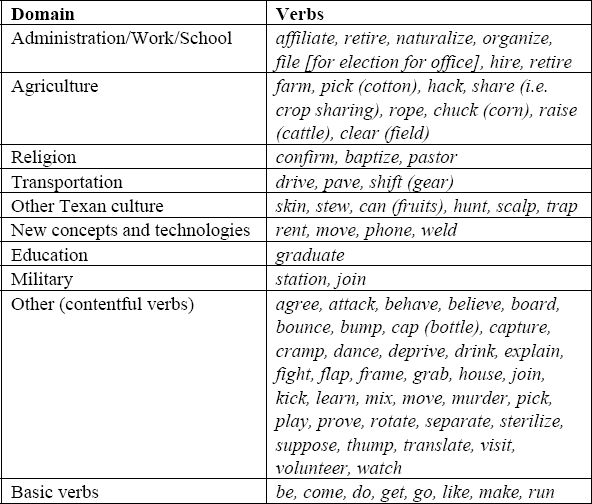
A total of 79 different verbs from a wide range of semantic domains occur among the 136 code-switching instances. Table 2 provides an overview of the code-switched verbs (in their English forms) organized according to semantic domains.
Verb types and semantic domains in the main TGDP dataset.

Many verbs come from domains identified in previous research as prominent sources of code-switches, such as administration, agriculture, religion, and transportation. Several other code-switches name concepts that did not feature in 19th-century European culture or were integral to the rural Texan lifestyle. Boas & Pierce (Reference Boas and Pierce2011) also noted the domains of education and transportation as prominent sources of code-switches, but only four verbs in the dataset come from these domains, namely, graduate, drive, pave, and shift [gears].Footnote 29 Another source of multiple code-switches, including the verbs join and station, is the domain of military service, which was not identified in previous research.
However, the exact range of domains of code-switched verbs does not entirely overlap with the code-switching domains identified in previous studies, which focus primarily on code-switched nouns. Interestingly, over half of the code-switched verb types (45 of 79) are not expected based on previous research, as they do not pertain to prominent domains for code-switching (such as agriculture or administration); or they refer to concepts not novel to U.S. or Texan life and for which the donor dialect would have its own verb. These are listed in the final two rows of table 2. Most of these verbs have fairly rich semantics (for example, behave, believe, deprive, fight, rotate, separate), but a handful of them are highly general verbs (for example, do, go, make, like, run).
There are several possible explanations for the use of English verbs by TxG speakers and for the lack of overlap between the semantic domains of code-switched verbs and the domains identified in previous research. Of course, the verbs in the top rows of table 2 are likely code-switched because the original immigrants did not have verbs to express these concepts. In the case of the verbs in the “Other” row, one probable explanation for code-switching is that speakers had never (or only rarely) been exposed to the StG counterparts of those verbs. This is likely the case with infrequent verbs such as deprive, sterilize, or volunteer.
Another potential reason for TxG speakers to code-switch English verbs could relate to differences in the argument structure of English and German verbs. For instance, while English agree only requires a prepositional object in a with PP, German equivalents such as zustimmen, einigen, and übereinstimmen further require reflexive direct objects and/or additional prepositional phrases. Another such verb is English retire, which can be used in simple intransitive constructions (She retired) but has several German equivalents, which involve several words, such as in Rente gehen ‘go into retirement’, sich pensionieren lassen ‘let oneself be pensioned’, or in den Ruhestand treten ‘step into retirement’. While these structural differences may not necessarily trigger code-switching in fluent bilinguals, TxG speakers may have a weaker command of these complex structures because of language attrition (or because they might have never learned them in the first place). These verbs underscore the complex nature of integrating foreign verbs into native language structures: Verbs—unlike nouns—are an integral part of their argument structure construction, and they cannot simply be inserted into foreign structures, as is often the case with code-switched nouns.
The code-switching of more general verbs such as be, make, and run (bottom row of table 2), however, cannot be attributed to attrition or structural differences, as these verbs are highly frequent and do not involve complex structures. Indeed, these code-switches are quite infrequent in the dataset, with each verb occurring only one time except for make (3 instances) and like (21 instances, discussed below). One potential explanation is that these verbs are borrowed as parts of idioms or English-specific senses.Footnote 30 Their usage in TxG may result from the simultaneous activation of multiple linguistic systems in speech production (see Goldstein Reference Goldstein2004), during which speakers utter the more easily accessible verb: Because the speakers activate a multi-word expression based on an English idiom (that is, a grammatical construction), they adopt the English verb as part of the expression. In sum, rather than attributing the use of English verbs to attrition or unfamiliarity, one must also recognize that structural complexity and idiomatic collocations may determine whether a verb is code-switched or not.Footnote 31
The analysis of code-switched verbs must also go beyond a mere lexical and semantic description because German morphological marking for tense, person, number, and so forth differs from that of English. Here, I investigate how English verbs are morphologically integrated into TxG. The phonological similarity of several affixes in German and English makes it very challenging to determine which language provides the morphology.Footnote 32 Thirteen examples could not clearly be assigned German or English morphology due to such overlap between the German and English verbal affixation systems. Another eight examples were omitted from the morphology analysis due to background noise or other issues in the original recordings. The remainder of this section therefore describes the affixation patterns of the remaining 115 code-switches. The examples fall into four main categories: German morphology, partial German morphology, English morphology, or combined English and German morphology. Each category is discussed in turn below.
The most common strategy involves the use of an English root and one or more German morphological markers. Thirty-four of the 115 analyzable examples exhibit StG morphological marking, while 46 examples exhibit German marking with slight deviations from the standard variety. Among the 34 purely German affixed examples, 22 have the final -en affix, which marks infinitives and 1st/3rd person plural forms, as in 2a and 2b, respectively.
-
(2)
Footnote 33
Seven examples exhibit the ge- prefix and a -t suffix, as in 3a, and one an -en suffix, as in 3b.Footnote 34
-
(3)
Finally, four examples exhibit only a suffix clearly pronounced as German [t]. Three such examples mark past tense or past participle, while one indicates a 3rd person singular present tense, as in 4.
-
(4)
I now turn to the 46 examples exhibiting partial German morphology that differs slightly from that expected in StG. Ten such examples exhibit the ge- prefix, but do not have any suffixes, as in 5.
-
(5)
The most prevalent pattern, both in this category and in the entire main dataset, are verbs with the German ge- prefix and suffixes that are indistinguishable between German -(e)t and English -(e)d. Thirty-six such examples were found in the dataset. The majority of such examples involve a root that ends in a voiceless consonant and would thus require the [t] allomorph in English, as in the following example:
-
(6)
Because these examples follow the affixation patterns virtually identical to those expected for StG verbs, it is unlikely that they have been influenced by English morphology.
The next major category is comprised of 22 examples. The English-origin TxG verbs in this category carry morphological marking closely related to that of the English-origin verbs. In 13 instances, the verbs exhibit no (ge-) prefix and a voiced -(e)d suffix, as in paved in 7, which makes this the most frequent pattern.
-
(7)
Seven of the examples that carry English morphology do not involve any affixes; they correspond to English forms that do not require tense-marking affixes. Five such unaffixed forms are used in infinitival contexts, as in 8a, while two unaffixed forms are used for plural present tense forms, as in 8b, both cases in which StG verbs require -en suffixes.
-
(8)
Two other examples clearly exhibit English morphology, in that the verb form undergoes ablaut, as expected in English (got in 9).Footnote 35
-
(9)
The final type involves a combination of English and German morphological marking. Most prevalent among these cases (11 examples in the main dataset) are verb forms exhibiting the German ge- prefix and a suffix, which is clearly voiced as -e(d), as expected in English:Footnote 36
-
(10)
The two remaining examples exhibit the ge- prefix with an ablauted form of the verb, as expected in English. In 11, for example, the verb drive has an English past participle form with a German prefix.
-
(11)
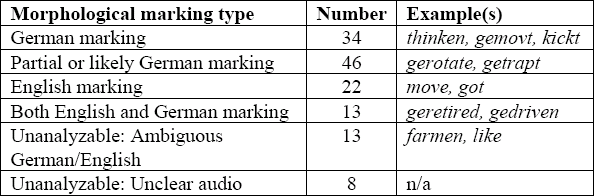
Table 3 summarizes the distribution of morphological marking types in the main dataset.
Morphological marking types for 136 code-switched English verbs in TxG.

Most code-switched verbs (80 of the 115 analyzed examples; 70%) exhibit some aspects of German morphological marking, as expected based on previous research discussed in section 2. Thirty-four examples clearly exhibit German marking, while 46 exhibit partial German marking or German marking that is partially ambiguous. Twenty-two examples (19%) exhibit marking identical to that expected in English. Thirteen examples (11%) involve some aspects of both German and English morphology. Finally, 21 examples were omitted from analysis due to ambiguity between German and English marking or to technical issues (for example, unclear audio). These findings largely corroborate the results of earlier research on TxG and those of Wichmann & Wohlgemuth (Reference Wichmann, Wohlgemuth, Stolz, Bakker and Salas Palomo2008), who claim that English verbs borrowed into (other) Germanic languages follow the direct insertion strategy, whereby the foreign verb is directly inserted into recipient language structures.Footnote 37 However, the existence of forms that do not follow the expected TxG morphology suggests that the direct insertion strategy does not fully capture all instances of code-switched verbs in TxG.
So far, it has been shown that code-switches make up the majority of instances of English verb transfers in the main dataset. Nearly half of the verb types come from domains that reflect cultural differences between Texas and 19th-century Europe—such as administration, agriculture, religion, new technologies, and rural life. The existence of such domains is expected based on previous studies on TxG code-switched nouns. However, there are just as many verb types that belong to more general semantic domains or express concepts that existed in 19th-century Europe. With respect to their formal integration, code-switched verbs can be subclassified according to the type of morphology assigned. In most cases, they are integrated into the German morphological structure, but they may also occur with English morphological marking, or a combination of both English and German marking.
4.2. Lexical Borrowing
I now discuss B&D’s category of lexical borrowing. This category includes synchronic code-switches that become conventionalized as lexical items of the recipient language. The difficulty of distinguishing nonce code-switches from established borrowings is well-documented in the literature (Haugen Reference Haugen1950, Backus Reference Backus, Isurin, Winford and De Bot2009).Footnote 38 Ideally, one may look at data from earlier stages of the language to determine whether transferred words from those stages are also prominent in synchronic data. Here, Jordan’s (Reference Jordan1977) list of frequent English-origin words is compared with the present-day TGDP data to determine whether the verbs on that list are frequently used today. Another strategy is to compare the frequencies of code-switched words with their native counterparts under the assumption that a high relative frequency of a foreign word suggests that this word is established as a borrowing. This strategy is employed when dealing with the three most frequent verbs in the main dataset: retire, like, and move (change residence).Footnote 39
Jordan’s (Reference Jordan1977) list of English-origin verbs in TxG includes 63 verbs. The entire TGDP corpus was searched to determine whether the verbs on Jordan’s list also occur frequently in the more recent TGDP data, which would suggest that they have become established borrowings in the TxG lexicon. Only three verbs from Jordan’s list appear with high frequency in the TGDP corpus. These verbs are farmen ‘farm’ (27/23), raisen ‘raise (livestock)’ (20/15), and (auf)picken ‘pick (up)’ (19/15).Footnote 40 Six other verbs appear relatively frequently in the TGDP corpus (four to nine utterances in total uttered by two to six different speakers): (auf)ringen ‘ring up’ (9/5), changen ‘change’ (6/6), fixen ‘repair’ or ‘prepare (a meal)’ (7/2), phonen ‘phone’ (4/4), shucken ‘shuck (corn)’ (7/6), smoken ‘smoke meat’, (6/4), kicken ‘kick’ (4/3), killen ‘kill’ (4/3), and fighten ‘fight’ (3/3).Footnote 41 Seventeen other verbs appeared less frequently, uttered only once or twice by one or two speakers.Footnote 42 Finally, 33 verbs identified as borrowings by Jordan (Reference Jordan1977) did not appear in the TGDP corpus.Footnote 43
As with the code-switches from the main dataset, most verbs that have likely become established borrowings refer to concepts prominent in 20th- (and 21st-) century Texan society but not in 19th-century Europe, such as (auf)ringen, phonen, shucken, and smoken. However, other borrowed verbs—such as changen, fixen, kicken, killen, and fighten—are not so easily explained, as they express concepts that were likely as prominent in the original settlers’ culture as they are today. In fact, of the 11 most frequent verbs out of 136 code-switched verbs in the main TGDP dataset, only two (shucken [corn] and farmen) were identified by Jordan (Reference Jordan1977). Among these 11 verbs, six verbs were code-switched by two different speakers (graduate, shuck [corn], farm, join, separate, suppose), and two verbs were code-switched by three different speakers (rent, run). In general, this comparison of TGDP data against historical data from Jordan Reference Jordan1977 shows that although several verbs mentioned by Jordan are used frequently today and thus have likely established themselves in the TxG lexicon, many other verbs used nearly 40 years ago are no longer prominent in present-day TxG.
Returning to the main dataset of 136 code-switches, three verbs are highly frequent and may be established as borrowings in TxG: retire is used five times by five different speakers, move (change residence) is used 11 times by six speakers, and like is used 21 times by six speakers. Here, I compare the frequencies of these verbs (exemplified in 12) with that of their German counterparts on the assumption that a high relative frequency of the English-origin verb suggests that it is an established borrowing (see B&D, p. 77).
-
(12)
For each of these verbs, the entire TGDP corpus was searched for both the code-switched English verb and any possible German-origin or loan-translated equivalents (for example, gleichen for ‘(to) like’).
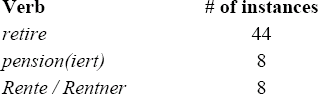
Table 4 shows the frequency of English retire in comparison with two German equivalents. Note that the English verb is frequently used as a past participle with an adjectival function, as in He is retired. The same is true for the German equivalent pensionieren, which often occurs in adjectival form as pensioniert. Other common German equivalents are the nouns Rente ‘retirement’, as in in die/der Rente gehen/sein ‘go/be into/in retirement’. These nonverb equivalents are nonetheless taken into account, as they express the same concept as the frequently code-switched verb retire.
Occurrences of retire and equivalents in the TGDP online archive.

Table 4 shows that the English verb retire is much more frequent than expressions used for similar concepts in StG, occurring over five times more frequently than any possible equivalent. This high relative frequency thus suggests that retire is an established borrowing in TxG.
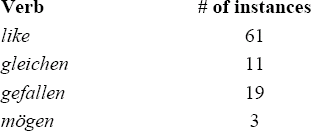
Table 5 shows the frequency of code-switched like compared with German equivalents gefallen ‘please’ and mögen ‘(to) like’ and the related loan-translated verb gleichen ‘(to) like’ (loan-translated from English like, discussed in more detail below). Gleichen and mögen exhibit the same argument structure pattern as English like, with the agent appearing as subject and the liked entity as direct (accusative) object, whereas gefallen realizes the liked entity as subject and the entity who likes it as a dative object.
Occurrences of like and equivalents in the TGDP online archive.

The data show that the verb like is more frequent than any of its (German or loan-translated) equivalents. However, its relative frequency over its counterparts is not as drastic as that of retire, as gefallen and gleichen also occur regularly in the data. Therefore, while like is likely an established borrowing for many TxG speakers, it still competes with native German forms and the loan-translated gleichen.Footnote 44
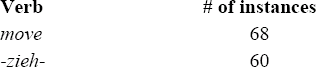
Table 6 shows the number of occurrences of English code-switched move (change residence) compared with German equivalents containing the root ziehen. Similar to English move, which appears with particles as in move in, move out, or move around, German ziehen occurs with various prefixes and prepositions to specify different aspects of the moving process.
Occurrences of move (change residence) and equivalents in the TGDP online archive.

A code-switched form of English move occurs 68 times in the data, but various forms of the German verb ziehen ‘move’, such as einziehen ‘move in’, nach X ziehen ‘move to X’, or hierherziehen ‘move here’, occur almost as frequently as move, with 60 instances in the corpus. Therefore, although English move is frequent, the stability of its StG counterpart(s) in TxG makes it difficult to classify as a fully established borrowing. It also remains to be determined whether the English verb is used variably by different individuals or speaker communities, or whether it is in free variation with its German counterpart(s).
This comparison of English code-switches with their German counterparts, based on relative frequency data in the TGDP corpus, shows that retire is an established lexical borrowing, like is fairly well established but still competes with various German counterparts, and move is also well established but still competes (more fiercely) with ziehen, whose various forms appear equally frequently in the corpus. There are several potential reasons for the borrowing of these verbs. Move and retire express concepts that were not as relevant in 19th-century Europe as they are nowadays: The original settlers were much less mobile than Texas Germans are today, and there was not an established system for retirement. However, a cultural explanation does not hold for like. Another reason may involve the argument structure of German equivalents, as described above: The complexity of the German patterns of argument realization could have encouraged speakers to employ an English item with simpler grammatical requirements. Again, this explanation may hold for move and retire, but the German verb mögen exhibits a similar argument structure to English like. Thus, while cultural and structural factors may (partially) explain the borrowing of rent and move, no plausible explanation for the frequent code-switching of like is available at present.
4.3. Loan Translation
As discussed in section 3, loan translation involves translating an English word using a formally related German word that does not have the same meaning in the original dialect. Repeated use of the loan-translated word with this meaning leads to the (diachronic) process of lexical change, whereby the meaning of the German translation is extended to include the meaning of the formally related English original (see section 4.5). Loan translations occur less frequently than code-switches in the dataset, as 37 loan translations were found among 186 total transferred verb instances (20%).Footnote 45 The analysis in the remainder of this section draws on B&D’s subclassification of loan translations based on the type and number of morphemes involved; it also builds on their finding that loan translation may lead to structural interference. My analysis facilitates a comparison between loan-translated and code-switched verbs and enables one to assess B&D’s specific claims presented at the end of section 3.
With respect to loan translations of content words, B&D (pp. 82f.) propose different categories for single-word, two-word, and multi-word loan translations. Examples 13–15 contain what seem to be one-word loan translations. In 13, the English verb like ‘be fond of’ is loan-translated into TxG as gleichen, which can only mean ‘be similar to’ in StG.
-
(13)
B&D (p. 83) refer to this type of loan translation as semantic extension, as the original meaning of the verb ‘be similar to’ is supplemented with a new meaning ‘(to) like’ based on its phonological similarity to the English verb.
In 14, the English expression to make it (to a place) is translated using the German verb machen ‘make’, even though StG does not use machen in this sense.
-
(14)
Although this example also involves one loan-translated verb, it differs somewhat from the example in 13 with gleichen: The verb machen is modeled on a more complex English idiomatic expression, which requires not only the verb but also a directional prepositional comple-ment. Here, only the verb is loan-translated, but the remaining portions of the construction are expressed using TxG.
In 15, the verb nehmen ‘take’ is used in the sense of ‘take an exam’, whereas StG employs the verb schreiben ‘write’ in this context.
-
(15)
In the case of 15, it is possible that the loan translation of the verb is triggered by the code-switching of the preceding noun exams, which in English requires the verb take. While the most appropriate category in B&D’s taxonomy for examples 14 and 15 is one-word loan translations, these examples differ from the semantic extension of gleichen in 13, as they are used as parts of larger collocations. In fact, B&D (pp. 91–92) claim that loan translations often occur as parts of larger fixed expres-sions, particularly object-verb or prepositional phrase-verb collocations.
There are several other cases, particularly those that involve complex verbs with prefixes or particles. These cases cannot be clearly classified as one- or two-word loan translations due to structural and orthographic differences between German and English. In 16, the speaker wishes to express that certain families in the area housed children. The speaker translates the English expression ‘take in (for example, guests)’ directly into German as reinnehmen (participle reingenommen), an expression not found in StG.
-
(16)
Similarly, 17 is based on the complex English expression ‘set somebody up in something’, in the sense of assisting them and providing them with opportunities. When talking about a man who received land and ‘set his sons up’ in farming, the speaker translates this expression into TxG as aufsetzen, which is not used in this sense in StG; rather it is used as ‘put on’ or ‘attach’.
-
(17)
Orthographic differences between English and German muddle the classification of this example according to the number of words involved. On the one hand, the lexico-grammatical rules of StG require the particle and verb root of participle forms to occur together, suggesting that it is a one-word loan translation. On the other hand, equivalent English expressions are written with the particle separate from the verb, which suggests that they should be classified as two-word loan translations. Such data show that it is not always trivial to categorize loan translations based on the number of morphemes involved.
An example of a two-word loan translation is given in 18, where ‘make a living’ is directly translated as Leben machen. This expression does not exist in StG; instead, a similar meaning would be expressed using Auskommen haben lit. ‘have subsistence’ or Leben bestreiten lit. ‘contest life’.
-
(18)
Example 18 is quite similar to the Exams nehmen example in 15 above, as both of these utterances involve the loan translation of a verb within a specific verb-object collocation. They differ only in that the object in 15 (Exams) is code-switched from English, while the object in 18 (Leben) is loan-translated. Once again, these two examples show the difficulty of classifying loan translations based on the number of morphemes involved.
Multi-word loan translations consisting of more than two content morphemes are slightly less frequent in the main dataset.Footnote 46 Indeed, many of these loan translations involve the translation of just one morpheme, but with repercussions for the surrounding words. One candidate for such a loan translation is provided in 19, which involves the use of German machen ‘make’ in the sense of ‘cause someone to do something’. While only the verb machen is loan-translated, it is likely that the speaker is translating the entire construction ‘it made me think’ along with machen.
-
(19)
A similar situation holds for 20, which contains the loan translation of the phrase ‘take up someone’s time’. As in the previous example, this utterance involves only the translation of one complex verb (or a verb-particle pair), but it is modeled on a multi-word English expression.
-
(20)
These examples show that B&D’s classification of content word loan translations into one-, two-, and multi-word categories is not as clear-cut as it appears. Specifically, while these examples contain only one (or two) clearly loan-translated words, the speakers are structuring the entire utterance based on complex grammatical constructions rather than on individual words.
B&D’s next major category of loan-translated items covers functional morphemes. One type of functional morpheme that seems prone to loan translation in TxG is argument-marking preposition. In these cases, TxG speakers use a German preposition with the same (or similar) phonological form as the English preposition (assigned by the verb), and not the preposition used with the same verb in StG. In 21, for instance, the speaker uses the preposition in analogously to the English construction ‘be interested in’, rather than an, which is used in the StG construction interessiert sein an ‘be interested in’.
-
(21)
Similarly, in 22, the speaker uses the preposition für ‘for’ on the basis of English ‘wait for’, rather than the expected preposition auf.Footnote 47
-
(22)
Another type of functional morpheme susceptible to loan translation is the auxiliary in perfect tense constructions. StG employs either haben ‘have’ or sein ‘be’ to support past participles, depending on whether the verb expresses motion toward something or a change in state (sein) or not (haben), with some exceptions. English, however, only uses the auxiliary have to introduce participles, except in some fossilized collocations (for example, He is risen). In 23, the verb gehen ‘go’ (participle gegangen) is used with the auxiliary haben, rather than the expected sein.
-
(23)
Footnote 48
While the above examples of code-switching and loan translation could largely be subsumed within the categories proposed by B&D, I now turn to another type of language contact phenomenon that requires an extension of B&D’s classification.
4.4. Loan Translation/Code-Switching Hybrids
One type of phenomenon that does not clearly fit into any of the relevant categories proposed by B&D are verbal constructions involving both code-switching and loan translation. Thirteen such instances were found in the dataset, comprising nearly 7% of all examples. Each of these cases involves a complex particle or prefix verb, with either the root or the particle/prefix being code-switched and the other element being loan-translated. Eleven of the 13 hybrid examples involve a code-switched root and a loan-translated prefix/particle. In 24, for instance, the speaker imports the English phrasal verb ‘look up (information)’, but loan-translates only the English particle up with the German verbal prefix auf (rather than StG nach), while using the German verb root gucken ‘look’.
-
(24)
Similarly, 25 is modeled on English ‘jack up (a car)’. Here, the speaker code-switches the English verb jack and uses the German prefix hoch ‘high/up’.
-
(25)
Less frequently (in only two of the 13 instances), the main verb is of German origin and the prefix/particle is code-switched from English. This is shown in 26, where the German main verb participle geschossen ‘shot’ is combined with the English particle off.Footnote 49
-
(26)
These types of combinations of loan-translation and code-switching have been identified in previous research. Haugen (Reference Haugen1950, Reference Haugen1953) uses the term loan blends for these cases, while Johanson (Reference Johanson1998) refers to them as mixed copies. Such hybrids appear at the intersection of B&D’s categories, as they involve the transfer of both, words (code-switching) and meanings (loan translation). To accommodate these cases, B&D’s model must be expanded to include the combination of multiple transfer types within the same utterance (and even within the same word).
4.5. Lexical Change
B&D’s (p. 77) category of lexical change involves the diachronic establishment of loan translations, whereby a native lexical item becomes conventionally associated with a foreign meaning. As discussed in section 4.2, nonce loan translations may be distinguished from those that have undergone lexical change (that is, they have become established within the speech community) by means of relative frequency: If a loan-translated expression is used more frequently with the foreign-motivated meaning than with its native meaning, or if it is used more frequently than a native expression with an equivalent meaning, then such loan-translated expression has likely been established as a lexical change. The term lexical change thus emphasizes that the range of a word’s possible functions has expanded (or changed altogether) in the contact variety (for example, TxG) relative to noncontact varieties of the language (for example, StG). Potential candidates for lexical change in the TxG data include gleichen, which is frequently used to express the non-native meaning ‘like/be fond of’, as well as a group of verbs that are highly frequent and have very general and broad meanings, such as machen ‘make’ and nehmen ‘take’, as described in the following paragraphs.
Here, the relative frequency of loan-translated gleichen ‘(to) like’ is compared against its use in the StG sense ‘be similar to’, following the method employed in section 4.2. A search for gleich in the TGDP concordancer revealed 11 instances of the loan-translated meaning compared with zero instances of the StG meaning ‘be similar to’. These results suggest that gleichen has changed its meaning from ‘be similar to’ in the original dialects to ‘(to) like’ in TxG.Footnote 50 However, such an investigation is complicated because in StG, the form gleich also has an adverbial meaning of ‘soon’ or ‘immediately’, which is used in TxG, as shown in 27. Such adverbial uses of gleich greatly outnumber the loan-translated usages of the verb gleichen (66 to 11).
-
(27)
At present, therefore, it appears that the verb gleichen has undergone lexical change from StG ‘be similar to’ to the English-based meaning of ‘(to) like’. However, as a morpheme, gleich still retains the adverbial meanings it had in the original dialect. As mentioned in the preceding section, the loan translation of gleichen is likely due to the fact that its form and meaning overlap with those of English (to) like.
The loan translation data also include many semantically light verbs, which are often loan-translated as parts of larger idiomatic collocations or light verb constructions; they can also acquire more structural functions. Two such loan translations are the verbs machen ‘make’ and nehmen ‘take’. TxG speakers use the verb machen in contexts where English make is expected, but not StG machen. This was shown in 19, where machen is used in the sense of ‘make somebody do something’; in 18, in the collocation Leben machen ‘make a living’, and in 14, where it is used in the sense of ‘make it to a place’. The English verb take is often loan-translated as nehmen, as in the collocation Exams nemmen in 15, where StG requires schreiben ‘write exams’, and in the collocation ‘take up somebody’s time’ in 20. Nehmen is also used in the more general temporal sense of ‘take (for example, one week of) time’, as in the expression das nemmt beinah ein Jahr ‘that takes nearly a year’ (1-78-1-5-a). The preponderance of light verbs among loan translations in the main dataset is indeed striking: Over half of the loan translation examples contain the verb nehmen ‘take’, machen ‘make’, gehen ‘go’, tun ‘do’, or laufen ‘run’. Even semantically richer verbs that are loan-translated do not have as rich of a meaning as (the vast majority) of TxG code-switched verbs listed in table 2 above. These include setzen ‘(to) set’, ziehen ‘draw/pull’, gucken ‘see/watch’, and halten ‘hold’.Footnote 51
The high frequency of loan-translated semantically general verbs is also observed by B&D (p. 92). They claim that basic vocabulary items are more likely to be loan-translated, while items with richer meanings are more frequently code-switched. B&D propose that this comple-mentarity may arise because “basic vocabulary patterns with functional elements are being produced without much conscious attention, while specific vocabulary is consciously selected.” To reframe this proposal in a (Diasystemic) Construction Grammar view of the mental lexicon, words with rich semantics (such as the code-switched verbs behave, deprive, or sterilize) are typically not elements of larger idiomatic expressions or collocations and can thus be directly code-switched from English. In contrast, the semantically light verbs appear in larger constructions and are more frequently loan-translated while other words in the constructions are uttered in German.
From a diachronic perspective, such light verbs may have undergone lexical change in TxG and thus have a broader (or different) range of functions than in the original dialect. Specifically, they may now be associated with new functions modeled on English collocations and idioms, while also maintaining the original StG functions. The close relation between German and English may encourage such lexical changes, as many idiomatic uses of these verbs are the same in noncontact varieties of English and German. However, diachronic developments have led to divergences in the exact range of functions the verbs can fulfill in each language.
In summary, the analysis of loan translations has shown that, although they are not as frequent in TxG as direct code-switches, they are more frequent than previous research suggests. As with the Turkish-Dutch data discussed by B&D, in TxG content, functional, or grammatical morphemes may be loan translated. B&D propose a subclassification of content word loan translations according to the number of words involved. However, the data revealed several examples that were difficult to categorize as either one- or two-word loan translations, particularly, particle and prefix verbs. There are also instances of code-switching/loan translation hybrids, identified by Haugen (Reference Haugen1950, Reference Haugen1953) as loan blends and by Johanson (Reference Johanson1998) as mixed copies, which do not fall neatly into B&D’s classification and require an extension of their taxonomy. The analysis also revealed three types of grammatical and functional morphemes that are susceptible to loan translation in German-English contact situations, namely, the prepo-sitions introducing prepositional objects, particles and prefixes of complex verbs, and auxiliaries in perfect constructions. These pheno-mena bleed into the realm of structural interference, as they involve reinterpretations of grammatically relevant morphemes, a phenomenon discussed in more detail below. Finally, the TxG data support B&D’s (p. 91) claim that loan-translated words are more semantically general than code-switched words, which likely relates to the more frequent occurrence of general words/verbs in idiomatic expressions or other complex constructions.
4.6. Structural Interference
I now turn to the next category in B&D’s taxonomy: structural interference. As this study focuses primarily on the lexical category of verbs, I only discuss cases of structural divergence from StG related to the transfer of verbs in the main dataset.Footnote 52 The discussion is also limited to instances of structural interference not mentioned in the previous subsections (prepositions, particles/prefixes, auxiliaries), namely, verbal inflection, case assignment, and word order. The structure of 28 differs from the corresponding StG structure with respect to each of these structural properties.
-
(28)
First, the StG participle of helfen ‘help’ is geholfen, but the verb form in this example is much more closely related to the English past (participle) form helped. Second, StG word order requires the inflected verb to appear in the second position in main clauses and in the final position in subordinate clauses; infinitives and participles appear in the final position in main clauses and preceding the main verb in subordinate clauses. In 28, however, the main verb appears directly after the auxiliary and before the object, an ordering expected in English.Footnote 53 Furthermore, the object of helfen in StG is realized in the dative case, but here it carries accusative case marking (that is, die Kirche). While this latter contrast may be due to influence from English, it likely results from the more general case syncretism in TxG, whereby the dative case is in decline (Boas Reference Boas2009, chapter 5; see section 2).
Another instance of structural interference is found in examples in which German besser is used in the modal sense associated with English besser, as in better do something. In 29, the loan translation besser appears in second position, but the main verb appears in third position directly after German besser. This type of word order is not expected in StG.
-
(29)
Footnote 54
These data clearly support B&D’s (p. 79) claim that items involved in loan translation, particularly multi-word expressions, may cause structural interference. In fact, it is more likely that the speaker is transferring an entire grammatical construction from English, including both the fixed lexical item besser, and the schematic slots for the main verb and its related elements. These cases thus emphasize that contact phenomena cannot be simply reduced to the transfer of words, structures, or meanings, but require a more holistic view of linguistic constructions.
The structure of TxG clauses can also be affected by code-switching. In 30, the speaker uses the English verb supposed, in the sense of ‘be expected/supposed to’.
-
(30)
Here, the speaker uses a syntactic configuration that exists in StG but is not used with the StG equivalent of the code-switched verb suppose (erwartet ‘expected’). Specifically, StG expressions such as dabei sein, etwas zu tun ‘be doing something currently’ or bereit sein, etwas zu tun ‘be prepared to do something’ have the same structure as 30: The agent is subject of a predicative construction, and the activity is expressed in a final infinitival clause. However, to express the concept in 30, StG would use the participle of erwarten ‘expected’ with the dummy subject es ‘it’ and express the agent as the subject of a subordinate clause headed by dass: Es wurde erwartet, dass wir kein Englisch sprechen ‘It was expected that we speak no English’.Footnote 55 While B&D (p. 81) point out that loan translation may result in structural interference, this example shows that even code-switching may influence the structure of the recipient language.
This cursory analysis of structural interference shows that the use of English verbs and verbal idioms in TxG influences TxG grammatical structures to some degree. Potential areas of structural transfer include word order, argument structure (for example, case assignment), inflectional patterns, as well as the argument-marking prepositions, verbal prefixes and particles, and auxiliaries of perfect constructions discussed above. My analysis shows how B&D’s taxonomy can be refined to account for specific grammatical features of German and English that are susceptible to structural interference in these types of contact situations. A richer taxonomy would also help account for how structural interference results from loan translation and code-switching.
5. Discussion
The analysis outlined in the previous sections achieves the two goals set forth in the introduction. The first goal was to provide an overview of how verbs are code-switched and loan-translated in present-day TxG, and to compare the results of this analysis with those of previous analyses of English lexical transference in TxG. Previous research on code-switching in TxG (Gilbert Reference Gilbert1965, Jordan Reference Jordan1977, Wilson Reference Wilson1977, Salmons Reference Salmons1983, Boas & Pierce Reference Boas and Pierce2011) focused primarily on code-switched nouns. According to those studies, the major domains for code-switching were those that were new to the original settlers or germane to rural Texan life, such as administration, agriculture, education, technology, and transportation. While these domains are still a prominent source of code-switched lexical items, verbs that name concepts familiar to the original settlers constitute a large portion—or even a majority—of all code-switched verbs in present-day TxG. Such cases of code-switching cannot be explained by their novelty to the TxG community. While many of these cases could be attributed to language attrition or general unfamiliarity with the lexical items under investigation, I proposed that the structural properties of the German and English translation equivalents may motivate their code-switching. Specifically, StG equivalents of the code-switched verbs often require more complex constructions, such as those involving reflexive objects (sich benehmen) or light verb constructions (in Rente gehen). TxG speakers may have a decreased command of such constructions due to language attrition or incomplete language acquisition. Therefore, they may opt to code-switch English verbs, which have a simpler structure and do not require additional elements (for example, behave, retire).
When TxG speakers code-switch English verbs, they must also decide how to mark them morphologically for tense, number, and person. My analysis has shown that the majority of code-switched English verbs exhibit (at least partial) German morphology, with some verbs exhibiting English morphology or morphology that is ambiguous between German and English. Drawing on Wichmann & Wohlgemuth’s (Reference Wichmann, Wohlgemuth, Stolz, Bakker and Salas Palomo2008) taxonomy of verb integration strategies, the dominant strategy in TxG is direct insertion of verbal roots: Most English verbal roots are inserted directly into German sentences (with German morphology) without any special affixation or light verb support that would mark them as non-native.
However, direct root insertion does not apply in all cases of code-switched verbs in TxG, as some of the analyzed code-switches exhibit morphology different from that expected in StG. The typological similarity between the two contact languages—English and German—poses some challenges for the morphological analysis, as many verbal affixes are phonologically similar. Future research should determine whether other English-German contact varieties exhibit the same distribution of morphological marking as TxG, and whether other language pairs would reveal other integration strategies for code-switched verbs.
In order to assess whether any code-switched verbs have become established as borrowings in present-day TxG, the TGDP data were compared with Jordan’s (Reference Jordan1977) list of borrowings. The comparison showed that only a handful of his 63 verbs are still frequent in modern-day TxG (farmen ‘(to) farm’, raisen ‘raise (for example, cattle)’, and (auf)picken ‘pick (up)’. I assessed the relative frequency of a handful of code-switched verbs that occurred frequently in the main dataset, compared to native forms. The results suggest that code-switched retire is highly conventional, whereas code-switched move (change residence) is frequent but still competes with native forms involving the root ziehen. Interestingly, both code-switched like and loan-translated gleichen ‘(to) like’ are highly frequent in TxG, but native forms such as gefallen and mögen are far from being extinct. While the results of this study are suggestive, these findings must be tested on a larger scale, taking into account additional factors, such as the degree of morphophonological integration and paralinguistic features such as hesitations, asides, or paraphrases (see Pfaff Reference Pfaff1979 and Matras Reference Matras2009).
The second goal of this analysis was to provide a more unified treatment of language contact phenomena and to increase recognition of the importance of loan translation, as called for by B&D. They point out that existing studies of language contact phenomena tend to focus on transferred words (code-switching) and transferred structures (structural interference), while often neglecting transferred meanings (loan translation). As a result, these studies overlook various phenomena that emerge at an intersection of the traditional categories. B&D go on to show how a more rigorous investigation of loan translations may help identify such borderline cases. Their discussion of loan translation in the speech of Turkish-Dutch bilinguals gives rise to three potential generalizations, each of which is supported by the present TxG-English bilingual data. First, loan translations often occur as parts of multi-word fixed expressions or idiomatic collocations. Second, the most frequent types of these expressions include object-verb combinations and prepositional phrase-verb combinations. Finally, there is a complementarity between loan-translated and code-switched words: The former come from the basic vocabulary with relatively bleached semantics, whereas the latter have richer meanings. A further potential explanation for loan-translated verbs, introduced at the end of section 3, relies on the Construction Grammar view of linguistic items as pairings of form and meaning: English verbs with semantic and phonological overlap with a German verb, such as like-gleichen and make-machen, are susceptible to loan translation.
B&D propose a classification of loan translations into four categories: content morphemes, functional morphemes, grammatical morphemes, and discourse patterns; content morphemes are further subclassified into those that contain one-, two-, or multiple words. This classification, however, does not fully capture the TxG data analyzed here. First, the distinction between functional and grammatical morphemes is not clear-cut and may vary across languages (for example, dative case in German versus prepositions in English). Second, the number of (content) words involved in a loan translation is not easily determined, either due to crosslinguistic differences (for example, between German prefixed verbs and English phrasal verbs), or because the loan translation of a single element may influence surrounding words.
This analysis of transferred English verbs in TxG allows one to identify the interrelations between the traditional categories of code-switching, loan translation, and structural interference—especially because verbs generally exhibit more structural complexity than other parts of speech. A comprehensive analysis of code-switched verbs, for instance, requires an investigation of their morphological marking and any potential influence on the surrounding words and structures. By identifying and analyzing frequent collocations with similar meaning in the two languages, one can explain why English verbs such as ‘make’ and ‘take’ are often loan-translated as German ‘machen’ and ‘nehmen’, respectively.
Furthermore, the investigation of transferred verbs reveals which aspects of grammatical structure are most susceptible to structural interference in specific language contact situations. In the case of the TxG–English language contact situation, these aspects of grammar include argument marking (that is, with case or prepositions), word order, and verbal inflection. These complex interrelations between the lexicon, morphology, and syntax in language contact situations underscore recent movements in Cognitive Linguistics and Construction Grammar (Goldberg Reference Goldberg1995, Reference Goldberg2006; Croft Reference Croft2001; Höder Reference Höder, Braunmüller and Gabriel2012). These movements emphasize that language structures cannot be compart-mentalized into traditional categories of phonology, syntax, semantics, and morphology; rather, they should be placed at the intersection of these categories.
6. Conclusion
This study offered the first comprehensive account of English verbs transferred into TxG. It improved on previous analyses by addressing how the transfer of verbs relates simultaneously to several well-studied synchronic and diachronic language contact phenomena. The analysis built on and offered improvements to B&D’s proposed classification of such phenomena. The discussions surrounding the data demonstrated how methods and principles of Cognitive Linguistics—particularly Construction Grammar—may give a clearer picture of how and why lexical items are transferred in language contact situations, and of how the careful analysis of such transfers may deepen our understanding of language change and language structure more generally.