Introduction
Bemisia tabaci Gennadius (Homoptera: Aleyrodidae) is an invasive and destructive pest of cotton and vegetable crops worldwide and particularly in Africa. It has a global distribution, and its members are major pests of agricultural crops, causing damage directly by feeding and indirectly by transmitting many plant viruses (Jones, Reference Jones2003). Many factors contribute to its population growth such as climatic conditions, host plant preference (Musa and Ren, Reference Musa and Ren2005), elimination of beneficial species (Gnankiné et al., Reference Gnankiné, Traoré, Sanon and Ouedraogo2004) and selection of insecticide-resistant populations (Dittrich et al., Reference Dittrich, Ernst, Ruesch and Uk1990; Byrne and Devonshire, Reference Byrne and Devonshire1997; Byrne and Toscano, Reference Byrne and Toscano2002; Roditakis et al., Reference Roditakis, Tsagkarakou and Vontas2006; Roditakis et al., Reference Roditakis, Grispou, Morou, Kristoffersen, Roditakis, Nauen, Vontas and Tsagkarakou2009). Its propensity to develop insecticide resistance, in combination with high genetic variability, makes its control problematic (Tsagkarakou et al., Reference Tsagkarakou, Mouton, Kristoffersen, Dokianakis, Grispou and Bourtzis2012). Bemisia tabaci is considered as a complex of morphologically indistinguishable species (Boykin et al., Reference Boykin, Shatters, Rosell, McKenzie, Bagnall, De Barro and Frohlich2007; McKenzie et al., Reference McKenzie, Hodges, Osborne, Byrne and Shatters2009; De Barro and Ahmed, Reference De Barro and Ahmed2011; De Barro et al., Reference De Barro, Liu, Boykin and Dinsdale2011; Hu et al., 2011; Liu et al., Reference Liu, Colvin and De Barro2012). Here, we refer to the Middle East–Asia Minor 1 (MEAM1) species (known commonly as biotypes B and B2) and to the Mediterranean (MED) species (known as biotypes Q, J, L and sub-Saharan Africa silverleaf (ASL) biotypes) (Dinsdale et al., Reference Dinsdale, Cook, Riginos, Buckley and De Barro2010). The MEAM1 and MED species belong to the same Africa/Middle East/Asia Minor major group of B. tabaci identified by Dinsdale et al. (Reference Dinsdale, Cook, Riginos, Buckley and De Barro2010). Another group from sub-Saharan Africa is composed of four species (sub-Saharan Africa 1, 2, 3 and 4) (Liu et al., Reference Liu, Colvin and De Barro2012). It is known that the MEAM1 species originates from the Middle East/Asia Minor region, whereas the MED species has its home range in the Mediterranean basin area and sub-Saharan Africa. The invasive non-silverleafing B. tabaci populations come from the Mediterranean basin (De Barro and Ahmed, Reference De Barro and Ahmed2011).
Life-history traits such as resource exploitation and resistance to insecticides may affect the distribution and frequency of the different members of the B. tabaci species complex (Pascual and Callejas, Reference Pascual and Callejas2004; Horowitz et al., Reference Horowitz, Kontsedalov, Khasdan and Ishaaya2005; Crowder et al., Reference Crowder, Horowitz, De Barro, Liu Shu, Showalter, Kontsedalov, Khasdan, Shargal, Liu and Carrière2010). These traits can also contribute to the exclusion or coexistence between different B. tabaci species (Pascual and Callejas, Reference Pascual and Callejas2004; Crowder et al., Reference Crowder, Horowitz, De Barro, Liu Shu, Showalter, Kontsedalov, Khasdan, Shargal, Liu and Carrière2010). In Israel, Q populations replaced B biotypes when insecticides were used, whereas B populations rapidly evolved resistance to insecticides in the USA (Horowitz et al., Reference Horowitz, Kontsedalov, Khasdan and Ishaaya2005; Khasdan et al., Reference Khasdan, Levin, Rosner, Morin, Kontsedalov, Maslenin and Horowitz2005).
In West Africa (Burkina Faso and Benin), Houndété et al. (Reference Houndété, Kétoh, Hema, Brévault, Glitho and Martin2010) showed resistance of the MED species to pyrethroids (PY; deltamethrin and bifenthrin), organophosphates (OP; dimethoate and chlorpyrifos) and neonicotinoids (acetamiprid and thiamethoxam). In this part of Africa, the MED species is present in two distinct populations, one that is able to induce silverleafing symptoms in squash (referred to as sub-Saharan ASL) and the other that is unable to induce these symptoms (referred to as Q). De Barro and Ahmed (Reference De Barro and Ahmed2011) showed that the MED species evolved in sub-Saharan Africa and then spread from there to the Mediterranean basin, a process that led to a loss of capacity to induce silverleafing. In more recent times, this Mediterranean population has reinvaded West Africa. Sequence analyses showed the presence of two genetic subgroups or haplotypes of the Q population recently detected in West Africa: Q1 and Q3 (Gueguen et al., Reference Gueguen, Vavre, Gnankine, Peterschmitt, Charif, Chiel, Gottlieb, Ghanim, Zchori-Fein and Fleury2010; Gnankiné et al., 2012). Q1 is predominant on cotton and reaches a very high frequency of up to 100%, but on vegetables such as tomato, eggplant and tobacco, it coexists with ASL (Gnankiné et al., 2012). We know that Q1 is associated with high levels of resistance to some insecticides (Gnankiné et al., 2012), but nothing is known on the insecticide resistance profile of ASL.
Here, we describe the distribution of B. tabaci MED species in two West African countries, Burkina Faso and Togo, as influenced by host plants and pest management programmes.
Materials and methods
Pest control strategies
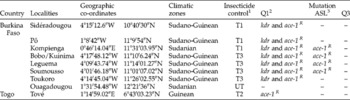
Four pest management strategies were used according to the host plants and study areas: (1) two to four treatments with PY plus OP and two other treatments with neonicotinoids (conventional treatment); (2) two to four treatments with PY plus OP; (3) one to two treatments of OP or PY depending on pest infestation; and (4) untreated, where no chemical was used (Table 1).
Climatic zones and pest management strategies for various populations of Bemisia tabaci in Burkina Faso and Togo during 2007, 2009 and 2010

1 T1: two to four treatments with PY plus OP and two other treatments with neonicotinoids (conventional); T2: two to four treatments with PY plus OP; T3: one to two treatments of OP or PY; UT: untreated.
2 Q1 populations have two mutation (kdr and ace-1 R) alleles (Gnankiné, 2011).
3 ASL populations have only the ace-1 R allele (Gnankiné, 2011).
Origin of the whiteflies
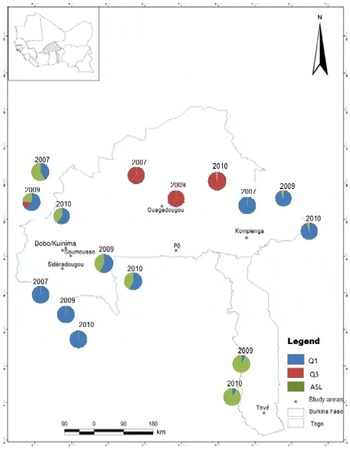
Live adult B. tabaci (males and females) were collected in Burkina Faso and Togo (Fig. 1) and individually placed in 1.5 ml tubes containing 95% ethanol, and conserved at − 20°C until DNA extraction. A total of 531 individuals collected from nine localities, on two cultivated host plants (cotton and tomato) and the invasive weed Lantana camara L. (Verbenaceae), were sampled during 2007, 2009 and 2010 (Table 1).
MED species of the Bemisia tabaci complex in localities in Burkina Faso and Togo (2007, 2009 and 2010) (a colour version of this figure can be found online at http://journals.cambridge.org/jti)

DNA extraction
Total DNA was extracted from each individual in 26 μl of an extraction buffer containing 50 mm KCl, 10 mm Tris–base (pH 8), 0.45% Nonidet P-40, 0.45% Tween-20 and 50 mg proteinase K/ml. The extraction buffer was added to the crude extract, incubated at 65°C for 3 h and then incubated at 100°C for 15 min. A volume of 35 μl of pure water was added to this extract, which was then stored at − 20°C until use.
Identification of B. tabaci species and genetic subgroups
Genomic DNA was extracted from each individual adult B. tabaci in 26 μl of Nonidet extraction buffer (Delatte et al., Reference Delatte, Reynaud and Granier2005) and stored at − 20°C. Biotypes were identified using a polymerase chain reaction-restriction fragment length polymorphism (PCR-RFLP) based diagnostic assay. Briefly, in this method, a fragment of the mitochondrial marker CO1 (cytochrome oxidase 1 gene sequences, mtCOI) gene was amplified by PCR (Frohlich et al., Reference Frohlich, Torres-Jerez, Bedford, Markham and Brown1999) using the universal COI primers C1-J-2195 (5′-TTGATTTTTTGGTCATCCAGAAGT-3′) and TL2-N-3014 (5′-TCCAATGCACTAATCTGCCATATTA-3′) (Khasdan et al., Reference Khasdan, Levin, Rosner, Morin, Kontsedalov, Maslenin and Horowitz2005). The PCRs were composed of a 25 μl Platinum® PCR SuperMix, a 0.5 μl forward primer (10 pmol/μl), a 0.5 μl reverse primer (10 pmol/μl) and a 2 μl DNA template. The PCR products were then digested by the restriction endonucleases XapI (Fermentas) and/or BfmI (Fermentas), which generated clear polymorphism between the populations B, MS, Q and the Q1, Q2 or Q3 genetic group. BfmI was used to separate Q2 to Q3 groups. The PCR products were incubated with 10 U XapI/μl (Fermentas) at 37 °C for 3 h before loading onto agarose gel.
Statistical analyses
Data collected on the frequencies of B. tabaci populations and pest control strategies were subjected to Fisher's exact test using Statview 5.0 software (SAS, 1991–1998). The significance threshold was 5%.
Results
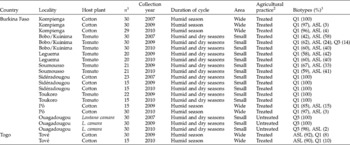
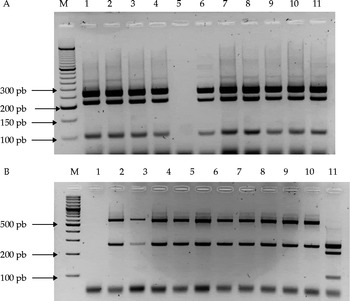
Among the 531 individuals sampled from nine localities in Burkina Faso and Togo, the Q and ASL biotypes of the MED species were identified (Tables 1 and 2; Figs 1 and 2A and B). The Q1 and Q3 genetic groups or haplotypes of Q populations were recorded in our sampling.
Frequencies of the Bemisia tabaci MED species complex related to host plants, localities and various years

1 Number of individuals in the sample.
2 This column indicates whether pesticides were used or not.
3 Percentage of each population found at the collecting site.
A, representative gels showing Q populations (Q1 group) collected in Burkina Faso. Lanes 1, 2, 3, 4: Q1; lanes 6, 7, 8, 9, 10, 11: Q1, digested with XapI. M: 50 bp DNA ladder. B, representative gels showing the ASL and Q1 populations collected in Togo. Lanes 2, 3, 4, 5, 6, 7, 8, 9, 10: ASL; lane 11: Q1, digested with XapI. M: Hyperladder IV.

Dynamics of biotypes on cotton plants
In Tové (southern Togo), ASL was always found on cotton in sympatry with Q1 and at a high frequency. ASL frequency was 92 and 90% in 2009 and 2010, respectively (Fig. 1). In Burkina Faso, Q1 dominated in most of the sites sampled. Q1 and ASL showed a different distribution pattern in Burkina Faso both in terms of spatial and temporal variability. The ASL biotype occurred at a low frequency and always in sympatry with Q1 on cotton in Kompienga (eastern) and Pô (middle-east), respectively. In Sidéradougou (south-western Burkina Faso) Q1 was predominant. In this area, from 2007 to 2010, Q1 frequency stood at 100% (Fig. 1).
Dynamics of biotypes on vegetables and L. camara
On tomato plants in Burkina Faso, the ASL biotype was found in sympatry with Q1 in populations from Bobo/Kuinima, Leguema and Soumousso throughout the study. From 2007 to 2009, in Bobo/Kuinima, ASL prevalence decreased from 58 to 24%, but increased again to 40% in 2010. Q1 frequency rose from 42% in 2007 to 60% in 2010 in the same locality, whereas Q3 was detected in Bobo/Kuinima only on tomato in 2009 (Tables 1 and 2). The dynamics in Leguema and Soumousso were similar with Q1 frequency on tomato (58 and 67% in 2009 and 60 and 59% in 2010, respectively).
In Toukoro, Q1 populations were only found between 2009 and 2010, and all individuals were collected on tomato. As for Q3, it was only observed on L. camara in Ouagadougou, year after year.
Impact of pest control strategies on the distribution of biotypes
A significant relationship was found between pest control strategies and the distribution of B. tabaci populations (P= 0.0005). In particular, on cotton in the Kompienga, Sidéradougou and Pô, areas where insecticide applications were intense, Q1 was predominant (P= 0.0005; Tables 1 and 2). On vegetables, where insecticide pressure was lower than on cotton, ASL was detected together with Q1, but their occurrence was not significantly related to pest control strategies (P= 0.70). In Toukoro, however, all individuals proved to be Q1 (Tables 1 and 2). Q3 was only found on tomato in Kuinima and was largely predominant on L. camara. Its occurrence was significantly influenced by pest control strategies (P= 0.003) and was only found on either untreated fields or in areas with few insecticide applications (Tables 1 and 2).
Discussion
Our results illustrate the dynamics of invasion and displacement between the MED species of B. tabaci over time in eight localities in Burkina Faso and one in Togo. As previously described, Q1 and Q3 showed a different distribution in Burkina Faso in terms of geographical position and host plant species. Q3 was only observed in the western part of the country and only on L. camara and tobacco, while Q1 occurred in most sampling sites and on most host plants (Gnankiné et al., 2012). Our results confirm that population identity on cotton is stable between the years.
The occurrence of the Q1 population raises the question of pest management and the risk of spread to other countries in West Africa. Q1 has so far been found in Mediterranean countries such as Morocco, Spain, Algeria, Portugal, Greece and France, as well as in The Netherlands, China, Japan, the USA and South Korea (Chu et al., Reference Chu, Wan, Tao, Liu, Fan and Bi2008). De Barro and Ahmed (Reference De Barro and Ahmed2011) showed that non-silverleafing MED species found in sub-Saharan Africa are all closely related to the haplotype of MED (MCh1), Q1 in our study. The most likely origin of Q in sub-Saharan Africa is the western Mediterranean (De Barro and Ahmed, Reference De Barro and Ahmed2011).
In addition, the parsimonious structure for MED established by De Barro and Ahmed (Reference De Barro and Ahmed2011) supports two home range distributions. The first is a sub-Saharan Africa and the second a Mediterranean range. For appropriate pest management, it is important to understand the invasion history. According to De Barro and Ahmed (Reference De Barro and Ahmed2011), one possible explanation is that MED evolved in sub-Saharan Africa and then extended to the eastern and western Mediterranean, respectively. Moreover, MED has recently moved back to sub-Saharan Africa from the Mediterranean region, possibly via Sudan (De Barro and Ahmed, Reference De Barro and Ahmed2011).
How did this population colonize West Africa? Its occurrence seems to be related to trade in ornamental plants during the last 10 years from the Maghreb. Another possibility would be migration, as the effective localized migrational range of B. tabaci could be 2.7 km or more, carried up by high winds (Byrne and von Bretzel, Reference Byrne and von Bretzel1987; Byrne, Reference Byrne1999).
High insecticide pressure due to frequent and persistent applications over time in cotton might have contributed to the selection of the invasive Q1 population on cotton plants. Gnankiné (2011) already showed on cotton fields the presence of both mutations (kdr and ace-1 R) in Q populations from Burkina Faso in 2009. The substitution of leucine by isoleucine at position 925 (L925 I) in the para-type voltage-gated sodium channel (kdr) is implied in pyrethroid resistance (Alon et al., Reference Alon, Benting, Lueke, Ponge, Alon and Morin2006; Tsagkarakou et al., Reference Tsagkarakou, Nikou, Roditakis, Sharvit, Morin and Vontas2009). The replacement of phenylalanine by tryptophan (F331 W) in the acetylcholinesterase enzyme ace1, which is implicated in organophosphate resistance (Alon et al., Reference Alon, Alon, Nauen and Morin2008; Tsagkarakou et al., Reference Tsagkarakou, Nikou, Roditakis, Sharvit, Morin and Vontas2009), has also been recorded in Q1 populations (Gnankiné, 2011).
In the USA, B populations often rapidly adapt to insecticide pressure because of the presence of these resistance alleles (Dennehy et al., 2004; Crowder et al., Reference Crowder, Ellers-Kirk, Yafuso, Dennehy, Degain, Harpold, Tabashnik and Carrière2008). On the contrary, in Israel, B populations show relatively little genetic variation for resistance to insecticides due to the scarcity of resistance alleles (Horowitz et al., Reference Horowitz, Kontsedalov, Khasdan and Ishaaya2005).
On vegetables, ASL and Q1 were found sympatrically with more or less the same prevalence over the years. The ASL biotype has already been discovered in Togo, Benin, Burkina Faso, Ivory Coast, Cameroon and Ghana (Gueguen et al., Reference Gueguen, Vavre, Gnankine, Peterschmitt, Charif, Chiel, Gottlieb, Ghanim, Zchori-Fein and Fleury2010; De Barro and Ahmed, Reference De Barro and Ahmed2011). Ecological traits and agricultural practices may affect the distribution and frequency of the different members of the B. tabaci species complex (Gnankiné et al., 2013). In West Africa on tomato, the frequency of insecticide applications is lower than that on cotton and most of the pesticides are derived from the cotton sector (Ahouangninou et al., Reference Ahouangninou, Fayomi and Martin2011). Farmers use insecticides only when the level of pest populations is very high. Nevertheless, Gnankiné et al. (2012) revealed ace-1 R but no kdr mutations in ASL individuals. The co-occurrence of the two sympatric populations raises questions on their management.
Conclusion
A better knowledge of Q1 and ASL seasonal dynamics will provide crucial information on their biology and might reveal the replacement of ASL by Q1 in areas with high insecticide pressure. Agricultural practices associated with the negative effects of chemicals such as PY and OP raise the question of their use in the management of pests. In addition, insecticides are expensive and have only a limited effect on whiteflies. Thus, the search for alternatives to limit significantly the quantities of insecticide used remains a main priority.
Acknowledgements
This study was partly funded by CORUS 6015. The authors would like to thank Yé Moumine and Handé Samou who supplied us with samples.