Introduction
Research on gait in cattle has largely been driven by an interest in detecting lameness. Lameness, defined as a deviation in gait resulting from pain or discomfort from hoof or leg injuries and disease, can affect many cows (some studies have reported prevalence of up to 55%; Clarkson et al., Reference Clarkson, Downham, Faull, Hughes, Manson, Merritt, Murray, Russell, Sutherst and Ward1996), reduces milk production, feed intake and fertility and is costly for producers (Green et al., Reference Green, Hedges, Schukken, Blowey and Packington2002; O’Callaghan, Reference O’Callaghan2002; Hernandez et al., Reference Hernandez, Garbarino, Shearer, Risco and Thatcher2005). Most gait evaluations assess changes relative to ‘normal gait’, but such changes can be difficult to judge; Whay et al. (Reference Whay, Main, Green and Webster2003) reported that producers identified only one of every four cases of dairy cattle with hoof injuries or disease, and another study found that only one of every three cows were correctly identified (Espejo et al., Reference Espejo, Endres and Salfer2006). The stoic nature of cattle means that even painful pathologies of the hoof or leg may cause little or no obvious changes in behaviour, and some pathologies such as heel erosion may cause little pain, at least in early stages of development. Subjective assessments can suffer from poor inter- and intra-observer reliability, problems that can be avoided by using objective kinetic and kinematic measures. However, the equipment used to collect these measures can be expensive and impractical for on-farm assessments. Both subjective and objective methods need to be validated to show how the values recorded relate to the presence of hoof and leg pathologies, and the pain and discomfort that these cause. The aims of this paper are to critically review the growing literature on gait assessment in cattle, discuss the reliability and validity of measures that have been used, and point to areas where new research is most needed.
Subjective methods of gait assessment
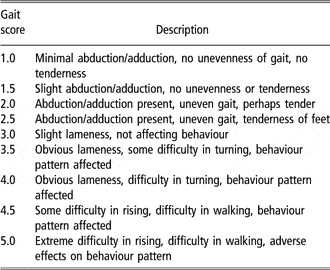
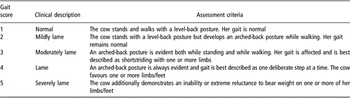
Lameness researchers commonly use subjective observational methods to study the effect of hoof and leg pathologies on gait. Two main approaches are currently used: numerical rating scores (NRS), and to a lesser extent, visual analogue scales (VAS). NRS rate individual cows, typically on a five-point scale, for the presence or absence of certain behaviours and postures related to gait. The first NRS used in dairy cattle research was on a 1 to 5 scale (with half points) with scores assigned by observers according to the criteria in Table 1 (Manson and Leaver, Reference Manson and Leaver1988). Interpreting the Manson and Leaver system can be difficult, for instance, the terms slight, some and obvious will depend on the previous experiences of the observer, perhaps explaining why few research papers use this system today. More recently, some authors have created simpler scoring systems by using only one or two specific behaviours. For example, the Sprecher system (Sprecher et al., Reference Sprecher, Hostetler and Kaneene1997; Table 2) is popular due to its simplicity, and largely relies on the observation of the presence of an arched back when standing and walking. The validity of this system has never been established, but the original idea may date back to Morrow (Reference Morrow1966) who anecdotally described a case of a lame cow that stood with an arched back. The issue of validity of subjective measures will be discussed in more detail in the next section.
A numerical rating system (NRS) for dairy cattle locomotion (from Manson and Leaver, Reference Manson and Leaver1988)

A numerical rating system for dairy cattle locomotion (from Sprecher et al., Reference Sprecher, Hostetler and Kaneene1997)

VAS were developed for use by human patients to rate pain (Scott and Huskisson, Reference Scott and Huskisson1976), and consist of a horizontal line with a description of the extremes at either end of the scale. VAS have been adapted for lameness assessments so that an observer marks on the line the perceived condition of the animal between ‘sound’ and ‘could not be more lame’. Welsh et al. (Reference Welsh, Gettinby and Nolan1993) used VAS to assess foot rot in sheep through observations of animals trotting and argued that it was more sensitive than NRS because it allowed sheep to be measured on a continuous scale, rather than restricting scores to discrete units.
Validity of subjective measures
One approach to validating scoring systems is to compare gait in animals with and without known hoof and leg pathologies. Previous studies have reported weak to modest relationships between scores and measures of hoof and leg injuries or disease. For example, a series of studies have shown that the presence of sole lesions accounted for 20% to 70% of the variation in gait scores (Whay et al., Reference Whay, Waterman and Webster1997; van Eerdenburg et al., 2003; Flower and Weary, Reference Flower and Weary2006).
Another way to identify valid lameness measures is to compare animals with or without a treatment known to reduce hoof or leg injuries. The positive effects of access to pasture on hoof health are well documented; cows kept indoors have a greater prevalence of claw disorders than those allowed to graze (Smits et al., Reference Smits, Frankena, Metz and Noordhuizen1992). Thus, one approach to validating lameness assessment measures is to compare gait in animals with and without pasture access. In one study, Hernandez-Mendo et al. (Reference Hernandez-Mendo, von Keyserlingk, Veira and Weary2007) compared a matched sample of lame cows, kept for 5 weeks either in a freestall barn or on pasture. The NRS improved rapidly for the cows on pasture but the NRS for cows kept indoors showed no improvement. This clear effect of treatment was also apparent using some specific gait attributes (like reluctance to bear weight), but there was no effect of treatment on other gait attributes like back arch or head bob.
Although subjective methods may be well suited for on-farm assessment (i.e. they can be conducted quickly on-site, require no technical equipment and enable evaluators to provide an overall assessment of gait in large number of animals), one observer’s assessment may differ from another’s or even from his own assessment conducted on another occasion. We turn to the issue of reliability below.
Reliability of subjective assessments
Martin and Bateson (Reference Martin and Bateson1998) defined the reliability of a variable as the extent to which it is precise and consistent. Both the observer and the scoring system may affect the reliability of subjective methods of gait assessment. Hollenbeck (Reference Hollenbeck1978) suggested that observers could affect the repeatability of a study in a number of ways. Firstly, results can be influenced by sources of bias, such as errors by omission (e.g. failing to score a behaviour that occurred) or errors resulting from observer expectations (e.g. failing to score an animal as lame because the rest of the herd was healthy). Secondly, experience may influence repeatability. For example, Main et al. (Reference Main, Clegg, Spatz and Green2000) reported that the agreement of scores of experienced and inexperienced observers evaluating pigs with NRS was only 26% to 53%, whereas agreement between experienced observers was 94%. Finally, observer scores may change over time (Hollenbeck, Reference Hollenbeck1978). Such ‘observer drift’ is especially a problem for live observations; researchers using video recordings are able to quantify drift by re-scoring the same tapes at different times.
Characteristics of the scoring system may also affect reliability. Some scoring systems use very general terms to categorize animals (e.g. ‘sound, imperfect locomotion, mild lameness, moderate lameness and severe lameness’; Whay et al., Reference Whay, Waterman and Webster1997), allowing more leeway among observers, and others use more detailed descriptions of the behaviours (e.g. Whay, Reference Whay2002). One way to assess the reliability of the scoring system is through observer consistency, in other words the extent to which scores agree when assigned separately on two occasions by the same observer. For example, Kestin et al. (Reference Kestin, Knowles, Tinch and Gregory1992) reported a rank correlation of 0.72 for within-observer consistency for an NRS of broiler chickens. Garner et al. (Reference Garner, Falcone, Wakenell, Martin and Mench2002), using a more explicit version of Kestin et al.’s (Reference Kestin, Knowles, Tinch and Gregory1992) system, reported much higher within-observer consistency with a correlation coefficient of 0.95. Although a number of factors varied between the studies, it seems likely that the use of more explicit criteria in each category enhanced within-observer consistency.
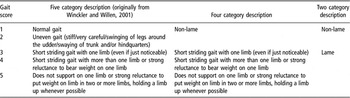
A second method of assessing reliability of scoring systems is between-observer repeatability, i.e. the extent to which scores of different observers agree. Winckler and Willen (Reference Winckler and Willen2001) reported 68% agreement between three observers simultaneously evaluating the gait of dairy cattle (n = 147) using a five-point NRS (Table 3). However, most disagreements (30%) differed by only one category and the authors argued that these differences would not result in misjudging animals. Similar levels of inter-observer repeatability were also demonstrated by Manson (1986; r = 0.84) and Flower and Weary (Reference Flower and Weary2006; r = 0.83), suggesting that observers will rarely be in total agreement when assessing gait.
A numerical rating system for dairy cattle locomotion with five, four and two categories (from Brenninkmeyer et al., Reference Brenninkmeyer, Dippel, March, Brinkmann, Winckler and Knierim2007)

The scoring methods described above rely on an overall evaluation of the animal’s condition, involving simultaneous evaluation of several behaviours. In general, there has been little attempt to justify the inclusion of specific behaviours like back arch. An alternative approach is to score specific behaviours separately. For example, in one study we scored six specific behaviours (head bob, back arch, tracking-up, joint flexion, asymmetric gait and reluctance to bear weight) using a VAS, allowing us to assess the reliability for each behaviour (Flower and Weary, Reference Flower and Weary2006). Some of the behaviours could be scored with a high inter- and intra-observer reliability (e.g. tracking-up; r = 0.91 and 0.95, respectively), but other behaviours proved more difficult to score consistently (e.g. joint flexion; r = 0.62 and 0.75, respectively). Even for those behaviours that could be scored with reasonable reliability, agreement was best for the higher scores, with low and intermediate scores showing poor consistency (Flower and Weary, Reference Flower and Weary2006).
Effect of training and experience
Recent work has demonstrated that newer subjective assessments are more reliable. For instance, Brenninkmeyer et al. (Reference Brenninkmeyer, Dippel, March, Brinkmann, Winckler and Knierim2007) tested three types of scoring systems and found good inter-observer agreement when a two-category scoring system was used (lame or not lame; prevalence adjusted bias adjusted kappa (PABAK) coefficient value = 0.70) but less agreement when a five-category system was applied (PABAK = 0.53; Table 3). Importantly, the authors found that agreement improved over time (i.e. with more experience observers were more likely to agree). This finding was mirrored in March et al.’s (Reference March, Brinkmann and Winckler2007) study where the PABAK value between an experienced and an initially inexperienced observer was 0.53 on the first occasion but improved to 0.88 after scoring 49 farms with the five-category system. Furthermore, March et al. (Reference March, Brinkmann and Winckler2007) reported that to achieve a good level of reliability, at least 200 to 300 cows need to be used to train an observer.
Issues of reliability also plague clinical scores used to evaluate hoof health. Holzhauer et al. (Reference Holzhauer, Bartels, van den Borne and van Schaik2006) showed that trimmers varied greatly in scores for disorders such as digital dermatitis (presence or absence) and interdigital dermatitis/heel horn erosion and sole haemorrhages (graded on four-point scales). This variation may be a result of the individual experience, scoring system or the conditions at the time of trimming (e.g. poor lighting). Like gait scoring systems, some existing lesion scoring systems provide well-defined categories for different stages of hoof disease (e.g. classes for digital dermatitis described by Döpfer et al., Reference Döpfer, Koopmans, Meijer, Szakáll, Schukken, Klee, Bosma, Cornelisse, van Asten and ter Huurne1997) and should promote consistency in future work.
In conclusion, current scoring methods are subjective in nature with varying reliability and validity. Ambiguous terminology used in previous scoring systems is now replaced with more detailed and specific definitions in an attempt to decrease measurement error. Observer biases, experience and drift can also influence reliability; hence new work is starting to provide refinements to these systems and document reliability of scoring systems to address such issues. Some work has attempted to validate these scoring systems in relation to pathology and treatment but this attempt has met with variable success. Another approach to assessing gait is to use sophisticated recording equipment to collect objective kinetic and kinematic data, avoiding the problems of variable inter- and intra-observer reliability inherent with subjective scoring systems. We review objective kinetic and kinematic gait assessment in the next section.
Objective methods of gait assessment
Kinetics is the study of the forces involved in motion (Hall, Reference Hall1995). Typical kinetic studies in animal gait research use force plates or force-recording shoes to obtain force data. Both devices can measure horizontal and vertical forces exerted by hooves in contact with the ground and have been used successfully to assess forces involved in walking of dairy cows (Scott, Reference Scott1988; Van der Tol et al., Reference Van der Tol, Metz, Noordhuizen-Stassen, Back, Braam and Weijs2002). Kinematics is the study of changes in the position of body segments over time, without reference to the forces involved in motion (Hall, Reference Hall1995). Small spheres are commonly attached to the skin at standard anatomical locations, and high-speed cinematography captures the movement of the animal. Records are analysed using motion analysis software, capable of digitizing a sequence of movements automatically, and the data collected are used to calculate linear and angular displacements, velocity and acceleration of each marker (e.g. Peham et al., Reference Peham, Licka, Girtler and Scheidl2001).
Both kinetic and kinematic techniques have practical applications for research on lameness. For example, Rajkondawar et al. (2002) proposed that force plate systems could be installed on dairy farms and used as a tool to detect cows with hoof injuries, and Herlin and Drevemo (Reference Herlin and Drevemo1997) used kinematic techniques to evaluate the long-term influence of management systems on the locomotion of dairy cows.
Validity of objective measures
The problems over reliability, discussed earlier for subjective methods, should not be as serious for objective methods, and can easily be quantified. However, validity is still a concern. For example, a force plate system used by Rajkondawar et al. (Reference Rajkondawar, Liu, Dyer, Neerchal, Tasch, Lefcourt, Erez and Varner2006) has been proposed as a tool to detect lameness in dairy cattle, but it is not clear how the measures actually relate to injury even in a single limb, much less to multiple injuries in several limbs. Although Rajkondawar et al.’s (Reference Rajkondawar, Liu, Dyer, Neerchal, Tasch, Lefcourt, Erez and Varner2006) study correlated the force plate measures of walking cattle with gait scores as the measure of lameness, the paper did not report how forces varied with known hoof and leg pathologies. Neveux et al. (Reference Neveux, Weary, Rushen, von Keyserlingk and de Passillé2006) investigated the weight distribution of standing cows using force plates. The authors found that cows with high hoof-injury scores showed greater variation in weight bearing between their legs when standing compared to cows with no injuries. These results indicate that measures of forces (both of stationary and moving animals) are a promising approach to identify cows with hoof injuries, but further work is required to establish whether these systems can identify specific hoof and leg pathologies.
Some specific gait measures have been successfully validated in some studies, but not in others. For example, we found that objective kinematic measures were valid indicators of sole ulcers in one study (Flower et al., Reference Flower, Sanderson and Weary2005), but not in another (Flower et al., Reference Flower, de Passillé, Weary, Sanderson and Rushen2007). We have generally found that derived measures (stride overlap, time in triple support and speed) are more useful in detecting differences than basic kinematic measures like stride duration (Flower et al., Reference Flower, Sanderson and Weary2006 and Reference Flower, de Passillé, Weary, Sanderson and Rushen2007). Pastell and Kujala (Reference Pastell and Kujala2007) validated measures of force from cows standing in a robotic milker, modelling the data into a probabilistic neural network, against hoof lesions and gait scores, and found they could positively detect 100% lame cows with this technology. We suspect that sophisticated methods of data handling and analysing, like those reported by Pastell and Kujala (Reference Pastell and Kujala2007), will allow for better integration of objective data, and more powerful predictive models for detecting cows with hoof and leg pathologies.
Technical issues
Objective methods can be subject to technical difficulties that reduce their usefulness. One difficulty of force plate studies is the inability to control where the animal places its feet on the ground (Barrey, Reference Barrey1999). Merkens et al. (Reference Merkens, Schamhardt, Hartman and Kersjes1985) reported that multiple attempts (average 2.9) were needed to provide adequate data on the force exerted by a single limb of a horse, and Corr et al. (Reference Corr, McCorquodale, McGovern, Gentle and Bennett2003), testing broiler chickens, required on average 10 attempts per bird before sufficient data had been collected. This creates challenges for researchers in terms of keeping animals walking and avoiding fatigue. One alternative is to use force-recording shoes that avoid the issue of foot placement on the force plate. Researchers have developed force-recording shoes for horses (Schamhardt et al., Reference Schamhardt, van den Bogert and Hartman1993; Barrey, Reference Barrey1999), but these are heavier and thicker than regular horseshoes and thus may shorten strides and swing phases and increase the effort needed to move the limbs (Roepstorff and Drevemo, Reference Roepstorff and Drevemo1993).
Another difficulty of kinematic studies is that skin displacements during locomotion can limit the accuracy of measures (Barrey, Reference Barrey1999). For example, Van Weeren et al. (Reference Van Weeren, van den Bogert and Barneveld1988) quantified marker position errors in horses and reported displacements of ⩽2 mm at the fetlock joint but up to 20 mm at the distal end of the tibia. Schamhardt et al. (Reference Schamhardt, van den Bogert and Hartman1993) suggested using sites where skin movement is negligible, at the fetlock for example, but this approach might not detect problems higher up the limb, such as arthritis in the hip joint.
In conclusion, both kinetic and kinematic methods can quantify behaviours associated with hoof and leg injuries and disease. These objective methods are likely more repeatable than the subjective methods described earlier, but they are subject to similar concerns regarding validity and to some technical difficulties, even under relatively controlled laboratory conditions. Other objective methods also show promise. For example, hand-held infra-red thermography devices are being explored as a way to detect changes in temperature around the hoof, indicative of hoof lesion development (Nikkhah et al., Reference Nikkhah, Plazier, Einarson, Berry, Scott and Kennedy2005). More work is needed to determine whether this technology is valid and practical.
Relationships between subjective and objective measures
To our knowledge, only two studies have directly investigated relationships between objective and subjective gait assessment measures. One recent study compared a locomotion scoring system and a force plate system in detecting painful lesions (Bicalho et al., Reference Bicalho, Cheong, Cramer and Guard2007). The authors concluded that a trained veterinarian using a locomotion scoring system performed better than the force plate system. The five-point locomotion scoring system was more sensitive (67.5% v. 33.3%, respectively) but slightly less specific (84.6% v. 89.5%, respectively) than the force plate system.
Flower et al. (Reference Flower, de Passillé, Weary, Sanderson and Rushen2007) examined the relationship between one subjective and one objective measure of gait, but in this case both measures were designed to assess the same basic gait attribute; the extent to which cows overlapped in the location of front and rear hoof placements when walking was measured using kinematics (stride overlap) and a subjective gait assessment (tracking-up). These measures were related, but variation in the kinematically assessed stride overlap accounted for only 26% of the variance in subjectively assessed tracking-up. This relatively weak relationship may have been because the two variables recorded different aspects of overlap: stride overlap was based on an average of the left and right sides, whereas tracking-up assessed both the left and right sides, but assigned a score based on the worst side. Moreover, subjective judgements of ‘tracking-up’ likely include more than just the quantitative relationship of hoof-fall positions. Which of these measures should be preferred will depend upon the information these provide about hoof and leg pathology and the pain and discomfort experienced by the cow.
The effects of pain on gait
In principle, pathologies such as a cartilage obstruction in the joint might affect gait (for e.g. by restricting the range of motion within that joint), without causing the animal pain or discomfort. The ailments of greatest welfare concern are those that cause pain. It seems likely that the reason why many ailments cause changes in gait is that they cause pain, and animals attempt to modify gait so as to reduce this pain. Despite the apparent importance of understanding the role of pain, very little work has examined how changes in gait relate to the pain cows experience while walking. Various hoof injuries and diseases afflict dairy cattle; sole ulcers, sole haemorrhages, digital dermatitis, heel horn erosion, white line disease and interdigital necrobacillosis are frequently found on modern commercial dairy farms, but it is not clear how much pain is caused by these ailments. In some validation studies, pronounced changes in gait for cows with sole ulcers were observed, but not for those with sole haemorrhages, suggesting that the latter are less painful (Flower et al., Reference Flower, Sanderson and Weary2005; Flower and Weary, Reference Flower and Weary2006). However, it is also possible that the gait measures used were only effective at detecting higher intensities of pain or that grouping all haemorrhages together masked effects.
We also require a greater understanding of the underlying mechanisms in order to generate meaningful predictions. For some measures, the link between changes in behaviour and pain reduction is relatively clear. For example, in comparison to cows with no injuries, cows with a sole ulcer may be expected to reduce loading on the affected leg and redistribute weight among the other three legs (as evidenced, for e.g. by increased duration of triple support; Flower et al., Reference Flower, Sanderson and Weary2005). For other measures (such as stride height), it is less clear how the change in gait is expected to reduce the pain cows experience while walking.
A more explicit way of addressing the role of pain is to measure changes in behaviour when pain-relieving analgesics or anaesthetics are provided. For example, Rushen et al. (2007) found modest improvements in gait scores of lame cows when they were provided either a local anaesthetic. This approach can also be used to further address the validity of various scoring methods. Flower et al. (Reference Flower, Sedlbauer, Carter, von Keyerslingk, Sanderson and Weary2008) found that the NRS showed a clear dose-dependent decline with analgesic treatment, but that for several specific gait features (e.g. tracking-up) there was no relationship with treatment. Further research is now required using cows with specific hoof and leg ailments, to determine the pain that these cause and how this pain affects gait.
An alternative approach to the issue of pain is to look for responses that generalize across injuries and locations. For example, a painful injury will sometimes increase the animal’s sensitivity to other sources of pain. This ‘hyperalgesia’ response can be assessed by exposing the animals to a painful stimulus (such as mechanical pressure or heat) and measuring the withdrawal response. Whay et al. (Reference Whay, Waterman, Webster and O’Brien1998) found that cows with sole ulcers showed more evidence of hyperalgesia than cows without hoof injuries. This study also found that this hyperalgesia response was even greater for cows with white line disease and digital dermatitis, indicating that these ailments are especially painful.
Lastly, researchers need to carefully consider which measures of pain are appropriate for lameness studies. For example, Dyer et al. (Reference Dyer, Neerchal, Tasch, Wu, Dyer and Rajkondawar2007) used hoof pressure testers as a way to measure pain. They found that cows that were sensitive to this pain assessment also had higher locomotion scores. However, the authors also found high locomotion scores and low sensitivity to pressure, as well as low locomotion scores and sensitive hooves (i.e. false negatives and false positives), suggesting that at least some of the variation in either the pressure or locomotion scores was not related to pain.
Effects of conformation and posture
Conformation refers to the physical dimensions and shape of a cow (Greenough et al., Reference Greenough, McDaniel and Leipold1997), and is typically evaluated on a nine-point scale for both production traits (such as udder depth) and non-production traits (such as hoof angle). Cow conformation may affect a range of gait variables, such as stride length or speed. For instance, tall cows with long legs likely have longer strides than smaller cows. In order to increase the ability to identify gait differences due to painful injuries, these size differences should be minimized or controlled for. For example, a study on broiler hens showed that expressing results as a percentage of each hen’s body weight enabled comparisons between birds of different weights (Corr et al., Reference Corr, McCorquodale, McGovern, Gentle and Bennett2003). Unfortunately, few cattle gait studies have incorporated body size measures into kinematic-type analysis (e.g. Herlin and Drevemo, Reference Herlin and Drevemo1997). Body weights of cattle are highly variable, in part due to differences in gut and rumen fill, so measures such as leg length may be more appropriate to account for size differences. In the human literature, Pierrynowski and Galea (Reference Pierrynowski and Galea2001) showed that scaling gait variables by weight or leg length reduces inter-subject variation, but no scaling was necessary when sizes were similar. Thus, comparisons involving animals highly variable in size (e.g. heifers v. cows) are most likely to benefit by including morphometric measures as covariates.
Posture may also affect gait. Posture refers to how a cow stands or moves and animals may assume certain postures to relieve pain. For example, Greenough et al. (Reference Greenough, McDaniel and Leipold1997) described that standing cows sometimes ‘camp back’ or ‘camp forward’, referring to the position of the hind legs in relation to a vertical line drawn from the pelvis, and suggested that cows used the postures to relieve pain in the toe or heel. Certain postures, such as perching (standing with the two front legs in a cubicle and the two hind legs in the alley), are seen frequently in loose-housed dairies. Pilot work by our group has found that perching accounted for 41% of the variation in the number of hoof lesions (Flower and Weary, 2002), although this does not show which (if either) variable plays a causal role in the relationship.
Cows may also assume a posture to adjust for mechanical influences, such as a full, heavy udder. In one study we monitored changes in cow gait (including stride length, height, duration, speed, triple support and tracking-up) for cows walking to and from the milking parlour (Flower et al., Reference Flower, Sanderson and Weary2006). Gait differed on the return from the parlour; for example, cows walked faster, used longer strides and had a shorter duration of triple support. These differences may have been in response to udder fill, or may have been due to cows being more motivated to return to their stalls (and fresh feed) after milking than when they were going to the parlour in the first place. New research is now required to better understand the effects of motivation on gait.
Environmental effects
Flooring surface, especially concrete, is a known risk factor in the development of hoof and leg injuries and disease in cattle (Wells et al., Reference Wells, Garber and Wagner1999; Vokey et al., Reference Vokey, Guard, Erb and Galton2001; Somers et al., Reference Somers, Frankena, Noordhuizen-Stassen and Metz2005; Platz et al., Reference Platz, Ahrens, Bahrs, Nüske and Erhard2007). For instance, Somers et al. (Reference Somers, Frankena, Noordhuizen-Stassen and Metz2003) recorded higher incidences of hoof disorders for cows on concrete than on straw, and Vokey et al. (Reference Vokey, Guard, Erb and Galton2001) found higher sole haemorrhage scores for cows housed on concrete than on rubber. Although it is recognized that flooring can cause hoof pathologies, little is known about the immediate effects of flooring on gait. Some basic work has demonstrated that certain characteristics of flooring, such as friction and firmness, may modify how cows walk. For example, Phillips and Morris (Reference Phillips and Morris2001) reported that dairy cows walking on low friction surfaces took frequent, short strides compared to when walking on higher friction surfaces (0.65 v. 0.59 strides/s; 1.30 v. 1.36 m, respectively) and Dijkman and Lawrence (Reference Dijkman and Lawrence1997) found that cattle walked more slowly in 30 cm deep mud than on concrete (0.81 v. 1.05 m/s).
Rubber is now being introduced as an alternative flooring surface in dairy barns. The surface is intended to benefit hoof health, but little is known about how rubber affects cow mobility. Telezhenko and Bergsten (Reference Telezhenko and Bergsten2005) tested cows walking on solid and slatted concrete, solid and slatted rubber and wet, compressed sand. The authors concluded that rubber mats had a positive effect on locomotion. Flower et al. (Reference Flower, de Passillé, Weary, Sanderson and Rushen2007) also found that cow gait improved (in terms of gait scores and kinematic measures) on a soft, higher friction rubber surface in comparison to concrete, particularly for cows with higher gait scores. Rubber flooring may provide more secure footing and more comfort than concrete, probably because the rubber surface reduces the rate at which weight is loaded onto the hoof.
Clearly, more detailed studies on the effects of flooring are needed, but results to date indicate that flooring can have profound effects on gait. This variation may pose a challenge for those conducting gait assessments on different farms. Other studies on the effects of environmental variation on gait also need to be studied. We suggest that social effects may be especially important; for example, gait likely differs when cows walk alone or in a group, and some gait features (like walking speed) are likely affected by the behaviour of others in the herd walking with the focal cow.
To summarize, differences in conformation, size, flooring and other cow and environmental features may account for much of the variation in the way cows walk. An understanding of these factors will be particularly important when conducting on-farm evaluations that require scoring cows at different times (e.g. before or after milking) and on different surfaces (e.g. concrete v. rubber); uncontrolled variation could result in misclassifying cows and confounding comparisons between herds. If gait assessments are used to compare farms, these factors should be standardised (e.g. all evaluated after milking, on concrete) or accounted for in the statistical model.
Experimental design considerations: within- and between-animal comparisons
To understand how hoof and leg pathologies affect gait, researchers often compare animals before and directly after imposing some form of treatment. Both within- and between-animal tests can be affected by the measure’s repeatability. If study animals do not respond consistently when tested on multiple occasions, then treatment differences will be difficult to detect. Some evidence suggests that animals are not always consistent in the way they walk. For example, Corr et al. (Reference Corr, McCorquodale, McGovern, Gentle and Bennett2003) reported that the ground reaction forces exerted by individual hens varied considerably between multiple recordings of the same animal, and even when speed was accounted for coefficients of variation remained high (32% to 53%). Accurate recordings of gait characteristics may therefore require multiple measures; Corr et al. (Reference Corr, McCorquodale and Gentle1998) argued that a large number of tests are required to calculate one individual’s gait profile with even modest precision.
Within-animal comparisons allow researchers to use the animal as its own control and thus avoid variation due to the animal factors described above. For example, previous studies on horses and other animals have recorded measures of gait from a sound animal and reported changes in these variables after an injury was ‘induced’, either through injection or by a device attached to the hoof (Peloso et al., Reference Peloso, Stick, Soutas-Little, Caron, DeCamp and Leach1993; Gentle and Corr, Reference Gentle and Corr1995; Buchner et al., Reference Buchner, Savelberg, Schamhardt and Barneveld1996; Keegan et al., Reference Keegan, Pai, Wilson and Smith2001). One problem with this approach is to determine when animals are sound. This can be difficult particularly for cattle where sole injuries can take approximately 8 weeks to become visible as haemorrhages or ulcers (Bergsten, Reference Bergsten1994), meaning that researchers can never be certain whether a cow is free from injury.
Cross-over experiments, where each animal is subject to treatments in succession (i.e. presence or absence of a hoof or leg pathology), can sometimes create an order effect that is confounded with treatment (Morris, Reference Morris1999). This is a common problem for studies investigating hoof and leg pathologies because the animals used are often all started on the same treatment; in such cases researchers cannot distinguish the effect of treatment from the effects of treatment order and time. Experiments can be balanced for order, but most work to date on hoof and leg pathologies has failed to recognize the effect of order in the experimental design (e.g. Peloso et al., Reference Peloso, Stick, Soutas-Little, Caron, DeCamp and Leach1993; Keegan et al., Reference Keegan, Pai, Wilson and Smith2001). A better approach may be to use a switchback design in which a cow may begin the trial lame, is then given an analgesic for a period of time and then returns to the lame condition after the drug wears off. This design allows each animal to act as its own control, although researchers still need to prevent carry-over effects by allowing sufficient time between treatments.
Another way to assess the effects of hoof and leg pathologies is to compare cows, although grouping together various pathologies can be a source of error in these between-animal comparisons. For example, Buchner et al. (Reference Buchner, Kastner, Girtler and Knezevic1993) compared kinematic data from a group of sound horses and a group of horses that had varying degrees of hind limb lameness. Although this research indicated that horses with hind limb problems walked differently from sound animals, it did not specify how different hoof and leg pathologies affected an animal. A dairy cow with digital dermatitis, for instance, may walk differently from a cow with a sole ulcer. By recording the different responses of animals with specific injuries and diseases of the hooves and legs, researchers can gain a better understanding of how these injuries and diseases affect cow gait. More research is now required to understand how dairy cows respond to a single injury, such as a lesion on a specific limb. However, if studies are to use existing variation within the population (as opposed to experimentally induced injuries), they will likely require large sample sizes in part because few dairy cows are free of hoof or leg pathologies. As single hoof injures are rare, it is helpful to study individuals when the opportunity arises. We encourage researchers to begin documenting cases involving specific injuries.
Gait effects likely become more complicated as both the type and number of injuries increase. Force plate systems that monitor changes in weight bearing may be especially useful in detecting problems affecting a specific limb (e.g. Neveux, 2005). Kinematic gait analysis can also be used to explore how leg joint angles change during the stride (e.g. Herlin and Drevemo, Reference Herlin and Drevemo1997), and may help to understand how cows respond to single and multiple hoof injuries in different locations.
Conclusion
In this paper, we have critically reviewed the literature on gait assessment, providing some insight into the benefits and drawbacks associated with various methods and outlining areas that need to be explored further. An understanding of all these factors is important when conducting on-farm evaluations in order to avoid misclassifying cows and confounding comparisons between herds. Both subjective and objective gait assessment methods can be used to identify hoof and leg pathologies and the pain experienced by the cow. Subjective methods are ‘farm-friendly’; they provide an immediate, on-site assessment and require no technical equipment, but only recently have systems documented observer reliability. Results from a few studies show that some subjective scores can be applied consistently within and among observers, especially if the scoring system provides detailed definitions of each category and the observers have been trained. Objective methods of gait assessment are ‘lab-friendly’; they provide accurate and reliable data, but often require sophisticated technology, limiting their use on farms. Furthermore, objective and subjective methods may require multiple samples to overcome variations in gait. Ultimately, the choice of measure or combination of measures should depend on the type of information they can provide.
Acknowledgements
We are grateful to David Fraser, Anne Marie de Passillé, Jeff Rushen, David Sanderson and Cassandra Tucker for providing helpful advice and commenting on earlier drafts of this manuscript. We also thank supporters of the Animal Welfare Programme including the Natural Sciences and Engineering Research Council of Canada, the Dairy Farmers of Canada, and many others listed at http://www.landfood.ubc.ca/animalwelfare/.