Evidence is being increasingly used to assist in making appropriate choices in the adoption of health technologies (Reference Chalkidou, Tunis and Lopert3;Reference Neumann and Tunis20). However, the quality of existing evidence is often insufficient to address the needs of decision makers. Evidence may be lacking or may not be generalizable across jurisdictions. For these reasons, contextualized “real-world” effectiveness data may be useful in aiding the decision-making process (Reference Tunis, Stryer and Clancy28). For most health systems, failure to make a policy decision in the face inadequate evidence may lead to passive diffusion, no diffusion, or intuitive policy decision making.
In 2006, the Center for Medicare and Medicaid in the United States (US) instituted coverage with evidence development (CED) which offered an option for coverage of promising drugs, biologics, devices, diagnostics, and procedures that would not otherwise meet Medicare's evidentiary standards for being “reasonable and necessary” (Reference Tunis and Pearson27). It provides an option to fund a technology to collect primary data that informs decision making when uncertainty exists regarding efficacy or effectiveness. The United Kingdom-based National Institute for Health and Clinical Excellence in 2003 developed the capacity to promote additional research through its Only-In-Research program to gather primary evidence and inform guidance development. Other initiatives gave rise to registries (Reference Chalkidou, Hoy and Littlejohns2;19), but there are few successful examples of clinical trials that were sponsored to inform decision making. One rare example is a randomized controlled clinical trial (RCT) that assessed the efficacy of high dose chemotherapy with bone marrow support in the treatment of breast cancer (Reference Stadtmauer, O'Neill and Goldstein23). With an increasing interest in CED, we report on our experience using CED in the province of Ontario where coverage for a technology was provided conditional upon additional data being collected to specifically address residual uncertainty to better inform evidence-based decision making.
In 2003, the Ontario Health Technology Advisory Committee (OHTAC) was created as an arms-length evidence-based advisory committee to the Ministry of Health and Long-Term Care (MOHLTC) for non-drug health technologies. Residual uncertainty following analysis of available evidence by the Medical Advisory Secretariat (MAS) sometimes prevented OHTAC from making a recommendation regarding the adoption of a technology, even though patient benefits were potentially substantial. A field evaluation program to evaluate these technologies to address this uncertainty was subsequently developed by MAS in collaboration with several academic partners (Reference Goeree and Levin9;Reference Whicher, Chalkidou, Dhalla, Levin and Tunis30).
Since 2003, the field evaluation program has included a diverse range of health technologies. Nineteen field evaluation studies have been completed and an additional nineteen are under way. Of the nineteen completed studies, ten meet the definition of CED and are the focus of this study. We will specifically focus on the design, conduct, and impact of the CEDs on reducing residual uncertainty, impacting policy, and influencing changes in usage.
Features of the Current Ontario Program
Details of the evidence-based framework that guides the uptake and diffusion of health technologies in Ontario are published elsewhere (Reference Goeree and Levin9;Reference Levin, Goeree and Sikich12;Reference Whicher, Chalkidou, Dhalla, Levin and Tunis30). Briefly, the evidentiary core that feeds into OHTAC consists of peer-reviewed contextualized 16-week systematic reviews conducted by MAS to assess effectiveness. Synchronous economic analyses are undertaken by the Toronto Health Economic and Technology Assessment Collaborative (THETA) at the University of Toronto and the Program for the Assessment of Technologies in Health Research Institute (PATH) at McMaster University. Field evaluations are conducted by the Ontario Clinical Oncology Group (OCOG), PATH, THETA, and the University Health Network (UHN) Healthcare Human Factors Group. In addition, the Institute for Clinical Evaluative Sciences (ICES) houses linked health services data to support field evaluations.
The MOHLTC provides core support to these institutions and incremental allocations for each field evaluation. The total cost of each field evaluation is estimated at CAN$600,000 which includes protocol development and implementation and costs attributed to data collection, analysis and reporting. This estimate does not include costs absorbed by institutions or of the technology being tested. The process provides an opportunity to bend the diffusion—and, therefore, the cost-curves—for these technologies.
Most often the recommendation for a field evaluation is based on the quality of evidence of effectiveness assessed as part of the systematic review and determined by the Grading of Recommendations Assessment, Development and Evaluation (GRADE) process (Reference Atkins, Best and Briss1). Using GRADE criteria, further research is deemed less likely to affect the confidence in the estimate when the quality of evidence is moderate to high. Therefore, low to very low quality evidence often triggers consideration for a field evaluation if the technology is deemed to have potentially important effects. The assessment of cost-effectiveness, social values, and feasibility of implementation are additional components of the OHTAC decision-making process (Reference Johnson, Sikich and Evans11) that may also trigger a field evaluation, as may concerns regarding generalizability.
DESIGN OF FIELD EVALUATIONS
The design of each field evaluation varies according to the nature of the residual uncertainty. Randomized controlled trials (RCTs) are considered when there is no moderate to high quality evidence of efficacy; prospective observational trials evaluate “real-world” effectiveness, safety or accuracy; and registry studies measure real-world effectiveness or safety. The utility of registry studies is maximized when patient outcomes data are linked to robust administrative databases.
Decision analytic policy models have been built to examine effectiveness of discrete interventions, within the context of other interventions used for the same condition over variable time horizons. These are based on Ontario patient outcomes, cost, and (usually) epidemiological data and, therefore, provide realistic and grounded estimates of potential costs and outcomes to decision makers. Models built to date are for diabetes, cardiovascular disease, and pressure ulcers, but for the purpose of this article, only experience with the diabetes model will be presented. When using these models to examine the effects of new technologies, probabilities to populate the model are most often derived from the systematic review. It is anticipated that these models will become especially useful in setting long-term strategies and planning for chronic disease management.
RATIONALE, RESULTS, AND POLICY IMPLICATIONS OF COMPLETED CEDs
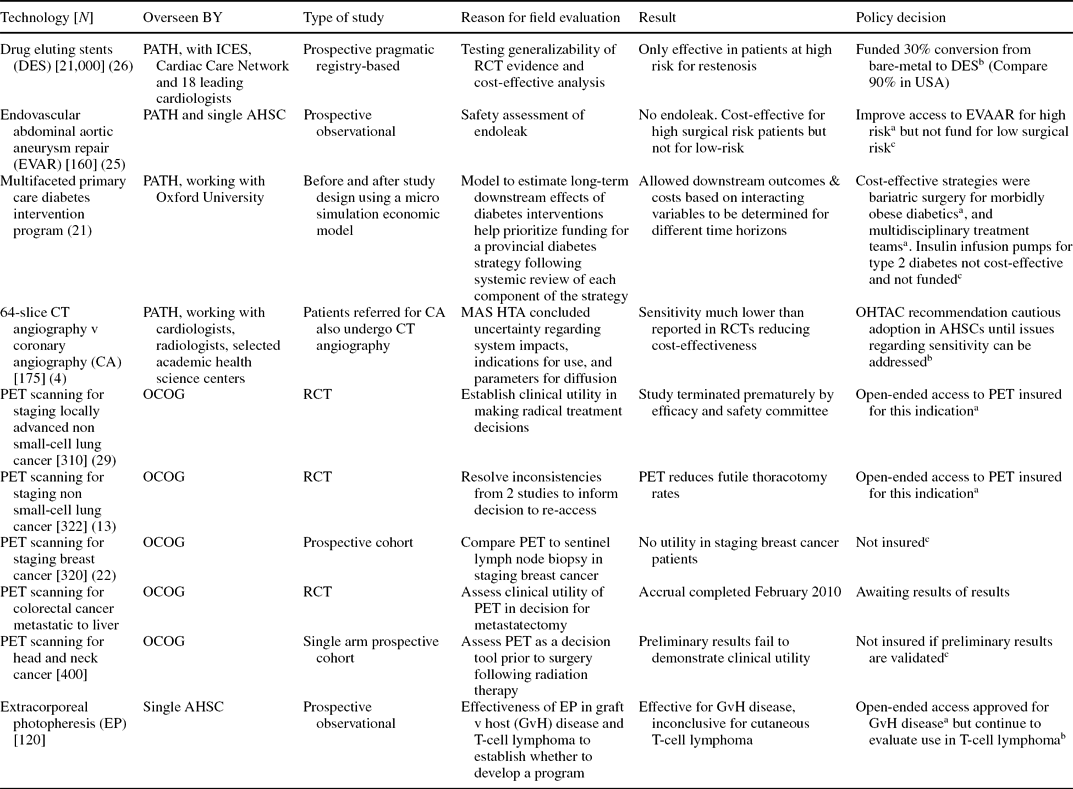
Table 1 shows the question asked in each CED, the nature of the evaluation undertaken, results, and policy decisions taken. Additionally, a study on deep brain stimulation was discontinued before the study commenced due to difficulties in executing a jointly funded arrangement and a study on negative wound pressure for chronic wound healing was discontinued due to poor patient accruals. The latter study raised concerns regarding difficulties in conducting research to capture primary patient data in a community setting. Two separate patient subgroups were considered in one CED related to the evaluation of endovascular aortic aneurysm repair (EVAAR) in high surgical risk and in low surgical risk populations. Four separate interventions were considered in another CED related to the evaluation of interventions in the management of diabetes, these being multidisciplinary care, behavior modification, insulin infusion pumps in the management of insulin-dependent type 2 diabetes, and bariatric surgery in the treatment of morbidly obese individuals with type 2 diabetes. One positron emission tomography (PET) study is awaiting final analysis. Twelve interventions and one patient subgroup will therefore be presented.
Completed Field Evaluations Meeting the Definition of CED and Policy Development

aWidespread adoption.
bLimited adoption.
cTechnology withdrawn.
Positron Emission Tomography (PET) – The Use of CED to Address Uncertainty Relating to Clinical Utility
For the analysis of diagnostic technologies, both accuracy and clinical utility are important outcomes. Clinical utility defines how a technology influences clinical decision making and affects patient outcomes. Examples of field evaluations to explore clinical utility for diagnostic technologies are provided by PET scanning, described in this section, and CT angiography, discussed in the section dealing with assessment of generalizability below.
When a decision regarding the adoption of PET scanning was first considered in 2002, few studies addressed clinical utility (10), and yet the potential cost to the health system was considerable. Three alternatives were: (i) to decline investment until evidence of clinical utility was available, (ii) to adopt an open-ended funding strategy with little evidence of clinical utility, or (iii) to evaluate PET scanning and to fund it according to evidence of its clinical utility in different disease conditions. The latter option was chosen, overseen by a provincial expert steering committee, with clinical trials conducted by OCOG. A description of this evaluation process for cancer indications has been published (Reference Evans, Laupacis, Gulenchyn, Levin and Levine7). The steering committee also monitors published evidence of clinical utility and makes recommendations for insurability based on these reports while the evaluation program conducts PET studies as recommended by the steering committee.
Five clinical trials have completed accrual to assess the clinical utility of PET scanning in early (Reference Maziak, Darling and Inculet13) and locally advanced (Reference Ung, Sun and MacRae29) non–small-cell lung (NSCL) cancers, early stage breast cancer (Reference Pritchard, Julian and McCready22), head and neck cancer and colon cancer metastatic to liver (Table 1).
PET in Early Stage NSCL Cancer
Rationale. There was originally conflicting evidence and therefore uncertainty as to whether PET scanning reduced futile thoracotomy rates. While reduced thoracotomy rates attributed to PET were potentially cost-saving and posed reduced risks to some patients, missing potentially curative surgery due to low sensitivity or increasing futile thoracotomies due to low specificity, would be to the patient's detriment. A confirmatory RCT was deemed necessary and was conducted by OCOG (Reference Maziak, Darling and Inculet13).
Results. A total of 170 patients were assigned to PET-CT and 167 to conventional staging. Disease was correctly upstaged in 23 of 167 PET-CT recipients and 11 of 162 conventional staging recipients (13.8 percent versus 6.8 percent; [95 percent CI, 0.3 to 13.7 percentage points]). Disease was incorrectly upstaged in eight PET-CT recipients and one conventional staging recipient (4.8 percent versus 0.6 percent; difference [CI, 0.5 to 8.6 percentage points]), and it was incorrectly under-staged in 4.9 percent versus 29.6 percent [CI, 5.7 to 23.4 percentage points]). At 3 years, fifty-two patients who had PET-CT and fifty-seven patients who had conventional staging had died (Reference Maziak, Darling and Inculet13).
Preoperative staging with PET-CT identified more patients with mediastinal and extrathoracic disease than conventional staging, thereby sparing more patients from stage-inappropriate surgery. While the strategy also incorrectly upstaged disease in more patients, on balance, the benefits of performing PET scans outweighed the risks.
Policy Implications. Full funding was made available for PET scanning for this indication
PET in Locally Advanced NSCLC
Rationale. In locally advanced NSCL cancer, the clinical utility of PET to prevent aggressive treatment (combined modality [CMT] using radical radiation therapy (RT) plus chemotherapy) in patients upstaged by PET was unknown. Without an understanding of clinical utility, there was a concern that patients could have been inappropriately treated based on the results of a PET scan. Patients who were considered candidates for CMT were randomized to PET-CT or CT for RT treatment planning (Reference Ung, Sun and MacRae29). The primary outcome was the proportion of patients who did not receive CMT because their tumor was upstaged or intrathoracic tumor was too extensive for radical RT.
Results. Following a planned interim analysis for the primary outcome, the Data Safety Monitoring Board recommended stopping recruitment because of superior efficacy with PET-CT. A total of 289/304 randomized patients had analyzable data. Twenty-five patients were unsuitable for CMT: twenty-one in the PET-CT arm (sixteen upstaged to Stage 4 and 5 unsuitable for radical RT) and four in the CT arm (unsuitable for radical RT) (p = .0002).
PET-CT was superior to CT alone in selecting appropriate patients for CMT. Longer follow-up will determine the impact on overall survival.
Policy Implications. Based on this CED, full funding was made available for PET scanning for this indication.
PET as an Adjunct in Pre-Operative Assessment for Liver Metastasectomy in Colon Cancer
Rationale. There was uncertainty regarding the clinical utility of PET as an adjunct to CT in the pre-operative assessment of patients undergoing liver metastasectomy. A prospective RCT of PET/CT versus CT alone was funded to resolve this issue before committing to a definitive funding decision.
Results. A total of 410 patients randomized and study completed. Results of the analysis are awaited.
Policy Implications. Definitive funding for this indication will be predicated on the results of this CED.
PET as an Adjunct to Conventional Imaging with CT to Aid Decision Whether to Proceed to Radical Neck Resection Following Radiation Therapy
Rationale. Surgery is undertaken for patients with locally advanced squamous cell carcinoma of the head and neck following radiation therapy with or without chemotherapy. There was uncertainty regarding the utility of PET scanning to improve patient selection for surgical neck dissection following RT. A cohort CED study was undertaken in which all patients underwent conventional imaging followed by PET scanning after receiving conventional RT. All patients subsequently underwent neck dissection and the results of PET scanning compared with pathology results.
Results. Following accrual of 400 patients, this study demonstrated that the addition of PET to conventional CT scanning before neck dissection had no clinical utility in determining whether patients should proceed to neck dissection. Detailed results await publication.
Policy Implications. Funding for this indication will be withdrawn according to expectations set out for the CED predicated on final results.
PET in Early Stage Breast Cancer
Rationale. Sentinel lymph node (SLN) biopsy has become an important investigation to aid decision making whether to undertake an axillary lymph node dissection for patients with early stage breast cancer. A cohort CED was funded to address the uncertainty as to whether PET scanning could replace or act as an adjunctive imaging technology for this purpose.
Results. A total of 336 women were entered into a cohort study and all received a PET scan before proceeding to sentinel lymph node examination. Sentinel nodes were found for 312/325 women (Reference Pritchard, Julian and McCready22). Using logistic regression, age, body mass index, number of nodes, and tumor size were assessed as predictors of prevalence, positive PET, and sensitivity. Only tumor size was predictive (p < .05) for prevalence (OR = 1.6), PET positivity (OR = 1.7), and PET sensitivity (OR = 1.4). A low sensitivity and high positive predictive value for detection of axillary nodal metastases for PET compared with SLN biopsy suggested that this technology has limited, if any utility in staging breast cancer patients.
Policy Implications. Funding for this PET indication was withdrawn.
PET Registry
A PET registry was developed for indications where clinical trials were not feasible, where existing imaging modalities were unhelpful in the presence of collateral evidence of disease progression such as rising tumor markers with a normal or uncertain CT or MRI, or where good quality evidence was already available (e.g., solitary pulmonary nodule) but federal licensing precluded the used of the isotope fluoro-deoxy glucose (FDG) outside of a clinical trial.
Policy Implications. All PET studies for which evidence of clinical utility was demonstrated and registry studies were approved for funding as insured services in October 2009, comprising nine cancer and one cardiac indication. Additional approvals are anticipated in the future for indications in which clinical utility can be demonstrated.
Drug Eluting Stents and CT Angiography CED to Address Uncertainty Regarding Generalizability
The performance and use of a technology in the real world may differ from an RCT. Once diffused, adjunctive treatments excluded in the RCT may be provided with a new technology, or the technology may be used at a different stage of the disease than occurred in the RCT. The technology may not perform in the same way in a less-restrictive environment and especially when eligibility criteria are relaxed. The definition of successful outcomes may also not be as rigorous in the real world.
Drug Eluting Stents
Rationale. RCT evidence indicated that in patients with low risk coronary artery disease, the use of drug eluting stents (DES) resulted in significantly decreased restenosis rates when compared with patients who received conventional bare metal stents (BMS) (Reference Morice, Serruys and Sousa17;Reference Moses, Leon and Popma18). Based on these studies, acuity creep to high risk coronary artery disease seemed inevitable. Before making a definitive funding decision for DES, the MOHLTC funded PATH and ICES to undertake a prospective pragmatic study of patients who received BMS or DES to test the generalizability of this finding in the context of the Ontario health system. This was initiated soon after the RCT evidence was published.
Results. In this pragmatic prospective study, 23,000 patients were prospectively tracked on a modified existing patient outcomes and administrative database for BMS over an 18-month period to also cover DES (Reference Tu, Bowen and Chiu26). Propensity scores were used to find matched patients treated with DES or BMS. This was possible because of the large number of subjects, the collection of appropriate variables in the registry and the linkage to robust administrative data sets. Restenosis rates were similar for BMS and DES for low-risk patients, whereas high risk patients with narrow or long lesions with diabetes were found to derive benefit from DES (Reference Tu, Bowen and Chiu26).
Policy Implications. Based on the CED results, funding for DES was confined to high risk patients with diabetes, narrow and/or long stenotic coronary arteries. This led to a 36 percent conversion rate from BMS to DES in Ontario compared with an estimated 90 percent conversion rate in the United States (Reference Feder8) and an estimated annual saving of CAN$20 million. Possible reasons for difference in results included less restrictive criteria for use, the use of clopidogrel in stented patients, and the recent adoption of a newer version of the bare metal stent (personal communication).
CT Angiography
Rationale. CT angiography is a less invasive alternative to coronary angiography for the anatomical detection of coronary artery disease. A recent systematic review reported a pooled sensitivity of 0.96 (95 percent confidence interval [CI], 0.94–0.98), which was higher than for functional imaging (15). Uncertainty regarding clinical utility could result in over-use of this less-invasive anatomical diagnosis, duplication (many patients would still require a coronary angiogram), and creep to include asymptomatic individuals.
A CED was subsequently conducted by PATH in collaboration with leading cardiologists and radiologists to assess whether the published sensitivities were generalizable to Ontario to better inform decisions regarding the adoption of this technology. It was explicitly stated at the beginning of this study that a final decision regarding insurability would be predicated on the results of the CED. Patients referred for coronary angiography were invited to participate in this study in which they would undergo CT angiography before coronary angiography. Images from the two technologies were compared using dual reads and arbitration read to resolve disagreement.
Results. The sensitivity for CT angiography conducted at four academic health science centers was 82 percent, which was consistent with sensitivities reported for functional imaging modalities and lower than what was expected from published clinical trials (15). This study did not completely reflect real-world conditions as it was conducted with quality assurance and with experienced radiologists doing dual reads. It is expected that with more widespread adoption, sensitivity rates will be lower. Detailed results await publication (Reference Chow, Freeman and Bowen4).
Policy Implications. CT angiography remains uninsured and under policy consideration, which will be significantly affected by the results from this CED.
CED to Address Uncertainty Regarding Safety, and Indications – Endovascular Abdominal Aortic Aneurysm Repair
Rationale. A systematic review on the effectiveness and safety of abdominal aortic aneurysm repair (EVAAR) (14) concluded that there was evidence of effectiveness but uncertainty regarding endoleak from the edges of the deployed device. This was a potentially important technology as it offered a minimally invasive alternative to open abdominal surgery.
It was decided to undertake a CED to assess the safety of this device and its cost-effectiveness to better inform definitive funding decisions. A prospective observational single center study involving 160 patients and organized by PATH was undertaken (Reference Tarride, Blackhouse and De Rose25).
Results. Type 2 endoleak was identified as a complication, but this type of endoleak was reported not to present a safety hazard or reduce long-term effectiveness. The economic analysis based on the study showed that substituting EVAAR for open surgery in high surgical-risk patients was cost-effective, but not so for patients at low risk for open surgical repair.
Policy Implications. Based on this study, increased funding for EVAAR was approved for patients at high risk for open surgical repair of the abdominal aortic aneurysm. Provincial funding for patients at low risk for open surgical repair has not been provided.
In another example of uncertainty regarding the use of a technology, a CED was undertaken to evaluate extracorporeal photopheresis in the treatment of cutaneous T-cell lymphoma and in graft versus host disease. Although the results of this study have not yet been published, they were used to make a decision to fund this intervention for graft versus host disease and continued study in patients with cutaneous T-cell lymphoma.
Uncertainty Regarding Long-Term Costs and Effects for Chronic Disease
Rationale. Planning for the uptake of health technologies for chronic diseases can be complex due to long time horizons, difficulties understanding events avoided by the introduction of these technologies and associated impacts on cost-effectiveness.
Using a diabetes outcomes model developed by Clarke et al. (Reference Clarke, Gray and Briggs5), PATH developed an Ontario-specific version of this micro simulation model. The model has been used repeatedly to inform policy. One example was its use as a core evaluation tool to assess components of the provincial diabetes strategy which provided a basis for prioritizing four major components of the strategy based on cost-effectiveness and avoidance of downstream complication rates over a 40-year time horizon. The use of this model formed part of a broad evidence-based approach in conjunction with a mega-analysis on these interventions (16). Mega-analysis is a term used at MAS in which technologies around a disease condition are disaggregated for evidence-based analysis and then re-aggregated around common outcomes to identify technologies most likely to optimize patient outcomes.
Results. Using estimates of common outcomes attributed to multidisciplinary care, insulin infusion pumps in the treatment of type 2 diabetes, behavior modification, and bariatric surgery in the management of morbidly obese individuals with type 2 diabetes, the most cost-effective strategy was bariatric surgery, followed by multidisciplinary care, and behavior modification, all of which had an incremental cost-effectiveness of under CAN$36,000. Insulin infusion pumps in insulin-dependent type 2 diabetes were not cost-effective. Whereas behavior modification interventions were cost-effective, multidisciplinary teams are trained in these techniques so this was not considered as a separate decision point.
Policy Implications. Following this analysis, CAN$110 million was allocated to improve bariatric surgery services and to encourage its use especially in patients with type 2 diabetes. Funding was also provided to increase the number of multidisciplinary teams. Insulin infusion pumps in patients with type 2 diabetes requiring insulin may not be pursued as a policy option.
THE EFFECTS OF FIELD EVALUATIONS ON SUBSEQUENT ADOPTION
The effects of CED results on the adoption of technology could be assessed for twelve interventions and one subgroup. The CED was responsible for widespread access to and adoption of technologies in six instances, limited access in three instances, and withdrawal of the technology in four instances. Although a formal quantitative analysis of changes in usage/diffusion was beyond the scope of this study, the general diffusion effects are summarized in Table 1 in which the effects of the field evaluation on diffusion of the technology are summarized in the last column as (a) for widespread adoption, (b) for limited adoption, and (c) for withdrawal of funding or removal of the technology.
DISCUSSION
Primary research to address uncertainty that persists after a formal review of existing evidence is receiving increasing attention (Reference Chalkidou, Hoy and Littlejohns2;19;Reference Tunis and Pearson27;Reference Tunis, Stryer and Clancy28) but experience is limited. The Ontario Field Evaluation Program and specifically the CED studies reported here demonstrate the breadth of studies that can be used to address uncertainty following systematic review and represents the largest body of evidence and experience to date. The ability of HTA to directly influence policy decision making is an important indication of its relevance. By this measure, we would conclude that post-market evaluation to address uncertainty following systematic review adds a meaningful dimension to HTA. Furthermore, CED makes an important contribution to definitive decision making based on the true performance of technologies under “real-world” conditions.
We have demonstrated that the performance of health technologies in the “real-world” setting may differ from outcomes derived from the more rigid constructs that RCTs must use to eliminate bias. While this should not detract from the essential role of RCTs in demonstrating efficacy, post-market studies make an important contribution to the body of evidence and may be necessary before making long-term funding commitments. This is especially when there is residual uncertainty regarding effectiveness, cost-effectiveness, or safety following systematic review. Ideally, post-market studies should not restrict access to the technology while they are being conducted, but there must be an understanding that definitive funding will be predicated on the results of these studies.
Traditionally cost-effectiveness has not been a major decision point for approving non-drug health technologies in Ontario. OHTAC initially used clinical evidence as the primary decision-making criterion. As a result, residual uncertainty that led to field evaluations was almost always within the domains of effectiveness or safety. This has changed over time and cost-effectiveness is now one of the four considerations in the OHTAC decision determinants model used for making its recommendations (Reference Johnson, Sikich and Evans11). After the adoption of this broader decision determinants framework, residual uncertainty could reside in one of several areas—effectiveness, efficiency, social/ethical values, or system feasibility. Over time, economic considerations in particular have assumed greater weight in the decision process, such as occurred in the CED studies on EVAAR for low operative risk patients, in four components of the diabetes strategy and in CT angiography.
The question remains why health systems should become involved in improving the quality of evidence of effectiveness and cost-effectiveness. Ignoring this opportunity at the inflection point of the diffusion curve may invite passive diffusion and intuitive decision making. Results from the completed CEDs raises questions regarding the future scope for CED. Our results demonstrate how the performance of health technologies under “real-world” conditions (effectiveness) can differ from reported RCT results (efficacy). In some situations, the lack of external validity from efficacy RCTs may mean that definitive funding decisions should not necessarily be based on this evidence alone and that CED should be considered for technologies to test generalizability from RCT data before making definitive funding decisions.
We emphasize the importance for collaborations among decision makers, academia, physicians, and institutions to conduct field evaluations. There is a tension between conducting these evaluations expeditiously and ensuring the evaluations are methodologically rigorous and defensible. We have found that evaluations can be facilitated through the use of health administrative databases and through the use of policy models which can be applied to various technology considerations.
This work is also facilitated by the ability to link comprehensive health administrative data sets to strengthen evidence-based analyses, field evaluations, and economic modeling. Furthermore, if the scope of CEDs expands, greater efficiencies will need to be introduced through inter-jurisdictional collaboration, collaboration with industry partners, and by undertaking some studies in the pre-marketing phase.
Not reported in this report are non-CED post-market evaluations undertaken by the Ontario Field Evaluation Program. These have included polling people to establish prevalence and acuity for stress urinary incontinence to plan for the adoption of mid-urethral slings and to study barriers to access for patients with diabetes; safety studies by the UHN Usability and Human Factors Laboratory of newer versions of infusion pumps, of portable in-room air cleaners and of CT scanners and MRI; and the use of human papilloma virus detection as an adjunct to cytological screening for cervical cancer.
Decision making under uncertainty is a complex process that goes beyond evidence of effectiveness and cost-effectiveness. Fiscally constrained health systems will increasingly look toward post-marketing studies to support funding decisions as they raise their threshold for tolerating uncertainty and seek ways to prioritize funding for competing needs. Probabilistic findings of medical effectiveness are fundamentally ambiguous as they relate to action (Reference Tanenbaum24). This means that policy makers will need a range of different types of answers when confronting a set of findings from an evidence-based review and may require different types of supplementary or field analyses based on their context.
It is important to decide how to prioritize which technologies should be subject to post-market evaluation. Value of information analysis can be used not only to set research priorities (Reference Claxton, Briggs and Buxton6), but can and is being used in Ontario to define data collection for specific field evaluation studies (Reference Levin, Goeree and Sikich12).
As the scope of field evaluations including CED increases, we note the following methodological issues:
CED studies must be methodologically rigorous and defensible to be accepted by the research and health professional community. However, these studies must also be relevant to decision makers and this requires timely completion. Methods to increase patient accrual to RCTs and other prospective observational studies must be explored and the use of patient outcomes-linked administrative databases should be considered when possible.
Post-market evaluations should not unreasonably impede access to the technology being assessed.
Policy makers and opinion leaders should be involved in the formative process of field evaluations to ensure relevance of the outcome to decision making and to influence adoption of the technology according to the results.
CONCLUSION
The evaluation of health technologies under real-world conditions before adoption makes an important contribution to understanding their relevance to sustainability in health care. We have demonstrated that investment of this activity by health systems provides a sound basis for long-term funding decisions and can affect the adoption and associated costs for health technologies. Based on our experience, CED evaluation before making long-term funding decisions for widespread adoption, especially where there is uncertainty of effectiveness, safety, or cost-effectiveness, should be increasingly funded by health systems.
CONTACT INFORMATION
Leslie Levin, MD (Les.Levin@ontario.ca), Professor, Department of Medicine, University of Toronto, 21 King's College Circle, Toronto, Ontario M5T 1P7, Canada; Head, Medical Advisory Secretariat, Ministry of Health and Long-Term Care, 10th floor, 20 Dundas Street West, Toronto, Ontario M5G 2C2, Canada
Ron Goeree, MA (goereer@mcmaster.ca), Associate Professor, Department of Clinical Epidemiology and Biostatistics, McMaster University; Director, Programs for Assessment of Technologies in Health (PATH) Research Institute, St. Joseph's Healthcare Hamilton, 25 Main Street West, Suite 2000, Hamilton, Ontario L8P 1H1, Canada
Mark Levine, MD, MSc (mlevine@mcmaster.ca), Professor and Chair, Department of Oncology, McMaster University, 1200 Main Street West, Hamilton, Ontario L8N 3G5, Canada; Director, Ontario Clinical Oncology Group, c/o Henderson Research Centre, 711 Concession Street, Hamilton, Ontario L8V 1C3, Canada
Murray Krahn, MD, MSc (murray.krahn@theta.utoronto.ca), Professor and F. Norman Hughes Chair, Department of Medicine, University of Toronto, 21 King's College Circle, Toronto, Ontario M5T 1P7, Canada; Director, Faculty of Pharmacy, Toronto Health and Technology Assessment Collaborative, 144 College Street, Room 600, Toronto, Ontario M5S 3M2, Canada
Tony Easty, PhD, PEng, (tony.easty@uhn.on.ca), Associate Professor, Institute of Biomaterials and Biomedical Engineering, University of Toronto, 21 King's College Circle, Toronto, Ontario M5T 1P7, Canada; Senior Scientist, Centre for Global eHealth Innovation, University Health Network, 190 Elizabeth Street, Toronto, Ontario M5G 2C4, Canada
Adalstein Brown, PhD (adalsteinn.brown@utoronto.ca), Dalla Lana Chair in Public Health Policy, Department of Public Health Policy, Dalla Lana School of Public Health, University of Toronto, Sixth Floor, 155 College Street, Toronto, Ontario M5T 3M7, Canada; Scientist, Li Ka Shing Knowledge Institute, St. Michael's Hospital, 30 Bond Street, Toronto, Ontario M5B 1W8, Canada
David Henry, MB, CB (David.Henry@ICES.on.ca) Professor, Department of Medicine, University of Toronto, Ontario, Canada; President and CEO, Institute for Clinical Evaluative Sciences (ICES), G106, 2075 Bayview Avenue, Toronto, Ontario M4N 3M5, Canada
CONFLICT OF INTEREST
L Levin has received travel funding from HTAi, Institute of Medicine, and the Korean HTA agency NSCR. M Krahn has received a grant from Johnson & Johnson. T Easty's institute has received a grant from the Ministry of Health in Ontario for this work and other funding from NSERC, CIHR, CPSI, and Hospira Corp. The other authors do not report any potential conflicts of interest.