Introduction
Knowledge of phonological structure of a language develops early in life through natural exposure to spoken language in the home environment (Jusczyk, Friederici, Wessels, Svenkerud & Jusczyk, Reference Jusczyk, Friederici, Wessels, Svenkerud and Jusczyk1993). This not only mediates learning the sounds of a language, but also lays the foundation for development of ‘phonological awareness’ (PA). PA refers to the inherent awareness of sound structure of a language, which enables complex manipulations of speech sounds (Caravolas & Bruck, Reference Caravolas and Bruck1993; Chuang, Joshi & Dixon, Reference Chuang, Joshi and Dixon2011). An extensive body of work has shown that phonological awareness skills are also the key stepping stone to reading acquisition (Wagner & Torgesen, Reference Wagner and Torgesen1987; Wagner, Torgesen, Rashotte, Hecht, Barker, Burgess, Donahue & Garon, Reference Wagner, Torgesen, Rashotte, Hecht, Barker, Burgess, Donahue and Garon1997; Harm & Seidenberg, Reference Harm and Seidenberg1999; Goswami, Reference Goswami2001). However, most research to date has focused on the role of PA in reading development and relatively less effort has been made to investigate the neural correlates underlying PA itself. Given the above, the primary objective of this report was to examine the neuroanatomical structures underlying PA in children.
The children tested in this study were bilingual biliterates. It is estimated that about two thirds of the world's children are bilingual (Crystal, 1997). In many biliterate environments, children are instructed simultaneously in two languages (Bialystok, Luk & Kwan, 2005). Further, in various instances like Chinese–English, Hindi–English for instance, they learn to read languages that belong to distinct writing systems. Since the writing system that a language uses affects children's acquisition of literacy, biliteracy would be dependent on the successful acquisition of phonological information of two languages.
Past neuroimaging studies have demonstrated that acquisition of novel phonologies in multilinguals is associated with changes in brain structure. One such study (Abutalebi, Rosa, Castro Gonzaga, Keim, Costa & Perani, Reference Abutalebi, Rosa, Castro Gonzaga, Keim, Costa and Perani2013) specifically studied non-native language production in adult multilinguals and reported two important findings: (1) multilinguals exhibited increased activity in left putamen for non-native language, and (2) the same multilingual population also showed higher grey matter in the same region – left putamen, as compared to monolinguals. The study concluded that the observed grey matter changes were the result of expertise in articulating multiple phonologies. Such neuroanatomical effects are hitherto unexplored in bilingual children, where acquisition of two sets of phonologies takes place.
The population in the current study learnt two languages – Hindi and English – which showcase contrasting qualities in terms of both the writing systems used and consistency of sound to spelling relationships. Hindi is written in the Devanagari script, which has a transparent orthography with almost univalent grapheme-sound mapping. Devanagari is termed an alphasyllabary since it has distinct consonants and vowels akin to alphabetic scripts, and each grapheme or akshara roughly corresponds to a syllable, similar to syllabic scripts (Vaid & Gupta, Reference Vaid and Gupta2002). English, on the other hand, is written in an alphabetic, Roman script, and is relatively inconsistent in its sound-to-spelling mapping. The differences in phonological units employed in these languages may influence reading development in Hindi–English (henceforth H–E) biliterate children through distinct mechanisms, as per the psycholinguistic grain size theory (Ziegler & Goswami, Reference Ziegler and Goswami2005). The unique features of this language pair make H–E biliterates an interesting sample for studying reading development.
In the present study, association of brain structure with PA and reading skills was examined using voxel based morphometry (VBM) in H–E biliterate children between 8 and 10 years of age. Due to the distinct characteristics of the orthographies used to write Hindi and English described above, the study assessed phonological awareness as well as nonword reading skill separately in each language, in order to bring out clearly, any differences between the languages in either the underlying phonological abilities involved, or in the pattern of performance of H–E biliterate children.
Methods
Participants
Thirty typically developing, right handed, H–E bilingual biliterate children (Details in Table 1) from a private school in National Capital Region, Delhi, in northern India participated in the study. The participants were recruited from a single school to ensure reduced variability in the literacy environment. All participants acquired simultaneous reading instruction in Hindi and English in school from 5 years of age. Hindi was the native language (L1) of all participants, whereas English (L2) was primarily acquired through schooling, where it was used for instruction. As per teacher reports, children at school were provided 6 hours of daily instruction in English and one hour of daily instruction in Hindi. Children spent 7 hours at school and were encouraged to communicate primarily in English. Language of communication at home was Hindi. Participants had no history of reading difficulty, sensory, neurological or intellectual deficits, and had normal or corrected to normal vision.
Summary of participant details and behavioural measures. Means (M) and standard deviations (SD) are given and percent scores are shown wherever applicable. Subtests are denoted by italics and below them are the cumulative scores in the respective task domain.

All except one participant reported exposure to only English and Hindi and knew no other dialects or languages. The experimental procedures were approved by the Human Ethics Committee of National Brain Research Centre. All experimental procedures were carried out in accordance with approved guidelines. Written informed consent was obtained from parents of all participants.
Language assessments
Participants were assessed in the domains of PA, rapid naming ability and fluency in both Hindi and English. Due to the unavailability of norms based on the Indian population for the English tests (see below), we established reliability of assessments by computing Cronbach's alpha (see values appended to test descriptions) as a measure of internal consistency for power tests, as well as correlation coefficients (with Spearman-Brown correction) across categories within the fluency measures.
Owing to the lack of standardized tests in Hindi, a set of tests was developed to parallel the tests used in English. Here again, measures of internal consistency as well as equivalent-forms reliability were computed on participants’ scores. Given the large body of evidence across languages attesting to a robust positive correlation between phonological abilities and reading skills in the two languages of bilingual children (Schwartz, Geva, Share & Leikin, Reference Schwartz, Geva, Share and Leikin2007; Saiegh-Haddad & Geva, Reference Saiegh-Haddad and Geva2008; Melby-Lervåg & Lervåg, Reference Melby-Lervåg and Lervåg2011; Dixon, Chuang & Quiroz, Reference Dixon, Chuang and Quiroz2012), cross-language correlations of participants’ scores on all tests were calculated as an additional measure of the reliability of the Hindi measures. These computations revealed strong positive correlations between participants’ performance in Hindi and English on measures of phonological awareness (r = 0.59, p < 0.001), fluency (r = 0.58, p < 0.001) as well as reading tasks (r = 0.54, p = 0.001). Based on this reasoning, these inter-language correlations also served as a quasi-measure of the concurrent validity of these measures.
English tests
A subset of tests from the widely used Phonological Awareness Battery or PhAB (Frederickson, Frith & Reason, Reference Frederickson, Frith and Reason1997) was adapted for assessing skills in English.
Phonological awareness
To measure PA, two subtasks were used, namely rhyming and spoonerism tasks. These tasks respectively tap into a child's ability to manipulate phonological units at the syllable level (onset-rime) and at the level of individual phonemes. All stimuli were monosyllabic words with 3 to 5 letters. In the rhyming task, children were instructed to identify the non-rhyming word from a set of three words. 10 sets of 3 words each were used in total (e.g., bus-harm-farm, sail-boot-nail; Cronbach alpha = 0.9). The spoonerism task required the participants to replace the first phoneme in a word with a given phoneme. The test consisted of 12 items in total (e.g., ‘cot’ with /g/, response = ‘got’, ‘fun’ with /b/, response = ‘bun’; Cronbach's alpha = 0.9).
Fluency
Participants were tested on alliteration and semantic fluency tasks. In the former task, children named within 30 seconds as many words as possible beginning in a given sound, which was a phoneme (target sounds /b/ and /m/). In the semantic fluency task, children named within 30 seconds as many examples as possible from a given category (target categories ‘animals’ and ‘vegetables’).
Rapid naming
In the rapid naming test, children were given a sheet consisting of random and repeating pictures of five familiar objects (box, ball, hat, table, door) arranged in a 10×5 matrix. Participants were instructed to name them as fast as possible, starting from the top left corner and continuing to the end of the matrix. The time taken to complete the task was measured with a stop watch.
Hindi tests
As described above, tests to assess phonological awareness, rapid naming as well as fluency in Hindi were developed for this study. Detailed descriptions are given below.
Phonological awareness tasks
Similar to English, PA in Hindi was also assessed using rhyming and spoonerism tasks.As in English, the rhyming task tested awareness at the syllabic level. However, the spoonerism task in Hindi differed from that in English in that it required only syllable level awareness for generating the correct response. Stimuli in Hindi were designed to include both one- and two-syllable words in order to represent children's initial experience of playing rhyming and sound-substitution games.
The rhyming task required participants to recognize a non-rhyming Hindi word from a set of three words. 12 sets of 3 words each were used in the task (e.g.,
 (nāmFootnote
1
) –
 (kām) –
 (nīl);
 (tum) –
 (dhun) –
 (dum); Cronbach's alpha = 0.9). Four sets used two-syllable words, and the other sets consisted of monosyllabic words. Note that the concept of rhyme for two-syllable words entails matching the initial syllable rime plus the entire second syllable (e.g.,
 (mālā) –
 (tālā), akin to ‘hockey’ – ‘jockey’ in English).
In the spoonerism task, children were given a word and were instructed to replace the first akshara sound with a given akshara sound in Hindi. The task consisted of a total of 12 items (e.g.,
 (ghar) with
 <sa>, response =
 (sar),
 (khat) with
 <cha>, response =
 (chat); Cronbach's alpha = 0.8).
Fluency tasks
Tests of alliteration and semantic fluency were used to assess Hindi fluency. In the alliteration task, participants named words beginning with a given akshara sound within 30 seconds (target aksharas
 <pa> and
 <ta>). The semantic fluency task required participants to name, within 30 seconds, as many examples as possible from a given category in Hindi (target categories ‘vegetables’ and ‘animals’) (inter-item correlation with Spearman-Brown correction: alliteration r = 0.4, semantic fluency r = 0.6).
Rapid naming
This test was constructed similarly to the rapid naming test in English. A sheet depicting 50 pictures of 5 familiar objects (shoe, flower, chair, key, house) arranged in a random and repeating 10×5 matrix was presented to participants, and they were asked to name the pictures as quickly as possible, starting from the top left and continuing on to the last picture.
Reading tasks
In the absence of appropriate reading tests standardized for H–E biliterate children, word lists in English and Hindi were prepared from Government-prescribed textbooks for Grades 1 to 3. The words on these lists were then classified by teachers of Hindi and English as being either familiar or unfamiliar to a majority of children. 20 words that were unanimously classified by the teachers as being familiar were then shortlisted for reading assessment. 20 nonwords that were pronounceable were constructed by replacing a letter/akshara at a time from various positions within the selected words (For example, English: brush → frush, uncle → undle, Hindi:
 (bahan) →
 (bakan),
 (kahānī) →
 (kahāsī))
Participants read at their own pace from the list of words and of nonwords. Each correctly read word was assigned 1 point. For the nonword reading test in English, any response that adhered to letter-to-sound correspondence rules was considered correct; for example, /wa:pʌr/, /wæpʌr/ and /weɪpʌr/ were all considered correct responses to the nonword ‘waper’. Significant correlations were observed between nonword reading measures in Hindi and English (r = 0.62, p < 0.001).
Image acquisition and analysis
Image acquisition was performed using a 3 T Philips Achieva scanner equipped with a standard birdcage head coil. Participants lay supine and paediatric sandbags as well as a soft belt around the head were used to minimize movement during the experiment. The participants were given standard Philips headphones to reduce discomfort due to scanner noise. High resolution T1 weighted anatomical scans were acquired using a sequence with TR = 8.4 s, TE = 3.7 ms, flip angle = 8˚, 150 slices of 2 mm thickness, in-plane voxel size = 1 × 1 mm, FOV = 250 × 230 mm, with 252 × 205 matrix.
Data processing was performed using the VBM8 toolbox of SPM8 (Wellcome Department of Cognitive Neurology, UK) through a Matlab (version 7.12.0) interface. The structural images were segmented into grey matter (GM), white matter (WM) and cerebrospinal fluid using standard tissue probability maps. Bias regularisation (very light regularisation) was performed and the images were affine registered to the standard brain template. DARTEL was used for spatial normalization of the images. The normalized images were smoothed using an 8mm Gaussian FWHM kernel. A modulation was applied to the smoothed and spatially normalized images so as to preserve the total volume of tissue type, thereby generating images which control for differences in total brain volume.
The modulated grey matter images were entered into individual multiple regression models which used the General Linear Model (Friston, Frith, Liddle & Frackowiak, Reference Friston, Frith, Liddle and Frackowiak1991) in order to identify whole brain correlations with behavioural measures of phonological awareness and nonword reading in Hindi and English. Age, IQ and gender were added as covariates of no interest in all models. Correlations were examined at cluster level FWE corrected p < 0.05. For graphical representation, eigenvariates from significant clusters were extracted in SPM8 and plotted against the associated behavioural measures. Anatomical localization of all peak co-ordinates was performed using the AAL toolbox (Tzourio-Mazoyer, Landeau, Papathanassiou, Crivello, Etard, Delcroix, Mazoyer & Joliot, Reference Tzourio-Mazoyer, Landeau, Papathanassiou, Crivello, Etard, Delcroix, Mazoyer and Joliot2002).
Results
The mean scores on the behavioural measures used in the whole-brain analysis as well as other behavioural test scores are given in Table 1. Participants’ performance on rapid naming task did not differ significantly across Hindi and English (p = 0.45), suggesting that the ease of semantic retrieval was comparable across languages. On phonological awareness tasks, children performed uniformly well in rhyming task in Hindi and English (p = 0.44). Spoonerism scores were significantly lower in English (p = 0.007) reflecting the increased task difficulty due to fine grained phonemic manipulations required. In terms of fluency, participants gave more responses in English compared to Hindi, although this difference was significant only on the alliteration task (p = 0.007) but not on the semantic fluency task (p = 0.23). Children scored higher on word as compared to nonword reading in both languages, but this effect was not significant in Hindi (p = 0.07). Word identification skills were significantly higher in English (p < 0.001), whereas nonword reading was more accurate in Hindi compared to English. (p = 0.001).
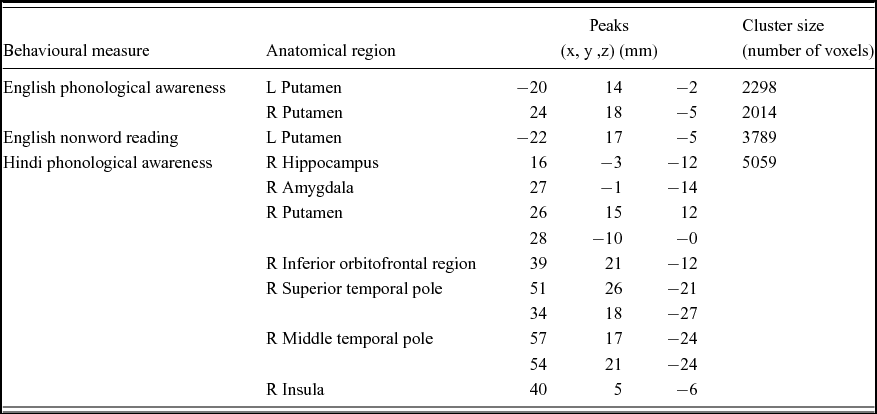
Details of clusters where GMV showed significant correlations with various behavioural measures (at cluster level FWE p < 0.05)

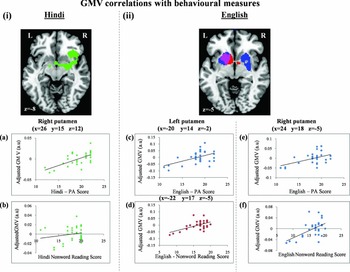
Figure 1 illustrates the results of the whole-brain analyses in which adjusted GMV was correlated against participants’ PA and nonword reading scores in L1 and L2 respectively. PA scores in Hindi showed a strong positive correlation with a large cluster covering right subcortical regions including the putamen as well as temporal regions (cluster level FWE, p < 0.05) (Figure 1.(i), graph (a)). At the whole-brain level, no suprathreshold clusters were found for the correlation between GMV and Hindi nonword reading.
Results of whole-brain correlation analyses between GMV and behavioural measures in (i) Hindi and (ii) English are shown. Axial section in (i) shows a right putamen cluster (green) exhibiting significant correlations with Hindi phonological awareness (PA) scores in the whole brain analysis (Graph (a)). Subject-wise GMV values in the same right putamen cluster are plotted against Hindi nonword reading scores in post-hoc analysis, revealing a trend toward positive correlation (r=0.19) (Graph (b)). Axial section (ii) shows clusters in bilateral putamen (blue) significantly correlated with English PA scores (graphs (c) and (e)) and a left putamen cluster (red) correlated with English nonword reading scores (Graph (d)). Purple regions indicate overlap between left putamen clusters. Graph (f) shows GMV values in right putamen cluster (blue) initially associated with English PA plotted against English nonword reading scores in a post-hoc analysis (r= 0.53).

PA scores in L2 English showed a positive correlation with GMV in putamen bilaterally (cluster-level FWE, p < 0.05) (Figure 1.(ii), graphs (c) and (e)), while L2 nonword reading showed a positive correlation with GMV in an overlapping cluster in a left putamen cluster (cluster level FWE, p < 0.05) (Figure 1.(ii), graph (d)) that overlapped with the bilateral cluster identified for PA.
Although GMV in the right putamen was found in the whole-brain analyses to be significantly correlated with PA in both L1 and L2, its relationship with decoding skill (as measured by nonword reading) could not be clearly determined through the initial whole-brain analyses. Therefore, these results motivated a separate set of post-hoc correlation analyses whose primary objective was to delineate the involvement of the right putamen in H–E biliterate children's reading.
In the post-hoc correlation analyses, two clusters were selected from the results of the whole-brain analyses: the right putamen cluster which had previously exhibited a correlation between GMV and English PA, and a second right putamen cluster that had shown a correlation between GMV and Hindi PA. For each cluster, extracted GMV values were then correlated with participants’ nonword reading scores in respective language. Results revealed a significant correlation between the English PA-based cluster and children's nonword reading scores in English (r = 0.53, p = 0.002) (Figure 1.(ii) - graph (f)), and a non-significant but positive relationship between GMV in the Hindi PA-based cluster and children's performance on Hindi nonword reading (r = 0.19, p = 0.31) (Figure 1.(i) - graph (b)).
Discussion
This study examined the relationship between brain structure and phonological and reading skill in Hindi–English biliterate children by comparing measures of grey matter volume (GMV) against participants’ performance on phonological awareness and decoding tasks. The results revealed a strong association between GMV in the putamen and children's reading-related cognitive skills in both L1 and L2.
Children's behavioural performance exhibited high levels of accuracy on measures of both phonological awareness and reading in Hindi as well as English (Table 1). The performance on reading task showed differences reflecting orthographic depth of the two languages. Further, word reading and alliteration scores were higher in the English, owing to its use in instruction at school. On the other hand, spoonerism tasks showed higher scores in Hindi, owing to the relatively easier manipulations at syllable level as compared to phoneme level in English.
The VBM results revealed robust correlations between GMV and measures of phonological awareness (PA): in L1 (Hindi), PA was correlated with GMV in the right putamen, while PA in L2 (English) was correlated with GMV in bilateral putaminal clusters. Further, a clear association emerged between English nonword reading and a left putamen cluster. Additional cluster-level analyses strengthened the association between putamen and reading ability by demonstrating a strong relationship between GMV in the same right putamen cluster initially linked to English PA; GMV in the right putamen was positively but not significantly linked to Hindi nonword reading.
Our results thus provide converging evidence for a strong association between GMV in the putamen and measures of reading-related skills in both L1 and L2 of Hindi–English biliterate children. To our knowledge, this study is the first to identify the anatomical correlates of phonological skills in bilingual, biliterate children.
An important result of this study was the finding of distinct patterns of association between the neuroanatomical substrates of literacy in Hindi versus English among biliterate children. Thus, PA and nonword reading in Hindi were correlated with GMV in the right putamen, whereas these measures for English exhibited correlations with bilateral putamen clusters. We account for this difference in terms of the differences in the orthography-to-phonology mappings of these two languages, and interpret the result as follows.
The Hindi akshara, the basic unit of writing, represents approximately one spoken syllable (Nag, Caravolas & Snowling, Reference Nag, Caravolas and Snowling2011). Initial literacy instruction in alphasyllabic orthographies like Hindi focuses on acquisition and mastery of the aksharamālā or repertory of characters, and on learning to read by assembling simple aksharas (Nag, Reference Nag2007; Tiwari, Nair & Krishnan, Reference Tiwari, Nair and Krishnan2011). Although data on phonological awareness in beginning Hindi readers is unavailable, evidence from alphasyllabaries like Kannada and Telugu indicates that successful early readers of these languages exhibit awareness of syllable but not phoneme level units (Vasanta, Reference Vasanta2004; Nag, Reference Nag2007), suggesting that early reading in an alphasyllabary may rely predominantly on phonological awareness at the level of syllables.
In contrast, learning to read in English requires phonological awareness of both phonemes and syllables – mastering grapheme to phoneme correspondences fosters phoneme-level skills, while reading by analogy promotes awareness of syllable structure, especially of the rime as a key to decoding syllables (Melby-Lervåg & Lervåg, Reference Melby-Lervåg and Lervåg2011). Reflecting this difference, the current study employed measures of phonological awareness (rhyming and spoonerism tasks) that could be successfully performed in Hindi by relying solely on syllable level phonological awareness, whereas performance on the English spoonerism task also required awareness at the phonemic level.
In light of the above distinction whereby the phonological skills that support early literacy in Hindi are likely syllable-oriented whereas those in English rely on both syllable and phoneme awareness, it is noteworthy that previous research on speech processing has demonstrated that phonemes, being smaller sound units, require rapid temporal processing that is accomplished by regions in the left hemisphere (Giraud & Poeppel, Reference Giraud and Poeppel2012; Morillon, Liégeois-Chauvel, Arnal, Bénar & Giraud, Reference Morillon, Liégeois-Chauvel, Arnal, Bénar and Giraud2012; Hartzell, Davis, Melcher, Miceli, Jovicich, Nath, Singh & Hasson, Reference Hartzell, Davis, Melcher, Miceli, Jovicich, Nath, Singh and Hasson2015). Syllables on the other hand are larger phonological units, and have been shown to recruit areas in the right hemisphere (Vigneau, Beaucousin, Hervé, Jobard, Petit, Crivello, Mellet, Zago, Mazoyer & Tzourio-Mazoyer, Reference Vigneau, Beaucousin, Hervé, Jobard, Petit, Crivello, Mellet, Zago, Mazoyer and Tzourio-Mazoyer2011). In line with these reports and in keeping with the Hindi–English differences outlined above, our findings show that phonological awareness measures in Hindi were correlated with GMV in the right putamen, while PA in English was correlated with bilateral regions of the putamen.
Likewise, the nonword reading tasks employed in our study were aimed at tapping into differences in grapheme-to-phoneme mapping strategies in the two languages. Analyses comparing nonword reading with brain structure demonstrated that English nonword reading was correlated with the GMV of clusters in both left and right putamen, whereas a positive (though not significant) relationship emerged between Hindi nonword reading and the right putamen. This finding further reinforced the initial link between putamen GMV and children's phonological awareness, and also confirmed the differential involvement of putamen areas in decoding in Hindi (right-lateralized) and English (bilateral). This is consistent with the psycholinguistic grain size hypothesis (Ziegler & Goswami, Reference Ziegler and Goswami2005) in that instruction in languages with distinct phonological grain size promotes different strategies of orthography-phonology mapping, which are cemented during reading development.
Despite differences in lateralization, the current results demonstrate an overarching similarity in the role of the putamen in phonological processing during reading in both Hindi and English. Interestingly, behavioural studies on bilingual children have previously revealed that phonological awareness transfers across languages and is often highly correlated across languages (Durgunoğlu, Nagy & Hancin-Bhatt, Reference Durgunoğlu, Nagy and Hancin-Bhatt1993; Geva & Wang, Reference Geva and Wang2001; Gottardo, Yan, Siegel & Wade-Woolley, Reference Gottardo, Yan, Siegel and Wade-Woolley2001; Durgunoğlu, Reference Durgunoğlu2002; Durgunoğlu, Reference Durgunoğlu2002). These reports hint at language-independent mechanisms underlying phonological skills in bilinguals, which we observed in our findings as well. Additionally, the consistent correlation in the present results between GMV in the putamen and decoding skills in English suggests that reading skills in the L2 of early biliterates may be critically modulated by their phonological abilities. This is supported by a vast body of research showing phonological ability to be a strong and significant predictor of reading skills (Ziegler & Goswami, Reference Ziegler and Goswami2005; Melby-Lervåg & Lervåg, Reference Melby-Lervåg and Lervåg2011).
It is noteworthy that previous studies of bilinguals have consistently reported an increase in putamen activity in L2 processing, which was often ascribed to effortful articulatory processing (Klein, Zatorre, Milner, Meyer & Evans, Reference Klein, Zatorre, Milner, Meyer and Evans1994; Klein, Milner, Zatorre, Meyer & Evans, Reference Klein, Milner, Zatorre, Meyer and Evans1995; Abutalebi, Cappa & Perani, Reference Abutalebi, Cappa and Perani2001; Perani & Abutalebi, Reference Perani and Abutalebi2005; Klein, Watkins, Zatorre & Milner, Reference Klein, Watkins, Zatorre and Milner2006). Several studies have also connected the putamen with speech control (Price, Green & Von Studnitz, Reference Price, Green and Von Studnitz1999; Hervais-Adelman, Moser-Mercer, Michel & Golestani, Reference Hervais-Adelman, Moser-Mercer, Michel and Golestani2014). In addition to the above, recent findings have revealed a fresh link between putamen structure and acquisition and control of articulatory and phonological repertoire in multilinguals (Abutalebi et al., Reference Abutalebi, Rosa, Castro Gonzaga, Keim, Costa and Perani2013).
Although the role of putamen in speech was already well established, its involvement in phonological processing during reading was first reported in a PET study which demonstrated that literates activated the putamen during production of novel sound sequences, and also outperformed illiterates (Castro-Caldas, Petersson, Reis, Stone-Elander & Ingvar, Reference Castro-Caldas, Petersson, Reis, Stone-Elander and Ingvar1998). Another study using PET demonstrated a correlation between successful phonological processing and putamen activity, concurrent with the notion that putamen mediates phonological processing (Tettamanti, Moro, Messa, Moresco, Rizzo, Carpinelli, Matarrese, Fazio & Perani, Reference Tettamanti, Moro, Messa, Moresco, Rizzo, Carpinelli, Matarrese, Fazio and Perani2005). Past studies have provided evidence linking putamen with speech and phonological processing (Preston, Frost, Mencl, Fulbright, Landi, Grigorenko, Jacobsen & Pugh, Reference Preston, Frost, Mencl, Fulbright, Landi, Grigorenko, Jacobsen and Pugh2010). To the best of our knowledge, the current study presents, for the first time, evidence linking putamen with phonological and literacy in bilingual, biliterate children.
As yet, it is unclear whether higher putaminal volume is a consequence of experience-dependent neural plasticity in biliterates or whether it is a predisposing factor for developing successful biliterate phonological skills. Untangling these effects is beyond the scope of the current study, but presents an important avenue for future research.
The current study hence revealed several important facets of the neural bases of reading development in biliterate readers of languages with highly dissimilar orthographies. Our findings showed distinct patterns of association within the same neuroanatomical substrate, namely the putamen, with reading-related skills in Hindi and English. These anatomical markers were not only linked with children's phonological abilities, but also their decoding skills. It is possible that simultaneous reading instruction may have significantly contributed to the early emergence of divergent patterns of correlation between putamen and reading-related skills in L1 and L2. However, the present findings are insufficient to claim any advantage of dual-language learning setting which have been previously reported (Berens, Kovelman & Petitto, Reference Berens, Kovelman and Petitto2013). Convergent results from reading and PA tasks in English agree with theories of reading development in that reading skills in a language hinge on access to phonological representations of the language (Perfetti, Reference Perfetti1992). Additionally, the observed cross-linguistic correlations in various domains ranging from reading to phonological skills are in line with early theories of bilingual language development (Cummins, Reference Cummins1979; Geva & Wang, Reference Geva and Wang2001), despite distinct characteristics of the languages learnt.
To sum up, the current study demonstrates that the neural bases of reading skill development reflect unique features of the orthographies used to represent different languages as well as differences in instructional strategies. These findings once again underscore the need for research that focuses on diverse bi- and multi-lingual contexts in exploring the critical cognitive skill of reading.