

1. Introduction
Does economic inequality between ethnic groups induce states to use repressive measures?Footnote 1 Scholars have found that reinforcing cleavages along economic and ethnic dimensions are an important source of domestic grievances and conflicts, including civil wars, secessionist conflicts and democratic breakdowns (Cederman et al., Reference Cederman, Weidmann and Gleditsch2011; Deiwiks et al., Reference Deiwiks, Cederman and Gleditsch2012; Houle, Reference Houle2015; Østby, Reference Østby2008; Østby et al., Reference Østby, Nordås and Rød2009).Footnote 2 Despite the strong relationship between ethnic inequality and ongoing domestic instability, existing studies have not considered that states have various tools at their disposal to counter the likelihood of domestic instability arising from ethnic inequality. Our article focuses on one of these tools, repressive measures, which leaders use to address domestic challenges and maintain power (Nordas and Davenport, Reference Nordas and Davenport2013).
States often use coercive measures to control potential domestic conflicts arising from economic inequality between ethnic groups. For instance, ethnic tension between indigenous and nonindigenous groups in Guatemala is partly caused by the extreme level of ethnic inequality.Footnote 3 The grievances and resentment among indigenous populations create potential threats to government stability and, hence, lead to increasing use of repressive measures by the government (Pallister, Reference Pallister2013).Footnote 4 In another example, protests from majority ethnic groups (Oromos) were met with repressive measures from a minority-led (Tigrayan) Ethiopian government.Footnote 5 Grievances among Oromos were mainly caused by persistent economic inequality between Oromos and other ethnic groups under the Tigrayan government led by Prime Minister Meles Zenawi.Footnote 6
Our contention is that inequality between ethnic groups increases the level of states’ repressive measures. We argue that reinforcing cleavages along economic and ethnic lines increase grievances in society and promotes ethnic mobilization, posing a severe destabilizing threat to the government in power. Given that most political leaders want to maintain their positions in power, when there are a greater number of perceived threats, it is more likely that repressive measures will be employed to counteract those threats—all else being equal (Nordas and Davenport, Reference Nordas and Davenport2013). Furthermore, we argue that democracies are able to moderate the impact of ethnic inequality on state repression. Various institutional mechanisms in democracies hold political leaders accountable; these mechanisms increase the costs of repression and reduce leaders’ incentives to employ coercive measures, even when facing high levels of ethnic inequality. Using a dataset covering 152 countries from 1992 to 2011, we find strong support for our arguments. Our main results are robust to instrumental variable techniques, the inclusion of additional controls and alternative model specifications. We further examine the potential mechanism that ethnic inequality increases perceived threats to governments by fuelling political instability. Using political dissent data from the Cross-National Time-Series Data Archive (Banks, Reference Banks2014), we also find evidence for this claim. Finally, we explore whether ethnic inequality affects state repression directly or indirectly through political instability. This research is an attempt to detect the existence of both pre-emptive (direct effect) and reactive repression (indirect effect) against political dissent when ethnic inequality arises. The empirical results indicate that ethnic inequality relates to state repression both directly and also indirectly through its influence on domestic political instability.
This study makes several contributions. First, our article echoes previous studies emphasizing the devastating consequences of ethnic inequality on domestic politics. However, the extant scholarship has paid little attention to how leaders counteract the destabilizing impact of ethnic inequality. We contribute to the literature by investigating an important tool of state control and find that ethnic inequality increases the level of state repression. Second, following Nordas and Davenport (Reference Nordas and Davenport2013), we argue that states can act both reactively and proactively in confronting domestic threats. Repressive measures are attractive strategies for governments to either pre-empt or counter potential instability. Finally, this article speaks to the literature that investigates the effect of ethnic diversity and ethnic exclusion on state repression (Buhaug et al., Reference Buhaug, Cederman and Gleditsch2014; Lee et al., Reference Lee, Lindstrom, Moore, Turan, Carey and Poe2004; Rørbæk and Knudsen, Reference Rørbæk and Knudsen2017). While controlling for ethnic fractionalization and ethnicity-based political exclusion, we still find evidence that reinforcing cleavages along economic and ethnic lines increase the level of state repression. Therefore, our finding on between-group economic inequality is not simply a reflection or artifact of the impact of ethnic diversity or ethnicity-based political inequality; it also suggests that exploring the various consequences of distributional conflicts among ethnic groups, rather than the general structure of ethnicity, would be a fruitful direction for future research.
The remainder of the article is organized as follows: In the second section, we review the logic and main determinants of state repression, with an emphasis on how perceived threats increase states’ coercive measures. In the third section, we discuss the links between ethnic inequality, perceived dissent and repression, and we derive our two hypotheses. In the fourth section, we present the data and research design, followed by our empirical findings and discussion. In the final section, we offer our conclusions.
2. The Logic and Determinants of State Repression
Scholars have suggested that state repression can be best understood by studying why political leaders employ coercive measures (Davenport, Reference Davenport2007; Davenport and Armstrong, Reference Davenport and Armstrong II2004). Generally, political leaders calculate the costs and benefits of employing repressive measures: the higher the costs, the less likely that repression will be employed.Footnote 7 Existing studies mostly focus on the costs of using repressive strategies when examining their determinants. The literature has identified two factors that are the most robust predictors of state repression: democratic institutions and domestic dissent (Davenport, Reference Davenport2007).
Democratic regimes have a low level of state repression because the cost of repression is higher in democracies, where various institutional mechanisms hold political leaders accountable and constrain leaders’ overuse of coercive action (Davenport, Reference Davenport2007; Davenport and Armstrong, Reference Davenport and Armstrong II2004; Poe and Tate, Reference Poe and Tate1994). Domestic dissent is the other consistent predictor. Domestic conflicts challenge the status quo and increase states’ assessment of the threat, making the cost of repression seem acceptable to rulers. Coercive measures are exercised to counter such threats. These measures also signal that the regime is still in control of its territorial jurisdiction (Davenport and Armstrong, Reference Davenport and Armstrong II2004). Related to this, the potential dissent and perceived threats to governments are found to be important explanatory factors of state repression (Davenport, Reference Davenport1995; Nordas and Davenport, Reference Nordas and Davenport2013). For instance, Nordas and Davenport (Reference Nordas and Davenport2013) find that a youth bulge increases perceived threats to governments due to the potential rebelliousness of the youth. Thus, those governments are more likely to engage in state repression to control potential instability.
Ethnic inequality is found to be associated with increased levels of domestic dissent, ethnic mobilization and collective grievances (Hillesund, Reference Hillesund2015; Langer, Reference Langer2005; Stewart, Reference Stewart2002; Vadlamannati, Reference Vadlamannati2011). For instance, Langer (Reference Langer2005) reveals that ethnic inequality spurs violent group mobilization by facilitating ethnic elites to mobilize their supporters using ethnic cues. Additionally, scholars have examined the impact of ethnic inequality on domestic violence using cross-national analyses. They find that economic inequality between ethnic groups is related to civil wars (Cederman et al., Reference Cederman, Weidmann and Gleditsch2011; Østby, Reference Østby2008; Østby et al., Reference Østby, Nordås and Rød2009), secessionist conflicts (Deiwiks et al., Reference Deiwiks, Cederman and Gleditsch2012) and democratic breakdowns (Houle, Reference Houle2015). Obviously, ethnic inequality can have a detrimental impact on domestic stability, so it increases the perceived threats to ruling governments. However, the effect of ethnic inequality on state repression has yet to be theorized and empirically tested. Rulers may employ repressive measures to counter domestic threats to stay in power. Thus, this study investigates how perceived threats arising from ethnic inequality enter into governments’ cost-benefit calculation of employing repressive measures. We detail our theoretical argument below.
3. Ethnic Inequality and State Repression
We argue that ethnic inequality has the potential to generate domestic distributive conflicts between poor and rich ethnic groups. Furthermore, ethnic identity, along with economic inequality between ethnic groups, intensifies ethnic tensions by facilitating ethnic mobilization (Langer, Reference Langer2005). Hence, ethnic identity increases each group's collective action capability to pursue their opposing material goals. A poor ethnic group would demand more redistribution, whereas a rich ethnic group would prefer less redistribution. Ethnic grievances accompanied by high mobilization capability increase the likelihood of challenges to states, leading to high levels of perceived threats to governments. Thus, ethnic grievances generate motivation for political leaders to employ repressive measures to address the potential threats. The greater the perceived threat to the regime, the more likely that political leaders will make use of coercive measures (Nordas and Davenport, Reference Nordas and Davenport2013).
When inequality between ethnic groups increases in a society, the change is likely to produce higher levels of domestic grievances. First, an unequal distribution of wealth along ethnic lines will create distributive conflicts between rich and poor ethnic groups. On the one hand, a disadvantaged ethnic group feels relative deprivation and demands more government redistribution. On the other hand, a privileged ethnic group may resist redistribution because it takes away its wealth to subsidize the poor of different ethnic groups. Thus, ethnic inequality is likely to generate grievances for both poor and rich ethnic groups, due to the distributive tensions between them (Cederman et al., Reference Cederman, Weidmann and Gleditsch2011; Houle, Reference Houle2015).
Second, a high level of between-group economic inequality increases the salience of ethnic identity and helps create in- and out-group comparisons (Cederman et al., Reference Cederman, Weidmann and Gleditsch2011). This comparison is a potential source of domestic instability and grievances. Increased salience of ethnic identity helps each ethnic group at different rungs of the socio-economic ladder pursue their opposing agendas regarding the redistribution of state resources. This process potentially destabilizes ruling governments because either the poor or rich ethnic group is likely to feel dissatisfaction with the redistributive policies implemented by the government. Utilizing ethnic identity, ethnic elites can easily mobilize their group members because ethnic cues and identity-based sanctions promote group cohesion and ease the collective action problem for political action (Cederman et al., Reference Cederman, Weidmann and Gleditsch2011).
Therefore, we argue that ethnic inequality increases domestic grievances and the salience of ethnic identity, which are two important sources of potential instability. A society in which economic inequality coincides with ethnic cleavages is exposed to the risk of political dissent (Cederman et al., Reference Cederman, Weidmann and Gleditsch2011; Houle, Reference Houle2015; Østby, Reference Østby2008; Østby et al., Reference Østby, Nordås and Rød2009). States can either anticipate domestic dissent or experience outright conflict in the presence of high ethnic inequality. Those anticipated or manifested domestic instabilities increase the perceived threats to governments. A large perceived threat is likely to generate motivation for governments to use repressive strategies as responses (Nordas and Davenport, Reference Nordas and Davenport2013). Furthermore, since ethnic identity can increase the efficiency of repression by facilitating the targeting of those groups that challenge the state (Moore, Reference Moore1995), perceived threats arising from ethnic inequality may make using coercive measures an attractive strategy to address potential dissent. Our first hypothesis follows the theoretical discussion:
Hypothesis 1:
Countries with higher levels of ethnic inequality are likely to experience higher levels of repression than countries with lower levels of ethnic inequality.
Studies have found that democracies reduce states’ use of repressive strategies (Davenport, Reference Davenport2007; Davenport and Armstrong, Reference Davenport and Armstrong II2004; Poe and Tate, Reference Poe and Tate1994). For instance, Poe and Tate (Reference Poe and Tate1994) argue that democratic states have less incentive to use violence due to their emphasis on democratic values and institutional constraints. Building on these insights, we further argue that the impact of ethnic inequality on state repression is likely to be moderated by the level of democracy. Democratic institutions and accountability affect political leaders’ cost-benefit assessment of using repressive measures. Those features in more democratic countries would make the cost of using a repressive strategy higher than it would be in more authoritarian countries. First, the level of political accountability differs in accordance with the level of democracy. Compared to more authoritarian countries, more democratic countries allow real political opposition and a free press, which means incidents of coercive measures are usually quickly and widely exposed to the general public and media.Footnote 8 This type of exposure substantially increases the political and electoral costs of repression in democracies. Relatedly, the development of democratic institutions is likely to hamper leaders’ use of repressive strategies. Even if top executives have strong incentives to use coercive measures, they may not able to do so if other political institutions, such as legislative bodies or judicial institutions, oppose it. Studies have shown that decision-making processes in developed democracies are highly institutionalized (Martin and Vanberg, Reference Martin and Vanberg2011), so political leaders may not able to unilaterally employ repressive measures, even when they have motivations to do so. We therefore propose a second hypothesis:
Hypothesis 2:
As the level of democracy rises, the impact of ethnic inequality on state repression decreases.
4. Data, Measurement and Research Design
Dependent variables
Following mainstream research on state repression, we employ three commonly used indexes of governments’ coercive measures: (1) physical integrity rights from Cingranelli and Richards (Reference Cingranelli and Richards2010, hereafter CIRI), (2) physical integrity rights from the Political Terror Scale (PTS) and (3) latent human rights protection from Fariss (Reference Fariss2014). CIRI codes the degree of governments’ respect for physical integrity rights and quantifies cases where governments use excessive force, ranging from 0 (no respect for physical integrity rights) to 8 (full respect for physical integrity rights). For easier interpretation, we reverse the scale of the original CIRI measure, so a higher value indicates more state repression.
We also test our claim using PTS data (Gibney et al., Reference Gibney, Cornett, Wood and Haschke2012). The coding of PTS data produces two separate indexes—from the US State Department's Country Reports on Human Rights Practices and from the Amnesty International annual report. Each PTS index captures physical integrity rights using an ordinal variable of five categories. These two indexes have slightly different coverage, and both have been criticized for possible biases (Poe et al., Reference Poe, Carey and Vazquez2001). Following various scholarship (Daxecker and Hess, Reference Daxecker and Hess2013; Demirel-Pegg and Moskowitz, Reference Demirel-Pegg and Moskowitz2009), we therefore use the average of these two indexes to counterbalance biases. The average PTS index takes on nine values, ranging from 1 to 5, with an incremental increase of 0.5.Footnote 9 A higher value indicates more state repression.
Finally, we use a recent dataset on human rights protection as a third dependent variable. Fariss (Reference Fariss2014) calculated a latent estimate of human rights protection to correctly address agents’ changing standards of assessing state behaviours over time. Because the Fariss index measures human rights protection rather than human rights violation, a higher value indicates stronger human rights protection and less state repression.Footnote 10
Independent variable
Alesina et al. (Reference Alesina, Michalopoulos and Papaioannou2016) calculated the estimate of ethnic inequality by comparing satellite images of luminosity across historic homelands of each ethno-linguistic group. Using luminosity per capita as a proxy for economic development,Footnote 11 this new measure of ethnic inequality captures differences in mean income across ethnic groups and reflects the overall level of ethnic inequality in a given country. The data cover a global sample for three time points: 1992, 2000 and 2012. To construct the annual level of ethnic inequality, we linearly interpolated the ethnic inequality measure.Footnote 12 Alesina et al. (Reference Alesina, Michalopoulos and Papaioannou2016) provide two measures based on different geo-ethnic information data: Ethnologue (Gordon, Reference Gordon2005) and the Geo-referencing of Ethnic Groups (GREG) data (Weidmann et al., Reference Weidmann, Rod and Cederman2010). Since GREG-based data have a greater country coverage, we report the main results using the GREG data.Footnote 13 A detailed explanation on how Alesina et al. (Reference Alesina, Michalopoulos and Papaioannou2016) measure ethnic inequality can be found in the online appendix.
Studies on state repression have long argued the impact of democracy in reducing states’ coercive measures (Davenport, Reference Davenport2007). We include a continuous measure of democracy using Polity2 scores (Polity IV dataset, Marshall et al., Reference Marshall, Jaggers and Gurr2014). We add a value of 10 to this index for easier interpretation. We also include an interactive term between ethnic inequality and Polity2 to test Hypothesis 2.
Control variables
Countries experiencing inter- or intra-state wars are found to have higher levels of state repression (Davenport, Reference Davenport2007). Thus, we include two dummy variables to capture ongoing civil war and interstate war from the UCDP/PRIO Armed Conflict Dataset. These war variables are coded as 1 when there is an ongoing war in a given country-year (otherwise it is coded as 0). The relationship between state repression and ethnic inequality cannot be tested without controlling for relevant economic factors, given that ethnic inequality is likely to be associated with economic underdevelopment (Alesina et al., Reference Alesina, Michalopoulos and Papaioannou2016). We include the gross domestic product (GDP) per capita and annual GDP growth from the World Development Indicators (WDI). We use the natural logarithm for GDP per capita variable. Given that countries with larger populations tend to engage in repressive strategies due to limited political and economic resources (Walker, Reference Walker2007), we also include a natural logarithm of population size from the WDI. We also include the natural logarithm of oil and gas income per capita in 2000 US dollars (Ross, Reference Ross and Mahdavi2015), since countries with abundant natural resources may have higher levels of inequality (Fum and Hodler, Reference Fum and Hodler2010) and tend to use more repressive measures (Hill and Jones, Reference Hill and Jones2014). Finally, we include an ethnic fractionalization measure (Alesina et al., Reference Alesina, Devleeschauwer, Easterly, Kurlat and Wacziarg2003). Since ethnic inequality is the main independent variable, it would be important to show that our finding is not merely a reflection of other features of ethnicity, such as ethnic fractionalization. The summary statistics for all variables are shown in Table A3 in the online appendix, and all the countries in our sample are listed in Table A4.
Model specification
Our dataset has a time-series cross-sectional (TSCS) structure. The unit of analysis is country-year.Footnote 14 We use a Prais-Winsten estimation with a first-order panel-specific autocorrelation structure and panel-corrected standard errors to control panel heterogeneity, contemporaneous correlation and the time dependency of state repression (Beck and Katz, Reference Beck and Katz1995). We also include regional and half-decade dummiesFootnote 15 to account for unobserved region-specific factors, time trends and time-specific shocks. All explanatory variables are lagged one year.
5. Results and Discussion
Before discussing cross-national evidence regarding the impact of ethnic inequality on state repression, we present three neighbouring country pairs. These country pairs are similar in other country characteristics except for ethnic inequality and state repression. This provides illustrative evidence for the positive linkage between ethnic inequality and state repression (using 2000 data). Compared to its neighbour Chile (ethnic inequality: 0.6), Peru has a higher level of ethnic inequality between indigenous and nonindigenous populations (ethnic inequality: 0.9). Peru happens to have a lower level of respect for human rights (Fariss index: −0.3) than Chile (Fariss index: 0.6). Two neighbouring country pairs in the Middle East and North Africa also reveal a positive relationship between ethnic inequality and state repression: Morocco (ethnic inequality: 0.2; Farris index: 0.4) versus Algeria (ethnic inequality: 0.9; Farris index: −1.2), and Kuwait (ethnic inequality: 0.1; Fariss index: 1.2) versus Iraq (ethnic inequality: 0.7; Farris index: −2.0). We further test our argument to account for potential confounding factors in the cross-national multivariate analysis.
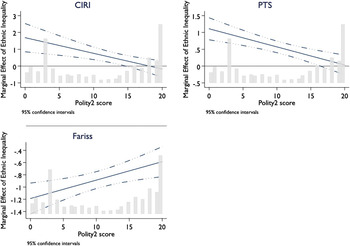
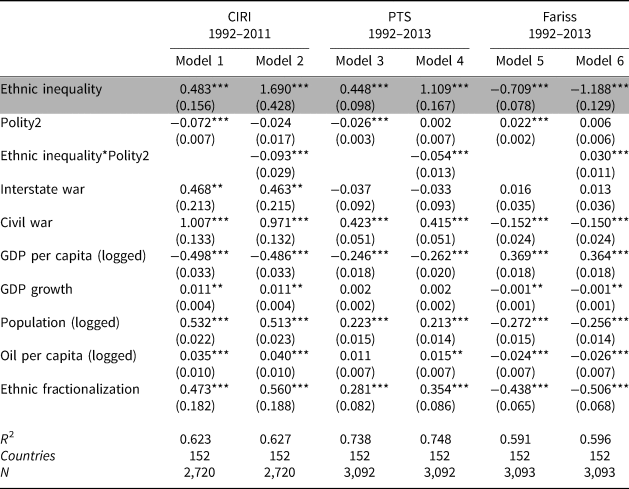
Table 1 shows the estimated effect of ethnic inequality on state repression in the multivariate analysis. Models 1, 3 and 5 are estimations without the interaction, while Models 2, 4 and 6 are with interaction terms. We test our argument using three different measures of state repression and find support for our claim. As expected, the coefficient estimate for ethnic inequality is positive and statistically significant when we use two measures of state repression (CIRI and PTS indexes), while the coefficient estimate is negative and statistically significant with the measure of human rights protection (Fariss index). The results strongly support Hypothesis 1: that a higher level of ethnic inequality is associated with more state repression. Importantly, we also find that the level of democracy significantly moderates the relationship between ethnic inequality and state repression, as suggested by Hypothesis 2. To clarify the moderating effect of democracies, we generate a marginal effect plot of ethnic inequality at different levels of democracy. Figure 1 clearly shows that the impact of ethnic inequality is more pronounced in more authoritarian countries. However, its impact diminishes as the level of democracy increases.
Marginal Effect of Ethnic Inequality at Different Levels of Democracy

The Effect of GREG-Based Ethnic Inequality on State Repression

Note: All models are estimated with Prais-Winsten correction for panel-specific AR1 process. The numbers in parentheses are panel-corrected standard errors. All regressions include decade and regional dummy variables. All explanatory variables are lagged one year. Decade and regional dummies, as well as intercepts, are omitted to conserve space. ***p < = .01; **p < = .05; *p < = .1
Regarding control variables, the results are broadly in line with previous studies. We find that there is more repression in countries experiencing ongoing civil war, with lower levels of economic development and with larger population sizes. The results also show that resource-rich countries tend to be more repressive. Finally, we find that countries with a greater ethnic diversity experience a higher level of state repression.
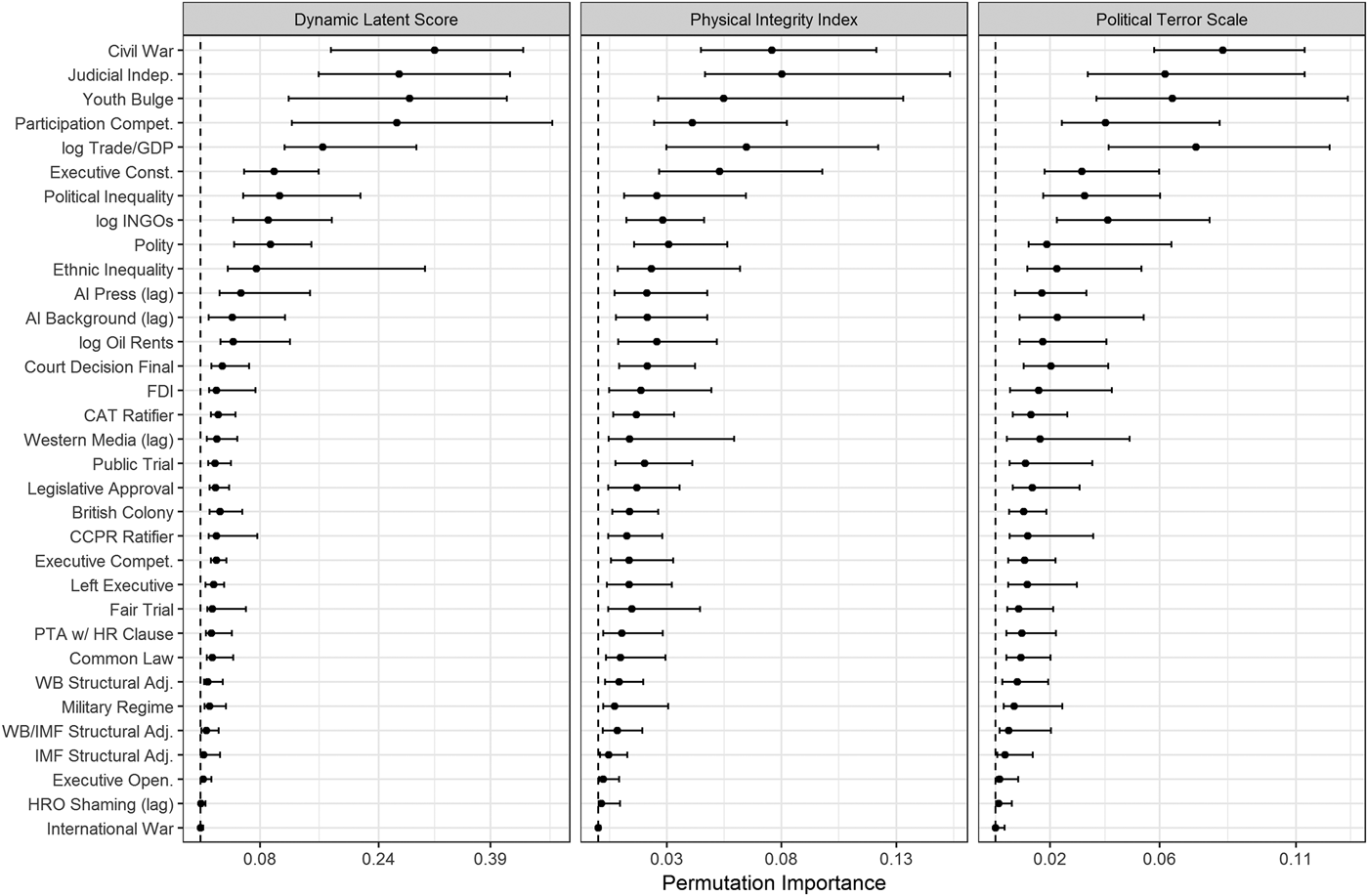
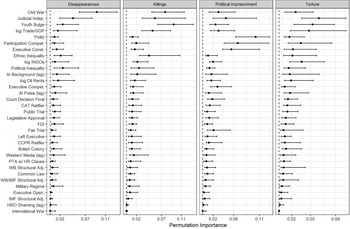
A number of recent studies propose that the algorithmic approach of fitting random-forest is a better way to clarify the relationship between primary variables and the dependent variable than traditional approaches (Hill and Jones, Reference Hill and Jones2014; Muchlinski et al., Reference Muchlinski, Siroky, He and Kocher2016). Building on the algorithmic approach, we investigate the predictive power of ethnic inequality using random-forest and assess the substantive effect of ethnic inequality on repression. In the state repression literature, Hill and Jones (Reference Hill and Jones2014) and Frantz et al. (forthcoming) assess the relative importance of each covariate by fitting random-forest. We follow their approach and generate permutation importance plots to examine the predictive power of ethnic inequality on state repression.Footnote 16 A permutation importance plot shows the mean increase in the prediction error if a specific variable is permuted in the model. The underlying logic behind this plot is that excluding/permuting an important independent variable will increase prediction error. On the other hand, excluding an unimportant independent variable will not affect prediction error. Figure 2 shows permutation importance plots with our three dependent variables. Similar to Hill and Jones (Reference Hill and Jones2014), we also generate additional plots (Figure 3) for each of the four components of the CIRI index: disappearance, killings, political imprisonment and torture. The predictive power of ethnic inequality is quite meaningful across all seven plots. Among the variables that Hill and Jones (Reference Hill and Jones2014) suggest as important predictors of state repression, the predictive power of ethnic inequality is at least comparable to that of the level of democracy. Additionally, it seems that ethnic inequality is one of the most important predictors of the disappearance and killings components of the CIRI (the fifth best predictor). To summarize, permutation importance plots confirm that the inclusion of ethnic inequality meaningfully improves the predictive power of the empirical model of state repression.
Marginal Permutation Importance of Independent Variables on State Repression Estimated Using Random Forest

Marginal Permutation Importance of Independent Variables on the CIRI Components Estimated Using Random Forest

Investigating potential mechanisms
Our theory suggests that ethnic inequality can be linked to state repression by fuelling distributive conflicts and generating political instability. To explore the potential mechanism, we first test the effect of ethnic inequality on measurable political instability. We use diverse forms of political instability, general strikes, riots, revolutions and anti-government demonstrations (Banks, Reference Banks2014) as dependent variables. In addition to employing these four indicators as the dependent variables, we also use two aggregated indexes—political dissent (the sum of general strikes, riots and demonstrations) (Nordas and Davenport, Reference Nordas and Davenport2013) and the conflict index (Banks, Reference Banks2014). As shown in Table A14 in the online appendix, we generally find that ethnic inequality is associated with political instability. This lends support to our argument that ethnic inequality increases perceived threats to rulers by fuelling distributive conflicts and domestic grievances. A detailed discussion of control variables, model specifications and empirical results can be found in the online appendix.
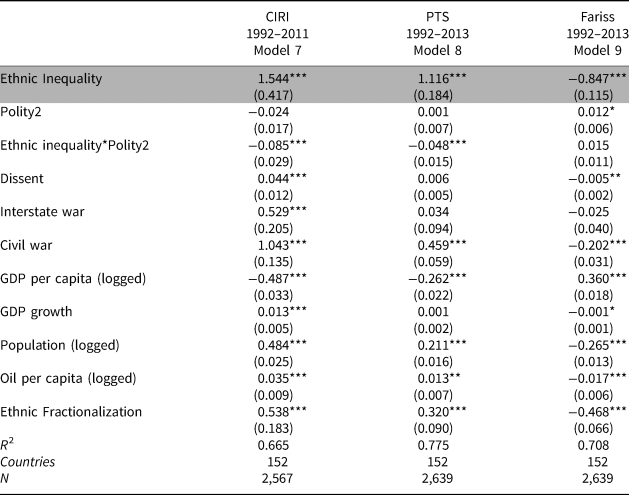
Additionally, we aim to understand whether states pre-emptively repress to address domestic grievances when ethnic inequality arises or whether they reactively respond to political instability caused by ethnic inequality using repressive measures. We therefore rerun our model with a political dissent variable. If the coefficient estimate for ethnic inequality is still significant, it would indicate states also employ pre-emptive repression to address high ethnic inequality. As shown in Table 2, the coefficient estimate for the dissent variable is mostly in the expected direction, indicating that states reactively use repressive measures. Importantly, coefficient estimates for ethnic inequality and the interaction term between ethnic inequality and Polity2 are statistically significant, suggesting that ruling leaders, particularly authoritarian ones, indeed pre-emptively engage in coercive measures to maintain their power when facing high levels of ethnic inequality. To summarize, these findings imply that states use repressive measures not only to reactively respond to ethnic inequality motivated political instability but also to pre-emptively address perceived threats arising from ethnic inequality, particularly in the context of authoritarian regimes.
The Impact of Ethnic Inequality on State Repression: Direct and Indirect Effect

Note: All models are estimated with Prais-Winsten correction for panel-specific AR1 process. The numbers in parentheses are panel-corrected standard errors. All regressions include decade and regional dummy variables. All explanatory variables are lagged one year. Decade and regional dummies, as well as intercepts, are omitted to conserve space. ***p < = .01; **p < = .05; *p < = .1
Robustness checks
We verify the robustness of our empirical results in the following ways. First, the relationship between ethnic inequality and state repression is open to the charge of endogeneity, regarding reverse causation. Ethnic inequality might well be a result of repressive or discriminatory practices by states targeting particular ethnic groups. While our theoretical framework posits that ethnic inequality is likely to increase state repression, we argue that state repression could either increase or decrease the level of overall ethnic inequality in a given country. Whether it increases the level or decreases it depends on the economic status of ethnic groups targeted by states’ repressive measures. Repressive measures may increase the level of ethnic inequality if they target poor ethnic groups, but they may decrease it if used against rich ethnic groups. In this case, the existence of reverse causation is likely to work against our finding on the positive relationship between ethnic inequality and state repression. There are several illustrative cases that states actually use repression against rich ethnic groups. Chua (Reference Chua2003) argues that the confrontation between economically dominant ethnic minorities and poor majority ethnic groups is an important source of political instability (for example: economically dominant ethnic minorities, such as Chinese minorities in the Philippines, Indonesia and Malaysia; Lebanese communities in Western Africa; the Igbo in Nigeria; and the Kikuyu in Kenya). Similar situations were noted by Stewart (Reference Stewart2002) in Uganda, Sri Lanka and South Africa. Resentment and confrontation may induce politically empowered majority poor groups to take repressive or discriminatory actions against those rich minorities (for example: Suharto in Indonesia against the Chinese minority, Robert Mugabe in Zimbabwe against white minority farmers), which would, to some extent, reduce the level of overall ethnic inequality.
We further address the concern of reverse causation by conducting an instrumental variable analysis. We use a geographic endowments inequality variable that captures inequality in geographic endowments across ethnic homelands. This variable has been used as an instrument for ethnic inequality by scholars such as Alesina et al. (Reference Alesina, Michalopoulos and Papaioannou2016) and Houle et al. (Reference Houle, Kenny and Park2019). Alesina et al. (Reference Alesina, Michalopoulos and Papaioannou2016: 1) argue that “differences in geographic endowments across ethnic homelands explain a sizable fraction of the observed variation in economic disparities across groups.” Following their approach, we calculate the geographic endowments inequality index. The correlation between this instrument and ethnic inequality variable is about 0.56. We then re-estimate our main models with a two-stage least-square estimator. As shown in Table A5 in the online appendix, we continue to find support for our argument. A detailed discussion of this analysis is shown in the online appendix.
Second, we use a multiple imputation method to fill in missing values for independent and dependent variables. Although ethnic inequality is relatively sticky over time in a given country, the evolving pattern of ethnic inequality may vary across different countries. Keeping that in mind, we include polynomials and interactions between polynomials and country units to allow patterns of ethnic inequality to vary across different countries when running multiple imputations (Honaker and King, Reference Honaker and King2010). Our main results are robust, as shown in Table A6 in the online appendix.
Third, we control for political inequality. Aside from economic inequality between ethnic groups, ethnicity-based political inequality is also a potential source of ethnic grievances. We use two indicators to capture between-group political inequality: the size of political exclusion measured as the sum of the excluded ethnic population relative to the total population (Rørbæk and Knudsen, Reference Rørbæk and Knudsen2017) and the degree of political discrimination measured as the size of the largest discriminated ethnic group relative to the joint size of the discriminated group and the group in power (Buhaug et al., Reference Buhaug, Cederman and Gleditsch2014). Both indicators are from the Ethnic Power Relations database (Wimmer et al., Reference Wimmer, Cederman and Min2009). Our results remain robust with controls of political inequality (Table A7 in the online appendix).
We then employ an alternative measure of ethnic inequality. Houle (Reference Houle2015) constructs a between-group economic inequality (BGI) index using multiple cross-national surveys. Using various survey data, he creates a group-level ethnic inequality dataset by calculating inequality between average income/wealth for a given ethnic group and average income/wealth for the given country. Using these group-level data, Houle calculates the country-level BGI index as a weighted average of group-level BGI. The coefficient estimates for ethnic inequality remain significant and have the expected signs in Table A8 in the online appendix, even though using Houle's BGI measure reduces our sample size from 152 countries to 76 countries.
In addition, we control for the level of social spending. Since political leaders have various tools at their disposal to address distributive conflicts, the employment of social policies may moderate the redistributive grievances arising from ethnic inequality. This means that governments may not need to rely on repressive measures if they choose to increase social spending. We thus re-estimate our main models by controlling two different proxies for social spending: government expenditure as a percentage of GDP and public health expenditure as a percentage of GDP from the WDI. As shown in Table A9 in the online appendix, our results are broadly robust. We also find that health expenditure reduces the level of state repression and increases human rights protection. Also, we control for vertical inequality, given that overall inequality may increase the likelihood of conflict (Bartusevicius, Reference Bartusevicius2014), which may lead to greater state repression as a response. Based on Bartusevicius (Reference Bartusevicius2014), we include two vertical inequality measures: income inequality from Solt (Reference Solt2009) and educational inequality from Benaabdelaali et al. (Reference Benaabdelaali, Hanchane, Kamal and A2012). Table A9 in the online appendix shows that our results are robust.
Furthermore, we test the robustness of our results using cross-sectional regressions and ordered logit estimations with the PTS data. Some may be concerned that our TSCS setup is likely to overestimate the correlation between ethnic inequality and state repression. Therefore, we test the robustness of our findings using a simple cross-sectional specification. We first run cross-sectional regressions by converting all independent and dependent variables at their means. We also use ethnic inequality in the year 2000 and examine how this correlates with state repression in the following 10 years, given that GREG-based ethnic inequality uses the territorial boundary of the year 2000 to measure ethnic homelands. Table A10 in the online appendix shows the coefficient estimates of cross-sectional regressions. Our results are generally similar. We also employ ordered logistic estimations for PTS indexes. We estimate models with two separate PTS indexes, one from the US State Department's Country Reports on Human Rights Practices and the other from the Amnesty International annual report. Table A11 in the online appendix shows our results are robust in the ordered logistic estimations.
Finally, we explore the possibility that governments would react with coercive measures only when confronting one particularly marginalized group. It is possible that the underprivileged poor group tends to nurse more grievances, so that group is more likely to challenge the government. Since our country-level measure of ethnic inequality does not allow us to disaggregate the inequality at the group level, we use two variables from Buhaug et al. (Reference Buhaug, Cederman and Gleditsch2014): the relative income gap between the income level for the richest group and the mean income, and the relative income gap between the mean income and the income level for the poorest group. Table A12 in the online appendix shows the results. We find that countries with larger sized economically highly marginalized groups (poorest) employ more coercive measures. Similar to the effect of ethnic inequality, the effect of marginalized groups is stronger in more authoritarian countries. Also, countries where the richest ethnic group outperforms other ethnic groups show a high level of state repression in estimations with CIRI and Fariss indexes, even though the moderating effect of Polity2 is only observed in estimations with the CIRI index. The empirical finding regarding the effect of relative income gaps on state repression is consistent with our theoretical argument. This finding confirms that between-group economic inequality generates redistributive conflicts for both rich and poor ethnic groups, posing a challenge to the stability of the states. Governments thus are likely to respond to perceived threats with repressive measures.
6. Conclusion
The presence of reinforcing cleavages, particularly ethnicity and class, has been found to be an important source of domestic grievances and conflicts. However, the current literature fails to answer questions about how states address the domestic instability arising from ethnic inequality. In this article, we focus on the strategy of using coercive measures, which are important tools for leaders to maintain domestic order and stay in power. We argue that states can employ repressive measures to counteract the potential destabilizing impact of ethnic inequality. Economic inequality between ethnic groups reinforces cleavages along economic and ethnic lines and creates collective grievances for ethnic groups. Ethnic inequality also increases ethnic salience and promotes group mobilization, posing a significant threat to the stability of a society and a government's prospect of staying in power. The greater the perceived threats, the more likely states are to employ coercive measures as responses. Using a sample of 152 countries from 1992 to 2011, we find strong support for our claim that a higher level of ethnic inequality leads to more state repression. We also find that democracies moderate the impact of ethnic inequality on state repression, likely due to the fact that various institutional mechanisms holding political leaders accountable raise the costs of employing coercive measures. In addition, we examine the possible channels linking ethnic inequality to state repression. We find that ethnic inequality increases perceived threats to governments by fuelling political instability. We further explore whether ethnic inequality affects state repression directly or indirectly through the channel of political instability. The empirical results suggest that states are likely to engage in both pre-emptive and reactive (via political instability) repressions when ethnic inequality arises.
Our study has important implications for future research. The empirical finding suggests that redistributive social policy (for example, health spending), by addressing domestic grievances and conflicts, can reduce the demand for repressive measures. This implies that states have multiple tools at their disposal to counteract the potential threats arising from ethnic inequality. Thus, one direction for future research is to explore the relationship between ethnic inequality, social policy and state repression. Specifically, there is considerable value in investigating what induces states to employ repressive measures rather than redistribution-oriented social policies when facing high levels of ethnic inequality. Additionally, the question of what type of social policy is the most effective in addressing redistributive conflicts between ethnic groups has not been answered. More fine-grained data on social policy need to be collected to examine these potential research topics. Relatedly, we may need detailed data on different categories of social spending—such as education, health, housing and welfare programs—that can benefit individuals at the lower end of the income scale.
Supplementary material
To view supplementary material for this article, please visit https://doi.org/10.1017/S0008423919000520.
Acknowledgments
Earlier versions of this article were presented at the 2016 annual meeting of the International Studies Association and at the Workshop on Comparative Politics and Policy at Shanghai University of Finance and Economics. We thank the participants for comments. Two anonymous reviewers also provided excellent suggestions.