Emotions can guide our behavior in different ways depending on the context. For example, they can intervene in situations where it is necessary to interpret other person’s behavior, make decisions or interact with others. However, these emotions may not be appropriate for the context in which they arise, may last for a long time, or be highly intense (Gross & Jazaieri, Reference Gross and Jazaieri2014). In this way, emotional experiences could be seen as problematic and may interfere with people’s normal performance. This is why many individuals try to influence or regulate their emotional experiences, especially when intense, negative affect is present (Koole, Reference Koole2009).
Over the past few decades, there has been an increased interest in exploring how people manage or regulate their emotions using specific strategies, and how they experience and express these emotions at the physiological, cognitive, and behavioral levels. Adaptive emotion regulation (ER) involves a set of heterogeneous processes by which emotions might be modified both intrinsically and extrinsically to increase or decrease either a positive or negative emotion, changing its intensity, quality or duration, or with the aim of achieving a goal (Gross, Reference Gross and Gross2015).
The process model of emotion regulation (Gross, Reference Gross1998) is one of the most influential theoretical proposals to outline the mechanisms by which people modulate their emotions, whether consciously or unconsciously, to appropriately respond to environmental demands. This proposal includes five sets of ER strategies: (a) Situation election, (b) situation modification, (c) attention deployment, (d) cognitive change, and (e) response modulation. Specific ER strategies have been differentiated as antecedent-focused or response-focused, along with timelines consistent with an unfolding emotional response. The former refers to what one can do before the emotion response tendencies have become fully activated, changing our behavior and peripheral physiological responding. The latter refers to those measures adopted once an emotion is already being experienced, that is, after the response tendencies have already been generated (Gross, Reference Gross and Gross2015). This model has received considerable empirical attention both in clinical (e.g., Aldao, Nolen-Hoeksema, & Schweizer, Reference Aldao, Nolen-Hoeksema and Schweizer2010; Kring & Sloan, Reference Kring and Sloan2010) and nonclinical population (e.g., Llewellyn, Dolcos, Iordan, Rudolph, & Dolcos, Reference Llewellyn, Dolcos, Iordan, Rudolph and Dolcos2013; Webb, Miles, & Sheeran, Reference Webb, Miles and Sheeran2012), in order to identify which forms of regulation result more effective at modifying affect or are associated with better mental health (Aldao & Christensen, Reference Aldao and Christensen2015). In this regard, the successful regulation of emotional states has turned out to be relevant for psychological, social adjustment, and overall wellbeing. Conversely, difficulties in regulating emotions have been consistently related to internalizing disorders, behavioral problems, interpersonal difficulties, and lesser resilience to stressful events (Hu et al., Reference Hu, Zhang, Wang, Mistry, Ran and Wang2014).
Within the process model of ER, two well-defined ER strategies have been empirically explored to a greater extent: Cognitive reappraisal (CR), a cognitive strategy that involves redefining a potentially emotion-eliciting situation in such a way that its emotional impact is changed; and expressive suppression (ES), a form of response modulation involving the inhibition of ongoing emotion-expressive behavior (Gross, Reference Gross1998; Reference Gross and Gross2015). The reason to focus on these particular strategies is that they are good examples of antecedent-focused and response-focused strategies, being commonly used in everyday life by adults (Gross & John, Reference Gross and John2003), as well as children and adolescents (Gresham & Gullone, Reference Gresham and Gullone2012). Prior literature has shown that these two strategies have diverse affective, cognitive, and social consequences, which have been extensively explored in adults. More specifically, these strategies have been differentially associated with variables of psychological adjustment and health, converging to negative effects of suppression and positive effects of reappraisal (Gross & John, Reference Gross and John2003). Thus, CR has been positively correlated with vitality, positive affect, self-esteem, optimism, personal growth, and purpose in life, while inverse correlations with negative affect, stress, and depression have been reported (Cutuli, Reference Cutuli2014; Gross, Reference Gross and Gross2015). On the other hand, ES increases physiological activity and has negative effects on memory; moreover, ES has been positively associated with negative affect, anxiety and depression, but negatively related to positive affect, life satisfaction, optimism, wellbeing and social support (Hu et al., Reference Hu, Zhang, Wang, Mistry, Ran and Wang2014; Llewellyn et al., Reference Llewellyn, Dolcos, Iordan, Rudolph and Dolcos2013).
Studies assessing the association between these two ER strategies and wellbeing in adolescence are instead few, despite the challenges in emotional regulation that characterize this critical period. In addition to this, past research has shown that the use of specific strategies in adulthood seems based on experience and learning occurred in earlier developmental stages (Mihalca & Tarnavska, 2013; Verzeletti, Zammuner, Galli, & Agnoli, Reference Verzeletti, Zammuner, Galli and Agnoli2016). In particular, early adolescence is characterized by a higher rate of conflict with parents and a higher variability of negative emotions compared to late adolescence. The increased emotionality during early and middle adolescence may be caused by biological changes with increased reward sensitivity and intense hormonal influences (Zimmerman & Iwanski, 2014). With regard to the two strategies studied in this work, similar findings have been reported in adolescents, with positive associations between ES and depression, negative affect, or emotional loneliness. Furthermore, negative links have been found between CR and anger, hostility and internalizing problems such as depression, anxiety and social anxiety (Eastabrook, Flying, & Hollestein, Reference Eastabrook, Flying and Hollestein2014; Gullone, Hughes, King, & Tonge, Reference Gullone, Hughes, King and Tonge2010; Gullone & Taffe, Reference Gullone and Taffe2012), as well as positive correlations with life satisfaction, social support perception and positive affect (Mitrofan & Ciuluvică, 2012; Verzeletti et al., Reference Verzeletti, Zammuner, Galli and Agnoli2016).
To assess individual differences in how people apply both strategies, Gross and John (Reference Gross and John2003) designed the Emotion Regulation Questionnaire (ERQ). This instrument comprises 10 Likert-type items distributed on two scales to measure the degree of agreement regarding the use of both strategies. The ERQ has been translated into numerous languages (Abler & Kessler, Reference Abler and Kessler2009; Balzarotti, John, & Gross, Reference Balzarotti, John and Gross2010; Cabello, Salguero, Fernández-Berrocal, & Gross, Reference Cabello, Salguero, Fernández-Berrocal and Gross2013; Christophe, Antoine, Leroy, & Delelis, Reference Christophe, Antoine, Leroy and Delelis2009, Ioannidis & Siegling, Reference Ioannidis and Siegling2015), and validated across diverse cultural contexts (Melka, Lancaster, Bryant, & Rodríguez, Reference Melka, Lancaster, Bryant and Rodríguez2011; Sala, et al., Reference Sala, Molina, Abler, Kessler, Vanbrabant and van de Schoot2012; Vuorela & Nummenmaa, Reference Vuorela and Nummenmaa2004).
This measure was adapted to children and adolescents by Gullone and Taffe (Reference Gullone and Taffe2012), who created the ERQ-CA by simplifying the item wording and reducing the response scale from 7 to 5 points. According to these authors, middle childhood and adolescence years constitute a time of profound transformation related to emotion regulation processes. Thus, the executive functions and cognitive complexity become more sophisticated with the consequence that individual emotion regulation often includes long-term goals. The same applies to the understanding of emotions, which is relevant for monitoring and evaluating one’s emotional reactions. From a human development perspective, a continuous increase in self-regulation, paralleled by a continuous decrease in social or external regulation, would be expected from infancy to adulthood (Zimmerman & Iwanski, Reference Zimmermann and Iwanski2014). Accordingly, certain normative age changes would explain how certain emotion regulation strategies could vary across lifespan (Verzeletti et al., Reference Verzeletti, Zammuner, Galli and Agnoli2016). To this extent, it is generally assumed that cognitive reappraisal emerges during late childhood but its use by adolescents is comparable to young adults. Furthermore, a higher use of suppression has been found during adolescence than adulthood, supporting the claim that emotion regulation efforts become healthier with age (Gullone et al., Reference Gullone, Hughes, King and Tonge2010). A study examining the psychometric characteristics of the ERQ-CA version, in a sample of 827 participants aged between 10 and 18 years, observed acceptable levels of internal consistency and stability over a 12-months period. Also, sound construct and convergent validity were demonstrated, concluding that ERQ-CA was a valid age-appropriate measure for investigating the use of these two specific strategies during childhood and adolescence (Gullone & Taffe, Reference Gullone and Taffe2012).
The ERQ-CA has been adapted to different languages such as Portuguese (Teixeira, Silva, Tavares, & Freire, Reference Teixeira, Silva, Tavares and Freire2015) and Chinese (Liu, Chen, & Tu, Reference Liu, Chen and Tu2017). In our country, we found three published studies validating the Spanish translation of ERQ in adolescent samples but neither of them evaluated the specific psychometric qualities of this instrument in a sample of early adolescents, despite the peculiarities of these critical developmental stages (Lerner & Steinberg, Reference Lerner and Steinberg2009). In the first one, Gómez-Ortiz, Romera, Ortega-Ruiz, Cabello, and Fernández-Berrocal (Reference Gómez-Ortiz, Romera, Ortega-Ruiz, Cabello and Fernández-Berrocal2016), the authors did not use the specifically adapted instrument for adolescent population by Gullone and Taffe (Reference Gullone and Taffe2012). In the second one, Martín-Albo, Valdivia-Salas, Lombas, and Jiménez (Reference Martín-Albo, Valdivia-Salas, Lombas and Jiménez2018) validated the ERQ-CA in another sample of children and adolescents (age range 11–17) but they did not include indices of wellbeing other than self-reported depressive symptomatology, and did not explore whether the scale was appropriate for specific age groups. In the third one, Navarro, Vara, Cebolla, and Baños (Reference Navarro, Vara, Cebolla and Baños2018) tested the psychometric properties of the ERQ-CA in a sample of children and adolescents with a wider age range (10–19) but they used only one questionnaire measuring difficulties in emotion regulation for the convergent validity assessment. In addition, the sample size for each specific age group they assessed was moderate, and the authors indeed pointed out the need of further research validating the ERQ-CA for specific age groups, as our study does.
In order to provide the Spanish-speaking community with a valid and reliable measure of ER, suitable for early adolescence, we translated, adapted, and assessed the internal consistency, as well as the factorial and convergent validity of the ERQ-CA in a sample of Spanish adolescents. To this end, in the present study we used a broader range of affective and behavioral self-report instruments that cover relevant features in relation to emotional regulation to verify whether the scale is appropriate for this specific age group.
Method
Participants
Two hundred and forty-eight early adolescents (128 boys) ranging from 13 to 14 years old (M = 13.39, SD = 0.49) participated in this study. As a proxy of socioeconomic status (SES), we used the Family Affluence Scale (FAS) developed by Currie et al. (Reference Currie, Molcho, Boyce, Holstein, Torsheim and Ritcher2008), which is based on material conditions in the family and was previously used in similar age range Spanish samples (e.g., Gracia-Marco et al., Reference Gracia-Marco, Ortega, Casajús, Sioen, Widhalm, Béghin and Moreno2012). The scale is composed of four questions: Do you have your own bedroom? (No = 0, Yes = 1); How many cars are there in your family? (None = 0, 1 = 1, 2 = 2, > 2 = 3); How many computers are there in your home? (None = 0, 1 = 1, 2 = 2, ≥ 3 = 3); Do you have Internet access at home? (No = 0, Yes = 1.) A final score was computed by summing the answers from all the questions (ranging from 0 to 8). According to prior literature, three groups were established based on the final SES score: Low (0–2), medium (3–5) and high (6–8). In this study, most of participants (73%) reported medium SES and 12% low SES. Overall mean value for the final scores in the FAS was 4.22 (SD = 1.4).
Parental education was also included as an additional measure of SES. This indicator was self-reported and corresponded to the highest level of completed education by father and mother. In our study, 50% of the adolescents reported at least one of their parents with university degree.
Measures
Emotion Regulation Questionnaire for Children and Adolescents (ERQ-CA)
The Spanish version of the Emotion Regulation Questionnaire for Children and Adolescents (ERQ-CA; Gullone & Taffe, Reference Gullone and Taffe2012) was used to evaluate participants’ individual differences in emotion regulation (ER) strategies. The ERQ-CA is a 10-item self-report measure that requires answers on a five-point Likert scale quantifying the agreement to the behavior described (1 = strongly disagree, 2 = disagree, 3 = half and half, 4 = agree, 5 = strongly agree). This instrument provides scores on two uncorrelated scales: Cognitive Reappraisal (CR) comprises 6 items encompassing an ER style that consists on redefining a potential emotion-eliciting situation in such a way that its emotional impact is changed; Expressive Suppression (ES) comprises 4 items encompassing an ER style that consists on the inhibition of ongoing emotion-expressive behavior. The translation and adaptation of the ERQ-CA to the Spanish population was performed as suggested in International Test Commission (2017), with the participation of several independent translators and a back-translation. First, the items included in the English version of the questionnaire were translated into Spanish separately by 3 different senior researchers with a PhD degree in Psychology, which were Spanish natives, experts in emotion and emotion regulation and had knowledge about Spanish versions of other questionnaires in this field. Afterwards, the team of experts discussed the divergences in order to reach a consensus regarding the exact wording for each item, considering the version of the ERQ questionnaire validated for Spanish adult population. Then, the final version was given to 2 additional experts (bilingual and fluent in Spanish-English languages) who returned their back-translation from Spanish to English to the research team. Back-translated versions and the original English version were compared. This comparison suggested that the Spanish version was semantically, idiomatically, and conceptually equivalent to the English version of the ERQ-CA. Internal consistency coefficients of the ERQ-CA scales in this study are presented in the results section (see Table 3 in Results section).
Trait Meta-Mood Scale (TMMS–24)
The Spanish modified version of the Trait Meta-Mood Scale (TMMS; Fernández-Berrocal, Extremera, & Ramos, Reference Fernández-Berrocal, Extremera and Ramos2004) was used to evaluate perceived emotional intelligence. The modified version of the TMMS is a 24-item self-report measure that requires answers on a five-point Likert scale quantifying the agreement to the behavior described (1 = strongly disagree, 2 = disagree, 3 = somewhat agree, 4 = agree, 5 = strongly agree). This instrument provides scores on three scales resulting from the sum of 8 items each: Attention to feelings, which relates to monitoring emotions; Clarity of feelings, which relates to perceived ability to discriminate between emotions; and mood Repair, which relates to perceived ability to regulate unpleasant moods or maintain pleasant ones. Cronbach’s alpha in this study was .90 for Attention to feelings, .89 for Clarity of feelings, and .83 for mood Repair.
Positive and Negative Affect Schedule for children and adolescents (PANASN)
The Spanish modified version for children and adolescents of the Positive and Negative Affect Schedule (PANAS; Sandín, Reference Sandín2003) was used to assess positive and negative affect. This instrument is a 20-item self-report measure that requires answers on a three-point Likert scale measuring the frequency of different feelings (1 = never, 2 = occasionally, 3 = frequently). This instrument provides scores on two scales resulting from the sum of 10 items each: Positive Affect (PA), which reflects the level of pleasant engagement; and Negative Affect, which reflects a general dimension of negative engagement and distress. Cronbach’s alpha in this study was .71 for PA and .77 for NA.
Behavior Assessment System for Children and Adolescents (BASC)
The Spanish version of the Behavior Assessment System for Children and Adolescents (BASC; González, Fernández, Pérez, & Santamaría, Reference González, Fernández, Pérez and Santamaría2004) was used to assess emotional disturbances and behavioral disorders. The version for adolescents (BASC–S3) is an 185 yes-no item measure that provides 4 composite scores resulting from the sum of items corresponding to clinical and adaptive features: School Maladjustment (33 items referring to negative attitudes to school and teachers), Clinical Maladjustment (54 items referring to anxiety, atypicality, locus of control, and somatization), Personal Adjustment (42 items referring to interpersonal relations, self-reliance, and self-esteem), and Emotional Symptoms (77 items referring to depressive symptoms, social stress, and sense of inadequacy). Cronbach’s alpha for composite scales ranged from .83 (Personal Adjustment) to .93 (Emotional Symptoms).
Procedure
Participants were selected from DADOS (Deporte, Adolescencia y Salud) Study, a 3-year longitudinal research project with a community sample (from 2015 to 2017) aimed to assess the influence of physical activity on health, cognition and psychological wellness through adolescence. Participants in this project were recruited from secondary schools and sports clubs in Castellon (Spain), and met the general inclusion criteria: Born in 2001, enrolled in the 2nd grade of secondary school, not receiving pharmacological treatment, and with no identifiable physical or psychological diseases from the parent’s perspective. The sampling procedure was similar to a prospective cohort study, trying to assure a reasonable group of early adolescents that met the criteria for the physically active or for the sedentary group. After the baseline information was collected, participants were observed longitudinally in several outcomes, according to the above DADOS study goals.
The results presented in this study belong to the baseline data obtained between February and May of 2015. More specifically, participants with valid data for at least ERQ-CA, Trait Meta-Mood Scale (TMMS–24), Positive and Negative Affect Schedule for children and adolescents (PANASN) and Behavior Assessment System for Children and Adolescents (BASC–S3) were included in the analysis. This latter instrument has three control scales evaluating validity (V), social desirability (L), and negative self-presentation (F). Attending to the criteria for these control scales, BASC–S3 profiles of 4 participants were excluded (V index > = 2, L index = 12, F index > = 5). Thus, correlational analyses between ERQ-CA and BASC–S3 were performed on 244 participants (125 boys).
Volunteers and their parents (or guardians) were informed of the nature and characteristics of the study and provided written informed consent. The DADOS study protocol was designed in accordance with the ethical guidelines of the Declaration of Helsinki, and approved by the Research Ethics Committee of the Universitat Jaume I.
Questionnaires were administered in groups of 25 children, always in the same order and the same specific rooms at Universitat Jaume I. The TMMS–24 and PANASN were completed in electronic format in a multiple computers room at the university located in the Faculty of Social and Human Sciences. Afterward, participants were taken to the sports building where they had a snack and rested for a while, and then were conducted to a separated classroom in this building where they were given the BASC–S3 and ERQ–CA in pencil-and-paper format, along with other assessment tools not reported here. The overall administration of the self-report instruments took about 2 hours.
Statistical analyses
With the purpose of quantifying potential common method bias (CMB) introduced by the exclusive use of self-reported measures (Podsakoff, MacKenzie, Lee, & Podsakoff, Reference Podsakoff, MacKenzie, Lee and Podsakoff2003), we first performed Harman’s single-factor test. The test consisted in loading all items of all self-reported measures used in the study in an exploratory factor analysis with principal components method of extraction and with the number of factors to extract fixed to one. This test assumes that if a large amount of common method variance were present, the majority of covariance among measures (> 50%) would be accounted by a single factor. Second, CMB of Likert self-reported scales (ERQ-CA, PANASN, and TMMS) was also explored by means of Common Latent Factor (CLF) method, a diagnostic technique based on Confirmatory Factor Analysis (CFA) devoted to assess the extent to which common method variance could be a problem. Items’ standardized regression weights of a model including a CLF are compared to items’ standardized regression weights of a model not including CLF. It is assumed that a specific item is too affected by CMB when the difference between its two regression weights (with and without CLF) is high (we adopted the commonly used criteria of difference > 0.2).
Factor validity was assessed using a semi-confirmatory analytical approach consisting in a factorial analysis based on exploratory structural equation modeling (ESEM; Marsh, Liem, Martin, Morin, & Nagengast, Reference Marsh, Liem, Martin, Morin and Nagengast2011) and semi-specified procrustean rotation. This analytical approach was selected in order to avoid excessive restrictiveness of CFA that usually fails to fit factorial solutions previously obtained by exploratory factor analysis. It has been claimed that the complexity of the structure of psychometric tests could not be completely explained in terms of the restrictive assumptions of CFA (Ferrando & Lorenzo-Seva, Reference Ferrando and Lorenzo-Seva2014). Procrustes rotation, successfully applied to well-validated tests such as the NEO-PI-R along with ESEM, has been recommended as an unrestricted alternative to CFA (Lloret-Segura, Ferreres-Traver, Hernández-Baeza, & Tomás-Marco, Reference Lloret-Segura, Ferreres-Traver, Hernández-Baeza and Tomás-Marco2014). Factor analysis in this study was based on the polychoric correlation matrix as it is advised for ordinal polytomous items that are asymmetric or with an excess of kurtosis. The number of factors to be retained was determined by optimal implementation of parallel analysis. The robust unweighted least-squares (RULS) estimation method was adopted for factor analysis. The factor solution was rotated using a semi-specified orthogonal procrustean rotation. This rotation confers a confirmatory nature to the analysis since it is based on a semi-specified target matrix a priori defined by the researcher (Lloret-Segura, Ferreres-Traver, Hernández-Baeza, & Tomás-Marco, Reference Lloret-Segura, Ferreres-Traver, Hernández-Baeza and Tomás-Marco2017). The assignation of items to each factor for defining the target matrix was based on the factorial solution reported for the original version of the ERQ-CA (Gullone & Taffe, Reference Gullone and Taffe2012). The orthogonal rotation was chosen since the CR and ES constructs are theoretically and empirically independent (Cabello et al., Reference Cabello, Salguero, Fernández-Berrocal and Gross2013; Gross & John, Reference Gross and John2003; Gullone & Taffe, Reference Gullone and Taffe2012). Different kinds of robust goodness-of-fit indices were computed: As absolute fit indexes we obtained the mean and variance adjusted chi-square statistic, the relative chi-square (χ2/df) —measure used in order to adjust chi-square for sample size—, the Goodness-of-Fit Index (GFI), the Standardized Root Mean Square of Residuals (SRMR) and the Root Mean Square Error of Approximation (RMSEA). The Comparative Fit Index (CFI) and the Non-Normed Fit Index (NNFI) were obtained as relative measures of fit. Bootstrap confidence intervals (95% from 500 samples) were obtained using the bias corrected and accelerated (BCa) percentile method. Interpretation of fit indexes was based on cutoff value proposed by Hu & Bentler (Reference Hu and Bentler1999) in the case of SRMR, RMSEA, CFI, and NNFI (.08, .06, .95, and .95, respectively). Regarding relative chi-square, it has been proposed that a value smaller than 2 reflects good fit (Ullman, Reference Ullman, Tabachnick and Fidell2001). Cutoff for GFI was .95 (Shevlin & Miles, Reference Shevlin and Miles1998). Tucker’s congruence coefficient was also obtained to quantify similarity between the rotated loading matrix and the target matrix. Congruence values greater than .95 reflect good similarity (Lorenzo-Seva & ten Berge, Reference Lorenzo-Seva and ten Berge2006). Multi-group factor analysis was performed to assess for gender invariance. The chi-square difference (Δχ2), the change in CFI (ΔCFI) and the change in RMSEA (ΔRMSEA) were used to test the invariance degree throughout sequential CFA analyses with progressively restricted models (unconstrained, equal factor loading, equal covariance, and equal residuals).
Cronbach’s alpha, mean item-total correlation, and mean inter-item correlations were calculated as indexes of internal consistency of the ERQ-CA scales and other questionnaires used in this study. Inter-item correlations were computed because these coefficients are not affected by the number of items of the scale. In order to explore the validity of the ERQ-CA, correlational analyses were performed between the two subscales (CR and ES) and measures of emotional intelligence (TMMS–24), affect (PANASN), and behavior (BASC–S3).
Two independent-samples t-tests were conducted separately for the CR and ES scales to explore plausible gender differences. Factor analysis was performed using FACTOR 10.8.02 (Lorenzo-Seva & Ferrando, Reference Lorenzo-Seva and Ferrando2013). The IBM SPSS Statistics version 21 was used to compute internal consistency statistics, correlations, and Harman’s single-factor test. AMOS 23 was used to perform CLF and gender invariance tests.
Results
Assessment of Common Method Bias (CMB)
The Harman’s single-factor test showed that a single factor would explain 11.96% of variance, which is below the cutoff of 50% that would indicate the presence of disturbing CMB. Consistently, the CLF test showed that no item was considerably affected by CMB since the difference between regression weights was low (all differences < 0.1). These results indicate that the variance attributable to common method is in an acceptable range, thus not substantially influencing the conclusions of the study.
Factor validity
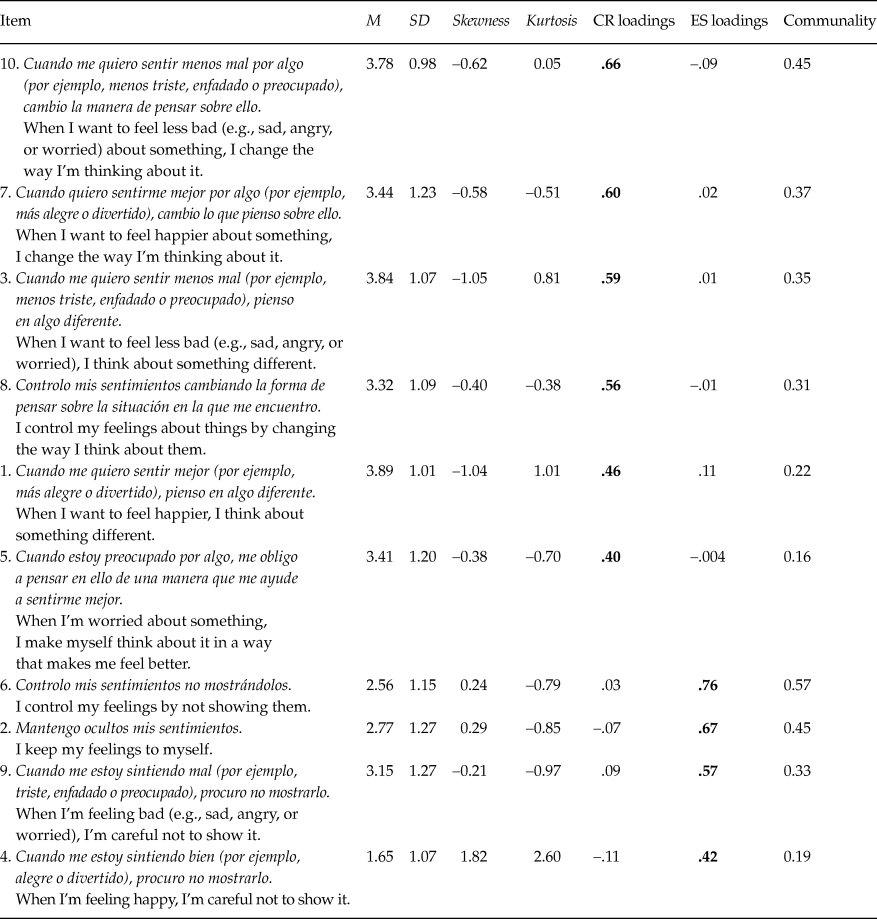
Although Kaiser–Meyer-Olkin’s index, KMO = 0.69, 95% CI [.66, .75] could be considered as mediocre, Bartlett’s test of sphericity, χ2(45) = 352.90, p < .00001, indicated that the sampling was adequate to conduct a factor analysis of the data. The parallel analysis determined two factors to be retained. Rotated factor loadings for the two factors solution -46.35% of variance explained-, as well as descriptive statistics of each of the 10 items of the questionnaire, are presented in Table 1. Replicating the two-factor structure of the English ERQ-CA, the CR factor yielded an explained variance of 25.31% and comprised 6 items related to cognitive change strategies. The ES factor -with an explained variance of 21.04%- was made up of 4 items that describe the inhibition of ongoing emotion-expressive behavior. Correlation between CR and ES scales was low, r(246) = .01, p = .93.
Descriptive Statistics and Rotated Factor Loadings for the Spanish Version of the ERQ-CA Items

Note: Loadings > |0.30| are in bold. Spanish version of the Gullone and Taffe (Reference Gullone and Taffe2012) ERQ-CA items are italicized. ERQ-CA = Emotion Regulation Questionnaire for Children and Adolescents; ES = Expressive Suppression; CR = Cognitive Reappraisal.
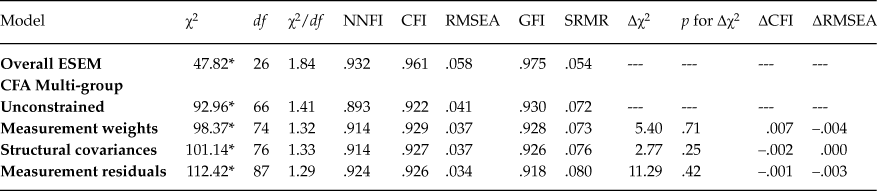
Only one coefficient was slightly below the cutoff indicating good fit, NNFI = .93, 95% CI [.88, .99]. The remaining indexes obtained from the semi-confirmatory factor analysis suggested an adequate fit of the two-factor model of the Spanish version of the ERQ-CA: χ2(26) = 47.82, p < .01, χ2/df ratio = 1.84, GFI = .98, 95% CI [.97, .99], SRMR = .05, 95% CI [.04, .06], RMSEA = .06, 95% CI [.02, .07], CFI = .96, 95% CI [.93, .99]. In addition, congruence between the rotated loading matrix and the target matrix was .98, 95% CI [.97, .99], further indicating high similarity between the two-factor solution obtained here and that obtained in other studies. Beyond, non-significant changes in chi-square among increasingly restricted CFA models suggested gender invariance, all ps > .25, which was also supported by small changes in CFI, ΔCFIs < .01, and RMSEA, ΔRMSEAs < .01 (see Table 2).
Goodness-of-Fit Indices for the Overall Two Factor Model and Tests of Structural Invariance for the Multi-Group (Boys and Girls) Model

Note: ESEM = Exploratory Structural Equation Model; CFA = Confirmatory Factor Analysis.
* p < .05
Internal consistency
The descriptive statistics and internal consistency coefficients for CR and ES scales are shown in Table 3. Alpha scores were not excellent maybe due to the small number of items of the scales. However, the other two measures based on the item correlation matrix -i.e., mean item-total and mean inter-item correlations- suggested adequate internal consistency of the ERQ-CA scales.
Descriptive Statistics and Internal Consistency for ERQ-CA Scales

Note: ERQ-CA = Emotion Regulation Questionnaire for Children and Adolescents; CR = Cognitive Reappraisal; ES = Expressive Suppression
Convergent validity
Table 4 shows zero-order correlations between the CR and ES scale scores of ERQ-CA and TMMS–24, PANASN, and BASC–S3 composite scale scores. Scores on the CR scale were associated with greater scores on the Attention and Repair scales of TMMS–24, as well as higher values on the Positive Affect scale of PANASN (small but significant direct correlation coefficients ranging from .153 to .275). In contrast, ES scale scores were negatively related to Clarity and Repair scales of TMMS–24, besides the Positive Affect scale of PANASN (small but significant inverse correlation coefficients ranging from –.174 to –.271). Scores on ES were also associated with larger scores on the Negative Affect scale of PANASN (small but significant inverse correlation of –.216). Regarding BASC–S3 composite scales, CR scores were associated with higher scores on the Personal Adjustment composite (small but significant direct correlation of .212) and smaller scores on the Emotional Symptoms composite (small but significant inverse correlation of –.138). In the other hand, ES scores were positively related to School and Clinical Maladjustment (small but significant direct correlation coefficients of .189 and .257, respectively), and Emotional Symptoms (moderate but significant direct correlation coefficient of .354) composites of the BASC–S3, while negatively related to Personal Adjustment composite of this instrument (small but significant inverse correlation of –.277).
Correlations between ERQ-CA and TMMS, PANASN and BASC-S Composite Scales

Note: ERQ-CA = Emotion Regulation Questionnaire for Children and Adolescents; CR = Cognitive Reappraisal; ES = Expressive Suppression; TMMS = Trait Meta-Mood Scale; PANASN = Positive and Negative Affect Schedule; BASC–S3 = Behavior Assessment System for Children and Adolescents (adolescent self-reported version).
* p < .05. ** p < .01. *** p < .001.
Gender differences
Regarding gender, there were no significant differences in the ERQ-CA scale scores when comparing boys (M = 21.85, SD = 4.21 and M = 10.39, SD = 3.16) and girls (M = 21.38, SD = 3.96 and M = 9.87, SD = 3.45; respectively for CR and ES), ts(247) < 1.25, ps > .21, ds < 0.17.
Discussion
The aim of this study was to translate, adapt and assess the internal consistency and validity of the ERQ-CA Spanish version. In order to evaluate and compare current results to the two-factor model originally proposed for adult population (Gross & John, Reference Gross and John2003), as well as children and adolescents (Gullone & Taffe, Reference Gullone and Taffe2012; Liu et al., Reference Liu, Chen and Tu2017; Teixeira et al., Reference Teixeira, Silva, Tavares and Freire2015), we conducted a semi-confirmatory factor analysis, which showed acceptable goodness-of-fit indices. Thus, the two-factor solution was confirmed with six items composing the Cognitive Reappraisal factor (CR) and the remaining four items the Expressive Suppression factor (ES). It is worth noting that gender invariance was evidenced, thus indicating structural equivalency when comparing boys and girls. This also supports the use of an invariant factor solution of the Spanish version of the ERQ-CA in the gender groups of this age. Current results were similar to those reported in previous studies, validating the factor structure in different languages, cultures, and across diverse life-span populations (Abler & Kessler, Reference Abler and Kessler2009; Balzarotti et al., Reference Balzarotti, John and Gross2010; Cabello et al., Reference Cabello, Salguero, Fernández-Berrocal and Gross2013; Teixeira et al., Reference Teixeira, Silva, Tavares and Freire2015).
We also analyzed the psychometric properties of the questionnaire, which showed acceptable levels of internal consistency and convergent validity. With regards to internal consistency, alpha scores were slightly higher for CR factor than ES factor, similarly to previous results obtained with the adult and children versions of the questionnaire. In our study, alphas were lower than those reported in the original version (Gullone & Taffe, Reference Gullone and Taffe2012) and the Chinese adaptation (Liu et al., Reference Liu, Chen and Tu2017) of the ERQ-CA maybe due to cultural peculiarities and/or age range of the sample. In fact, Teixeira et al. (Reference Teixeira, Silva, Tavares and Freire2015), whose Portuguese sample could be considered culturally similar to our Spanish sample, reported lower alpha scores for the specific subsample of early adolescents with similar age to ours (9th grade). In contrast to alpha coefficients that can be affected by the number of items of the scale, the other indicators of internal consistency reported in our study (i.e., mean item-total correlation and mean inter-item correlation), suggest an appropriate internal consistency of the Spanish version of the ERQ-CA.
Regarding convergent validity, CR and ES factors showed differential relationships with the other self-report questionnaires administered in this study. In particular, CR was positively related to the Attention and Repair scales of the TMMS while ES was negatively related to the Clarity and the Repair scales. Results suggest that adolescents who tend to redefine emotional situations in a cognitive level are more able to observe and think about their own feelings and perceive themselves as better at regulating their own mood. On the other hand, the inhibition of ongoing expressive reactions seems to be associated with a low self-reported ability to understand and regulate one’s emotional states.
Divergent associations with positive/negative affect measured by PANASN were also obtained for CR and ES, with the former being positively related to positive affect, whereas the latter was negatively related to positive affect and positively related to negative affect. Given the above associations of the CR and ES scales, these results suggest that the use of cognitive strategies of emotion regulation proves to be advantageous for mental health, compared to expressive suppression (Balzarotti et al., Reference Balzarotti, John and Gross2010; Gross & John, Reference Gross and John2003). This pattern of results is consistent with prior literature, whether with adults or children and adolescents, as CR has been generally understood as a more efficient and adaptive strategy to facilitate the individual adjustment to the context, whereas ES is considered a maladaptive regulatory strategy (Cutuli, Reference Cutuli2014; Mihalca & Tarnavska, 2013).
In addition, the ERQ-CA scales behave differentially to BASC–S3 composite scales. CR strategies were related to good personal adjustment that includes features such as interpersonal relations, self-reliance and self-esteem. On the other hand, ES showed to be related to an increase of emotional symptomatology such as social stress, depressive tendencies, and inadequacy, as well as school and clinical maladjustment. Taken together, our results suggest that the use of this specific cognitive antecedent-focused ER strategy seems to be more adaptive, efficient, and psychologically healthier than the corresponding response-focused ER strategy explored in our study. Notwithstanding, other antecedent-focused strategies could result maladaptive when managing negative emotions, whereas different response-focused strategies could also be adaptive depending on the specific context, as well as the flexibility during selection and implementation stages (Aldao & Christensen, Reference Aldao and Christensen2015). Thus, whereas suppression might be adaptive and effective in certain situations (e.g., hiding disappointment after receiving an undesirable gift), the habitual use of this strategy may become maladaptive, which could result in sustained unpleasant feelings in combination with decreased positive emotions (Eastabrook et al., Reference Eastabrook, Flying and Hollestein2014).
Among the main outcomes of emotion regulation skills, it should be emphasized their impact on psychosocial adjustment, as well as their role in the development and maintenance of certain psychopathology. To this extent, dysregulated emotion processes seem to underlie behavioral maladjustment, as ineffective ways or failure in the use of these strategies can place people at risk (Gross & Jazaieri, Reference Gross and Jazaieri2014; Southam-Gerow, Reference Southam-Gerow2016). The analyses of regulation processes and strategies in adolescence, seems crucial to understand individual differences in wellbeing and adjustment, or which factors could possibly provide indications for the prevention of problems linked to dysfunctional regulation later on in adulthood. As a plausible transfer outcome of this basic research, therefore, current contributions along with previous findings regarding preferred regulatory strategies should be considered in the development of future education programs on emotional competences for children and adolescents.
With regard to gender, current results have not corroborated previous reports of males scoring higher than females on the ES scale. Consistently, a similar null result was obtained in other recent study validating the ERQ-CA in Spanish adolescents (e.g., Navarro et al., Reference Navarro, Vara, Cebolla and Baños2018). These findings could be an effect of culture and age of participants. Thus, it might be possible that Spanish adolescent males and females tend to suppress the expression of emotions to a similar extent, differing from Australian and Portuguese adolescents (Gullone & Taffe, Reference Gullone and Taffe2012; Teixeira et al., Reference Teixeira, Silva, Tavares and Freire2015), Italian and American youth (Balzarotti et al., Reference Balzarotti, John and Gross2010; Gross & John, Reference Gross and John2003), and Spanish adults (Cabello et al., Reference Cabello, Salguero, Fernández-Berrocal and Gross2013). Other studies using Spanish versions of the ERQ with comparable samples in terms of culture and age (e.g., Gómez-Ortiz et al., Reference Gómez-Ortiz, Romera, Ortega-Ruiz, Cabello and Fernández-Berrocal2016; Martín-Albo et al., Reference Martín-Albo, Valdivia-Salas, Lombas and Jiménez2018) have reported differences between boys’ and girls’ scores in ES. However, effect size of such differences was quite small, with a Cohen’s d = 0.27 and η2p = .03, for Gómez-Ortiz et al. (Reference Gómez-Ortiz, Romera, Ortega-Ruiz, Cabello and Fernández-Berrocal2016) and for Martín-Albo et al. (Reference Martín-Albo, Valdivia-Salas, Lombas and Jiménez2018) studies, respectively. To this extent, note that the magnitude of gender differences in ES scores in our study was akin to that obtained in other studies but not significant, maybe due to our smaller sample size. Taken together, the above results suggest that gender differences for specific emotion regulation strategies such as ES are, at most, scarce in Spanish adolescent population, consistent with recent findings in Italian teenagers (Verzeletti et al., Reference Verzeletti, Zammuner, Galli and Agnoli2016).
This study also has several limitations that should be mentioned. To start with, the current investigation was a cross-sectional study, in which the design of the broader research did not allow either a test-retest reliability assessment or a wider age range. As a consequence, the adaptation of the ERQ-CA was finally carried out with a sample of early adolescents (13–14 years old), which somehow provided homogeneity to the explored age-specific cohort but certainly limited the generalization of the results. Therefore, future investigations with additional test-retest analyses, longitudinal cohort studies, cross-cultural research, gender analyses, and further multi-group factor analysis should provide additional information on usability and efficiency of this questionnaire. In this line, considering the contributions of previous literature about the development of emotional competencies, coping and other regulatory strategies throughout childhood and adolescence periods (e.g., Zimmer-Gembeck & Skinner, Reference Zimmer-Gembeck and Skinner2011; Zimmermann & Iwanski, Reference Zimmermann and Iwanski2014), further studies with comparable samples should be conducted in order to extend our current findings to Spanish children (10–12 years old) and late adolescents (15–18 years old).
Notwithstanding, despite the smaller sample size compared to other studies and the already mentioned limitations, the present Spanish version of the ERQ-CA has evidenced its appropriateness for assessing two commonly used ER strategies in early adolescents (Gresham & Gullone, Reference Gresham and Gullone2012). In this regard, considering the small number of items in the ERQ-CA, as well as recommendations on sample size requirements for factor analysis (Wolf, Harrington, Clark, & Miller, Reference Wolf, Harrington, Clark and Miller2013), the size of our experimental sample would be methodologically adequate to explore factor validity. In addition, in the present study, we report several approaches for determining the internal consistency and validity of the scores obtained with the ERQ-CA Spanish version, concluding that behaves at least as consistent and valid as previous versions.
Finally, the practical implications of our study are noticeable. Childhood and adolescence are critical developmental phases characterized by relevant changes in biological, cognitive, social, and emotional domains (Lerner & Steinberg Reference Lerner and Steinberg2009; Zimmerman & Iwanski, 2014). During adolescence, several areas of life seem to be accompanied by more intense emotions (Silk, Steinberg, & Morris, Reference Silk, Steinberg and Morris2003; Villegas & Raffaelli, Reference Villegas and Raffaelli2018), being furthermore a crucial period in terms of the formation and maintenance of social relationships, which can contribute in turn to future psychological wellbeing during adulthood. The ability to manage emotions during these developmental periods, and the systematic use of adaptive vs. maladaptive emotion regulation strategies, could clearly modulate the interpersonal and psychological adjustment (Southam-Gerow, Reference Southam-Gerow2016). Consequently, due to the particularities of these critical developmental periods, it is highly recommended the use of valid age-appropriate measures, specifically adapted (in terms of vocabulary and facilitation of item comprehension and answering) to accurately measure the most commonly used ER strategies in children and adolescents, avoiding the administration of versions for adults.