1. Introduction
Now that current European Commission proposals are being implemented, the world is on the verge of introducing a new trade measure of border carbon adjustments (BCAs) on a large scale (European Commission (EC), 2020, 2021). These measures, which combine environmental and trade policies by levying border adjustments based on the estimated social costs of greenhouse gas emissions, could have enormous implications for both economic and environmental outcomes in both developed and developing countries. The tax rates involved would likely dwarf current tariffs.
An extensive literature has examined potential proposals for BCAs to accompany carbon taxes, or equivalents such as emission trading schemes (ETS), in Energy Intensive and Trade Exposed (EITE) industries (see, for example, Böhringer et al., Reference Böhringer, Balistreri and Rutherford2012), in a situation where some countries introduce carbon taxes but others are unwilling to do so. This literature has generated important insights into the potential impacts of these measures. In particular, it suggests that BCAs frequently can reduce the cost of cutting emissions relative to use of carbon taxes (or emission trading systems) alone, although the reasons why this might be so do not seem to have been clarified.
Interpretations based on this literature tend to suggest that import barrier mechanisms are much more important than export rebate mechanisms although, as noted by Cosbey et al. (Reference Cosbey, Droege, Fischer and Munnings2019), this is partly because the industries on which attention has focused are import competing in the richer countries for which they have been analyzed most intensively. Given that a system of carbon taxes would likely need to be expanded and the rates applied to increase over time if sufficient abatement is to be achieved, it seems dangerous to rely on insights from a subset of products in today's industrial countries. As the coverage of carbon taxes is expanded either geographically or by commodity, they must increasingly include cases in which emission-intensive products are export oriented.
The extensive literature on BCAs includes important discussions of implementation issues (see, for example, Cosbey et al., Reference Cosbey, Droege, Fischer and Munnings2019); analyses of the compatibility, or otherwise, of BCAs with WTO rules (e.g., Hillman, Reference Hillman2013); and model-based studies of the potential impacts of BCAs on global emissions. This paper builds on this literature in several ways, including: (i) providing a simple explanation of how a BCA can fundamentally change the incentives created by a system of carbon taxes from taxing the supply of emission-intensive goods to taxing demand for these goods; (ii) showing how simple differences between elasticities of supply and of demand can make such a demand-based system a more efficient and perhaps more politically acceptable approach to reducing global emissions; (iii) providing some insights into when a system of BCAs might have a better chance of being found compatible with WTO rules.
Section 2 of this paper considers the goals leading policy makers to introduce BCA systems and their potential implications. Section 3 provides a graphical explanation of the relationship between carbon taxes (CTs) and BCAs, particularly the way a complete system of BCAs converts a carbon tax from a tax on production of emissions to one on demand. Section 4 uses a simple, global general equilibrium model to identify differences between demand and supply elasticities as a potential reason to prefer taxing demand over taxing supply. Section 5 deals with key policy choices such as the choice between taxing goods and taxing carbon; dealing with indirect emissions; implications of import-only CTBAs; carbon clubs; and compatibility with trade rules. Section 6 concludes.
2. Policy Goals
It is vitally important to spell out the goals of any BCA proposal because these goals may dramatically affect the nature of the desired measures. Hillman (Reference Hillman2013) offers three long-term motivations for BCAs: (i) to maintain competitiveness following introduction of carbon taxes (CTs) or equivalent measures, (ii) to reduce ‘leakage’ where production in the country imposing such a CT is replaced by production from countries not imposing a CT, and (iii) to create incentives for other countries to adopt CTs. The first two of these are applicable in both small and large countries, while the third is relevant only for large countries or groups of countries.
The competitiveness goal clearly has both an equity/fairness and an efficiency dimension. Producers are likely to feel that it is unfair that competitors who do not face a carbon tax are able to undercut them and take away market share. The efficiency concern arises when domestic output is replaced by imported goods of equal or greater emission intensity that have not faced a carbon tax, or when exports lose market share to more emission-intensive competitors who do not pay a carbon tax. It is vitally important to separate the fairness and efficiency aspects of any competitiveness goal as they can have very different policy implications. The equity/fairness argument may help generate strong political resistance to carbon taxes.
The ‘leakage’ goal might appear to be more of an economic efficiency argument. If a carbon tax reduces output and domestic firms lose market share to more carbon-intensive firms not facing a carbon tax, the resulting economic outcome may be less efficient (considering both costs internal and external to the firm) than in the absence of trade. However, as pointed out by Kortum and Weisbach (Reference Kortum and Weisbach2017), simply reducing leakage is not an economically coherent goal. What matters is the extent to which policies increase economic welfare, considering both the costs resulting from emissions and the costs associated with reducing those emissions. A goal of reducing leakage that takes no account of the costs when determining the optimal level of intervention, or whether any given reduction in emissions is achieved at the lowest possible cost, is an inadequate guide to policy.
The third goal of creating incentives for other countries to join is relevant only for countries or groups of countries that are collectively large. One approach to this is ‘carbon club’ proposals where a group of countries agrees on a set of standards and imposes substantial barriers against imports from non-member countries (Nordhaus, Reference Nordhaus2019).
3. Interventions and Emissions in a Small, Open Economy
For any industry, a carbon abatement policy such as a carbon tax or an emissions trading system on emissions from fuel combustion in producing a product affects emissions through two channels: (i) changes in technique, and (ii) changes in output. This distinction is important because BCAs on output operate only through the output effect. The effect of a carbon tax, at any given output price, on emissions is given by:
 $$\hat{e} = -[ {\eta_f + \eta_ss} ] \tau _f$$
where  $\hat{e}$ is the proportional change in use of a fuel and the associated emissions; η f is the elasticity of demand for fuel at constant output of the product; η s is the elasticity of output supply for the product; s is the share of fuel in production costs; and τ f is the proportional change in the power of the tax (equal to 1 plus the proportional tax on fuel) on fuel use.
If the elasticity parameters from the CGE models widely used to assess the impacts of BCAs provide any guide, the output effect is likely larger than the change of technique effect. This is because, for individual non-resource-based commodities, the partial equilibrium supply elasticities used in most of the general equilibrium models to analyze this question are almost infinite. By contrast, the opportunities to reduce emissions by changing the input mix captured in the η f elasticity are likely much smaller. Consistent with this, Bellora and Fontagné (Reference Bellora and Fontagné2020) and many other studies using the GTAP-E model use an elasticity of substitution of 0.5 between energy and capital, which accommodates some limited substitution between energy (assumed to be the primary source of GHG emissions) and other inputs. McKibbin et al. (Reference McKibbin, Morris, Wilcoxen and Liu2018), by contrast, use elasticities of substitution between energy and other inputs, and between different energy sources, that are strongly differentiated by sector and, in some cases, considerably above 0.5. The meta-analysis by Stern (Reference Stern2012) finds many elasticities of substitution between different fuels as high as 2, but even this yields elasticities that are likely small relative to the output effects.
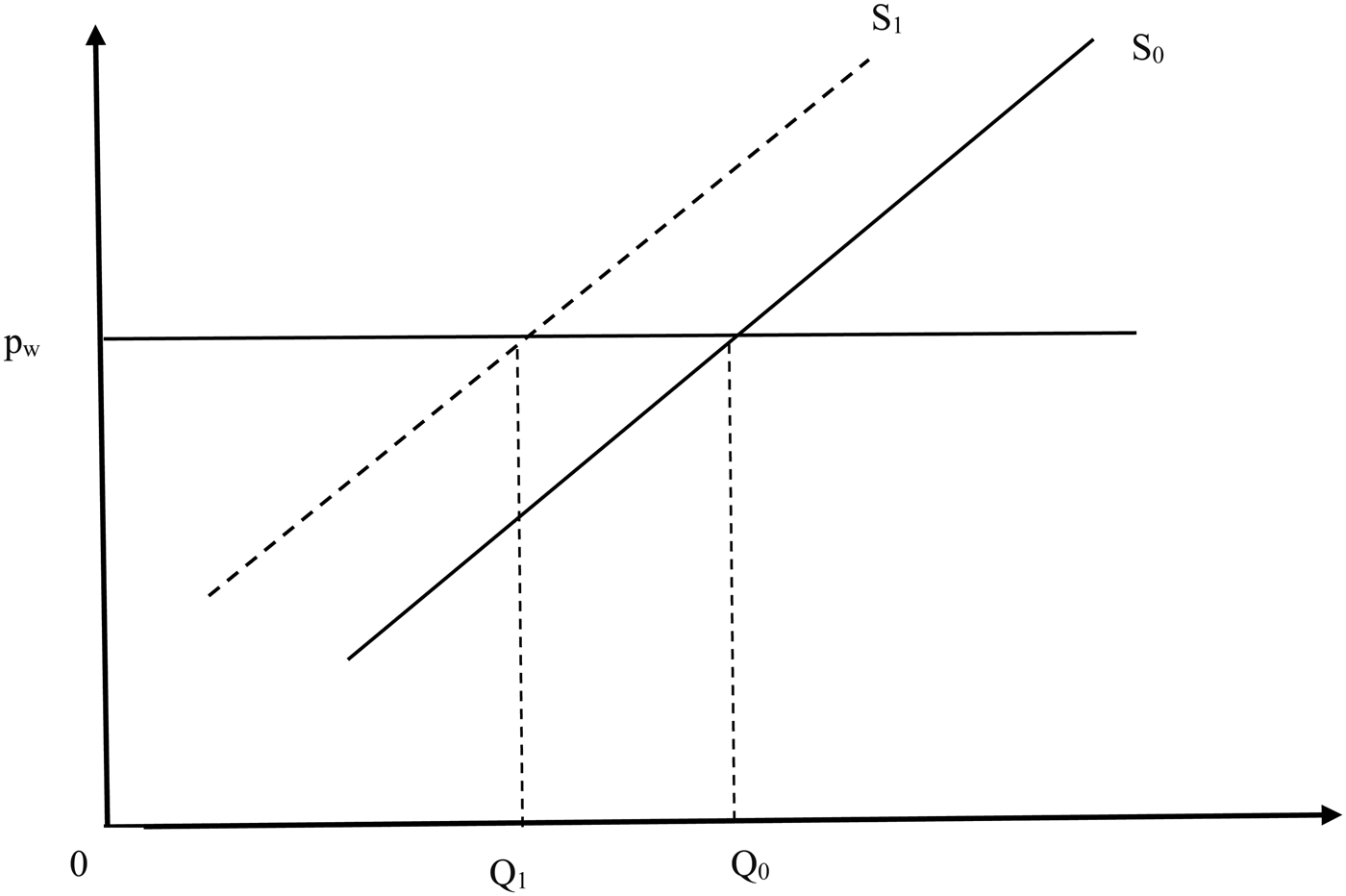
Figure 1 uses a very simple diagram to show the effect of a carbon tax that raises marginal costs of production for a commodity, and hence its supply curve, from S 0 to S 1. The resulting reduction in output, from Q 0 to Q 1, is larger the greater is the supply elasticity.
The effect of a carbon tax on output in a small, open economy

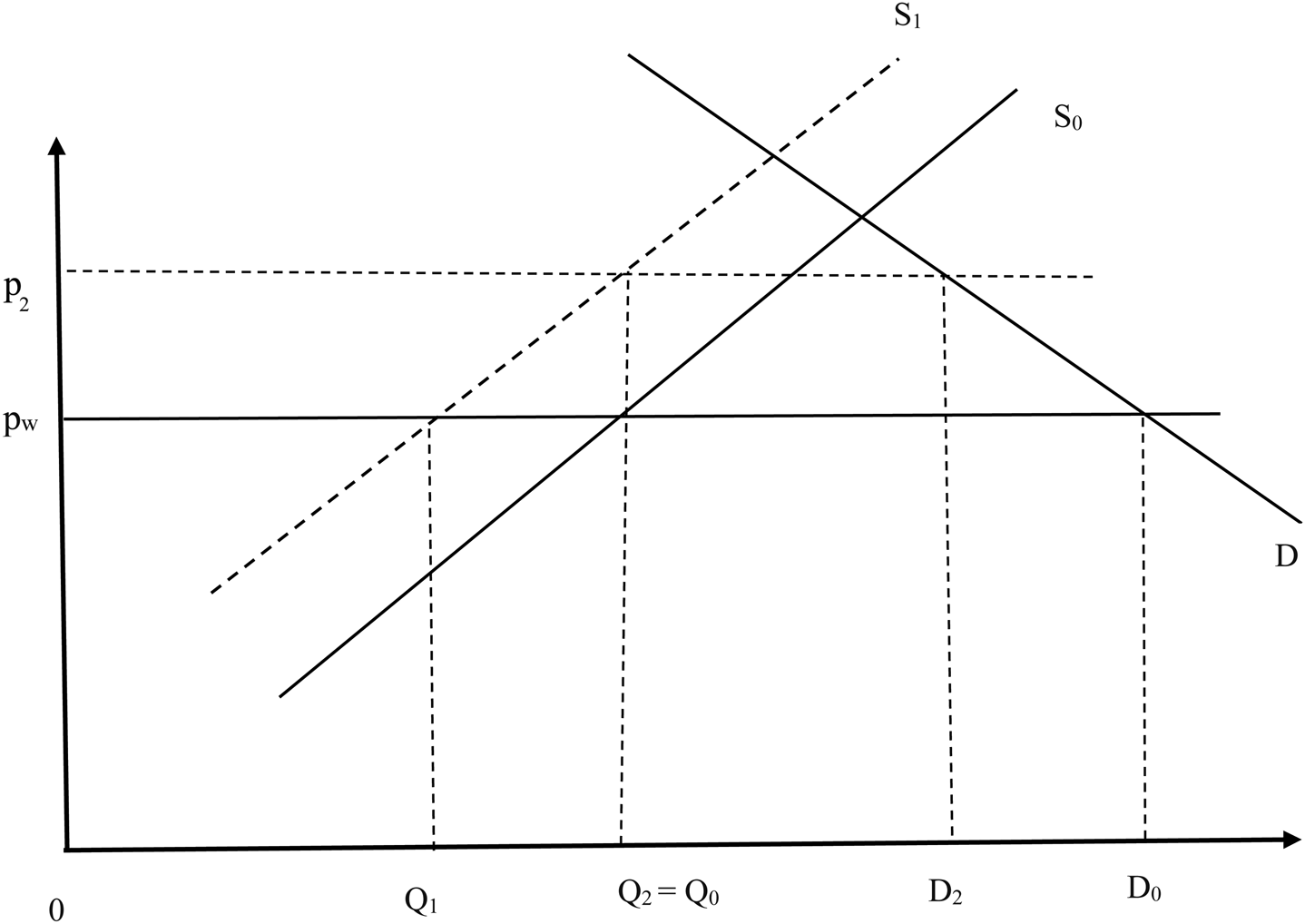
Adding an import BCA at the same rate as the cost increase created by a carbon tax, i.e. at a rate τ g = sτ f for the finished good, raises the domestic price of the good. This case is shown, for an importable good, in Figure 2 by the shift in the price line from pw to p 2. Adding the BCA raises output from level Q 1 to Q 2 = Q 0, its level in the absence of the carbon tax. The BCA, however, also creates a tax on consumption, raising the consumer price from pw to p 2 and reducing demand from D 0 to D 2. This tax on demand is a key means by which a carbon tax plus BCA (CTBA) can contribute to environmental goals, despite its neutralization of the direct incentive for output reduction created by the carbon tax.
Effects of a CTBA on an importable good in a small, open economy

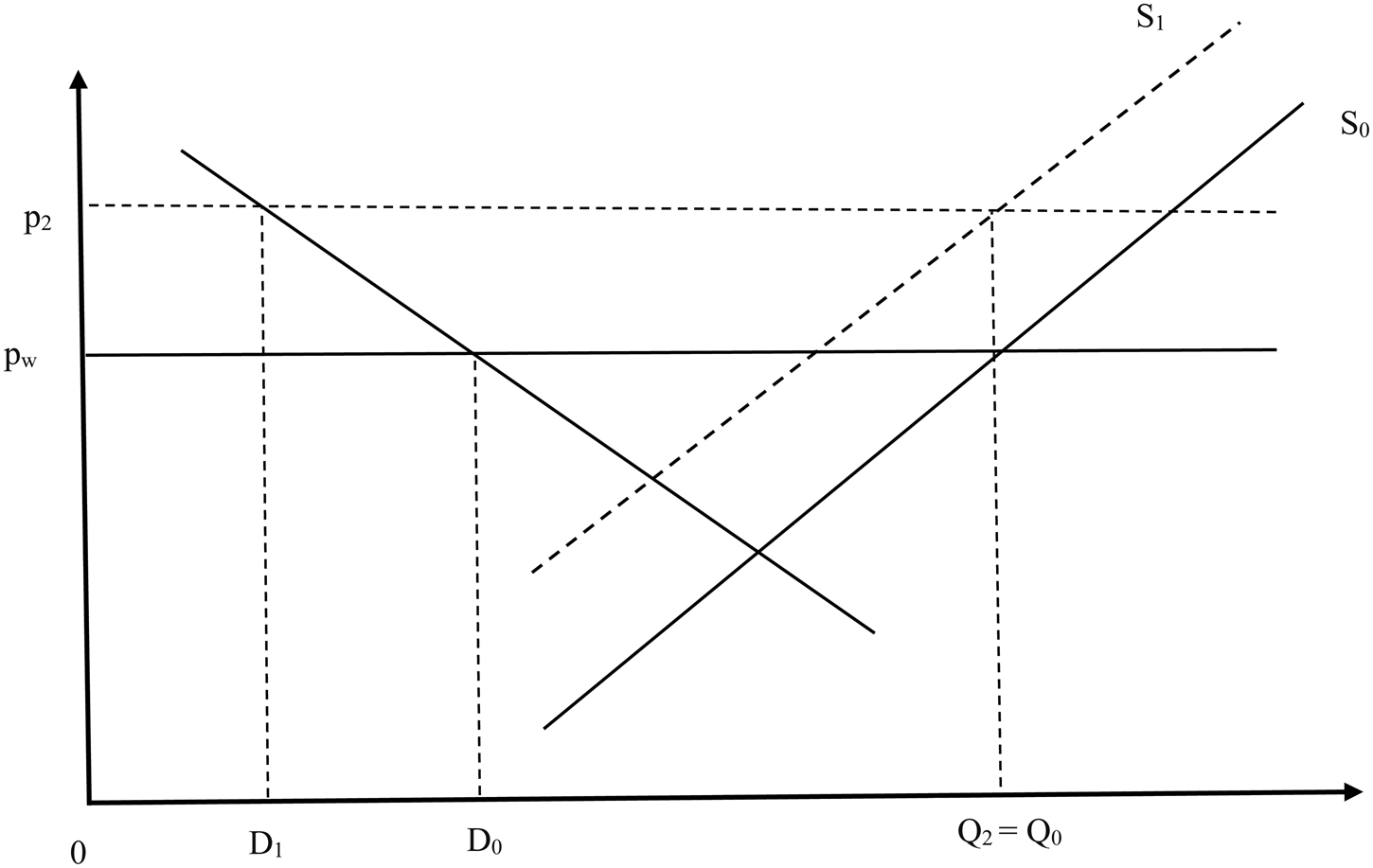
A BCA can also be applied on exports, as shown in Figure 3. Following the example of a VAT, this would likely take the form of an export rebate at the common rate of the CTBA. The effects on output and demand are similar to those for an importable. Because export sales yield pw plus a rebate of (p 2–pw), the domestic consumer price of the good is increased from pw to p 2 as producers equate their net returns from both markets. Producers are compensated for the increase in their costs associated with the carbon tax and so maintain their original level of output. Consumers face the higher price p 2 and so reduce their consumption from its pre-carbon tax level, D 0 to D 1. The competitiveness concerns of producers have been dealt with, while the reduction in consumer demand for the emission-intensive good contributes to global emission reduction.
Effects of a CTBA on an exported good in a small, open economy

A full CTBA (i.e., one with an import levy and an export rebate) is thus a tax on demand for emission intensive goods, while a CT alone is a tax on their production. This parallels the distinction between destination-based taxes such as a value-added tax and origin-based taxes such as income taxes. An important feature of the change from a CT to a CTBA is that the CT element of the CTBA continues to create incentives to move to less emission-intensive approaches to production.
For simplicity, the discussion of Figures 1–3 has considered a specific commodity – such as fertilizer – covered by a BCA applied at the same rate per unit of the commodity as the domestic carbon tax. If, however, policy makers should choose to base the BCA on the emissions actually generated in production of goods crossing the border, then the same diagrams could be used for a ‘virtual’ commodity, the carbon embodied in the domestic and imported goods. While the emission intensity of imported goods might differ from that for domestic goods, the BCA rate on the embodied carbon would be the same for the carbon embodied in domestic and foreign goods. An export BCA based on the emission intensity of domestic goods would likewise eliminate the impacts of the CT on exports of embodied carbon.
A CTBA on an imported good generates two sources of government revenue – one from the carbon tax and one from the BCA on imports. The export rebate requires governments to pay out some of their revenue from the carbon tax and the import BCA. With balanced trade, there would be no net revenue from a full BCA. Governments would, however, still receive full revenues from the carbon tax.
4. Global Impacts
A central question for this paper is whether conventional carbon taxes should be accompanied by full BCAs that convert them into taxes on demand for emission-intensive products. If all countries adopt a uniform CT without a BCA, the global impact comes about because the tax reduces the prices received by producers relative to consumers. If all countries introduce CTBAs, the global impacts come about because the tax raises prices to users (not just final consumers but users of intermediate inputs as well) relative to producer prices. In this situation, it does not matter whether the tax is on demand or on supply making the choice of a CT or a CTBA irrelevant (Gruber, Reference Gruber2019). But the central problem under consideration arises when some countries are willing to impose a CT while others are not.
The CT and the CTBA bring about their global impacts quite differently. A carbon tax directly reduces supply in the countries that impose it. If the set of countries is collectively large, this effect is offset by an increase in the world market price of the good which, in turn, results in higher output in non-participating countries – and leakage from the CT countries to their trading partners. By contrast, a full CTBA on a good in a collectively large set of countries reduces its world price and the incentive to produce in both taxing and non-taxing countries. In this case, leakage arises because the lower world price stimulates demand in non-participating countries.
The vast array of work examining the impacts of potential BCAs using CGE models has incorporated a great deal of important and useful detail on key parameters such as elasticities and emission intensities. However, the large number of parameters involved makes it very difficult to examine the sensitivity of the results to key, simple parameter differences such as those between the slopes of the supply and demand curves in Figures 2 and 3.
In the rest of this section, a very simple general equilibrium model is used to examine the importance of these elasticities in a model where market shares can change. This model, presented in the Working Paper version (Martin, Reference Martin2023), includes two countries (Home and Foreign), two commodities (emission-intensive (E) and a clean numeraire). Initially both allocate 50% of their resources to production of E and spend 50% of their income on that good. Under the policy experiments, only the Home country imposes a tax – whether on production or consumption. In the base case, demand elasticities are determined using a constant elasticity of substitution model with an elasticity of substitution of 0.3, while supply elasticities are determined using a constant elasticity of transformation function with an elasticity of transformation of 2. Because these key parameters are readily changed in this model, it is very easy to assess the sensitivity of the results to changing them.
Because the fundamental hypothesis tested using this model is that differences between elasticities of supply and demand are critical for determining whether taxing production or consumption of emissions is more efficient, it is important to examine the evidence on differences between these parameters. As noted earlier, the partial elasticities of supply of manufacturing and services in CGE models are close to infinite because they have no fixed factors and can draw in capital and labor from the rest of the economy. By contrast, elasticities of final demand are invariably below unity in absolute value (Hertel, Reference Hertel1997). Elasticities of demand for intermediate inputs are generally also low because, in default mode, intermediate inputs are assumed to be demanded in fixed proportion to output.
Empirical estimates of supply elasticities for manufactures and services are scarce because they are challenging to estimate given that major, sustained changes in their prices are rarely observed. One study that addresses this problem by examining output responses to price booms (Edgerton, Reference Edgerton2011) finds average elasticities of supply for machinery of 5. Roberts and Schlenker (Reference Roberts and Schlenker2013, p. 2278) find even short-run supply elasticities for food between two and three times as high in absolute value as demand elasticities. The hypothesis that supply elasticities exceed the absolute values of demand elasticities appears to be well supported in the literature.
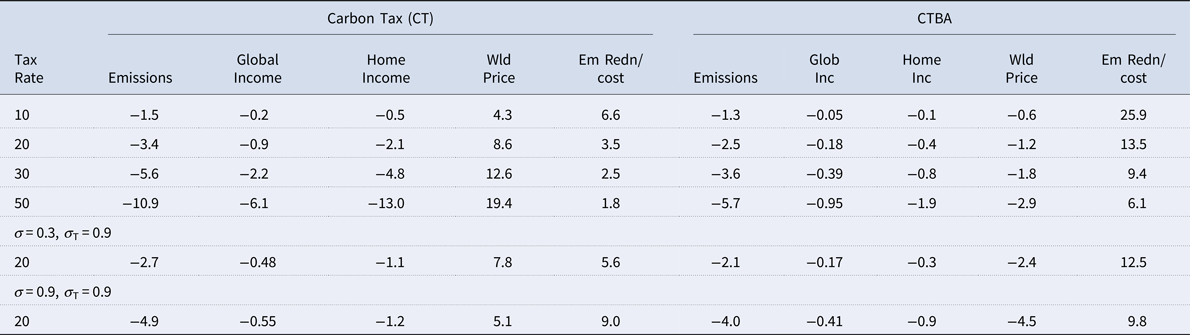
The results in Table 1 highlight the importance of the elasticity of supply relative to demand. Under the assumptions of the base case, the full CTBA is much more cost effective in reducing output of the emission intensive good than a carbon tax on production. At a 10% tax rate, the CTBA is almost four times as cost effective as the carbon tax. The cost effectiveness of both measures declines slowly as the tax rates go up, because the costs of these distortions rise as the square of their rate. But the cost effectiveness of the CTBA is still over three times greater with a CTBA than with a CT at a tax rate of 50%.
Impacts of a Carbon tax vs a Carbon Tax and BCA, % changes

Note: Reported emission changes reflect only output changes, ignoring incentives to change production methods resulting from the Carbon Tax.
These findings appear to be quite sensitive to the difference between the demand and supply elasticities. With the standard (0.3, 2.0) assumptions, the CTBA is almost four times as cost effective as the CT, but if we reduce supply elasticities by specifying an elasticity of transformation of 0.9 instead of 2.0, that ratio drops to just over two.
In the carbon tax case, the taxing country generally suffers real income losses that are more than twice as large as those suffered by the world as a whole. It goes from being self-sufficient in the emission intensive good to an importer and drives up the price substantially, compounding its losses from the deadweight cost of the tax and making the partner country slightly better off through its terms of trade. With a CTBA, the home country's loss as a share of GDP is generally closer to half the global loss. It becomes an exporter of the taxed good but faces a much smaller decline in the price of that good.
5. Policy Choices
The analysis to this point has used simple, stylized models with a uniform carbon tax and BCA to generate some key insights. Formulating practical BCAs requires considering several key issues: (i) taxing goods vs taxing carbon, (ii) indirect emissions, (iii) challenges with import-only BCAs, (iv) carbon clubs, and (v) likely WTO compatibility.
5.1 Taxing Goods vs Taxing Carbon
Many proposals for CTBAs involve differentiated rates depending on the emission intensity of production in the exporting country, or whether CTs have been applied to that production. Clearly, the rate at which a carbon tax based on, say, fuel use is applied on domestic industries will differ depending on the efficiency of the individual firm, with low fuel use and low emission firms facing a lighter burden from the carbon tax.
Ideally, this type of differentiation would be carried over into BCAs, with BCAs taxing demand for emissions, rather than production. As previously noted, Figures 1–3 remain relevant, but with embodied emissions, rather than goods, on the horizontal axis and the same tax rate applied on domestic and imported carbon. More emission-intensive goods would be subject to higher BCAs than domestic goods, and vice versa. Lower emission firms, facing lower costs from the carbon tax, would receive smaller rebates on their exports, which might reduce their incentive to invest in reducing their emissions. There would be a tendency for imports to shift from high-intensity suppliers to low intensity suppliers, which would be helpful, although high-emission-intensity suppliers might respond by shuffling their exports between markets without necessarily reducing overall emissions.
A major practical problem with BCAs based on emission intensities of production by the supplier is the enormous information costs and risk of malfeasance in estimating these rates. How would authorities in the importing markets assess the emission intensity of production in foreign markets? How accurate would the resulting measures be? Would the process become captured by domestic lobbies and result in disproportionately high barriers? To avoid this risk, perhaps estimation of these intensities might be put in the hands of a neutral certification body. But that way lies a potential risk of a different form of capture, where foreign producers might convince the assessment body that their CT regime is strict when it is in fact ineffective.Footnote 1 These problems become even greater once the need to deal with indirect emissions is recognized.
Given all these problems, there might well be a case for using BCAs based on the average emission intensity of domestic firms. This would require only information from domestic sources, avoiding the near impossible challenge of setting different rates by product and firm. It would need updating as the average emission intensity of domestic production declined but firms’ export rebates would not decline with reductions in their emission intensities.
5.2 Indirect Emissions
Another key question is whether a BCA should be based only on direct emissions from production of a good or should also account for indirect emissions from production of intermediate inputs. If BCAs are calculated based on domestic emission intensities, the cost of inputs covered by an import or export BCA is increased, and this cost increase should be included in calculating the BCA along with the increase in costs associated with the CT on direct emissions.
When BCAs are based on the emission content of imported goods, accounting for indirect emissions is even more challenging than for direct emissions. Where emissions generated by individual firms supplying inputs to foreign producers are covered by a CT in the importing country, eliminating the competitiveness impacts of these input taxes requires an import BCA incorporating both the CT on output and the effects of the CTs on inputs. The need to incorporate estimates of emissions from input suppliers as well as from the firms directly supplying exports will greatly increase the tasks involved in calculating the BCA rates to be applied.
5.3 Import-Only CTBAs
Import-only BCAs without export rebates are frequently recommended (e.g., European Commission (EC), 2021). This approach clearly reduces concerns about competitiveness among import-oriented producers. Some also advocate this approach because an export rebate system is seen as ‘subsidizing’ exports of emission-intensive goods (e.g., Blandford, Reference Blandford2018, p. 16).
There are several concerns with these arguments. First, an export BCA would only be applied on industries where a carbon tax has been levied to reduce emissions so there is no subsidy to emission-intensive exports, only relief from the burden of the carbon tax. Second, the absence of a BCA on these commodities removes the incentive to reduce domestic demand for this product. Third, import-only CTBAs appear to be very costly.
Import-only CTBAs raise the cost of producing exports both through input–output linkages and through increases in the prices of nontraded goods, thus shrinking exports and reducing the range of products that can profitably be exported, just as traditional protectionist policies did (Dornbusch et al., Reference Dornbusch, Fischer and Samuelson1977). Both production and consumption decisions are distorted because importable commodities receive support from BCAs while exportables do not. Model-based analysis suggests that import-only BCAs would be an inefficient approach to reducing emissions (Mattoo et al., Reference Mattoo, Subramanian, van der Mensbrugghe and He2009). If imposed primarily by developed countries, import-only BCAs would have very adverse implications for the exports of developing countries, damage that would be undone by moving to full CTBAs (Mattoo et al., Reference Mattoo, Subramanian, van der Mensbrugghe and He2012).
Where BCAs are based on the costs imposed on domestic producers by the carbon tax, any adjustments for indirect emissions under an import-only BCA regime depend on whether the input is exportable or importable. Prices of importable inputs rise and this cost increase should be included in the BCAs for goods in which they are incorporated. Prices of exportable inputs do not rise and so should not enter the calculation of the BCA. This further complicates calculation of BCA rates.
Import-only CTBAs also create a potentially serious problem of double taxation, with exports subject to a carbon tax at home and a BCA on entry into the partner markets. Many proposals for import-only BCAs seem to envisage reducing or waiving the BCA on products that have been produced subject to a carbon tax or equivalent measure. But this raises many questions, such as what constitutes an emission regime comparable enough to the domestic CT for the duty to be waived? And is an ETS with free allocations of emission quotas comparable to a carbon tax? Relying on partners for relief from the burden of your own carbon taxes seems likely to be a formula for serious trade conflicts. Countries wanting to avoid their exports being double taxed can do this unilaterally by implementing their own export BCAs.
In terms of political economy, there are also important questions about import-only BCAs. Exporters are worse off under import-only BCAs than under CTs alone. Not only do they have to pay carbon taxes on their own emissions, but they also face higher prices for inputs produced by import-competing firms. Opposition from organized exporter interests may impede adoption of import-only CTBAs. Perhaps for this reason the European Commission now appears to be examining options for adding export rebates to its proposed BCA system (Blanchard et al. Reference Blanchard, Gollier and Tirole2022).
5.4 Carbon Clubs
Carbon clubs are an extension of the import-only CTBA approach, where a set of countries set a common standard of carbon abatement, waive BCAs on club members, and impose them on countries outside the club (Nordhaus, Reference Nordhaus2019; Meyer and Tucker, Reference Meyer and Tucker2021). If imposed by a group of large countries, it would certainly create incentives for some countries to join. But this approach is only one, uncooperative, approach to dealing with the international externalities associated with climate change.
If the rules of the trading system allow one group of countries to introduce BCAs that discriminate against non-members of their club, then presumably other countries could similarly impose barriers against them. The result of such a system might involve some non-members adopting carbon taxes and joining the club but would likely result in others imposing retaliatory BCAs. As shown by Staiger (Reference Staiger2022, p. 148), the resulting competitive equilibrium would result in carbon taxes that are too low and tariffs that are too high relative to an efficient outcome.
Identifying a common standard for a carbon club seems likely to be difficult. Such proposals also seem likely to result in very serious political conflicts with developing countries unable or unwilling to be included when, as noted by Lester (Reference Lester2021), it is today's industrial countries that are responsible for most of the stock of greenhouse gases driving the world's worsening climate crisis. These conflicts could become very serious if the implications for developing countries’ opportunities for industrial development are as dire as depicted by Mattoo et al. (Reference Mattoo, Subramanian, van der Mensbrugghe and He2012).
Much of the support for carbon club proposals seems to arise from concerns that CTs are not politically feasible. But are full CTBAs really infeasible? Have they ever been tried? Surely it would be worth considering approaches like full CTBAs that can be implemented by individual countries without requiring international agreement, and that are less vulnerable to “leakage” because they focus on less-elastic demand rather than supply, before moving to exclusionary carbon clubs?
5.5 Compatibility with Trade Principles
Lamy et al. (Reference Lamy, Pons and Leturcq2020) note that there are two promising paths towards WTO compatibility of BCAs – approaches based on establishing non-discrimination under Articles I, II, and III of GATT and approaches based on the general exceptions under Article XX.
Hillman (Reference Hillman2013) focuses on non-discrimination and argues strongly that a BCA would likely be compatible with WTO rules as long as it is applied at a rate that does not exceed the carbon tax rate applied on domestically produced goods. Staiger (Reference Staiger2022, p. 153) builds a case for border adjustments – whether on imported or exported goods – based on the carbon content of domestic production. He shows that trading rules that allow BCAs that match the domestic costs imposed by carbon taxes – but not those based on the carbon content of foreign goods – could provide a basis for negotiating climate agreements that internalize the externalities associated with climate change.
Many authors and participants in policy debates recognize the desirability of a full BCA with export rebates but rule out considering export rebates, arguing that these are not permissible under WTO rules. Trachtman (Reference Trachtman2017, p. 491) indicates that this is far from clear, particularly given footnote 1 to the Agreement on Subsidies and Countervailing measures ‘the exemption of an exported product from duties or taxes borne by the like product … .not in excess of those which have accrued, shall not be deemed a subsidy’. Given the analogy between a rebate of such a carbon tax and the rebates used with Value Added Taxes, it seems plausible that a rebate could be designed to be consistent with WTO rules. Hillman (Reference Hillman2013, p. 13) feels that these rules would allow export rebates based on taxes on energy or fuel consumption used in production to be rebated. Ruling out such export rebates as WTO incompatible frequently leads to proposals that rely on the much broader, and potentially more open-ended, Article XX General Exceptions. Concessional imports under import-only CTBAs and carbon clubs raise a range of potential challenges based on contravention of WTO rules on nondiscrimination.
Some authors concerned about the WTO legality of export rebates, such as Heine (Reference Heine2020) and OECD (2020), argue for sales tax approaches that tax demand without the need for export rebates. This seems a very complex way to avoid potential WTO compliance issues. Because excise taxes are levied only on final consumption, while carbon taxes also apply to intermediate use, collection systems for sales/excise taxes would be massively incomplete for demand-based carbon taxes. Neuhoff et al. (Reference Neuhoff, Acworth, Barrett, Owen, Fischer, Munnings, Ismer, Kim, Pauliuk, Wood, Sartor, Sterner, Zhang, Zetterberg and Roth2015) propose an entirely new collection system where tax liabilities would be incurred but not paid when goods are produced or imported and are exempted when exported. If WTO members and WTO Dispute Settlement panels are concerned about explicit export rebates, surely they would be just as concerned about implicit export rebates of this type? This type of problem has been addressed in typical destination-based VAT systems (Ebrill et al., Reference Ebrill, Keen, Bodin and Summers2001). Since VAT rebates from destination-based rebates have withstood concerns about consistency with WTO rules, it seems reasonably likely that WTO compatibility would not be a binding constraint for inclusion of an export rebate in a BCA.
Most import-only BCA proposals seek to avoid double taxation of goods produced subject to CTs in other countries by providing some concessional treatment for those goods on the import side. This feature of these schemes seems likely to create serious WTO challenges. Important questions will certainly arise about the nature of this concessional treatment. Should commodities produced subject to environmentally friendly regulations be given concessional treatment, along with imports from countries imposing a carbon tax? What rate of carbon tax must be applied in order to trigger these concessions, and should it be applied to all emissions or only those generated directly in the production of the good?
6. Conclusions
Many current proposals for Border Carbon Adjustments (BCAs) would focus only on import measures, would involve sharply different border adjustments by country and by product, and could generate serious economic costs and risks of conflict between countries. Does this mean that the idea of using BCAs as a complement to carbon taxes or similar measures should be rejected? Not necessarily.
To see how BCAs might be designed in ways that avoid these problems, it is important to begin with a clear goal. Are they designed to deal with the competitiveness concerns of producers or to deal with ‘leakage’? It is clear that producers’ concerns about competitiveness – and unequal treatment where they must pay a carbon tax not paid by foreign competitors – are a serious obstacle to implementation of carbon taxes and other measures to mitigate emissions. By contrast, as argued by Kortum and Weisbach (Reference Kortum and Weisbach2017), leakage reduction is only very weakly related to fundamental economic concerns such as the cost of achieving mitigation of greenhouse gas emissions. There seems to be a strong case for focusing instead on the contributions of BCAs to reducing the costs of lowering emissions and lowering the political economy barriers to reform.
This paper compares traditional production-based carbon taxes with carbon taxes buttressed by BCAs. It shows that, while the former are clearly taxes on production, the latter are taxes on demand for carbon-intensive commodities. There are clear parallels with comparisons of origin-based taxes such as income taxes, and destination-based taxes such as traditional VATs, with the important differences that CTBAs would involve different rates between commodities based on carbon intensity and would tax intermediate use as well as final demand. The suggested approach would involve using full BCAs, applied through import charges and export rebates, to complement carbon taxes without requiring discrimination between trading partners. It would minimize both carbon leakage and the cost of reducing emissions by transforming the tax from supply to demand.
This paper uses simple diagrams to show that a combination of a carbon tax and a BCA, or a CTBA for short, increases the cost to users of products purchased domestically while allaying producers’ concerns about competitiveness by relieving them of the cost burden imposed by the tax, and leaving in place the incentives for producers to change their production techniques in ways that reduce emission intensities. While production-based carbon taxes have proved extremely difficult to implement because of concerns about competitiveness, a CTBA may be able to solve those problems at national level and allow introduction of CTs with measures that deal with these direct competitiveness concerns. This approach would deal with the competitiveness concerns of producers in both importable and exportable sectors by setting BCAs based on the WTO's National Treatment principle of securing equal treatment for domestic and foreign goods.
A simple modeling exercise suggests that a full CTBA could substantially lower the cost of achieving any given level of reduction in greenhouse gas emissions when only some countries impose carbon taxes. This is because elasticities of demand for individual goods are generally lower than their elasticities of supply. In this situation, a consumption-based tax is being imposed on the less elastic side of the market that is less vulnerable to ‘slippage’ where the impact of the tax in one market on global demand declines because the share of that market shrinks as the tax rate rises.
While, in principle, CTBAs could be based on carbon content of products by firm, this would involve likely prohibitive problems of obtaining enormous volumes of reliable firm and process specific data. This challenge would be compounded if information on indirect emissions from inputs into the production process were also included.
Import-only BCAs are frequently advocated but create major economic distortions. Because they disadvantage exporters more than a carbon tax alone, they are likely to encounter strong resistance from organized exporters. Attempts to reduce double taxation of imports by providing concessional import access are likely to create conflicts both with trading partners and with international law.
An approach focused on taxing consumption rather than production of carbon could potentially avoid having to deal with the acute economic and international law challenges associated with having different border tax rates by country. With a competitiveness-focused approach, where any BCAs are based on the cost of compliance with domestic measures, there is no risk of discriminating between suppliers, and the measures are likely to comply with existing WTO rules (Hillman, Reference Hillman2013).
Much uncertainty – and many important questions for future research – remains in this area, with three particular areas standing out. Better estimates of elasticities of supply and demand for products to be subjected to border carbon adjustments are needed to more accurately assess the relative costs of traditional carbon taxes and carbon taxes plus border adjustments. Another key question is whether the power of organized export interests will be enough to compel governments to adopt lower cost policies that apply border adjustments symmetrically on both imports and exports, rather than solely on imports. The questions related to compatibility with WTO rules will also generate an enormous literature, with the questions changing as policies change and jurisprudence accumulates.
Supplementary Materials
To view supplementary material for this article, please visit https://doi.org/10.1017/S1474745623000113
Acknowledgements
This paper has benefitted enormously from comments by audience members in presentations at the International Conference of Agricultural Economists, IFPRI, the US International Trade Commission, the World Trade Organization and the International Agricultural Trade Research Consortium.