Background
Aortic coarctation is a common congenital anomaly, with an incidence of 1 per 1200 in the general population and ~5–7% in patients with CHD.Reference Jenkins and Ward 1 , Reference Campbell 2 Traditional teachings have suggested a bimodal distribution with infantile and adolescent/adult forms; however, more recent evidence suggests a continuum with more severe obstruction – regardless of location – presenting earlier in life.Reference Jenkins and Ward 1 Many patients who present later in life maintain systemic perfusion by developing arterial collaterals that bypass the narrowed segment of the aorta.Reference Keane, Lock, Fyler and Nadas 3 In these older patients, systemic hypertension is the most common finding leading to diagnosis, but patients also suffer from headaches, left ventricular hypertrophy on electrocardiogram, abnormal chest X-ray findings, and diminished femoral pulses with radial-femoral delay.Reference Moss and Allen 4 A few recent case series have discussed the association between intercostal aneurysms and aortic coarctation; although these aneurysms are less commonly discussed, they are a relatively common finding associated with coarctation diagnosed in adults.Reference Zhu, Zhu, Xi and Zhang 5 , Reference Rohit, Thingam, Gopal, Vuppaladadhiam and Grover 6 In fact, up to 40% of adult-diagnosed patients have aneurysms, and the vast majority occur in the intercostal arteries.Reference Braimbridge and Yen 7 We present the following cases to highlight this association and describe a combined therapeutic approach.
Cases
We present the cases of two patients diagnosed with aortic coarctation associated with a large intercostal aneurysm. Neither patient had other significant medical issues and both were diagnosed within 2 months of catheterisation.
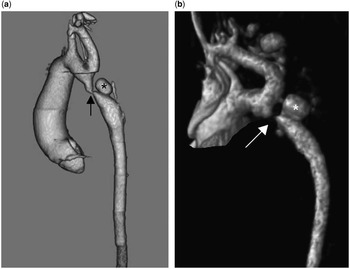
Patient no. 1 was a 48-year-old Russian nun. She was diagnosed with hypertension during her 2nd decade of life and had been medically managed with diuretics and β-blockers. She recently immigrated to the United States and was referred to a cardiologist. Evaluation by our adult congenital cardiology team noted non-palpable femoral pulses with upper extremity blood pressure between 110 and 125 mmHg, no gradient between her arms, and unobtainable pressures in her lower extremities. A contrast-enhanced chest MRI confirmed a discrete coarctation of the aorta (Fig 1a).
Pre-procedural 3D-re-constructed CT ( a ) and MRI ( b ) images of the reported patients. The * denotes the intercostal aneurysm and the arrow points to the coarctation.

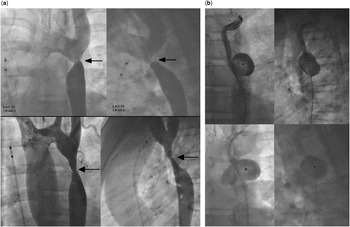
Patient no. 2 was a 14-year-old boy who presented with elevated blood pressure. He was asymptomatic and had not received regular medical evaluations. A new physician noted diminished femoral pulses and an upper–lower blood pressure gradient of ∼50 mmHg. A contrast-enhanced cardiac CT confirmed aortic coarctation (Fig 1b). Both patients’ scans also documented the large intercostal aneurysm (Fig 1). Initial haemodynamic and angiographic assessments in the catheterisation laboratory documented normal cardiac indices. Patient no. 1 had a discrete coarctation measuring 3 mm in minimal diameter, but also had relative hypoplasia of the distal arch and proximal descending aorta extending ~3 cm; the peak systolic gradient from ascending to descending aorta was ∼50 mmHg. Patient no. 2 also had a discrete coarctation, minimal diameter of ~3 mm, with only mild and shorter segment hypoplasia of the distal arch, and a peak gradient of ~45 mmHg. The supreme intercostal artery was aneurysmal in both patients: the left in patient no. 1 and the right in patient no. 2 (Fig 2).
Descending aortic and selective intercostal angiograms demonstrating the coarctation ( a ) and intercostal aneurysm ( b ) in both patients.

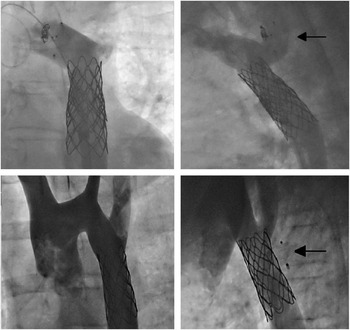
In patient no. 1, we placed two Amplatzer Vascular Plug 2TM (St. Jude Medical, St. Paul, Minnesota, United States of America) devices into the feeding intercostal artery just cephalad to – that is, farthest from the aorta – the aneurysm. We then placed three covered stents in her aorta; two were required to treat the coarctation and one was used to cover the aortic ostium of the aneurysm. In patient no. 2, we placed one Amplatzer Vascular Plug-2 device into the intercostal feeding the aneurysm. We were able to treat both the coarctation and cover the aortic aspect of the aneurysm with a single covered stent (Fig 3). There was no gradient from ascending to descending aorta in either patient after intervention with no flow into the excluded aneurysms. Both the patients tolerated the procedure well without complications. Both were doing well, with no evidence of re-coarctation or other complications, at the most recent follow-up.
Descending aortic angiograms after device placement and deployment of covered stents in both patients. Note that the aneurysms do not fill either retrograde or antegrade.

Discussion
Although recent case reports of arterial aneurysms associated with aortic coarctation are limited, this phenomenon is not rare. In her treatise on coarctation, Abbott describes the presence of numerous aneurysmal vessels associated with coarctation in adults.Reference Abbott 8 She refers to what is likely the first case of a patient with coarctation who died from a ruptured intercostal aneurysm, first published in 1858 by Leudet.Reference Abbott 8 A later review by Braimbridge documented the presence of intercostal aneurysms in ~40% of adult-diagnosed, unrepaired coarctation patients.Reference Braimbridge and Yen 7 He noted that the incidence of aneurysms increased with patient age. He also found that intercostal artery aneurysms were most common followed by aneurysms of the descending aorta distal to the coarctation; aneurysms of the ascending aorta or brachiocephalic vessels were exceedingly rare.Reference Braimbridge and Yen 7
The precise mechanisms leading to aneurysm formation remain unclear. The following two factors are likely implicated: altered vessel histology and flow dynamics. The abnormal histology has been noted since at least Dr Abbott’s time, who described many vessels in coarctation patients as “thin-walled and atheromatous”.Reference Hamilton and Abbott 9 Subsequent authors have labelled this phenomenon as “cystic medial necrosis”, but more recent evidence demonstrated that the underlying arterial histopathology is characterised by depletion and disarray of elastin fibres in the vessel wall.Reference Isner, Donaldson, Fulton, Bhan, Payne and Cleveland 10 , Reference Dunnill 11 Aneurysm formation is possibly related, at least in part, to this loss of structural integrity.
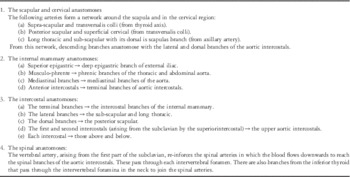
Another potential factor relates to the altered flow through the intercostal artery, which acts as a collateral. Bramwell documented this reversal of flow in a postmortem study, elegantly delineating the numerous vessels, which potentially act as collateralsReference Bramwell and Jones 12 (Table 1). A large amount of published data associates flow and arterial branching angles to the development of intracranial aneurysms.Reference Norman and Powell 13 – Reference Shojima, Oshima and Takagi 16 Given the reversed flow associated with coarctation, abnormal shear forces may develop along the arterial walls – especially at branching points – that promote the formation of aneurysms through processes previously described.Reference Lehoux, Tronc and Tedgui 17 – Reference Mitchell and Pollock 19 More data are needed to truly understand the factors leading to aneurysm formation in patients with coarctation.
Collateral channels in coarctation of the aorta.

Reproduced with permission from Bramwell and JonesReference Bramwell and Jones 12
Aneurysms have numerous, potentially significant deleterious effects. The most obvious is the risk of rupture; the patient described by Leudet was a 37-year-old woman in whom the intercostal eroded into her left main bronchus leading to severe haemoptysis and death.Reference Hamilton and Abbott 9 Rupture has also been reported after treatment for coarctation, many years after surgery in one case.Reference Cohen, Fuster, Steele, Driscoll and McGoon 20 , Reference Toro-Salazar, Steinberger, Thomas, Rocchini, Carpenter and Moller 21 In addition to rupture, aneurysms may calcify and enlarge.Reference Jayavelan, Saldanha and Muthukumar 22 Moreover, cases of paralysis have been reported secondary to compression of the anterior spinal artery by the pulsatile aneurysm.Reference Brewer, Fosburg, Mulder and Verska 23
We decided to exclude the aneurysm from both sides, given the known abnormal histological profile of systemic arteries in patients with coarctation as well as the reported complications even after treatment of the coarctation. We postulate that, in some patients, covering only the aortic end of the aneurysm may allow further aneurysm growth – with potential complication – by the feeding vessel. Others have demonstrated that covered stents can be effective in treating coarctation and aortic aneurysm.Reference Duggal, Radhakrishnan, Mathur, Khurana and Shrivastava 24 , Reference Forbes, Matisoff, Dysart and Aggarwal 25 In addition, the technique of excluding an aneurysm on both sides – with either a coil or a device – has also been reported in a patient after aneurysm rupture.Reference Töpel, Steinbauer, Paetzel and Kasprzak 26 , Reference Tapping and Ettles 27 We combined both strategies in our approach.
In addition to the medical consequences, unrecognised aneurysms have the potential to mislead operators in the catheterisation laboratory. Unrecognised aneurysms may fill slowly after coarctation stent placement. The slow, incomplete filling of large aneurysms may mimic flow into the mediastinum from a transmural aortic tear, potentially causing concern for post-intervention aortic rupture. This may lead to placement of additional stents to exclude the aortic aspect of the aneurysm where one well-placed stent may have dealt with both lesions if recognised earlier. Furthermore, excluding the vessel feeding the aneurysm is difficult – if not impossible – after placement of an aortic stent.
The potential for aneurysm growth may persist if the feeder is not occluded. Therefore, pre-procedural recognition of the aneurysms is critical. Recent studies have shown that MRI and CT have the capability of demonstrating intercostal and other aneurysms.Reference Salanitri 28 , Reference Luo, Lai, Zhu, Li, Liu and Zhou 29 This evidence, coupled with the increasing availability of MRI and CT, suggests that these modalities may be indicated as part of the pre-procedural work-up of adult-diagnosed coarctation.
Conclusions
Intercostal aneurysms are a common association with adult-diagnosed coarctation of the aorta. The consequences of these aneurysms are varied and may be significant, including massive haemorrhage and death. We lack a complete understanding of the factors that lead to the development of these aneurysms, but the abnormal histopathological features of the vasculature and reversed flow in the collateral arteries may play a role. Therefore, one strategy to address these lesions is concomitant treatment of the coarctation with complete exclusion of the aneurysm, thereby reducing the potential for ongoing aneurysm growth with complications.
Acknowledgements
None.
Financial Support
This research received no specific grant from any funding agency, commercial, or not-for-profit sectors
Conflicts of Interest
None.
Ethical Standards
The authors assert that all procedures contributing to this work comply with the ethical standards of the relevant US national guidelines on human experimentation and with the Helsinki Declaration of 1975, as revised in 2008. The Children’s Hospital of Philadelphia Institutional Review Board’s approval was sought, but was not required given that this report involved retrospective results from only two patients.