


1. Introduction
Experimental research frequently employs deception, such as withholding information from participants or exposing them to false claims without revealing that the claims are false. This ensures the internal validity of the experiment and the successful delivery of the treatment (Walster et al., Reference Walster, Berscheid and Abrahams1967; Holmes, Reference Holmes1976). One prevalent form of deception in misinformation research, central to this study, involves presenting misinformation to participants without their awareness (Greene et al., Reference Greene, de Saint Laurent, Murphy, Prike, Hegarty and Ecker2023; Clayton et al., Reference Clayton, Porter, Velez and Wood2024). Given ethical obligations to correct participants’ induced false beliefs, effective debriefing becomes essential, not only to correct misperceptions but also to preserve participants’ trust and willingness to engage in future research (Oczak and Niedźwieńska, Reference Oczak and Niedźwieńska2007).
However, recent research suggests that interventions correcting misinformation, though effective in reducing false beliefs, can inadvertently increase skepticism toward accurate information and erode trust in credible sources (van der Meer et al., Reference van der Meer, Hameleers and Ohme2023; Altay et al., Reference Altay, De Angelis and Hoes2024; Hoes et al., Reference Hoes, Aitken, Zhang, Gackowski and Wojcieszak2024; Thorson, Reference Thorson2024; van Erkel et al., Reference van Erkel, Van Aelst, Van Nieuwenborgh, de Vreese, Hameleers and Hopmann2026). For instance, Hoes et al. (Reference Hoes, Aitken, Zhang, Gackowski and Wojcieszak2024) show that common misinformation interventions (e.g., fact-checking, media-literacy messaging) often prime individuals to approach all information skeptically, diminishing trust in accurate information, and that warnings about misinformation can decrease trust in scientists (Hoes et al., Reference Hoes, Clemm, Gessler, Qian and Wojcieszak2025). Debriefings in experimental research may produce similar effects: not only do they explicitly warn participants about the presence of misinformation, but they also reveal that participants were deliberately deceived. This combination could amplify feelings of being misled, increasing skepticism toward the study or science in general. At the same time, as Altay et al. (Reference Altay, De Angelis and Hoes2024) and van Erkel et al. (Reference van Erkel, Van Aelst, Van Nieuwenborgh, de Vreese, Hameleers and Hopmann2026) note, transparency-focused interventions can promote trust when they clearly signal reliability and distinguish false from true content. Debriefings, particularly when specific and detailed, may therefore also enhance perceptions of researcher transparency and foster greater trust and engagement.
Given these nuanced findings, this preregistered study (see also Supplementary Appendix A) systematically investigates both potential positive and negative consequences of specific and general debriefing strategies following exposure to misinformation within the study. In line with recent research on debriefings (Clayton et al., Reference Clayton, Porter, Velez and Wood2024), we operationalize the difference between a specific and general debriefing such that in the former the false claims used in the study are actively debunked and accompanied by links to fact-checking websites, whereas in the latter they are not.
To ensure our treatments reflect actual research practices, we designed them based on debriefing materials systematically extracted from studies in Greene et al. (Reference Greene, de Saint Laurent, Murphy, Prike, Hegarty and Ecker2023) comprehensive review of ethical practices in misinformation research. Of the studies that reported a debriefing, 81 included specific debriefings and 7 included general debriefings (Greene et al., Reference Greene, de Saint Laurent, Murphy, Prike, Hegarty and Ecker2023, Table 1). However, as Greene et al. (Reference Greene, de Saint Laurent, Murphy, Prike, Hegarty and Ecker2023) document, researchers who used general debriefings were systematically less likely to report them in their papers than those who used specific debriefings, suggesting these figures reflect reporting practices rather than the true distribution of debriefing approaches in the field. Fewer than 30% of the 346 included studies reported any debriefing at all, leaving the practices of the large majority unknown. Our treatments were thus designed to reflect real-world variation in debriefing practices currently employed in the field.
Based on previous evidence (Clayton et al., Reference Clayton, Porter, Velez and Wood2024), we hypothesized that specific debriefings will correct false beliefs more effectively than general debriefings. Specifically, we examine belief accuracy for false news that was presented both before and after treatment, as well as for novel false claims shown only posttreatment. The key difference here is that the repeated news items were corrected in the specific debriefing, whereas the novel news items were not. Throughout the paper, we refer to these as “repeated” false (and true) news items—those that participants rated both before and after the debriefing, and which were explicitly debunked in the specific debriefing, and “novel” false (and true) news items—those presented only after the debriefing and not mentioned in either debriefing condition. This terminology allows us to distinguish between correction of previously exposed items and potential spillover effects to new (mis)information.
In addition, we explore a series of open-ended research questions regarding broader outcomes that remain largely unexamined in prior work on debriefings (see also Supplementary Appendix A). While earlier studies have primarily focused on belief correction as the main outcome (Walster et al., Reference Walster, Berscheid and Abrahams1967; Ross et al., Reference Ross, Lepper and Hubbard1975; Greene et al., Reference Greene, de Saint Laurent, Murphy, Prike, Hegarty and Ecker2023; Clayton et al., Reference Clayton, Porter, Velez and Wood2024), few have systematically investigated how debriefings affect trust in information, perceptions of transparency, or willingness to participate in future research. Though some have raised theoretical concerns about such consequences (Oczak and Niedźwieńska, Reference Oczak and Niedźwieńska2007), empirical evidence remains limited. We therefore assess whether debriefings unintentionally heighten skepticism toward accurate information (using both repeated and novel news items) or, conversely, enhance trust and attitudes toward the study. We summarize the preregistered directional hypotheses and open research questions in Supplementary Appendix B. By simultaneously examining potential harms (e.g., generalized skepticism) and benefits (e.g., trust and transparency), our study offers novel insights into how debriefings can better balance methodological rigor, ethical responsibility, and participant welfare in experimental misinformation research.
2. Methods
The preregistrations, materials, R scripts, and the data to reproduce the findings are publicly available on the Open Science Framework (OSF). The full preregistration is also available in Supplementary Appendix A.
Debriefings used as the treatment materials. The general debriefing is depicted on the left. The specific debriefing on the right.

This study received ethics approval from the University of Zurich. On June 13, 2025, we recruited 900 U.S. participants via the platform Prolific. After excluding four participants who failed the attention check, our final sample consisted of 896 respondents (median age = 37; 482 women and 404 men; median education = college degree). Before being randomly assigned to one of the two treatment groups (specific or general debriefing, see Figure 1) or the control group (no debriefing), participants completed a set of demographic questions and a pretreatment survey in which they rated several true and false claims and indicated their attitudes toward the study, the researchers, and science more broadly. After the treatment, participants again answered questions—some of which repeated earlier items, and others that were new, as detailed below. For ethical reasons, all participants received a final debriefing at the end of the study, regardless of condition.
After the first debriefing, participants in the treatment conditions were asked, “Were you exposed to false or misleading information in this study?” [Yes, No, Not sure]. Participants in the Control Condition answered the same question at a similar point in the survey (without being exposed to the debriefing). This item served as a manipulation check. In the General Debrief condition, 74% of participants reported having been exposed to false or misleading information in the study, compared to 70% in the Specific Debrief and 48% in the Control. Overall, 169 participants in the treatment conditions failed the manipulation check (i.e., did not respond “Yes”).
We selected a total of six false claims and six true claims. Of these six, four were part of the pre- and posttreatment survey (repeated), and the two additional items were presented posttreatment only (“novel” items). The false claims were selected from a larger pool of headlines that were gathered by visiting the prominent fact-checking websites Snopes and PolitiFact. The true claims were selected by visiting prominent legacy media outlets such as the New York Times, the Guardian, and the Washington Post. Of all the headlines, we selected six true and six false claims balanced in terms of political leaning (i.e., pro Republican or pro Democrat). We based this approach on current best practices in the field (Pennycook et al., Reference Pennycook, Binnendyk, Newton and Rand2021). The survey, including the true and false claims, can be found on OSF and in Supplementary Appendix C.
For the true and false claims, and all the questions below, participants answered on a 5-point Likert scale (“Strongly disagree,” “Disagree,” “Neutral,” “Agree,” “Strongly agree”).
Attitudes toward the study were measured only posttreatment. We did not measure them pretreatment because participants could not meaningfully evaluate the study’s purpose, transparency, or ethical aspects before receiving the debriefing. Measuring them beforehand could also have primed participants or drawn unnecessary attention to the design of the study. Participants indicated whether they agreed with eight statements about the study. Five statements were positive (e.g., “The way this study was conducted was ethically acceptable”) and four were negative (“I felt manipulated by how this study was designed”). After reverse coding the negative items, the scale has high internal validity (Cronbach’s alpha = 0.78).
Trust in scientists was measured before and after the treatment. Participants indicated whether they agreed with six statements about scientists, three were positive (e.g., “I trust scientists to act responsibly and in good faith”) and three were negative (“I am generally skeptical about the intentions of scientists”). After reverse coding the negative items, the scale has high internal validity (Cronbach’s alpha = 0.85 pretreatment and 0.86 posttreatment).
Trust in institutions was measured pre- and posttreatment. Participants indicated whether they agreed with four statements about news organizations, fact-checkers, and the government, such as “I trust news organizations to provide accurate and balanced information.” The scale has low internal validity (Cronbach’s alpha of 0.59 pretreatment and 0.66 posttreatment). On OSF, we break down the scale and show that the treatments did not affect any of the specific items of the scale.
As with attitudes toward the study, willingness to participate in future studies was measured only posttreatment, since participants could not meaningfully assess their willingness to participate in similar studies before knowing the study’s purpose and procedure. Participants indicated whether they agreed with the following statements: “I am willing to participate in future research studies” and “I would consider taking part in a similar research study that includes exposure to false or misleading information” (Cronbach’s alpha = 0.67). On OSF, we break down the scale and show that the treatments did not affect any of the specific items of the scale.
2.1. Statistical analyses
In all the models, we control for age, gender, education, and political orientation. We report the unstandardized beta (b) in the text, while in the figures, we report the standardized beta to facilitate comparison across variables with different scales. We report all the regression tables on OSF. Supplementary Appendix B summarizes all tested hypotheses, research questions, and corresponding comparisons between experimental groups and their results.
To estimate the effect of the debriefings on the perceived accuracy of true and false news, we analyze the data at the response level and conduct linear mixed-effect models with random effects for news item and participant. For news items measured pre- and posttreatment, we interact condition with a term for pre/post, whereas for the novel news items, only measured posttreatment, we do not.
For all the other outcomes, we use ordinary least squares linear regressions. For outcomes measured pre- and posttreatment, we estimate differences posttreatment while controlling for pretreatment levels, whereas for outcomes measured only posttreatment, we do not.
3. Results
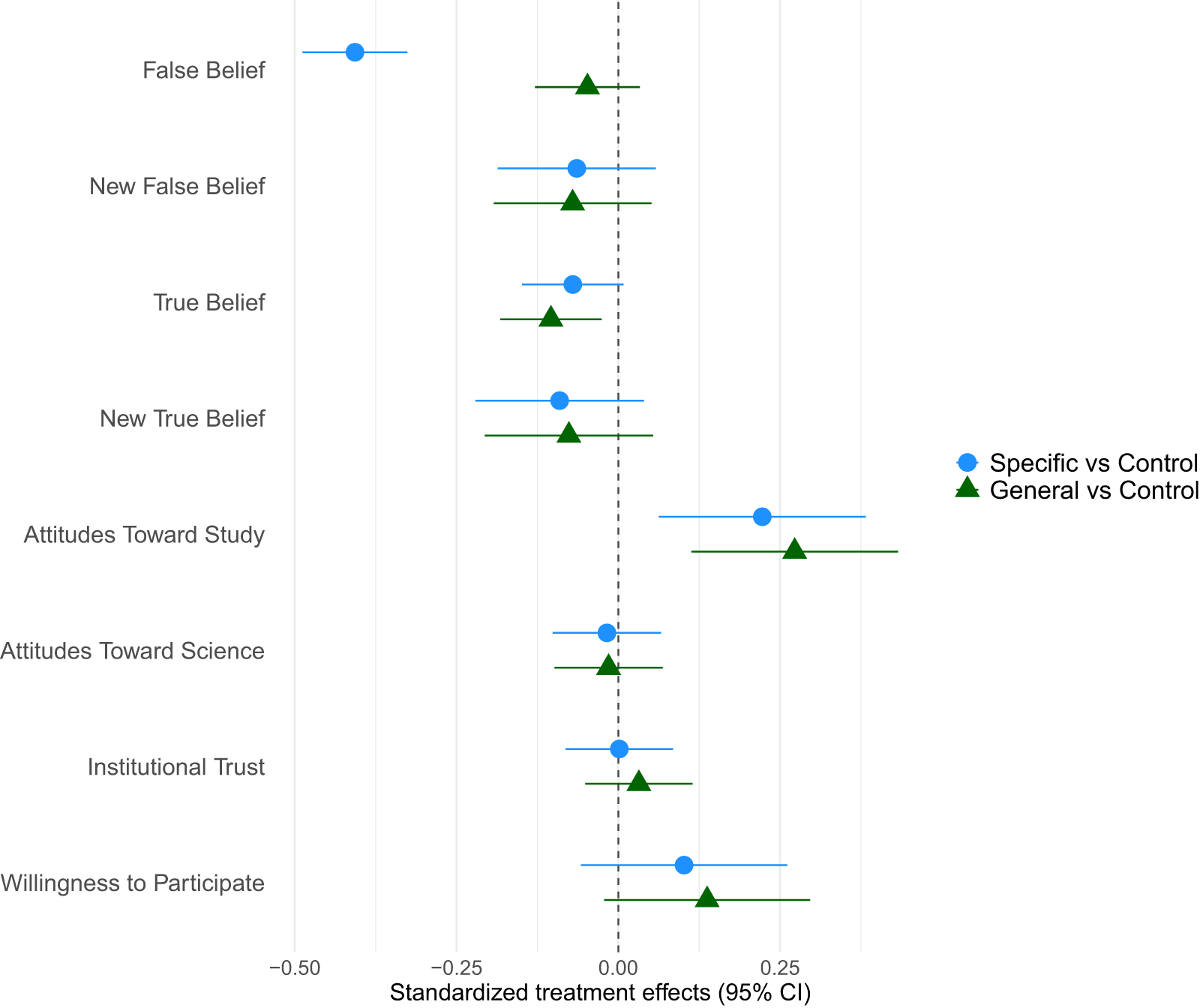
In Figure 2, we plot the effect of the debriefings. The blue circles compare the Specific Debriefing to the Control, while the green triangles compare the General Debriefing to the Control.
Main effects of the debriefings on all the dependent variables. Effects are shown separately for each debriefing condition to allow both inference about the pooled effects (reported in the text) and direct visual comparison between the two debriefing types.

Figure 2 Long description
False Belief; New False Belief; True Belief; New True Belief; Attitudes Toward Study; Attitudes Toward Science; Institutional Trust; Willingness to Part icipate. Horizontal axis label: Standardized treatment effects (95 percent CI). Tick labels shown: minus 0.50, minus 0.25, 0.00, 0.25. A vertical dashed reference line is drawn at 0.00. Legend entries: Specific vs Control (circle marker) and General vs Control (triangle marker). False Belief: circle marker left of minus 0.25 with a horizontal confidence interval; triangle marker slightly left of 0.00 with a horizontal confidence interval. New False Belief: circle marker slightly left of 0.00 with a horizontal confidence interval; triangle marker slightly left of 0.00 with a horizontal confidence interval. True Belief: circle marker slightly left of 0.00 with a horizontal confidence interval; triangle marker left of 0.00 with a horizontal confidence interval. New True Belief: circle marker slightly left of 0.00 with a horizontal confidence interval; triangle marker slightly left of 0.00 with a horizontal confidence interval. Attitudes Toward Study: circle marker right of 0.00, near 0.25, with a horizontal confidence interval; triangle marker right of 0.00, near 0.25, with a horizontal confidence interval. Attitudes Toward Science: circle marker slightly left of 0.00 with a horizontal confidence interval; triangle marker slightly left of 0.00 with a horizontal confidence interval. Institutional Trust: circle marker at 0.00 with a horizontal confidence interval; triangle marker slightly right of 0.00 with a horizontal confidence interval. Willingness to Part icipate: circle marker right of 0.00 with a horizontal confidence interval; triangle marker right of 0.00 with a horizontal confidence interval.
3.1. Effects of the debriefing on belief in false claims
The Specific Debriefing reduced belief in repeated false claims by 0.78 points on the 7-point scale (p < .001), whereas the General Debriefing did not (b = 0.09, p = .25)—partially supporting H1a. The effect of the Specific Debriefing was 0.69 points larger than that of the General Debriefing (p < .001)—supporting H1b. This shows that specific fact-checks reduce belief in false news whereas general warnings about false news do not.
The Specific Debriefing (b = −0.11, p = .30) and the General Debriefing (b = −0.13, p = .26) did not significantly reduce belief in novel false claims compared to the Control—and the two debriefings were not statistically different from each other (b = 0.01, p = .92). This null finding indicates that specific debriefings do not produce spillover effects that enhance participants’ general ability to identify misinformation beyond the specific false claims that were explicitly corrected.
3.2. Effects of the debriefing on true claims
The General Debriefing reduced belief in repeated true claims by 0.20 points on the 7-point scale (p = .009) whereas the Specific Debriefing did not (b = −0.14, p = .079). However, the effect of the debriefings is not significantly different from each other (b = 0.07, p = .40). Debriefings may thus prime a general skepticism that affects how participants retrospectively reevaluate information they encountered during the study, regardless of its veracity. We further reflect on this in Section 4.
The Specific Debriefing (b = −0.17, p = .17) and the General Debriefing (b = −0.15, p = .25) did not significantly reduce belief in novel true claims.
3.3. Effects of the debriefing on attitudes toward the study
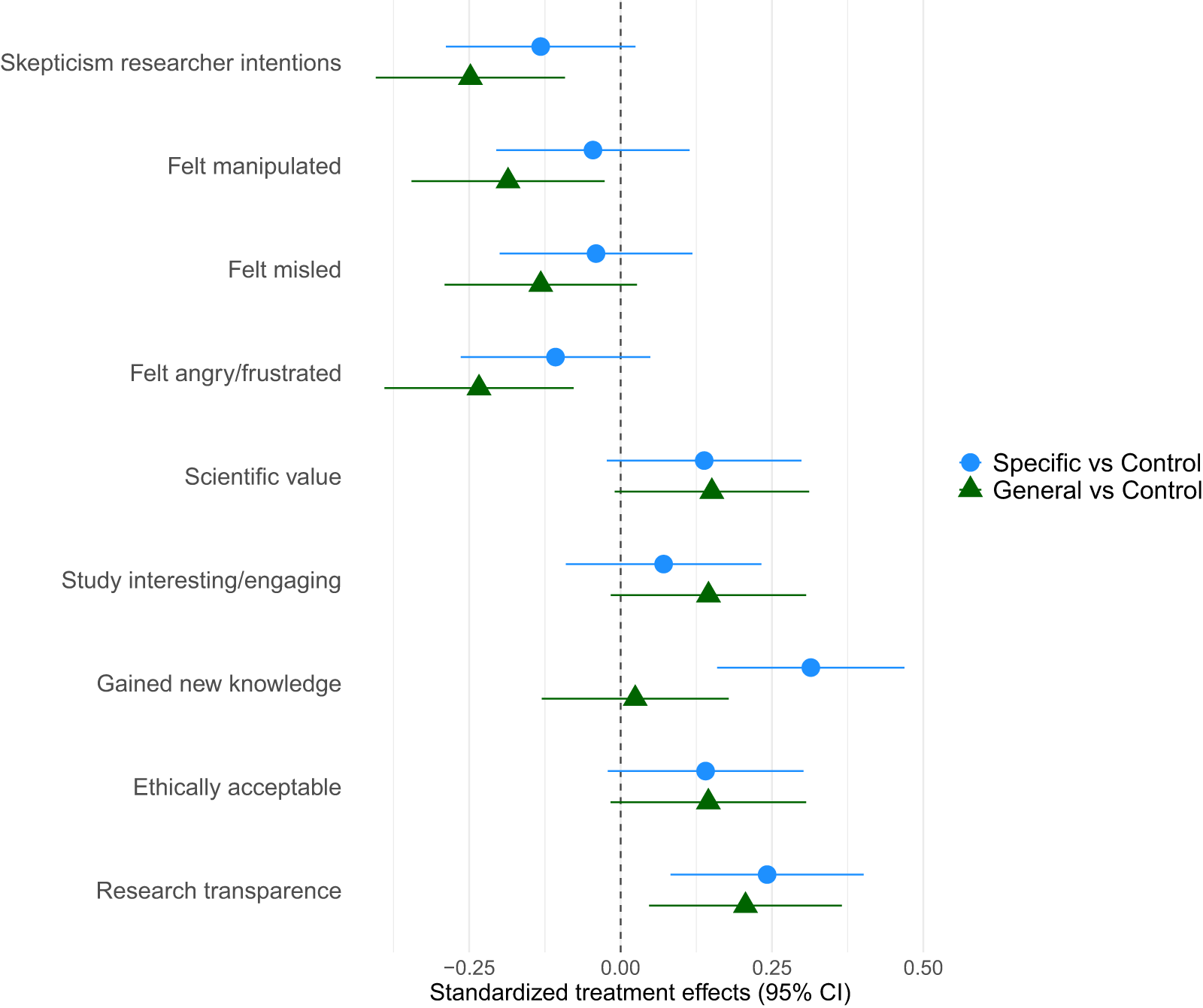
The debriefings improved participants’ (positive) attitudes toward the study (b = 0.14, p < .001)—both the Specific Debriefing (b = 0.13, p = .006) and the General Debriefing (b = 0.16, p = .001) did so. In Figure 3, we break down the results by specific attitudes toward the study. Compared to the Control and the General Debriefing, the Specific Debriefing increased participants’ feeling that they gained new knowledge by participating in the study (b = 0.31, p < .001). Compared to the Control, the General Debriefing (b = 0.21, p = .011) and the Specific Debriefing (b = 0.24, p = .003) increased the perceived transparency of the study. Compared to the Control, the General Debriefing reduced skepticism of researchers’ intentions (b = 0.25, p = .002), feeling of being manipulated (b = 0.19, p = .022), and anger or frustration associated with the study (b = 0.23, p = .003)—these effects are not statistically different from the Specific Debriefing.
Main effects of the debriefings on attitudes toward the study.

Figure 3 Long description
Standardized treatment effects (95 percent CI) Single forest plot with nine outcome rows: Skepticism researcher intentions; Felt manipulated; Felt misled; Felt angry or frustrated; Scientific value; Study interesting or engaging; Gained new knowledge; Ethically acceptable; Research transparence. The x-axis label is Standardized treatment effects (95 percent CI). The x-axis shows tick labels at minus 0.25, 0.00, 0.25 and 0.50. A vertical dashed reference line is drawn at 0.00. A legend at the right shows two series: Specific vs Control marked with circles and General vs Control marked with triangles. Each row contains one circle and one triangle with a horizontal confidence-interval line. Skepticism researcher intentions: the circle is left of 0.00; the triangle is further left of 0.00. Felt manipulated: the circle is slightly left of 0.00; the triangle is left of 0.00. Felt misled: the circle is slightly left of 0.00; the triangle is left of 0.00. Felt angry or frustrated: the circle is left of 0.00; the triangle is left of 0.00. Scientific value: the circle is right of 0.00; the triangle is right of 0.00. Study interesting or engaging: the circle is right of 0.00; the triangle is right of 0.00. Gained new knowledge: the circle is right of 0.25; the triangle is slightly right of 0.00. Ethically acceptable: the circle is right of 0.00; the triangle is right of 0.00. Research transparence: the circle is right of 0.00; the triangle is right of 0.00.
3.4. Effects of the debriefing on attitudes toward scientists
The debriefings did not significantly (b = 0.01, p = .66) influence attitudes toward scientists (e.g., “I trust scientists to act responsibly and in good faith”; both effect sizes are extremely small: b = 0.01, ps > .69).
3.5. Effects of the debriefing on institutional trust
The debriefings did not significantly (b = −0.01, p = .65) influence institutional trust (i.e., trust in news organizations, fact-checkers, and the government; the effect sizes are very small: b < 0.04, ps > .47).
3.6. Effects of the debriefing on willingness to participate in surveys
The debriefings did not significantly (b = −0.07, p = .089) influence participants’ willingness to participate in future surveys (b < 0.09, ps > .08). On OSF, we report an exploratory analysis in which we break down the scale and show that the treatments did not significantly affect any of the specific items of the scale.
Taken together, we found no evidence that the debriefings affected several outcomes of theoretical concern: attitudes toward science (RQ4), institutional trust (RQ5), or willingness to participate in future studies (RQ6). Similarly, we found no spillover effects to novel items, neither for false news (RQ1) nor true news (RQ2b).
3.7. Moderating effect of total number of survey taken on prolific
The positive effects of the debriefings on attitudes toward the study were stronger among participants who have taken more surveys on Prolific (b = 0.06, p = .006)—for both the Specific Debriefing (b = 0.05, p = .029) and the General Debriefing (b = 0.06, p = .013). We expected the effect of the debriefing to be weaker, not stronger, among participants who have more experience with surveys. We found no other statistically significant differences.
An exploratory analysis showed that the effect of the Specific Debriefing on repeated false claims was stronger among participants who have taken more surveys on Prolific (b = 0.09, p = .032)—but not for the General Debriefing (b = 0.02, p = .57).
3.8. Heterogeneous treatment effects (exploratory analyses)
We found no statistically significant heterogeneous treatment effect by true or false claims (repeated and novel), or by the political orientation of the participants. Compared to the Control, the Specific Debriefing was more effective at correcting belief in repeated false claims among less educated (b = 0.27, p < .001) and older participants (b = 0.12, p = .031). The Specific Debriefing also increased positive attitudes toward the study slightly more among women than men compared to the Control (b = 0.20, p = .033). The General Debriefing increased positive attitudes toward the study more among less educated participants compared to the Control (b = 0.13, p = .004).
3.9. Robustness checks
Finally, as a robustness check, we applied a Holm–Bonferroni correction separately to the main dependent variables (24 contrasts) and specific attitudes toward the study (27 contrasts; see Supplementary Appendix D). The main findings survived the correction: the Specific Debriefing’s reduction in belief in repeated false claims (vs both Control and General) and its increase in perceived learning (vs both Control and General), and the General Debriefing’s improvement of attitudes toward the study and reduction of skepticism toward researchers. Other findings did not survive correction: the Specific Debriefing’s effect on attitudes toward the study, the General Debriefing’s effect on belief in repeated true claims, both debriefings’ effects on perceived research transparency, and the General Debriefing’s effects on feeling angry/frustrated and feeling manipulated.
4. Conclusion and discussion
This study offers a comprehensive assessment of how different debriefing strategies affect participants in experimental misinformation research. While prior work has mainly focused on belief correction, we extend this literature by examining not only whether debriefings effectively correct misperceptions, but also how they shape participants’ attitudes toward the study, trust in science, willingness to participate in future research, as well as their belief in true information. By investigating both intended and unintended consequences—including the possibility that debriefings heighten generalized skepticism—we provide a more complete picture of how debriefings function in the context of misinformation studies. Focusing on the increasingly common practice of exposing participants to misinformation without their awareness, we compare the effects of a general warning and a specific corrective debriefing. Our findings offer both reassuring and cautionary insights for researchers navigating the ethical and methodological trade-offs involved in the use of deception.
Consistent with prior work on fact-checking and debunking interventions (Clayton et al., Reference Clayton, Porter, Velez and Wood2024), specific debriefings improved belief accuracy regarding the exact falsehoods presented during the study. In contrast, general debriefings—though ethically compliant—did not reduce belief in false information. This finding reinforces the growing consensus that vague or broad warnings about misinformation are insufficient to correct misperceptions and that specific, claim-level corrections remain a best practice when addressing false beliefs.
However, our findings also reveal important boundary conditions. The Specific Debriefing showed no spillover effect to novel false claims, indicating that debriefings function as targeted corrections of the specific false beliefs that were induced during the study. This absence of transfer effects suggests that participants do not extract generalizable lessons about identifying misinformation from exposure to corrections, even when those corrections are detailed and accompanied by credible source information. From an ethical standpoint, this is reassuring. Specific debriefings effectively fulfill their primary obligation to correct any false beliefs that may be the results of false claims that researchers deliberately included.
Yet our findings also reveal potential unintended consequences. The debriefings slightly reduced belief in true news that participants had seen before, suggesting that even ethically motivated transparency can prime generalized skepticism. While this is in line with recent concerns that interventions aimed at debunking misinformation can erode trust in accurate content or sources (Altay et al., Reference Altay, De Angelis and Hoes2024; Hoes et al., Reference Hoes, Aitken, Zhang, Gackowski and Wojcieszak2024; Thorson, Reference Thorson2024), our findings refine that concern. Specifically, the similarity in effect size across the general and specific debriefing conditions suggests that this reduction in belief in true news is not primarily driven by the act of debunking itself, but by shared elements of both debriefings—namely, the warning about misinformation and the revelation of intentional deception. Our design cannot isolate which component drives this effect, but the pattern suggests that warning participants about misinformation—especially when framed as having been deliberately introduced by the researchers—may undermine confidence in adjacent or truthful content.
Importantly, however, our findings also point to positive consequences. Both debriefings increased perceived transparency and improved attitudes toward the study. The general debriefing also lowered feelings of manipulation and frustration. These results echo recent work suggesting that interventions can foster trust when they are perceived as transparent and clearly delineate truth from falsehood (Altay et al., Reference Altay, De Angelis and Hoes2024; van Erkel et al., Reference van Erkel, Van Aelst, Van Nieuwenborgh, de Vreese, Hameleers and Hopmann2026). Compared to the general debriefing, the specific debriefing was particularly effective in helping participants feel they had gained new knowledge, further supporting the idea that transparent, claim-level corrections can enhance the perceived value of research participation. Contrary to concerns about backlash from deception, we found no negative effects on trust in scientists, institutions, or willingness to participate in future studies. These findings speak directly to longstanding methodological concerns in experimental economics, where the no-deception rule is maintained primarily to preserve participants’ trust and ensure the continued viability of experimental methods (Ortmann and Hertwig, Reference Ortmann and Hertwig2002; Jamison et al., Reference Jamison, Karlan and Schechter2008). Our results suggest that deception—even when explicitly communicated—need not undermine future experimental validity.
Taken together, these findings offer a more nuanced understanding of how debriefings function—not merely as ethical afterthoughts but as active interventions with meaningful consequences. While the corrective power of specific debriefings is clear, their broader informational and psychological effects deserve more attention. Future work should explore how different framing choices—e.g., apologetic versus assertive tones, attribution of blame, or source emphasis—may shape these effects. Moreover, experimental designs that allow finer isolation of the warning versus correction components are needed to disentangle their respective roles. Additionally, future studies should include behavioral measures—such as actual participation in a second follow-up survey—to assess attrition and willingness to reengage more robustly than through self-reports alone. A further limitation concerns the manipulation check. While we report awareness of misinformation exposure separately by condition, the check item does not distinguish between the two debriefing types, as both disclose that misinformation was used. Future studies should include condition-specific checks—for instance, asking participants in the specific debriefing condition whether they recall receiving corrections to particular claims—to better assess whether the independent variable was successfully moved for each treatment.
Ultimately, our results suggest that debriefings can both promote accuracy and foster trust, while also introducing risks of overgeneralized skepticism. Ethical experimental design must therefore strike a careful balance between maximizing transparency and learning, while minimizing confusion and doubt.
Supplementary material
The supplementary material for this article can be found at https://doi.org/10.1017/psrm.2026.10117. To obtain replication material for this article, please visit https://url.uk.m.mimecastprotect.com/s/Y9QPCN9DDHN5D45QumfDfyvssv?domain=doi.org.



 Open access

