China's middle class: unified or fragmented?
The middle class has been widely considered the most potent agent of the sociopolitical transition toward democracy, and the cornerstone for the survival of such a political system (e.g., Lipset, Reference Lipset1959, Reference Lipset1981; Fukuyama, Reference Fukuyama, Diamond and Plattner1993; Huntington, Reference Huntington1991; Glassman, Reference Glassman1995, Reference Glassman1997). This conviction about the role of the middle class is mainly based on one crucial assumption that the middle class will act for democracy in a uniform fashion. Yet, does a middle class in such a transitional society as China act for democracy in a collective fashion and hence serve as the harbinger of democratic change in that country, as the earlier studies of the middle class in the West suggest? As China's new middle class has gradually emerged as an increasingly salient social force in the country's urban areas since the onset of the post-Mao reforms, political scientists and China watchers alike have become more and more interested in the question (see, e.g., Chen, Reference Chen2002; Glassman, Reference Glassman1991; Goodman, Reference Goodman, Goldman and MacFarquhar1999; Pearson, Reference Pearson1997; Li, He, Reference Li2003). However, their answers to this important question do not as yet point to a consensus on the role of the middle class in a potential democratic transition. One exception is Jie Chen and Chunlong Lu's new article in 2011 − ‘Democratization and the Middle Class in China’. This article systematically examines Chinese middle class's attitudes towards democracy based on a representative survey, and concludes that the middle class in China does not necessarily support democratization and there is a negative correlation between the middle class's dependence on the state and its support for democracy.
This study has a different focus, that is to understand whether the newly rising Chinese middle class has a shared class identity and definition of class interests. By examining the behavioral orientations of Chinese middle class toward the local elections which are held in the urban areas (including the local people's congress election and the urban self-government system election), and the attitudinal orientations of Chinese middle class toward the current regime, this article suggests that this new middle class is not unified but fragmented; it is a class without a common class identity. Such a conclusion is supported by three multivariate regression models based on data collected from a representative-sample survey conducted in five Chinese cities in the middle of 2008 (see Appendix).
Who is the middle class in contemporary China?
Subjective and objective approaches to the conceptualization of the middle class
In the conceptualization and operationalization of the middle class as a sociopolitical group, there are two distinct theoretical traditions in the studies of Western societies. One is the so-called ‘subjective’ approach (see, e.g., Centers, Reference Centers1949; Eulau, Reference Eulau1956a, Reference Eulau1956b; Campbell et al., Reference Campbell, Converse, Miller and Stokes1960; Lipset, Reference Lipset1968; Hayes, Reference Hayes1995; Walsh et al., Reference Walsh, Jennings and Stoker2004), and the other is the ‘objective’ approach (see, e.g., Alford, Reference Alford1962; Erikson and Goldthorpe, Reference Erikson and Goldthorpe1992; Lipset, Reference Lipset1968; Milbrath, Reference Milbrath1977; Nie et al., Reference Nie, Powell and Prewitt1969; Verba and Nie, Reference Verba and Nie1972; Wright, Reference Wright1997). The subjective approach suggests that, because a ‘social class is a psychological attachment that is part of an individual's overall self-concept’ (Walsh et al., Reference Walsh, Jennings and Stoker2004: 470), the middle class is identified according to an individual's belief or perception that he or she belongs to the middle stratum of a certain society. According to this approach, more importantly, such a psychological attachment to a social class significantly affects a person's attitudes toward and participation in politics. For example, some empirical studies of the US public found that those who subjectively identified themselves with the middle class scored higher than did those who identified with the working class on measures of attitudes and behavior that were conducive to the maintenance of the democratic system in the United States (Eulau, Reference Eulau1956a; Walsh et al., Reference Walsh, Jennings and Stoker2004).
On the other hand, the objective approach argues that a sociopolitical class is mainly determined by such important objective socioeconomic indicators as income, education, and occupation. Within this approach, there are two conceptual branches. One branch emphasizes the quantitative, cumulative property of the objective indicators (e.g., Nie et al., Reference Nie, Powell and Prewitt1969; Verba and Nie, Reference Verba and Nie1972; Milbrath, Reference Milbrath1977; Sherkat and Blocker, Reference Sherkat and Blocker1994). This branch, the ‘quantitative’ branch, suggests that the best way to capture an individual's class identity is to form a quantitative index of income, education, and occupation, and then to identify the person with a social class according to the person's position on the index. As a result, the middle class usually consists of those who are in the middle range of the scale.Footnote 1 The other branch, or ‘qualitative’ branch, of the objective approach stresses the qualitative property of the various objective indicators of social class (e.g., Burris, Reference Burris1986; Erikson and Goldthorpe, Reference Erikson and Goldthorpe1992; Glassman, Reference Glassman1995; Wright, Reference Wright1997; Zipp, Reference Zipp1986). This branch argues that the middle class is composed of those who possess a set of certain socioeconomic attributes, which qualitatively distinguish them from other social classes. These qualitative attributes are derived directly from some key modern occupations in a society, such as private entrepreneurs of small/medium firms, managerial personnel, and white-collar professionals. Finally, both branches of the objective approach argue that either quantitative or qualitative objective indicators of social class significantly influence people's beliefs about politics.
An approach to the identification of China's middle class
In this study, we choose the objective approach, over the subjective one, to the identification of China's middle class. The main reason for this choice is that the unique social background of the emergence of the middle class in China seems to entail the objective approach to the conceptualization of this social class. Only until the late 1980s, was the middle class by Western standards said to emerge gradually in China (Zheng and Li, Reference Zheng and Li2004; Xiao, Reference Xiao2001; Lu, Reference Lu2004); and, moreover, as we just mentioned, the social identity of the Chinese middle class is still in formation. While the subjective approach requires most of the population to have at least a basic understanding of the middle class (vs. other classes, such as working class and upper class) that takes a long time to shape up (Milbrath, Reference Milbrath1977; Hayes, Reference Hayes1995; Eulau, Reference Eulau1956a, Reference Eulau1956b), the objective approach relies only on objective indicators that are less likely to be affected by the perception or misperception of the class. Within this unique historical and social context, therefore, the objective approach to the identification of this class seems to be much more suitable than the subjective one.
Both the quantitative and qualitative branches of the objective approaches have been applied to the identification of middle class in some early studies conducted in the Chinese setting. Within the quantitative branch, a person's income has been the most common indicator of social class.Footnote 2 However, this income-based, quantitative measurement of middle class has suffered a serious drawback: it is very hard to achieve any consensus on the criterion of income when defining middle class, since actual personal income is hard to detectFootnote 3 and varies dramatically with areas in such a fast-changing society as China.Footnote 4
On the other hand, within the qualitative branch of the objective approach, several key modern occupations have been used to define the middle class in China.Footnote 5 This branch of the objective approach seems to be promising in overcoming the drawback that the quantitative branch has suffered. This is mainly because, in contemporary China, occupations are much easier to detect and more constant across regions than is actual personal income, and they tend to present ‘groupings that are distinct and separate from one another’ (Oppenheimer, Reference Oppenheimer1985: 7). Therefore, such an occupation-based, qualitative measure (of the objective approach) seems to be a more reliable and practical indicator of the middle class in the Chinese setting. In addition, such a measure seems to be more suitable for cross-nation comparison, since the modern occupations used in this measure (e.g., professional, private entrepreneur, managers, and white-collar office workers) are derived mainly from the general trends of modernization and industrialization at the global level and hence share commonalities across countries (see, e.g., Marsh and Kaase, Reference Marsh, Kaase and Barnes1979).
More importantly, two groups of the Pacific Asian scholars designed a common operationalization of the middle class from this occupation-based, qualitative measure to suit the situations of the countries in the region of Pacific Asia, and thereby to ensure rough comparability across countries in this region (Hattori et al., Reference Hattori, Funatsu and Torii2003; Hsiao and So, Reference Hsiao, So and Hsiao1999). According to these scholars, the middle classes in the Pacific Asia include salaried professional, technical, administrative, and managerial white-collar workers who have special skills and expertise, small proprietors and the self-employed, and salaried, non-manual routine clerical workers and personal service workers. Therefore, by adopting the same occupation-based, qualitative measure, this article seeks to compare the findings of the Chinese middle class, which has been left behind by the two groups of the Pacific Asian scholars,Footnote 6 with the existing studies of other countries in the Pacific Asian region.
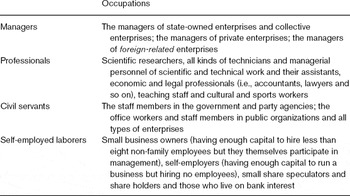
Consequently, based on the qualitative branch of the objective approach, we operationalize the middle class in urban China by combining four occupational groups typically used in both Chinese and non-Chinese settings:Footnote 7 self-employed laborers (i.e., private entrepreneur of small or medium-sized business in the Chinese context), managerial personnel, professionals, and civil servants (i.e., white-collar office workers in the Chinese context). The composition of each occupational group in Chinese society is summarized by the following Table 1.
The occupational composition of the Chinese middle class

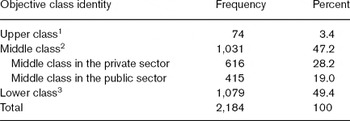
The results of these four occupational groups combined showed that within the working population in five cities (excluding students and retired), about 47% of our respondents belonged to the objectively conceptualized middle class. Furthermore, as will be discussed in the following paragraphs, due to the continued importance of the state institutions in influencing ordinary Chinese citizens’ life opportunities during the reform era, the formation of the middle class in contemporary China follows two distinct paths. The first is through the state institutions, where the middle class is employed in government and party agencies, state-owned enterprises, collective-owned enterprises, and public organizations. The second path is through the market institutions, where the middle class is employed in the private sector (e.g., private enterprises, foreign-related enterprises, and private organizations) or self-employed (e.g., self-employed laborers). The result indicates that within the working population in the five Chinese cities, about 28% of our respondents belonged to the subgroup of the middle class in the private sector, while 19% belonged to the subgroup in the public sector (see Table 2). This finding clearly indicates that about a half of the Chinese middle class is employed in the public sector, and this finding is consistent with some earlier observations of the Chinese middle class (Zhang, Reference Zhang2005; Zheng and Li, Reference Zheng and Li2004). This result also confirms the suggestions from some earlier China studies that the Chinese state played an important role in creating and shaping the middle class in that country (e.g., Goodman, Reference Goodman, Goldman and MacFarquhar1999; Tomba, Reference Tomba2004; Zhang, Reference Zhang2005; Zheng and Li, Reference Zheng and Li2004; Zhou, Reference Zhou2005).
The distribution of social classes in five Chinese cities within the working population

Notes:1 Upper class includes ranking administrative personnel of state affairs and social affairs and private entrepreneur of large business.
2 Middle class includes private entrepreneur of small or medium business, managerial personnel, white-collar professional, and civil servants.
3 Lower class includes service workers, industry workers, and unemployed.
Does the Chinese middle class have a shared class identity?
Does the Chinese middle class have a shared class identity and take collective political action? The theoretical insights on which we base our answer to this question come mainly from the studies of Western societies in general and the observations of the Pacific Asian countries in particular, which are supplemented by the newly emerging yet still very limited literature from the Chinese setting.
The general studies of Western societies
Within the general studies of Western societies, the predominant view suggests that the middle class does act for democracy in a uniform fashion. First, these studies contend that they are most likely to act for democracy because they have a high level of political efficacy; that is, they are more confident of their role in public affairs and more competent participating in politics than are members of the lower class (e.g., Eulau, Reference Eulau1956a, Reference Eulau1956b; Nie et al., Reference Nie, Powell and Prewitt1969; Verba and Nie, Reference Verba and Nie1972; Milbrath, Reference Milbrath1977; Lipset, Reference Lipset1981). According to this argument, such confidence and competence come mainly from three sources. One is the experience and expertise related to the occupations of middle class individuals. As small/medium entrepreneurs, managerial personnel, and white-collar professionals, these individuals have experiences in running businesses and supervising others, and many may have expert knowledge. As a result, they feel more competent than lower class individuals to participate in various social and political activities (e.g., Lane, Reference Lane1959). A second source is that they are better informed about public and political affairs. Due to the nature and needs of their occupations, middle class people have a bigger stake in acquiring information about public policies and politics in general than working class people. As owners of small/medium businesses, managers and professionals, for example, these peoples need to have timely information about changes of government policies and of leaders at various levels, because such changes could directly affect their immediate and long-term occupational interests. As Luskin (Reference Luskin1990: 336) argues, people in the middle class have ‘more politically impinged occupations [that require] more political information . . . about what the government is doing or is likely to do . . . and what effects its actions are likely to have’. The last, but not least, source of middle class people's confidence and competence is their social network (as opposed to clientelist ties with the state power). Compared to the working class, those in the middle class have broader social networks due to the nature of their occupations and professions (Kahl, Reference Kahl1957; Mills, Reference Mills1953; Milbrath, Reference Milbrath1977). For example, while small/medium business owners have to contact people in various walks of society for the operation and growth of their businesses, managers and professionals need networks at least in their professions for the maintenance and advancement of their careers.
Second, these studies assume that the middle class will act in a unified fashion. In the view of the modernization theorists (e.g., Lipset, Reference Lipset1959, Reference Lipset1981; Huntington, Reference Huntington1991; Glassman, Reference Glassman1995, Reference Glassman1997), the middle class as a group appears to be a consistent agent for democracy within a society, and will act in a collective way for democracy. Based on this assumption, they further suggest that with economic development in a society, the middle class will emerge and gain in size, and, in turn, work as a causal agent for the establishment of democracy. Moreover, modernization theorists assume that this developmental path is linear − economic development creates an affluent middle class in a society, which, in turn, leads to a democratic system − and can be generalized to all countries and regions (Glassman, Reference Glassman1995, Reference Glassman1997).
However, this belief leaves these scholars in a weak position. As suggested by Dietrich Rueschemeyer and his associates (1992: 53), ‘not all classes are collective actors in history; nor do they become eventually such actors with any generalized necessity’. Furthermore, they suggest, ‘neither class consciousness nor class organization and collective action follow with any simple necessity from class position’. Dietrich Rueschemeyer and his associates (1992: 56) further suggest that ‘the structure of the economy and its development have strong direct effects on the organizational formations of a class’, and they argue that the state's role in the economy will shape the way how a class forms its identity and interest, and how a class acts for its interest.
The observations of the Pacific Asian countries
Throughout the developing world, the activities of the state have been a primary source of the formation of the middle class. As Dale Johnson has observed:
In less developed societies the state tends to grow to the limits of resources that can be taxed or otherwise appropriated by government . . . In part, this overdevelopment compensates for the presence of weak classes of local capitalists, or even their virtual nonexistence: States assume entrepreneurial functions, giving birth to technocratic, managerial, and technical groupings. (Johnson, Reference Johnson and Johnson1985: 15)
Many empirical observations of the Pacific Asian societies suggest that the rise of the middle class in these countries is a direct consequence of rapid state-led economic development in the past several decades (e.g., Bell, Reference Bell1998; Brown and Jones, Reference Brown, Martin Jones and Bell1995; Hattori and Funatsu, Reference Hattori and Funatsu2003; Jones, Reference Jones1998; Koo, Reference Koo and Hsiao1999; Torii, Reference Torii2003). A large sector of the newly emerged middle class in the Pacific Asian societies is ‘dependent upon the state for their employment, either as public servants, or as employees of state-supported companies’ (Brown and Jones, Reference Brown, Martin Jones and Bell1995: 92). The direct result of this active state intervention in the formation of the middle class in the Pacific Asian societies is that this class is highly dependent upon state patronage (e.g., Bell, Reference Bell1998; Brown and Jones, Reference Brown, Martin Jones and Bell1995; Jones, Reference Jones1998; Torii, Reference Torii2003). This unique relationship between the state and the newly emerged middle class in the Pacific Asian societies makes this class quite different from its counterparts in the Western democratic societies.
Moreover, these studies tend to suggest that since the state often played a very active role in creating and shaping the formation of the middle class in the Pacific Asian societies, the emergence of a unified and distinctive middle class identity was nearly impossible. These studies further suggest that the political orientations of the middle classes in these societies are not unified but fragmented (e.g., Koo, Reference Koo and Hsiao1999; Shin, Reference Shin1999).
As Ulf Sundhaussen concluded, inquiry into the political orientations of the middle classes in the developing world such as the Pacific Asian countries ‘would have to begin with distinguishing between the different kinds of Middle Classes’. Furthermore, he observed that:
the salaried professionals, often in state employ, are usually too dependent on their employer, especially if the state has been organized along patrimonial lines . . . Only, the intellectuals, academics, lawyers and journalists, can reasonably be expected in Third World countries to champion the cause of democracy. (Sundhaussen, Reference Sundhaussen1991: 112)
Some empirical observations of the Pacific Asian societies have found that the political orientations of the middle classes in the Pacific Asia are not unified but divided (Hattori and Funatsu, Reference Hattori and Funatsu2003; Koo, Reference Koo1991; Shin, Reference Shin1999). In Malaysia, Singapore, Philippines, Thailand, and South Korea, a large sector of the upper middle classes, which are employed either in the state bureaucracy or in businesses with links to the ruling political party, have generally supported the consolidation of authoritarian rule, since these upper middle classes were the main beneficiaries of the state activities in the past decades; thus they have a vested interest in the continuity and stability of authoritarian rule (Bell, Reference Bell1998; Jones, Reference Jones1998; Englehart, Reference Englehart2003; Brown and Jones, Reference Brown, Martin Jones and Bell1995; Lam, Reference Lam and Morley1999; Rodan, Reference Rodan and Rodan1993). On the other hand, in these countries, a majority of the new middle classes, which consist of professional and technical workers, as well as managers, tends to be more progressive and is more likely to demand democracy than the upper middle classes which have close ties with the state. Therefore, it would be difficult to summarize the general political orientations of the middle classes due to such intra-class variation in these countries.
The dependence of Chinese middle class upon state power
As has been the case in other Pacific Asian countries, the development of China's middle class was influenced by national politics and government policies. In the past 50 years, government policies and the changes in the state institutions determined the patterns of social stratification in Chinese society. Before the establishment of the People's Republic of China in 1949, a small middle class, including managerial personnel, professionals, small businessmen, and civil servants, constituted approximately 7% of the Chinese population (Lu, Reference Lu2004). In the period beginning in 1949 and ending in 1978, China was a statist society ruled by a strong Leninist party; the private economy was gradually eliminated, and private entrepreneurs, small and medium-size businessmen, as well as independent professionals, disappeared in Chinese society (Bian, Reference Bian2002; Davis, Reference Davis2000; Lu, Reference Lu2004; Qiu, Reference Qiu2004; So, Reference So2003; Whyte, Reference Whyte1975). During this period, the Chinese Communist Party (CCP) successfully transformed the pre-1949 independent middle class into a subservient stratum (Davis, Reference Davis2000).
Since 1978, the CCP has gradually legitimized the existence of the private economy in Chinese society and has taken genuine measures to encourage its development (International Finance Corporation, 2000; Pearson, Reference Pearson1997). The CCP has abandoned their monopolization of occupational mobility, allowing ordinary Chinese citizens to have greater freedom to choose their occupations (Zhou, Reference Zhou2004; Qiu, Reference Qiu2004), and the CCP has also de-emphasized the importance of political loyalty and activism in educational attainment and occupational advancement (Cao, Reference Cao2001; Walder et al., Reference Walder, Li and Treiman2000). The post-Mao reform has changed the social structure of China and consequently paved the road for the emergence of a middle class. Since the late 1980s, a middle class by Western standards has emerged in Chinese society.
However, due to the continued importance of the state institutions in influencing ordinary Chinese citizens’ life opportunities during the reform era, the formation of the middle class in contemporary China follows two separate paths (e.g., Li, Chunling, Reference Li2003; Li, Qiang, Reference Li2003; Lu, Reference Lu2002, Reference Lu2004; Zhang, Reference Zhang2005; Zheng and Li, Reference Zheng and Li2004; Zhou, Reference Zhou2005). The first is through the state institutions, where middle class positions in government and party agencies, state-owned enterprises, collective-owned enterprises, and public organizations are considered to be ‘closed’ positions, and access to these positions is subject to screening for political loyalty and party membership. This sub-group, the middle class employed in the public sector, which includes managers in the state-owned enterprises, professionals in the public organizations, and staff members in the government and party agencies and public organizations, is, in varying degrees, still affected by state power (e.g., Lu, Reference Lu2002, Reference Lu2004; Zhang, Reference Zhang2005; Zheng and Li, Reference Zheng and Li2004). The second path is through the market institutions, where middle class positions in the private sector are considered to be ‘open’ positions, and the access to these positions is determined by the workings of the market institutions. This sub-group, the middle class employed in the private sector, which includes managers in the private and foreign-related enterprises, professionals in the private sector, self-employed laborers (i.e., private entrepreneur of small or medium-sized business in the Chinese context), and white-collar office workers in the private entities, is much more independent than the first sub-group in terms of its relationship to state power (e.g., Lu, Reference Lu2002, Reference Lu2004; Zhang, Reference Zhang2005; Zhou, Reference Zhou2005).
The Chinese middle class's views on the Communist government
Since Chinese middle class is highly dependent upon the state power, we expect that this new middle class is very supportive of the Communist government, because most middle class members ‘enjoy a comfortable lifestyle and a high socioeconomic status relative to other groups’ in the post-Mao state-led development (Wright, Reference Wright2010: 83). Moreover, we hypothesize that the middle class people in the public sector are more likely than those in the private sector to support the current political regime. There is at least one rather straightforward rationale behind this hypothesis. Because the middle class individuals in the public sector have close relations with the Communist party and government, and enjoy many privileges sanctioned by the party-state (e.g., Lu, Reference Lu2002, Reference Lu2004; Zhang, Reference Zhang2005; Zheng and Li, Reference Zheng and Li2004), they have a vested interest in the continuation of the current regime.Footnote 8 For example, as David Goodman points out, the managers in the state-owned and collective enterprises, and the professionals in the public sector, in general, ‘far from being alienated from the [P]arty-state or seek[ing] their own political voice, [appear] to be operating in close proximity and through close cooperation’ with the party-state (Goodman, Reference Goodman, Goldman and MacFarquhar1999: 260–1). As a result, the public-sector middle class people tend to have a very positive evaluation of the currently implemented political regime. On the other hand, the private-sector middle class people who are employed in the private entities or self-employed often do not have close ties the party-state; thus they are independent from the CCP (e.g., Lu, Reference Lu2002, Reference Lu2004; Zhang, Reference Zhang2005; Zhou, Reference Zhou2005). Moreover, the material benefits enjoyed by the private-sector middle class were mainly acquired through the market (Zhang, Reference Zhang2005; Zheng and Li, Reference Zheng and Li2004). As a result, the private-sector middle class people do not feel attached to the current political regime. On many occasions, when their interests are impinged on, the private-sector middle class people lack powerful political patrons to protect their interests and very often they have to rely on legal weapons;Footnote 9 therefore they have a fairly strong demand for an institutionalized democracy to guarantee the proper functioning of the market, to contain the widespread corruption, and to secure their property and their bourgeois lifestyle.Footnote 10 This rising demand for democracy will, of course, constitute a major challenge to the current political regime, since the current regime can at best be characterized as semi-democratic, which is not consistent with the expectations of those who strongly believe in democratic principles.
Our measurement of support for the government (or diffuse support) within the middle class is designed based on the theoretical framework developed by David Easton (see, Easton, Reference Easton1965, Reference Easton1975). Diffuse support, often seen as the more influential dimension, represents a person's support for the regime that refers to the fundamental values, norms, and institutions of the government. It is believed that citizens are linked to the regime by diffuse support stemmed from their assessment of the fundamental values, norms, and institutions of the government. Thus, diffuse support for the regime is also regarded as the ‘belief in legitimacy’ of the political regime (Easton, Reference Easton1965: Chapter 18). According to this conceptualization, specifically, diffuse support in this study refers to the middle class's supportive attitudes toward the fundamental values that the current, post-Mao regime advocates, and the basic political institutions through which the regime rules the country.
To measure Chinese urban residents’ diffuse support for the current political regime, we asked respondents to assess the following seven items (or statements): ‘I believe that the Communist party can represent my interests’; ‘I believe that the National People's Congress can represent the Chinese people's interests’; ‘I believe that the Liberation Army can protect our country’; ‘I believe that the security forces in China guarantee the fair enforcement of the law’; ‘I believe that the courts in China guarantee fair trials’; ‘I have an obligation to support the current political system’; ‘I feel that my personal values are the same as those advocated by the government’. Respondents were asked to assess each of these seven statements on a 5-point scale, where ‘1’ stands for strong disagreement with the statement and ‘5’ refers to strong agreement with it.
We ran a factor analysis among these seven items within the respondents of the middle class. The results from the factor analysis indicated that only a single dominant factor emerged among these seven items, accounting for 80% of the original variance. Given such a degree of coherence among these seven items, the factor score from the factor analysis will be used as the collective indicator of diffuse support in the multivariate analysis that follows.
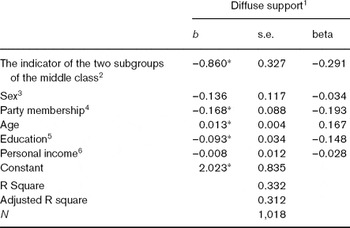
To test the hypotheses that have been discussed above, we ran a multiple regression model (OLS) based on the sample of middle class respondents. In this model, particularly, we included a dummy variable for the two subgroups of the middle class (with public-sector middle class = 0; private-sector middle class = 1) to in order to confirm the impact of such a division on diffuse support for the Communist government. Table 3 presents the results of this multiple regression model. Overall, the results from the regression model are consistent with our expectations: even independently of some key sociodemographic attributes, the division between public-sector middle class and private-sector middle class influences diffuse support for the Communist government.
Ordinary least square (OLS) regression of diffuse support

Notes: * p < 0.01.
1 The value of diffuse support is the factor score of the seven items (‘I believe that the Communist party can represent my interests’; ‘I believe that the National People's Congress can represent the Chinese people's interests’; ‘I believe that the Liberation Army can protect our country’; ‘I believe that the security forces in China guarantee the fair enforcement of the law’; ‘I believe that the courts in China guarantee fair trials’; ‘I have an obligation to support the current political system’; ‘I feel that my personal values are the same as those advocated by the government’).
2 Public-sector middle class = 0; private-sector middle class = 1.
3 Male = 0; female = 1.
4 Party member = 0; Non-party member = 1.
5 Middle school and below = 1; high school = 2; post-secondary professional training = 3; four-year university education = 4; graduate level = 5.
6 Income is measured by Chinese currency, yuan.
From the results from Table 3, we can see that those who belonged to the private-sector middle class were much less likely than those who belonged to the public-sector middle class to support the current Communist regime (b = −0.860). Such an attitudinal division between the two subgroups of the middle class may indicate that Chinese middle class does not have a shared class identity. To further confirm this argument, we will examine the behavioral orientations of the two subgroups of the middle class. We expect that the two subgroups of the middle class may have different behavioral orientations in a similar fashion as diffuse support for the Communist regime.
Dependent variable: voting behavior
In the democratic societies, the middle class is more likely to participate in conventional political activities than other social groups. This participation is crucial for the maintenance and functioning of a democratic system (Dahl, Reference Dahl1971; Lane, Reference Lane1959; Milbrath, Reference Milbrath1977). According to Sidney Verba and his associates, conventional political activities are ‘legal acts by private citizens that are more or less directly aimed at influencing the selection of governmental personnel and the actions that they take’ (Verba et al., Reference Verba, Nie and Kim1978: 46). Moreover, Verba and his associates identify four modes of conventional political participation: voting, campaign activity, communal activity, and particularized contact. From the outset of the post-Mao economic and political reforms, ordinary Chinese citizens have been participating in public affairs and politics at least at the local level (Shi, Reference Shi1997; Tang and Parish, Reference Tang and Parish2000; Chen, Reference Chen2000, Reference Chen2004; Manion, Reference Manion1996; Jennings, Reference Jennings1997), even though the Chinese political system is at most semi-democratic. Studies of Chinese politics have identified several common modes of conventional political participation: voting, campaign behavior, and particularized contact (Chen, Reference Chen2000, Reference Chen2004; Shi, Reference Shi1997).
It was established earlier in this study that the two subgroups of the middle class in China are supposed to act in a divided way, that is the middle class individuals employed in the public sector will act differently from the middle class individuals employed in the private sector. Given this assumption, what are the participatory orientations of the two sub-groups of the middle class in regard to these conventional political activities?
This article is going to explore this question by examining how the two sub-groups of the middle class act in the elections of (1) the local people's congress and (2) the urban self-government system. There were several reasons to choose the voting behavior in the elections of (1) the local people's congress and (2) the urban self-government system as the case to study the participatory orientations of the two sub-groups of middle class people. First, all Chinese middle class people are urban residents, thus it is necessary to study political behavioral orientations of the middle class people by examining how they act in the public affairs and politics in the urban areas of China. People's participation in the elections of the local people's congress and the urban self-government system by no means exhaust their political behaviors in urban China; nonetheless, they may serve as a good test of the relationship between people's class identity and political behavioral orientations in urban China. Second, people from all socio-economic classes of the urban areas are familiar with the elections of the local people's congress and the urban self-government system, and they tend to act in a more sophisticated way in the elections of the local people's congress and the urban self-government system. Therefore, people's participation in the elections of the local people's congress and the urban self-government system may represent their fundamental political behavioral orientations. Third, in the reform era, people are free to choose to participate or not to participate in the elections of the local people's congress and the urban self-government system.Footnote 11 For this reason, survey questions about these acts were ‘unlikely to make respondents give interviewers false answers’ (Shi, Reference Shi1997, 27). Thus, people's behavioral orientations toward the elections of the local people's congress and the urban self-government system provide a good opportunity to study the impact of class identity on their behavioral orientations.
The nature of the elections of the local people's congress and the urban self-government system
In order to fully understand the voting behavior of the two subgroups of the middle class, it is necessary to provide an overview of the nature of the elections of the local people's congress and the urban self-government system first. Since the onset of the post-Mao reform, the Chinese central government has made genuine efforts to democratize the local people's congress and the urban self-government system and encouraged urban residents to participate in the elections of the local people's congress and the urban self-government system. Moreover, the Chinese government viewed the elections of the local people's congress and the urban self-government system as the symbol of democratic development in that country.Footnote 12 However, the Chinese government has imposed several constraints on the elections of local people's congress and the urban self-government system to an extent that both elections can be characterized as ‘semi-democratic’.
First, with regard to the local people's congress election, the Communist government has firmly imposed two formidable constraints to prevent any organized and individual opposition from challenging its ruling position. The Communist government has directly or indirectly controlled virtually the entire process of local people's congress elections: from the nomination of candidates, electorate deliberation, to the determination of final candidates on the ballot (Halpern, Reference Halpern and Baum1991: 38; Burns, Reference Burns1999: 591). Such control of election process has been done mainly through the party-dominated, local election committees (Shi and Lei, Reference Shi and Jingxuan1999: 21–3). Meanwhile, the Communist government has designed and implemented a list of measures in order to prevent the local people's congress elections from becoming a forum spreading bourgeois liberal thoughts or political views contrary to the official ideology. The party prohibits any large-scale or publicized electoral campaign that is considered part of ‘bourgeois democracy’ (as opposed to ‘socialist democracy’), and it requires that all electoral activities and deliberations be carried out within a limited scope (e.g., work unit or danwei, 单 位) under firm control by the party-dominated election committee (Shi and Lei, Reference Shi and Jingxuan1999; Wang, Reference Wang1998).
Second, with regard to the urban self-government system election, there seems to be a consensus in field observations by China scholars. This consensus suggests that the urban self-government system has to a certain extent liberalized political life in urban China through such measures as elections of community residential committee (CRC or shequ juweihui 社 区 居 委 会) leaders and the creation of residents’ representative assemblies. But the consensus also maintains that this grassroots political system can be characterized as ‘semi-democratic’ (Benewick et al., Reference Benewick, Tong and Howell2004; Derleth and Koldyk, Reference Derleth and Koldyk2004; Gui et al., Reference Gui, Cheng and Ma2006). This is because elections of CRC leadership and the management of self-government are in general dominated and controlled by local party organizations. For example, Wang and his associates (Reference Wang2003), have summarized the serious problems in various areas (e.g., election committees, nomination procedures, election competitiveness, and the relations between the state and urban self-government) of the urban self-government system that have prevented this system from being truly democratic and autonomous.
Comparison of the voting behaviors between the two subgroups of the middle class
Specifically, participation in the elections of the local people's congress and the urban self-government system were measured by the following two questions:
1. Have you voted in the last election of the local people's representatives?
2. Have you voted in the last election of the local community residents’ committee members?
Respondents were asked to answer each of these two questions on a dummy scale, where 1 indicated respondents’ participation, and 0 referred to their non-participation.
Based upon the above discussion, we expect that the two subgroups of the middle class have different orientations toward the two voting behaviors. In specific, we hypothesize that the private-sector middle class is less likely to participate in the elections of the local people's congress and the urban self-government system. There are two reasons to support this expectation. First, as we have observed, those who belonged to the private-sector middle class were much less likely than those who belonged to the public-sector middle class to support the current Communist regime. Thus, the private-sector middle class people's negative evaluation of the current regime may cause the private-sector middle class people to engage in non-participatory action to express their discontent with the current political system; on the other hand, the public-sector middle class people's positive evaluation of the current regime may cause the public-sector middle class people to vote in the elections of the local people's congress and the urban self-government system to express their support for the current system.
Second, the middle class individuals in the public sector have close relations with the current regime; moreover, many of them are situated within the current political system (tizhinei), and, as a result, they have more access to the electoral process when the elections take place. On the other hand, the middle class individuals in the private sector in general are excluded from the current political system, and, as a result, they have less access to the electoral process. For example, ballot boxes and stations might not be available for them at election time. In addition, the public-sector middle class is more likely to be coopted by the Communist party than the private-sector middle class; therefore, the public-sector middle class is more likely to be mobilized by the party to vote at election time. In our survey, approximately 28% of the public-sector middle class reported the party membership, whereas about 8% of the middle class people in the private sector had the party membership.
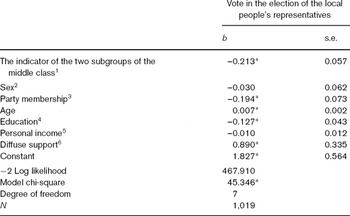
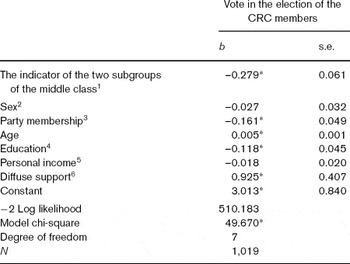
To test our hypothesis, we ran two logistical regression models, with one regression using vote in the election of the local people's representatives as the dependent variable, and the other regression using vote in the election of the CRC members as the dependent variable. The results of two logistical regressions are illustrated in Tables 4 and 5 respectively.
Logistic regression of voting behavior in the election of the local people's representatives

Notes: * p < 0.01.
1 Public-sector middle class = 0; private-sector middle class = 1.
2 Male = 0; female = 1.
3 Party member = 0; non-party member = 1.
4 Middle school and below = 1; high school = 2; post-secondary professional training = 3; four-year university education = 4; graduate level = 5.
5 Income is measured by Chinese currency, yuan.
6 The value of diffuse support is the factor score of the seven items (‘I believe that the Communist party can represent my interests’; ‘I believe that the National People's Congress can represent the Chinese people's interests’; ‘I believe that the Liberation Army can protect our country’; ‘I believe that the security forces in China guarantee the fair enforcement of the law’; ‘I believe that the courts in China guarantee fair trials’; ‘I have an obligation to support the current political system’; ‘I feel that my personal values are the same as those advocated by the government’).
Logistic regression of voting behavior in the election of the CRC members

Notes: * p < 0.01.
1 Public-sector middle class = 0; private-sector middle class = 1.
2 Male = 0; female = 1.
3 Party member = 0; non-party member = 1.
4 Middle school and below = 1; High school = 2; post-secondary professional training = 3; four-year university education = 4; Graduate level = 5.
5 Income is measured by Chinese currency, yuan.
6 The value of diffuse support is the factor score of the seven items (‘I believe that the Communist party can represent my interests’; ‘I believe that the National People's Congress can represent the Chinese people's interests’; ‘I believe that the Liberation Army can protect our country’; ‘I believe that the security forces in China guarantee the fair enforcement of the law’; ‘I believe that the courts in China guarantee fair trials’; ‘I have an obligation to support the current political system’; ‘I feel that my personal values are the same as those advocated by the government’).
Overall, the findings from the two logistical regression models are consistent with our hypothesis. Specifically, and first of all, as Table 4 indicates, after controlling for other objective social-demographic variables, the objective indicators of the two subgroups of the middle class have an independent influence on vote in the election of the local people's representatives. That means, the private-sector middle class is less likely to participate in the elections of the local people's congress than the public-sector middle class. Table 5 indicates a very similar result, after controlling for other objective social-demographic variables, the objective indicators of the two subgroups of the middle class also have an independent influence on vote in the election of the CRC members. That means, the private-sector middle class is less likely to participate in the elections of the urban self-government system.
Second, both regression models indicate, among the middle class respondents, there is a positive relationship between diffuse support for the current regime and voting behaviors in the elections of the local people's congress and the urban self-government system. This finding suggests that the middle class people who are supportive of the current political system tend to vote in the elections of the local people's congress and the urban self-government system. As we have established before, the public-sector middle class is more likely to be supportive of the current regime than the private-sector middle class. Combining these findings in one picture, we may imply that the public-sector middle class people's positive evaluation of the current regime causes the public-sector middle class people to vote in the elections of the local people's congress and the urban self-government system; whereas the private-sector middle class people's negative evaluation of the current regime causes the private-sector middle class people to engage in non-voting behavior.
Conclusions and discussions
Does the middle class in China act for democracy in a uniform way? It is seems to be too ambitious for us to answer this question in this study. Instead, we only focus upon one aspect of this question: does the middle class in China have a shared class identity and take collective action? Overall, we find that the Chinese middle class can be divided into two subgroups: public-sector and private-sector. Moreover, the two subgroups of the middle class have different orientations toward diffuse support for the Communist government and act differently in the elections of the local people's congress and the urban self-government system. Therefore, we may conclude that the Chinese middle class is a class without a common identity. Here we highlight these findings and implications.
First of all, the public-sector middle class people are more likely to support the current regime and thus are more likely to vote in the elections of the local people's congress and the urban self-government system. On the other hand, the private-sector middle class people are less likely to support the current regime and thus are less likely to vote in the elections of the local people's congress and the urban self-government system.
The implications of these findings are twofold: first, the CCP still enjoys political legitimacy in the minds of the public-sector middle class, but, on the other hand, the CCP shall need to make necessary reforms to meet the political demands from the private-sector middle class. Second, there is a strong division within the group of the middle class, especially along the line of the relationship with the state. That is, the private-sector middle class acts in a different from the public-sector middle class. Therefore, we conclude that the Chinese middle class is a class without a common identity and consequentially cannot act in a uniform way.
Previous studies have found class can be defined upon objective criteria, but to take class-unified action it requires a well-formed class identity. Jon Elster (Reference Elster1985: 331) clearly articulates that ‘a class is a group of people who by virtue of what they possess are compelled to engage in the same activities if they want to make the best use of their endowments’. Dietrich Rueschemeyer and his associates also articulate that the ‘objective conception of class must be supplemented by an analysis of the subjective mentality, ideas, and dispositions found among members of a class . . . not all classes are collective actors in history; nor do they become eventually such actors with any generalized necessity’ (Rueschemeyer et al., Reference Rueschemeyer, Stephens and Stephens1992, 53).
Why does the Chinese middle class fail to form a common identity? First of all, Chinese middle class came into being within the short period of one generation since the post-Mao reform. In the West, the growth of the middle class has a very long process of more than 200 years, in which many middle class families have shown higher inter-generational succession. However, in China, as we have discussed, since the establishment of Communist China in 1949, the middle class has been gradually eradicated from Chinese society because of a series of Maoist policies. Therefore, the newly emerged middle class in contemporary Chinese society is in a sense the first generation of middle class (Zhou, Reference Zhou2005). Therefore, this first-generation middle class still need time to form a common identity. Second, the development of Chinese middle class is heavily influenced by state power. Based on the distance from the state power, Chinese middle class can be divided into two subgroups: public-sector and private-sector. The sharp diversity between these two subgroups tends to produce the variant political orientations within the middle class. Based upon these two reasons, we conclude that the formation, maintenance, and strengthening of a unified and distinctive middle class identity in China is impossible in near future.
Moreover, the findings from this study echoed many previous studies. These studies have found that since the state often played a very active role in creating and shaping the formation of the middle class in the transitional world, the emergence of a unified middle class was nearly impossible. As a result, these studies suggest that the political orientations of the middle classes in the transitional world are not unified but divided along the lines of the relationship with the state. As Ulf Sundhaussen (Reference Sundhaussen1991: 112–13) concluded, inquiry into the political orientations of the middle classes in the transitional world ‘would have to begin with distinguishing between the different kinds of Middle Classes’. Furthermore, he observed that:
the salaried professionals, often in state employ, are usually too dependent on their employer, especially if the state has been organized along patrimonial lines . . . Only, the intellectuals, academics, lawyers and journalists, can reasonably be expected in Third World countries to champion the cause of democracy.’
About the author
Chunlong Lu (Ph.D., Old Dominion University) is Professor of Political Science, and Associate Dean of School of Politics and Public Administration at the China University of Political Science and Law, Beijing, People's Republic of China. His research interests include Chinese politics, particularly the middle class, political participation, as well as Chinese foreign policy. He has recently published articles in peer-reviewed journals such as Modern China, the Middle East Journal, Social Science Quarterly, and International Political Science Review.
Appendix: Survey and sample
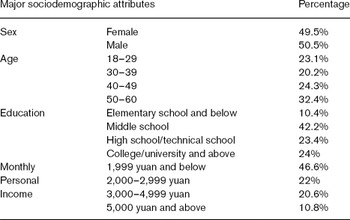
The data used in this study came from a public opinion survey conducted in five Chinese cities (Shanghai, Guangzhou, Wuhan, Chengdu, and Hangzhou) in the middle of 2008. The survey was based on a probability sample of the general urban residents of the five Chinese cities, aged 18 years and older. This probability sample was derived from a multistage sampling strategy. Three urban districts (qu) were randomly chosen at the first sampling stage in each city. At the second sampling stage, two streets (jiedao) were randomly selected from the three districts in each city, yielding a total of 30 streets. From each of the 30 streets, two residents’ communities were randomly chosen at the third stage of sampling, yielding a total of 60 residents’ communities in five Chinese cities. Then 2,400 households were randomly chosen from 60 residents’ communities. At the final stage, one individual was chosen randomly from each of the 2,400 households as the interviewee. The adjusted response rate of this survey was 91% (2,184), which was very high by Western standards, but quite similar to the response rates from other surveys conducted in Beijing (e.g., Shi, Reference Shi1997; Chen, Reference Chen2004). The key socio-demographic attributes of the sample are described in Table 6.
Sociodemographic attributes of the surveyed respondents

College students of political science were employed as field interviewers; they were trained by project members in field interviewing techniques before the actual survey was carried out. The technique of face-to-face interviews was used in the survey. Our interviewers conducted face-to-face interviews in the respondents’ homes, reading the well-designed questionnaire in the same manner (ensuring reliability). Respondents were offered confidentiality and encouraged to provide answers that best captured their true feelings. In general, circumstantial evidence and evidence from other public opinion surveys conducted in China (e.g., Chen, Reference Chen2004) suggest that Chinese urban residents feel free to express their views in such public opinion survey as ours.