“God bless all of you, God bless Canada!” is the way Stephen Harper finishes every campaign stump speech. It is an unusual line in a country where politicians do not customarily talk about God or their religious beliefs, where church attendance is plummeting and same-sex marriage has become legal and widely accepted despite the opposition of many religious leaders. “It sounds very American,” said Jackie Mitchell, a 45-year-old music teacher who attended a Harper rally on Saturday in this woodsy, rural community.
Kraus, Clifford. 2006. “A Conservative Evolves, and Leads a Canadian Race.” New York Times, January 16INTRODUCTION
This article reports an analysis of the roles religion and (with special emphasis) religiosity plays in shaping Canadians' political attitudes. Canada offers a particularly valuable observatory for religious influences in politics because it juxtaposes two relevant political dimensions: (1) a persistent but underemphasized (and often completely overlooked) religious cleavage in the party system and (2) a political culture that embraces social diversity and attempts to minimize political conflict along group cleavages, especially the religious cleavage. There has been an increasing recognition of the strength of the religious impulse in Canadian politics and a substantial literature has examined many of its facets (see Kim Reference Kim1993; Reimer Reference Reimer1995; Noll Reference Noll and Rawlyk1997; Kollar Reference Kollar1998; Stackhouse Reference Stackhouse1993; Guth and Fraser Reference Guth and Fraser2001; Hoover et al. Reference Hoover, Martinez, Reimer and Wald2002; Lusztig and Wilson Reference Lusztig and Wilson2005; Ang and Petrocik Reference Ang and Petrocik2005; Blais Reference Blais2005) but its impact on political beliefs and its capacity to structure the nation's party divisions remains under-examined.
We use data from the Canadian Election Studies to analyze the role that religion and religiosity play in shaping voters' attitudes, paying particular attention to controversial and divisive moral issues. The results establish two important points about Canadian politics. First, there is a divide among voters on moral issues that is shaped by religion and, even more, religiosity. Second, the religious cleavage remains an unmobilized social division that crosscuts the party divide. Thus, the contemporary moral divide may serve as a portent of a Canadian version of the “culture war” that has provoked considerable discussion in the United States. The possibility of such a development gives particular political relevance to this analysis, despite at least one failure of Stockwell Day's attempt to promote cultural issues.
THE RELIGIOUS CLEAVAGE IN CANADA
Early survey analyses of Canadian mass politics tended to deprecate the role of religion and religiosity, even as scholars acknowledged the historical role of religion in shaping the development of the early Canadian party system (see e.g., Kanji and Archer Reference Kanji, Archer, Bickerton and Gagnon2004).Footnote 1 Meisel (Reference Meisel and Courtney1967, Reference Meisel1974, Reference Meisel and Meisel1975) demonstrated empirically that the voting behavior of Protestants differed from that of Catholics but went on to assert that religion was of virtually no political importance in contemporary federal politics in Canada (Meisel Reference Meisel1974, 9). For Meisel, the most salient cleavage in Canadian politics was language. Irvine (Reference Irvine1974) dismissed the religious cleavage as merely an echo of past issues that had divided Protestants and Catholics, and an artifact of children inheriting the party loyalties of their parents. For Irvine, the religious cleavage was a “dinner guest” who had lingered for far too long — “from early in [the twentieth century] or before” — and now needed to be ushered out (Irvine Reference Irvine1974, 563).Footnote 2
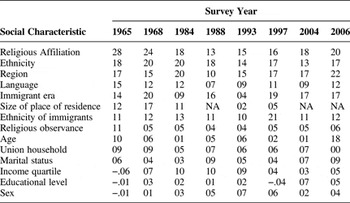
The refusal to engage with the “uninvited dinner guest” is particularly striking given the persistence and longevity of the religious cleavage in Canadian party politics. Table 1 reports the demographic correlates of party preference in Canadian federal elections from 1965 to 2006. While the data in Table 1 indicate relatively weak correlations (in 2006, the strongest demographic correlate was region at a modest 0.22 and it is uncorrelated with household union membership) between demographic characteristics and party preference compared with Western European countries (Clarke et al. Reference Clarke, Jenson, Leduc and Pammett1984; Ang and Petrocik Reference Ang and Petrocik2005), it nonetheless reveals a discernible pattern of a party-religion cleavage in Canadian electoral politics that is as prominent as any other.Footnote 3 As Table 1 documents, while religious affiliation has declined as a correlate of party preference, with an eta coefficient of 0.28 in 1965 to 0.20 in 2006, it nonetheless remains one of the best predictors of Canadians' party preferences.Footnote 4
The Demographic Correlates of Party Preference: 1965–2006

Religion outstrips social class variables — union membership, income, and educational levels — in explaining Canadians' party preferences (see also Guth and Fraser Reference Guth and Fraser2001, 61); in 2004 religious affiliation was the single best predictor of party preference, edging out ethnicity, region, and language.Footnote 5Table 1 also indicates that even when religious affiliation is not the best predictor of party preference; it is always a top three predictor. Further, the religious influence on party preference is understated since Table 1 disaggregates the effects of religious affiliation and religious observance. When religious observance is combined with religious affiliation, “religion” becomes the most important predictor of party preferences in all of the elections in the study.Footnote 6 The measures of religion have an average multiple correlations of 0.18 with party preference in the 1997, 2004, and 2006 Canadian election studies. By contrast, the zero-order effects of the social class measures that we are using (education, income, and union membership) have a multiple correlation of 0.12.Footnote 7 The net effects are even more instructive. Controlling for the class differences on party preference (which are very weak) has virtually no effect on the zero-order relationship between party preference and religion and religiosity.
The correlations are similar to what is observed in nations with comparable party systems. The Canadian party system, like that of the United States and Great Britain, for example, is not sharply divided along class or religious lines (see Clarke et al. Reference Clarke, Jenson, Leduc and Pammett1984; Guth and Fraser Reference Guth and Fraser2001). On average, both differences do less to structure party divisions among the Anglo-American democracies than is typical of party democracies, but they are meaningful divisions in Canada as they are in culturally similar Great Britain and the United States.Footnote 8 Whether the data are looked at from the party system or individual level (Table 1), there is no question about the place of religion and religiosity as a marker for the party preference of Canadians.
The religious dimension of the party system has received more attention in the last 10 to 15 years. Blais (Reference Blais2005, 823–826) noted that the electoral success of the Liberal Party was built on a foundation of strong support among Catholics. Found that religious denomination had a significant impact on vote choice in the 2004 elections outside of Quebec. Ang and Petrocik (Reference Ang and Petrocik2005) found that denominational affiliation is a key element in the contemporary Canadian party system, with the strong conservative preference of Protestants producing a conservative bloc that is much more Protestant than the population. Catholics are correspondingly over-represented in the liberal party bloc. They note that while contemporary policy disputes between the party blocs may not be overtly religious, they nonetheless reflect the values of distinct subcultures that assume differences between themselves and other social groups.
THE UNMOBILIZED SOCIAL DIVISION
More recently, scholars have found a renewed role for Irvine's “uninvited dinner guest” — especially in its religiosity guise — in Canadian politics (see for example, Lapp Reference Lapp1999). Guth and Fraser (Reference Guth and Fraser2001, 63) identified a religious divide in the Canadian party system and suggested that “Canadian politics is not entirely immune to the ‘culture war’ reshaping American partisanship.”Footnote 9 Hoover et al. (Reference Hoover, Martinez, Reimer and Wald2002) found that Canadian evangelicals possess morally conservative attitudes that set them apart from the non-evangelicals in Canadian society, in ways that are commonly observed in the United States. Lusztig and Wilson (Reference Lusztig and Wilson2005, 126) found that moral traditionalism is a key element of the post-1993 realignment and the rise of the new right in Canada, further noting that “moral conservatism is relatively unexplored in the literature on Canadian electoral politics.”
In their analysis of the religious bases of the Canadian party system, Guth and Fraser (Reference Guth and Fraser2001) found that Reformers and New Democrats possessed the most distinctive moral or cultural attitudes. Reformers were most likely to oppose gay rights and abortion, while New Democrats were their mirror image, strongly supportive of both gay rights and abortion. Other party supporters were not so easily distinguished by their moral or cultural attitudes (Guth and Fraser Reference Guth and Fraser2001, 59). Hoover et al. (Reference Hoover, Martinez, Reimer and Wald2002) found that Canadian evangelicals shared similar attitudes with their American coreligionist but were significantly more morally conservative in their attitudes toward family concerns, gay rights, and abortion than non-evangelical Canadians. Wilson and Lusztig (Reference Lusztig and Wilson2005, 52) concluded that “moral traditionalism” played a key role in the realignment of 1993 as voters abandoned the Progressive Conservative Party in favor of the Reform Party (and later the Canadian Alliance), and conclude that moral traditionalism is “relatively unexplored in the Canadian electoral politics literature.”
RELIGION AND POLITICS: THE RELIGIOSITY EFFECT IN CANADA
The complexity of the social and political manifestations of religion is well-delineated and studied (see for example, Stark and Glock Reference Stark and Glock1968; Wilcox Reference Wilcox1990; Kellstedt et al. Reference Kellstedt, Green, Guth and Smidt1997). Most standard references (represented by Layman Reference Layman2001) distinguish religion/denomination differences from effects related to “religiosity” — understood as the salience and centrality of religious beliefs and practice for how a person lives and views the society (Wald and Smidt Reference Wald, Smidt, Leege and Kellstedt1993). Common experiences create shared interests within denominations and differences between them that are then picked up by the political parties and shape inter-party conflict. The effects are more than religious, per se, but a product of the identification with, and social interaction among, the members of the religious group. Social identity effects (see Sidanius and Prato Reference Sidanius and Pratto2001), often intensified by other cultural differences, rather than individual adherence to particular moral values, create the linkage of religious denominations to parties (see Lazarsfeld, Berelson, and Gaudet Reference Lazarsfeld, Berelson and Gaudet1948; Berelson, Lazarsfeld, and McPhee Reference Berelson, Lazarsfeld and McPhee1954).
The religiosity effect arises when individuals acquire views and behavioral imperatives through religious devotion, social interactions with other religiously observant individuals, and by the religious practices — frequent attendance at religious services, reading the Bible, praying, and so forth — expected of individuals by the religion (Wald and Smidt Reference Wald, Smidt, Leege and Kellstedt1993, have useful insights here as well). This “religious impulse” allows distinct social and political differences to exist within, rather than between (or just between), denominations (Hunter Reference Hunter1991; Wuthnow Reference Wuthnow1988; Lopatto Reference Lopatto1985; Layman and Carmines Reference Layman and Carmines1987). The religious impulse is rooted in a “religious commitment” that cuts across denomination and religious tradition to produce “distinctive cultural and political values” (Layman Reference Layman2001, describes this well) in members of all denominations. The political consequences of the religious impulse arise from differences rooted in adherence to “values” regarding the morality of personal behavior — moral beliefs associated with conceptions of what is good and how they affect the individual, the family, and society. Key political differences are not expected between Protestants, Catholics, and Jews, but between members of those denominations who are motivated by a religious impulse and who adhere to a particular set of religion-inspired cultural or moral values as they apply to personal behavior and those who are more strongly influenced by other commitments and loyalties.
Cultural issues such as abortion and gay rights are particularly salient for the religiously motivated because they invoke moral positions that divide individuals who are traditional in their religious orientation and values structure from those who subscribe to non-traditional beliefs (see for example, Guth et al. Reference Guth, Kellstedt, Smidt and Green2006; Campbell 2007; Campbell and Monson Reference Campbell and Monson2008). Since the religious effects of “believing” and “behaving” are deemed not specific to any single denomination (although denominations emphasize believing and behaving differently) but consistent across all denominations, we would expect to see that the most orthodox and committed adherents of different denominations would embrace more traditional positions (Layman and Green Reference Layman and Green1998).
THE ANALYTIC QUESTION
Our interest is the range and magnitude of the impact of the religious impulse on the political beliefs of Canadians (and implicitly on Canadian politics). The question for the analysis, therefore, is whether differences in religiosity are a source of political opinion that may fuel a strong religious divide in the party system.Footnote 10 To assess this possibility, the analysis will examine whether a measure of religiosity predicts issue positions net of all other plausible sources of opinion (including party affiliation, social class, ethnic and national identity). The religiosity effect should be apparent independent of religious denomination in adherents' attitudes toward cultural issues. The effect of the religious impulse on other issues — gender attitudes, the status of ethnic minorities, feelings about the government's responsibility in the provision of social services, or foreign and international relationships — is less predictable, probably in proportion to the palpable moral content or apparent religious relevance of the issue. For these issues, preferences and perceptions may be shaped by social influences embedded in ethnicity, social class, or idiosyncratic social networks that are unrelated social institutions. We are not concerned with these latter sources of political beliefs. All that is necessary here is to document that religious influences are substantial and independent of other influences on political beliefs.
DATA AND METHODS
The analysis focuses on data drawn from the 1997, 2004, and 2006 Canadian Election Studies (CES). The longer series of election study surveys (going back to 1965) are missing many of the orientations we need to permit the analysis reported below.
Dependent Variables
To assess the significance of religiosity on issue opinion we used 19 different dependent variables grouped into six issue areas: cultural, gender, equal rights, minority rights and protection, social services, and foreign policy issues. For cultural issues, we utilized the mail back survey questions in the CES that asked respondents about their support for gay marriage, abortion, the death penalty, adapting moral behavior to a changing world, new lifestyles contributing to the breakdown of society, and whether there would be fewer problems if traditional values are emphasized.
The gender issues dependent variables consist of questions that ask respondents whether they agree or disagree that companies should first Lay off women whose husbands have jobs, whether having more women in Parliament is the best way to protect women's rights, and if feminism puts men down. The equal rights issue dependent variable asked whether equal rights have been pushed too far. For the minority rights dependent variable, we used questions about whether minorities need special rights, if recent immigrants want to fit into Canadian society, if the government should look after native-born Canadians first, and if Aboriginals would as well-off as other Canadians if they tried harder. The social welfare issues dependent variables consisted of two questions: whether government should leave people alone to get ahead themselves and if the welfare state makes people less willing to look after themselves. The foreign policy dependent variables consist of two questions: whether international trade creates more jobs than it destroys and if Canada should continue with peacekeeping even when it places Canadian lives in danger.
All of the variables are binary, with conservative or morally traditional attitudes (opposition to gay marriage or abortion) coded as 1 while liberal or modernist attitudes are coded as 0.Footnote 11 If the religious impulse thesis is correct, we expect to see a clear, positive correlation between religiosity and conservative or morally traditional attitudes on cultural issues.
Independent Variables
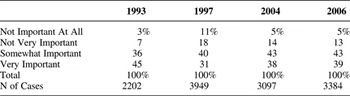
The full set of party, demographic, and other variables (including denomination) are listed in Appendix C. Religiosity is the subjective salience or importance of religion to the individual. Although the self-statement incompletely samples the full conceptual space of the religiosity idea, it is closely related to religious behavior and belief, correlating with all of the other behaviors and predispositions that appear to be face-valid indicators of religiosity (attendance at religious services, regular prayer, bible reading or the reading of religious texts, thinking and talking about religious matters, and so forth — measures that are not available in the Canadian surveys), and it is commonly used to distinguish those who are religiously observant (see for example, Layman Reference Layman2001). Its coding corresponds to the direction of the attitude measures. That is, the political orientations are coded so that larger values indicate a more conservative preference; the religiosity measure is coded so that larger values indicate the increasing importance of religion for the respondent.Footnote 12 As Table 2 indicates, most Canadians assert that religion is a factor of considerable importance in their lives — something which, on its face, might inspire questions about the significance of religious influences on attitudes and beliefs.
Religiosity in Canada, 1993–2006

The Analysis
We use logistic regression to examine the effect of religiosity on political beliefs.Footnote 13 The estimation begins with a baseline coefficient for the effect of religiosity on each political attitude, and then compares this coefficient across successive equations where the influence of religiosity is estimated net of a series of control variables that plausibly represent rival alternative hypotheses that account for the influence of religiosity.
If the effect of religiosity is only a marker for other influences (class, language, or region for example), the coefficient associated with religiosity will be reduced (conceivably to zero but at least statistical insignificance) when the variables measuring the other influences are entered as controls. So, for example, a substantial decline in the religiosity coefficient when various socio-demographic controls (income, education, age, language, etc) are introduced indicates that it is not religion but, rather, demographic differences with which religion is associated that are shaping attitudes. If, on the contrary, the religiosity coefficient is largely unaffected by the introduction of control variables, then religiosity is an independent influence on the attitude.
A significant coefficient for religiosity after the introduction of a control for party indicates that differences in religiosity within the parties shapes intra-party issue differences. That condition, which existed in the United States throughout the period of the New Deal party system, was one of the elements that gave rise to the emergence of a religious dimension to contemporary American party conflict (Petrocik Reference Petrocik1998, Reference Petrocik, Green and Coffey2006). The emergence of issue entrepreneurs who were driven by sincerity and strategy to raise “wedge” cultural issues such as abortion, school prayer, crime, and the catch-all traditional American values reshaped the American party coalitions by the early 1990s. Something similar may be possible in the Canadian party system; and step 3 (below) in the analysis is a window for observing this potential.
Three distinct statistical steps are used to perform this assessment. The first uses a straightforward zero-order relationship between religiosity and the attitudes; the second adds demographic controls to the zero-order religiosity model; the third includes a control for party preference.
The zero-order effect of religiosity is estimated with a simple bivariate logistic regression model of the form:

where π(x) denotes the probability of a conservative preference on an issue (abortion, social spending, and so forth). To control for the possible effects of the denominational and other socio-demographic influences, we utilize a multi-variable logistic regression model where:

Denomination is a series of dummy variables for Mainline Protestants, Evangelical Protestants, Catholics, Jews, and Others, with those professing no religious affiliation as the baseline category. The socio-demographic factors are an even more lengthy series of variables that represent rival hypotheses that are related to individual differences in: language, ethnicity, region, union membership, sex, age, marital status, income, and education.Footnote 14 A third specification to test whether religiosity has an influence on political beliefs includes party identification in the form:

RELIGION AND POLITICAL BELIEFS IN CANADA
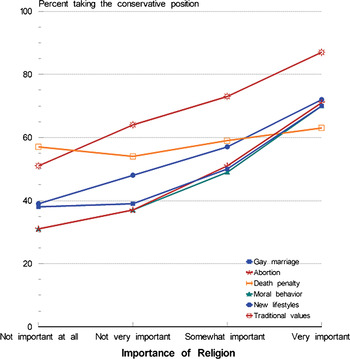
As religion increases in importance for the respondents, there is a corresponding greater likelihood that they will oppose gay marriage, be less supportive of abortion, oppose the idea that people should adapt their moral behavior to changing times, believe that new lifestyles contribute to a breakdown of society, and believe that there would be fewer problems if there were a greater emphasis on traditional values. In the case of the death penalty, a cultural-moral issue in the American political environment, there is a weakening in support for the death penalty as religion increases in importance for the respondents. The effect of religiosity on political issues is limited principally to moral issues in Canada. There is a weak relationship between religiosity and general feelings about the importance of ensuring that the society protects the rights of all equally. The slope is consistent with expectations that the religious impulse shapes a conservative preference — increased religious commitment results in a greater likelihood of the conservative or traditional response that equal rights have been pushed too far — but the magnitude of the differences are trivial. The religiosity effect is almost completely absent for virtually all other matters. It is unrelated to how they feel about either of our questions about gender roles and a host of other questions that have concerned Canadian public life in the last decade: social spending, trade, the peacekeeping role of Canada, and so forth. Religiosity does not appear to matter when it comes to minority, welfare state, and foreign policy issues. However, as Figure 1 documents, relationships between religiosity and social and cultural questions are substantial.Footnote 15
(Color online) Moral issues.

RELIGION AND MORAL ISSUES IN CANADA
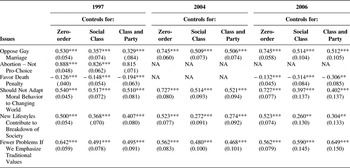
Table 3 reports the results of the logistic regression analyses of the impact of religiosity on cultural issues. The numbers in the table are limited to the logistic regression coefficient for religiosity and their associated standard errors (in parentheses) since only the coefficient for religiosity is of interest and a table with coefficients for all the control variables would be extremely large and difficult to read.Footnote 16 The first column for each year reports the simple bivariate logistic regression coefficient for the effect of religiosity on the issues (the step 1 model as we described it above). The second column for each year reports the coefficient for religiosity controlling for plausible rival hypotheses that are demographic or social class related. The third column reports the religiosity coefficient controlling for all of the social class variables and party affiliation.
Religiosity and Cultural Attitudes

Note: Entries are logistic regression coefficients with asymptotic standard errors in parentheses. All coefficients are significant at or above the .01 level. “NA” indicates that the relevant variables are not available.
The test of the persisting strength of religiosity as an independent influence on the attitudes is how the religiosity coefficient barely changes as control variables are introduced (as we move from the left-most, zero-order column for each issue in each year, to the column that controls for demographic factors (the second column for every year) to the third column for each year (which reports the religiosity coefficient after controlling for demographic differences and the party preference of the individuals). For example, consider attitudes toward gay marriage in the 1997 survey. Religiosity has a strong zero-order (bivariate) relationship with this attitude in 1997 (the coefficient has a value of 0.530, which expresses the magnitude of the relationship plotted in Figure 1). The adjacent column to the right reports a coefficient of 0.357 after social class controls are introduced. The third column for 1997 reports a coefficient of 0.329 after social class and party controls are introduced.
If the religiosity effect in column one (and the corresponding slope in Figure 1) had been nothing more than a mask for social class and other demographic variables, we would have expected the coefficient in the second 1997 column to decline to zero or at least become statistically insignificant. If the coefficient for religiosity in the first column masked class and partisan effects, the coefficient in the third column for 1997 would have approached zero, or statistical insignificance. That does not happen for any of the zero-order relationships. The association of religiosity with gay marriage attitudes is only slightly diminished, remaining significant and large and establishing the independent role of religiosity in shaping this attitude. A comparison across the columns, for each year and for each attitude, documents the strong and independent influence of religiosity on social and moral attitudes.
Religiosity effects on the attitudes are not simply masks for socio-demographic influences, since the socio-demographic controls produce only minimal reductions in the effect of religiosity on the attitudes. The largest change occurs for the “new lifestyles” question in 2006, but religiosity retains a powerful net influence. Not only is the religiosity effect on the other moral issues substantively strong but the numerical value of the coefficient is virtually unchanged substantively: religiosity is an influence on political beliefs in its own right and virtually un-moderated by denomination, education, income, or language.
The third column for each issue in each year demonstrates that the influence of religiosity occurs within parties. Religious Liberals, religious Conservatives, religious French Nationalists, and even religious New Democrats are, on average, more conservative in their cultural attitudes than those who are not religiously oriented. In fact, inter-party differences among the most religious are uniformly and consistently smaller than the differences between those who are and are not religiously oriented within the same party. Clearly, the moral and cultural issues are classic cross-cutting issues with potential to alter the party alignment in Canada.
Death penalty attitudes are largely unrelated to religiosity, contrary to the general pattern and our expectation. And it is a curious result because the relationship between the death penalty variable and a slightly different measure of religiosity (church attendance) in 1993 was in the expected direction. The lack of a consistent set of measures in the surveys compromises our ability to explore this further. We cannot determine whether the death penalty is exempt from the general pattern or there was something unusual happening in 1993. Whatever the case might be for the death penalty relationship, the pattern in Table 3 strongly demonstrates the significant shaping of moral issue preferences by religiosity in Canada. All of the coefficients in the first columns for each year are significant beyond the 0.01 level. The key result for this analysis is the continuing large and statistically significant impact of religiosity after all the plausible alternative sources of these attitudes are controlled.
INTERPRETING THE COEFFICIENTS
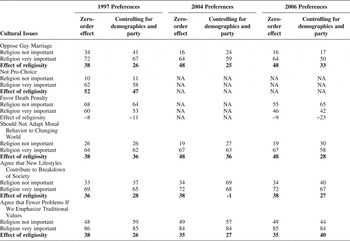
Table 4 converts the logistic regression coefficients into more easily interpretable percentages. It reports three numbers for each issue and for the three survey years: (1) the proportion with the conservative preference among those for whom religion is not all important, (2) the proportion with the conservative preference among whom it is very important, and (3) the arithmetic difference between these proportions. In the case of the gay marriage question in 2006, for example, the table reports that (see the upper right cell) 16 percent were opposed among those for whom religion was not important, 64 percent opposed gay marriage among those for whom religion was very important, and the effect of religiosity on opinion — which is a shift of 48 percentage points in the probability of opposing gay marriage (64 percent minus 16 percent). The result that demonstrates the importance of religiosity and its independence of party and demographic influences on issue preferences is presented in the adjacent column of the table. The difference in the issue positions of the most and least religious on gay marriage in 2006 is reduced only 15 percentage points (from 48 to 33 percentage points) after controlling for the common sources of political attitudes; in 2004 the difference is reduced by 23 percentage points (from a 48 point to a 25 point difference); and in 1997 the difference in the position of the most and least religious on gay marriage is 12 points (from a 38 point to a 26 point difference).
Conservative Moral Attitudes as a Function of Religiosity

Religiosity-related preferences are, across the table, resistant to explanation by denomination, social class, or party allegiance. Differences between the least and most religious that are approaching 40 percentage points in many cases remain large — near 30 percentage points — after controlling for party and demographic influences on cultural attitudes. Religiosity is clearly the major source of these beliefs, and a much greater influence than denomination, social class, or party allegiance.
COMPARATIVE EFFECTS
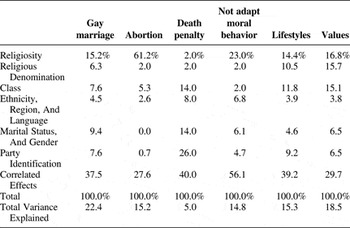
Finally, how does religiosity compare with denomination in predicting voters' attitudes on cultural issues? Table 5 reports a decomposition of the variance — the percentage of the variance in the dependent variable that is uniquely explained by each independent variable — to estimate the relative predictive power of the models.Footnote 17 The “total variance explained” row at the bottom of the table reports the variance in the opinion explained by religiosity, denomination, social class, ethnicity, language, region, gender, marital status, and party affiliation — all of the variables that provide explanatory accounts of contemporary electoral patterns in Canada. The cell entries above are the percentages of this total correlated with religious, socio-demographic, and party affiliation differences.
Variance Decomposition for Cultural Issues

Note: Figures are average percent of variance uniquely explained by the sets of independent variables.
Two points stand out. First, with the exception of support for the death penalty, religiosity explains a greater portion of the variance in any given opinion than any other characteristic, including religious denomination. The religiosity effect is quite large for some cultural issues: for example, it accounts for 61 percent of the explainable variance in opposition to abortion but typically accounts for between 15 and 20 percent of the explainable variance and is, overall, the largest uniquely identifiable influence on opinions on cultural issues. The second point is that the combined effect of religiosity and religious denomination is, by an order of magnitude, more influential than class, ethnicity, or region — the most common terms for understanding Canadian public opinion. Effects that cannot be disentangled are the largest, and some of this certainly includes class and ethnicity. However, un-partitionable religiosity and religion effects are in that component as well.
The identifiable components establish the paramount influence of religiosity and denomination on these preferences. It is worth noting that the effect of religiosity exists within major denominations (data not shown). That is, the more religiously concerned Catholics are more conservative on each of the cultural issues (with the exception of the death penalty, where religiosity has a negative relationship). Similarly, the more religiously concerned among Protestants are more conservative on each of the cultural issues. A full set of controls for socio-demographic differences and partisanship do not eliminate the influence of religiosity on these opinions within religious denomination. Viewed from every perspective, religiosity seems to be a source of political attitudes among Canadians.
CONCLUSION
There appears to be a “moral divide” in Canada, very similar to that which exists in the United States, which separates those with different levels of religious commitment in their attitudes toward cultural issues. The relationship is statistically significant and independent of influential socio-demographic factors (including religious tradition) and party identification. It is a regularity that conventional interpretations of Canadian political life at least underestimate despite a long trail of evidence of its prominence. This enduring religious cleavage in Canadian society, however, may be indicative of things to come — Canada's past conflicts along religious lines may yet be prologue to its own version of the culture wars.Footnote 18 Most Canadians would disparage the electoral potential of this difference (see Simpson and MacLeod Reference Simpson, MacLeod and Stark1985), but most Americans, presented with the prospect of a religious division between the Democrats and Republicans would have responded similarly as recently as 30 years ago.
Canada is not divided by deep religious differences, but it is a society where religion continues to be linked to party allegiance (see also Guth and Fraser Reference Guth and Fraser2001; Blais Reference Blais2005; Ang and Petrocik Reference Ang and Petrocik2005), providing the conditions that create the opportunity for an aspiring political entrepreneur who can imagine a reshuffling of party supporters along religious lines — perhaps parallel to the American experience of the 1980s.Footnote 19 The religious impulse and issues related to differences in the moral traditionalism associated with religiosity have become a staple of the Democratic-Republican party cleavage, influencing elections at all levels since the 1980s (Petrocik Reference Petrocik1998, Reference Petrocik, Green and Coffey2006; but see also, Campbell Reference Campbell2007a, Reference Campbell2007b; Green Reference Green2007; Guth et al. Reference Guth, Kellstedt, Smidt and Green2006). The experience of the United States, moreover, provides an intriguing insight into the possible future of the religious cleavage in Canada. The American National Election Surveys from the early 1950s indicated that voting patterns were correlated with religious tradition and religiosity but political elites did nothing to exploit it. The effective political mobilization of religious groups in the United States did not occur until issue entrepreneurs linked to the Republican party, driven by sincere commitments and an awareness of its electoral potential, articulated positions that made the Republican party as much of a party of traditional morality as conservative economics — the traditional “Christian Democratic” profile (see Petrocik Reference Petrocik1998; Layman, Reference Layman2001; Leege, et al. Reference Leege, Wald, Krueger and Mueller2002).
Successful entrepreneurial action — of both the market and political varieties — requires the satisfaction of three conditions. First, a profit opportunity must exist; second, someone must be alert enough to spot the opportunity and recognize the opportunity for profit; and third, the individual must be willing to act on the opportunity once it is recognized (Holcombe Reference Holcombe2002, 143).Footnote 20 Electoral opportunity deriving from cultural issues appears to be present and Canadian politicians have not been entirely unaware of its potential and have tried to act on the opportunity. Preston Manning of the Reform Party and Stockwell Day of the Canadian Alliance attempted to push what many political observers considered a socially conservative political agenda, and were ultimately unsuccessful.Footnote 21
Future research should more closely examine why Canadian political parties have been unable to exploit fully this moral divide among voters. Bean et al. (Reference Bean, Gonzalez and Kaufman2008) have suggested that Canadian evangelicals are less likely to be responsive to political mobilization around moral issues because they construct their subcultural identity differently compared to American evangelicals. However, given the evidence that the moral divide in Canada cuts across denominational lines, the potential for cultural or moral issues to serve as divisive “wedge issues” must be deemed ever-present.Footnote 22 A successful political entrepreneur can base his or her political appeal on a consideration that is already salient or s/he can make salient a consideration that is a central concern but not necessarily salient. Campaigns and information flow generally can create a salient issue where there was only a heretofore central consideration (see Iyengar and Kinder Reference Iyengar and Kinder1987; Krosnick and Kinder Reference Krosnick and Kinder1990; but also Zaller Reference Zaller1992). However, the consideration can, nonetheless, be very reactive and quickly become salient because of its attitudinal centrality for people. We believe the moral and ethical dimensions of political evaluations have this quality, and it explains why some moral and ethical issues can be strong influences in politics at some points and minor considerations at others. Political entrepreneurs out of calculation or conviction (but probably both) can move issues that have great centrality on to the political agenda, making them salient and influential for the electorate.
Malloy (Reference Malloy2009) points out that the role of religion in public life and politics is very different in Canada and the United States, while Adams (2004) points to different levels of religious commitment in the two countries.Footnote 23 While there is some evidence that religious factors are influencing a wider range of attitudes in the United States (see for example, Campbell Reference Campbell2007a), there is also competing evidence to suggest that the “culture wars” are not being waged unconditionally. Layman and Green (Reference Layman and Green2005, 77) find that the link between religious behavior and belief and non-moral policy predispositions and issue attitudes are “weaker and less consistent across religious traditions.” We found strong evidence of the impact of the religious impulse on cultural issues but only weak relationships with non-cultural issues. Future research needs to focus on the extent to which the moral divide in Canada is mediated by religious, policy, and political contexts. We recognize that the religion cleavage in Canada is to some extent more complex than it is in the United States. In this article we have focused primarily on the religiosity dimension of the religious cleavage in Canadian politics. A complete sampling of the religious cleavage would have to take into account the continued role played by religious tradition, as well as the mitigating roles played by region, language, and ethnicity in Canada (see Ang and Petrocik Reference Ang and Petrocik2005). We close, therefore, with a call for further research, not just relating to the role that religion plays in Canadian politics but also as it relates to comparisons between the United States and Canada.
APPENDIX A
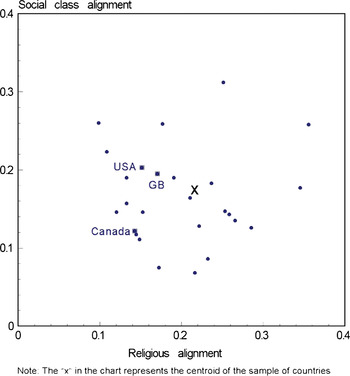
Figure 2 plots the percentage of variance in party preference correlated with religious and social class differences for 25 comparable democracies. The data are drawn from the ISSP survey of 1998. Estimates of the variance in party preference with class and religion are derived from multiple classification analyses. An expressed religious preference and measures of religious observance and activity measure religion. Education, income, and union membership measure class. The religion and class effects were estimated separately to approximate a zero-order comparison of the alignment of religion and class with party. Full details can be requested from the authors.
(Color online) Social class and Religion as a basis for party alignment.

The Canadian party system, like that of the United States and Great Britain, is not sharply divided along class or religious lines (see also Clarke et al. Reference Clarke, Jenson, Leduc and Pammett1984; Guth and Fraser Reference Guth and Fraser2001). On average, both differences do less to structure party divisions among the Anglo-American democracies than is typical of party democracies (the average effect is represented by the “x” in the figure), but they are nonetheless meaningful divisions in Canada, Great Britain, and the United States. Three features of the location of the Canadian party system in the overall pattern deserve note. First, party preference has a greater association with religion and religiosity than it does with social class markers. Second, Canadian commentary on their party system has preferred to assert the importance of social class, even though, as the figure demonstrates, it correlates with party preference more weakly in Canada than it does in the United States and typical democratic party systems (cf. Gidengil 1992; Lapp Reference Lapp1999; Guth and Fraser Reference Guth and Fraser2001). Finally, the influence of religion on party preference in Canada is not measurably different from its influence in the United States.
APPENDIX B
Question Wording of Cultural Issue Variables from the Canadian Election Studies (1997, 2004, 2006)
All items have been rescaled as binary 0/1 responses. Conservative or morally traditional attitudes to the issues were coded as 1, while liberal or modernist attitudes were coded as 0. Thus, a value of 1 indicates the following: opposition to gay marriage; opposition to abortion; favoring the death penalty; opposition to adapting moral behavior to fit a changing world; a belief that newer lifestyles contribute to the breakdown of society; a belief that there would be fewer problems if we emphasized traditional family values.
Opinions about Gay Marriage
“Homosexual couples should be allowed to be married legally. Do you strongly agree, agree, disagree, or strongly disagree?” (1997, 2004)
“Gays and lesbians should be allowed to get married. Do you strongly agree, agree, disagree, or strongly disagree?” (2006)
Opinions about Abortion (1997 Survey Only)
“Of the following three positions, which is closest to your own opinion: One: abortion should never be permitted; Two: should be permitted only after need has been established by a doctor; Three: should be a matter of the woman's personal choice?”
Opinions about the Death Penalty (Included Only in 1997 and 2006 Surveys)
“Capital punishment is never justified, no matter what the crime. Do you strongly agree, somewhat agree, somewhat disagree, or strongly disagree?” (1997)
“Do you favour or oppose the death penalty for those convicted of murder?” (2006)
Opinions about Adapting Moral Behavior (Included in 1997, 2004, and 2006 Surveys)
“The world is always changing and we should adapt our view of moral behavior to these changes. Do you strongly agree, agree, disagree, or strongly disagree?”
Opinions about New Lifestyles (Included in 1997, 2004, and 2006 Surveys)
“Newer lifestyles are contributing to the breakdown of our society. Do you strongly agree, agree, disagree, or strongly disagree?”
Opinions about Traditional Family Values (Included in 1997, 2004, and 2006 Surveys)
“This country would have fewer problems if there were more emphasis on traditional family values. Do you strongly agree, agree, disagree, or strongly disagree?”
APPENDIX C
Measurement of Independent Variables
Religiosity
“In your life, would you say religion is very important, somewhat important, not very important, or not important at all?”
The item is recoded on a scale of 1 through 4, such that 1 indicates that religion is “not important at all” and 4 indicates that religion is “very important.”
Religious Denomination
Dummy variables were created for, Mainline Protestants, Evangelicals, Catholics, Jews and Other, with Seculars serving as the baseline category.
Region
Dummy variables were created for Quebec, Ontario, Prairies (Alberta, Saskatchewan, and Manitoba), and British Columbia, with the Atlantic (Newfoundland, Prince Edward Island, New Brunswick, and Nova Scotia) as the baseline category.
Ethnicity
Dummy variables were created for British, French, and European ethnicities, with Others as the baseline category.
Language
Dummy variable coded 1 for English, 0 for French.
Gender
Dummy variable coded 1 for males, 0 for females.
Union membership
Dummy variable coded 1 for membership in a union, 0 otherwise.
Marital Status
Dummy variable coded 1 for respondents who are married or living with a partner, 0 otherwise.
Income
The item is recoded on a scale of 1 through 4, such that 1 indicates lowest income quartile and 4 indicates highest income quartile.
Age
Respondent's Age.
Party Identification
For 1997 dummy variables for were created for Liberals, Progressive Conservatives, Reform, NDP, Bloc Quebecois, and None, with Other Parties as the baseline category.
For 2004 and 2006 dummy variables were created for Liberals, Conservatives, NDP, Bloc Quebecois, and None, with Other Parties as the baseline category.