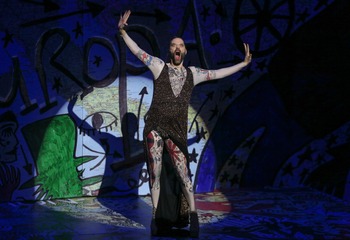
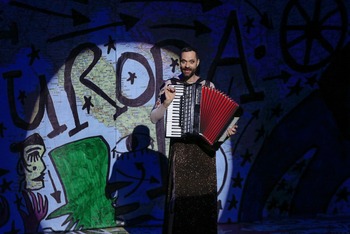
“Von der Pußta Footnote 1 will ich träumen Bei Zigeuner Musik […] Wo der braune Chicco singt, Wo vor Glut mein Herz zerspringt” (I want to dream of the Puszta with gypsy music […] Where the brown chicco sings, where my heart bursts into flames). These words, once sung by Swedish singer Zarah Leander in the German movie Der Blaufuchs (The Blue Fox, 1938), now open Roma Armee (2017), directed by Yael Ronen at the Maxim Gorki Theater in Berlin. Footnote 2 In Roma Armee, instead of the Swedish diva—who, we are told, happened to be “one of Hitler’s best friends” Footnote 3 —it is sung by Lindy, a gay Swedish Romani Traveller. Lindy wears a long, glamorous dress, diva style, and plays the accordion, an instrument often associated with the Roma people. Lindy’s dress is obviously open in the front, leaving his male underwear exposed along with a printed leotard that covers his body in pseudo-tattoos of Roma symbols. In this first image, Ronen presents us with a multiplicity of contrasting stereotypes coexisting in a single body. And with the playfulness that characterizes the cabaret form, she places an impossible puzzle in our heads. Not only is Lindy a gay-identifying diva, but he also becomes, as a Romani Traveller, the wild and dangerously seductive Roma boy invoked by the song, the “brown chicco.”
In Viktor Tourjansky’s film, Leander plays Ilona Paulus, who begins an extramarital affair because her husband, a scientist obsessed with fish, neglects her. The Gypsy (Zigeuner) mentioned in the song, as is often the case in representations of the Roma, is used to symbolize that which is exotic and desired, yet unattainable, dangerous, and forbidden. He also stands in opposition to the rational and scientific (represented by Ilona’s boring husband). In Roma Armee, however, Lindy’s song of longing for the Gypsy and Gypsy-land reappropriates the imagery associated with the Roma people, and also queers its stereotypes.
The Roma, and gay men, suffered a fate similar to that of the Jews under Hitler’s regime. Historians estimate that between 250,000 and 500,000 Roma (between 25 to 50% of all European Roma at the time) were murdered by the Nazis, and between 5,000 and 15,000 gay men were imprisoned in concentration camps, many of whom died (USHMM 2021). In the play, Lindy, who comes out as both gay and Roma, cheerfully takes possession of Nazi-sympathizer Leander’s image.
Lindy sneaks out to sing even before the curtain rises, setting in motion a play that constructs an army precisely to combat the ways in which the identities of the Roma and Romani Travellers have been appropriated and terrorized by Gadjé (non-Roma) throughout European and global history. The Roma are not a homogenous group. There are many communities grouped together under that umbrella (Sinti/Manush, Calé, Kale, Romanichals, Lovari, and others). Originally from central/northern India, most Roma have long been nomadic, possibly arriving in Europe between the 8th and 10th century CE (COE n.d.). Footnote 4 However, not all the communities grouped as Roma share a common ancestry—not all are descendants from people of northern India—and not all of them are nomadic. Most Roma speak Romani or one of its variations, although in the Balkans, for example, there are groups who regard themselves as Roma but do not speak Romani. Travellers in Ireland, on the other hand, are itinerant groups who do not claim Roma heritage but who often have maintained close ties with Romanies who do. In truth, what all these communities share is a history of persecution, a “heritage of exclusion” that gives them “the sense of shared ‘pasts,’” says Romani studies scholar Adrian Marsh (Reference Marsh2013). “Roma” itself feels like a nomadic concept, always on the move. The moment one tries to define it, there’s an exception that contradicts that definition.
In the Middle Ages, the Roma were thought to come from the Peloponnese region of Greece called “Little Egypt,” hence the word “gypsies” (Taylor Reference Taylor2014:11). However, given the negative connotations associated with “Gypsy,” “Roma” is today the most accepted term. “Rom” means man or person in the Romani language and “Roma” stands for the collective identity (19). Still, in Western Europe, some continue to refer to themselves as “Gypsies” (or its national equivalent, such as Gitanos in Spain); some scholars also use “Gypsy” when it seems more historically accurate (19). I will mostly use “Roma” but will retain “Gypsy” when that term is used in sources, or when I feel it is necessary to stress the history of discrimination connoted in the term.
Lindy Larsson, the emcee who introduces the members of the army, in the opening scene of Roma Armee by Yael Ronen and ensemble, based on an idea by Sandra Selimović and Simonida Selimović. Teatro di Roma/Teatro Argentina, Premio Europa per il Teatro XVI, Rome, Italy, December 2017. (Photo by Florin Ghioca)

Lindy Larsson, impersonating Zarah Leander, singing “Von Der Puszta Will Ich Träumen.” Roma Armee by Yael Ronen and ensemble, based on an idea by Sandra Selimović and Simonida Selimović. Teatro di Roma/Teatro Argentina, Premio Europa per il Teatro XVI, Rome, Italy, December 2017. (Photo by Florin Ghioca)

In Roma Armee, Lindy is the emcee who introduces the members of the army. They will fight stereotypes—false representations—by proposing instead contradictory images that prevent simplification. In the play, each piece of information in regard to identity becomes an aperture into a kaleidoscope that releases the characters/actors from having to fit into others’ (and even their own) assumptions about who they are and what they represent. They address the Gorki audience directly because, of course, the best possible setting for talking about representation is the theatre!
Like much of Ronen’s work, Roma Armee complicates notions of identity. Ronen is Jewish Israeli; she was born in Jerusalem in 1976 and now resides in Berlin. Ronen was married to a Palestinian man with whom she has a son. For her, Berlin is a place where her son can grow up free from prejudice for having a Jewish mother and a Palestinian father (Teicke Reference Teicke2015). Displacement, also key to her work, is part of her family history: her grandfather had to emigrate from Vienna to Palestine in 1936, and she suspects he would have been disappointed to learn that his grandchildren (Yael and her actor-director brother Michael) returned to Europe (see Bartlick Reference Bartlick2015).
As a theatre director, Ronen is well established internationally with a reputation for tackling thorny, sometimes taboo, political conflicts. Ronen doesn’t shy away from putting her finger on the collective wounds that hurt the most. Her 2008 production Third Generation at the Schaubühne Berlin, and soon after in Tel Aviv, aroused controversy even before it opened. The play connects the Holocaust with the expulsion of Palestinians after the creation of the State of Israel, a theme that is taboo both in Israel and Germany. Still, Third Generation was chosen Best Play of the Year in 2010 by Theater heute (Bartlick Reference Bartlick2015). In Third Generation, Germans, Israelis, and Palestinians address without inhibitions issues, feelings, fears, and hopes that are still a challenge to discuss openly. As we also see in Roma Armee, Ronen’s use of humor offers a seductive way of processing very sensitive material so that it disarms rather than offends. The America-Israel Cultural Foundation calls her “the funniest therapist among theatre-makers” (2019). In her productions, Ronen very consciously brings the audiences’ attention to the fact that they are in the theatre by revealing the mechanisms that build the narrative onstage and by having the actors play versions of themselves and address the audiences directly. This metatheatricality characterizes Ronen’s theatre, becoming her tool to evidence social processes of identity formation. She tends to begin by exposing stereotypes.
Roma Armee presents a world in which the stereotype does two things simultaneously: it blinds us, yes, but it also brings visibility. In Ronen’s hands, stereotypes are an entry point to a much more complex, even indefinable, reality. She estranges a stereotypical image to show that it is only in its open-endedness and in its suggestion of multiplicity that an image can offer more truthful representation. Ronen and the ensemble in Roma Armee use stereotypes to deconstruct and reconstruct identity in order to begin a process of healing and reconciliation. However, to better understand the relevance and urgency of Ronen’s work, and Roma Armee in particular, it is important to contextualize it. Under artistic director Shermin Langhoff, who took over in 2013, the Maxim Gorki Theater has turned into a cultural hub that stimulates debate on and beyond the stage, and is at the forefront of a movement aiming to honor Berlin’s diversity by changing attitudes and practices. This commitment, in turn, allowed the Roma art renaissance to find a home at the Gorki. At the center of this Roma art renaissance is the issue of representation, and several of the artists participating in the movement come together in Roma Armee. Although Ronen is not Roma herself, a fact that could have compromised the integrity of the piece, the way in which she devises plays with the active participation of the actors and her willingness to tackle sensitive political and social issues makes her the obvious candidate within the Gorki to direct the project. Further, the metatheatricality that characterizes Ronen’s work is the perfect conduit for the play’s message.
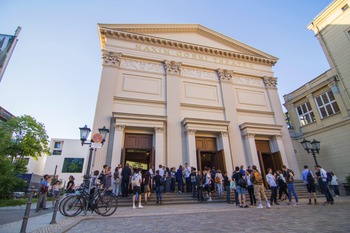
Maxim Gorki Theater, Berlin, a cultural hub at the forefront of a movement aiming to honor Berlin’s diversity by changing attitudes and practices. (Photo by Nils Tammer; courtesy of the Maxim Gorki Theater)

The Gorki and Berlin
The Center of the Roma Renaissance
The Gorki is a Stadttheater (municipal theatre), one of five state-subsidized theatres in Berlin. Named after the Soviet writer Maxim Gorky, the Gorki was founded in 1952 in East Berlin in a historical building—the city’s oldest concert hall, the venue where the Prussian National Assembly created Prussia’s constitution after the revolution of 1848. The mission of the theatre is to serve the city, and the Gorki’s trajectory reflects—and at times has actively shaped—Berlin’s own struggle with its identity, from the East versus West Berlin to Berlin united. Since the arrival of Langhoff, the Gorki reflected a Berlin that recognizes and celebrates its diversity—of ethnicity, race, gender, and sexual orientation. Appointed by then Mayor Klaus Wowereit—Berlin’s first openly gay mayor—Langhoff positioned the Gorki at the forefront of a movement in theatre, and the arts in general, to interrogate ideas of nation, identity, and belonging. Langhoff was not only the first woman at the head of a municipal theatre in Berlin, but also the first immigrant in such a position in Germany (Sharifi Reference Sharifi2020:501). Langhoff’s parents migrated to Germany from Turkey when she was nine years old. Her mother was recruited as a guest worker by the electrical equipment manufacturer AEG (Kiyak Reference Kiyak2011). Immigrants and their children constitute about a quarter of Berlin’s population, and the city’s Turkish community is the largest outside of Turkey (Shea Reference Shea2015).
Today, the Gorki prides itself on being a space for discourse and dialogue among all those living in Berlin, regardless of their legal status (Maxim Gorki Theater n.d.). To that end, all productions use English supertitles to make them accessible to non-German speakers. As Matt Cornish points out, “when multiple languages are spoken onstage, it is done to connect with diverse audiences, not distance them with incomprehensible polyglossia” (2019:193). Beyond its main stage, the Gorki offers numerous platforms to encourage public engagement. The Gorki X, for example, focuses on education and community, and the Studio ⇓ is a lab for artists to experiment with merging political theory and new performance forms.
Even before arriving at the Gorki, Langhoff had pioneered a theatre committed to contending Europe’s traditional concept of a homogenous nation-state by creating spaces for migrant artists to intervene in mainstream narratives about Germany (Sharifi Reference Sharifi2020). After many years of working in film, Langhoff became a curator at Berlin’s Hebbel am Ufer (HAU) theatres from 2004 to 2008, where she founded the Akademie der Autodidakten (Academy of Autodidacts). Her Beyond Belonging: Migration project series began in 2006 and represented second-generation immigrant artists (Sharifi Reference Sharifi2020:493). In 2008, Langhoff founded the Ballhaus Naunynstraße as a venue for theatre artists in the margins (including migrants and artists of color); its purpose, as characterized by Azadeh Sharifi, was “to develop and present their work without being put in a box, named, and labeled as the Other” (497). It was there that the term postmigrant theatre emerged as a self-chosen way to identify a theatre that intervenes in the migration and integration debates in Germany (see Sharifi Reference Sharifi2017 and Cornish Reference Cornish2019), with an understanding that “the process of migration does not only affect immigrants and their descendants, but German society as a whole” (Sharifi Reference Sharifi2020:497). During her time at the Ballhaus Naunynstraße, Langhoff initiated some of the collaborations that continue today at the Gorki, often with Jens Hillje—who was the Gorki’s coartistic director and chief dramaturg until 2019—and with some of the artists in Roma Armee, including Hamze Bytyçi, who is now one the driving forces behind the Roma Biennale that takes place at the Gorki.
Upon assuming her position at the Gorki, Langhoff emphasized racial and ethnic diversity and reshaped the theatre’s administration and ensemble. Composed of more than 20 actors, the Gorki’s ensemble is the most racially and ethnically diverse in Germany (Shea Reference Shea2015). It was during that first season (2013/14) that Yael Ronen (herself a migrant) became a resident director. In the 2019/20 season, Ronen became a member of the newly formed Artistic Advisory Board (Maxim Gorki Theater n.d.).
The Gorki has taken a leading position in integrating immigrants into Berlin’s theatrical scene. Possibly the most significant of such initiatives was the creation of the Exil Ensemble (Exile Ensemble), a platform for professional artists who live in exile that Ronen helped establish with Winterreise (Winter Trip, 2017), the play that inaugurated the company. The actors in the Exil Ensemble were offered full-time contracts with the theatre; they had to participate in the creation of two mainstage productions a year and also to further their training as actors. The idea behind this was to prepare them to work in the German theatre scene beyond the Gorki, helping them better integrate into the country. Footnote 5 At the same time, the Exil Ensemble’s work gives German theatregoers a chance for “de-integration,” a term that Langhoff uses to refer to experiencing the familiar world through the eyes of another (in Grime Reference Grime2018). For example, in the developing of Winterreise, Ronen took the six actors of the newly formed Exil Ensemble, who had just arrived as refugees from Syria, Afganistan, and the Palestinian territories, on a two-week bus trip through Germany. Niels Bormann, a German actor already at the Gorki, was their guide. The performance was devised from the actors’ observations of the tour as well as their experiences of war and displacement.
Winterreise turns the lens around: instead of portraying how the natives see the immigrants, it shows how the immigrants see Germany and experience the German people. Bormann’s character represents the “prototypical German” who offers cultural interpretations of the various situations the group encounters as they travel together. He also provides assistance with how to better navigate German culture. However, some German attitudes and practices, when seen through a refugee’s eyes, look absurd and ridiculous, and Bormann’s attempts to explain them, instead of bridging gaps, accentuate comic incongruity. For example: The actors re-created the bus trip, sitting on suitcases that are aligned to suggest the rows of seats on the bus. A very snowy German landscape in motion is projected behind them as the passing view from the bus windows. Maryam Abu Khaled turns to Bormann in urgency and, despite his resistance, makes him leave the driver’s seat and sit next to her. The lights onstage soften to create a more intimate space between them as she confesses: “I think I have a German problem and I need a German advice, from a German. I met a guy, German.” Footnote 6 “And that is a problem?” asks Bormann. “That he is German, no, but his problems are German.” Maryam then proceeds to narrate her very German date with her German boyfriend, who is an actor at the Deutsches Theater. After her boyfriend stopped at the Deutsches Bank, next to the Deutches Historisches Museum, they went to the Deutsches Opera, “in Deutsch, Wagner, Deutsch, twelve hours! I slept, amazing,” remarks Maryam. They had a wonderful time, she goes on, including at the Deutsches Zoo and at a Deutsches restaurant. She felt connected to her new boyfriend, they hugged, and she felt close and intimate with him, so they ended up in his apartment. That is when the German problem comes in, as the boyfriend’s girlfriend arrives. Maryam explains that her boyfriend had mentioned something about an open relationship, but she thought he meant “open as in open-minded, open to each other… But he has a girlfriend and his girlfriend has a girlfriend and they all want to partner together, with me. What’s wrong with you, Germans?”
As Francesco Marzano suggests, the fact that Winterreise is about the impressions Germans make on the newly arrived “is already an innovation” (2019:91–92). What usually ends up happening when immigrants (or other minorities) are portrayed onstage is that instead of bridging the gap between their realities and those of the natives (or majority), their Otherness is emphasized because they become the “thing” to be observed (91). In Winterreise, the migrants are the starting point of a conversation that invites spectators to reflect on their own attitudes: behind the concept of “de-integration” is the understanding that we live in a plural culture in which, as Cornish emphasizes, “everyone in society must continually (re)assimilate, not just newcomers” (2019:193).
As part of the same welcoming culture, the Gorki, since opening Roma Armee, has also become the headquarters for the Roma art renaissance in Berlin. This movement began around 2007 with the inauguration of the Roma Pavilion at the Venice Biennale. Funded by Open Society Foundations, an organization founded by Hungarian American philanthropist George Soros, the pavilion exhibited the work of 16 artists from 8 different countries. Although the Roma produce vast amounts of art, until the Roma Pavilion, which sparked a new generation of Roma intellectuals and artists, their art was mostly relegated to ethnographic museums. The pavilion was curated by Timea Junghaus, the first Roma art historian in Hungary, an advocate against the oppression of the Roma and a key figure in the Roma art renaissance and the “birth of Roma consciousness” (Junghaus and Székely 2007:17). Junghaus directs the European Roma Institute for Arts and Culture (ERIAC), a Berlin-based organization created in 2017 to provide a home for the Roma art renaissance.
The pavilion, named Paradise Lost, resisted the distorted ways that non-Roma artists have depicted the Roma people—like the brown Gypsy of “Von der Puszta will ich träumen”—as representing an escape from the wearisome modernity of European life, a romanticized and primitivized portrayal. As the press release notes, “to this day an imaginary ‘world of Gypsy romance’ conjures up images of barefoot dancers happily banging on tambourines” (Universes in Universe 2007). The Roma’s association with the natural and wild is linked to the idea that they are incapable of being integrated into modern society. They’re seen as living on the peripheries, as a threat to the establishment—both exotic and criminal (Pabijanek Reference Pabijanek2018).
As Huub van Baar synthesizes, in “The Time of the Gypsies: A ‘People without History’ in the Narratives of the West,” Katie Trumpener argues that during the Enlightenment, in Romanticism, and in literary Modernism, scholars and artists have looked at Gypsies as people who live at odds with modern temporality (van Baar Reference van Baar, van Baar and Kóczé2020:50). Time slows down or stands still whenever a literary character encounters a Gypsy. The Roma are seen as people who are concerned with neither future nor past, living in an eternal present of almost magical dimensions: “a people who insisted, inexplicably, on remaining ‘nature’ rather than entering ‘history’” (Trumpener Reference Trumpener1992:865). Depictions of the Roma not only show them as timeless, but also genderless Footnote 7 and against the nation-state—an everlasting escape from modernity (van Baar Reference van Baar, van Baar and Kóczé2020:50). In this sense, the Roma are Europe’s ultimate Other, commonly portrayed as strangers who don’t belong.
For the Roma Pavilion in the Venice Biennale, Junghaus invited Roma artists to present a counternarrative, to begin “reinventing the Roma tradition and its elements as contemporary culture” (Universes in Universe 2007). In the program for Paradise Lost, Michael M. Thoss writes about “Europe’s First Nation”: “The Roma Pavilion, the first transnational pavilion in the Biennial’s history, is a genuine European pavilion highlighting the artificiality of national borders and the fiction of ‘otherness’ in Europe today” (in Junghaus and Székely 2007:34). The arbitrariness of national borders in Europe is also very much what motivates Langhoff’s work at the Gorki.
Most of the actors and designers in Roma Armee are Roma activists or artivists, part of the Roma art renaissance. Actor Hamze Bytyçi founded RomaTrial e.V. in 2012, a transcultural Roma organization and interactive platform that aims to bring the problems of antiziganism onto the stage, screen, and “above all in[to] the minds of society” (RomaTrial 2018a). One of RomaTrial’s projects is the Roma Biennale, which the Gorki Theater has hosted on International Roma Day (on 8 April) since its inception in 2018 (RomaTrial 2018a). Most of the actors and designers of Roma Armee participated in that first festival. Simonida Selimović and Sandra Selimović (sisters), Riah Knight, and Lindy Larsson—all actors in Roma Armee—performed in the 2018 biennale as independent artists. That year, the festival was dedicated to the memory of Damian Le Bas, a major Roma artist whose work is seen in Roma Armee, who died just a few months after the 2017 premiere of the play. Delaine Le Bas, who lives in London and cocreated (with her late husband) the stage art for Roma Armee and designed the costumes (with Maria Abreu’s assistance), cocurated the Roma Biennale with Bytyçi both in 2018 and in 2020. In putting together Roma Armee, the Gorki Theater dedicated space for this group of Roma artists who then went on to collaborate in other projects. In their fight to provide new narratives for the Roma people and their place in Europe, these artists further the march of the play’s army beyond the stage.
The Selimović sisters came up with the idea for Roma Armee, envisioning an army of Roma factions that would challenge the traditional portrayal of the Roma as helpless victims. The army would fight against the myth that turns Roma into witches, fortune tellers, nomads, deceivers, bandits, or horse thieves—a narrative fully complicit in maintaining antiziganist exclusion and violence (Pabijanek Reference Pabijanek2018). The Roma army is a militant force that does not terrorize other people, but combats the various ways in which others have terrorized them. Damian Le Bas, who was already prominent in the late 1980s, appropriated the initials “RAF” to stand for Roma Armee Fraktion. “RAF” signifies not only the British Royal Air Force but also the Rote Armee Fraktion (Red Army Faction, aka the Baader-Meinhof Gang), the militant, West-German, far-left organization led by Andreas Baader and Ulrike Meinhof that terrorized Germany for almost three decades beginning in the early 1970s. Le Bas wrote “RAF” on his paintings of maps of Europe and Berlin as a public intervention and provocation. Those initials generate discomfort in passersby walking on Unter den Linden in front of the Gorki Theater (van Baar Reference van Baar, van Baar and Kóczé2020:47). Le Bas’s RAF “is not about taking up guns to fight or plan terrorist attacks to threaten fellow citizens, but about using art, culture, and their visual and discursive idioms to fight against a dreadful but often unnoticed history of terrorizing representations and imageries” (47).
As this Roma renaissance demonstrates, the arts are a vital tool promoting a Romani counternarrative, especially because, as Junghaus states, “in art, Roma are always an asset” (in Mirga-Kruszelnicka Reference Mirga-Kruszelnicka2017). ERIAC’s deputy director, anthropologist and Roma activist Anna Mirga-Kruszelnicka, speaking at the Gorki after the performance of Roma Armee on 16 September 2017, said:
Roma arts and culture are both a space where emancipation takes place but also a powerful tool to communicate with the majority. The Roma art is a space of radical liberation and a field which has been developing very dynamically across Europe. With the establishment of ERIAC—launched in Berlin in June 2017—we finally have a place from which to support this development. With time, I trust we will succeed in showing Roma culture for what it really is—a collective, diverse and beautiful part of Europe’s cultural legacy, and a patrimony of national cultures and histories, which needs to be cherished and protected. (Mirga-Kruszelnicka Reference Mirga-Kruszelnicka2017)
Yael Ronen
Disarming Prejudice with Humor
Ronen uses theatre to encourage dialogue and cooperation and build reconciliation. Theatre offers her a means to recapture the stories and liberate the voices of those who have been silenced by oppression and to make visible complex inner feelings and emotions—those we tend to suppress. In rehearsals, Ronen often asks her actors to write down what they think and feel, sometimes inviting them to keep a diary, fragments of which might appear later in the final script (Kultivision 2015; Mülheimer Theatertage 2020). The actors end up playing versions of themselves; the historical combining with the personal and the autobiographical. She calls her theatre “mockumentary” because it blurs the line between fiction and reality (Pabijanek Reference Pabijanek2018:171). With Ronen, the plays erupt during rehearsals out of a collective healing process in which the actors share their real-life experiences with each other. Ronen considers this a necessary first step in the process of reconciliation (in Kultivision 2015).
Common Ground (2014), for example, centers on the aftermath of the war in former Yugoslavia. Ronen developed it with Bosnian, Croatian, and Serbian actors living in Berlin who dug into their pasts to create the play. Because of the intimate nature of the process through which the play was devised—painful memories and trauma often surfaced—Ronen included massages and Reiki sessions in the rehearsals (Kultivision 2015). The play brings into the open guilt, anger, shame, and grief. It invites both the actors—and later the spectators—to honestly face unresolved issues from their experiences of war.
As in Roma Armee, The Situation (2015), named Play of the Year by Theater heute, uses stereotypes as an entry point for exploring the contradictions that abound in Germany’s attempt to integrate migrants. The Situation unfolds around the encounters between Stefan, a prototypically good-hearted German, and the various migrants he offered to help and welcomed into his home. He not only provides them with accommodations, but also teaches them the German language. The play parodies Stefan’s good intentions as it shows he is not free of prejudice, fear, and naivité. In one comic scene, Stefan’s good samaritanism crumbles when he asks Syrian Hamoudi about his past. Hamoudi narrates how in order to get to Europe he became involved with terrorist groups. Hamoudi mobilizes stereotype after stereotype to build the story that Stefan most fears: harboring a terrorist in his home. Is Hamoudi pulling Stefan’s leg? We never really find out if his story is true or not. This puts German spectators in an uncomfortable position, making them confront their own fears of and prejudices against migrants. Ronen does not offer an easy way out. She does not rescue Hamoudi from failing to conform to German spectators’ expectations of goodness and civility that allow them to believe in a process of integration that will not threaten their safety or the status quo. The “situation” of the title refers to a number of troubled historical, as well as personal, circumstances in which the characters find themselves. Like representations of the Roma by Gadgé, these circumstances have acquired such cultural weight that they end up entangled with the characters’ personal identities. The “situations” are slippery and complex, and rather than attempting the impossible task of defining them, the characters euphemize them simply as “the situation.” Ironically, Stefan turns out to be “Sergej from Kazakhstan,” a migrant himself who has followed Germany’s rules for integration to the fullest, an example of what is ultimately required of migrants: the erasure of all traces of Otherness.
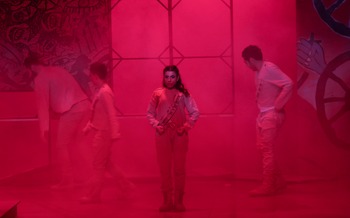
Ronen’s pieces playfully and theatrically intertwine the biographical and the fictional, creating a realm of possibility between the real and the fantastical. This at times gives her work an ambiguous, sometimes spiritual, dimension. In Roma Armee, for example, this place between the real and the dreamed, the fantasized and/or the invented, is utopian, offering the possible restoration of what has been lost. Following the most difficult scenes of the play—scenes that expose the level of violence and terror that some of the actors have been subjected to in their real lives and their subsequent anger against the dominant white heterosexual European male patriarchy—a bright white light illuminates Simonida, sitting on a scaffold on the remains of a stage that has been torn to pieces, but appearing almost to float in the darkness that surrounds her. Simonida has been introduced as a healer and now she appears to tell us about a vision she’s had in which the people of a world that has come close to the edge of annihilation try to look to the wisdom of the Roma for their own and the world’s salvation.
Scene 10: Simonida’s Vision. Roma Armee by Yael Ronen and ensemble, based on an idea by Sandra Selimović and Simonida Selimović. Teatro di Roma/Teatro Argentina, Premio Europa per il Teatro XVI, Rome, Italy, December 2017. From left: Hamze Bytyçi, Orit Nahmias, Sandra Selimović, Simonida Selimović (front), Mihaela Drăgan, Mehmet Ateşçi, Riah Knight, Lindy Larsson (background). (Photo by Florin Ghioca)

Music is often part of the world onstage rather than an outside effect, disrupting and yet enhancing the everydayness and the immediacy of Ronen’s productions. As music transports spectators to a more emotional domain, it provides entrée to realms that are inaccessible to the rational while keeping her pieces grounded in the raw reality of the actors and characters. In The Situation, Maryam Abu Khaled wants Stefan to help translate young Palestinian rapper Karim Daoud’s song into German. Karim enters the stage doing a somersault. Then the music to the rap he will sing begins. This rap allows Karim to express himself uncensored about the horrors he experienced in the occupied streets of Palestine. After singing, he reads the lyrics to Stefan, but when he gets to “all Zionists should burn,” Footnote 8 Stefan stops him immediately because this is not something he should say in Germany. “You can say it in Paris, you can say it in London, for sure; but in Germany this is a very sensitive issue.” Stefan suggests he should rap about graphic sex instead—that’s “what sells in Germany”—and he proceeds to show how “a German rap sounds.” Karim responds to Stefan’s rap by telling Maryam, “We should go to London, the Germans are freaks.” The rap has allowed Karim to express himself more freely than he could have otherwise; he has brought onto the stage the rawness of his real-life feelings.
In fact, all Ronen stagings tend to mix real life’s immediacy with the playfulness of theatre. The actors are most of the time in street clothes; they populate minimally designed sets, which often seem to be like playgrounds with big blocks that can be moved around and used by the actors to help tell (or disrupt) the story. Scaffolding is used as well, showing the play as a dynamic process. Ronen often uses video projections to facilitate rapid changes of location or, as in Winterreise, to bring the pasts of the actors—their travels through Germany—into the present moment. As Katarzyna Pabijanek states in her review of Roma Armee, Ronen uses theatre to explore “how majoritarian narratives internalize the concepts of nation-state, identity, neoliberalism, patriarchy, and hetero-normativity” (2018:171). Ronen hopes, in turn, that the work will help heal wounds of war, displacement, and patriarchy (Kultivision 2015). In Roma Armee, nomadism, central to the history of the Roma, emerges as a workable alternative to an increasingly oppressive nation-state system in a Europe that no longer seems to be able to contain massive waves of migration.
Roma Armee
From Duality to Plurality
I wish we had a real and united Roma community […] with the different places we come from, with the different groups and subgroups […] We should come together […] We have to embrace our history but we also have to think forward. We have to create new stories because the stories we have are all about the past […] we have to find more models of inspiration for our communities. It’s time for us to create our own vision of the future we want to live in.
These are Hamze Bytyçi’s words in scene 15, towards the end of Roma Armee, a scene titled “Pride + Vision + Rebranding.” Ronen and the ensemble evidence the need for new representations of the Roma to neutralize—if not erase—the oppressive labels that haunt them. It is hard to leave the past behind when there are no alternative stories, because the old representations are the only things preserving one’s identity, and the idea of leaving them behind feels like condemning oneself and one’s own people to oblivion.
Hence, Roma Armee proposes a new model for the Roma. To do this—as in most of her productions—Ronen begins by initiating a dialogue about stereotypes, because these hold the oldest, most pervasive ideas. She proceeds to deconstruct the stereotypes by offering more ambivalent images, often presenting stereotypes in puzzling ways that affirm the multiplicity and fluidity of a person’s identity. In this sense, Ronen combats representation with representation. The ritualistic aspects of theatre—action that has the capacity to have an impact in the world—allow the performance to have a direct effect on the reality of those participating (actors and spectators) beyond contemplation and reflection. Roma Armee is really about the theatre’s capacity to be representation and ritual simultaneously, to fight against stereotypes and other belittling representations, and, as Hamze says, to create the “vision of the future we want to live in.”
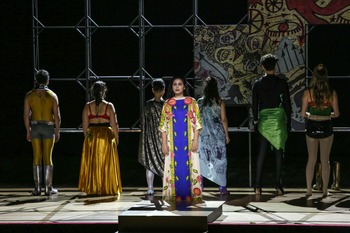
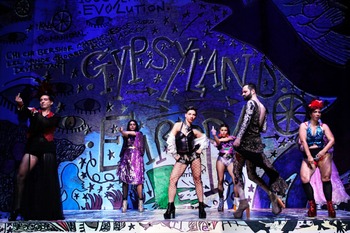
The play includes a cast of Roma and Romani Travellers from Austria, Serbia, Germany, Kosovo, Romania, England, and Sweden who, together with Israeli-German-Turkish Gadjé, become an army that transcends national and ethnic identities. It is a feminist and queer army that struggles against tyrannical masculinities and other oppressive forces. In their first appearance they dress in flashy leather and sequined outfits, fishnet stockings, all of them wearing high platform shoes. They are: the Selimović sisters, the feminine and spiritual Simonida and the “gender liquid” and “macho-Roma” Sandra; Riah Knight, a tall, blond, very pale British Romani young woman; Mihaela Drăgan, a queer actress and playwright with a feminist agenda, described as “passionate” and “superstitious,” who presents as white, black, and brown simultaneously; Hamze Bytyçi, an activist born in Kosovo, who is introduced as a father and as a queer, brown, short, Muslim man; Swedish Romani Traveller Lindy Larsson, who is also white, tall, gay, and skinny, and who sports a dark beard and moustache. Orit Nahmias, who is Jewish-Israeli and plays in many of Ronen’s productions, finds herself in a “supporting role” here as her whiteness and heterosexuality turn her into the privileged one. Mehmet Ateşçi, a German-Turkish gay man is, with Orit, the only other Gadjé in the play.
A feminist and queer army that fights against tyrannical masculinities and other oppressive forces. Roma Armee by Yael Ronen and ensemble, based on an idea by Sandra Selimović and Simonida Selimović. Maxim Gorki Theater, 2017. From left: Mehmet Ateşçi, Simonida Selimović, Sandra Selimović, Mihaela Drăgan, Lindy Larsson, and Orit Nahmias (not seen: Hamze Bytyçi and Riah Knight). (Photo by Ute Langkafel)

The play follows the structures of a cabaret and talk show simultaneously, in which one member of the cast presents themselves and their story and the others offer both comments and support. Including musical numbers that erupt within and out of those conversations, Roma Armee is composed of 16 scenes that are grouped into 3 acts. However, each scene functions almost independently, as in a revue. In the script, the scenes are headed with titles that remind us of songs in a musical, and music in fact draws the scenes together. Music is important in the play, not only because of the place it occupies within Romani culture, but also because it is the shared language among a group of people who come from all over Europe and the Middle East, who speak multiple tongues.
Roma Armee reveals and shares mostly personal material. The actors reflect on and at times even make fun of their own experiences. In one of the scenes, the actors share with the audience letters they’ve received from their mothers, who wanted to make sure they’d include in the show topics such as “The rising Xenophobic violence in the UK post-Brexit,” “How the life expectancy of Romani Travellers is 10 years—10 YEARS!—below that of the UK average,” and “the struggle of our party against the deportation of Roma asylum seekers under the new law of safe countries.” A scene that seems to be about public issues—despite seemingly originating from within the intimacy of their families—turns personal when the actors begin to confront their own relatives and communities with more private matters. “Dear aunt, dear father, dear community, I am lesbian,” says Sandra, “I know some of you don’t understand why I have to mention it onstage, why it should come as a topic in a show that is supposed to deal with Roma issues” but “I’m Roma and I’m queer, and I do not apologize for either.” Mihaela also rebels against her mother and aunt who had warned her against even mentioning the word “early marriage” onstage not to perpetuate “the belief that you, Gadjé, have on us that all Roma girls get married at 13, virgins.” But, even if she is not supposed to, Mihaela tells us about a girl “who hung herself in order to avoid marriage.” And, at the risk of hurting loved ones by revealing family secrets, Lindy apologizes to his Uncle Simon for telling “in front of all these people” (the audience) that his uncle was sterilized “just because (he was) a Romani Traveller.” Later in the scene, Lindy also confronts his father who physically abused him as a child.
“Mihaela: I’m an angry Roma woman.” Roma Armee by Yael Ronen and ensemble, based on an idea by Sandra Selimović and Simonida Selimović. Teatro di Roma/Teatro Argentina, Premio Europa per il Teatro XVI, Rome, Italy, December 2017. From left: Lindy Larsson, Sandra Selimović, Mihaela Drăgan (center), Mehmet Ateşçi. (Photo by Florin Ghioca)

Most of the time, there seems to be little separation between actor and character. In that sense, Roma Armee is not purely theatre of representation (a form associated with the Western European canon); instead the play becomes a ritual in which each actor presents their own story. The scenes are mostly monologue-driven as the actors share moments of their lives, dreams, and fantasies. They’re adding their own voices to compose a narrative, and, as in ritual, their performance is meant to affect the world around them, both on a personal level and, more generally, people’s perceptions of the Roma. The actors come together to clear the demons that tyrannize them for being “Gypsy” in the white patriarch’s nation-state.
The actors move away from victimhood—despite their shared stories of persecution, harassment, and even horrific torture; in order to reclaim their agency as individuals, they cannot let those experiences crush their humanity or their will. They continue to have desires and dreams, and, most importantly, the strength and courage to pursue them. At one point, the actors turn into made-up superheroes. From a stage in semidarkness, we hear Lindy say parodically in a solemn and mysterious tone, “I found out the truth about who I really was somewhere in late childhood. I always knew or felt I was different,” and in a very overdramatic gesture, he opens up his arms to reveal a superhero cape. At this point, the rest of the ensemble appears, also dressed as their invented superheroes. They go on to share similar narratives about their childhood: a lonely kid who felt alienated but then found in their difference the source of their superpower. After comically narrating the fantastical stories of some of these superheroes—in which fiction always comes to rescue reality—the scene ends in a group-empowerment rite in which they help each other to “come out” (as Roma) because as Lindy states, “if we don’t break the silence, we are doomed.”
The actors’ fight to make their true selves seen and heard goes beyond an us-versus-them narrative: in their own complexities, the actors also stumble against the assumptions and discourses of their own tribe, proving there’s no real “us” and no real “them.” In an early scene, the actors end up killing one another because they all judge each other as less than “a true Roma.” They are too gay, too white, too Romanian, too femme, etc.
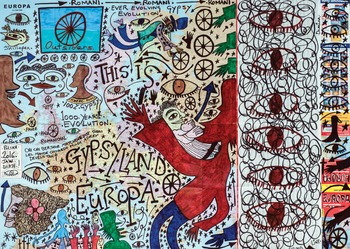
The collaboration with visual artists Damian Le Bas and Delaine Le Bas is vital to Roma Armee, as their work is about “literally putting Gypsies on the map” (Gallery8 2018); they call for “Gypsies” to create the imagery that represents them. As Damian Le Bas states, “from being perceived as Tramps and Thieves with togetherness we can become the Kings & Queens of Gypsyland Europa. After all, wouldn’t Europe be a more boring place without us Gypsies?” (Gypsy Dada Reference Dada2018). Footnote 9 Indeed, Gypsyland Europa by Damian Le Bas is the first image Roma Armee’s spectators encounter, even before the play starts, as the map is projected on the still-closed Gorki proscenium curtains. Delaine Le Bas defines Gypsyland Europa as “constrained by neither limitations nor boundaries, flexible in thought, positive in enabling abilities that reinterpret the negative into positivity,” as it sketches out
“From being perceived as Tramps and Thieves with togetherness we can become the Kings & Queens of Gypsyland Europa.” Gypsyland Europa by Damian Le Bas (1965–2017), 2016. Marker ink on printed map of Europe, 94 cm x 136 cm. Collection: The House of European History, Brussels, Belgium. (Courtesy of Delaine Le Bas)

a vision for a safer European home (RomaTrial 2018b).
The map is configured with eyes, wheels, arrows, and human figures typical of Le Bas’s graffiti-style work. This is a much more humane and welcoming map than the cartographies we are used to seeing. At the bottom left corner, we find the Iberian Peninsula, a historical center of expulsion and rejection, now with a big red four-petaled flower in its center, projecting a more hospitable image. On the right side of the map, a large silhouette of a human figure personalizes the territory. Le Bas’s iconic eyes are present all over the map, reminding us that much has been overlooked in the current mapping of Europe. The stereotypes about the Roma make them hypervisible, yet that hypervisibilty ends up rendering them invisible. “Antigypsyism makes you blind. Blind to the diverse, complex reality around us, which does not correspond to the widespread stereotypes about Roma” (RomaTrial 2018b).
Since the map is projected as video and not as a still image, the map seems to move. Mobility—demonstrated in the dynamic iconography that dominates the painting—is an essential attribute of Gypsyland Europa. Furthermore, the map extends beyond political borders, beyond the walls. Wheels and boots (crowned with Le Bas’s emblematic eye) not only escape the framing of the proscenium and spill onto the walls at the sides of the stage, they
also appear on Lindy’s tattooed sleeve: this embodiment of the map sneaks through the curtains, very much in emcee fashion, to open the play with song.
Movement is key in Roma Armee, not only as part of the nomadic culture of the Roma but also as an indication of process. Above the highlighted title of the map (Gypsyland Europa) we read, “1000 years. EVOLUTION.” Footnote 10 The idea that the play is part of a larger process is crucial; process has its own functions within the play, both structurally and thematically. For one, Roma Armee is not a completed and static artwork or product, but a process of unfolding and discovery. It is an exploration of identity in its multiple and paradoxical dimensions. Presented as process, the play avoids making unambiguous statements and categorical definitions about the Roma people—and migrants in general. Yael Ronen queers the stereotypes, demonstrating that movement is embedded in the fluidity of the actors’ identities.
In the same way that wheels, boots, and the eye break through the framing of the proscenium, the presentation of the play as process also allows the actors to escape fixed framing. If Le Bas’s map is there to offer a homeland without the restriction of imposed borders, the frame of the proscenium gives focus and visibility to the actors, but without turning them into products or commodities.
The idea of process also connotes a different, nonlinear temporality. As noted above, Trumpener observes that the Roma tend to be seen as people at odds with modern structures of temporality. This, in turn, prevents them from being part of Western modern life in general, leaving them outside the modern nation-state system, associated instead with the premodern and the “natural.” Ronen complicates this stereotype by presenting the Roma as individuals who live within contemporary Berlin, London, and other major European cities. She has these urban Roma who live outside of time devise an army that will lead us away from a “Europe that drifts away into neofascism.” Roma Armee moves spectators towards a utopian freedom of almost mystical dimensions, beyond inflexible borders toward an all-encompassing plurality. The Roma people’s nomadic culture is proposed as an example for a world stuck in the rigidity, intolerance, and paternalism of the nation-state. Ronen and the Roma Armee ensemble show that nomadism is not only an actual circumstance but also an inner state. The characters in Roma Armee are free to traverse categorical definitions without feeling they need to attach themselves to classifications in order to belong. Their plurality brings them together.
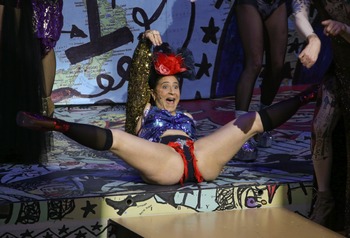
It is no coincidence that the actors who populate Roma Armee are all female and/or queer. In addition, when these actors are introduced by Lindy in a scene titled: “Identity fragments—Voguing,” the connection between them becomes menstruation. Mihaela calls her period “the Vampire Gate,” and Simonida “hasn’t had her period for nine months.” When Lindy states that Riah’s period started two years ago, Riah corrects him that it is not two but five years ago. Lindy misinterprets that to mean that Riah “was five when her period started,” which is likely impossible yet is presented as a fact, which alters Riah’s biography in the same way that most representations of the Roma have been misrepresentations. Many of the distortions in stories about the Roma are accepted and recirculated without question, just as Lindy does here with Riah’s story. However, while Lindy’s misunderstanding appears funny and innocent, distorted stories about the Roma have historically led to the perception that they are a people to be avoided and feared, inciting the horrific violence that some of these actors have experienced.
Ronen also uses this scene to play with our expectations. Mehmet “doesn’t like to talk about his period. PERIOD. He is very sensitive,” showing that we cannot make any assumptions about anyone’s identity, since things get more complex, ever trickier, the deeper we look. Mehmet’s introduction leads us to believe that maybe not only women have a period. It also suggests, unconventionally, that men can be defined by their sensitivity. Or maybe, it tells us that “woman” and “man” do not exactly mean what cisgender people have been told they mean. Signifiers and signifieds become ambiguous in Roma Armee, and the play is full of words with double and triple meanings. Hamze is short and robust with dark olive skin color, very much a man even though he wears a princess dress and a girly blond wig. He “does not have his period but bleeds from his nose.” And Sandra, who is a “macho-Roma,” ends up being the person with “very long and very strong” periods.
Orit’s period. Ronen dedicates a scene to menstruation to reclaim a part of women’s identity that has been made taboo by patriarchy. Roma Armee by Yael Ronen and ensemble, based on an idea by Sandra Selimović and Simonida Selimović. Teatro di Roma/Teatro Argentina, Premio Europa per il Teatro XVI, Rome, Italy, December 2017. (Photo by Florin Ghioca)

The period, as most of the elements in Roma Armee, is itself paradoxical. On one hand, it represents womanhood, but on the other hand not only women menstruate. Ronen dedicates a scene to the menstrual period to reclaim a part of women’s identity that has been made taboo by patriarchy. By introducing the characters through their periods, she places the feminine (even among males) at the center of the new world the play is constructing. At the same time, though, the period stands for pain and suffering. Sandra hates it, and it bloodies Hamze’s nose. The period is blood and necessary for life—but giving birth is painful. Blood is also shed in revolution, connecting change, life, and death, literally and metaphorically.
Roma Armee performs the paradoxes at the core of representation itself. In theatre, the paradox begins with the duality of the performer onstage living as both actor and character, which Ronen complicates even further by having the actors perform characters that represent the actors’ own selves: moving from duality to plurality. One of the most distinctive characteristics of Ronen’s theatre is this metatheatricality, which blurs the line between reality and fantasy—what happened in real life and what an actor is making up. Her theatre acknowledges that representations are the building blocks of our reality, even—or especially—when representations are contradictory, not letting people differentiate between dreams and waking life. But of course reality also includes our fictions and devised narratives; we are and are not our own representations. One thing Roma Armee makes certain: we cannot exist without playing ourselves. Thus, the production insists, instead of letting others dictate our narratives and representations, we better start creating them ourselves. This recognition is a fundamental step in healing the wounds of displacement and discrimination; it opens up the possibility for reconciliation, a process requiring active engagement.
In scene 10, Simonida shares a vision she’s had in which the world becomes “very very lost” because of all the destruction and hatred. But, she goes on, just when people have lost all sense of meaning and purpose, they “become hungry for life again.” At that moment, she says, people will turn around and look for the wisdom of the Roma, and “all we would see is the details of an old history unrecognized.” That “old history” is being erased by the repeated violence the Roma have suffered.
But then the words would come—I don’t know if they came from inside of me or outside or of all of us together—but it says: Do you believe in peace? Do you believe in equality of the people? And at that moment finally I could say: Yes. Yes I do. And at that moment the Spirit said to me: Good. Because we have a lot of work for you.
Ronen’s metatheatricality places theatre itself at the center of the reconciliatory process. The ritualistic practices of theatre allow people to be seen and heard, which is indispensable to the healing process of those who have been silenced and disappeared. Theatre reminds us that it is through the material that we reach the immaterial. By means of doing we experience the spiritual; through representation we approach the ineffable. Maybe the knowledge that Simonida alludes to in her vision has to do with learning to live in the here and now, present and open to the multiplicity of everything, in a state of eternal becoming. As the actors of Roma Armee sing towards the end of the play:
Somos camino nosotros. No el punto de llegada ni de partida. Somos lugar, nosotros. No quien lo ocupa. No existimos, nosotros. Sólo somos.
(We are the path. Not the point of arrival or departure. We are the place, we. Not who occupies it. We do not exist, we. We just are.)