Introduction
Aphidophagous ladybirds are largely generalist predators. Their prey is categorized on the basis of their differential prey-dependent growth, development, survival, reproductive performance and life-history parameters (Francis et al., Reference Francis, Haubruge, Defrance and Gaspar2000; Bilde and Toft, Reference Bilde and Toft2001; Stamp and Meyerhoefer, Reference Stamp and Meyerhoefer2004; Ishiguri and Toyoshima, Reference Ishiguri and Toyoshima2006; Dixon et al., Reference Dixon, Agarwala, Hemptinne, Honek and Jarosik2011). While Hodek (1962) proposed the categories essential, alternative and rejected (Hodek and Honek, Reference Hodek and Honěk1996), Malcolm (Reference Malcolm and Crawley1992) suggested an alternative terminology, included, peripheral and excluded for the respective categories. Michaud (Reference Michaud2005) further subdivided essential prey into optimal, adequate and marginal, based on the differences in their nutritive values and the ways by which the nutrients are assimilated and utilized (Phoofolo et al., Reference Phoofolo, Giles and Elliot2007). Also, prey selected by ovipositing females for their larvae has been termed as ‘nursery prey’ (Dixon, Reference Dixon2000) on which the larvae develop best in terms of survival and growth (Wilder et al., Reference Wilder, Toft, Rypstra, Pilati and Vanni2010).
It has also been observed that predators with higher growth rates have high consumption indices and conversion efficiencies (Mills, Reference Mills1981; Baumgaertner et al., Reference Baumgaertner, Gutierrez and Summers1981; Schuder et al., Reference Schuder, Hommes and Larink2004; Mishra et al., Reference Mishra, Kumar, Shahid, Singh and Omkar2011; Omkar and Afaq, Reference Omkar and Afaq2011). Predators that are efficient in converting food into their own biomass are also efficient in converting prey biomass into progeny (Omkar et al., Reference Omkar, Pervez, Mishra, Srivastava, Singh and Gupta2005a). Such studies based on consumption rates, conversion efficiencies and growth rates have not only provided information on the behaviour of concerned predators in relation to their feeding, but also helped in assessing their energy budget for various biological activities (Mishra et al., Reference Mishra, Omkar, Kumar and Pandey2012). Further, conversion efficiency overcomes the confounding effects of the relative sizes of predators during the evaluation of predation by predators of variable sizes (Dixon, Reference Dixon2000). Thus, it is possible that predatory parameters might also be effective in assessing prey suitability in ladybirds; if found effective, such measures would reduce the assessment duration of prey suitability.
Therefore, in the present investigation, predatory performance of the two most predaceous stages, i.e. fourth-instar larvae and adult females, of four locally common aphidophagous ladybirds (Mishra et al., Reference Mishra, Kumar, Shahid, Singh and Omkar2011), namely Coccinella septempunctata (L.) (C7), C. transversalis F. (Ct), Cheilomenes sexmaculata (F.) (Cs) and Propylea dissecta (Mulsant) (Pd) (all Coleoptera: Coccinellidae) on the aphids Aphis craccivora Koch and Lipaphis erysimi (Kaltenbach) (both Homoptera: Aphididae) was assessed in terms of voracity, consumption index, conversion efficiency and growth rate. Both prey species used in the experiment are essential prey (Omkar and Srivastava, Reference Omkar and Srivastava2001, Reference Omkar and Srivastava2003a; Omkar and Bind, Reference Omkar and Bind2004; Omkar and Pervez, Reference Omkar and Pervez2004; Pervez and Omkar, Reference Pervez and Omkar2004; Omkar and Mishra, Reference Omkar and Mishra2005; Omkar et al., Reference Omkar, Pervez, Mishra, Srivastava, Singh and Gupta2005a) and form an equivalent niche for these common aphidophagous ladybirds. The predatory parameters thus obtained were then compared with existing prey suitability records based on developmental and reproductive attributes of the four ladybirds on the two prey species.
The findings of this study will not only help assess the possibility of predatory parameters working as a measure of prey suitability but will also increase our knowledge of the nutritional ecology of these ladybirds. The findings may be further utilized in the mass multiplication of these biological control agents for use in the augmentative biocontrol of these important aphid pests of agricultural crops.
Materials and methods
Stock maintenance
Adults of C7 (n= 52), Ct (n= 45), Cs (n= 68) and Pd (n= 38) were collected from the fields close to Lucknow, India (26°50′N, 80°54′E) and were reared for a generation under constant abiotic conditions (27 ± 2°C; 65 ± 5% relative humidity; 14 h light–10 h dark) in environmental test chambers (CH-6S; Remi Instruments, India). Ten emerging pairs of each species were divided into two groups, one of which was supplied with A. craccivora reared on bean (Dolichos lablab Linnaeus) (Fabaceae) and the other with L. erysimi reared on mustard (Brassica campestris Linnaeus) (Brassicaceae), both of which are economically important host plant complexes in the region. Prey supply was replenished every 24 h. Paired adults were placed in plastic Petri dishes (14.5 × 1.5 cm), which were checked for eggs twice a day. Adults were transferred to fresh Petri dishes post-egg laying. The newly emerged larvae (neonates) were reared individually in Petri dishes on a diet similar to the parents until adult emergence. Owing to their higher voracities, fourth instars and adult females were used in the experiments (Kawauchi, Reference Kawauchi1979; Omkar and Srivastava, Reference Omkar and Srivastava2001; Pervez and Omkar, Reference Pervez and Omkar2004; Sharma and Joshi, Reference Sharma and Joshi2010).
Experimental design
Prior to the commencement of the experiment, the fourth instars (12 h after moulting; C7 17.70 ± 1.99 mg; Ct 15.30 ± 0.90 mg; Cs 8.80 ± 0.91 mg and Pd 7.20 ± 0.81 mg) and 10-day-old unmated adult females (C7 27.80 ± 1.32 mg; Ct 21.30 ± 1.32 mg; Cs 14.40 ± 1.61 mg and Pd 11.50 ± 0.50 mg) were starved for 12 h and then weighed (0.01 mg precision; Sartorius CP225-D). They were then provided with 50 mg of intermediate (second and third) instar aphids (same species as fed in stock) in Petri dishes, which were kept for the next 24 h under the same climatic conditions as mentioned above. After 24 h, the predators and the remaining aphids were separated and weighed. There were 10 replicates per stage per aphid species in each ladybird, totalling 160 larvae and adults.
To assess the natural reduction in aphid biomass, if any, in the absence of predators, 50 mg of aphids of each species were placed in Petri dishes and kept under similar conditions for 24 h, reweighed and considered as controls. The average loss of biomass, if any, based on five replicates per aphid species, was used to normalize the data on consumption prior to calculating the various predatory parameters.
Predation parameters were calculated using formulae (1) (Lucas et al., Reference Lucas, Demougeot, Vincent and Coderre2004), (2) (Waldbauer, Reference Waldbauer1968; Ramdev and Rao, Reference Ramdev and Rao1979), (3) (modified after Dixon, Reference Dixon2000) and (4) (Waldbauer, Reference Waldbauer1968; Ramdev and Rao, Reference Ramdev and Rao1979):
 $$Voracity\ (mg/day) = biomass\ of\ aphids\ consumed\ per\ predator\ per\ day\ (mg/day), $$<label>(1)</label>
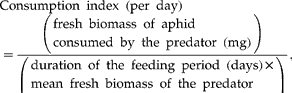 $$Consumption\ index\ (per\ day) = \frac {\left (fresh\ biomass\ of\ aphid\ consumed\ by\ the\ predator\ (mg)\right )}{\left (duration\ of\ the\ feeding\ period\ (days)\,\times mean\ fresh\ biomass\ of\ the\ predator\ during\ the\ feeding\ period\ (mg)\right )}, $$<label>(2)</label>
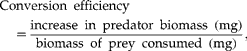 $$Conversion\ efficiency\quad = \frac {increase\ in\ predator\ biomass\ (mg)}{biomass\ of\ prey\ consumed\ (mg)}, $$<label>(3)</label>
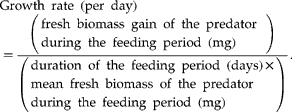 $$Growth\ rate\ (per\ day)\,\, = \frac {\left (fresh\ biomass\ gain\ of\ the\ predator\ during\ the\ feeding\ period\ (mg)\right )}{\left (duration\ of\ the\ feeding\ period\ (days)\,\times mean\ fresh\ biomass\ of\ the\ predator\ during\ the\ feeding\ period\ (mg)\right )}. $$<label>(4)</label>
Statistical analysis
All data obtained in the study were checked for a normal distribution using the Kolmogorov–Smirnov test for normality and Bartlett's test for homogeneity of variances prior to being subjected to further analysis. Predation parameters (dependent factors), namely consumption index, conversion efficiency and growth rate of each stage, were individually subjected to two-way ANOVA followed by Tukey's post hoc comparison of means, with ladybird (C7, Ct, Cs and Pd) and aphid (A. craccivora and L. erysimi) species as independent factors. Interactions between the two independent factors were taken into consideration.
Because the ladybirds differed in size, body masses of the larval and adult stages of the ladybird species were considered as covariates and voracity evaluated by two-way ANCOVA (general linear model) followed by Tukey's post hoc comparison of means. All statistical analyses were performed using Minitab 16 (Minitab Inc., State College, Pennsylvania, USA).
Results
The results of two-way ANOVA revealed that the consumption index (F ANOVA(interaction)= 6.80; P< 0.0001; df = 3, 79), conversion efficiency (F ANOVA(interaction)= 3.61; P= 0.017; df = 3, 79) and growth rate (F ANOVA(interaction)= 3.23; P= 0.027; df = 3, 79) of fourth instars varied significantly with variations in both ladybird and prey species. However, two-way ANCOVA (general linear model, GLM) indicated a significant influence of the ladybird and prey species (F ANCOVA(interaction)= 14.58; P< 0.0001; df = 3, 79), and also the body mass of the ladybird species (covariate; F ANCOVA= 4.76; P= 0.033; df = 1, 79), on the voracity of fourth instars.
Similarly, consumption index (F ANOVA(interaction)= 48.42; P< 0.0001; df = 3, 79), conversion efficiency (F ANOVA(interaction)= 5.04; P= 0.003; df = 3, 79) and growth rate (F ANOVA(interaction)= 5.94; P= 0.001; df = 3, 79) of adult females were significantly affected by both ladybird and aphid prey species. The results of two-way ANCOVA (GLM) further indicated that in addition to the ladybird and prey species (F ANCOVA(interaction)= 6.86; P< 0.0001; df = 3, 79), the body mass of the ladybird species (covariate; F ANCOVA= 5.82; P= 0.018; df = 1, 79) also influenced the voracity of adult females.
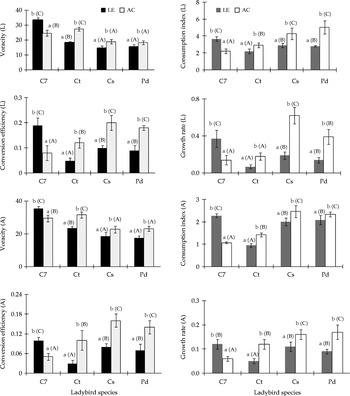
The fourth instars and adult females of all the ladybird species, except C7, performed better on A. craccivora than on L. erysimi. In C7, better parameters were observed on L. erysimi. For A. craccivora, though the smaller ladybirds had significantly lower voracities than the larger ones, they had better consumption indices, conversion efficiencies and growth rates. This was also true for L. erysimi, with the exception of C7 (Fig. 1).
Comparative predatory performance of fourth-instar larvae (L) and adult females (A) of the four co-occurring ladybirds on the aphid species A. craccivora (AC) and L. erysimi (LE). Values are mean ± SE. Small and capital letters in parentheses represent the comparison of means between the aphid species and between the ladybird species, respectively.

Discussion
Based on predatory parameters, the present study reveals that prey species had a significant influence on the predatory performance of the four co-occurring aphidophagous ladybirds, and apart from C7, the other three species performed best when fed on A. craccivora. Earlier studies based on reproductive, developmental and/or life table parameters have also reported A. craccivora to be an essential and preferred prey of these ladybirds, namely Ct (Debaraj and Singh, Reference Debaraj and Singh1990; Omkar et al., Reference Omkar, James and Srivastava1999; Bista and Omkar, 2013), Cs (Sugiura and Takada, Reference Sugiura and Takada1998; Omkar and Bind, Reference Omkar and Bind2004) and Pd (Pervez and Omkar, Reference Pervez and Omkar2004; Omkar and Mishra, Reference Omkar and Mishra2005), while L. erysimi has been reported to be more suitable for C7 (Lakhanpal and Raj, Reference Lakhanpal and Raj1998; Omkar and Srivastava, Reference Omkar and Srivastava2001; Sharma and Joshi, Reference Sharma and Joshi2010).
Differential biomass consumption and utilization is perhaps indicative of aphid palatability and of a ladybird's preference for a particular species of aphid prey of suitable morphology, behaviour and chemical constitution (Okamoto, Reference Okamoto and Hodek1966; Dixon, Reference Dixon2000). The high voracity, consumption index, conversion efficiency and growth in the biomass of fourth instars and adult females of C7 fed on L. erysimi indicated that this ladybird is a more efficient exploiter of this prey in comparison with the other ladybird species tested. The presence of higher levels of proteins and the absence of unsuitable chemicals have been reported in L. erysimi (Atwal and Sethi, Reference Atwal and Sethi1963). In contrast, numerous earlier studies have reported that this aphid sequesters chemicals from its host plant, which contains certain alkaloids that are toxic for many ladybirds (Hodek, Reference Hodek1956; Okamoto, Reference Okamoto and Hodek1966). Its pungent smell, possibly due to the presence of allyl isothiocyanates, is also responsible for its reduced suitability as a prey (Joshi et al., Reference Joshi, Ballal and Rao1999; Noble et al., Reference Noble, Harvey and Sams2002; Omkar et al., Reference Omkar, Kumar and Sahu2009). Thus, it is supposed that either the allelochemicals that L. erysimi derive from their host plant are highly suitable for the metabolic activity of C7 or these harmful chemicals are detoxified by the higher abilities of C7 when compared with the other three ladybird predators.
With the exception of C7, the higher predatory performance of the other ladybird species on A. craccivora than on L. erysimi indicates that the former is more suitable than the latter for their growth and development. The better performance of these ladybirds when fed on A. craccivora may be attributed to the presence of suitable nutrients in this aphid species which they derive from their host plant (Rajmohan and Jayraj, Reference Rajmohan and Jayraj1974; Islam and Haque, Reference Islam and Haque1978; Omkar et al., Reference Omkar, Mishra, Srivastava, Gupta and Singh2005b), i.e. D. lablab. Earlier studies have also reported the high suitability and palatability of A. craccivora to Ct (Omkar and James, Reference Omkar and James2004), Cs (Omkar and Bind, Reference Omkar and Bind2004) and Pd (Omkar and Mishra, Reference Omkar and Mishra2005) when reared on the same host plant.
Contrarily, A. craccivora obtained from host plants such as Robinia pseudoacacia L. (Fabaceae) (Obatake and Suzuki, Reference Obatake and Suzuki1985), Astragalus sinicus L. (Fabaceae), Vicia hirsuta (L.) (Fabaceae), Capsella bursa-pastoris (L.) (Brassicaceae), Cardamine flexuosa With. (Brassicaceae), Rorippa palustris (L.) (Brassicaceae) and Hemistepta carthamoides Kuntze (Asteraceae) (Hukusima and Kamei, Reference Hukusima and Kamei1970) have been reported to be highly toxic to ladybirds, probably due to the presence of amines, canavanine and ethanolamine, from both the host plant and aphid species (Obatake and Suzuki, Reference Obatake and Suzuki1985).
Previously reported voracities, conversion efficiencies and growth rates of these four ladybirds fed on the pea (Pisum sativum L.; Fabaceae) aphid Acyrthosiphon pisum (Harris) (Mishra et al., Reference Mishra, Kumar, Shahid, Singh and Omkar2011) were, however, higher than those reported here after feeding on A. craccivora and L. erysimi. Studies on the life-history traits of Ct and C7 on A. pisum and A. craccivora have also indicated A. pisum to be a more suitable prey than A. craccivora (Kalushkov and Hodek, Reference Kalushkov and Hodek2004; Bista and Omkar, 2013).
With the exception of C7 on L. erysimi, it was also observed that the smaller ladybirds had lower voracity than the larger ones, but had better consumption indices, conversion efficiencies and growth rates, regardless of the aphid species provided. Similar findings have been observed when size-based predatory parameters of the four ladybird predators were tested on A. pisum (Mishra et al., Reference Mishra, Kumar, Shahid, Singh and Omkar2011, Reference Mishra, Omkar, Kumar and Pandey2012).
In brief, the assessment of prey suitability on the basis of the growth, development and reproduction of ladybirds is well established (Kalushkov and Hodek, Reference Kalushkov and Hodek2001; Stamp and Meyerhoefer, Reference Stamp and Meyerhoefer2004; Omkar and Bind, Reference Omkar and Bind2004; Ishiguri and Toyoshima, Reference Ishiguri and Toyoshima2006; Omkar, Reference Omkar2006; Omkar et al., Reference Omkar, Kumar and Sahu2009, Reference Omkar, Kumar and Sahu2011; Berkvens et al., Reference Berkvens, Landuyt, Deforce, Berkvens, Tirry and De Clercq2010; Sarwar and Saqib, Reference Sarwar and Saqib2010). A few studies have also considered the rate of prey consumption or voracity as a measure of prey suitability (Omkar and Srivastava, Reference Omkar and Srivastava2001, Reference Omkar and Srivastava2003b; Finlayson et al., Reference Finlayson, Alyokhin, Gross and Porter2010) and have established that higher prey consumption signals better performance (Omkar and Mishra, Reference Omkar and Mishra2005; Omkar et al., Reference Omkar, Kumar and Sahu2009). Thus, when prey consumption and/or voracity are measures of prey suitability, why cannot consumption indices and prey utilization efficiencies of ladybirds be considered as measures?
The better predatory performance in terms of the voracity, consumption index, conversion efficiency and growth rate of C7 on L. erysimi, and those of Ct, Cs and Pd on A. craccivora, complies with earlier prey suitability studies based on either life table studies or developmental and/or reproductive parameters. This correlation between better predatory performance and previously reported suitable aphid species indicates that these parameters are equally effective in assessing prey suitability. Moreover, these parameters have reduced the assessment duration of prey suitability and can thus prove to be better than previously used assessment methods. Hence, conducting such preliminary short-duration prey–predator trials based on predatory parameters prior to the release of predators in agricultural fields may: (i) provide early confirmation of prey suitability for the concerned predator and (ii) reduce the cost of mass multiplication.
The findings of the present study, other than indicating that predatory parameters can be used to assess prey suitability, also suggest that: (i) C7 is the most efficient consumer and exploiter of L. erysimi among the four ladybird species tested; (ii) although these four ladybird species co-exist as the predators of A. craccivora, the larger ladybirds are more voracious, whereas the smaller ones are efficient exploiters of this aphid prey; hence, the combinations of large and small ladybirds may be exploited to control the infestation of A. craccivora in agricultural fields; and (iii) for C7 and the other three ladybird species tested, L. erysimi and A. craccivora are the most suitable aphid prey, respectively, which can reduce the cost of mass multiplication, enabling better utilisation in the augmentative biocontrol of these important aphid pests.
Acknowledgements
The authors would like to thank Professor A.F.G. Dixon, Professor Emeritus, School of Biological Sciences, University of East Anglia, Norwich, UK for critically reviewing an earlier draft of the manuscript and providing invaluable suggestions. This study was financially supported by the Department of Higher Education, Government of Uttar Pradesh, India in the form of Centre of Excellence in Biocontrol of Insect Pests.