INTRODUCTION
Rice (Oryza sativa)–wheat (Triticum aestivum) is the dominant cropping system in the IGPs of south Asia occupying about 13.5 million ha (Gupta et al., Reference Gupta, Singh, Ladha, Singh, Singh, Singh and Pathak2007). The major expansion of this system has taken place between 1960 and 1990's with the availability of high-yielding, semi-dwarf, short-duration varieties of rice and wheat, which are highly responsive to fertilizers and irrigation (Ladha et al., Reference Ladha, Fischer, Hossain, Hobbs and Hardy2000). Afterwards, the growth rates of rice and wheat yields are either stagnating or declining. The productivity of these crops in some parts of India has attain a plateau and in a few states it has shown declining trends. Cultivation of rice is considered to be more detrimental than wheat for sustainability of the system, since rice is a high water demanding crop. RW system requires contrasting edaphic conditions. Rice is transplanted in puddled soil and is given continued submergence whereas wheat is grown in upland well-drained soils having good tilth. Since continuous soil tillage strongly influence the soil properties, it is important to adopt appropriate tillage practices that avoid the degradation of soil structure, maintain crop yield as well as ecosystem stability. Continuous cultivation of RW monoculture system for long period, has led to decline in soil productivity, factor productivity and other environmental problems. Hence, it is needed to diversify the system with alternative remunerative crops like pulses, leguminous oil seeds like soybean. Soybean (Glycine max L.) is a good alternative to rice because being a grain legume it will not only meet its own nitrogen requirement to a great extent through biological nitrogen fixation but also leave considerable amount of nitrogen in soil and crop residues for utilization for succeeding crops (Herridge et al., Reference Herridge, Peoples and Boddey2008). There is immense scope to go for ZT raised bed for SW where both crops are grown successfully by preventing the direct contact of stagnant water during rainy season for soybean and reduction in turnaround time for timely sowing of wheat thereby escaping from terminal heat injury and its associated yield losses (Ram, Reference Ram2006). ZT technique is an ecological approach for soil surface management and seed bed preparation resulting in less energy requirement, less weed problem, better crop residue management and higher or equal yield (Jain et al., Reference Jain, Mishra, Kewat and Jain2007), energy efficient and beneficial to environment as compared to conventional practices (Sharma et al., Reference Sharma, Chhokar, Vijaya, Gathals and Kum2002a). Further, the permanent bed (PB) planting allows the bed to be re-used for succeeding crop and thus has the potential to minimize the cost of cultivation similar to ZT. Although crop residues were abundant in this region it is miss managed by burning for timely sowing of the crops. Instead if those crop residues are recycled in the system it will enhance the system productivity, resource use efficiency and result in favourable soil physico-chemical properties. However, most of the studies are restricted to irrigated RW systems. Relatively limited information is available about tillage (either ZT-ZT or CT-CT) and crop-establishment techniques (bed or flat) and residue management practices on the performance SW system. Thus, it becomes imperative to sustain the productivity of agricultural systems concomitant with environment friendly and efficient utilization of production resources. Hence, a study was undertaken with the objective to evaluate the effect of tillage and crop-establishment techniques and residue management practices on performance of SW system in IGPs of India.
MATERIALS AND METHODS
Experimental site
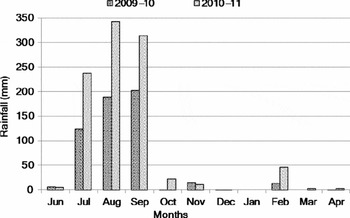
Field experiments were conducted during 2009–11 at the Indian Agricultural Research Institute (IARI), New Delhi, situated at 28°35′ N latitude and 77°12′ E longitude and at an altitude of 228.61 m above mean sea level (Arabian sea). Soil of the experimental site was sandy loam (Typic Haplustept, Inceptisol) with pH 7.6 and 3.8 g C kg−1 at 0–15 cm depth of soil. The total precipitation during the study period was 542.2 mm and 997.0 mm during 2009–10 and 2010–11 respectively while 50 years average rainfall of the site is 650 mm and more than 84% generally received during then south–west monsoon (July–September) with mean annual evaporation of 850 mm. Mean monthly relative humidity in 2009–10 and 2010–11 ranged from 42 to 97%, and 13 to 94%, respectively during the period of experimentation. Water table remained below 3.5 m deep from ground surface during the crop growth period. The rainfall pattern and total rainfall during the cropping seasons from 2009–10 to 2010–11 are presented in Figure 1.
Monthly rainfall and distribution pattern (mm) during the cropping season.

Treatments and crop culture
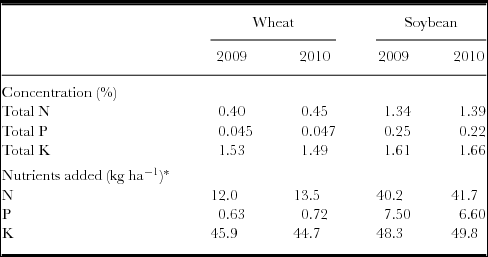
Field experiments were conducted involving SW system, in which soybean was grown during summer/rainy season (June–November) and wheat was grown during winter/dry season (November–April) during 2009–10 and 2010–11 in split plot design (SPD) with three replications in a fixed lay out. The main plot treatments consisted of four tillage and crop establishment for both soybean and wheat, namely conventional tillage-flat (CT─F); ZT─F; conventional tillage-bed (CT─B) and ZT─B while the sub plot treatments were control, wheat residue (3 t ha−1), soybean residue (3 t ha−1) and soybean + wheat residue (3 t ha−1 each). Field was divided into three blocks (replications). In each block, four main plots were marked to accommodate the treatment combinations of tillage and crop establishment. Each main plot was further divided into four sub-plots to accommodate different crop residue management. In CT─F after the harvest of previous crop the plots were ploughed with a disc harrow twice and cultivator was run twice followed by planking before sowing of seeds through seed drill. In CT─B seeds were sown with the help of bed planter after the land preparation as in CT─F. In ZT─F no tillage operation was carried out after harvest of previous crop, soybean was sown with the help of ZT seed drill. In ZT─B soybean was sown with the help of bed planter without any tillage operation. The beds were formed at a distance of 70 cm from bed to bed both in CT─B and ZT─B. The gross plot size of the sub plot was 18 m2, while the gross size of the main plot was 72 m2. The soybean variety DS 9814 during rainy (June to October) and wheat variety PBW 550 during winter (November to April) were grown at row to row spacing of 35 cm and 20 cm, respectively. Well dried crop residues of wheat and soybean of previous season were applied @ 3 t ha−1 to soybean and wheat crop respectively by spreading the material uniformly a week before preparation of the field for CT─F and CT─B. In ZT─F and ZT─B, the residues of previous crop were applied immediately after sowing of the crop. Chemical composition of the crop residues were determined by adopting the procedure described by Prasad et al. (Reference Prasad, Shivay, Kumar and Sharma2006) presented in Table 1. This cropping pattern was continued over two years starting with soybean sown in July 2009.
Chemical composition of crop residues applied in the field experiment.
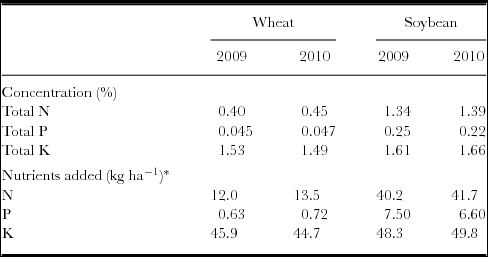
*Nutrient added from residue of 3.0 t ha−1.
Crop management
The recommended practice of fertilizer application was followed to both the crops. The N, P and K were given in the form of urea, single super phosphate and muriate of potash, respectively. The recommended dose of fertiliser in soybean (20:60:40 N, P2O5 and K2O kg ha−1) and wheat (120:60:40 N, P2O5 and K2O kg ha−1) were applied. In soybean, pendimethalin @ 0.75 kg a.i ha−1 was applied as pre-emergence followed by two hand weeding at 20 DAS and 40 DAS and in wheat one blanket spray of paraquat was made before sowing of the crop only in ZT plots followed by application of isoproturon and 2,4-D at 30–35 DAS to the whole plots. Harvesting during second fortnight of October and first fortnight of April was carried out for soybean and wheat respectively in each year.
Irrigation management
A ‘Parshall flume’ was used to quantify water applied for wheat crop through irrigation. Depth of irrigation water was maintained at 7 and 5 cm for flat and bed system of crop establishment both in CT and ZT. Wheat crop received five irrigations in 2009–10 and four irrigation 2010–11 accordingly.
Data collection and analysis
Crop yield
Crops were harvested manually 10 cm above the ground and threshed with the help of pull man thresher. The biological yield, grain yield and stover yields were recorded.
System productivity
Productivity of SW system was calculated in terms of wheat equivalent yield (WEY) by using the following expression
-
WEY of soybean = (Soybean yield × Soybean price)/Wheat price.
-
System productivity = Wheat yield + WEY of soybean.
Estimation of energy requirement
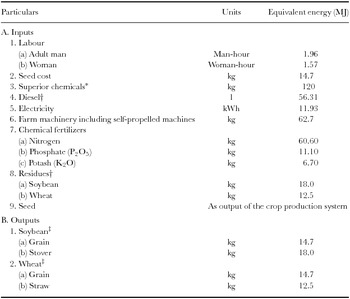
The energy inputs referred to the both renewable and non-renewable energy. Renewable energy includes manual, animal/bullock, seed, manure, crop residue etc. Whereas, non-renewable energy encompassed chemical fertilizer (NPK), diesel, electricity, lubricants, machinery and agro-chemical etc. Total physical output referred to both grain and by-product yield. The energy output from the economic and by-product yield was also estimated. For estimation of energy inputs and outputs for each items of inputs and agronomic practices (expressed in MJ ha−1) equivalents (Table 2) were utilized as suggested by Mittal and Dhawan (Reference Mittal and Dhawan1988), Baishaya and Sharma (Reference Baishaya and Sharma1990), Panesar and Bhatnagar (Reference Panesar and Bhatngar1994) and Singh et al. (Reference Singh, Pal, Thakur and Verma1997). Energy efficiency was calculated using the following formula as follows:
Energy equivalents for different inputs and outputs.

*Requires dilution at the time of application; †Includes cost of lubricant; ‡Dry mass.
Source: Mittal and Dhawan (Reference Mittal and Dhawan1988), Baishaya and Sharma (Reference Baishaya and Sharma1990), Panesar and Bhatnagar (Reference Panesar and Bhatngar1994) and Singh et al. (Reference Singh, Pal, Thakur and Verma1997).
-
Energy efficiency = Energy output (MJ ha−1)/Energy input (MJ ha−1)
-
Net energy (MJ ha−1) = Energy output (MJ ha−1)–Energy input (MJ ha−1)
Water use efficiency (WUE)
The WUE was calculated as explained by Singh et al. (Reference Singh, Gandhi and Raheja1960) by the following formula as the dry grain yield (kg ha−1) divided by the irrigation water applied (cm).
-
WUE (kg ha−1 cm−1) = Grain yield (kg ha−1)/water use (cm).
Economic analysis
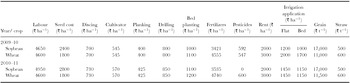
The economic analysis in terms of gross and net returns and benefit: cost ratio (returns per rupee invested) were made out on the basis of existing rate of inputs and output in the local market (Table 3). Total variable cost included the cost of inputs such as seeds, fertilizers, irrigation, crop residues and the cost for various cultural operations such as ploughing, sowing, weeding, harvesting, threshing etc. The rental value of land was also considered in the cost of cultivation. Returns were calculated by using the following formula.
Costs for different inputs and outputs during 2009–10 and 2010–11.

₹50 = ~US$1 during the period of investigation.
-
Gross returns = Value of the grain/seed + Value of straw/stover
-
Net returns = Gross returns–Total variable costs
-
Benefit: Cost ratio = Gross returns/Total variable cost
Statistical analysis
The data recorded for different parameters were analysed with the help of analysis of variance (ANOVA) technique for a SPD using MSTAT-C software. The results are presented at 5% level of significance (p = 0.05).
RESULTS
Performance of soybean
Yield
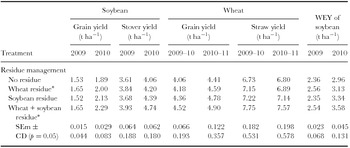
The influence of tillage and crop establishment on grain yield of soybean was non-significant during both the years. Residue management had pronounced effect on the grain yield during both the years of study. During 2009, wheat residue application gave more yield than no residue treatment. In 2010, wheat + soybean residue gave maximum grain yield (2.29 t ha−1) which was 20.95, 14.47 and 7.27% higher than the no residue, wheat residue and soybean residue management practices respectively. The tillage and crop-establishment practices influenced stover yield of soybean significantly during 2010, but it was similar during 2009. In 2010, ZT─F (4.60 t ha−1) produced higher stover yield than rest of the tillage treatments. Crop residue application recorded higher stover yield (Table 4) than no residue treatment during both the years of study. The maximum stover yield of soybean was recorded with wheat + soybean residue treatment.
Effect of residue management on yield of soybean and wheat and WEY of soybean.

*only wheat residue was applied during the year of initiation; WEY: wheat equivalent yield.
Performance of wheat
Yield
Grain yield did not differ significantly among various tillage and crop-establishment techniques during both the years of study. Residue management practices influenced the grain yield significantly during both the years of study. The maximum grain yield (4.52 and 4.90 t ha−1) was recorded during 2009–10 and 2010–11, respectively with wheat + soybean residue application which was 11.3 and 11.1% higher than the no residue treatment, respectively. This was followed by soybean residue, wheat residue and no residue and they were at par with each other. The no residue treatment recorded the lowest grain yield (4.06 and 4.41 t ha−1) in both the years, respectively. A similar trend was recorded for straw yield with tillage and crop-establishment technique and residue management practices, during both the years of studies (Table 4).
Wheat equivalent yield of soybean
The residue management treatments influenced the WEY of soybean significantly during both the years (Table 4). The maximum WEY was recorded with wheat residue receiving treatment in the year 2009 and combined application of wheat + soybean residue in the year 2010.
System productivity
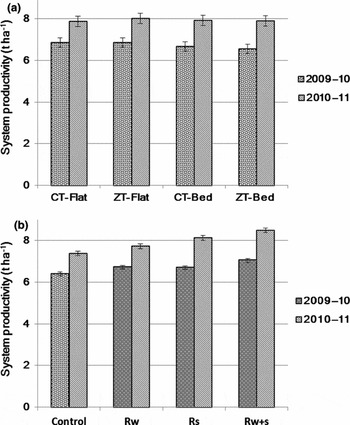
The tillage and crop-establishment treatments did not influence the system productivity of SW system significantly during both the years (Figure 2). The maximum system productivity of 6.86 and 8.01 t ha−1 was recorded in CT─F and ZT─F during 2009–10 and 2010–11 respectively. The residue management practices also influenced the system productivity of SW significantly during both the years. The maximum system productivity was registered with the combined application of wheat + soybean residue during both the years (Figure 2).
System productivity as affected by (a) tillage and (b) residue management in SW system.

Nutrient uptake
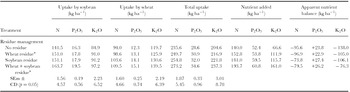
The uptake of NPK in SW system is presented in the Table 5. The total nutrient removal by the SW system was maximum for N followed by K and P. Less nutrient uptake was recorded under control (no residue) and a progressive increase in uptake of nutrients were found with two different crop residue sources and their application in combination to both the crops. The maximum uptake of nutrient was obtained with the wheat + soybean residue treatment which was significantly higher than rest of the treatments. The total (soybean + wheat) nutrient uptake was marginally higher in flat system than bed system of crop establishment in case of N and P uptake, while similar for the K uptake. The wheat + soybean residue application recorded higher system nutrient uptake than the other three treatments. The NPK uptake of each crop and SW system uptake with wheat residue and soybean residue were found to be at par with each other.
Effect of residue management on nutrient uptake and apparent balance in SW system (mean of 2009–10 to 2010–11).

*only wheat residue was applied during the year of initiation.
Apparent nutrient balance
The negative balance was in the order of K > N and the maximum negative balance for N with ZT─F and for K with CT─B (Table 5). The maximum positive P balance was obtained with ZT─B. Among the residue treatments the wheat residue receiving treatment either as sole or in combination resulted in negative balance for N than soybean residue and control (no residue) treatment. Also no residue treatment found to record the maximum negative balance for K nutrient.
Energy relations
Energy input and energy output
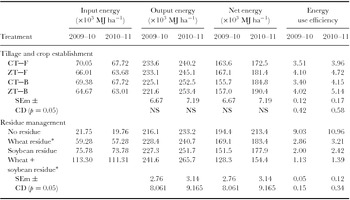
During both the years of study the energy input requirement was significantly higher with CT for SW system (Table 6). Whereas, the ZT treatments registered less energy input requirement in the system. In SW system higher energy input was recorded with wheat + soybean residue treatment during both the years. The energy output among the continuous tillage and crop-establishment treatments was non-significant during both the years of study. Among the residue management treatments the less energy output was recorded with no residue while the maximum was recorded with wheat + soybean residue treatment which was 11.80 and 13.94% higher energy output than no residue treatment during the year 2009–10 and 2010–11, respectively.
Effect of tillage and crop-establishment techniques and residue management on energy relations in SW system.

*only wheat residue was applied during the year of initiation.
Net energy and energy use efficiency
Net energy output of the SW system was non-significant during both the years of study. However, the maximum net energy was recorded in ZT─F (167.1 ×10³ MJ ha−1) and ZT─B (190.4 ×10³ MJ ha−1) during the years 2009–10 and 2010–11, respectively in the SW system (Table 6). Evidently the residue management practices significantly influenced the net energy. The control treatment recorded 194.4 and 213.4 ×10³ MJ ha−1 net energy during the year 2009–10 and 2010–11 respectively. In SW system the no residue treatment recorded 51.51 and 38.21% higher net energy than the wheat + soybean residue treatment during the year 2009–10 and 2010–11 respectively. Energy use efficiency of the SW system was significantly influenced by the tillage and crop-establishment treatments. In 2009–10 maximum energy use efficiency was recorded in the ZT─F (4.10) and ZT─B (4.02) which was statistically at par with each other. In second year highest energy use efficiency was obtained with ZT─B and statistically similar with ZT─F treatment. The residue management practices significantly influenced the energy use efficiency of the SW system. Apparently the no residue treatment recorded higher energy use efficiency of 9.03 and 10.96 and this was 699.1 and 688.4% higher than wheat + soybean residue treatment during 2009–10 and 2010–11, respectively.
Water use efficiency (WUE) in wheat crop
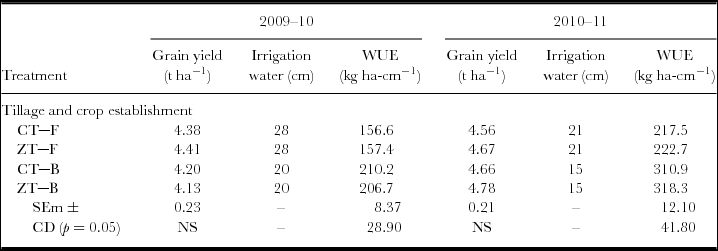
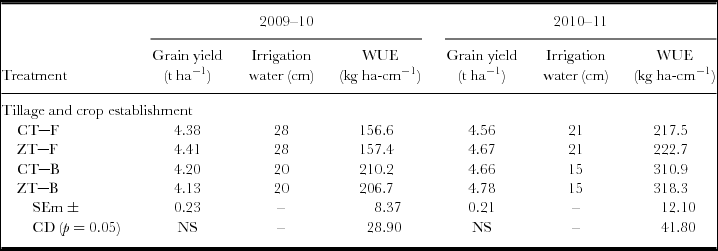
In wheat the WUE was significantly influenced due to tillage and crop-establishment practices during both the years (Table 7). The highest WUE was obtained with bed system of crop establishment (CT─B and ZT─B) during both the years. An average of 38.58 and 37.12% improvement in WUE with CT─B over CT─B and ZT─B over ZT─B and saving of irrigation water was 28.57%.
Effect of tillage and crop-establishment techniques on WUE of wheat.
Economics
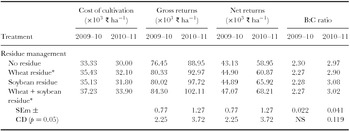
The net returns were significantly influenced due to residue management (Table 8). The highest net returns of 47.07 and 68.21 ×10³ ₹ ha−1 was obtained from the combined application wheat + soybean residue and the lowest of 43.13 ×10³ and 58.95 ×10³ ₹ ha−1 was obtained from no residue treatment during 2009–10 and 2010–11, respectively. The soybean residue and combined application of wheat + soybean residue was found to be at par with each other during both the years. The B:C ratio of SW system did not influenced significantly due to tillage and residue management practices during both the years of study. The highest B:C ratio was recorded with ZT─F (2.35 and 3.08) during the year 2009–10 and 2010–11 respectively. The B:C ratio was non-significant during the year 2009–10, while the same was significantly influenced by the residue management options during the year 2010–11. The highest B:C ratio was recorded with soybean residue (2.28 and 3.08) which was at par with all other three residue treatments during the year 2009–10 while in the year 2010–11, it differed significantly than rest of the treatments.
Effect of residue management on economics of SW system.

₹50 = ~US$1 during the period of investigation; *only wheat residue was applied during the year of initiation.
DISCUSSION
Weather and yield
The weather parameter (Figure 1) influenced the crop performance during 2009–10 and 2010–11. The yield and yield attributes were influenced significantly due to application of crop residues over no residue application. The yield increase under residue application might be due to additional nutrient release through residue application to the tune of 25.5–107.4 kg N, 1.35–2.76 kg P and 90.6–188.7 kg K ha−1 during decomposition and its sustained release to meet the requirement of crop growth. Recycling of nutrient through residue application resulted in higher grain and biological yield of the crop. Application of crop residues improves soil nutrient status, modifies the hydrothermal regimes of the soil surface by reducing the temperature and act as barrier against water loss (Tsuji et al., Reference Tsuji, Yamamoto, Matsuo and Usuki2006). Sekhon et al. (Reference Sekhon, Hira, Sidhu and Thind2005) reported that wheat straw mulch (SM) applied to soybean helped in lowering the temperature and reducing evaporation loss, and mulching increased soybean yield by 4.40 to 68.30%. Bakht et al. (Reference Bakht, Shafi, Jan and Shah2009) reported that on an average, crop residue incorporation increased the wheat grain yield by 1.31 times and straw yield by 1.39 times. In this study, the flat system of crop establishment with ZT and CT performed equally well with SW system. Similar yield in ZT might be due to biological tillage (earth worm) and good soil physical structure, chemical and microbial status thereby providing favourable environment for wheat establishment, growth and development, root proliferation and uniform distribution of nutrients in the soil profile. Bed planting versus flat planting in soybean the yields were similar however, the flat planting had an edge over the bed planting in both the crops except for wheat in the year 2010, where the bed planting yielded marginally higher due to more conducive weather conditions at the time of seeding of the crop, which resulted better crop establishment, uniform plant population resulting in more effective spikes. Sharma et al. (Reference Sharma, Bohra, Singh and Srivastava2002b) reported that, there are some situations where the performance of wheat on beds has been inferior to that of CT─F due to reduced tillering during vegetative stage due to water deficit in sandy loam soil. There were also reports showing no advantage in bed planting of soybean over flat planting (Singh et al., Reference Singh, Chhina and Kler2004). Adoption of permanent ZT─F for both rainy and winter season was found to perform well without any yield reductions. Though tillage and crop-establishment techniques performed almost similarly still it has significance due to the fact that even in ZT either in bed or flat, we avoid 8 to 10 passes of tillage which reduced cost of production and reduce diesel consumption by 50–60 litres ha−1 (Sharma et al., Reference Sharma, Singh and Dhyani2005) and also prevent environmental damage by reduction in emission of green house gases to atmosphere.
System productivity
The system productivity due to different tillage and crop-establishment practices in SW was similar. The system productivity during 2010–11 was 17.6% higher than 2009–10. The lower level of grain and stover yield of soybean and wheat due to less favourable weather conditions during 2009–10 resulted in lower system productivity. This was in good agreement with Sayre et al. (Reference Sayre, Limon-Ortega and Govaerts2005). The system grain yield was lowest in no residue treatment and increased by 10.02 and 15.05% with residue management treatment involving wheat + soybean residue. This is due to addition of large amount of residues over the years which added nutrients to the system resulting in higher levels of system productivity. The no residue treatment system productivity was apparently limited by nutrient availability, which may be due to the recommended fertilizers was inadequate and imbalanced as it lacked other essential nutrients including micronutrients which might have been available from crop residues (Behera et al., Reference Behera, Sharma and Pandey2007). Moreover, residue application improved the soil physico-chemical and biological environment in the soil through addition of nutrients, enhanced microbial activity (Singh et al., Reference Singh, Marwaha and Kumar2009). This study revealed that yield of wheat and soybean was improved with the residue addition which indirectly added the nutrient to the system. Similarly Sayre et al. (Reference Sayre, Limon-Ortega and Govaerts2005) based on wheat and maize yield performance after 10 years of testing, reported yield improvements between 25–30% through adoption of ZT seeding, appropriate rotations and residue retention as compared to the common practice of heavy tillage before seeding, mono-cropping and residue removal.
Apparent balance
The apparent nutrient balance in the system as a whole seems to be negative with respect to N and K while it is positive in case of P. Nonetheless the actual balance of different nutrients may not be so wide because of addition of recommended fertilizer dose (RFD) along with crop residues and considerable quantities of biomass through leaf litter fall, root and nodule biomass of soybean as well as root stubbles of wheat besides small amounts through irrigation and rain water, which have not been accounted might have resulted in this negative balances for N and K. This was in conformity with the findings of Behera et al. (Reference Behera, Sharma and Pandey2007). The negative balance of N might have offset to some extent due to substantial N contributions through addition of leaf litter to the tune of 1.0–1.5 t ha−1, root biomass of 1.5–2.0 t ha−1 and also Rhizobium biological N fixation, besides small amount through rainfall and irrigation water. P registered a positive balance as well as increase from the initial nutrient status of the soil (11.2 kg P ha−1) which may be due to more addition of nutrients through RFD and crop residues. In the no residue treatment of the SW system recorded an increase of 11.0 kg P ha−1 over the initial soil status. Potassium has shown a negative balance in the SW system which may get replenished from the fixed reserve of fixed sources (Subba Rao et al., Reference Subba Rao, Muneswar, Reddy, Saha, Manna and Singh1998). This continuous withdrawal of K by crops without adequate replenishment from external sources might cause K deficiency in the long run (Behera et al., Reference Behera, Sharma and Pandey2007). In spite of the fact that the uptake of K by an average soybean crop is about 101–120 kg ha−1 (Aulakh et al., Reference Aulakh, Sidhu, Arora and Singh1985), hardly any attention has been paid to meet the crop requirement. Vedprakash et al. (Reference Vedprakash, Ghosh, Singh and Gupta2001) found that values of net depletion of K (sum total of available and non-exchangeable K) from soil profile after 27 cropping cycles of SW were quantitatively much higher than the expected K depletion values suggesting considerable depletion of K from soil. There has been a wide gap between recommendations of K application vis-à-vis its uptake. This status of nutrition management in soybean make it unbalanced. Now, it has become imperative to optimize K nutrition for SW system so as to optimize the productivity of the system by the way of making the balanced fertilization.
Energy relations
Though soybean being a legume crop it requires less energy due to reduction in application of high energy N-fertilizer while wheat crop in the highest position in terms of total energy requirement. The high energy requirement in SW system was attributed to the energy consumed in the application of crop residues and fertilizers. In conservation agriculture the high energy value of crop residue (wheat @ 12.5 MJ kg−1 and soybean @18.0 MJ kg−1) was the reason for maximum energy requirement with the residue treatments. In most cases the indicators such as energy input, net energy and energy use efficiency in SW system were non-significant except for the energy use efficiency with tillage and crop-establishment techniques. The energy use efficiency was highest with ZT─F and ZT─B due to less energy used for seed-bed preparation, and slightly higher yields. Ram et al. (Reference Ram, Kler, Singh and Kumar2010) were also reported similar results in maize–wheat cropping system. Significant variation in energy relations were obtained with residue management treatments where the gross energy output was high with wheat + soybean residue while the reverse was recorded with net energy and energy use efficiency. This might be due to the high energy input with three tonnes of each wheat (12.5 MJ kg−1) and soybean (18.0 MJ kg−1) residues together constitutes 91500 MJ ha−1 of energy in the production system. However, the high energy supply through crop residue application may have beneficial effect in build up of organic carbon in the soil and improving overall productivity of the SW system.
Water use efficiency (WUE) in wheat crop
In wheat the highest WUE was with the bed system of crop establishment during both the years irrespective of CT and ZT. Due to favourable weather conditions in wheat growing period necessitate only four and three irrigations during 2009–10 and 2010–11, respectively. Depth of irrigation water was maintained with the help of ‘Parshall flume’ at 7 and 5 cm for respective flat and bed system of crop establishment, this 2 cm difference in irrigation water is the reason for higher WUE in bed system of planting. An average of 38.58 and 37.12% improvement in WUE by CT─B over CT─F and ZT─B over ZT─F and saving of irrigation water was 28.57% which connote the importance of bed planting over flat planting irrespective of CT and ZT. Behera and Sharma (Reference Behera and Sharma2013) reported an increased WUE of 20–25% in bed compared to flat planting. Similarly, higher WUE was also reported in bed planting (Ram et al., Reference Ram, Kler, Singh and Kumar2010). Contrary to our findings Ibragimov et al. (Reference Ibragimov, Evett, Esenbekov, Khasanova, Karabaev, Mirzaev and Lamers2011) reported that IWUE was statistically similar with CT and PB in winter wheat.
Economics
The highest net returns were obtained from the combined application wheat + soybean residue and the lowest returns were obtained from no residue treatment during both the years. Cost of cultivation was lowest under NT and highest under CT in maize and low production cost was mainly through saving in cost for tillage practices (Jat et al., Reference Jat, Srivastava, Sharma, Gupta, Zaidi, Rai and Srinivasan2005). The use of ZT significantly reduces energy costs, mainly by reducing tractor costs associated with conventional methods (Erenstein and Farooq, Reference Erenstein and Farooq2009).
CONCLUSIONS
The study revealed that SW system can be sustained with ZT─F and ZT─B system without sacrificing yield on sandy loam Inceptisol in the IGP of India with higher net returns and resource saving. ZT with combined application of soybean and wheat crop residues was promising to sustain the system with maximum net returns and productivity. Therefore, ZT─F/B along with crop residue recycling need to be popularized in SW system among farmers of northwest IGP as a diversification measure in agriculture to replace RW for improving productivity, energy use efficiency and profitability.
Acknowledgements
The authors greatly acknowledge the IARI, New Delhi for providing financial assistance to conduct this study. The technical support from Mr. Billu Singh, Technical Officer and help and support received from Dr. A.R. Sharma, Former Professor, Division of Agronomy, IARI, New Delhi is duly acknowledged. The authors are also grateful to the anonymous reviewers for much help in improving this manuscript.