Introduction
The balance and cycles operating among structural elements (such as C), limiting elements (as N and P), and their ecological stoichiometric ratio in plant organs have always been a focus of interest (Jia et al., Reference Jia, Qu, You and Qu2018). C/N and C/P ratios determine the plant’s ability to assimilate C and P, to a certain extent, reflecting N and P use efficiency, respectively (Sun et al., Reference Sun, Yu, Shugart and Wang2016). N/P ratio can serve as an index to establish N and P saturations and nutrient supply from soils to plants (von Oheimb et al., Reference von Oheimb, Power, Falk, Friedrich, Mohamed, Krug, Boschatzke and Härdtle2010), as N and P are essential and critical for improving biomass and productivity, but limiting elements in agricultural ecosystems, forests, and wetlands (Elser et al., Reference Elser, Bracken, Cleland, Gruner, Harpole, Hillebrand, Ngal, Seabloom, Shurin and Smith2007). Fertilization and agricultural management are traditional ways of boosting crop productivity and promoting ecosystem health (Sanaullah et al., Reference Sanaullah, Usman, Wakeel, Cheema, Ashraf and Farooq2020). Awareness and use of biochar and fertilizer mixtures are fast gaining interest as alternatives amongst modern-day sustainable agricultural practices (Wang et al., Reference Wang, Wang, Sardans, Fang, Singh, Wang, Huang, Zeng, Tong and Peñuelas2020). Biochar has a special pore structure and singular physicochemical properties, which can improve physical and chemical properties of soils, and consequently increase nutrient use whilst reducing greenhouse gas emissions (Yin et al., Reference Yin, Peñuelas, Sardans, Xu, Chen, Fang, Wu, Singh, Tavakkoli and Wang2021a). Intrinsically, biochar is of immense value to both agriculture and the environment (Xu et al., Reference Xu, Wu, Dong, Zhou and Xiong2016). However, further research is required in defining the nutrient contents, storage, and ecological stoichiometry of plant organs under a combination of nitrogen fertilizers and biochar. Studies of the stoichiometric ratios among C, N, and P contents and storages in plant organs following the application of N-enriched biochar can help develop a robust theoretical basis for understanding the drivers of biogeochemical cycles.
The root system is an important and environmentally sensitive organ involved in nutrient absorption and storage (Cao et al., Reference Cao, Li, Zhang, Zhang and Chen2020). Stems are vital for nutrient transport and coordination among plant organs (Fortunel et al., Reference Fortunel, Fine and Baraloto2012), while leaves are primary sites of photosynthesis (He et al., Reference He, Yan, Cui, Gong, Li and Han2020). Then, the contents and distribution of N and P among plant organs affect the photosynthesis of plants (Dordas, Reference Dordas2009). Plant organs have different nutrient use strategies and ecological functions and cooperate with each other in terms of nutrition and function (Zhao et al., Reference Zhao, He, Wang, Zhang, Wang, Xu and Yu2014). The contents of N and P in plant organs will be different due to organ function, as organs with intense metabolism tend to enrich more in N and P and form higher biomass (Zhang et al., Reference Zhang, Zhao, Liu, Yang, Li, Yu, Wilcox, Yu and He2018). In addition, agricultural management patterns and global changes will affect the accumulation of C, N, and P by plants and change the ecological stoichiometric ratio (Elser et al., Reference Elser, Bracken, Cleland, Gruner, Harpole, Hillebrand, Ngal, Seabloom, Shurin and Smith2007; Sardans et al., Reference Sardans, Janssens, Ciais, Obersteiner and Penuelas2021). For example, C/N changes can reflect changes in N use efficiency by plants (Zhang et al., Reference Zhang, He, Liu, Xu, Chen, Li, Wang, Yu, Sun, Xiao, Han and Reich2020). In fact, the lack of studies on disentangling nutrient allocation strategies from ecological stoichiometry of plant organs has hindered our understanding.
Organ function, climate, latitude, and soil nutrients all affect the allocation of C, N, and P and the stoichiometric ratios in plant organs (He et al., Reference He, Zhang, Tan, Hu, Su, Wang, Huang, Zhang and Li2015). Generally, climate and latitude determine nutrient allocation patterns in plants. For example, plants in temperate regions at high latitudes are most limited by N, while in tropical regions at low latitudes are limited by P (Reich and Oleksyn, Reference Reich and Oleksyn2004). Soil nutrient concentrations also affect root absorption and use efficiencies (Zeng et al., Reference Zeng, Li, Dong, An and Darboux2016). From a macroscopic perspective, climate and soil environment will jointly affect plant growth (Lin et al., Reference Lin, Lai, Tang, Qin, Liu, Kang and Kuang2022). Soil nutrient content and plant nutrient use strategies can determine plant growth more than climate factors in desert areas (Luo et al., Reference Luo, Peng, Li, Gong, Liu and Han2021). Regardless of the environment, chlorophyll is of great significance for biomass production and crop yield in the ecosystem (Cai et al., Reference Cai, Chu, Yuan, Liu, Chen, Chen, Mi and Zhang2012; Li et al., Reference Li, Liu, Zhang, Yang, Xu, Wang, Mi, Sack, Wu, Hou and He2018), being its content affected by N and P in leaves (Allen and Williams, Reference Allen and Williams1998).
China’s subtropical region is an important rice production area with a large demand for N and P fertilizers (Li et al., Reference Li, Liu, Wu, Han and Zhang2010; Wang et al., Reference Wang, Lai, Wang, Tong and Zeng2016). As a new soil conditioner, biochar has a positive effect on plant growth in subtropical acidic soil (Hossain et al., Reference Hossain, Bahar, Sarkar, Donne, Ok, Palansooriya, Kirkham, Chowdhury and Bolan2020; Li et al., Reference Li, Liang, Niyungeko, Sun, Liu and Arai2019). In our previous studies, the application of N-enriched biochar in subtropical rice fields increased the soil concentrations of C, N, P, and available P, changing the composition of microbial communities and reducing greenhouse gas emissions (Yin et al., Reference Yin, Peñuelas, Sardans, Xu, Chen, Fang, Wu, Singh, Tavakkoli and Wang2021a, Reference Yin, Peñuelas, Xu, Sardans, Fang, Wiesmeier, Chen, Chen and Wang2021b). The C, N, P contents of plant organs constitute good proxies of overall plant nutrient status and can provide information of how crop amendments impact on plant nutritional status (Ogle et al., Reference Ogle, Swan and Paustian2012; Yu et al., Reference Yu, Liu, Wang, Wei, Schuler, Sun, Harper and Zegre2019). However, little is known about how C, N, and P storages in rice organs are changed when soil C, N, and P contents are increased as well as about the relationships among ecological stoichiometric ratios of C, N, and P, soil and plant factors. We collected samples of rice roots, stems, leaves, and grains at different growth stages along a year to investigate whether N-enriched biochar would change the concentrations and storage of C, N, and P, and C/N/P ratios in different rice organs, and also how soil environmental factors can influence C, N, P storage of rice organs and the regulation of stoichiometric ratio.
Materials and methods
Experimental area
The study was performed in the Wufeng Experimental Base of the Rice Research Institute of the Fujian Academy of Agricultural Sciences, China (26.1°N, 119.3°E, 3 to 5 m altitude) in the subtropical marine monsoon climate region. The early and late rice (Oryza sativa L.) cultivars were conventional indica rice Hesheng 10 (Jiangxi Academy of Agricultural Sciences, China) and Qinxiangyou 212 (Fujian Academy of Agricultural Sciences, China). Within a year, the farming practice was two successive rice crops (early and late rice) and then vegetables (Ipomoea aquatica Forsk) (Yin et al., Reference Yin, Peñuelas, Sardans, Xu, Chen, Fang, Wu, Singh, Tavakkoli and Wang2021a). The growth period of early rice was from April to July and that of late rice was from July to November. The average air temperature and humidity during the early rice and late rice cycles were 27.1°C and 84.9%, and 26.5°C and 78.9%, respectively (Yang et al., Reference Yang, Vancov, Penuelas, Sardans, Singla, Alrefaei, Song, Fang and Wang2022). The rice paddy cultivation soil layer consisted of 28% sand, 60% silt, and 12% clay silty loam. The soil pH was 6.5, and soil contents of C, N, and P were 18.2, 1.9, and 1.8 g kg−1, respectively. The available P, NH4 +-N, and NO3 − + NO2 − in soil were 0.3, 4.6, and 29.6 mg kg−1 (Yin et al., Reference Yin, Peñuelas, Xu, Sardans, Fang, Wiesmeier, Chen, Chen and Wang2021b).
Rice seedlings were transplanted and sown by a transplanter, with plant spacing and line spacing of 14 and 28 cm, respectively. Compound fertilizers (N:P2O5:K2O, 16:16:16) and urea (46% N) were the main fertilizers used to provide 42 kg N ha−1, 40 kg P2O5 ha−1, and 40 kg K2O ha−1 before rice planting, and then 35 kg N ha−1, 20 kg P2O5 ha−1, and 20 kg K2O ha−1 during tillering. After tillering, 18 kg N ha−1, 10 kg P2O5 ha−1, and 10 kg K2O ha−1 were supplied again to plants. Throughout the tillering stage, water levels were maintained at 5 to 7 cm above the soil surface using an automatic water level controller. After the tillering stage, the dry-wet alternate mode of intermittent irrigation was implemented. Water was drained from the paddies two weeks prior to harvest.
Field experiments
The experiment was designed based on the planting habits of Chinese subtropical farmers and previous research (Yin et al., Reference Yin, Peñuelas, Sardans, Xu, Chen, Fang, Wu, Singh, Tavakkoli and Wang2021a, Reference Yin, Peñuelas, Xu, Sardans, Fang, Wiesmeier, Chen, Chen and Wang2021b). Spring and summer were the main periods for planting early rice, while summer and autumn were for late rice. In April 2017, plants of the same size and height in the early rice experimental field were selected, and control, 4 t ha−1, and 8 t ha−1 N-enriched biochar treatment groups were established. Three plots per treatment were established in a total of nine plots over an area of 10 m2, 0.5-cm thick and 30-cm high PVC plates were placed between each plot to isolate replicate areas.
The experimental N-enriched biochar had total carbon concentration (TC) 6%, total nitrogen concentration (TN) 8%, and total phosphorus concentration (TP) 0.4%, with other components as detailed in Suppl. Material Tab. S1, and the electron microscopy image of N-enriched biochar in Suppl. Material Fig. S1. The process of preparation of biochar includes slow pyrolysis of biomass at 600 °C for 90 min, and thereafter mixing with nitrogen fertilizer at a ratio of about 1:3 (Yin et al., Reference Yin, Peñuelas, Xu, Sardans, Fang, Wiesmeier, Chen, Chen and Wang2021b). The main reason for considering application of N-enriched biochar is based on the characteristics of subtropical rice fields, where soil N is an important limiting factor (Inamura et al., Reference Inamura, Mukai, Maruyama, Ikenaga, Bu, Xiang, Qin and Amano2009; Yin et al., Reference Yin, Peñuelas, Sardans, Xu, Chen, Fang, Wu, Singh, Tavakkoli and Wang2021a). In particular, the role of eutrophic biochar (N, P, etc.) is increasingly valued because it is designed for specific areas and may have great potential for sustainable agricultural development (Karim et al., Reference Karim, Kumar, Singh, Kumar, Kumar, Ray and Dhal2022).
Plant analyses
Three samples of plant roots, stems, leaves, and grains from the control, 4 t ha−1, and 8 t ha−1 treatment groups were randomly collected during the tillering and maturity stages from both early and late rice crops. Fresh leaves were also collected and used to measure chlorophyll concentration, while the remainder of the plant was oven-dried to constant weight for biomass measurement. The leaf surface area was calculated through the equation 1 by measuring the leaf length and maximum leaf width (Umashankar et al., Reference Umashankar, Babu, Kumar and Prakash2005).
 $${\rm{Leaf\;}}\,{\rm{surface}}\,{\rm{area}} = {\rm{maximum\;}}\,{\rm{leaf}}\,{\rm{width}}*{\rm{leaf}}\,{\rm{length}}*0.75$$
Biomass of rice roots, stems, and leaves was determined by drying at 60 °C. The dried roots, stems, leaves, and grains were ground with a ball mill (KZ-ll, China). The plant C and N contents were measured by dry combustion using CN element analyzer (Vario EL, Germany) following Leuschner et al. (Reference Leuschner, Voß, Foetzki and Clases2006), while plant P content was determined after sulfuric acid and perchloric acid digestion, using a continuous flow analyzer (Skalar analytical SAN++, Netherlands), as reported by Van Staalduinen et al. (Reference Van Staalduinen, Dobarro and Peco2010).
For chlorophyll determination, leaf samples were ground to homogenate, and chlorophyll was extracted with anhydrous ethanol to a fixed volume of 25 mL. The chlorophyll concentrations in rice leaves were measured using an ultraviolet-visible spectrophotometer (Shimadzu UV-2450, Kyoto, Japan) and estimated as follows (Zou, Reference Zou2000):
 $$Chla{\rm{\;}}\left( {{\rm{mg\;}}\,{{\rm{L}}^{ - 1}}} \right) = 13.95{\rm{*}}{D_{665}} - 6.88{\rm{*}}{D_{649}}$$
 $$Chlb{\rm{\;}}\left( {{\rm{mg\;}}\,{{\rm{L}}^{ - 1}}} \right) = 24.96{\rm{*}}{D_{665}} - 7.32{\rm{*}}{D_{649}}$$
 $$Chl\;\left( {{\rm{mg}}{\mkern 1mu} \ {{\rm{g}}^{ - 1}}} \right) = \left( {Chla + Chlb} \right){\rm{*}}{V \over M}$$
where Chla and Chlb are the concentrations of chlorophyll a and b in the extract, Chl is the concentration on mass basis, D 649 and D 665 represent absorbance at a given wavelength (665 nm and 649 nm), M is the sample weight, and V is the volume (mL).
Soil analyses
Soil C and N contents were determined by dry combustion using CN element analyzer (Vario MAX CN, Elementar, Germany), following Amishev and Fox (Reference Amishev and Fox2006). Soil P content was digested by sulfuric acid and perchloric acid, and determined by continuous flow analyzer (Skalar analytical SAN++, Netherlands) (Yu et al., Reference Yu, Wang, Meixner, Yang, Wu and Chen2010). Soil salinity, pH, and temperature were measured at a depth of 15 cm with a conductivity meter (2265FS EC Meter, Spectrum Technologies Inc., USA) and pH/temperature meter (Starter 300, USA), respectively.
Allometric growth
The proportional allometric model
 $y = a{x^k}$
was used to explore the proportional relationship among C, N, and P in rice plant organs. Firstly, the logarithm of both sides was transformed as follows:
 $$k = {{\log \left( y \right) - \log \left( a \right)} \over {\log \left( x \right)}}$$
where k is the slope (allometric growth index), and x and y are the C, N, and P contents and storage. During the analysis, the original data were converted into a base-10 logarithmic form. When k = 1, the ratio of any two elements in the roots, stems, and leaves of the rice fields was isokinetic, whereas when k > 1 or k < 1, the ratio of the two elements was allokinetic. Regression analysis was used to analyze the model parameters (Niklas and Cobb, Reference Niklas and Cobb2005).
Calculation of storage of C, N, and P in rice organs
The C, N, and P storages per unit area (Y storage) in both early and late rice were estimated according to Ogle et al. (Reference Ogle, Swan and Paustian2012):
 $${Y_{{\rm{storage}}}} = {X_{{\rm{concentration}}}}*{B_{{\rm{biomass}}}}$$
where X concentration is the content of C, N, or P in a given organ and B biomass is the biomass of a given organ.
Statistical analysis
All the experimental data were tested for normality and homogeneity of variance before analysis, and inconsistent data were standardized. Data were plotted using Excel 2019 (Microsoft, USA), Origin 2020 (OriginLab, USA), and SPSS 20.0 (SPSS Inc., USA) statistical analysis software. A one-way analysis of variance (ANOVA) and repeated-measures ANOVA in SPSS 22.0 were used to analyze differences in C, N, and P contents, storages, and ecological stoichiometric ratio of rice roots, stems, leaves, and grains after application of the N-enriched biochar. While one-way ANOVA was used to analyze the treatment effects in each sampling time, repeated-measures ANOVA was used to analyze the overall treatment effect along time and the interactions of time with treatment. The minimum significant difference (LSD, at p < 0.05) was used for comparisons. The storages, ecological stoichiometric ratios, contents of C, N, and P in roots, stems, leaves, and grains were mapped using a linear fitting of the allometric growth in Origin 2020. The redundancy analysis (RDA), the Pearson correlation analysis, and the mapping of the environmental factors, plant C, N, and P contents, storages, and their stoichiometric ratios were carried out with Canoco 5 and R language corrplot package (McKenna et al., Reference McKenna, Meyer, Gregg and Gerber2016).
Results
N-enriched biochar, phenotypic parameters, and biomass of rice organs
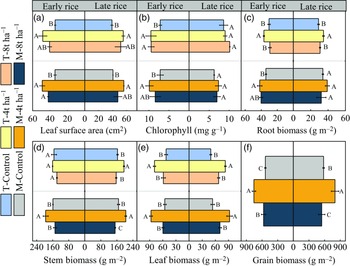
During the tillering and maturity stages, 4 t ha−1 N-enriched biochar increased leaf surface area in both early and late rice (Fig. 1a), and the chlorophyll concentrations in early rice (Fig. 1b). Applying 4 t ha−1 N-enriched biochar during the tillering stage increased root biomass in early and late rice, and at maturity stage, 4 t ha−1 N-enriched biochar increased root biomass of only early rice (Fig. 1c). The 4 t ha−1 N-enriched biochar increased stem biomass at maturity for both early and late rice (Fig. 1d). The 4 t ha−1 N-enriched biochar during the tillering and maturity stages in both early and late rice increased leaf biomass (Fig. 1e) and increased grain biomass in both early rice and late rice (Fig. 1f). In comparison, application of 8 t ha−1 N-enriched biochar (cf. control) generally had no effect on the measured phenotypic parameters, except chlorophyll concentrations of early rice at tillering.
Effects of N-enriched biochar (4 and 8 t ha−1) on leaf surface area (a), chlorophyll concentration (b), and root (c), stem (d), leaf (e), and grain (f) biomass of early and late rice crops. Mean values and standard errors. Uppercase letters indicate differences among treatments in a given growth stage (p < 0.05). In legend, T stands for tillering stage and M stands for maturity stage.

N-enriched biochar and C, N, and P storages in rice organs
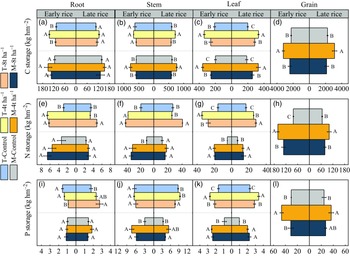
In early rice, 4 t ha−1 N-enriched biochar dose increased C storage in roots and leaves at the tillering stage (Fig. 2a, c), and in stems, leaves, and grains at the maturity stage (Fig. 2b–d). In late rice, 4 t ha−1 biochar increased C storage in stems and leaves at the tillering and maturity stages (Fig. 2b, c). Yet, 8 t ha−1 biochar dose generally had no effect on C storage in roots and stems, but it did increase C storage in leaves both in early and late rice.
Effects of N-enriched biochar (4 and 8 t ha−1) on C (a–d), N (e–h), and P (i–l) storages in root (a, e, i), stem (b, f, j), leaf (c, g, k), and grain (d, h, l) of early and late rice crops. Mean values and standard errors. Uppercase letters indicate differences among treatments in a given growth stage (p < 0.05). In legend, T stands for tillering stage and M stands for maturity stage.

In early rice, 4 and 8 t ha−1 doses of N-enriched biochar increased N storage in roots, stems, and leaves at the tillering stage (Fig. 2e–g), and in stems and leaves, at the maturity stage (Fig. 2f, g). In late rice, 8 t ha−1 of N-enriched biochar increased N storage in roots and stems at the tillering stage (Fig. 2e, f), and 4 t ha−1 and 8 t ha−1 doses increased N storage in leaves at the tillering and maturity stage (Fig. 2g). In both early and late rice, 4 t ha−1 N-enriched biochar dose increased N storage in grains (Fig. 2h).
In both early and late rice, 4 and 8 t ha−1 doses of N-enriched biochar increased P storage in leaves during the tillering and maturity stages (Fig. 2k). In early rice, 4 and 8 t ha−1 doses increased P storage in stems at the maturity stage (Fig. 2g). In both early and late rice, 4 t ha−1 biochar dose increased P storage in grains (Fig. 2l). In addition, repeated-measures ANOVA showed N-enriched biochar treatment had a great impact on C, N, and P storages in rice organs as a whole, while time and biochar × time interaction had a great impact on N storage of rice roots, stems, and leaves (Suppl. Material Tab. S2).
N-enriched biochar and the ecological stoichiometric ratios
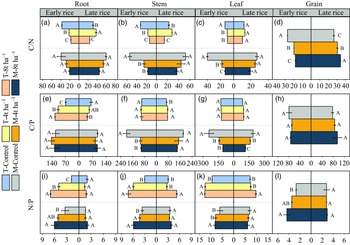
In early rice, 4 and 8 t ha−1 doses of N-enriched biochar reduced the C/N in roots at tillering and in stems and leaves at both tillering and maturity stages (Fig. 3a–c). At the maturity stage, 4 and 8 t ha−1 doses of N-enriched biochar decreased the C/N in grains of early rice (Fig. 3d). Four and 8 t ha−1 doses of N-enriched biochar increased root C/P in early rice at tillering (Fig. 3e), but decreased stem and leaf C/P at maturity (Fig. 3f, g). The 4 and 8 t ha−1 doses of N-enriched biochar reduced leaf C/P of late rice at the maturity stage (Fig. 3g). At the tillering stage, 4 and 8 t ha−1 doses of N-enriched biochar significantly increased N/P in roots, stems, and leaves in early rice (Fig. 3i–k). In early rice, 8 t ha−1 N-enriched biochar dose increased N/P in all rice organs at the maturity stage (Fig. 3i–l). On the other hand, 8 t ha−1 N-enriched biochar dose increased N/P only in stems and leaves of late rice at the tillering stage (Fig. 3j, k). Overall, N-enriched biochar treatment had a great impact on the C/N and C/P of rice roots and stems, while time and biochar × time interaction impacted N/P of rice roots and stems (Suppl. Material Tab. S2).
Effects of N-enriched biochar (4 and 8 t ha−1) on C/N (a–d), C/P (e–h), and N/P (i–l) ratios in root (a, e, i), stem (b, f, j), leaf (c, g, k), and grain (d, h, l) of early and late rice crops. Mean values and standard errors. Uppercase letters indicate differences among treatments in a given growth stage (p < 0.05). In legend, T stands for tillering stage and M stands for maturity stage.

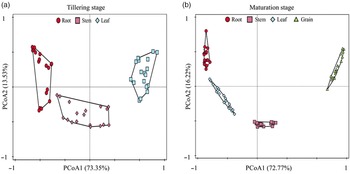
Based on the principal component analysis, we found significant differences between C, N, and P storages of roots, stems, and leaves and the ecological stoichiometric ratio at the tillering stage. Among them, the difference between stems and roots was the most obvious (Fig. 4a, b). C, N, and P storages of stems and grains were higher than those of roots and leaves in both early and late rice (Suppl. Material Fig. S2).
Principal component analysis of C, N, and P storage and ecological stoichiometric ratio in rice organs at the tillering (a) and maturation stages (b). The data include early and late rice. The horizontal and vertical axes represent the first and second principal coordinates, respectively. The percentage marked on the horizontal and vertical axis is the contribution of the principal coordinate to the difference of the sample matrix data variance.

Allometric growth, C, N, and P storages, and ecological stoichiometric ratio
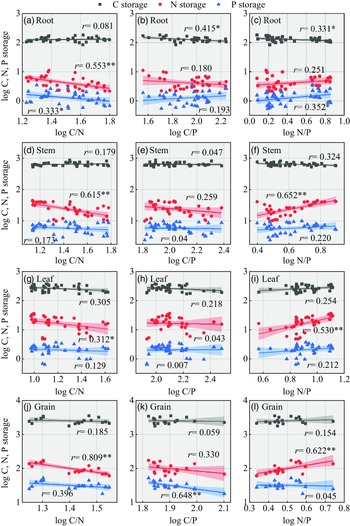
The allometric growth model of ecological stoichiometric ratio and C, N, and P storages revealed that root N storage was negatively correlated with C/N (Fig. 5a) and root P storage was negatively correlated with C/N and positively correlated with N/P (Fig. 5a, c). Root P storage was negatively correlated with C/N and positively correlated with N/P (Fig. 5a, c). Root C storage was negatively correlated with C/P and N/P (Fig. 5b, c). The N storage of stems, leaves, and grains was negatively correlated with C/N and positively correlated with N/P (Fig. 5d, f, g, i, j, l), while grain P storage was negatively correlated with C/P (Fig. 5k).
Correlations between C, N, and P storage (gray square, red circle, and blue triangle, respectively) and ecological stoichiometric ratios C/N (a, d, g, j), C/P (b, e, h, k), and N/P (c, f, i, l) in root (a–c), stem (d–f), leaf (g–i), and grain (j–l) of rice plants. r is the correlation coefficient, * and ** stand for p < 0.05 and p < 0.01, respectively.

Contents, storages, and ecological stoichiometric ratio as affected by environmental factors
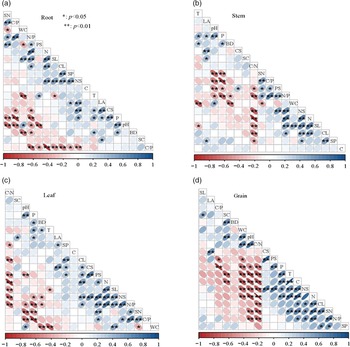
The cumulative interpretation degrees of soil environmental factors to the contents, storages, and ecological stoichiometric ratio of C, N, and P in rice roots, stems, leaves, and grains were 27.9%, 59.9%, 59.9%, and 91.5%, respectively (Suppl. Material Fig. S3a–d). Among them, soil pH was the main factor affecting roots, and soil pH, bulk density, and water content were the main factors affecting stems. The soil P content, bulk density, and leaf surface area were the main factors affecting leaves, and soil C content and leaf surface area were the main factors affecting grains (Suppl. Material Fig. S3a–d). From the relationship between soil environmental factors and C, N, P storages and ecological stoichiometric ratio, soil pH was negatively correlated with P storage in various rice organs (Fig. 6a–d), negatively correlated with C/P in roots, stems, and leaves (Fig. 6a–c), and negatively correlated with grain N/P in various organs (Fig. 6d). Soil salinity was positively correlated with N storage in roots, stems, and leaves and negatively correlated with C/N (Fig. 6a–c). Soil N content was positively correlated with P storage and C/P in roots, stems, and leaves of rice (Fig. 6a–c). Soil P content was positively correlated with N storage and negatively correlated with C/N in roots and stems (Fig. 6a, b). Leaf surface area was positively correlated with C storage, and chlorophyll was positively correlated with N storage and negatively correlated with C/N in various organs (Fig. 6a–d).
Correlation analysis of C, N, and P concentrations, storage, ecological stoichiometric ratios, and soil environmental factors, considering root (a), stem (b), leaf (c), and grain (d) of rice plants. WC: Soil water content; CL: Chlorophyll; BD: Soil bulk density; T: Soil temperature; SL: Soil salinity; LA: Leaf surface area; SC: Soil C; SN: Soil N; SP: Soil P, CS: C storage, NS: N storage, PS: P storage.

Discussion
C, N, and P storages and ecological stoichiometry in rice organs as affected by N-enriched biochar
Biochar can affect plant growth by changing the composition and then physical and chemical properties of soil microbial community (Liao et al., Reference Liao, Li, Zhang, Zhou, Ma, Min, Ye and Hou2016), which is an important additive affecting the cycling of nutrients such as N and P (Hossain et al., Reference Hossain, Bahar, Sarkar, Donne, Ok, Palansooriya, Kirkham, Chowdhury and Bolan2020). During both early and late rice cultivation, 4 t ha−1 N-enriched biochar increased biomass, and storage of C, N, and P in grains, and 4 and 8 t ha−1 N-enriched biochar increased storages of C, N, and P in leaves (Figs. 1c–f and 2c, d, g, h, k, l). During early rice cultivation, 4 and 8 t ha−1 N-enriched biochar increased the content of N in roots, stems, and grains, increased the contents of C, N, and P in leaves, and increased C, N storages of roots and N storage of stems (Fig. 2a, e, f and Suppl. Material Fig. S4c, e, f, g, h, k). These changes supported the hypothesis that N-enriched biochar would increase the contents and storages of C and N in some rice tissues. Our results are also in agreement with previous reports on the application of P-enriched biochar and other types of biochar (Biederman and Harpole, Reference Biederman and Harpole2013; Wang et al., Reference Wang, Camps-Arbestain and Hedley2014). The most direct influencing factor is that N-enriched biochar improves the plant accumulation of N, P, and biomass (Yuan et al., Reference Yuan, Tan and Huang2018). Because the application of N-enriched biochar increased the contents of soil C, N, and P through the increase of fungal and bacterial abundance and the improvement of soil physics and chemistry, P sequestration in subtropical paddy soil was increased and N limitation alleviated (Yin et al., Reference Yin, Peñuelas, Xu, Sardans, Fang, Wiesmeier, Chen, Chen and Wang2021b). In addition, the N-enriched biochar applied in this experiment contained elements such as iron, aluminium, manganese, and silicon (Suppl. Material Tab. S1), which can meet other nutrient needs of plants, combine with cations in soil minerals and reduce nutrient loss (Yin et al., Reference Yin, Peñuelas, Sardans, Xu, Chen, Fang, Wu, Singh, Tavakkoli and Wang2021a).
N-enriched biochar has unique pore structure and high specific surface area, which improve soil physical and chemical conditions to increase the nutrient retention capacity of soils and then improve the nutrient use efficiency of plants (Hossain et al., Reference Hossain, Bahar, Sarkar, Donne, Ok, Palansooriya, Kirkham, Chowdhury and Bolan2020; Jin et al., Reference Jin, Chen, Chen, Jiang, Hopkins, Zhang, Han, Billy and Benavides2019). For example, N-enriched biochar can improve soil cation and anion exchange capacity to reduce nutrient gaseous volatilization and leaching loss (Tomczyk et al., Reference Tomczyk, Sokołowska and Boguta2020), and reduce soil bulk density to improve soil water-holding capacity and aggregate stability (Shaheen and Turaib Ali Bukhari, Reference Shaheen and Turaib Ali Bukhari2018). Therefore, N-enriched biochar can play a role in nutrient fixation and provide potential nutrient sources for plants. However, due to the influence of environmental factors such as soil physics and chemistry and temperature, the relationship between the application amount of biochar and the absorption of nutrients by plants is not linear (Yuan et al., Reference Yuan, Tan and Huang2018). Our study revealed that the application of 4 t ha−1 N-enriched biochar had better effects on C, N, and P storage and phenotypic parameters of rice than 8 t ha−1 (Figs. 1 and 2). In fact, excessive fertilization can cause nutrient overload or even disrupt the ecological stoichiometric balance between C, N, and P in plant organs, negatively affecting plant growth (Hoegberg et al., Reference Hoegberg, Fan, Quist, Binkley and Tamm2006; Penuelas et al., Reference Penuelas, Poulter, Sardans, Ciais, Van Der Velde, Bopp, Boucher, Godderis, Hinsinger, Llusia, Nardin, Vicca, Obersteiner and Janssens2013).
The ecological stoichiometric ratio of C, N, and P elements in plants can reveal nutritional limitations, as well as changes in use of nutrients and growth rate (Luo et al., Reference Luo, Peng, Li, Gong, Liu and Han2021). Herein, we found that after the application of N-enriched biochar, the C/N of rice organs decreased in early rice (Fig. 3a–d), which also supported the hypothesis that N-enriched biochar would reduce the C/N in some rice tissues. This finding indicates that the limitation of N in rice organs decreased, and the N use efficiency increased, which was conducive to the provision of biomass and yield (He et al., Reference He, Zhang, Tan, Hu, Su, Wang, Huang, Zhang and Li2015; Hurtado et al., Reference Hurtado, Chiconato, de Mello Prado, Junio, Viciedo and de Cássia Piccolo2020). In addition, N and C/N, P, and C/P in rice organs were negatively correlated, suggesting that the nutritional limitation imposed by N and P decreased after the application of N-enriched biochar (Fig. 6). Plant N/P can indicate the degree of limitation of N and P. When N/P < 14, plant growth tends to be affected by N restrictions, whereas N/P > 16 suggests plant growth tends to be restricted by P. When N/P is between 14 and 16, plant growth may be affected by N and P, or not limited by them (Koerselman and Meuleman, Reference Koerselman and Meuleman1996). Our study showed that N/P of rice plant organs was less than 14 (Fig. 3). During early rice cultivation at tillering stage, 4 and 8 t ha−1 N-enriched biochar increased N/P of rice roots (1.7 and 2.8 times, respectively), stems (97% and 1.4 times, respectively), and leaves (32% and 33%, respectively), as shown in Fig. 3i–k. During early rice cultivation at maturity stage, 8 t ha−1 N-enriched biochar increased the N/P of grains in 62% (Fig. 3l). Taken together, our data suggest that rice was mainly affected by N, but the application of N-enriched biochar increased the N/P ratio in rice and so compensated for the N limitation.
C, N, and P storages and ecological stoichiometric allocation strategies in rice organs as affected by N-enriched biochar
The ecological stoichiometric ratio of C, N, and P among plant organs can reflect nutrient acquisition strategies, functional differentiation, and nutrient cycle patterns (Luo et al., Reference Luo, Peng, Li, Gong, Liu and Han2021). The results of PCoA showed that the distance between roots and leaves and grains was greater than that of stems. Differences in C, N, and P storages among roots, leaves, and grains due to N-enriched biochar application (Fig. 4) are consistent with a general change in functioning of rice organs and with the ecological stoichiometry paradigms (Sardans et al., Reference Sardans, Grau, Chen, Janssens, Ciais, Piao and Peñuelas2017). The allometric growth theory indicates that C, N, and P contents in leaves have positive allometric correlation (Suppl. Material Fig. S5). As important metabolic organs, leaves capture CO2 through photosynthesis and increase the accumulation of plant organic matter (Gao et al., Reference Gao, Su, Tian and Shen2020). In structural organs such as roots and stems, P is stored to meet the needs of rice growth (Schreeg et al., Reference Schreeg, Santiago, Wright and Turner2014). During the maturation, grain growth needs more nutrients to promote rice heading and high yields (Deng et al., Reference Deng, Wang, Ren, Mei and Li2015). Therefore, physiological functions and nutrient use strategy enable plants to selectively adjust their nutrients to support growth (Schreeg et al., Reference Schreeg, Santiago, Wright and Turner2014; Yan et al., Reference Yan, Guan, Han, Han, Guo and Fang2016). Our results also show that plants can coordinate the distribution and accumulation of nutrients in organs through the ecological chemometrics of C, N, and P (Fig. 5), thus supporting our hypothesis that N-enriched biochar changes the stoichiometry of C, N, and P accumulation among rice organs. There was a negative allometric relationship between N storage and C/N in all organs of rice (Fig. 5a, d, g, j). Herein, low C/N corresponded to higher N storage (Fig. 5d, e, g, j), which was caused by N limitation in subtropical rice fields where rice with fast growth rate but short cycle should absorb more nutrients (Wang et al., Reference Wang, Lai, Wang, Pan and Zeng2015). In addition, N/P of rice stems, leaves, and grains showed positive allometric correlation with N storage, and N/P of roots showed negative allometric correlation with P storage (Fig. 5c, f, i, l). Enrichment of N in stems, leaves, and grains after the application of N-enriched biochar would alleviate N limitation and increase N stock. The enrichment of P in roots would increase P stock as well. This may be related to the differential distribution of N and P among rice organs (Suppl. Material Fig. S2b, c). The aboveground parts (stems, leaves, and grains) usually have richer chlorophyll concentration, and then N should be concentrated to meet the photosynthetic requirement in a shorter life cycle (Ullah et al., Reference Ullah, Santiago-Arenas, Ferdous, Attia and Datta2019). Because of P limitation, roots should absorb more P in subtropical soil to promote rice growth (Elser et al., Reference Elser, Bracken, Cleland, Gruner, Harpole, Hillebrand, Ngal, Seabloom, Shurin and Smith2007; Hurtado et al., Reference Hurtado, Chiconato, de Mello Prado, Junio, Viciedo and de Cássia Piccolo2020). Therefore, the accumulation of C, N, and P is affected by the nutrient allocation strategy and the C, N, and P ecological stoichiometry of rice organs.
C, N, and P storages in rice organs as affected by environmental factors
Our results showed that soil environmental factors such as soil pH, salinity, soil N, and P contents affected the C, N, and P storages and ecological stoichiometric ratio of rice organs (Fig. 6). In order to adapt to a changing environment, the nutrient dynamics and nutrient absorption strategy of plants should change and improve allocation to match growth (Leishman et al., Reference Leishman, Haslehurst, Ares and Baruch2007). Correlation analysis revealed that low pH was associated to reduced P storage in roots, stems, and leaves of rice (Fig. 6a–c). Soil P is easily fixed by iron and aluminium in acid soil, making it difficult for plants to use this nutrient (Elser et al., Reference Elser, Bracken, Cleland, Gruner, Harpole, Hillebrand, Ngal, Seabloom, Shurin and Smith2007). However, the N-enriched biochar contains alkaline metal ions, which improve soil pH, improve the acidic soil environment, and help rice to obtain more available P from the soil (Hossain et al., Reference Hossain, Bahar, Sarkar, Donne, Ok, Palansooriya, Kirkham, Chowdhury and Bolan2020). For example, P content in rice roots, stems, and leaves was positively correlated with soil pH (Fig. 6a–c). In addition, soil salinity had a positive relationship with N storage of rice roots, stems, and leaves (Fig. 6a–c). Higher investment in P mineralization and uptake is common when N availability increases in terrestrial plant communities due to higher capacity of phosphatases and root growth (Sardans and Peñuelas Reference Sardans and Peñuelas2012). Based on the special specific surface area and pore structure, N-enriched biochar increases the content of soluble NO3 −, K+, and Ca2+ by affecting soil water-holding capacity and pH (Igalavithana et al., Reference Igalavithana, Mandal, Niazi, Vithanage, Parikh, Mukome, Rizwan, Oleszczuk, Al-Wabel, Bolan, Tsang, Kim and Ok2017). However, excessive salinity would reduce the absorption of nutrients such as N and P and this effect should be considered when applying N-enriched biochar. Previously, the application of N-enriched biochar increased the contents of soil C, N, and P (Yin et al., Reference Yin, Peñuelas, Xu, Sardans, Fang, Wiesmeier, Chen, Chen and Wang2021b). Our results showed that N-enriched biochar increased and strengthened the relationships between soil N and P contents and the N and P storages in rice organs (Fig. 6). Soil N and P contents were interrelated with plant N and P storages, and leaf surface area was positively correlated with C storage in rice organs while chlorophyll was positively correlated with N storage in rice organs (Fig. 6). In fact, rice with short growth cycle needs more chlorophyll – and then N – to accumulate organic matter (Wang et al., Reference Wang, Lai, Wang, Pan and Zeng2015). In conclusion, we found that organs responded differently to environmental factors, most likely due to different nutrient use strategies.
Overall impact of N-enriched biochar on economic and environmental benefits in rice paddy fields
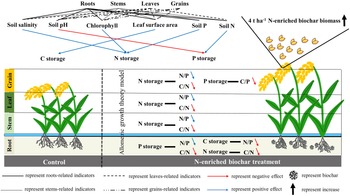
The application of N-enriched biochar can change the physical and chemical properties of soil, leaf surface area, and chlorophyll and increase the storages of C, N, and P, which are regulated by the ecological stoichiometric ratio of C, N, and P in rice organs (Fig. 7). A negative linear relationship between rice N storage and C/N was found, while N/P has a negative linear relationship with P storage of rice roots, and a positive linear relationship with N storage of rice stems, leaves, and grains (Fig. 7). These findings can be explained by nutrient utilization strategy and the optimal ratio among plant organs (Zhang et al., Reference Zhang, He, Liu, Xu, Chen, Li, Wang, Yu, Sun, Xiao, Han and Reich2020). Our study showed that the application of N-enriched biochar will be conducive to the accumulation of rice biomass and N and P storage and stimulate plants to use and remobilize nutrients from rice organs, especially under 4 t ha−1 of N-enriched biochar. At the same time, N-enriched biochar help to reduce costs and accumulation of pollutants in farmland, thereby providing both economic and environmental benefits (Wang et al., Reference Wang, Wang, Sardans, Fang, Singh, Wang, Huang, Zeng, Tong and Peñuelas2020). For example, Yin et al. (Reference Yin, Peñuelas, Sardans, Xu, Chen, Fang, Wu, Singh, Tavakkoli and Wang2021a) found that the application of N-enriched biochar in subtropical rice fields reduced greenhouse gas emissions while increasing rice yield. Previous studies have also shown that the application of N-enriched biochar in subtropical rice fields alleviates the limitation of N in soil and increases total and available soil P by improving soil physicochemical properties and microbial community richness, thus promoting rice growth (Yin et al., Reference Yin, Peñuelas, Xu, Sardans, Fang, Wiesmeier, Chen, Chen and Wang2021b).
A conceptual model of the effects of N-enriched biochar on the concentrations, storage, and ecological stoichiometric ratios of C, N, and P in rice organs.

The preparation of N-enriched biochar in this study used waste straw and wood, with a cost of about USA$ 222.40 per ton, while the price of nitrogen fertilizer was about USA$ 355.85 per ton. By using agricultural residues such as waste straw and wood, we can reduce transportation costs and environmental pollution caused by incineration (Galinato et al., Reference Galinato, Yoder and Granatstein2011). It is worth noting that the carbon trading system may also bring some economic income to farmers in the future (Pandit et al., Reference Pandit, Mulder, Hale, Zimmerman, Pandit and Cornelissen2018). From the perspective of soil environment improvement, plant nutrient absorption, and reduction of greenhouse gas emission, the application of 4 t ha−1 N-enriched biochar would promote the sustainable development of subtropical rice production and offer farmers a new way of increasing rice yields. However, we must recognize that the rice response to 8 t ha−1 N-enriched biochar in terms of biomass and yield was low, which indicates that excessive dosage of biochar may produce low economic and ecological benefits. This may be due to the negative effect of high salinity, as commented previously (Biederman and Harpole, Reference Biederman and Harpole2013; Hossain et al., Reference Hossain, Bahar, Sarkar, Donne, Ok, Palansooriya, Kirkham, Chowdhury and Bolan2020).
Conclusion
In general, this study comprehensively analyzed the changes of C, N, and P storages in rice organs and their responses to soil environmental factors and ecological stoichiometry. The application of 4 t ha−1 N-enriched biochar played a positive role in the nutrient accumulation in rice organs. Our study also revealed that in the subtropical paddy field dominated by N limitation, the storage of C, N, and P among organs of rice varied, and the accumulation of C, N, and P and their stoichiometric relations were affected mainly by soil pH, salinity, and N and P concentrations. Finally, the application of N-enriched biochar in subtropical areas can promote the absorption and accumulation of plant nutrients such as C, N, and P and provide good economic and ecological benefits.
Supplementary material
The supplementary material for this article can be found at https://doi.org/10.1017/S001447972300008X
Acknowledgements
This study was supported by the National Natural Science Foundation of China (41571287). JP and JS were funded by the Spanish Government projects PID2019-110521GB-I00 and PID2020115770RB-I, Fundación Ramón Areces project ELEMENTAL-CLIMATE, and Catalan government project SGR2017-1005. We extend our appreciation to the Researchers Supporting Project (no. RSP2023R218), King Saud University, Riyadh, Saudi Arabia.
Financial support
The authors declare that they have no known competing financial interests or personal relationships that could have appeared to influence the work reported in this paper.